
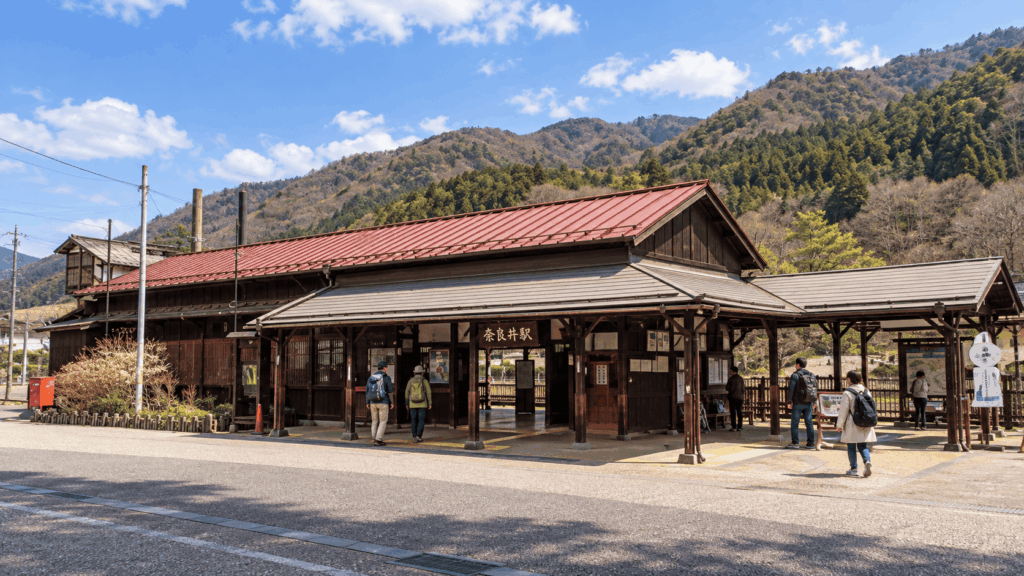
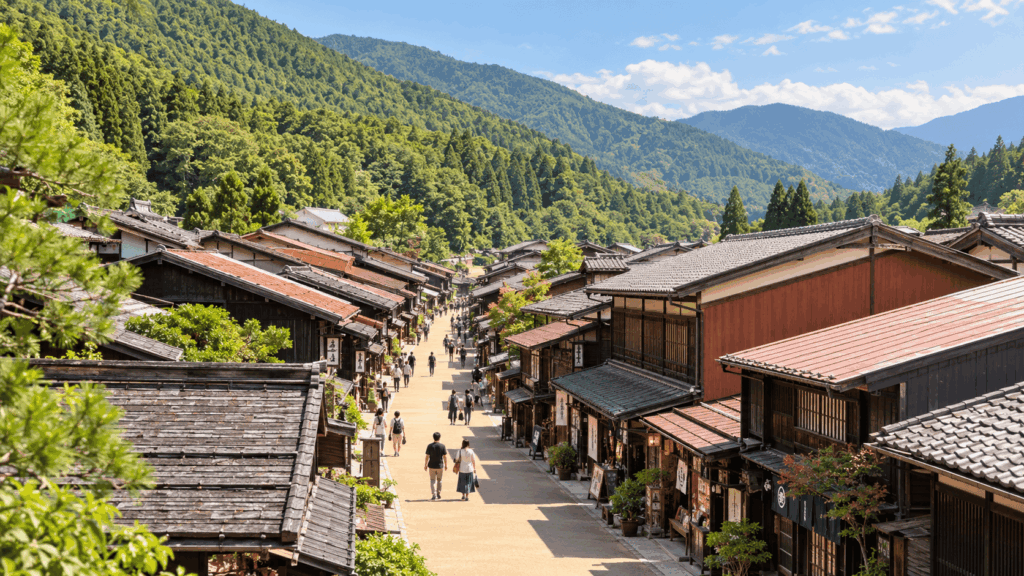
Narai Station sits on the JR Chuo Main Line at the north end of Narai-juku, the longest surviving post town on the old Nakasendo road. The preserved historic street begins only a few minutes’ walk from the platform, so once you arrive you do not need a bus, taxi, or any extra transfer. From Matsumoto, local trains take roughly an hour; from Nagoya, plan for around 2.5 hours including the Limited Express Shinano plus a local-train connection, because the Shinano does not stop at Narai. Luggage is manageable too: coin lockers now operate near the station, and the tourist information office inside the station accepts bags for a fee (details as of September 2026).

The short version: Narai is easy to visit independently, especially from Matsumoto, but it rewards travelers who check their return trains and sort out luggage before they start walking. Everything you need to plan that—routes, lockers, parking, and timing—is below.
If you would rather see Narai-juku without building your day around infrequent local trains, there is a guided option from Matsumoto that combines Narai-juku with Matsumoto Castle and handles the transport between stops. Check current departure details, live availability, and recent traveler reviews for the Matsumoto Castle and Narai-juku day trip.
Narai Station at a Glance
If you are deciding whether Narai-juku fits into your itinerary, these are the facts that matter most.
- Station: Narai Station (奈良井駅), JR Chuo Main Line
- Nearest major cities: Matsumoto (around 45–60 minutes by local train) and Nagoya (roughly 2.5 hours with a connection)
- Limited Express Shinano: does not stop at Narai Station
- Station to historic street: the preserved street starts within a few minutes’ walk of the station
- Street length: about 1 km, making Narai-juku the longest surviving post town in Japan
- Coin lockers: yes—near the station (small ¥300 / large ¥500, as of September 2026)
- Staffed luggage storage: yes—tourist information office inside the station, ¥700 per item, 8:40–16:40
- IC cards: not valid at Narai Station; buy paper tickets (see below)
Narai Station is not an interchange where you transfer from train to bus. It is the starting point of the walk itself—a fact that surprises most first-time visitors in a pleasant way. The mistake I see travelers make is treating Narai like an urban station, where a missed train costs you ten minutes. Here, trains are infrequent enough that the timetable, not the distance, is what shapes your day.
Narai is a good fit if you are based in Matsumoto and want a half-day or full-day escape, you are traveling the Kiso Valley independently, or you want to walk a preserved Edo-period street at a slow pace without a car.
Consider another plan if your itinerary depends on transfers timed to the minute, you prefer not to think about train schedules at all, or you expect to wander with a large suitcase rather than storing it first.
How to Get to Narai-juku from Matsumoto
The most common route is also the easiest. From Matsumoto Station, take a JR Chuo Main Line local train toward the Kiso Valley (Nakatsugawa / Nagiso direction) and get off at Narai Station. The ride typically takes around 45–60 minutes depending on the service—the Japan National Tourism Organization quotes roughly 50 minutes—so it works well as a morning departure from Matsumoto.

When I bring first-time visitors to Narai from Matsumoto, the train ride itself is never the problem. It is comfortable, scenic, and short enough to feel like a day trip. What catches people out is the gap between trains: if you miss one, the next may not come for an hour or more. Treat the departure time as the fixed point of your plan, not something you can drift toward.
Local trains through this section are infrequent compared with what most visitors are used to in Tokyo or Kyoto, so decide on your return service before you leave Matsumoto in the morning. For the same reason, a half-day from Matsumoto is realistic only if you match your sightseeing to two or three specific trains rather than “heading back whenever.”
If you would rather not build your day around local-train gaps, a guided day trip from Matsumoto that includes Narai-juku removes most of the timetable planning.
Do You Need to Change Trains from Matsumoto?
Not always. Some local JR Chuo Main Line services run direct from Matsumoto to Narai, while others require a change at Shiojiri Station. Rather than worrying about whether your specific train is direct, search the timetable for your date and choose the service whose Narai arrival (and return departure) fits your plans. A connection at Shiojiri is easy—it is a short, same-line transfer—so the more useful question is simply which train gets you there when you want to be there.
How to Get to Narai-juku from Nagoya
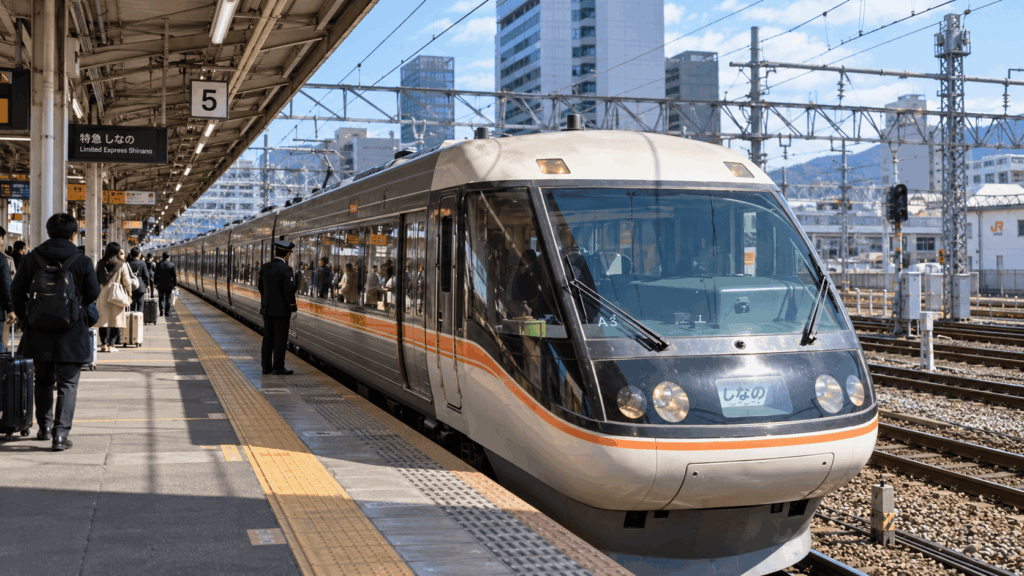
From Nagoya Station, the usual route is the Limited Express Shinano toward the Kiso Valley and Nagano, then a local train for the final stretch. Get off the Shinano at Kiso-Fukushima Station and change to a JR Chuo Main Line local train toward Shiojiri / Matsumoto, getting off at Narai. Depending on the connection, budget roughly 2.5 hours in total—sometimes a little less, sometimes more.
Nagoya to Narai is possible as a day trip, but it is not a casual half-day the way Matsumoto is. Connections can stretch the journey well beyond what the express train’s speed suggests, so it fits most naturally as part of a longer Kiso Valley or Nakasendo itinerary—for example, continuing on from Narai toward Tsumago or Magome—rather than as a quick out-and-back from Nagoya alone.
Does the Limited Express Shinano Stop at Narai?
No. The Limited Express Shinano does not stop at Narai Station, which is one of the most common sources of confusion when travelers first look at the map. If you board the Shinano from Nagoya, you must change to a local train at Kiso-Fukushima Station (or, on some routings, at Shiojiri Station) to reach Narai. There is no express service that drops you directly at Narai, so factor the transfer into your timing and confirm the day’s schedule before you go.
The table below compares your three realistic options.
| Starting point / method | Typical travel time | Transfers | Best for | Main drawback |
|---|---|---|---|---|
| Matsumoto by local train | Around 45–60 minutes | None on some services; a change at Shiojiri on others | Half-day or full-day visitors based in Matsumoto; the simplest way to reach Narai | Infrequent local trains—miss one and the next can be an hour away |
| Nagoya by Limited Express Shinano + local train | Roughly 2.5 hours depending on the connection | Change at Kiso-Fukushima (or Shiojiri) | Travelers combining Narai with a wider Kiso Valley / Nakasendo route | Long total travel time and two timetables to coordinate |
| Rental car | Around 1 hour from Matsumoto via National Route 19; roughly 2.5–3 hours from Nagoya via the Chuo Expressway | None | Families, groups, or anyone who also wants to stop at Torii Pass or other Kiso towns along the way | The preserved street is closed to non-resident traffic, so you still park outside the town and walk |
Narai Station Lockers and Luggage Storage
Yes—Narai Station now has both coin lockers and staffed luggage storage. This is worth stating clearly because a lot of older English-language travel posts and forum threads say there are no lockers at Narai Station. Those posts usually describe an earlier situation, and they do not match the current official information from the Narai-juku Tourism Association (confirmed for this article as of September 2026).
When I first visited Narai, I had to leave my bag with the staff at the tourist information office because there were no coin lockers at the station at that time. Current official information now lists coin lockers near Narai Station, which is why this guide reads differently from older ones you may have seen. If you come across an old forum thread saying “no lockers at Narai,” treat it as out of date rather than as a warning about today.
Coin lockers are on the south side of Narai Station, between the bicycle parking area and Rakurakutei, a soba shop marked by a water wheel. There are six small lockers at ¥300 and four large lockers at ¥500 per use.
Staffed luggage storage is available at the tourist information office inside Narai Station. It costs ¥700 per item regardless of size, and bags must be collected during opening hours. Fragile items, cash, and valuables cannot be left here. Note that the reception curtain closes from 11:45 to 13:00, but staff remain in the office during that break—call out and they will help you.
| Option | Location | Price | Size / suitability | Time restriction | Best for |
|---|---|---|---|---|---|
| Coin lockers | South side of Narai Station, between the bicycle parking and Rakurakutei soba shop | ¥300 small / ¥500 large | Small: 6 units (H596 × W420 × D455 mm). Large: 4 units (H895 × W420 × D515 mm) | None—available around the clock | Carry-on or medium bags; quick access whenever you return |
| Staffed luggage storage | Tourist information office inside Narai Station | ¥700 per item, any size | Large suitcases and odd shapes accepted; fragile items, cash, and valuables not accepted | 8:40–16:40; reception curtain closed 11:45–13:00 (staff still on site) | Large suitcases, lockers full, or bags that need a guaranteed spot |
Prices, locker sizes, and storage hours are from official sources as of September 2026 and can change—confirm them close to your travel date.
Which Is Better: Locker or Staffed Luggage Storage?
Choose based on your bag, not on price alone. If your luggage fits a locker—a carry-on or medium suitcase generally does—the locker is the better default: it costs less, and you can collect it whenever you like, including after the information office closes. Head for the staffed storage instead if you have a large suitcase that will not fit the large locker, if the lockers happen to be full, or if you simply want a guaranteed spot for an awkward bag.
The one condition to build into your plan is the pickup deadline. Staffed storage closes at 16:40, so if you use it, work backward from that time when choosing your return train. Lockers remove that pressure entirely.
Kai’s tip: Deal with your luggage before you look at a single shop front. I have seen travelers walk halfway down the historic street with a suitcase, realize the ground is harder going than it looks, and backtrack to the station—that round trip quietly eats 20 minutes of a short visit. Arrive, store the bag, then walk the street empty-handed. If you use the staffed office, confirm the 16:40 collection time against your return trains before you hand the bag over, not when you come back for it.
From Narai Station to the Historic Street
Narai Station sits at the northern end of the town, and the preserved main street runs roughly 1 km south from it along the Narai River. In practice this means you step off the train, cross the station forecourt, and you are at the start of the historic district within a few minutes. There is no bus to catch and no transfer to think about—the station is the trailhead.
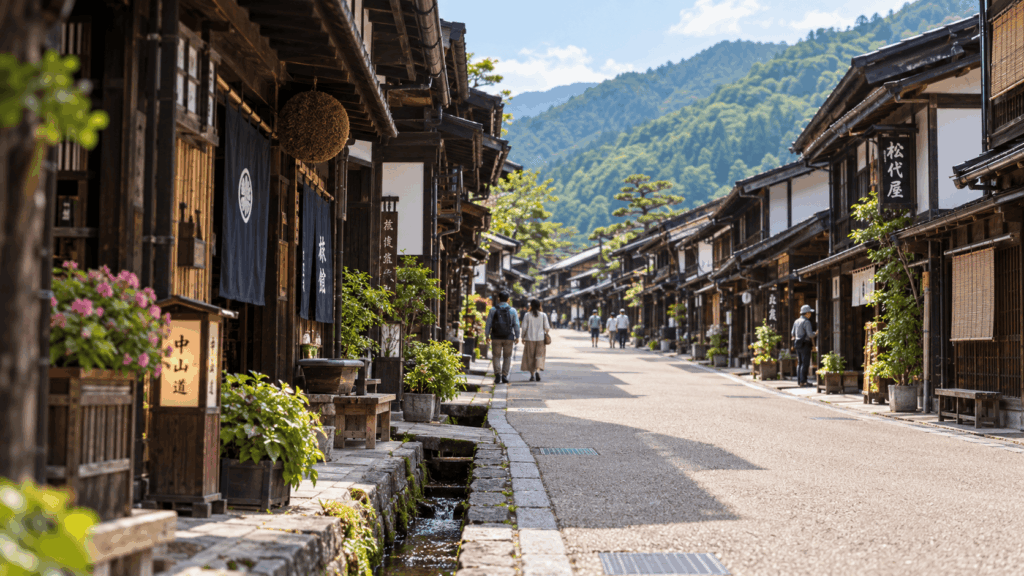
What surprises most visitors is not the distance from the station but the length of the street itself. Narai-juku is the longest surviving post town on the Nakasendo, and because it is a lived-in neighborhood rather than an open-air museum, the street rewards walking slowly. If you plan to see the whole strip and come back to the station, you are covering roughly 2 km on foot before you add any shops, shrines, or meal stops. Comfortable shoes and an honest sense of how far you like to walk make a real difference here.
As you walk, the Narai River runs parallel to the street, and the Kiso Ohashi—a 33-meter wooden pedestrian bridge built about 35 years ago—crosses it near the town. As of September 2026, however, the bridge is closed for major repair work expected to continue until the end of March 2027, so do not plan on using it as a pedestrian crossing for now. Free Wi-Fi (SHIOJIRI Free Wi-Fi) is available around the station and the main street if you need to check train times or shop opening days while you are out.

How Much Time Do You Need in Narai-juku?
There is no single answer, because Narai suits two very different styles of visit. Match your time to what you actually want to do rather than picking a round number.
-
- 1–2 hours: Enough to walk the main street, take photos, and get a genuine feel for the town. This works if you are between trains or making a quick stopover, and most visitors who come for the streetscape are satisfied with this.
- 2–4 hours: The realistic range if you want to browse shops, stop at a café, have lunch, and step inside one or two of the historic buildings open to the public. This is the most common visit length for day-trippers from Matsumoto (see our guide on things to do in Narai-juku for specific recommendations).
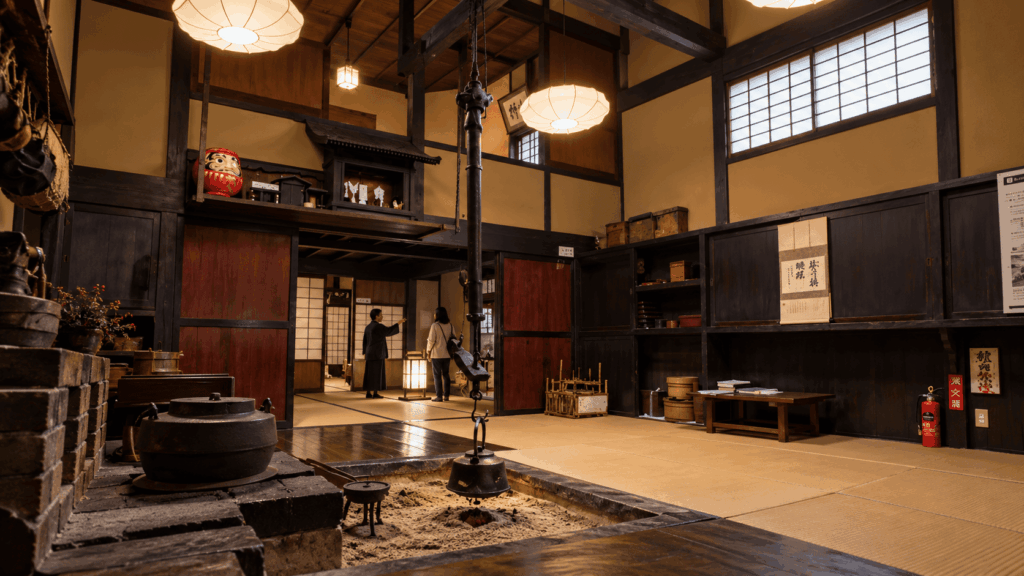
- Half day or more: Worth it if you like to move slowly, eat properly, visit both preserved residences, and still have slack for the things you did not plan. Narai is quiet enough that extra time does not feel wasted, especially if you are staying overnight in Narai-juku.
In my experience, the variable that most often extends a visit is food: if you arrive without knowing which shops are open that day, you can spend a surprising amount of time deciding where to eat. If your visit is 2–4 hours, decide your lunch or café plan in advance rather than improvising on the street.
If you only have one day in Matsumoto and would rather not build your schedule around infrequent local trains, a guided day trip that includes Narai-juku can remove most of the transport planning.
Narai-juku Parking: Where to Leave a Rental Car
Driving to Narai is straightforward, but the preserved district itself is closed to non-resident vehicles, so you will always park outside the historic street and walk in. The town runs roughly 1 km north to south, and where you park decides how much of that street you walk and from which end you start.

Shiojiri City lists six main visitor lots (figures below are from the city’s official parking page, updated January 2026). The tourism association’s own page shows slightly different totals for some lots, so treat capacities as approximate and check live availability on the association’s “GO NARAI JUKU” page on busy days.
| Parking lot | Price | Capacity | Where it puts you | Note |
|---|---|---|---|---|
| Narai Station Front Parking (奈良井駅前駐車場) | ¥500 | About 14 cars | Directly beside the station, at the north end of the street | Closest to the historic street, but the entrance is tight and it can be awkward to leave; closed every August 12 for the summer festival |
| Narai-juku Tourist Parking (奈良井宿観光駐車場) | Free | About 30 cars | North side of the town, a short walk from the street | A café and toilets are nearby; a good free option if you want to start from the station end |
| Kiso Ohashi East Parking (木曽の大橋東駐車場) | Free | About 11 cars | Directly off National Route 19 on the east side of Kiso Ohashi; normally linked to the town by the footbridge | Toilets available. Kiso Ohashi is currently closed for repair work expected through March 2027, so do not use this lot expecting to cross the bridge directly into Narai. |
| Narai Gonbei Parking (奈良井権兵衛駐車場) | ¥500 per car | About 13 cars, plus bus spaces | South end of the town | One of the lots serving the southern entrance; buses need to reserve in advance |
| Narai Gonbei No. 2 Parking (奈良井権兵衛第二駐車場) | ¥500 | About 56 cars | South end of the town, behind the preserved steam locomotive | The largest lot in the area; fills up first on weekends and festival days |
| Third Parking (第三駐車場) | ¥500 | About 11 cars | At the south entrance, in front of Chinjusha Shrine | Small paid lot inside the town fringe; handy for the southern end |
Note that the Michi-no-Eki Narai Kiso no Ohashi, on the east side of the river near Kiso Ohashi, also has a large free lot. The parking and roadside-rest facilities remain useful, but the bridge itself is currently closed for repair work, so it cannot be used as the usual pedestrian shortcut into Narai. Free wheelchair loans are available at the Gonbei parking area, Narai Station, and the tourist information office if mobility is a concern.
Kai’s tip: Choose your lot by which end of the street you want to start from, not by price alone. I have parked at the far end of the town before and enjoyed the walk in—then felt the return leg much more than I expected. The street is about 1 km, so parking at one end and walking to the other means a roughly 2 km round trip before you add any browsing. If you are short on time or traveling with people who tire easily, park at the end nearest your main goal, and treat the walk back to the car as part of the plan.
Check Your Return Train Before You Start Walking
This is the single most useful habit for a smooth visit to Narai. Local trains through this section are infrequent—roughly one service per hour is normal at many daytime times—so the timetable, not the distance, is what actually limits your day. Unlike in a city, you cannot assume that if you miss a train, another one will arrive in ten minutes.
Before you leave the platform, look at the departure board and pick one or two return services that would work for you. Note their departure times, set a rough turnaround point for your walk, and head into the town with that plan in mind. It sounds obvious, but the travelers who end up waiting at Narai Station are almost always the ones who said “we’ll just head back when we’re ready.”
If you are using the staffed luggage storage, the math is even simpler: the desk closes at 16:40, so your return train must leave after you collect your bag. Working backward from that deadline tells you exactly how long your walk can be.
Kai’s tip: When I visit places on lines like this one, I treat the last train I am willing to take as a fixed appointment, not a preference. Before walking into the town, I check the timetable, decide which train I will not miss, and set that as my day’s anchor. It sounds overly disciplined for a relaxed post town, but it is the difference between a calm afternoon and an anxious wait on a quiet platform. Do the same with your luggage: if your bag is with the staff, your pickup time is the real deadline, and the train is secondary to it.
One more ticket note that catches visitors out: IC cards such as Suica, ICOCA, and TOICA do not work at Narai Station. The station has no IC card gates or ticket machines, and the surrounding local section between Nakatsugawa and Shiojiri is outside the IC-card network. Buy a paper ticket before you board at Matsumoto or Nagoya—and if you can, buy a round trip at the same time. Return tickets can also be bought at Narai Station’s ticket window, which the tourist information office operates, but that window keeps daytime hours only, so a round trip bought at your starting station removes any doubt. If you tap in with an IC card by mistake, the conductor may collect the fare in cash on the train, and you will need to sort out the IC entry record later at a staffed station—easier to avoid by buying the paper ticket from the start.
A Few Things I Would Check Before Visiting Narai
Narai is an easy place to visit, but it is a small town of small businesses, and a little checking before you go will save you the kind of friction that is hard to solve once you are there.
- Confirm your lunch and café choices are open on your day. I once visited on a Monday after a holiday period and found several restaurants and cafés I had planned to try closed. This does not mean Mondays are always a bad time to visit—opening days vary by business, and some places close on weekdays while others close midweek. If food is an important part of your trip, check the individual shops you want to visit.
- Deal with your luggage first. Whether you use a coin locker or the staffed desk, sort your bags before you start walking so you are not dragging a suitcase along a historic street.
- Pick your return train before you explore. As above, the timetable is the real constraint on your day.
- Decide which end of the town you are starting from. This matters whether you arrive by train (north end) or by car (your lot decides it).
- Do not assume the Michi-no-Eki is a restaurant complex. The Michi-no-Eki Narai Kiso no Ohashi, near Kiso Ohashi on the east side of the river, functions mainly as a parking and rest area with toilets and an information space—not a dining or shopping facility. The bridge itself is currently closed for repair work, so do not count on crossing it into Narai. Plan your meal in the town itself.
Weekdays are a genuine trade-off here. On the one hand, the town is quieter and the streetscape is easier to enjoy without crowds; on the other, some shops and restaurants close on weekdays, especially outside the main season. If you are flexible about food, a weekday visit is often lovely. If a specific soba shop or café is the reason you are coming, check its opening days first.

Train or Guided Tour: Which Is Better for Narai-juku?
Independent travel to Narai is completely realistic, and nothing in this guide should read otherwise. The train ride from Matsumoto is short, the station is right at the town, and the main challenges—luggage, return trains, and shop opening days—are all manageable with a little planning. A guided tour is not a requirement; it is an alternative for travelers who would rather spend their energy on the town than on logistics.
| Independent by train | Guided day tour | |
|---|---|---|
| Cost | Lower—just the local fare plus locker or storage fees | Higher, but it bundles transport, guiding, and often other sightseeing |
| Flexibility | Total—stay as long as you like until your chosen train | Set itinerary with fixed stops and times |
| Transport planning | You manage the local-train gaps and paper tickets yourself | Handled for you, including transfers and timing |
| Context | Self-guided; you explore at your own pace | An English-speaking guide adds history and local detail |
| Best for | Budget travelers, independent types, and anyone happy to check a timetable | Travelers combining Narai with Matsumoto Castle or other sights in one day, and those who prefer not to think about train schedules |
Prefer to skip the train planning? Check current guided day trips from Matsumoto that combine Narai-juku with other Kiso Valley or Matsumoto sights—they are a good fit if you want the town without the timetable.
If you want Narai-juku and Matsumoto Castle in one day but would rather not manage local-train gaps, paper tickets, and return timings yourself, this is the guided option that fits that kind of itinerary best.
Why I’d book this one
- Recent travelers consistently mention knowledgeable guides and useful historical context, which adds more value than simply being driven between the two stops.
- Transport and timing between Matsumoto and Narai are handled for you, removing the main logistical friction described throughout this guide.
- The booking page lets you check current cancellation terms, start times, availability, and recent reviews before you commit.
Frequently Asked Questions
Does Narai Station have coin lockers or luggage storage?
Yes. Coin lockers operate on the south side of Narai Station, between the bicycle parking area and Rakurakutei soba shop: six small lockers at ¥300 and four large at ¥500 per use. The tourist information office inside the station also accepts bags for ¥700 per item between 8:40 and 16:40. Older English-language posts that say “no lockers at Narai” describe an earlier situation and are out of date.
How do I get from Matsumoto to Narai-juku?
Take a JR Chuo Main Line local train from Matsumoto Station toward the Kiso Valley (Nakatsugawa or Nagiso direction) and get off at Narai Station. The ride takes roughly 45–60 minutes depending on the service. Some trains run direct, while others require a change at Shiojiri Station. Buy a paper ticket before boarding, as IC cards are not valid at Narai Station.
How long does it take to reach Narai-juku from Nagoya?
Budget roughly 2.5 hours one way. The usual route is the Limited Express Shinano from Nagoya to Kiso-Fukushima Station, then a JR Chuo Main Line local train to Narai. Because the Shinano does not stop at Narai and connections vary, the total time depends on the day’s schedule. A day trip from Nagoya is possible but not a casual half-day.
Does the Limited Express Shinano stop at Narai Station?
No. The Limited Express Shinano passes through Narai without stopping. To reach Narai-juku by train, change to a local JR Chuo Main Line service at Kiso-Fukushima Station or Shiojiri Station.
Can I use a Suica or ICOCA card at Narai Station?
No. Narai Station has no IC card gates or ticket machines, and the surrounding local section between Nakatsugawa and Shiojiri sits outside the IC-card network. Buy a paper ticket before boarding at Matsumoto or Nagoya. A round trip bought at your starting station is the most reliable option, since Narai’s ticket window (the tourist information office) sells tickets only during daytime hours.
Is parking at Narai-juku free?
Yes, there are free lots: the Narai-juku Tourist Parking (about 30 cars) on the north side of town, the Kiso Ohashi East Parking (about 11 cars) directly off National Route 19, and a larger free lot at the Michi-no-Eki Narai Kiso no Ohashi. One important 2026 caveat: Kiso Ohashi itself is closed for repair work expected through March 2027, so the east-side lots do not currently give you their usual direct pedestrian crossing into Narai. Paid ¥500 lots operate near the station and at the south end. Since the preserved street is about 1 km long, choose the lot nearest the end you want to start from.
How much time should I spend in Narai-juku?
One to two hours is enough to walk the main street and absorb the atmosphere. Two to four hours is the realistic range if you want to browse shops, eat, and visit a historic residence. Half a day suits travelers who like to move slowly. Whatever you choose, check your return train before you start walking, and remember that staffed luggage storage closes at 16:40.
Final Verdict: Is Narai Station Easy to Use?
For visiting Narai-juku, Narai Station is about as convenient as a rural post-town station gets. It sits at the north end of the preserved street, so there is no bus, taxi, or shuttle to arrange—you step off the train and the historic district begins a few minutes’ walk away. Coin lockers and staffed luggage storage now cover the two practical concerns that older travel posts still warn about. The honest caveats are the ones this guide has kept returning to: local trains are infrequent, and you should sort out your return service and your luggage before you start exploring.
- For first-time visitors to the Kiso Valley: Coming from Matsumoto is the smoothest introduction. Store your bag, note your return train, and give the street at least two hours. It is a lived-in town rather than a museum, which is exactly what makes it worth the trip.
- For travelers on a tight schedule: Narai still works with one to two hours because the station is the trailhead. Arrive, confirm the next two return trains, walk the main street at your own pace, and head back with time to spare.
- For families or anyone with large suitcases: Use the staffed storage at the tourist information office rather than gambling on locker space, and treat the 16:40 collection time as your fixed deadline. Wheelchair loans are also available free at the station, the tourist office, and the Gonbei parking area if needed.
- For drivers: Pick your lot by which end of the 1 km street you want to start from, not by price. The free lots near the Michi-no-Eki and the north side are solid options, while the paid lots cluster around the station and the south entrance.
- Choose a guided day tour instead if: you are combining Narai-juku with Matsumoto Castle or other sights in a single day, you prefer not to manage local-train gaps and paper tickets at all, or you want historical context explained as you walk. Independent travel is perfectly realistic—a tour is simply the option that trades flexibility for convenience.
If a friend told me they were visiting Matsumoto and wondered whether to include Narai, my answer would be simple: go, but treat it as a day shaped by two train times and one bag decision, and the town will feel effortless. Narai Station is not the destination—it is the front door—and now you know exactly what is on the other side of it.

Hi, I’m Kai. I’m a Tokyo-based travel writer, tourism industry insider, and the author of a published guidebook for international visitors to Japan. With over 10 years of professional experience at a leading Japanese tourism company, my mission is to help you skip the tourist traps and navigate Japan’s best destinations like a local. I believe the perfect day trip is like a traditional kaiseki meal: a beautiful balance of precise planning and unforgettable seasonal discovery. When I’m not out conducting field research, you’ll usually find me drafting new itineraries with one of my favorite fountain pens!