
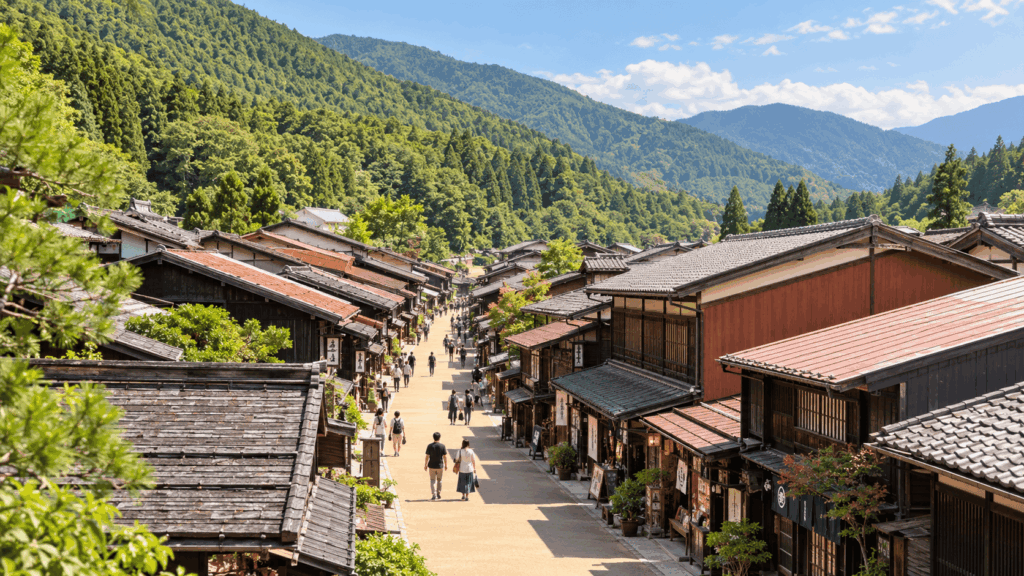
Staying overnight in Narai Juku is worth it — if the reason you travel is to see a place after the day-trippers leave. This former Nakasendo post town is lovely in daylight, but the empty main street at dusk and early morning is what staying here is really about. One night is enough for most visitors, and I would prioritize a stay that includes dinner: the same quiet streets that make Narai magical after 5 p.m. also mean very limited evening dining. For comfort and easy international booking, BYAKU Narai is the strongest choice. For a more traditional, lower-key stay, Oyado Iseya or Minshuku Shimada are excellent and far easier on the budget. I spent a night in the town with visiting friends in 2025, and one honest warning from that trip: there is no natural onsen in Narai Juku itself, so plan accordingly if a hot spring is non-negotiable.
Quick booking check: If BYAKU Narai is the comfort-first option you are considering, check current room availability, room types, and booking details for BYAKU Narai before you lock in the rest of your Kiso Valley route.
Where should you stay in Narai Juku? My quick picks
There is no single “best” stay in Narai Juku. The right choice depends on whether you value comfort, atmosphere, price, or the experience of a family-run inn. These are the picks I would start from:

- Best for comfort and easy international booking: BYAKU Narai — a boutique inn spread across restored Edo-period buildings, with an official English website and Western-style beds.
- Best for a traditional ryokan stay: Oyado Iseya — a family-run ryokan in a historic building, with tatami rooms, two-meal plans, and an English reservation form.
- Best for a family-run minshuku experience: Minshuku Shimada — a small Edo-era minshuku on the main street run by a local couple, bookable in English and priced well below the luxury end.
- Best for a very small historic inn: Echigoya Ryokan — a working inn since 1789 that currently takes around one group a day.
- Best for privacy: Hana to Kyusoku wakamatsu — a one-group-per-day renovated townhouse with a gallery.
- Best modern alternative: LA TERRA NARAI — a renovated kominka with a cypress bath and Italian-style dinners, for travelers who want the town without a strictly Japanese stay.
| Stay | Best for | Style | Dinner available | Private / shared facilities | Easy to book from overseas? | Natural onsen? | Main drawback | Price level |
|---|---|---|---|---|---|---|---|---|
| BYAKU Narai | Comfort, food, easy booking | Boutique inn in restored Edo-era buildings (16 rooms) | Yes — Japanese course dinner at Restaurant kura | Private baths in many rooms; large shared spring-water bath (SAN-SEN) | Yes — official English site and major booking sites | No | High price | $$$$ |
| Oyado Iseya | A traditional ryokan stay | Family-run ryokan in a historic building (main house + annex) | Yes — dinner and breakfast | Shared toilets; two private baths available without advance reservation | Yes — English reservation form on official site | No | Shared facilities | $$ |
| Minshuku Shimada | A family-run minshuku experience | Edo-era family minshuku on the main street (7 rooms) | Yes — dinner and/or breakfast options | Shared shower rooms; optional private bath; some rooms with private toilet | Yes — English site and booking form | No | Cash only; early-evening arrival expected with dinner | $–$$ |
| Echigoya Ryokan | A very small historic inn | Historic ryokan operating since 1789; around one group per day | Yes — handmade multi-course dinner | Traditional shared facilities; one family bath | Limited — phone/email, Japanese-centric | No | Booking friction and very limited availability | $$$ |
| Hana to Kyusoku wakamatsu | Privacy — the whole house to yourselves | One-group-per-day renovated late-Edo townhouse with gallery | Optional light shojin-style meal at extra cost | Private, but a basic household bath; no loungewear provided | Direct via official site; bookings open about two months ahead | No | Limited services; closed in winter | ¥27,500 per group (up to 3), meals extra |
| LA TERRA NARAI | A modern alternative in a historic house | Renovated kominka with cypress bath and cafe | Yes — Italian dinner and local breakfast | Private (cypress bath) | Yes — official site and online booking | No | Fewer rooms; check current rates and meal options | $$$ |
Prices change constantly and depend on season, room type, and how many people share. The symbols above are a general guide; the exact per-person rates with meals for Oyado Iseya and Minshuku Shimada start around ¥16,500 and ¥14,200 respectively at the time of checking, and BYAKU Narai typically runs from the mid-hundreds to over US$1,000 per room per night. Confirm current figures before booking. None of the inns listed above has a natural onsen — SAN-SEN at BYAKU is a spring-water bath, not a hot spring.
If comfort, food, and an easy international booking matter most, BYAKU Narai is the natural place to start checking rates and availability — just know it is neither the cheapest nor the most traditional option in town.
Is it worth staying overnight in Narai Juku?
If your plan is simply to walk the preserved main street and photograph the lattice-front houses, a few hours between trains is enough. The town’s 1 km of Edo-era buildings — the longest stretch of surviving post town on the Nakasendo — is compact, and you can see the highlights without a bed. For a breakdown of what to do if you aren’t staying the night, see our guide to the best things to do in Narai Juku.
What you cannot see on a day trip is Narai Juku outside its opening hours. The value of staying overnight is not that there is more to do after dark; it is that the town stops performing for visitors and simply becomes a small mountain community again. Arriving late and waking up early turns the same street you walked in the afternoon into a different place.

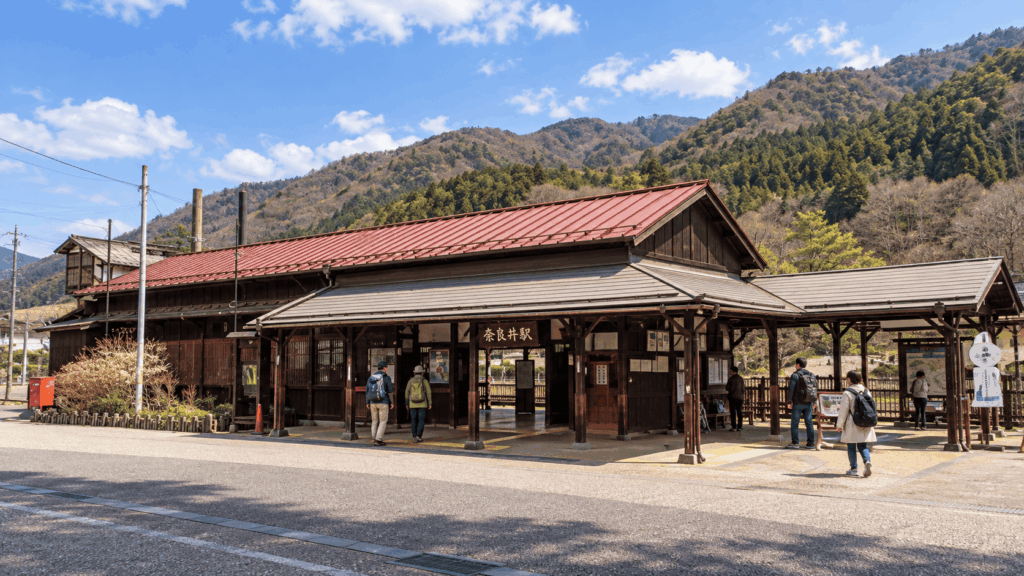
Narai Station sits on the JR Chuo Main Line roughly an hour by local train from Matsumoto, and limited express services do not stop here — which is part of why the town stays quiet. Day-trippers arrive mid-morning and are gone by late afternoon, and the overnight crowd is small.
What Narai Juku is like after 5 p.m.
Do not come expecting nightlife. There is no neon, no bar strip, and no evening entertainment. What you get instead is a lantern-lit street of wooden buildings, almost no foot traffic, and the sound of the Narai River. Recent visitors who stay overnight consistently mention this quiet evening stretch — and the empty early morning — as the highlight of their stay, not the sights themselves.
Kai’s tip: The quiet after 5 p.m. is exactly why you should stay overnight — and exactly why you should book dinner with your room. On my 2025 visit, many shops and eateries along the main street had wound down by early evening; the empty street under the lamps was wonderful to walk, but it left very few places to eat for anyone without a dinner plan. Choose a stay that includes an evening meal and you get the best of both: the silent town at night, then a proper dinner waiting for you.
Is one night enough?
For most first-time visitors, yes. One night gives you the late-afternoon calm, the evening walk, and the early morning before the day-trippers return — the three times of day that make staying worthwhile. A second night only makes sense if you are building in something bigger, such as walking a section of the Nakasendo trail or exploring the wider Kiso Valley, rather than simply seeing Narai Juku itself. If you are on a Matsumoto-to-Nagoya or Nagoya-to-Matsumoto route, treat one night here as the slow, atmospheric break in the middle of the journey (see our 2- and 3-day Kiso Valley itinerary for how to structure this).
Best places to stay in Narai Juku
The stays below are the ones I would weigh up first, compared on comfort, atmosphere, meals, privacy, and how straightforward they are to book from outside Japan. I personally stayed at BYAKU Narai in 2025 and describe it from that experience. For the other inns I have relied on official information and on the patterns that come up again and again in traveler reviews, not on having slept there myself.
BYAKU Narai — best for comfort and a special-occasion stay
Best for: Travelers who want the atmosphere of a historic post town without giving up modern comfort, a proper restaurant, and a Western-style bed. This is also the easiest Narai stay to book from abroad.
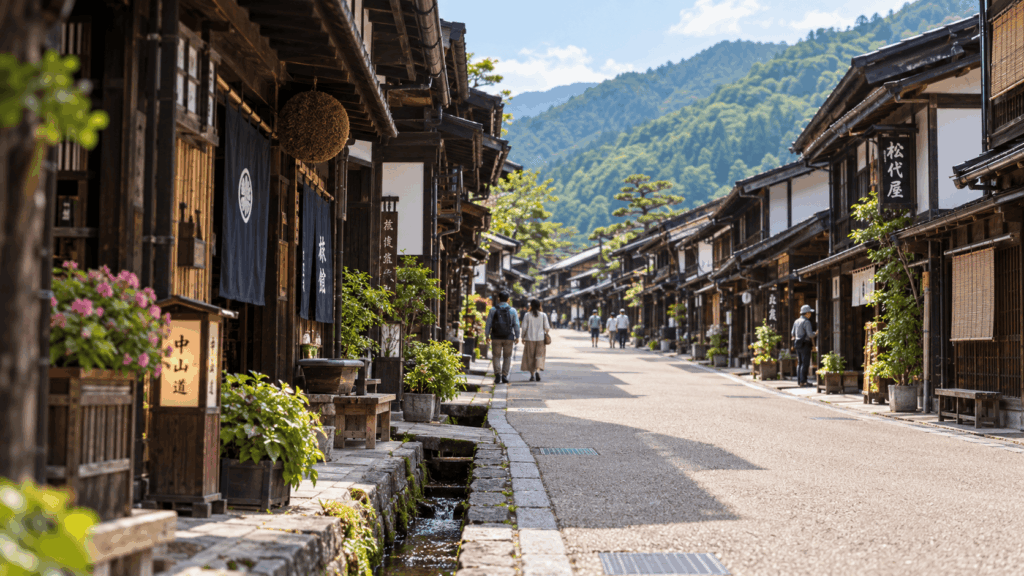
BYAKU Narai is not one building but four restored historic properties with 16 individually designed rooms: the former Suginomori Shuzo sake brewery (founded in 1793), a former guesthouse, a former lacquerware shop, and a residence that once stood in front of the town’s temple. Rather than flattening the history out of them, the renovation works with it — you notice it the moment you arrive, because the facades look like the rest of the Edo-period street while the interiors are calm and modern.
During my stay in 2025 I was struck by that contrast every time I came back to the room: thick old timber and black clay walls outside, soft lighting, and underfloor heating inside. My room sat under low beams, and the stairs to the upper level were steep — I learned to duck and to take them slowly. The staff member who showed us around the buildings explained their history in excellent English, and the whole check-in process felt designed for international guests.

The bath at BYAKU is worth explaining precisely, because it is often misdescribed online. SAN-SEN is a large indoor bath fed by the mountain spring water that forms the source of the Shinano River. It was relaxing after a day of walking, and our room also had bath salts made with sake lees and hinoki cypress. But it is not a natural onsen — there is no volcanic hot spring in Narai Juku — and the property itself describes it as spring water rather than as a hot spring.

Dinner at Restaurant kura, set in the former brewery storehouse, was a highlight of the trip: a Japanese course built around vegetables grown in Nagano, with local flavors and seasonal cooking. My companions happily added the sake pairing from the brewery that shares the site. Breakfast, served in the same dining room or as a packed bento, follows the same regional theme. Staff described the meal plan as exclusive to overnight guests, so check what is included when you book.
What to weigh up: The cost is the obvious one — expect a significant step up from the ryokan and minshuku below. Some rooms have private open-air or semi-open-air baths; others share the main SAN-SEN bath, and room layouts vary, so check the details of the specific room you are offered, especially if stairs are a concern. Children are not allowed in some rooms, and availability for popular dates can be tight well in advance.
If a historic setting with modern comfort and easy English booking is your priority, check current rates and availability for BYAKU Narai early — prices vary by season and room, and this is not a property you can assume will have space at the last minute.
Why I’d book this one
- It is best suited to travelers who want Narai’s after-hours atmosphere without giving up modern comfort or straightforward online booking.
- Recent travelers consistently highlight the historic setting, attentive service, and overall comfort as major strengths.
- Room layouts and bath arrangements vary, so it is worth checking the exact room type, current availability, meal options, and booking conditions for your dates.
See current availability, room options, and recent guest reviews for BYAKU Narai.
Oyado Iseya — best for a traditional ryokan stay
Best for: Travelers who want a genuine ryokan rhythm — tatami rooms, futon beds, an elaborate dinner served in the room or dining area, and a soak in a wooden bath — without the luxury price tag.
Oyado Iseya is a family-run ryokan in a historic building on the main street, with nine Japanese-style rooms split between the main house and an annex. Facilities are traditional rather than hotel-like: toilets and baths are shared, and two private baths can be used without reservation. Guests consistently describe the historic atmosphere and the quality of the two-meal plan as the strengths of a stay here, and the owners’ direct, personal service comes up in reviews far more often than it does for larger properties.
From overseas, this is one of the more approachable traditional inns in town: the official website has an English reservation form, basic English is spoken, and credit cards are accepted. Rates start around ¥16,500 per person per night with dinner and breakfast at the time of checking, with small surcharges on weekends and busy dates. Note the check-in window ends early (around 6 p.m., with advance notice needed if you will be later), because the evening meal is served promptly after arrival.
What to weigh up: Shared bathrooms and steep traditional stairs are part of the package — Iseya suits travelers who accept some inconvenience in exchange for a more authentic stay, not those who need hotel-level facilities.
Minshuku Shimada — best for a family-run minshuku experience
Best for: Travelers on a tighter budget who still want to sleep in an Edo-era building and eat home-style Japanese cooking, and who enjoy meeting their hosts.
Minshuku Shimada is a seven-room minshuku on the main street, run by a couple who have lived in Narai for over 60 years. A minshuku is smaller and more personal than a ryokan — closer to staying in someone’s home — and that is exactly what reviewers highlight: the warmth of the hosts, the generous dinner, and the chance to talk with people who know the town deeply. This is also one of the few small Narai inns with a proper English website and an English booking form, which makes it a realistic choice for overseas travelers who want to skip the big hotels.

Rates start around ¥14,200 per person with dinner and breakfast at the time of checking (¥10,700 room-only), with extra charges for street-facing rooms, private toilets, and weekend dates. There are shared shower rooms — reservable in time slots at no charge — and an optional private bath for a fee. Expect to pay in cash, since credit cards are not accepted.
What to weigh up: This is a guesthouse experience, not a hotel one: rooms vary in size because of the old architecture, the building has steep stairs and thin walls, and you will need cash and a reasonably early arrival if you book dinner. If you are comfortable with those trade-offs, Shimada offers the most direct contact with Narai’s residents of any stay in this guide.
Echigoya Ryokan — best for a very small historic inn
Best for: Travelers who find the romance of a tiny, centuries-old inn more important than facilities, and who are willing to plan around a booking process that runs on phone and email.
Echigoya Ryokan has operated as an inn since 1789 — the only lodging in Narai Juku that can claim an unbroken run back to the days of the hatago inns that served Nakasendo travelers. Guests sleep in rooms that have sheltered travelers for centuries, and the handmade multi-course dinner built around local Kiso ingredients is the kind of meal reviewers describe as a memory, not just dinner. The poet Hakushu Kitahara once stayed here, and the inn still shows the room.
Be realistic about what this means in practice. The inn currently accepts around one group per day with a maximum of four guests, and consecutive-night stays are not possible, so availability is extremely limited. Reservations run through phone or email rather than an international booking site, and the inn announced a new rate structure in December 2025 — expect to pay from roughly ¥27,000 per person with two meals and to confirm the current figure, availability, and any English support directly when you enquire.
What to weigh up: This is the hardest stay in this guide to book from overseas, and the most fragile to plan around. If the idea of a one-group-per-day historic inn excites you more than it worries you, contact them early — this is not a property you can book on impulse. Travelers who want certainty and online booking should start with BYAKU, Iseya, or Shimada instead.
Hana to Kyusoku wakamatsu — best for privacy
Best for: Small groups or families who want a restored townhouse entirely to themselves, and who are happy to run their own evening rather than expect ryokan-style service.
Hana to Kyusoku wakamatsu is a renovated late-Edo-period house that rents to one group per day, with a small gallery attached. You get the whole building: an 8-tatami bedroom, the run of a historic home, and total privacy on Narai’s quieter stretches. It suits travelers who like the feeling of borrowing a local house rather than staying in someone’s inn.
Set expectations before you book, because this is closer to a self-catered rental than a ryokan. The bath is a standard household bathroom rather than a deep wooden soaking tub; loungewear is not provided; amenities are minimal; and the kitchen cannot be used. Dinner is optional and must be requested — a light shojin-style vegetarian meal at an extra charge — and guests on consecutive nights are asked to arrange their own meals. Bookings open only about two months ahead, the property closes in winter, and the rate is a flat ¥27,500 per group of up to three per night, meals extra.
What to weigh up: Wonderful for privacy and for guests who enjoy a self-directed stay; a poor fit if you want dinner service, a soaking bath, or help with logistics. Because reservations open on a fixed schedule and close in winter, check the current booking window and seasonal closure dates before you build a route around it.
LA TERRA NARAI — best modern alternative
Best for: Travelers who want to sleep in Narai Juku but prefer a renovated, design-led stay with Western-style comfort, a private bath, and dinner that is not strictly Japanese.
LA TERRA NARAI is a renovated kominka — a traditional farmhouse — reinterpreted with antique furniture and modern styling, a few minutes’ walk from Narai Station. Its defining feature is a private cypress (hinoki) bath, which guests consistently enjoy after a day of walking the post town. The evening meal is a seasonal Italian course built around local ingredients, with a wine pairing drawn from Shiojiri’s own vineyards, and breakfast follows the same local theme. It is a genuine alternative for travelers who want the town’s atmosphere but a stay that feels more like a boutique hotel.
The property can accommodate some dietary needs if you declare them in advance, and online booking through the official site and major travel platforms makes it easy to arrange from overseas. There is no dedicated parking, so nearby coin parking is the norm for drivers, and rates sit well above the minshuku level — check the current price and meal options, which vary by season and plan.
What to weigh up: Choose LA TERRA NARAI over BYAKU if you prefer a smaller, more design-led space and Italian rather than Japanese fine dining; choose BYAKU if the full historic-building experience with a Japanese course dinner matters more. Both are modernized, private-bath stays — neither is a traditional ryokan, and neither has a natural onsen.
Ryokan, minshuku or boutique hotel — which should you choose?
If you are deciding by accommodation style before looking at individual names, this comparison keeps the trade-offs honest. Narai’s stays fall into four broad types, and the biggest driver of your experience — and your price — is which type you pick.
| Luxury renovated stay (e.g., BYAKU Narai) |
Traditional ryokan (e.g., Oyado Iseya) |
Family-run minshuku (e.g., Minshuku Shimada) |
Whole-house stay (e.g., Hana to Kyusoku wakamatsu) |
|
|---|---|---|---|---|
| Comfort | High — beds, heating, modern amenities | Moderate — futon on tatami, shared baths | Basic to moderate — home-style, shared showers | Self-directed — bring your own expectations |
| Historic atmosphere | Present, but polished and curated | Strong and lived-in | Strong and very personal | Strong, and entirely yours |
| Privacy | Private baths in many rooms | Shared facilities; two private baths available | Shared showers; some rooms with private toilet | Total — one group per day |
| Meals | Restaurant-quality Japanese course | Elaborate two-meal plan included | Home-style cooking, generous portions | Optional light meal at extra cost |
| English & online booking | Strong — official English site and OTA listings | Good — English reservation form | Good — English site and form | Direct booking, window opens about 2 months ahead |
| Accessibility | Best of the four, but stairs still vary by room | Steep traditional stairs likely | Steep stairs and old building | Historic townhouse; ground-floor living mostly |
| Typical cost | $$$$ | $$ | $–$$ | Fixed per-group rate |
The pattern is simple: the more authenticity and personal contact you want, the more shared facilities, stairs, and booking friction you tend to accept — and the less you usually pay. The more comfort and booking ease you want, the higher the price climbs. There is no wrong answer, only the trade-off you are willing to make. That is the whole logic of this guide: decide how much inconvenience you will trade for atmosphere, then pick the stay that matches.
How to book a Narai Juku minshuku from overseas
A common point of confusion is that not every Narai inn appears on major international booking sites. Searching Booking.com or Agoda and finding nothing does not mean the town is fully booked — several small properties sell rooms directly, through their own websites, or through Japanese-language platforms only. The reverse is also true: some listings you find online are outdated, so always confirm details before you pay.
The good news is that the town’s most bookable stays — BYAKU Narai, Oyado Iseya, and Minshuku Shimada — all offer English-friendly booking paths, which is one reason they lead this guide. Traditional properties like Echigoya Ryokan run on direct contact instead, which is authentic but requires more patience.
A simple booking order for international travelers
- Search the property’s official English site first. For BYAKU Narai, Iseya, and Shimada, the official site is the most reliable source of current rates, room types, and policies.
- Check an international booking platform such as Booking.com if the property is listed there — useful for comparison and for travelers who prefer a familiar cancellation process.
- Use the property’s English contact or reservation form. Iseya and Shimada both provide English forms on their official sites; BYAKU Narai offers full English booking online.
- Confirm meals, arrival time, payment method, and cancellation rules before you commit. Dinner-based stays require a reasonably early check-in, some inns are cash-only, and cancellation windows at small properties can be strict.
- Do not assume an OTA showing “sold out” means the inn itself has no rooms. Some small properties sell rooms directly rather than through every platform, so a quick message to the inn can be worth it before you give up on a date.
If you book dinner with your stay, expect the inn to ask about your arrival time — the evening meal is usually served shortly after check-in, and kitchens close early in a town this quiet. If you are arriving late, book a room-only night and arrange food before you get here, or eat before you arrive.
Book dinner with your stay if you can
This is the single most practical piece of advice in this guide: for a first overnight visit to Narai Juku, book a stay that includes dinner. The reason is the same quiet that makes the town worth visiting — after the day-trippers leave, so do the open kitchens. Many of the shops and eateries along the main street wind down by early evening, and while Narai is not completely empty of evening options, the choice is thin and cannot be relied on. A room-only booking here is a gamble that there will be somewhere to eat when you are hungry.
Room-only: Cheaper and more flexible, and a fine choice if you arrive with food already arranged — for example, a late-afternoon train after eating in Matsumoto. But if you arrive expecting to wander out for dinner, you may find most doors closed and end up with the limited options that remain.
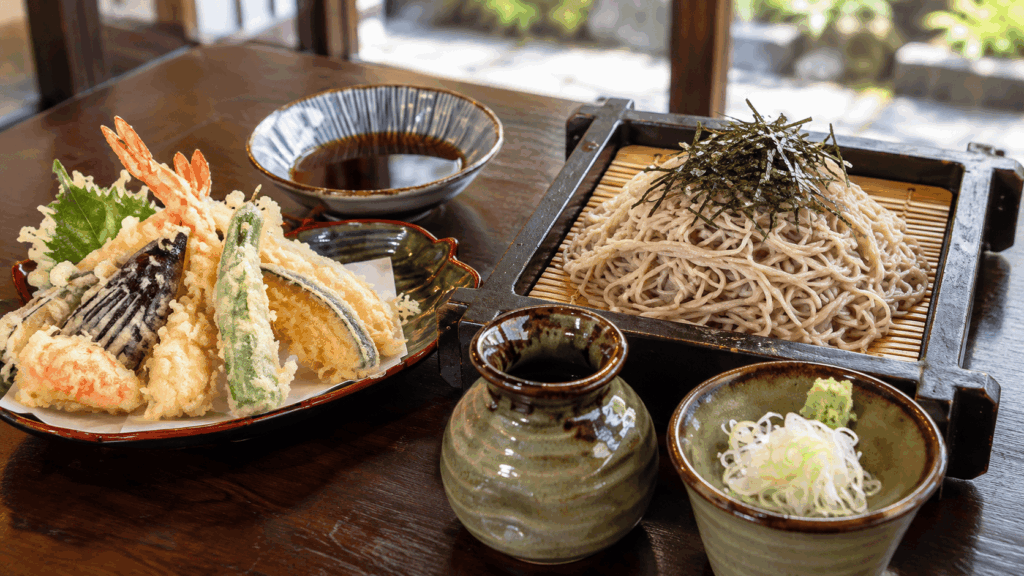
Half board (dinner and breakfast): Costs more, but removes the single biggest risk of an overnight stay and is often the best introduction to local Kiso cooking — mountain vegetables, river fish, and regional specialties you would not find on your own. At traditional inns like Iseya and Shimada, the two-meal plan is the heart of the experience, and reviewers consistently rate the home-style dinner and breakfast among the best parts of their stay.
At BYAKU Narai, dinner is served in Restaurant kura, the former brewery storehouse, as a Japanese course built around Nagano-grown vegetables and seasonal local ingredients. On my 2025 stay the meal was one of the best reasons to be there — a quiet, unhurried dinner a few steps from the empty main street, with my companions adding the sake pairing from the brewery on site. Menus change with the seasons and with what the local farms are producing, so treat that as a description of the style, not a fixed menu.
If you are weighing two otherwise similar stays and one includes dinner, choose the one with dinner. When evening dining is uncertain, a guaranteed meal is worth the difference in price.
Does Narai Juku have an onsen?
No — Narai Juku itself does not have a natural hot spring. This is worth stating clearly because it is the most common misconception in reviews and booking listings, and it can quietly derail a trip if you discover it after arriving.
The local tourism association lists no natural onsen among the town’s lodging, and the properties themselves are accurate about what they offer:
- BYAKU Narai has the large indoor SAN-SEN bath, which is fed by mountain spring water from the headwaters of the Shinano River. BYAKU itself describes it as spring water — “SAN-SEN” — not as an onsen. Some rooms add a private open-air or semi-open-air bath fed the same way. Relaxing, yes. Natural hot spring, no.
- Oyado Iseya offers wooden private baths and shared bathing with heated water.
- LA TERRA NARAI has a private cypress (hinoki) bath.
- Minshuku Shimada has shared showers and an optional private bath.
A Japanese-style bath and a natural onsen are different experiences. If your trip is built around soaking in volcanic mineral water, you will not find it in Narai Juku — and no amount of searching will change that. On my own stay I found the spring-water bath at BYAKU genuinely relaxing after a long walking day, but I would never describe it as an onsen, and neither should a booking listing. If a natural hot spring is a must, plan to sleep somewhere like the Kiso-Fukushima area and visit Narai Juku as a day trip or stopover instead. You can find onsen options in our guide to the best ryokan in the Nakasendo and Kiso Valley.
Practical things to know before staying in Narai Juku
Narai’s traditional atmosphere comes with practical quirks that city hotels do not have. None of these should stop you staying — they should just shape how you pack and what you book. One small budget note: since June 2026, Nagano Prefecture applies an accommodation tax of ¥200 per person per night on stays of ¥6,000 or more, so expect a small addition to the rates quoted in this guide.
Large suitcases are inconvenient
The preserved main street is paved for history, not for wheels. Its surface is uneven under a roller suitcase, and most historic inns have no elevator, no porter, and sometimes stairs at the entrance itself. The mistake I see first-time visitors make is arriving with the same large checked bag they carried through Matsumoto or Tokyo.
Kai’s tip: On my 2025 overnight trip I had companions arriving by train, and I advised them to carry just one night’s worth in a backpack while leaving the big wheeled case behind. It was the right call — the uneven main street makes roller bags awkward even over the short distance from Narai Station, and there is no elevator or luggage service waiting at a traditional inn. If you cannot travel light for the night, Narai Station now has coin lockers nearby (small ¥300 / large ¥500 as of September 2026), and the tourist information office inside the station also offers staffed luggage storage for ¥700 per item from 8:40 to 16:40. Older posts saying there are no lockers at Narai are out of date.
Historic buildings can mean steep stairs and shared facilities
Rooms in preserved buildings sit behind the facades you came to see, which means low beams, steep stairs, and narrow corridors in many properties. Travelers commonly report steep stairs at traditional stays across Narai, along with shared toilets, washbasins, and baths at ryokan and minshuku level. At BYAKU, which is otherwise the most modernized stay in town, my own room had low beams and a steep staircase to the upper level — manageable, but worth knowing about in advance. Room types vary significantly even within a single property, so ask about the specific room you are offered: which floor it is on, whether it has a private bath, and whether children are allowed there.
If you have limited mobility or simply prefer not to navigate steep stairs after dark, filter your search accordingly: choose a stay with ground-floor or first-floor rooms, or one of the modernized properties, and confirm the room layout before you book.
Pack an extra layer even outside winter
Narai Juku sits in a narrow valley at roughly 934 m above sea level, and mountain evenings behave differently from city ones. Even in mild seasons, the temperature drops noticeably after sunset and stays low until mid-morning.
Kai’s tip: I stayed in late May and was struck by how cold the night and early morning were — the days were pleasant, but I was genuinely glad BYAKU had heated floors and long-sleeved loungewear. Pack one extra layer than you think you need: a light fleece or sweater for the evening walk and the early-morning stroll. I am not saying May is always cold in Narai — I am saying the nights can surprise you in any season outside high summer, and a layer weighs almost nothing in a backpack.
Who should not stay overnight in Narai Juku?
An honest guide also says when not to do this. Staying overnight in Narai Juku is a poor fit if you are looking for:
- Nightlife or a lively evening scene — the town is deliberately, beautifully quiet after dark.
- A wide choice of restaurants — evening dining is limited; book dinner with your stay or arrive fed.
- A natural onsen — there is none in town. Sleep in the Kiso-Fukushima area instead and make Narai a day stop.
- Maximum accessibility — historic stairs, low beams, and uneven paving are part of the package at most properties.
- The absolute lowest budget — day-tripping from Matsumoto or another base costs less than any overnight stay.
- A luggage-heavy itinerary — if you are moving between cities with large suitcases every day, an overnight stop here adds friction that a day visit avoids.
None of this makes Narai a lesser destination. It means the town rewards a specific kind of traveler: someone with flexible time, a small overnight bag, and a preference for atmosphere over convenience. For everyone else, a day trip that arrives mid-morning and leaves by late afternoon still delivers the preserved street, the shops, and the museum houses — just not the quiet hours that make staying memorable.
My recommendation for a first overnight stay in Narai
To bring the comparison together for a first visit:
- If you want comfort, food, and an easy international booking, and the budget allows: BYAKU Narai. It is the most reliable, most comfortable night in town — and the most expensive. Best for a special-occasion stay.
- If you want a traditional ryokan without the luxury price: Oyado Iseya — nine tatami rooms, a proper two-meal plan, and an English reservation form, with shared facilities as the trade-off.
- If you want a family-run minshuku experience on a budget: Minshuku Shimada — the warmest introduction to life in Narai, bookable in English, cash only.
- If a natural onsen is non-negotiable: sleep elsewhere and visit Narai Juku as a day trip or stopover. No stay in town will give you a hot spring.
For the great majority of travelers, the right formula is one night, dinner included, and a small overnight bag. That combination gives you the version of Narai Juku that day-trippers never see — and it is the version I remember best. What stayed with me from my 2025 visit was not any single sight but the sequence of empty hours: the lantern-lit street after dinner, then a walk at 7 a.m. with almost no one around, when local students were heading to school past buildings that have stood for centuries. The quiet early morning felt like the real reward of staying overnight.
Narai Juku rewards travelers who plan ahead, because the best stays are small and the dates fill. Once you have settled on the style that fits you, check current availability for your dates before you lock in the rest of your Kiso Valley route — and remember to confirm dinner, arrival time, payment, and the room’s layout while you are at it.
FAQ
Is it worth staying overnight in Narai Juku?
Yes, if you value atmosphere over nightlife or convenience. The preserved main street is rewarding in daylight, but the reason to stay is what comes after the day-trippers leave: the lantern-lit street in the evening and the quiet early morning, when the town returns to being a small mountain community. Most visitors find one night enough. The main cost of staying is practical rather than financial — evening dining options are limited, so book a stay that includes dinner unless you arrive already fed.
Does Narai Juku have an onsen?
No. There is no natural hot spring in Narai Juku itself, and the local tourism association lists none among the town’s lodging. The baths you will find are Japanese-style baths with heated or spring water: BYAKU Narai’s SAN-SEN is fed by mountain spring water and is described by the property as spring water rather than an onsen, Oyado Iseya has wooden private baths, and LA TERRA NARAI has a private cypress bath. All are relaxing, but none is a natural hot spring. If soaking in volcanic mineral water is a priority, sleep in an area like Kiso-Fukushima and visit Narai as a day trip instead.
How many nights should you stay in Narai Juku?
For most first-time visitors, one night is enough. It gives you the late-afternoon calm, an evening walk, and the empty early morning — the three times of day that make staying worthwhile. A second night only makes sense if you are adding something bigger, such as walking a section of the Nakasendo or exploring the wider Kiso Valley, rather than just seeing the post town itself.
Can you book a Narai Juku minshuku from overseas?
Yes, at the properties that matter most for international travelers. BYAKU Narai, Oyado Iseya, and Minshuku Shimada all offer English-friendly paths — official English websites and, for Iseya and Shimada, English reservation forms. Some smaller inns like Echigoya Ryokan run on phone or email contact instead. One useful thing to know: not every Narai inn appears on major booking platforms, so an OTA showing “sold out” does not necessarily mean the inn itself has no rooms — it can be worth contacting the property directly.
Is BYAKU Narai worth the price?
For the right traveler, yes — but it is not for everyone. You are paying for restored Edo-period buildings with genuinely modern comfort, a proper restaurant serving regional Japanese cooking, and one of the easiest English booking experiences in town. Reviews consistently rate its food, service, and atmosphere highly, while value for money comes up as the relative weakness — the same trade-off this guide keeps returning to. If you want that level of comfort and a special-occasion stay, BYAKU is the strongest choice in Narai. If you would rather spend less and accept shared facilities, Oyado Iseya or Minshuku Shimada delivers much of the atmosphere for a fraction of the price.
Final Verdict
Choose Narai Juku for your overnight stop if you are traveling with a small overnight bag, want to photograph and walk a preserved post town without crowds, and would trade nightlife and restaurant choice for a genuinely quiet evening and morning. One night with dinner included at a stay that matches your comfort level — BYAKU Narai for comfort and easy booking, Oyado Iseya for a traditional ryokan, Minshuku Shimada for a family-run minshuku — is the formula this guide keeps coming back to.
Stay elsewhere and visit Narai as a day trip if you need nightlife, a wide restaurant choice, a natural onsen, or maximum accessibility, or if your itinerary is built around large suitcases and fast movement between cities. Matsumoto makes a convenient base for a day visit, and the Kiso-Fukushima area works if a hot spring is non-negotiable. You will still see the preserved main street, the shops, and the museum houses — you will simply miss the quiet hours that make staying memorable.
- For first-time visitors: Do one night — not a day trip — and make dinner part of the booking. If the budget stretches, BYAKU Narai removes the most friction; if not, Oyado Iseya gives you the ryokan experience at roughly a third of the price. Arrive with one small bag and one extra layer.
- For couples and special occasions: BYAKU Narai is the standout — a private spring-water bath in some rooms, dinner in the former brewery storehouse, and an empty lantern-lit street a few steps away. Book well ahead and confirm which room type you are getting, since layouts and children policies vary.
- For families: Minshuku Shimada is the most welcoming budget choice, but check the steep stairs, shared showers, and room sizes against your children’s needs. Note that some rooms at BYAKU do not accept children, and Echigoya’s one-group limit makes it unsuitable for larger families.
- For travelers on a tight schedule: If you can only spare the daylight hours, a day trip from Matsumoto is the honest answer — Narai is roughly an hour away by local train and the main street is compact. Overnight stays earn their keep only when you have the evening and early morning to give them.
- For repeat visitors: If you have already done the polished stays, Echigoya Ryokan’s one-group-per-day historic experience or the whole-house privacy of Hana to Kyusoku wakamatsu offers something genuinely different — provided you can work around their limited booking windows and seasonal closures.
The bottom line: Narai Juku is worth staying overnight if you want the post town after the day-trippers leave. One night is enough for most travelers, dinner should be part of the plan, and the stay you choose should reflect how much authenticity you are willing to trade for comfort — because the town’s magic and its inconvenience come from the same source.
Hi, I’m Kai. I’m a Tokyo-based travel writer, tourism industry insider, and the author of a published guidebook for international visitors to Japan. With over 10 years of professional experience at a leading Japanese tourism company, my mission is to help you skip the tourist traps and navigate Japan’s best destinations like a local. I believe the perfect day trip is like a traditional kaiseki meal: a beautiful balance of precise planning and unforgettable seasonal discovery. When I’m not out conducting field research, you’ll usually find me drafting new itineraries with one of my favorite fountain pens!