
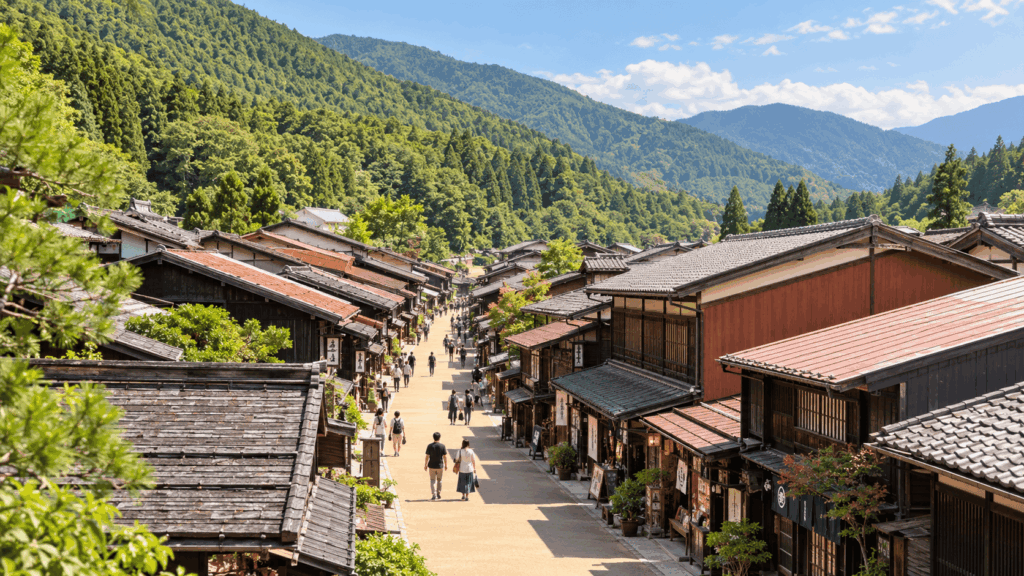
Two to three hours is the honest answer for most first-time visitors to Narai-juku. The town’s real attraction is not a checklist of monuments but the preserved main street itself — roughly one kilometer of Edo-era wooden buildings along the old Nakasendo. For a first visit, walk the street, go inside one historic house (the Nakamura Residence is the strongest choice), and add either lunch or a look at local lacquerware. That combination gives most travelers a satisfying visit without feeling rushed.
Two timing realities are worth knowing before you plan around them. Early morning is the most photogenic, but most shops and restaurants are still closed. And as of September 2026, the wooden Kiso Ohashi Bridge at the north end of town is closed for repair work expected to run until the end of March 2027, so older blog advice about crossing it no longer applies.
If you are staying in Matsumoto and want to see Matsumoto Castle and Narai-juku on the same day without coordinating local train times yourself, a guided day trip that covers both is the convenient option. For Narai-juku alone, however, going independently is genuinely easy: JR Narai Station sits right beside the post town, and no tour is needed to enjoy it.
Combining Matsumoto Castle and Narai-juku in one day? If you would rather have the transport and timing handled for you, check current availability, departure options, and recent traveler reviews for the guided Matsumoto Castle and Narai-juku day trip.
Is Narai-juku Worth Visiting?
Narai-juku is worth it if you enjoy historic streets, traditional wooden architecture, craft shops, and unhurried walking. It is a poor fit if you are looking for a high number of large attractions, expect shops and restaurants to stay open into the evening, or have less than about an hour to spend. The town rewards slowing down and noticing details — the width of the building fronts, the lattice windows, the way each house opens onto the street — rather than moving quickly from one ticketed sight to the next.
To be fair, some visitors do describe it as “beautiful but with not much to do.” That is usually a sign of mismatched expectations rather than a flaw in the town. There are no major museums on the scale of a city gallery and no rides or shows. What Narai offers is a remarkably complete post-town streetscape that is still lived in, with working shops, shrines, and a handful of small museums threaded through it. If you can enjoy a place without constantly “doing” something, you will almost certainly be glad you came.
How Long Should You Spend in Narai-juku?
Allow two to three hours for a first visit. That is enough time to walk the preserved street end to end, look inside one historic residence, and fit in either a meal or some lacquerware browsing without rushing.
| Time available | What you can realistically do | Best for |
|---|---|---|
| 1–1.5 hours | Main street walk and photos only. You can fit a museum or quick shop, but you will have to hurry. | Travelers passing through who mainly want to see the streetscape. |
| 2–3 hours | Main street walk, the Nakamura Residence, plus food or lacquerware shopping. This is the recommended sweet spot. | Most first-time visitors, including half-day trips from Matsumoto. |
| 4+ hours | A second museum, a slow sit-down lunch, and serious lacquerware browsing. Extend toward Kiso-Hirasawa if you are here for craft. | Travelers interested in museums and traditional crafts. |
Recent visitor reports on travel sites and forums repeat the same range: most people find one to three hours enough to see the town, and those who enjoy browsing shops and cafes wish they had scheduled a little more. Nothing about Narai forces you to stay longer — the value comes from choosing to go slowly.
Kai’s tip: The mistake I see in trip reports is planning only one hour for Narai. That gets you the street and the photos, but you leave without having stood inside a historic townhouse or eaten anything, and the place can blur into “another old street.” Budgeting two to three hours — even if that means cutting something else from a Matsumoto day — is what turns a photo stop into an actual visit.
Best Things to Do in Narai-juku
If you only have one visit, think in this order: walk the historic main street, go inside one preserved house (the Nakamura Residence), then add either local food or lacquerware depending on your interest. Everything else is a bonus for time you have left over.
1. Walk the Historic Main Street Slowly
The main street is the reason to come, so treat it as the centerpiece rather than a corridor between sights. From JR Narai Station you are only a few minutes’ walk from the first preserved buildings, and the streetscape runs for roughly one kilometer along the old Nakasendo. In the Edo period Narai was the longest post town on the route, and that length is exactly what makes the walk rewarding: the architectural style shifts subtly as you move through what were the upper, middle, and lower sections of the town.
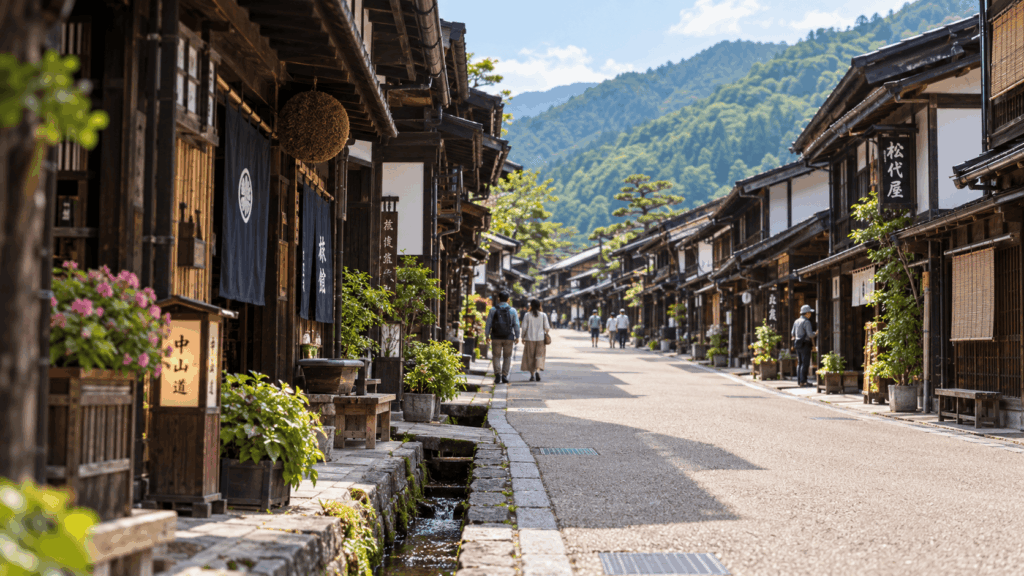
Slow down and look at the details rather than photographing each building quickly. Notice the low lattice fronts, the heavy roof lines, and the working houses where residents still slide their shutters open in the morning. Some buildings along the street are private homes, so treat doorways with respect. Early morning is the classic time for empty-street photos — just remember that at that hour the shops and restaurants are mostly still shut.
2. Go Inside Nakamura Residence
If you choose only one historic interior, make it the Former Nakamura Residence. This is the house of a family that ran a lacquered-comb wholesaling business, built around 1843, and designated a National Important Cultural Property. It looks modest from the street, but inside you can see how a successful post-town merchant actually lived: an earthen-floor work zone running from front to back, living rooms arranged alongside it, a kitchen hearth, and a tall open atrium that lets light and heat move through the building.
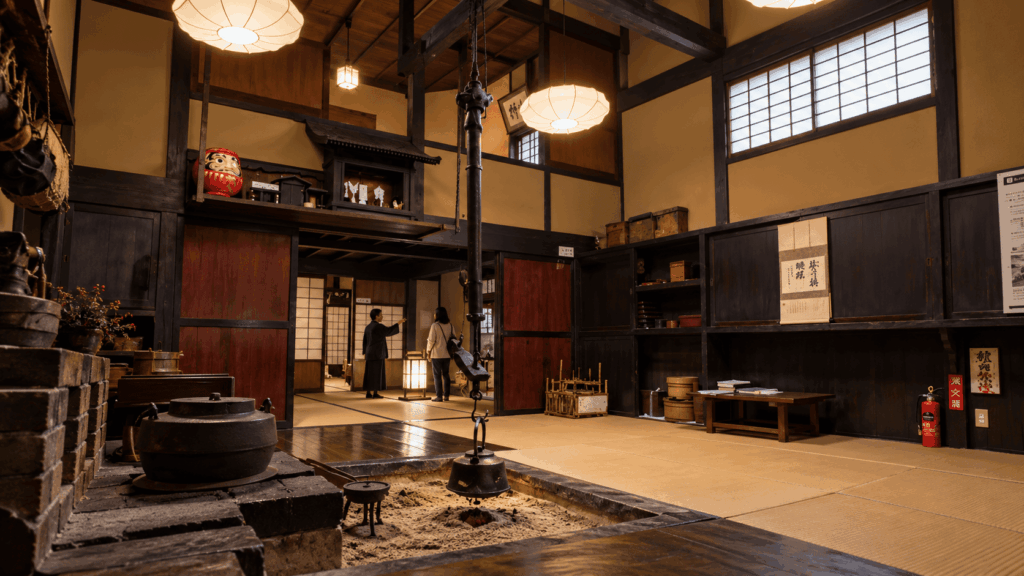
Admission is 500 yen for adults, while high school students and younger are free. From April to November, the house is open 9:00–17:00 with no regular closing days. From December to March, hours are 9:00–16:00 and it closes on Mondays, the day after public holidays, and over the New Year period (December 29–January 3); temporary winter closures are also possible. Last entry is 30 minutes before closing. Confirm current hours before your visit.
Seeing one interior changes how you read the street. Walking past the facades, I had assumed these were simple two-room houses; standing inside the Nakamura Residence, with its hearth and atrium and storage rooms running deep into the block, I understood how much commercial and domestic life these buildings once contained. If you skip every other museum, this one is worth the 45 minutes.
3. Try Soba or Gohei Mochi — But Don’t Leave Lunch Too Late
Narai has no nightlife district and no late-dinner scene, so food here means an early or midday meal. The local standbys are soba made with Kiso buckwheat and gohei mochi — grilled rice skewers coated in a sweet walnut, sesame, and sansho miso paste. Both suit the town well: they are quick, filling, and easy to fit into a walking itinerary.
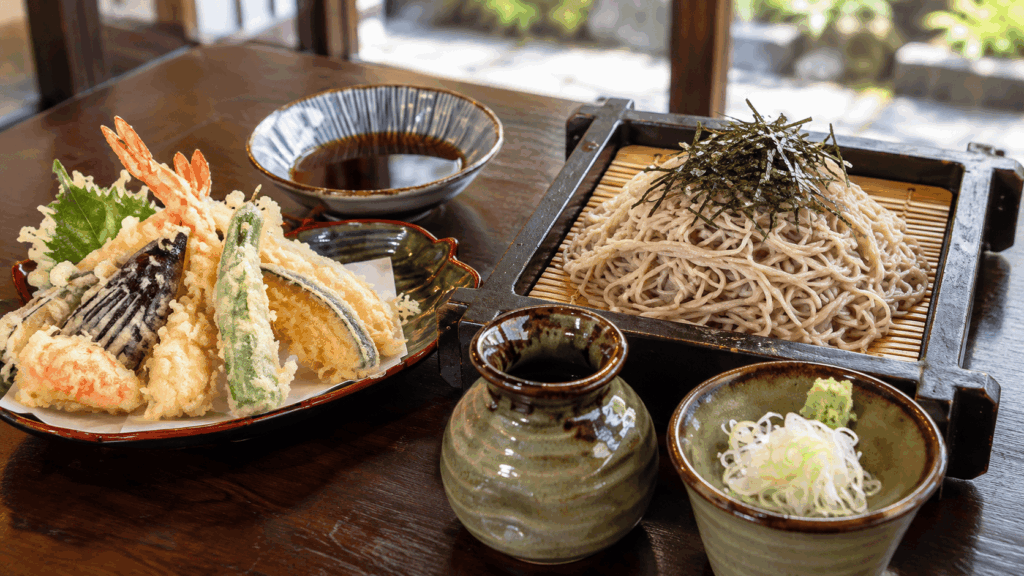
Restaurants are small, and several keep irregular closing days. One dependable reference point is Tokkuriya, a soba restaurant in a former Edo-period inn building on the main street; the local tourist association lists its hours as roughly 11:00–16:00 with irregular holidays. Visitor reports note that places like this sometimes close once the day’s soba sells out, occasionally well before the listed closing time. If a specific restaurant is your goal, check its status the same morning rather than assuming it will be open.
Kai’s tip: On my walks through post towns in the Kiso Valley, I have watched restaurants begin cleaning and closing well before their posted closing times — including one in Narai that was clearly winding down before 17:00 despite a sign saying it stayed open until then. Treat posted hours as a rough guide, and plan your meal for the middle of the day. Arriving at 14:30 and hoping for a relaxed late lunch is the quickest way to end up with vending-machine snacks.
4. Shop for Kiso Lacquerware
If you want a souvenir that lasts longer than a box of sweets, Kiso lacquerware is the town’s signature craft. Narai sits at the edge of the Kiso lacquerware region, whose workshops have produced lacquered bowls, trays, chopsticks, and bento boxes for centuries. Unlike generic gift-shop items, much of what you find here is made to be used daily, and prices vary widely from simple chopsticks to heirloom-quality pieces.
Shops are scattered along the main street with lacquerware in their windows. Kozakaya, a workshop that specializes in bento boxes and soba utensils, is a good example of the craft level you will find — though like many workshops it keeps irregular opening days, so check before making a special trip. If you fall for the craft itself, the neighboring town of Kiso-Hirasawa, a short distance away, is the deeper place to explore it.

On an earlier visit I bought a small lacquered bowl from a shop on the main street, mainly to test the “functional souvenir” idea for myself. Years later it is still the bowl I reach for first at breakfast — which is exactly the argument for buying one well-made object here instead of several trinkets.
5. Visit Shizume Shrine and the Two Hundred Jizo
If you have time left over, two quiet spots at opposite ends of town round out the walk. Shizume Shrine, the local guardian shrine of the post town, sits at the southern (Kyoto-side) entrance near the start of the Torii Pass route. The Two Hundred Jizo are at the other end, near Hachiman Shrine above Narai Station, reached along a cedar-lined stretch of the old Nakasendo — atmospheric, free, and usually uncrowded.

Treat these as optional add-ons rather than must-sees. Because they are at opposite ends of town, choose whichever fits your route and remaining time rather than trying to squeeze both into a short buffer. There is no admission charge and no fixed closing time.
Kiso Ohashi Bridge: Is It Open in 2026?
No. As of September 2026, the Kiso Ohashi Bridge — the arched, all-cypress pedestrian bridge at the north end of town — is closed for major repair work. This is the first large-scale repair since the bridge was built about 35 years ago, and the local tourist association expects construction to continue until the end of March 2027. The nighttime illumination that the bridge is known for is switched off for the duration.

This matters more than most updates, because plenty of older articles still describe walking across Kiso Ohashi and photographing the town from its deck. Ignore that advice for now. Do not build your itinerary around crossing the bridge, and if you are visiting soon, check the Narai-juku Tourist Association’s latest notice before you go — completion dates on construction projects can shift.
One small compensation: the bridge deck is currently stripped for replacement (expected to be re-laid by the end of 2026), and the tourist association notes that this offers a rare chance to see the bridge’s internal timber structure — though it is sometimes covered with protective sheeting in poor weather.
Kai’s tip: On a visit before the 2026 renovation, I crossed Kiso Ohashi and found the worn timber steps surprisingly slippery even on a dry, sunny day — the kind of thing you only notice once you are on the bridge. That is a memory of an earlier visit, not a comment on its present state, since it has been closed for repairs since 2026. If you travel after the bridge reopens, take the steps more carefully than you normally would on a wooden structure, especially after rain.
On the far side of the bridge is the Roadside Station Narai Kiso no Ohashi. It is a genuine roadside station with parking, toilets, and an information space, but it has no souvenir market, produce hall, or restaurant — so do not expect the usual roadside-station shopping stop. Its practical value is as a parking and rest base for drivers, not as an attraction itself.
Narai-juku Opening Hours: The Town Never Really “Closes,” but the Shops Do
The preserved street itself has no gate, no admission fee, and no uniform opening hours — you can walk it early in the morning or after sunset. What changes through the day is how much of it is actually open. Restaurants, shops, and museums each keep their own hours, and many close one or more days a week. In winter the situation tightens further: several places shorten their hours or close entirely for the season, and the Nakamura Residence, for example, switches to its 9:00–16:00 winter schedule from December to March. For weather and closures during these months, see our guide to visiting Narai-juku in winter.

| Time of day | Advantage | Drawback | Best for |
|---|---|---|---|
| Early morning | The street is at its quietest and most photogenic, with soft light on the wooden facades. | Most shops, restaurants, and museums are still closed. | Photographers and travelers who prioritize atmosphere over shopping and food. |
| Late morning | The best overall balance: shops are opening, light is good, and crowds are still manageable. | You may need to wait a little for the first restaurants to open. | Most visitors, especially those who want food, museums, and shopping in one stop. |
| Lunch / early afternoon | Restaurants are fully running, and the town feels lived-in. | Small eateries can fill up, and you may wait at popular places. | Travelers making lunch the centerpiece of the visit. |
| Late afternoon | Day-trip crowds thin out, and the street gets calmer again. | Some shops begin closing preparation before their posted closing times; kitchens stop taking orders early. | Those who have already done their food and shopping and want a last quiet walk. |
Visitor reviews repeat the same practical pattern: early morning is beautiful but empty of open shops, and by late afternoon you cannot count on a meal or a lingering browse. The window from late morning to early afternoon is when Narai is at its most functional — everything is open, food is available, and you still have daylight for the walk back to the station.
If you are arriving by car or from a nearby town just to photograph the streetscape, early morning is a fine choice. If your visit needs to include food, a museum, or lacquerware shopping, aim to be on the street by around 10:00–10:30.
A Simple 2–3 Hour Narai-juku Itinerary
Here is a realistic sequence that fits the recommended two to three hours, based on the pacing that worked for my own walk through the town and on what first-time visitors consistently report as comfortable:
- 0:00 — Arrive at JR Narai Station. Buy your return ticket before leaving the platform area if you have not already (more on this below), then walk the few minutes to the start of the preserved street.
- 0:00–0:45 — Walk the main street and take photos. Move slowly and let the streetscape set the pace. If the light is good, this is when you will take your best shots.
- 0:45–1:15 — Visit the Nakamura Residence. Thirty to forty minutes inside is enough to absorb one historic interior without museum fatigue.
- 1:15–2:00 — Lunch. Soba or gohei mochi at one of the small restaurants on the street. This is the slot to protect: eateries close earlier than you expect.
- 2:00–2:40 — Lacquerware shops and any streets you skipped. Even if you are not buying, the workshops are worth a look. If you bought a meal earlier instead, swap lunch and shopping.
- 2:40–3:00 — Shizume Shrine or the Two Hundred Jizo, if your train allows. They are at opposite ends of Narai-juku, so choose the one that best fits your route rather than trying to visit both in 20 minutes.
Two notes on this plan. First, if you prefer photography over food and shopping, shift the whole visit earlier and spend the saved time walking the street twice — it genuinely looks different in the morning light. Second, the Kiso Ohashi Bridge is deliberately not in this route while it remains closed for construction; once repairs finish, check current conditions and decide whether to add the short detour.
If you are staying in Matsumoto and the idea of matching this itinerary to local train times feels like friction, a guided day trip that combines Matsumoto Castle with Narai-juku removes that planning entirely — worth considering mainly for the efficiency of seeing both in one day. For Narai-juku on its own, the DIY version above is straightforward enough that a tour is not necessary.
If you fall into that first camp — you want to see both Matsumoto Castle and Narai-juku in a single day but do not want to build the day around local train connections — this is the one guided option worth comparing against the DIY plan.
Why I’d book this one
- It combines Matsumoto Castle and Narai-juku in one itinerary, which removes the main logistical friction discussed above.
- The value is not just transport: guided time at both historic stops adds context that a self-guided transfer day would not provide on its own.
- Recent travelers commonly highlight the usefulness of the guide and the convenience of having the day’s transport and timing handled; check the current cancellation terms and inclusions before confirming.
Getting to Narai-juku by Train: Two Small Things to Check First
Narai is easy to reach from Matsumoto: direct local trains on the JR Chuo Main Line run roughly once an hour and take about an hour, passing through Shiojiri on the way. From Nagoya, take a limited express toward Nagano and change at Shiojiri onto a local train. Either way, the station drops you at the edge of the post town, and no bus or taxi is needed.
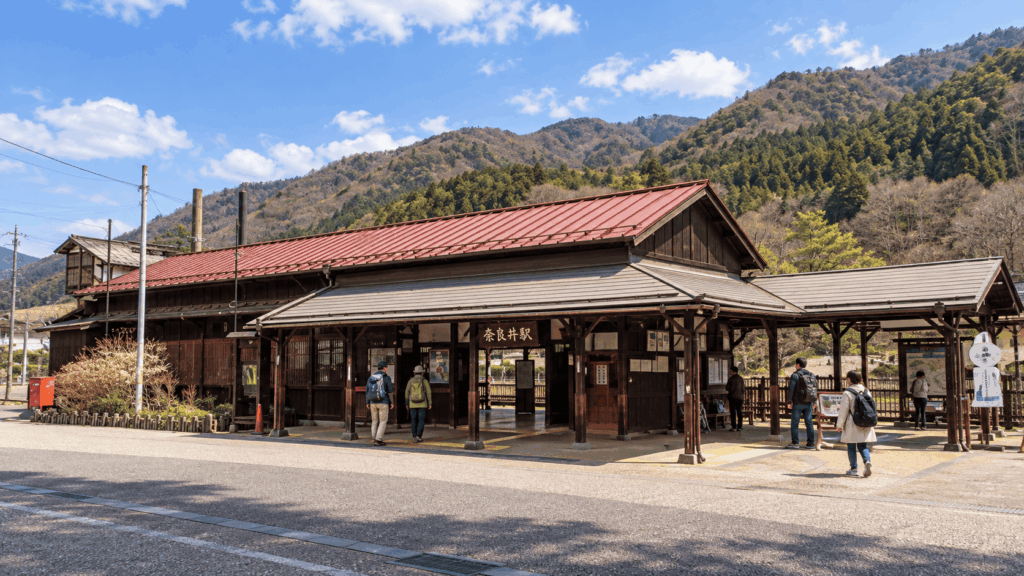
Two practical details catch travelers out, and both are worth handling before you board:
1. Check the return trains before you explore. Local service is not as frequent as in a big city. On some hours there is no convenient return train at all, and if you miss the last one of the afternoon you are looking at a long wait or an expensive taxi. Look at the departure board when you arrive and pick your return train first, then build your two to three hours backward from that time.
2. Buy a paper ticket — IC cards do not work here. The Chuo Main Line section between Shiojiri and Nakatsugawa, which includes Narai, does not accept Suica, ICOCA, or other major IC cards. This is one of the rare gaps between the JR East and JR Central IC areas, and the station at Narai has no IC gates you can tap through. If you are coming from Matsumoto, buy a paper ticket from Matsumoto to Narai before boarding (your journey from Matsumoto to Shiojiri is inside the IC area, but the Narai section is not), and keep it until you exit. A reserved limited-express seat does not change this rule.

Who Should Spend Longer Than 3 Hours?
Two to three hours suits most first-time visitors, but the town rewards a longer stay for specific kinds of travelers:
- Museum lovers. If you want to see more than one historic interior, add the Kamitoiya Museum (also known as the Tezuka Family Residence), a former post-town wholesaler’s house from 1840 that is a National Important Cultural Property in its own right. Note that it closes from December through February and keeps irregular closing days at other times, so check before you go.
- Slow lunchers. A relaxed sit-down meal in one of the old buildings, rather than a quick bowl of soba, can easily add an hour.
- Serious lacquerware shoppers. Choosing a piece properly — handling different finishes, asking about use and care — takes time, and the shops reward it.
- Craft travelers. If Kiso lacquerware is the real purpose of your trip, continue to Kiso-Hirasawa, the neighboring craft town where many of the workshops are based. Budget at least an extra half-day for that detour.
- Hikers. The Torii Pass, the old Nakasendo route over the hills toward the next post town, starts near Narai and suits travelers combining the town with a walk.

If your main interest is the streetscape and photography, if you are on a half-day trip from Matsumoto, or if one historic house is enough for you, two to three hours is genuinely sufficient. Some travelers report being satisfied with even an hour to two hours. The town does not pressure you to stay — the question is simply how much of its slower rhythm you want to absorb.

FAQ
How long do you need in Narai-juku?
Most first-time visitors should allow two to three hours. That gives you time to walk the roughly one-kilometer preserved main street, visit one historic house such as the Nakamura Residence, and fit in either lunch or lacquerware shopping. With only one to one-and-a-half hours, you can still see the streetscape, but you will have to choose between food, shopping, and a museum. Travelers with four or more hours can add a second museum, a slow lunch, or a detour toward the craft town of Kiso-Hirasawa.
What are the must-see places in Narai-juku?
For a first visit, prioritize the historic main street itself, the Nakamura Residence (a National Important Cultural Property built around 1843; adult admission is 500 yen, with shorter hours and regular closures in winter), and either local food such as soba and gohei mochi or Kiso lacquerware shopping. Shizume Shrine, the Two Hundred Jizo, and the cedar-lined Nakasendo stretch near the north end are worthwhile only if you have time left over.
Is Narai-juku open 24 hours?
The preserved street itself has no gates or uniform opening hours, so you can walk it at any time and there is no admission fee. Shops, restaurants, and museums are a different story: each keeps its own hours, many close one or more days a week, and winter brings shorter hours or seasonal closures. The practical window when the town is fully functional is roughly late morning to early afternoon.
Is Kiso Ohashi Bridge open?
As of September 2026, no. The bridge is closed for major repair work expected to continue until the end of March 2027, and its nighttime illumination is switched off for the duration. Older articles that describe crossing the bridge are out of date. Check the Narai-juku Tourist Association’s latest notice before your trip, since construction schedules can change.
Can you visit Narai-juku as a day trip from Matsumoto?
Yes. Direct JR Chuo Main Line local trains run from Matsumoto to Narai roughly once an hour, taking about an hour via Shiojiri. Two things to check before you go: confirm your return train time when you arrive, because service is thin on some hours, and buy a paper ticket — IC cards such as Suica do not work on the Chuo Main Line between Shiojiri and Nakatsugawa, which includes Narai.
Final Verdict: What Should You Prioritize in Narai-juku?
Narai-juku rewards a different mindset than most sightseeing days. Instead of trying to see many attractions, plan to experience three things well: the preserved main street, one historic house interior, and one taste of local life — food or lacquerware. For most travelers, that is a complete visit, and two to three hours is the right amount of time to give it.
Choose this plan if you enjoy historic streets, traditional architecture, craft shopping, and photography. Arrive by late morning, walk the street, go inside the Nakamura Residence, eat soba or gohei mochi before the restaurants start winding down, and browse lacquerware on your way back to the station.
Choose early morning instead if photography outranks everything else. You will have the street almost to yourself and the best light on the wooden facades — but accept that most shops and restaurants will be shut, and plan food elsewhere or later.
If you only have one hour, walk the street and take photos, and do not attempt the full loop. You can step into the Nakamura Residence if you are comfortable skipping some of the street, but trying to fit food, a museum, and shopping into one hour will leave you rushing the very thing you came to see.
If you have four or more hours, add the Kamitoiya Museum, a slow lunch, or a craft-focused extension to Kiso-Hirasawa — especially if lacquerware is your real reason for coming. The extra time converts Narai from a pleasant stop into a genuinely deep visit.
For first-time visitors in 2026, one last planning note: do not make the Kiso Ohashi Bridge the centerpiece of your trip while it is closed for repairs, and check the official construction notice before you go. The town itself is fully worth the journey without the bridge — and if you are combining it with Matsumoto Castle in a single day and prefer not to manage local train times, a guided day trip from Matsumoto is the convenient way to do both. For Narai-juku alone, going independently remains easy.
Information in this guide was checked against current official sources in September 2026; admission fees, opening hours, restaurant schedules, and construction conditions can change, so confirm the details that matter to your visit before you travel.

Hi, I’m Kai. I’m a Tokyo-based travel writer, tourism industry insider, and the author of a published guidebook for international visitors to Japan. With over 10 years of professional experience at a leading Japanese tourism company, my mission is to help you skip the tourist traps and navigate Japan’s best destinations like a local. I believe the perfect day trip is like a traditional kaiseki meal: a beautiful balance of precise planning and unforgettable seasonal discovery. When I’m not out conducting field research, you’ll usually find me drafting new itineraries with one of my favorite fountain pens!