
There is no single “best Nakasendo ryokan.” The right stay depends first on which stretch of the old Nakasendo highway you plan to walk, and second on how much old-building character you are willing to trade for comfort. If your plan centers on the classic Magome–Tsumago trail, base yourself in one of those two post towns. If the overnight atmosphere matters as much as the hike, Narai-juku is the stronger choice. And if you want an onsen, a wider choice of rooms and easy rail access, Kiso-Fukushima is the practical hub. Just be clear about one thing before you book: a traditional inn on the Nakasendo often means shared bathrooms, steep stairs and a very quiet evening — while a renovated historic stay (like BYAKU Narai) keeps the heritage but removes most of the friction, for a noticeably higher price.

If the classic Tsumago–Magome walk matters more to you than sleeping in a post town, there is another option: a guided day hike from Nagoya combines both towns, the 8 km trail and round-trip transport in one booking. Check current dates, start times and recent traveler reviews for the Nakasendo hiking tour before deciding whether you actually need an overnight stay.
Where Should You Stay on the Nakasendo?
Choose your post town before you choose your inn. The mistake I see first-time visitors make is falling in love with a specific ryokan’s photos, then discovering it is in the wrong place for the walking route they had planned. Magome and Tsumago sit about 8 km apart at the southern end of the Kiso Valley and are linked by the most popular hiking section; Narai is a separate, beautifully preserved post town to the north; Kiso-Fukushima is a working town and rail hub with the valley’s best hot-spring inns. Each makes sense for a different traveler. If you are struggling to choose, our Narai vs Tsumago guide breaks down the two most famous preserved towns.
| Area | Best for | Main advantage | Main drawback | Accommodation style | Best choice if… |
|---|---|---|---|---|---|
| Magome | Starting the classic Magome–Tsumago walk | Direct buses from JR Nakatsugawa; inns close to the trailhead | Day-tripper crowds; small traditional inns sell out fast | Small inns & minshuku, mostly shared facilities (INN TAJIMAYA, Magome Chaya) | You want the hike as the centerpiece and an early start on the trail |
| Tsumago | The preserved post-town atmosphere after the walk | One of Japan’s best-known preserved post towns; genuinely quiet in the evening | Few inns; most day restaurants close by late afternoon | Small minshuku and ryokan (Oyado Daikichi, Hanaya) | You finish the hike in Tsumago and want the town to yourself at night |
| Narai | Historic overnight atmosphere — the town as the destination | Long preserved main street; stays inside genuine Edo-era buildings, from basic minshuku to BYAKU Narai | Not an onsen town; further from the Magome–Tsumago trail | Traditional minshuku/ryokan and renovated historic luxury (Minshuku Shimada, Oyado Iseya, BYAKU Narai) | The quiet evening and the old building matter as much as the walking |
| Kiso-Fukushima | Comfort, rail access and natural hot springs | The valley’s rail hub; ryokan with real onsen and free station shuttles (Kaido Roman Onyado Tsutaya) | Less preserved post-town streetscape; you travel to the trail towns by bus or train | Hot-spring ryokan and hotels, plus a few traditional inns | Comfort and transport outweigh post-town immersion — or the trail towns are sold out |
Stay in Magome if the hike is your priority
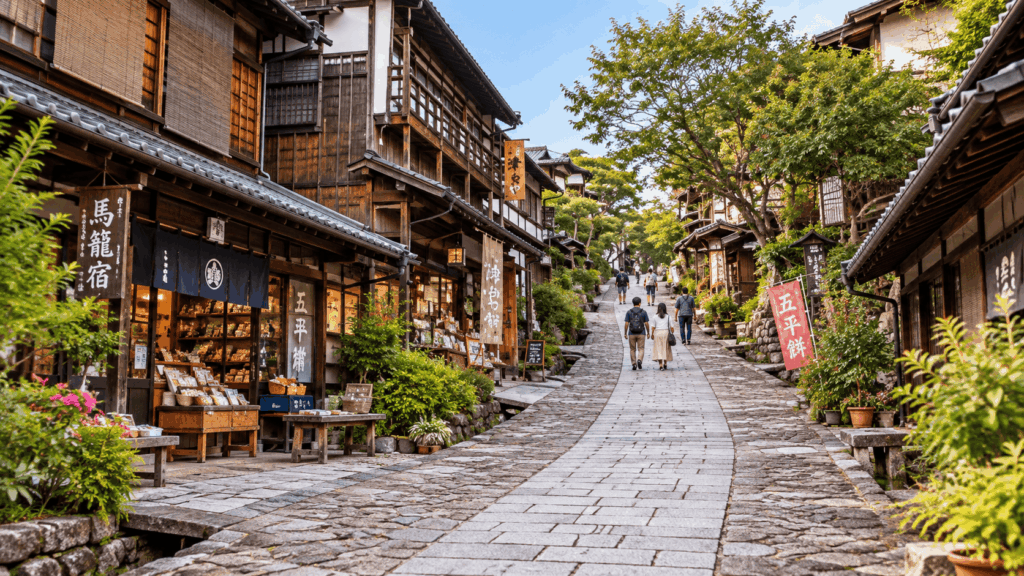
Magome is the post town most people picture when they search for Nakasendo accommodation: a single steep main street of wooden buildings, with the trailhead at the top of town. Because buses from JR Nakatsugawa run up the hill through the day, it is the easiest base to reach without a car. Staying overnight puts you at the start of the classic route, so you can walk the ridge toward Tsumago in the morning before the day-trip buses arrive — a window of relative quiet that makes the trail feel like the 19th century again. Expect small traditional inns such as INN TAJIMAYA and minshuku-style stays like Magome Chaya: Japanese-style rooms, shared bathrooms and dinner included, because evening restaurant options in the town itself are limited.
Stay in Tsumago if you want the quieter historic post-town feel
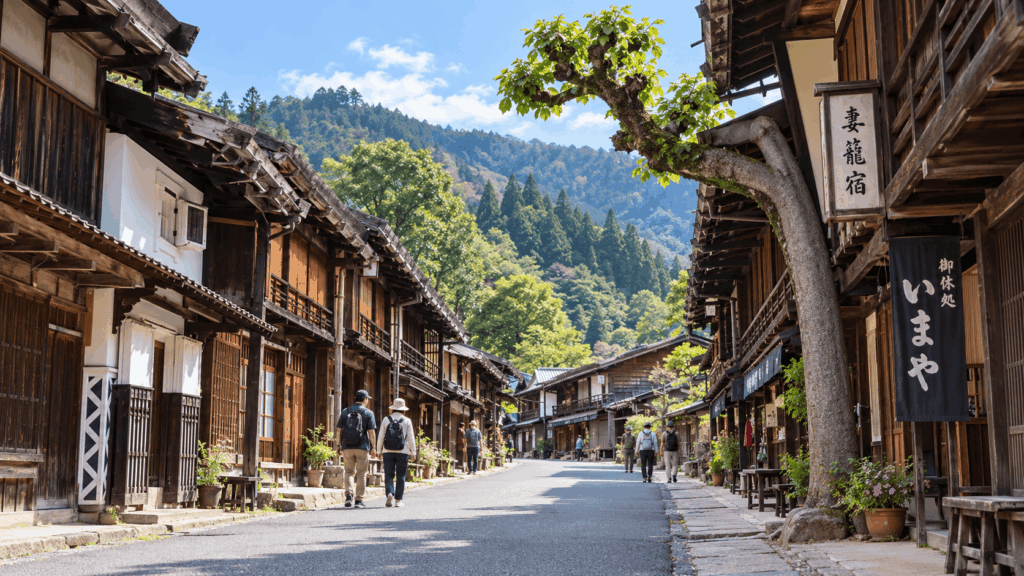
Tsumago is the town most often held up as the model of post-town preservation in Japan, and it shows: no modern signs compete with the wooden facades, and after the last bus leaves, the main street is remarkably still. It works beautifully as the overnight end point of the Magome–Tsumago walk — you hike over the pass during the day and arrive in time for an inn dinner. The trade-off is practical: Tsumago has only a handful of places to sleep (small inns like Oyado Daikichi and the larger Hanaya), most daytime restaurants close by mid-to-late afternoon, and there is no convenience store on the preserved street. This is a town where you plan dinner around your inn, not the other way around.
Stay in Narai if the overnight atmosphere matters as much as the walk
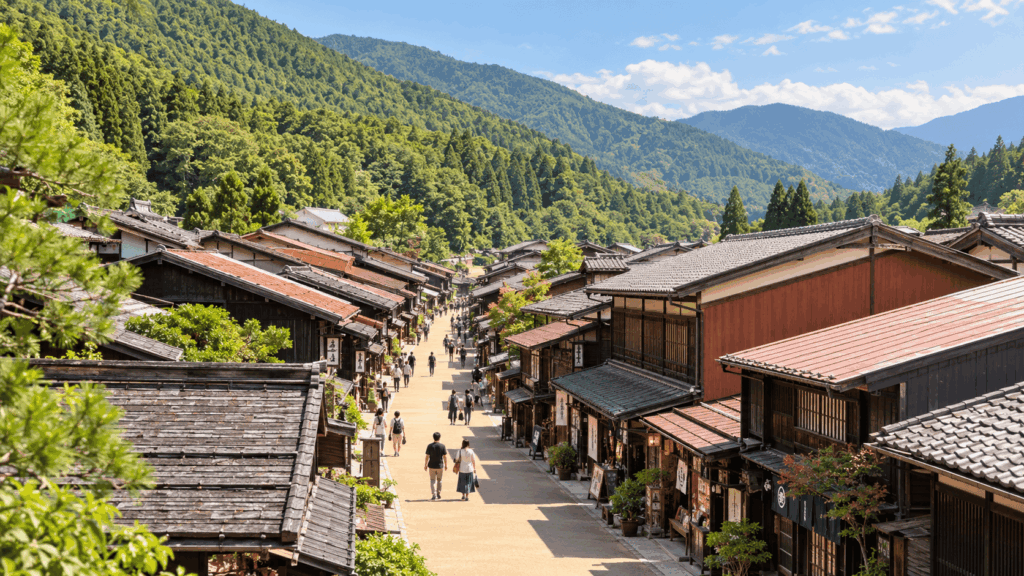
Narai-juku, the longest of the Nakasendo’s post towns, is where staying overnight stops being a logistics decision and becomes the point of the trip. Its roughly one-kilometer main street is lined with buildings that genuinely date from the Edo period, and several are now guesthouses. The first time I stayed overnight in Narai, I was struck by how quickly the street emptied once the shops closed; after dinner I walked the main road with almost no one else on it, under the lattice windows of the old inns. That stillness is something a day trip simply cannot give you. The range of stays is wider here than anywhere else on this list — from the simple family-run Minshuku Shimada, to the 200-year-old main building of Oyado Iseya, to the renovated luxury of BYAKU Narai — which makes Narai the easiest place to match an inn to your comfort level. For more options, see our complete guide to where to stay in Narai-juku. One honest warning: Narai is not a hot-spring town, and many traditional rooms share toilets, so this is a base for atmosphere first.
Stay in Kiso-Fukushima if comfort and transport matter more
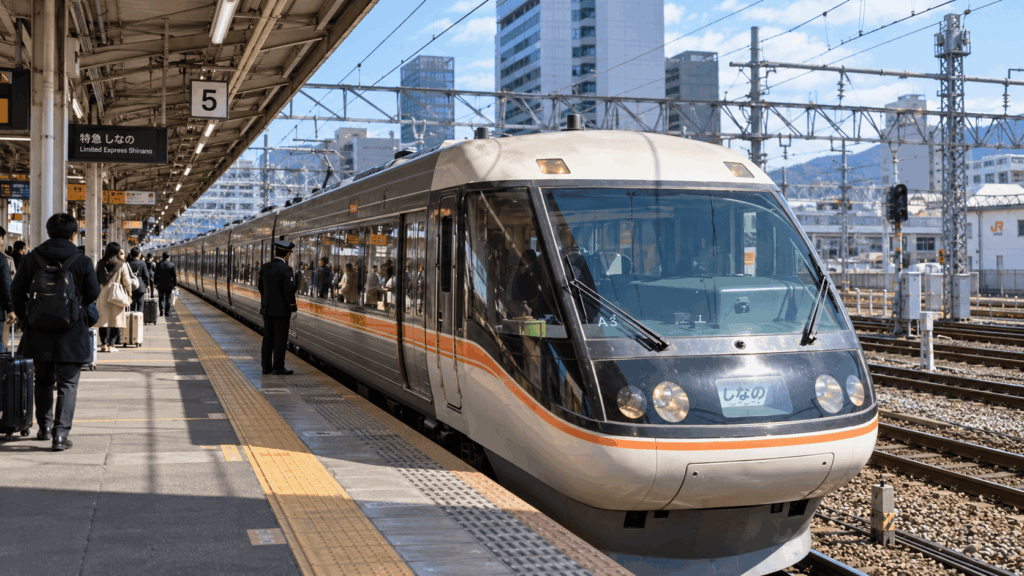
Kiso-Fukushima is the valley’s main rail town and the answer for travelers who want a ryokan experience without the post-town compromises. It has real hot springs — Kaido Roman Onyado Tsutaya, an inn founded in 1688 with a riverside open-air bath, offers station pickup by advance request — plus a wider range of restaurants and services than the preserved towns. You give up the concentrated Edo streetscape, and you will take a bus or train to reach the Magome–Tsumago trail. Think of it less as the most atmospheric base and more as the most forgiving one: the fallback that keeps your walking itinerary alive when Magome or Tsumago has no rooms left.
Traditional Ryokan, Minshuku or Renovated Historic Stay?
On the Nakasendo, the words ryokan and minshuku describe atmosphere and service more than they describe facilities. A minshuku is usually a family-run guesthouse: simpler rooms, home-style cooking, and often the cheapest way to sleep in a historic building. A ryokan tends to be a larger, more formal inn, but along this route many of the most atmospheric ryokan still use shared toilets and bathrooms — the word alone does not promise a private bath. At the other end of the spectrum, renovated historic stays such as BYAKU Narai keep the old structure — exposed beams, lattice windows, original floor plans — but add modern heating, private bathrooms in many rooms and English-friendly booking, for two to three times the price of a traditional inn. There is no objectively better choice; there is only the question of which trade-offs you will enjoy rather than endure.

| Stay type | Atmosphere | Private bathroom likelihood | Meals | Stairs & mobility | Winter comfort | Price level | Best for |
|---|---|---|---|---|---|---|---|
| Traditional minshuku | Family-run, homely, close to the host | Rare — expect shared bath & toilet | Simple home-style cooking, often excellent local produce | Old buildings; stairs and steps possible | Basic heating; rooms can feel cool | ¥ (lowest) | Budget travelers happy to share facilities for authenticity |
| Traditional ryokan | Historic building, more formal service | Only if stated — many are shared | Multi-course dinner, usually included | Steep stairs and uneven steps common | Varies; older wings are cooler | ¥¥ | Travelers who want heritage atmosphere plus a proper dinner |
| Renovated historic luxury | Old structure with modern comfort | Common — some rooms with open-air bath | Refined dinner; restaurant & bar on site | Still possible; ask about room position | Upgraded heating; comfortable year-round | ¥¥¥ (roughly 2–3× a minshuku) | Travelers who want character without shared baths or cold rooms |
As a rough guide to published rates: traditional minshuku and small ryokan in the Kiso Valley typically start around ¥11,000–12,500 per person per night with two meals — Oyado Daikichi in Tsumago lists its two-meal plan from about ¥12,500 — while renovated historic properties such as BYAKU Narai commonly start well above ¥30,000 per person with meals. Rates swing sharply with season and room type, so treat these figures as a starting point and check current prices for your dates.
Best Nakasendo Ryokan and Inns by Area
The properties below are the ones I come back to most often when helping travelers match an inn to a plan. None of them is “the best” for everyone — read the trade-off column honestly, then check availability for your dates. Every recommendation includes its main drawback, because on the Nakasendo the drawback is usually the thing that decides whether you enjoy the stay.
| Property | Area | Best for | Meals | Bathroom situation | Main trade-off | Booking route |
|---|---|---|---|---|---|---|
| BYAKU Narai | Narai | Historic atmosphere without giving up modern comfort | Refined dinner; restaurant & bar on site | Private in many rooms; some open-air baths (not onsen); public bath | Premium price; historic stairs | Official English site; major booking sites |
| Oyado Iseya | Narai | A traditional stay in a genuine Edo-era main building | Kiso mountain-vegetable and river-fish dinner | Shared toilets (first floor of main building); two private baths | Shared toilets; stairs in main building | Official site (online booking); Rakuten Travel |
| Minshuku Shimada | Narai | A simple, low-cost traditional stay | Home-style seasonal cooking | Shared bath; some rooms with a toilet are available for an extra charge | Basic comforts; book directly | Official site / direct contact |
| INN TAJIMAYA | Magome | The classic route with a traditional inn stay | Half board (dinner & breakfast) | Shared — no private bath or toilet | Shared facilities; fixed meal times | Official English site; booking sites |
| Magome Chaya | Magome | A straightforward minshuku-style stay near the trail | Dinner served at its restaurant across the street | Shared, gender-separated | Shared facilities; dinner timing | Booking sites |
| Oyado Daikichi | Tsumago | A small-scale stay in Tsumago | Two-meal plan from about ¥12,500 | Shared — confirm directly | Only about 10 guests; no two-night stays currently | Official site (direct) |
| Hanaya | Tsumago | A larger fallback when Tsumago’s small inns are full | Two-meal plan | Confirm directly | Less intimate than a small minshuku | Official site |
| Kaido Roman Onyado Tsutaya | Kiso-Fukushima | Onsen comfort with easy rail access | Multi-course dinner; open-air bath above the river | Natural hot-spring baths | Outside the preserved post towns | Official English site; booking sites |
BYAKU Narai — Best for historic atmosphere without giving up modern comfort
BYAKU Narai is the property I point travelers to when they love the idea of a 200-year-old building but worry about cold rooms, shared bathrooms or language barriers. The inn spans four restored historic buildings in the middle of Narai’s preserved street — one was a sake brewery that operated for centuries — and its 16 guest rooms all differ, several with private open-air or semi-open-air baths. There is a large public bath, a restaurant in the former brewery and a bar, and the English website makes booking straightforward.

Know before booking: this is the premium option on the Nakasendo, and it is not an onsen. BYAKU’s SAN-SEN bathing facility uses mountain spring water, but it is not a natural hot-spring bath; the private open-air and semi-open-air tubs should likewise not be confused with onsen. The buildings are authentically old, so uneven steps and stairs are part of the deal; ask about your room’s position if stairs are a concern. I have not stayed here myself — it sits above my usual budget — but travelers who prioritize comfort consistently describe it as the stay that solved the “old vs cold” dilemma.

See current availability, room options, and recent guest reviews for BYAKU Narai.
Oyado Iseya — Best for a more traditional Narai inn experience
If you want the real thing rather than the upgraded version, Oyado Iseya has been welcoming travelers since 1818 in a main building that is itself a piece of Narai’s architectural heritage: lattice windows along the street, slightly overhanging second-floor rooms and the fire-prevention walls typical of the town. Dinner is a Kiso Valley meal of mountain vegetables in spring, mushrooms in autumn and freshwater fish, served in a Japanese room. The inn now takes online reservations through its official site.

Know before booking: in the main building, toilets and washrooms are shared and located on the first floor, while most guest rooms are upstairs — worth understanding before you book if you will need the bathroom at night. The annex has same-floor shared facilities and one first-floor room; the inn asks guests to mention mobility needs in advance. There are also two private baths, usable freely without reservation, but they are not natural hot springs.
Minshuku Shimada — Best for a simpler traditional stay
Minshuku Shimada is the honest budget answer in Narai: a family-run guesthouse on the main street, a five-minute walk from JR Narai Station, with home-style meals built around seasonal mountain produce. It has none of BYAKU’s polish and does not pretend to — the value is a genuine, unscripted stay in the post town at a fraction of the price.

Know before booking: the bath is shared, although some rooms with a toilet are available for an extra charge. This is the kind of small inn you arrange directly rather than through a big international site. Confirm current rates, facilities and how to reserve well ahead of the autumn season.
INN TAJIMAYA — Best traditional stay in Magome for the classic route
INN TAJIMAYA (Oyado Tajimaya) sits right in Magome and keeps things simple on purpose: all Japanese-style rooms, no private bath or toilet, and a fixed half-board rhythm — dinner at 18:00, breakfast at 7:30 — that fits a hiker’s schedule perfectly. The English-language official site takes reservations directly, which removes most of the booking friction you will find at smaller inns. Do not confuse it with the unrelated Tajimaya hot-spring inns elsewhere in Japan; this one is at 4266 Magome in Gifu Prefecture.
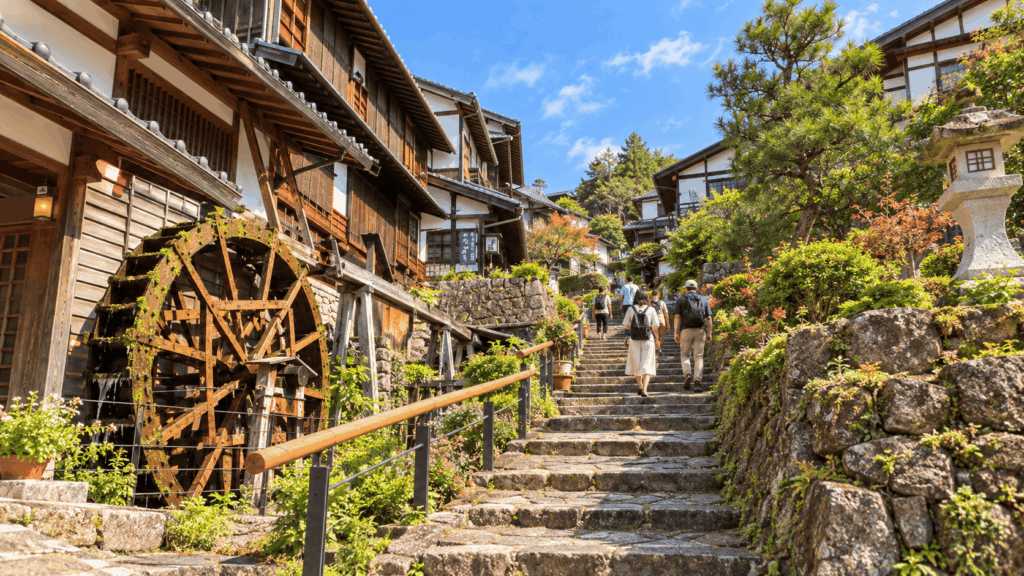
Know before booking: there is no private bathroom in any room, so you will use shared facilities like guests have for centuries. If that is a deal-breaker, this is not your inn — but for the classic Magome–Tsumago walk, the location and straightforward style are hard to beat.
Magome Chaya — Best for a straightforward minshuku-style stay
Magome Chaya covers the travelers who want the post town experience without a formal ryokan price tag. It is a minshuku-style guesthouse near the top of Magome, with shared gender-separated bathrooms and toilets, and dinner is served in the family’s restaurant across the street — which also happens to be one of the few reliable evening meal options in town. Rooms are air-conditioned and the inn is bookable through the usual international sites, making it an easy first reservation for nervous first-timers.
Know before booking: expect guesthouse simplicity — shared facilities, and a set dinner time at the restaurant rather than room service. Reviewers regularly mention that the shared bath is busiest right after dinner, so plan your soak for later in the evening if you prefer privacy.
Oyado Daikichi — Best for a small-scale stay in Tsumago
Oyado Daikichi is the kind of small family-run minshuku that makes Tsumago special: a few guest rooms, a total capacity of about ten guests, and dinner built around local Kiso cooking. Its two-meal plan starts at around ¥12,500 per person, and the inn takes reservations through its official site. Because the property is tiny, a stay here feels personal in a way a larger ryokan cannot match.
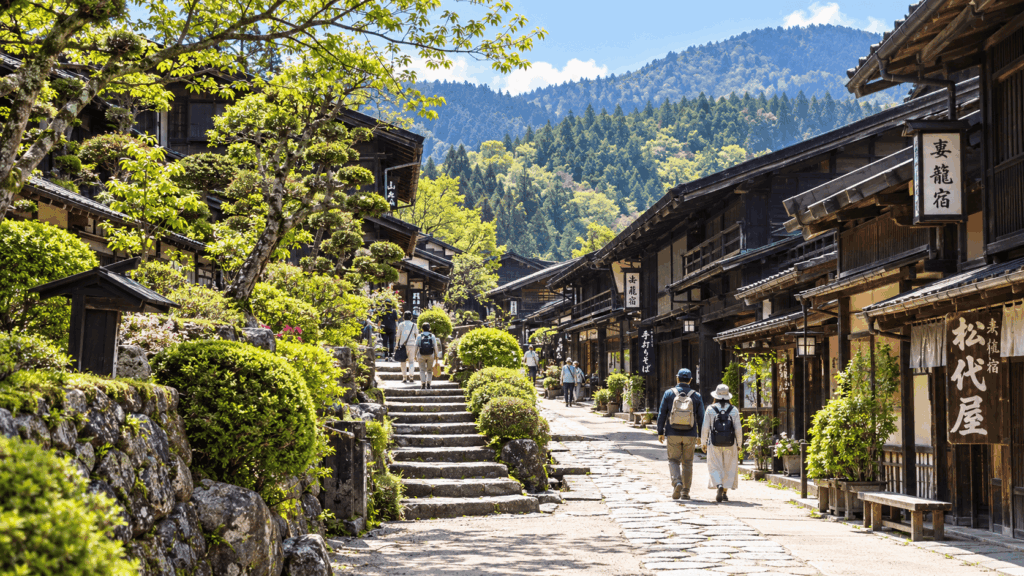
Know before booking: the inn currently does not accept two-night stays, so it suits a one-night stop on the trail rather than a base for exploring. Rooms are traditional and facilities shared; recent guests occasionally note the room size and bath as basic — read that as the trade-off for small-scale authenticity. If Daikichi is full, Hanaya, a much larger ryokan with about 300 years of history on the edge of the preserved area, is the practical same-town fallback.
Kaido Roman Onyado Tsutaya — Best if you want an easier base in Kiso-Fukushima
Kaido Roman Onyado Tsutaya is the answer when the post-town inns have no rooms or the idea of a shared toilet has killed the romance. This roughly 300-year-old ryokan in Kiso-Fukushima has natural hot-spring baths, including an open-air bath above the Kiso River, and offers a free shuttle from the station — the kind of comfort logistics that traditional post-town inns simply cannot provide. The town around it is a working hub with restaurants and services, so you are not dependent on your inn for dinner.
Know before booking: you are trading the preserved post-town streetscape for convenience and real onsen. For another hot-spring option in the same area, Nukumorino-yado Komanoyu is one of the few inns around Kiso-Fukushima with its own private hot-spring source. Check its current shuttle arrangements and rates directly when booking.
What Staying in a Historic Nakasendo Inn Is Really Like
Most guides describe traditional inns the way a brochure would: lattice windows, wooden beams, a sense of the past. All of that is real. What the brochures leave out is that the past was not always comfortable, and the gap between expectation and reality is where disappointed reviews are born. Let me tell you what staying in an old post-town building is actually like.
The charm: you experience the town after day-trippers leave
The single best reason to sleep in a post town rather than visit it is the hour after the shops close. When I stayed overnight in Narai, I watched the last day-trippers catch their trains, and then the main street belonged to the people sleeping there. Walking out after dinner, with the lattice fronts of the old buildings lit softly and almost nobody around, I understood why these towns feel different at night: they stop performing and simply exist. Day trips give you the buildings; an overnight stay gives you the town.

The trade-offs: stairs, shared facilities and old-building quirks
Now the honest part. Old wooden inns have steep stairs, and I mean steep — the kind you climb sideways with your bag in your hand. In a traditional main building, the toilet is often on a different floor from your room, so a nighttime visit means navigating a cold corridor and a flight of stairs. In the inn I stayed at, the washroom itself had been cleanly renovated — that is true of many places now — but the old electrical system was less forgiving: my hairdryer tripped the room’s breaker when the heater was running, a small and faintly comic reminder that the building predates modern wiring. None of this ruined the stay, and that is exactly the point: it was part of the experience, but it is not for everyone.
Kai’s tip: Before you romanticize a traditional inn, ask yourself how you will feel at 2 a.m. in a cold corridor walking to a shared toilet two floors down. If that image sounds like a story you will tell later, a traditional minshuku or ryokan will probably be a highlight of your trip. If it sounds like a problem, spend the extra money on a renovated historic stay or a Kiso-Fukushima ryokan instead — and never assume “ryokan” means a private bathroom. One question at booking settles most of this: “Is the toilet private or shared, and where is it relative to my room?”
Should You Book Dinner at Your Ryokan?
On the Nakasendo, the answer is almost always yes, and not mainly for the food. In Magome, Tsumago and Narai, most daytime restaurants close by mid-to-late afternoon — the official Tsumago tourism site publishes a monthly opening calendar in which many eateries stop service between 15:00 and 17:00 — and there are no convenience stores on the preserved streets. If you arrive without a dinner plan, you may be eating vending-machine snacks. A half-board plan (dinner and breakfast) is therefore a logistics solution as much as a culinary one.
The food itself is its own argument. The most memorable meal I had in Narai was not luxury ingredients — it was a quiet dinner of simply cooked local vegetables and perfectly steamed rice, the kind of meal that makes you understand why Japanese home cooking is so revered. The innkeeper talked through the dishes and, after dinner, the history of the post town. That combination — an honest local meal and a host who explains the place — is what you are actually paying for.
Kai’s tip: If you book dinner at your inn, tell them about dietary restrictions when you reserve, not at check-in — small kitchens cannot improvise the way city restaurants can. And if you are arriving late, confirm the dinner time and the latest check-in in writing; inns on this route set early meal times (often 18:00) and cannot hold dinner for guests who drift in at 21:00. Budget travelers who skip dinner should carry snacks and accept that the evening will be very quiet.
How Early Should You Book Nakasendo Accommodation?
Early. The best-known post-town inns are tiny — Oyado Daikichi sleeps about ten guests total — and the valley is a magnet for autumn-foliage travelers and hikers in spring, when rooms in Magome, Tsumago and Narai disappear quickly. A pattern I see constantly in traveler forums is the person who planned the hiking route first and searched for rooms a month out, only to find every characterful inn sold out. Another common confusion: a property that shows no availability may simply not have opened its calendar for your dates yet, so “sold out” and “not yet bookable” are not the same thing. If an inn looks full, check its official site directly — many small places release rooms on their own calendars before they appear on international booking sites.
As a rule of thumb, start looking two to four months ahead for spring and autumn dates, and be flexible about which post town you sleep in. For the rest of the year, one to two months is usually enough.
What to do if Magome or Tsumago is sold out
A sold-out post town does not mean a cancelled walk. Your first move is the other inns in the same town — Hanaya in Tsumago, for example, is larger and often still open when the small minshuku are full. If the whole town is booked, shift your night to Narai, which has the widest range of stays, or to Kiso-Fukushima, where hot-spring ryokan have more rooms. You can keep the classic hike exactly as planned by staying in the town you can get and using the morning bus or train to reach the trailhead — or simply walk the section in the opposite direction, since both Magome and Tsumago are served by public transport. The accommodation is the constraint; the trail itself rarely is.
If Magome or Tsumago is sold out — or you would rather remove the bus connections from the equation — a guided Nakasendo hike from Nagoya is the alternative worth comparing before you rearrange the rest of your route.

Why I’d book this one
- Recent travelers consistently mention knowledgeable, personable guides who add useful historical context along the trail.
- The itinerary combines Tsumago, the full classic 8 km section and Magome with round-trip transport, removing most of the day’s transport planning.
- It suits travelers who want the Nakasendo hike to remain the centerpiece even when an overnight stay in the post towns is unavailable or inconvenient.
Practical Things to Check Before Booking
Before you press reserve, run through this short checklist. On the Nakasendo, the details below cause more post-booking surprises than anything else:
- Is the bathroom or toilet private or shared, and where is it in the building?
- Are there stairs or steps between the entrance, your room and the facilities?
- Is dinner included, and what is the latest check-in time?
- How do you reach the inn from the station or bus stop, and does it help with luggage?
- What is the heating situation if you travel in winter?
- Are there extra charges at check-in? Since 1 June 2026, Nagano Prefecture adds a ¥200 per person per night accommodation tax when the per-person room rate is ¥6,000 or more — this applies in Tsumago, Narai and Kiso-Fukushima. Magome, which sits just across the prefectural border in Gifu, is not subject to the Nagano tax.
Accommodation details in this guide were checked in September 2026. Prices, availability, meal plans and facilities change — always confirm the current details with the property before booking.
Bathroom and toilet setup
This is the single most misunderstood point on the Nakasendo. The word ryokan does not mean private bathroom: INN TAJIMAYA in Magome states plainly that none of its Japanese-style rooms has a private bath or toilet, and Oyado Iseya’s main building shares toilets on the first floor. At the other extreme, BYAKU Narai gives many rooms their own bath. The only reliable method is to check each property’s facilities page and, when in doubt, ask directly in your booking message. “Do you have a private toilet in the room?” is a normal question for these inns, and they would rather answer it than host an unhappy guest.
Kai’s tip: When an old inn says facilities are “shared,” find out whether they have been renovated. In my experience the washrooms in post-town inns are often cleaner and more modern than the centuries-old rooms around them — the gap between a restored toilet block and a draughty corridor is exactly what determines whether a shared-facility stay feels charming or challenging. Ask for a photo or a description of the bathroom floor if the website does not show it.
Stairs and mobility
Historic buildings on the Nakasendo were not designed for wheeled luggage or weak knees. Expect steep stairs, uneven thresholds and rooms on upper floors reached by narrow staircases — this applies even at high-end properties like BYAKU Narai, whose restored buildings keep their original layouts. Oyado Iseya offers a first-floor annex room for guests who struggle with stairs, but you must request it in advance. If mobility is a concern, book a ground-floor or annex room, keep your main luggage elsewhere (see below), and confirm the entrance situation — some inns have a step or two at the front door that a taxi driver will not help you with.
Do not confuse a private bath with an onsen
Narai is not a hot-spring town — the local tourism association says so plainly — yet several of its inns advertise baths. Those are not natural hot-spring baths: BYAKU Narai’s bathing facility uses mountain spring water, and Oyado Iseya’s private baths are not onsen. If genuine natural hot springs matter to you, stay in the Kiso-Fukushima area, where Kaido Roman Onyado Tsutaya offers natural hot-spring bathing and Nukumorino-yado Komanoyu advertises its own private source. And if a property claims an onsen, check the source: in this valley, the distinction between a real spring and a non-onsen bath is a meaningful one.
Luggage forwarding can change where you stay
You do not have to carry a suitcase over the Magome–Tsumago trail. A seasonal luggage-forwarding service between Magome and Tsumago has operated for years — handled through the tourism information offices, typically around ¥1,000–1,500 per bag, with dates and fees changing every season — and a private same-day service now delivers bags hotel-to-hotel across the Magome, Tsumago and Narai area by advance arrangement. Because the pickup and drop-off windows are narrow (often mid-morning drop-off, afternoon delivery), confirm the current schedule before you lock in your inns. Forwarding your main bag also widens your accommodation choices, because it means you can stay in a traditional inn even if it sits at the top of a steep street.
FAQ
What is the best town to stay in on the Nakasendo?
There is no single best town — the choice depends on your walking plan. Stay in Magome or Tsumago if the classic Magome–Tsumago trail is the centerpiece of your trip; Narai is the better base if you want to experience a preserved post town after the day-trippers leave; and Kiso-Fukushima suits travelers who prioritize comfort, rail access and natural hot springs over the Edo-period streetscape.
Is it better to stay in Magome or Tsumago?
Both work for the same hike, from opposite ends. Staying in Magome puts you at the trailhead, so you can walk the section toward Tsumago in the morning before the day-trip buses arrive. Staying in Tsumago gives you the quieter, more strictly preserved town in the evening — but Tsumago has fewer inns and even fewer evening dining options, so your dinner plan will revolve around your inn either way. A common compromise is to sleep in Magome first, walk to Tsumago the next day, and stay there overnight before moving on.
What is the difference between a ryokan and a minshuku on the Nakasendo?
A minshuku is a family-run guesthouse with simpler rooms, home-style cooking and usually the lowest rates — think Oyado Daikichi in Tsumago or Minshuku Shimada in Narai. A ryokan is typically a larger, more formal inn, but along the Nakasendo the term does not guarantee modern facilities: many atmospheric ryokan still share toilets, and renovated historic properties like BYAKU Narai blur the line entirely. Judge each property by its facilities, not its label.
Do Nakasendo ryokan have private bathrooms?
Not automatically. INN TAJIMAYA in Magome has no private bath or toilet in any room, and Oyado Iseya’s historic main building shares toilets on the first floor. At the other extreme, BYAKU Narai gives many rooms their own bath, including open-air tubs. The word ryokan tells you nothing about bathrooms — check the property’s facility page or ask directly in your booking message before you reserve.
How far in advance should I book Nakasendo accommodation?
For spring and autumn dates, start looking two to four months ahead, because the most characterful inns are very small — Oyado Daikichi sleeps about ten guests total. Outside peak seasons, one to two months is usually enough. If a property shows no availability, check its official site: small inns often open their own booking calendars before rooms appear on international booking sites, and a room that looks sold out may simply not be bookable yet for your dates.
My Nakasendo Ryokan Recommendation by Traveler Type
If you ask me to pick a single stay for you, my first question is the same one I would ask a friend: do the small inconveniences of an old building sound charming or annoying? Your answer decides more than any star rating.
- Best for the classic Magome–Tsumago experience: INN TAJIMAYA in Magome — you wake up at the trailhead, and the fixed half-board rhythm suits a hiker’s day. If you would rather end the walk in a preserved town, book Oyado Daikichi in Tsumago instead, early.
- Best for historic atmosphere: Oyado Iseya in Narai — an 1818 building with lattice windows, shared toilets on the first floor and a proper Kiso dinner. Choose this only if you have read the trade-offs above and still smile at the idea.
- Best for comfort without losing character: BYAKU Narai — restored historic buildings, private baths in many rooms and English-friendly booking, at a premium price. This is the stay I suggest to travelers who want the old town but refuse to freeze or queue for a toilet.
- Best for budget-conscious travelers: Minshuku Shimada in Narai or Magome Chaya in Magome — simple, family-run, shared facilities, and the lowest realistic rates for sleeping inside a post town.
- Best if shared facilities worry you: skip the traditional post-town inns and look at a Kiso-Fukushima ryokan such as Kaido Roman Onyado Tsutaya, where you get natural hot-spring bathing and a wider choice of modern room setups — or pay for BYAKU Narai if you want the post town at night.
- Best fallback when the post towns are sold out: Hanaya in Tsumago for the same town at larger scale, then Kiso-Fukushima (Tsutaya or Nukumorino-yado Komanoyu) for the most rooms and real onsen.
For your dates, check which of these stays still has rooms before you lock in the rest of your Kiso Valley itinerary — the town that fits your walking plan matters more than any single inn, but the inn you can actually book is the one that makes the plan real.
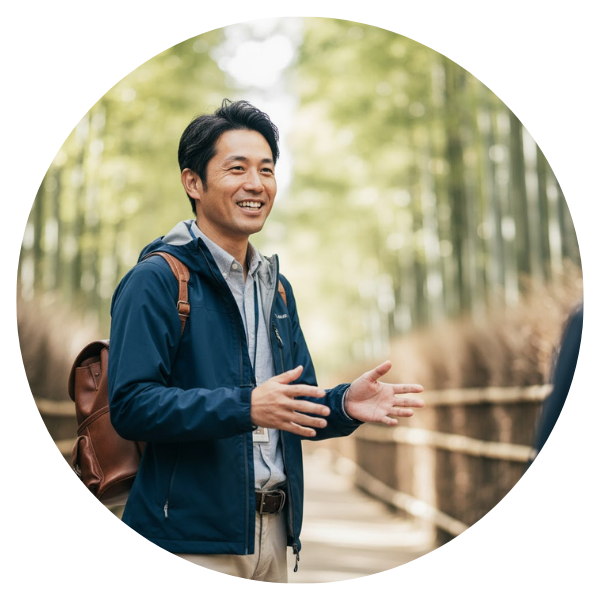
Hi, I’m Kai. I’m a Tokyo-based travel writer, tourism industry insider, and the author of a published guidebook for international visitors to Japan. With over 10 years of professional experience at a leading Japanese tourism company, my mission is to help you skip the tourist traps and navigate Japan’s best destinations like a local. I believe the perfect day trip is like a traditional kaiseki meal: a beautiful balance of precise planning and unforgettable seasonal discovery. When I’m not out conducting field research, you’ll usually find me drafting new itineraries with one of my favorite fountain pens!