
Narai-juku sits at roughly 940 m above sea level in the Kiso Valley, high enough that its cherry blossoms usually open later than Tokyo’s — often a week or more after the capital has already turned to green. For travelers who missed sakura in Tokyo or Kyoto, that makes this old post town a realistic “second chance” stop. But it is not a guaranteed Golden Week blossom spot. A few years ago, just before Golden Week, I brought overseas visitors who had missed Tokyo’s season out here — and they did catch blossoms along the street. In other years the trees finish earlier. The honest advice is to plan around current conditions rather than a fixed date, arrive early if you want quiet photos, and treat autumn as a strong backup if you want timing you can rely on.

If Narai-juku is part of a Matsumoto stay and you would rather combine it with Matsumoto Castle without managing the local transport yourself, a guided day trip covers both in one organized day. Check live availability, departure options, and recent traveler reviews for the Matsumoto Castle & Narai-juku day trip.
When Do Cherry Blossoms Bloom in Narai-juku?
The typical window is mid-to-late April, with some years stretching into early May. Because of the altitude, the season here consistently lags the lowlands: data for Nagano Prefecture puts local flowering an average of roughly two weeks behind Tokyo, and in cool springs the gap can stretch further. In practice, Narai-juku has been at or near its best around April 20–25 in recent years — for example, a local account recorded 2022’s peak around April 22. That said, no one can honestly give you a fixed “full bloom on this date” promise for a mountain valley where weather shifts quickly. In April 2025, for instance, snow fell across parts of the Kiso area mid-month, pushing some trees later than forecasters expected.

What this means for planning: if your Japan trip lands in the second half of April and you are already traveling toward Matsumoto or the Kiso Valley, Narai-juku is worth checking for late blossoms. If your dates are fixed in early April, you are probably too early — the town is a late option, not an early one.
Why Narai-juku Blooms Later Than Tokyo
The short answer is elevation. Narai-juku is one of the highest post towns on the Nakasendo at about 940 m, compared with roughly 25 m for central Tokyo or around 50 m for Kyoto. As a rule of thumb, air temperature drops about 0.6 °C for every 100 m of altitude, so the growing season here starts later and moves more slowly. Within the Kiso Valley you can watch this play out as a kind of blossom relay: Tsumago-juku sits around 430 m, Kiso-Fukushima around 750 m, and Narai-juku highest of all — which is why it tends to be the last of the three to reach its best.
Altitude explains the general pattern, but it does not let you predict a specific year. Mountain valleys are prone to “cold returns” — a late frost or snow can delay flowering well past the average, while a warm spring can pull everything forward. Treat the elevation as a reason to hope, not a reason to book.
Can You See Cherry Blossoms During Golden Week?
Possible, but not guaranteed. Golden Week (late April to early May) sits right at the edge of Narai-juku’s typical season, so you are essentially gambling on whether the year is running early, on time, or late.
- In a cool or average spring — blossoms can absolutely still be on the trees during Golden Week, especially around the first days of the holiday period. This is the scenario I saw with the visitors I brought up just before Golden Week a few years ago.
- In a warm spring — flowering can peak in mid-April and start falling before the holidays begin, leaving mostly green trees by early May.
My advice for Golden Week travelers: do not book Narai-juku only for sakura, but do keep it on your list as a possible late-blossom stop if your Kiso Valley itinerary already passes through the area. A few days before you go, check current conditions through the local tourist association or recent social media posts from the town, and adjust only if the trees are still showing. If the blossoms are gone, the town itself still holds up well — which leads to the next question.

Is Narai-juku a Good Place to See Cherry Blossoms?
It depends on what you expect. If you are picturing a dedicated cherry-blossom park with hundreds of trees — the kind of place people visit for the flowers — Narai-juku is not that. It is a preserved Edo-period post town with a roughly 1 km main street of wooden buildings, and the blossoms appear scattered along that setting: beside the old houses, along the Narai River, and in the gaps between the Lower Town (Shitamachi) and Middle Town (Nakamachi) sections. The appeal is the combination — old Japan plus seasonal color — not sheer volume of flowers.
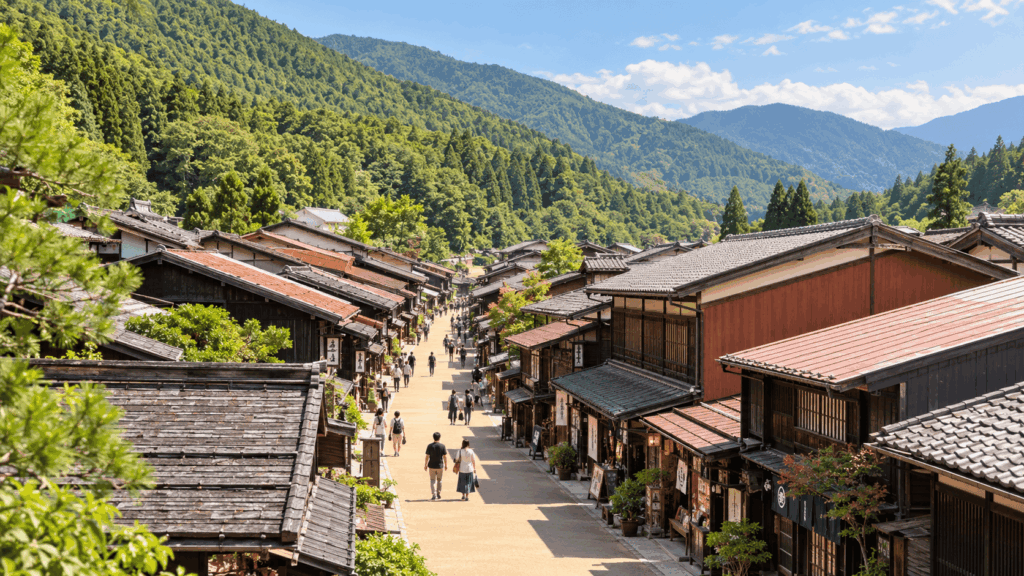
That framing matters because it changes who will enjoy it:
- Best for: travelers who missed sakura in the cities and want a photogenic post-town backdrop for late blossoms; anyone already visiting Matsumoto or the Kiso Valley who can fold Narai-juku into a half-day; photographers who prefer quiet streets over festival crowds.
- Skip it if: your single goal is to stand under a guaranteed full-bloom canopy (choose a dedicated sakura spot instead, and go in peak season); you are arriving in the late afternoon with no flexibility; or you are mainly after a lively shopping-and-dining street.
I position Narai-juku as a second-chance destination rather than a primary sakura sight: it rescued one blossom-less Tokyo trip for my guests, and it can do the same for yours — but the town is worth the detour even when the flowers are not cooperating. The street itself, with its deep eaves and mountain backdrop, is the real attraction; the sakura are a bonus that occasionally works in your favor.
What Time Should You Arrive to Avoid Crowds?
Narai-juku is a single main street, so “crowds” here means something milder than Kyoto’s famous lanes — but the difference between 9:00 and 11:00 is real. The street fills noticeably after about 10:00, when day-trippers arrive from Matsumoto and the first tour buses reach the parking lots. The trade-off is that most shops and cafes do not open until 9:30–10:00, so the emptiest hours are also the quietest commercially.
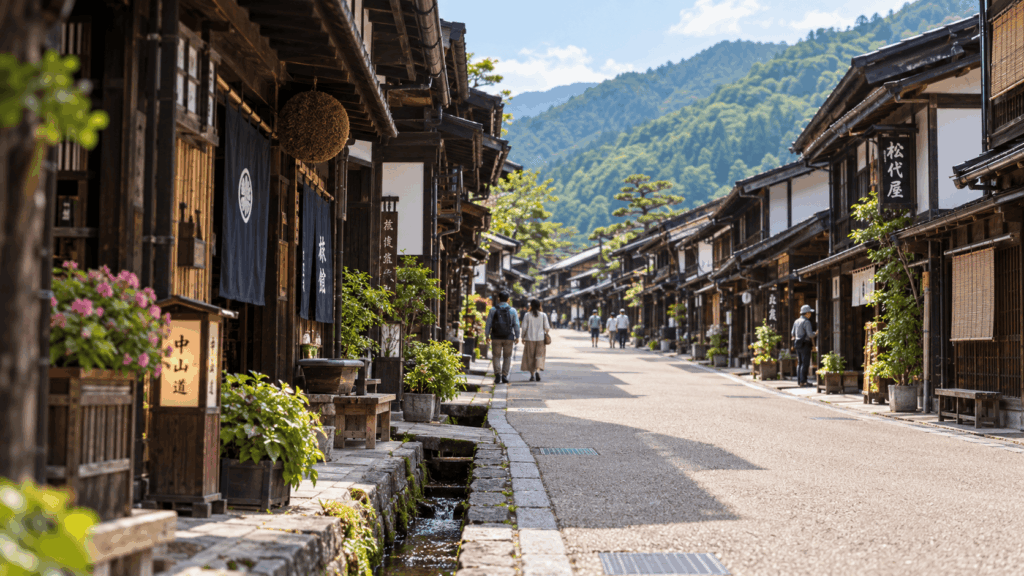
- Photo-first travelers: arrive between 8:00 and 9:00, photograph the street before the shops open, then catch a cafe as it opens around 10:00.
- Balanced visit (street + one cafe + a look in the shops): aim for a 9:30–10:00 arrival. The street is still manageable and businesses are just opening.
- Lunch-and-shopping focused: arrive from 10:00 onward, but do your main walk before the lunch rush; small eateries can develop queues around 11:30–13:00.
- Late afternoon (after 15:00): the street can get quiet again, but many shops and restaurants wind down by late afternoon, so this works best if you only want a short stroll, not a full visit.
Best Time for Empty-Street Photos
For near-empty shots of the Lower Town (Shitamachi) and Middle Town (Nakamachi), the 8:00–9:00 window is the most dependable (which is much easier if you are staying overnight in Narai-juku). Early visitors consistently report a very quiet street at that hour — one travel account described it as almost deserted at 7:00, with the first cafes still not open even by 10:00. You can go even earlier for a stronger sense of emptiness, but expect nothing to be open and, in cooler Aprils, a cold morning in the mountain valley.

Kai’s tip: If you only take one timing suggestion from this article, make it this: be on the street by 9:00. The light is still soft, the shops are about to open, and you beat the wave that arrives from around 10:00. On my visits, the difference between 9:00 and 11:00 has been the difference between a post town you can hear and one you mostly watch. A 9:00 arrival also lines up neatly with the tourist information center’s opening at 9:00 if you need a map or a luggage plan.
Best Time If You Want Cafes, Lunch and Shopping
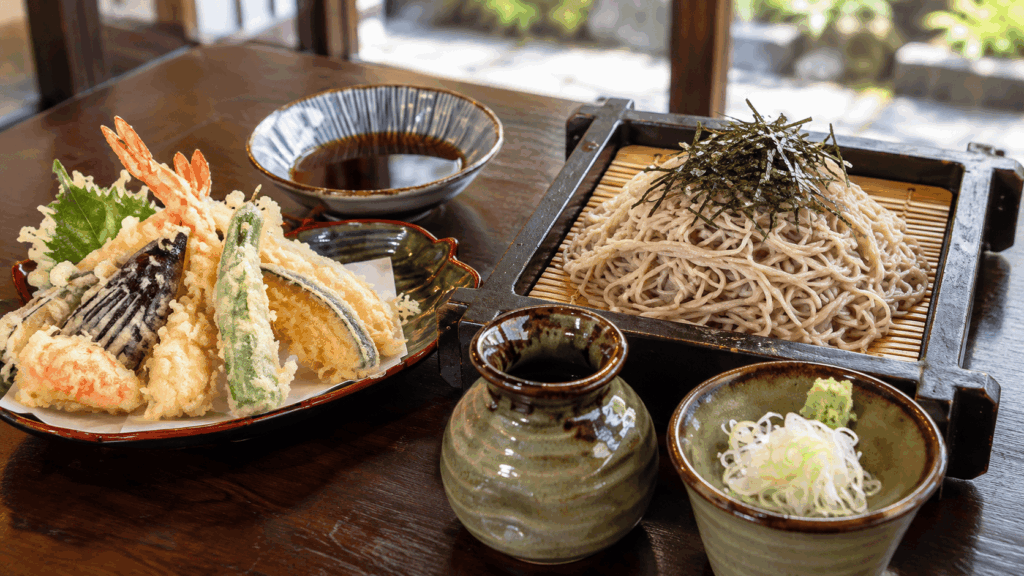
If eating is part of the appeal, do not arrive too early. Most cafes and shops open between 9:30 and 10:00, with opening times varying by individual business — a well-known local spot such as Kissaten Tanakaya, where you can try gohei-mochi (skewered rice cakes brushed with a miso glaze), is a good example of why you should check hours before you go: different sources list different opening times, and days off are irregular. The practical rhythm is to walk the street first, then settle into a cafe around 10:00–10:30, and eat lunch before the 11:30–13:00 window when the small restaurants get busy.
Arrival Time at a Glance
| Arrival time | Street atmosphere | Shops & cafes | Best for | Trade-off |
|---|---|---|---|---|
| 7:00–8:30 | Very quiet, almost empty | Almost all closed | Empty-street photography | Nothing open; cold mornings in April |
| 8:30–10:00 | Quiet and building slowly | Beginning to open from 9:30 | Photos plus an early cafe stop | Some shops still closed during your first pass |
| 10:00–12:00 | Busiest stretch of the day | Fully open | Lunch, shopping, full experience | Street fills up; eateries queue from about 11:30 |
| After 15:00 | Calmer again | Many begin closing by late afternoon | Short stroll, fewer people | Limited food and shopping choices |
Narai-juku in Spring vs Autumn: Which Is Better?
If you can choose your season freely, the honest answer is: autumn is the more reliable choice, spring is the more exciting gamble. The town is photogenic in both, but the two seasons reward different kinds of travelers.

| Spring | Autumn | |
|---|---|---|
| Main scenery | Late cherry blossoms scattered through the post town and along the Narai River | Mountain slopes turning red and gold above the wooden rooftops |
| Typical timing | Mid-to-late April, sometimes into early May; shifts noticeably year to year | Roughly mid-October to mid-November by local foliage guides |
| Best for | Travelers who missed sakura in Tokyo or Kyoto and are passing through Kiso anyway | Travelers who want color they can plan around without a daily blossom report |
| Main risk | Blossoms finish before you arrive; a warm spring can end the season by late April | Late November can already be bare and cold; weather can strip leaves early |
| Crowd consideration | Busiest around Golden Week and fine-weather weekends | Busy on peak foliage weekends, quieter midweek in October |
| Temperature & clothing | Cool mornings, mild middays; bring a layer | Crisp to cold, especially by November; the valley feels colder than Matsumoto |
| Who should choose it | Flexible planners who can check conditions and adjust a few days ahead | Travelers with fixed dates who prefer a wider reliable window |
Choose Spring If…
- You missed the main sakura season in Tokyo or Kyoto and want a realistic late-bloom second chance.
- Your trip already includes Matsumoto or the Kiso Valley in the second half of April.
- You are happy with a photogenic historic town even if the blossoms are past their best.
- You can check local conditions a few days before you go and adjust your plan.
Choose Autumn If…
- Color is your priority and you want a wider, more predictable window than sakura offers.
- Your dates fall between mid-October and mid-November.
- You are comfortable with cold mountain air and packing accordingly.
Kai’s tip: A warning from personal scouting: I walked the town in late November one year and found the trees almost bare, with a wind that felt like midwinter in Tokyo — atmospheric, but clearly past foliage season. If you read about autumn in Narai-juku and your visit is in the last week of November, lower your expectations for color and bring serious layers. The reliable foliage window really does sit earlier, around mid-October to mid-November.
How Long Should You Spend in Narai-juku?
-
- About 1–2 hours if you are mainly photographing the street and river and moving on.
- 2–3 hours if you add a cafe stop, a look inside a few shops, and a slow walk of the full 1 km street.
- 3–4 hours if you want lunch, a rest, and time to browse properly — the half-day length most local guides suggest.
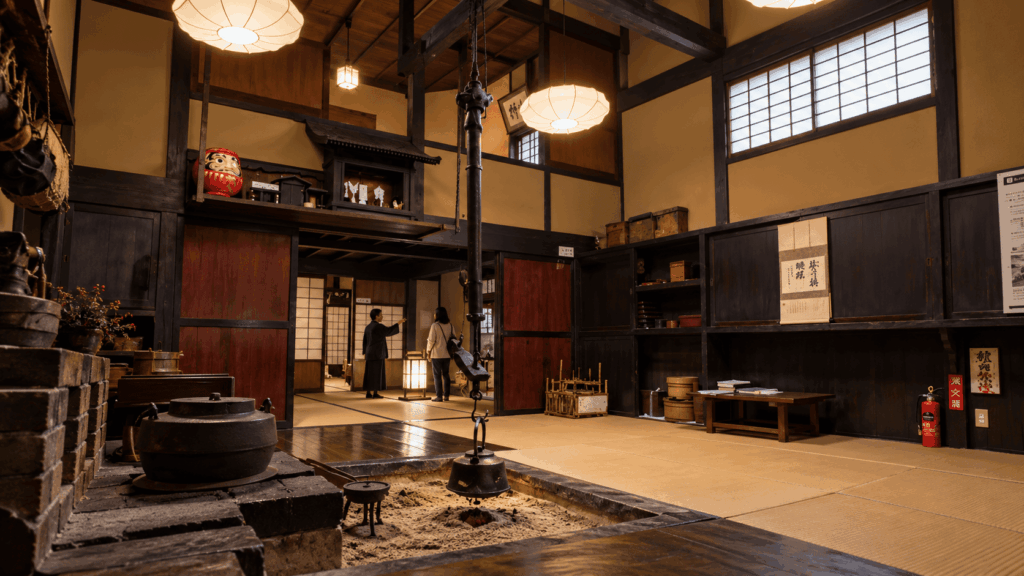
Because the town is one long street rather than a spread-out site, you never feel you are missing a “zone.” The main variable is how many shops and food stops pull you in (our guide on things to do in Narai-juku can help you plan the specifics). If you are arriving by local train, build in buffer time around the timetable: services on this stretch of the Chuo Line are limited, and checking departure times before you start walking will save you a rushed ending.
Train, Rental Car or Tour: What Works Best in Blossom Season?
All three work; the right answer depends on how you feel about timetables, parking, and early starts.
| Train | Rental car | Guided day trip | |
|---|---|---|---|
| Flexibility | Limited by timetable | Highest | Lowest |
| Early-morning arrival | Possible, but depends on the first train | Easiest if you drive | Usually not possible (tours start later) |
| Parking stress | None | Possible on weekends and holidays | None |
| Cost | Lowest if you already have a rail pass | Car rental + tolls + parking | Highest |
| Best for | Rail-pass users comfortable with local timetables | Travelers who want to set their own pace and shoot early | Matsumoto-based travelers who want a planned day out |
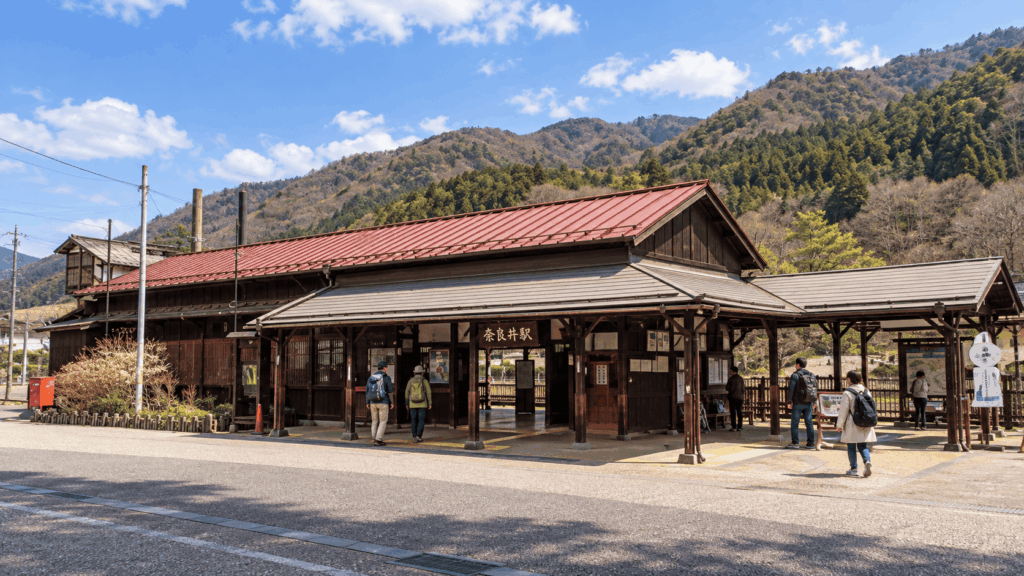
By train: Narai Station sits on the JR Chuo Line between Matsumoto and the Kiso Valley. The station is at the north end of the town, a short walk from the start of the preserved street. No parking worries, but check the timetable carefully — services are not frequent, and a missed connection can cost you an hour or two (our Narai Station guide covers timetables and luggage storage).
By rental car: Driving gives you the biggest advantage in blossom season: you can arrive before the tour groups. The Narai Gonbei parking areas near the south entrance cost around ¥500 per car; current official sources publish slightly different capacity totals for the two sections, so treat the number of spaces as approximate rather than planning around a fixed figure. There is also a small paid lot by Narai Station. On fine-weather weekends and during Golden Week, lots can fill, so an early arrival solves both the crowd problem and the parking problem at once.

Kai’s tip: On my first visit by car, I wasted time circling because I had assumed the parking would be obvious from the main road — it was not, and I ended up asking at the tourist information center by the station. Set your navigation for the Narai Gonbei parking lot rather than “Narai-juku” generally, and if the lot looks full, check for the smaller station-side lot before giving up. Confirming the lot location before you leave Matsumoto is five minutes that saves real frustration.
When a Guided Day Trip Makes Sense
A guided day trip that combines Matsumoto Castle and Narai-juku makes sense if you are based in Matsumoto without a car, you would rather not juggle local train times yourself, and you want the two sights in one organized day. Several operators offer this combination; check current listings on platforms such as GetYourGuide for departure points and durations, since details change.
It is a weaker fit if your priority is a quiet, early-morning Narai-juku shoot — most tours arrive mid-morning when the street is at its busiest — or if you are traveling on a tight budget and already have a rail pass. For those travelers, going by train on your own is both cheaper and more flexible.
If you fall into the first camp — you want Matsumoto Castle and Narai-juku in one day and prefer fewer transport decisions over an early-morning photo start — this guided option is the strongest fit.
Why I’d book this one
- Recent travelers consistently mention knowledgeable guides who add useful historical and cultural context at both stops.
- The transport between Matsumoto and Narai-juku is handled for you, reducing the need to plan around infrequent local train connections.
- The listing offers flexible booking conditions, so you can check the current cancellation and payment terms before committing.
A Simple Spring Visit Plan
This photo-first plan mirrors the timing advice above and works whether the blossoms are out or not:
- 8:30–9:00: arrive and walk the street from the Lower Town (Shitamachi) end while it is still quiet. This is your window for empty-street photos, with the sakura if they are holding.
- 9:00: if needed, stop at the Narai-juku Tourist Information Center near the station for a map and current blossom or foliage conditions.
- 9:00–10:00: continue through the Middle Town (Nakamachi) section toward the Narai River. The riverbank is where the blossoms and the mountain backdrop combine best.
- 10:00–10:30: settle into a cafe as the shops open.
- 11:00–12:00: browse the lacquerware and souvenir shops, then have lunch before the main rush — or head back to the station if you are on a train schedule.
One practical note: the wooden Kiso Ohashi Bridge over the Narai River is currently closed for major repair work expected to continue until the end of March 2027. Its deck is being replaced, with the new boards expected to be laid by the end of December 2026, and nighttime illumination is suspended during the project. If the bridge is part of your photo plan, treat the riverbank itself as the reliable viewpoint for now rather than planning to cross it.

FAQ
When do cherry blossoms bloom in Narai-juku?
Typically from mid-to-late April, with some years stretching into early May. Because the town sits at about 940 m, its season runs later than Tokyo or Kyoto — on average roughly two weeks behind the capital, sometimes more in cool springs. Recent years have placed the peak around April 20–25, but the exact dates shift every year, so check local conditions shortly before you go rather than planning around a fixed date.
Can you see cherry blossoms in Narai-juku during Golden Week?
It is possible but not guaranteed. Golden Week (late April to early May) falls right at the edge of the town’s typical season. In a cool or average spring, blossoms can still be on the trees; in a warm spring, they may peak in mid-April and fall before the holidays. Treat Narai-juku as a possible late-blossom stop if your route already passes through the Kiso area — not as a spot to book a trip around on the assumption of sakura.
What time should I arrive in Narai-juku to avoid crowds?
Arrive by 9:00 for quiet streets, or 8:00–8:30 if empty-street photos are your priority. The street fills noticeably from about 10:00 as day-trippers arrive from Matsumoto. The trade-off is that most shops and cafes only open between 9:30 and 10:00, so a 9:00 arrival gives you the best balance of quiet streets and businesses just starting to open.
Is spring or autumn better for visiting Narai-juku?
Autumn is the more reliable choice: local foliage guides point to roughly mid-October to mid-November, giving you a wider window to plan around. Spring offers the exciting possibility of late cherry blossoms — a realistic second chance if you missed sakura in Tokyo — but the timing is far less predictable. Choose spring if you are flexible and passing through anyway; choose autumn if color matters and you have fixed dates.
How many hours do you need in Narai-juku?
About 1–2 hours if you are mainly taking photos, 2–3 hours if you add a cafe and shopping, and 3–4 hours for a full visit with lunch. Because the town is one long street of about 1 km, the main variable is how many shops and food stops pull you in. If you are arriving by local train, build in buffer time around the timetable.
Final Verdict: Is Spring the Best Time to Visit Narai-juku?
For most travelers, the answer depends on what “best” means to you. If you missed sakura in Tokyo or Kyoto and you are already heading toward Matsumoto or the Kiso Valley, then yes — spring is an excellent time to visit, and the second-chance blossoms I have seen reward visitors here year after year in cool springs. If your dates are fixed over Golden Week and the blossoms are your only reason to come, treat the plan as a gamble and check conditions before you commit.
Choose spring if you are flexible, want a realistic late-sakura option, and will enjoy the historic town even if the flowers are past their peak. Arrive by 9:00, photograph the Lower Town and Middle Town while the street is quiet, then let the day fill in around you.
Choose autumn instead if you have fixed dates, want color you can plan around, and are visiting between mid-October and mid-November. The reliable foliage window makes autumn the safer seasonal bet — just do not push your trip to late November, when the trees are usually bare and the valley wind is cold.
For first-time visitors with a half-day to spare: Narai-juku works well as a calm counterpoint to Matsumoto Castle, and a 9:00 arrival gives you the quiet street, the river views, and a cafe stop without feeling rushed. For families, the flat, single-street layout is easy to manage, though food options are limited for picky eaters and the town is quieter than the big cities. For travelers on a tight schedule, a 1–2 hour photo stop from the station is realistic, but check the train times first. For repeat visitors, the most rewarding reason to return is the one that started this article — catching the season the crowds usually miss, whether that is late sakura in a cool spring or the first reds of October.
Whatever you decide, do not let the search for a perfect blossom date overshadow the town itself. Narai-juku is worth the detour with or without sakura — and on the years the timing works, it feels like a small piece of luck you planned for.

Hi, I’m Kai. I’m a Tokyo-based travel writer, tourism industry insider, and the author of a published guidebook for international visitors to Japan. With over 10 years of professional experience at a leading Japanese tourism company, my mission is to help you skip the tourist traps and navigate Japan’s best destinations like a local. I believe the perfect day trip is like a traditional kaiseki meal: a beautiful balance of precise planning and unforgettable seasonal discovery. When I’m not out conducting field research, you’ll usually find me drafting new itineraries with one of my favorite fountain pens!