
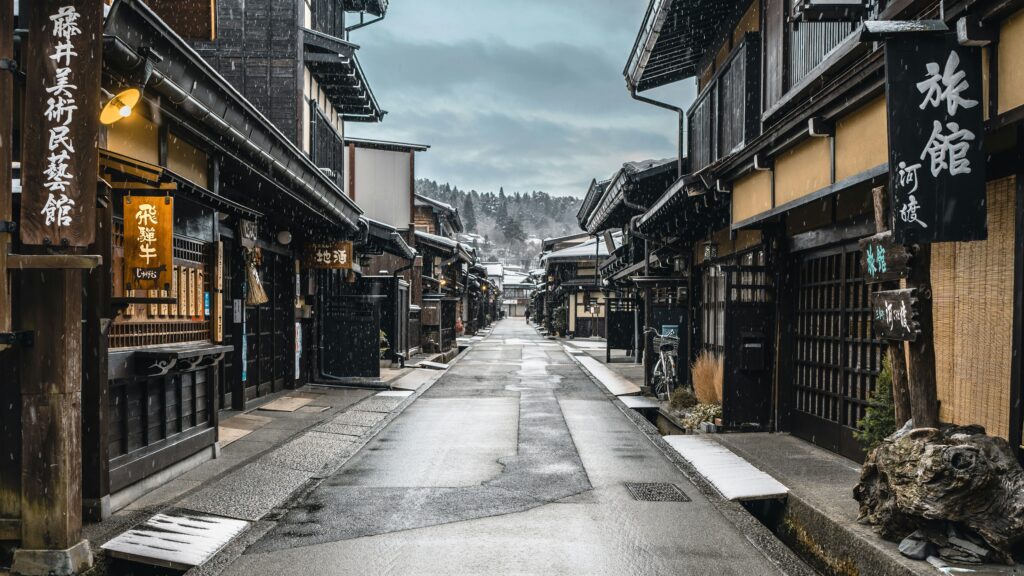
Quick Answer: When Is the Best Time to Visit Takayama?
For most travelers, the best time to visit Takayama is spring (mid-April to early May) for cherry blossoms and the Takayama Spring Festival, or autumn (mid-October to early November) for spectacular fall foliage and the Autumn Festival. These two windows deliver the city at its most atmospheric — but they also bring the biggest crowds and highest prices.
If your travel dates are flexible, here is the honest breakdown by traveler type:
- 🌸 Spring for cherry blossoms + festival: Mid-April is peak. Beautiful but crowded and expensive. Book accommodation 3–6 months ahead.
- 🍁 Autumn for fall foliage + festival: Mid-October to early November. Peak colors hit the city around early November, while higher elevations peak earlier (October). Also crowded during the Autumn Festival (Oct 9–10).
- 🌿 Late April or May (the “shoulder” sweet spot): Fewer crowds, pleasant weather, fresh greenery. Ideal if you missed the cherry blossoms.
- ☀️ Summer (July–August): Hot days but cool evenings. Fewer tourists. Great base for hiking in the Japan Alps (Kamikochi). Rainy season runs mid-June to mid-July.
- ❄️ Winter (December–February): Snowy, quiet, and cheapest. Magical if you want a traditional Japanese winter town scene. Some attractions have shorter hours.
If your dates are fixed and you want Takayama plus Shirakawa-go without juggling separate buses, it is worth checking live availability, start times, and recent traveler reviews for this guided day trip covering Takayama and Shirakawa-go before you lock in hotels or train times.
Takayama at a Glance: Seasonal Comparison
| Season | Main Highlights | Weather & Feel | Crowds | Accommodation Prices | Best For… |
|---|---|---|---|---|---|
| Spring (Mar–May) |
Cherry blossoms (peak: around mid-April), Takayama Spring Festival (Apr 14–15), fresh greenery | Cool to warm. 4–17°C (39–63°F) in April. Pleasant but can still be chilly in March. | High — especially during festival and cherry blossom peak | Peak season pricing. Book 3–6 months ahead. | First-time visitors who want the full “classic Japan” experience |
| Summer (Jun–Aug) |
Green season, hiking in Kamikochi & Japan Alps, fewer tourists | Warm to hot. 14–31°C (57–88°F). Rainy season mid-June to mid-July. Cooler evenings than Kyoto/Tokyo. | Low to moderate | Low season prices (except August Obon week) | Hikers and travelers who prioritize budget over seasonal scenery |
| Autumn (Sep–Nov) |
Fall foliage (city: peak early Nov; highlands: peak mid–late Oct), Takayama Autumn Festival (Oct 9–10) | Mild to cool. 9–20°C (48–68°F) in October. Crisp air, low rainfall, generally excellent weather. | High — especially around the Autumn Festival and foliage peak weekends | Peak season pricing for Oct. November is more moderate. | Photographers, foliage lovers, and anyone who wants the most comfortable weather |
| Winter (Dec–Feb) |
Snow-covered old town, quieter streets, onsen (hot spring) season, Shirakawa-go illuminations nearby | Cold and snowy. −4–4°C (25–39°F). Snowfall is frequent but the town is well-maintained. | Low (except New Year period) | Lowest prices of the year | Budget travelers, photographers wanting snowscapes, onsen enthusiasts |
Spring (March–May): Cherry Blossoms, Festival Crowds & the “Shoulder” Window
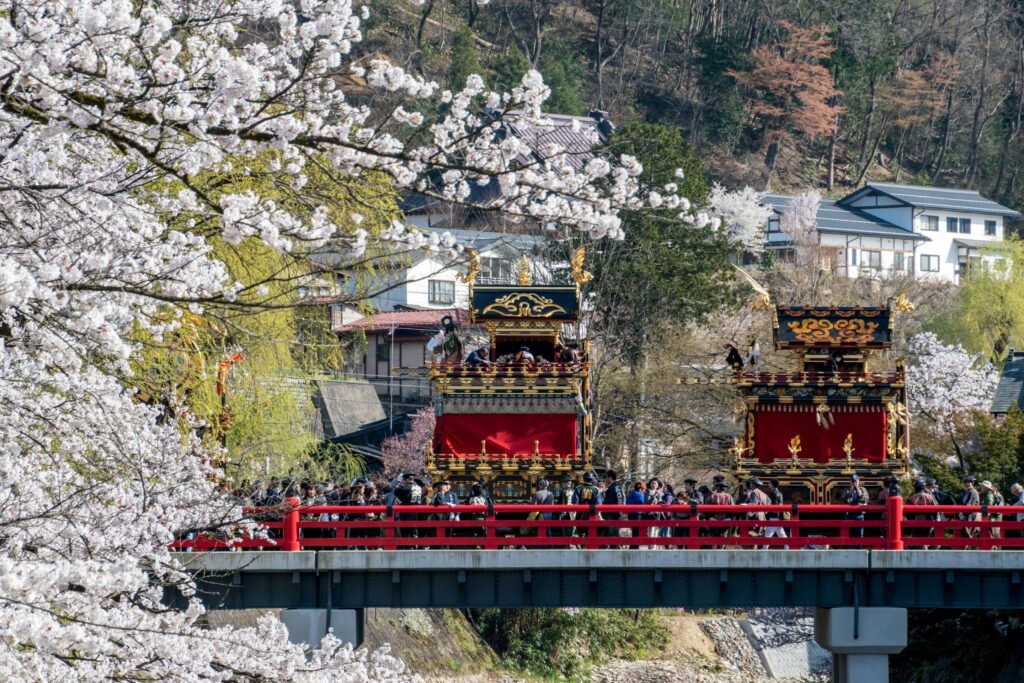
Spring is Takayama’s most popular season — and for good reason. The combination of cherry blossoms and the Takayama Spring Festival creates a window of intense beauty and, admittedly, intensity. But the season is wider than the two weeks everyone talks about.
Cherry Blossom Season in Takayama — Later Than Kyoto, Worth the Wait
Takayama sits at an elevation of around 570 meters (1,870 feet), which means its cherry blossoms bloom roughly one to two weeks later than in Tokyo or Kyoto. In an average year, the blossoms begin appearing in the last week of March and reach full bloom around the first to second week of April — typically peaking around April 10.
Best cherry blossom spots in Takayama:
- Shiroyama Park (城山公園): A hilltop park south of the Sanmachi Suji district with walking trails lined with cherry trees and views over the city. Good for a casual hanami (picnic under the blossoms).
- Miyagawa Riverbank: The main river running through the heart of the old town is lined with cherry trees. Cross any of the pedestrian bridges for photo-worthy views framed by the water.
- Enakawa Riverbank: The smaller eastern canal near the Higashiyama Walking Course. Less crowded than the Miyagawa area.
Kai’s tip: The most common mistake I see travelers make is planning Takayama cherry blossoms around Kyoto’s forecast. By the time Kyoto’s petals have fallen (early April), Takayama’s are just reaching their peak. If you’re doing a Golden Route trip (Tokyo → Kyoto → Takayama), reverse the order — or at least check the Takayama-specific forecast before locking your dates. The Japan Weather Association’s sakura forecast (usually published in early March) gives separate predictions for Gifu Prefecture, and they’re worth waiting for before booking non-refundable hotels.
The Takayama Spring Festival (April 14–15): What You Need to Know
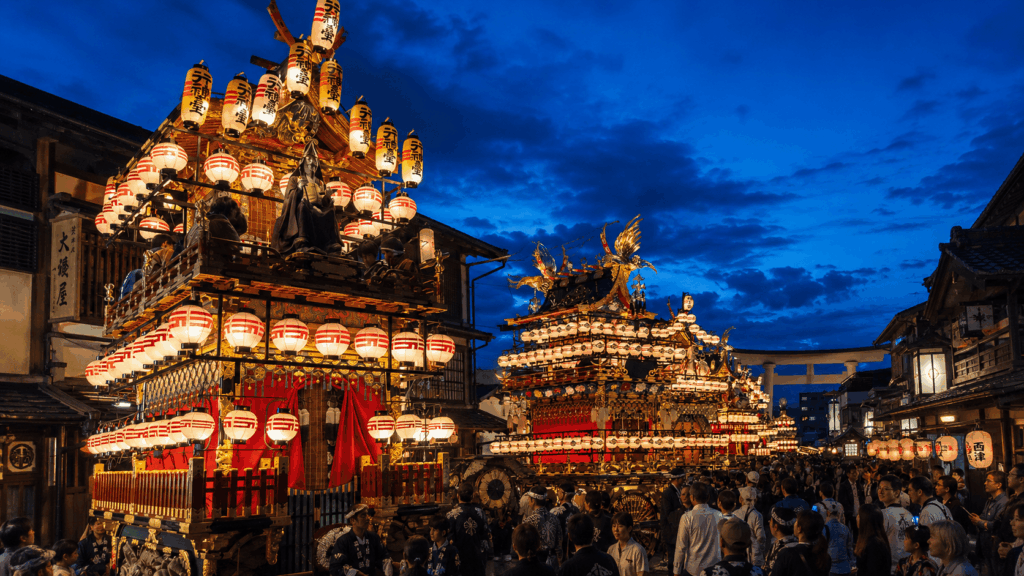
The Takayama Spring Festival (Sanno Matsuri / 山王祭) is the annual festival of Hie Shrine, held every April 14–15. It is considered one of Japan’s three most beautiful festivals alongside Kyoto’s Gion Matsuri and the Chichibu Yomatsuri. Twelve lavishly decorated festival floats (yatai) — designated Important Tangible Folk Cultural Properties — are paraded through the old town, accompanied by participants in samurai costume and traditional music.
The reality of visiting during the festival:
- Approximately 200,000 people attend each spring festival. The old town becomes shoulder-to-shoulder crowded, especially near the float parade routes.
- Hotels in Takayama are booked out months — sometimes 6 months — in advance. Prices can double or triple compared to a regular April night. If you haven’t booked by January, your options inside Takayama will be very limited.
- The nearest alternative bases are Furukawa (15 minutes by train), Gero Onsen (1 hour), or even Nagoya (2.5 hours away).
- In case of rain, the entire spring festival may be canceled (the floats are centuries-old cultural properties that cannot get wet). There is no rain date.
Kai’s tip: Here is the honest advice I give friends planning around the Takayama Festival: treat the festival day as a “viewing day,” not a “sleeping-in-Takayama day.” The accommodation reality is brutal — most decent hotels and ryokan are booked solid 4–6 months out, and prices for what remains are hard to justify. A very workable alternative is to book a hotel in Nagoya, take the first Limited Express Hida train (around 6:00 AM, arrives Takayama by 8:30 AM), enjoy the festival, and return on the last train. You lose the evening lantern parade if you do this, but for many travelers, it is the difference between attending and not attending at all.
Should You Visit in Late April or May?
If you want spring weather without the festival crowds, the window from April 20 to early May is excellent. The cherry blossoms have fallen, but the fresh green leaves on the trees give the old town a different kind of beauty. Temperatures are warm but not hot (17–22°C / 63–72°F), and the crowds drop significantly after the festival ends. This is what many frequent Japan travelers call the “spring shoulder season” — and it is genuinely one of the most comfortable times to walk Sanmachi Suji without elbowing through a crowd.
Spring — Best For / Not Ideal For
Choose spring if: You want to see cherry blossoms in a beautiful mountain town setting, you are willing to plan 3–6 months ahead for accommodation, and you do not mind significant crowds (especially April 14–15).
Skip spring if: You dislike crowds, you prefer to travel spontaneously without booking far in advance, or your budget is tight (April is the most expensive month for accommodation in Takayama).
Summer (June–August): Green Season, Fewer Crowds & the Rainy Season Reality
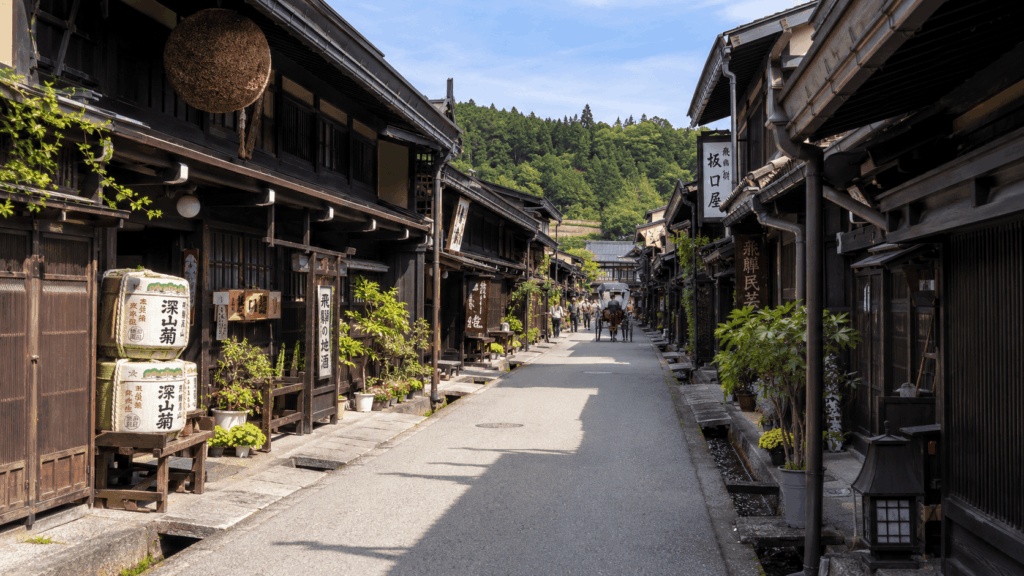
Summer in Takayama is a quieter proposition. The crowds thin out, prices drop, and the surrounding mountains turn a deep, vibrant green. But there is a reason summer is the low season — and it starts with the rainy season.
Tsuyu (Rainy Season) — Can You Still Enjoy Takayama?
Japan’s rainy season (tsuyu) typically hits central Honshu from mid-June to mid-July. In Takayama, this means more overcast days and occasional steady rain — but it does not rain every day. What surprises most visitors is that even during tsuyu, there are clear, sunny days interspersed between the rain fronts.
What to expect: Humidity is lower in Takayama than in Kyoto or Tokyo thanks to the elevation. A light rain jacket or compact umbrella is enough. The old town’s covered walkways and eaves in Sanmachi Suji provide decent shelter, and indoor attractions like the Takayama Jinya (historic government house) and the Yatai Kaikan (Festival Floats Exhibition Hall) are good rainy-day options.
July & August — Hot Days, Cool Evenings, Alpine Escape
July and August are genuinely hot in Takayama — daytime highs reach 29–31°C (84–88°F) — but unlike the big cities, the evenings cool down significantly. By 7:00 PM, it is common for temperatures to drop 8–10°C (15–18°F), making evening walks along the Miyagawa River genuinely pleasant.
The real draw of summer in Takayama, however, is what lies above it. Takayama is the gateway to the Japan Alps, and summer is the season when these high-altitude destinations are fully accessible:
- Kamikochi (上高地): Open from late April to mid-November. Summer offers lush alpine scenery, excellent hiking trails, and temperatures 8–10°C cooler than Takayama. A popular day trip from Takayama (bus: about 1.5 hours each way).
- Shinhotaka Ropeway (新穂高ロープウェイ): Japan’s only two-story cable car runs year-round, but summer offers clear views of the Hotaka mountain range.
Summer — Best For / Not Ideal For
Choose summer if: You want to avoid crowds, you are on a budget, you plan to combine Takayama with hiking in Kamikochi or the Japan Alps, or you are traveling with children during school holidays.
Skip summer if: Your main goal is seasonal scenery (cherry blossoms or autumn leaves), you dislike humidity and rain (especially June–mid-July), or you prefer crisp, cool weather for walking.
Autumn (September–November): Fall Foliage, the Autumn Festival & the Altitude Trick
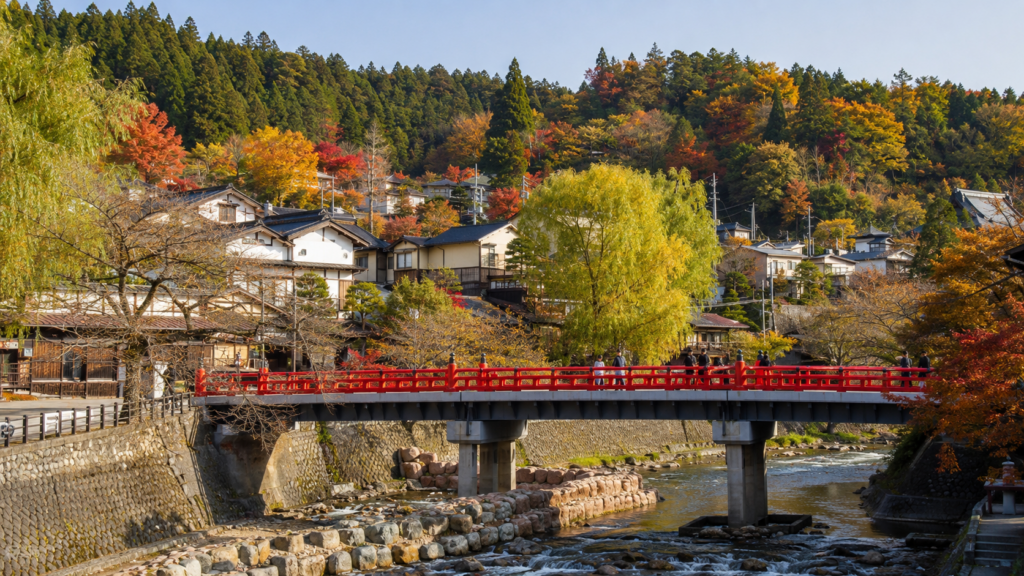
Autumn is Takayama’s second peak season — and for many visitors who have experienced both, it actually surpasses spring. The combination of brilliant fall colors, comfortable weather, and the atmospheric Autumn Festival makes this a genuinely spectacular time to visit. But autumn in Takayama has a secret that most guides skip: the foliage peaks at different times depending on elevation, and with the right plan, you can catch two separate peaks in one trip.
Takayama Autumn Foliage — The Altitude Trick Most Guides Don’t Tell You
Takayama’s elevation (570 meters) and its proximity to much higher terrain (2,000–3,000 meters in the Japan Alps) means that autumn colors arrive at different times across the region. If you time your visit well, you can experience peak foliage at two different elevations during a single stay.
How it works:
- High elevation (1,500–2,500m): Peak colors around early to mid-October. This includes Kamikochi (mid-to-late October), Shinhotaka Ropeway (mid-October), and Norikura Kogen (early to mid-October).
- Takayama city (570m): Colors begin in late October, reach their peak around early to mid-November (typically around November 1 in an average year), and linger into mid-November.
- Lower valleys: Some spots further south reach peak in late November.
Kai’s tip: Here is a planning technique that catches most first-time visitors off guard — and it works beautifully if your dates are flexible. If you visit Takayama in the second half of October, you can catch the tail end of Kamikochi’s peak foliage (day 1) and then, a week later, walk into Takayama city’s autumn colors as they reach their prime (days 2–3). The same trip, two different autumn peaks, about 30 kilometers apart. Most guidebooks treat “Takayama autumn” as one event — but when you are on the ground, the difference between October 15 at Shinhotaka and November 1 at Shiroyama Park is striking. If you only have one day, aim for the city’s Higashiyama Walking Course in early November — it concentrates more color variety in a compact 3.5 km loop than almost anywhere else in town.
Best Fall Foliage Spots in and Around Takayama
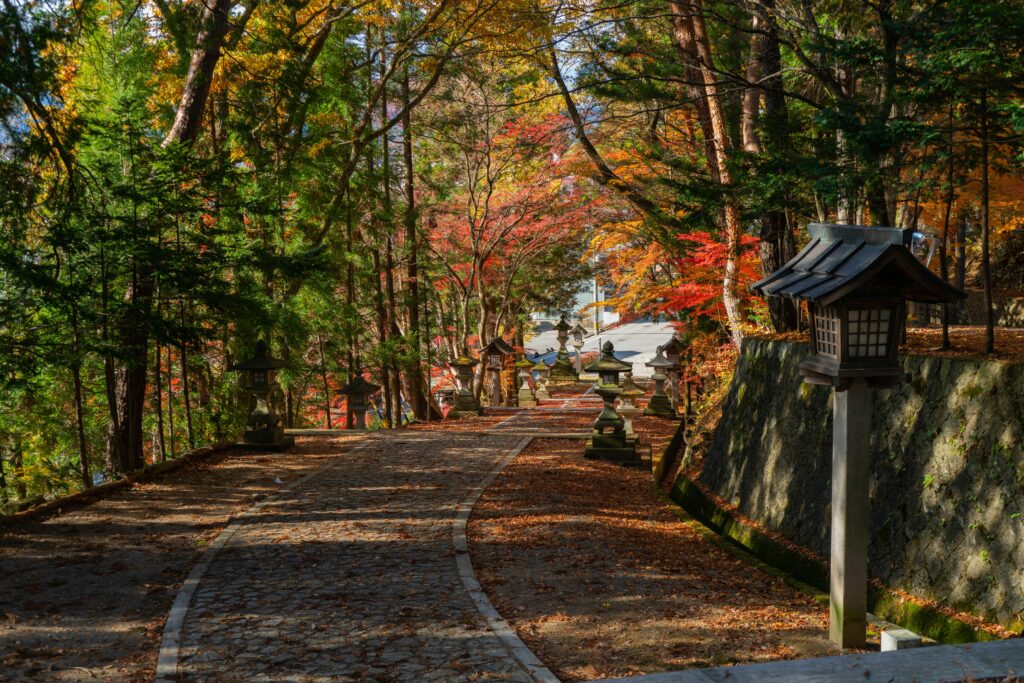
In the city (mid-October to mid-November):
- Shiroyama Park (城山公園): The same hilltop park that is beautiful for cherry blossoms transforms into a tapestry of red and gold maples in autumn. The walking trails are short but layered with color.
- Higashiyama Walking Course (東山歩道): A 3.5 km walking route that passes through a dozen temples, shrines, and wooded sections. The combination of vermilion temple gates and autumn leaves makes this one of the most photogenic walks in Takayama. Allow 1–1.5 hours at a leisurely pace.
- Hie Shrine (日枝神社): The shrine grounds of the Spring Festival’s host shrine are planted with maple trees that turn a deep crimson. Quiet and less crowded than the main walking course.
- Hida Kokubun-ji (飛騨国分寺): The ancient pagoda and the enormous ginkgo tree on the temple grounds turn a brilliant golden yellow. The contrast with the wooden temple architecture is classic Japan.
- Hida Folk Village (飛騨の里 / Hida no Sato): An open-air museum of traditional thatched-roof farmhouses on a hillside. The autumn colors frame the houses beautifully, and the hilltop offers views over the entire Takayama basin. About a 15-minute walk from Takayama Station.
Outside the city (mid-October peak):
- Kamikochi (上高地): Approximately 1.5 hours by bus from Takayama. Peak autumn color typically arrives in mid-to-late October. The contrast between the golden larch trees and the deep green of the mountain pines, set against the Hotaka mountain range, is extraordinary. Note that the Kamikochi access road closes for the season in mid-November.
- Shinhotaka Ropeway (新穂高ロープウェイ): The cable car ascent from 1,100m to 2,156m gives you elevated views of autumn color spreading across the valley. Mid-October is the prime window.
- Norikura Kogen (乗鞍高原): One of the earliest foliage spots in the region (early to mid-October). Accessible by bus or car from Takayama.
The Takayama Autumn Festival (October 9–10): What’s Different from Spring
The Takayama Autumn Festival (Hachiman Matsuri / 八幡祭) is the annual festival of Sakurayama Hachimangu Shrine, held every October 9–10. Like the spring festival, it features elaborate yatai floats — but the autumn festival has its own distinct character.
- 11 ornate floats, some with mechanical puppets (karakuri ningyo) that perform traditional movements during the parade.
- The evening event (宵祭 / yoi matsuri) on October 9 is famous: the floats are lit with lanterns and paraded through the old town after dark. This is widely considered the more photogenic of the two evening festivals.
- Attendance is also around 200,000 people over the two days.
- Rain policy differs from spring: The autumn festival is generally held in light rain, but the evening lantern parade may be canceled or shortened in wet weather.
- Accommodation situation is similar to spring: prices are high, availability is tight from 3–6 months out.
Key difference from spring: Because the Autumn Festival falls in October — still prime foliage season — you get the double bonus of festival floats framed by autumn leaves. This makes the October dates the single most photographed window of the year in Takayama.
Should You Visit in Late October or November?
The period from late October through mid-November is a fantastic window if you want autumn colors without the festival crowds. By October 11, the crowds dissipate sharply. The foliage in the city approaches peak in early November, meaning you can enjoy the Higashiyama Walking Course, Hida no Sato, and Shiroyama Park with significantly fewer people. Accommodation prices also drop to shoulder-season levels in November.
Autumn — Best For / Not Ideal For
Choose autumn if: Fall foliage is your priority, you want the most comfortable walking weather of the year (cool, crisp, low humidity), or you are a photographer seeking both festival and foliage shots.
Skip autumn if: You are on a tight budget (October is peak pricing), you dislike crowds (especially October 9–10), or your schedule forces you to come in September — which is still green and can be affected by typhoon season.
Winter (December–February): Snow, Silence & the Logistics Reality Check
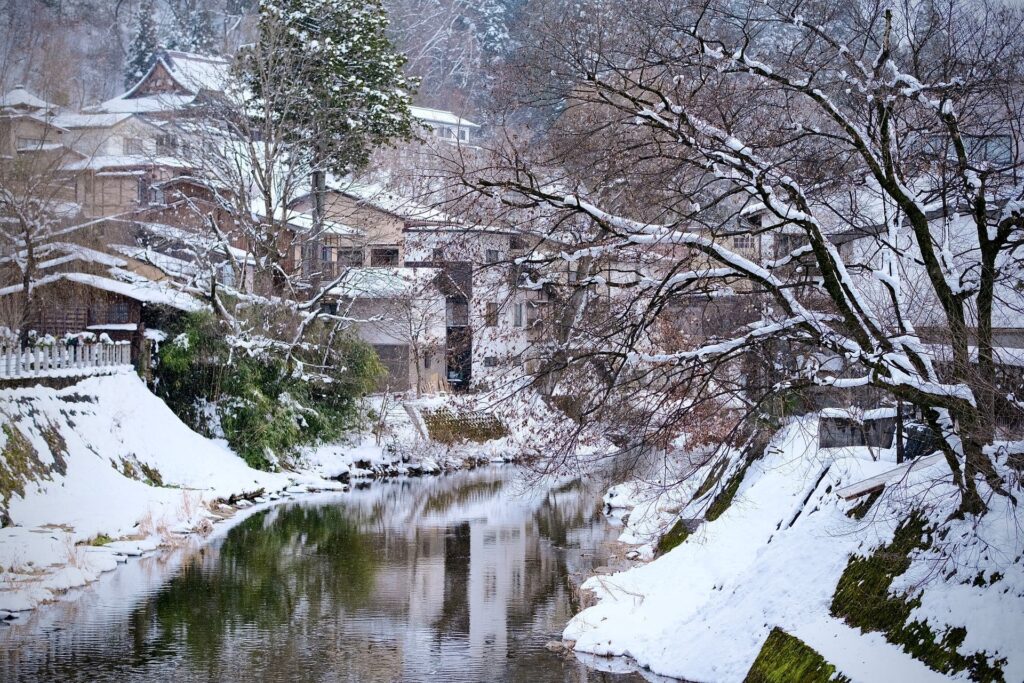
Winter in Takayama is a different world. The old town’s wooden machiya houses are dusted with snow, the crowds vanish, and the mornings are so quiet you can hear the snow melting off the rooftops. It is also the season that demands the most planning — and the most honesty about what you are signing up for. If you want to know what to expect, check out our full guide to Takayama in winter.
Takayama in Winter — Magical Snowscapes, But Plan Accordingly
The main appeal of a winter visit is the atmosphere. Sanmachi Suji under a light snowfall in December is the postcard image of rural Japan that many travelers dream of. The Hida Folk Village is particularly beautiful in the snow, and the nearby Shirakawa-go region is famous for its winter illuminations (typically held on select weekends in January and February — check the official schedule as dates change yearly).
What changes in winter:
- The Miyagawa Morning Market opens one hour later — from around 8:00 AM instead of 7:00 AM (December through March). This matters much more than it sounds like it should.
- The Takayama Jinya closes at 4:30 PM instead of 5:00 PM (November–February).
- Some shops and restaurants in the old town may close earlier or open later, particularly on weekdays in January and February.
- Snowfall is common from December through February, but the city is well-equipped — walkways are heated or cleared, and snow rarely accumulates to disruptive levels within the town center.
Kai’s tip: If you are visiting Takayama as a day trip in winter, the morning market’s later opening time creates a problem that seems trivial until you arrive. The first Limited Express Hida from Nagoya arrives around 8:30 AM. If your plan is “arrive, visit the morning market, then see the old town,” you will find that the market is just setting up — you have 30–45 minutes of standing around before things get interesting. My advice: either take an earlier train (there is one arriving around 8:00 AM) and bring a warm drink to wait, or rearrange your itinerary so that you start at the Takayama Jinya (opens at 8:45 AM) and loop back to the market around 9:30 AM when it is fully active.
Winter Transportation — What First-Time Visitors Should Know
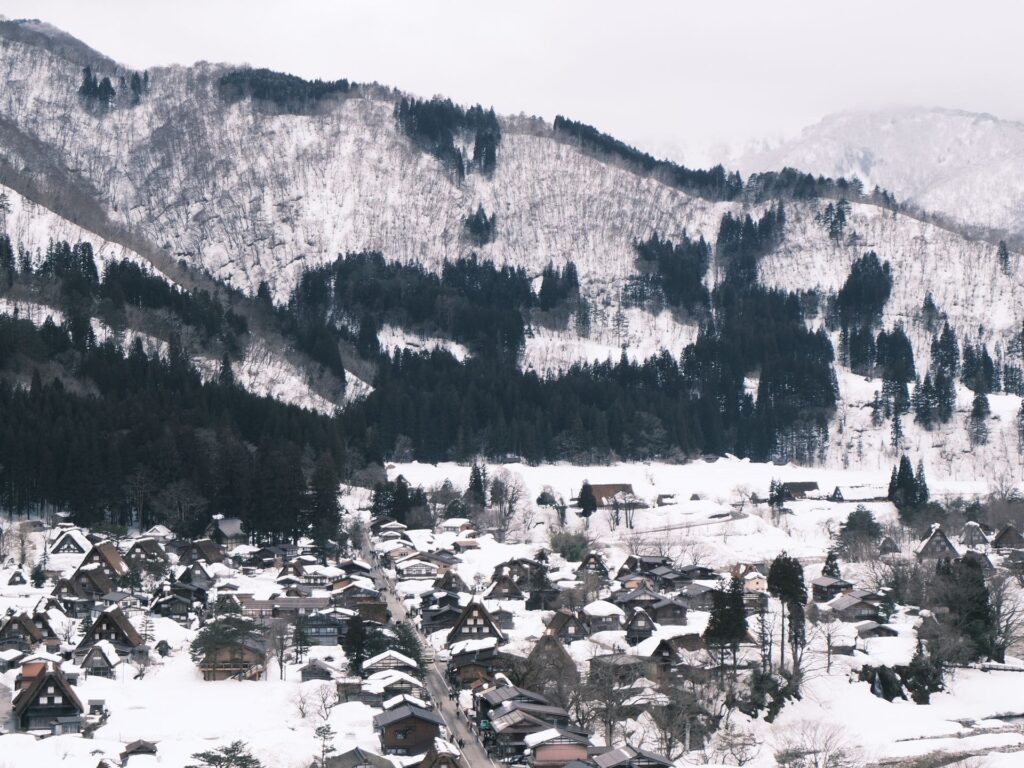
- The Limited Express Hida continues to run year-round and is generally reliable in winter. However, heavy snow can cause delays of 30–60 minutes. The 2.5-hour journey from Nagoya can stretch to 3 hours. For more details on routes from other major cities, read our guide on how to get to Takayama.
- If you are driving: winter tires are mandatory around Takayama and essential if you plan to visit Shirakawa-go, where the roads are mountainous and snow-covered.
- Bus services to Kamikochi and Norikura Kogen are suspended from November to April (snow closure of alpine roads). Shinhotaka Ropeway remains accessible by car or bus, but check road conditions before departing.
- Takayama Station has coin lockers, but in winter you will likely be carrying more layers and gear. The station’s locker stock is limited (especially larger sizes), so arriving early helps.
Winter — Best For / Not Ideal For
Choose winter if: You want the lowest prices of the year, you love snow and winter atmosphere, you are visiting specifically for Shirakawa-go’s winter illuminations, or you prefer exploring urban attractions without crowds.
Skip winter if: You dislike cold weather (temperatures drop below freezing every night), you want to hike or visit high-altitude destinations, you are traveling on a tight schedule with no buffer for potential train delays, or your main interest is seasonal scenery like cherry blossoms or autumn leaves.
Day Trip from Nagoya or Kanazawa? Seasonal Timing Tips
Many travelers visit Takayama as a day trip from Nagoya (2.5 hours by Limited Express Hida) or Kanazawa (2 hours by bus). The viability of a day trip varies significantly by season.
| Season | Day Trip Verdict | Key Concern |
|---|---|---|
| Spring (Apr–May) | ✅ Feasible, but crowded | 6–7 hours on the ground. Enough time for the morning market, Sanmachi Suji, and one attraction (Jinya or Hida no Sato). The festival days (Apr 14–15) are extremely crowded but still doable if you arrive early. |
| Summer (Jun–Aug) | ✅ Feasible | Long daylight hours (sunset after 7:00 PM). Good for a relaxed pace, including lunch and an afternoon walk. Rainy season days can reduce walking comfort. |
| Autumn (Oct–Nov) | ✅ Feasible, but short days from November | October offers excellent weather and daylight until 5:30 PM. By November, sunset is before 5:00 PM, so plan your route to prioritize outdoor sights before dark. |
| Winter (Dec–Feb) | ⚠️ Feasible with planning | Sunset before 5:00 PM. The morning market opens later (8:00 AM). If you arrive at 8:30 AM and leave at 5:00 PM, you lose about 1–1.5 hours to the adjusted market timing and early sunset. Still doable — but you will need a tighter itinerary than in summer. |
If you fall into that camp — you want Takayama’s old town and Shirakawa-go in one day, but you do not want to spend the trip managing bus times — this is the booking worth checking first.
Why I’d book this one
- It solves the biggest day-trip problem: the tour combines Takayama, Takayama Jinya, the old town, and Shirakawa-go with transport handled for you.
- Recent travelers consistently mention the guide and organization: reviews often point to knowledgeable English-speaking guides, smooth transport, and useful cultural context rather than just a basic bus transfer.
- It keeps your plans flexible: the listing offers free cancellation and reserve-now-pay-later options, which helps when weather or festival-season accommodation plans are still moving.
See live availability, start times, and recent traveler reviews for the guided Takayama and Shirakawa-go day trip before finalising your route.
FAQ
Is Takayama worth visiting for just one day?
Yes — but only if your main goal is to see the old town (Sanmachi Suji), the morning market, and one or two major sights like Takayama Jinya or Hida Folk Village. A day trip from Nagoya gives you about 6–7 hours on the ground, which is enough for a focused visit. What you miss is the evening atmosphere (shops close around 5:00 PM) and the chance to visit higher-altitude spots like Kamikochi, which requires a full day on its own. If your schedule allows, one night is better for pacing. Two nights is ideal if you want to include a side trip to Shirakawa-go or Kamikochi. To map out your days, take a look at our detailed Takayama itinerary planner.
Can I see both the Takayama Spring Festival and the cherry blossoms at the same time?
In most years, yes — but the overlap window is narrow. The Takayama Spring Festival is fixed on April 14–15 every year, while the cherry blossom peak in Takayama typically falls around April 10–14 in an average year. This means the festival usually coincides with the end of full bloom or the beginning of the petal-fall (sakurafubuki) stage. You will likely see blossoms on the trees, possibly with petals scattering in the wind — which many photographers consider even more beautiful than the peak. Just be aware that a week of warm rain can push the bloom earlier, causing the petals to fall before the festival arrives. There is no guarantee.
Does it rain a lot in Takayama?
Takayama receives moderate rainfall year-round, but it is not as consistently wet as coastal cities like Kanazawa or Tokyo. The rainy season (tsuyu) runs from mid-June to mid-July, bringing higher humidity and more frequent rain. September can also bring rain from approaching typhoons. The driest and most comfortable months are October, November, April, and May — each averaging 8–12 rainy days per month, but with long stretches of clear weather between rain fronts. Pack a compact umbrella or light rain jacket regardless of season.
Is Takayama too cold in winter?
It depends on your tolerance. Daytime highs in January and February hover around 3–4°C (37–39°F), and nighttime temperatures drop below freezing (−4°C / 25°F is common). If you come from a warm climate, this will feel cold — but it is manageable with proper layering (thermal underwear, a mid-layer, a warm jacket, gloves, and a hat). The snow adds to the scenery, and the cold is dry rather than damp, which makes it feel less penetrating than coastal winter cold. The streets are well-cleared, and indoor spaces (restaurants, museums, ryokan) are heated. If you plan to spend the day mostly walking outdoors, dress for it and you will be fine. If you dislike cold weather and want to spend time outside without bundling up, winter is not for you.
Can I visit Shirakawa-go from Takayama in winter?
Yes — the bus service between Takayama and Shirakawa-go operates year-round. However, winter conditions can affect the schedule. The journey takes about 50–60 minutes by highway bus, but heavy snow can extend this. The Shirakawa-go winter illuminations (typically held on select January and February weekends) are very popular — tickets are limited and require advance booking. For a complete guide to maximizing your visit, see our step-by-step Shirakawago itinerary. If you are visiting Shirakawa-go in winter, check the official Shirakawa-go bus reservation website (buses require reservations year-round, but they are especially tight during winter illumination dates). Winter tires are mandatory if driving.
How far in advance should I book accommodation for the Takayama Festival?
For either the Spring Festival (April 14–15) or the Autumn Festival (October 9–10), book at least 3–6 months in advance. The most popular ryokan and mid-range hotels in the old town area can sell out 4–5 months ahead. If you are booking less than 3 months before the festival, your choices will be limited to higher-end properties with very high prices, or hotels outside the city center (Furukawa, Gero Onsen, or even Nagoya). For a regular April or October visit (outside festival dates), booking 1–2 months in advance is usually sufficient — but weekends during foliage season can also fill up.
Final Verdict: Which Season Is Right for You?
Takayama rewards different travelers in different seasons. There is no single “best” month — only the right fit for your priorities, tolerance for crowds, and budget. Here is my honest take by traveler type:
First-time visitors to Japan who want the classic “old Japan” experience: Choose mid-April to early May (spring) or mid-October to early November (autumn). Yes, the crowds are real and the prices are high — but the combination of seasonal beauty (cherry blossoms or fall leaves) and the old town’s atmosphere is unmatched. If you can only come once, this is the window to aim for. Just book everything early.
Travelers on a budget or who dislike crowds: Choose late April to May (spring shoulder), late October to November (autumn shoulder), or winter (December–February). You sacrifice peak seasonal scenery in winter, but you gain peace, quiet, and the lowest prices of the year. November gives you a strong chance of fall colors still lingering with far fewer people than October.
Hikers and outdoor enthusiasts: Choose July–August (summer). Takayama is the gateway to Kamikochi, the Japan Alps, and the Shinhotaka Ropeway — all of which are fully accessible only from late April to mid-November. Summer offers the longest daylight hours, unrestricted trail access, and the cool high-altitude air that makes alpine hiking comfortable.
Families with children: Choose May or October. The weather is mild and comfortable, the crowds are manageable (avoiding the festival dates in October), and the attractions (Hida Folk Village, the riverside parks, Takayama Jinya) are stroller-friendly. Summer is also feasible if you can handle heat — the Higashiyama Walking Course is shaded and manageable for kids.
Photographers (landscape and architecture): Choose mid-October to early November (autumn) for foliage, or December–January (winter) for snow scenes. The Golden Route (Sanmachi Suji) in fresh snow, early in the morning before foot traffic, is one of the most photogenic urban scenes in Japan. For festival photography, the Autumn Festival’s lantern-lit evening parade (October 9) is the standout event.
Repeat visitors to Japan who have seen the “big three” (Kyoto, Tokyo, Hiroshima): Consider winter or summer. You already know what Japan looks like in peak seasons. Takayama in quiet seasons reveals a different character — local life is slower, ryokan hosts have more time to talk, and you experience the town as it lives, not as it performs for tourists.

Hi, I’m Kai. I’m a Tokyo-based travel writer, tourism industry insider, and the author of a published guidebook for international visitors to Japan. With over 10 years of professional experience at a leading Japanese tourism company, my mission is to help you skip the tourist traps and navigate Japan’s best destinations like a local. I believe the perfect day trip is like a traditional kaiseki meal: a beautiful balance of precise planning and unforgettable seasonal discovery. When I’m not out conducting field research, you’ll usually find me drafting new itineraries with one of my favorite fountain pens!