
Is Takayama Dead at Night? (The Honest Answer)
If you’ve been scrolling through travel forums ahead of a trip to Takayama, you’ve probably seen the same question pop up more than once: “Is there anything to do in Takayama at night?” The short answer is yes — but not in the way most travelers expect. And that distinction is exactly what makes an evening here worth planning for.
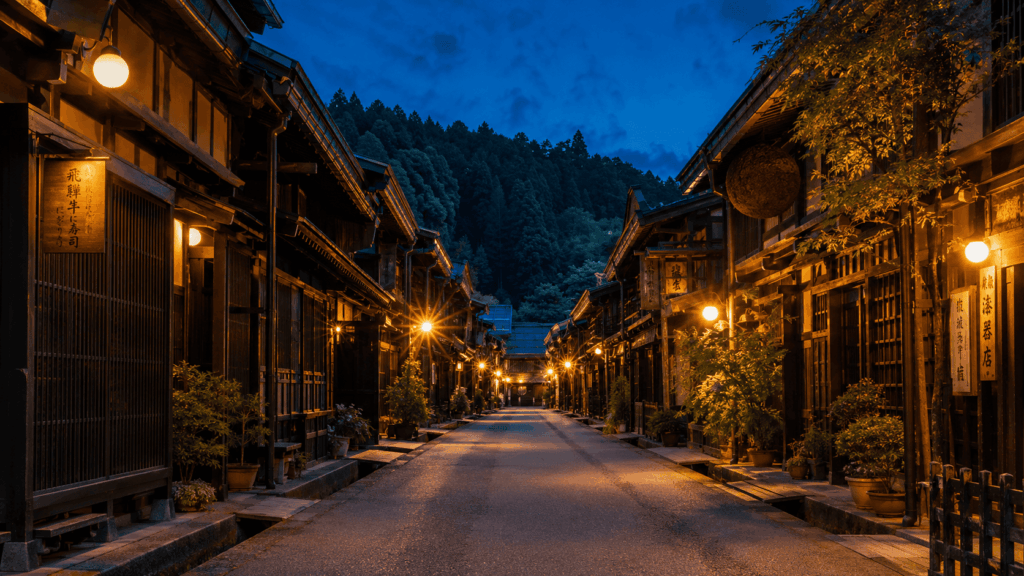
Here’s the reality that most guides skip: the historic Sanmachi Suji district — the picturesque Edo-era lanes lined with sake breweries and craft shops — largely winds down by 5:00 PM. Shops close their wooden shutters, the last rickshaw rolls away, and the crowds thin out almost completely. If you walk through Kamisannomachi at 5:30 PM, you’ll find a street that looks nothing like the bustling version you saw at noon.
But that doesn’t mean the town goes to sleep. Around the same time the old town quiets down, a different Takayama comes alive near the station side — in the narrow alleys of Suehiromachi, the retro food stalls of Dekonaru Yokocho, and the izakaya-lined streets of Asahimachi and Souwamachi. The energy shifts location rather than fading away.
What surprises most first-time visitors is this: the quiet hour after the shops close — when the lanterns come on and you have Sanmachi Suji almost to yourself — is arguably the most atmospheric time to experience the old town. The mistake travelers make is equating “closed shops” with “nothing to do.” In Takayama, the transition from day to evening is part of the experience itself.
This guide breaks down exactly what changes after dark — where to go, what stays open, where to catch sunset and sunrise, and whether the evening hours alone are worth booking that extra night.
If you already know you’d rather have the evening route, small-bar choices, and food logistics handled for you, check current start times and recent reviews for the Takayama Private Night Walking Tour with Dinner before you lock in your evening plans.
The Evening Shift — What Happens in Takayama After 5 PM
Takayama’s evening rhythm unfolds in distinct stages. Knowing this sequence helps you plan without wandering into shuttered streets expecting a crowd.
| Time | What’s Happening | Where to Be |
|---|---|---|
| 4:30 – 5:00 PM | Shops in Sanmachi Suji close for the day. Sake breweries (like Harada Brewery) stop tastings. | Old town streets become quiet |
| 5:00 – 6:00 PM | Golden hour over the old town. Soft light on wooden facades and the Nakabashi Bridge. | Kamisannomachi, Nakabashi Bridge |
| 6:00 – 7:00 PM | Dinner service starts. Izakayas and restaurants in Suehiromachi and Asahimachi fill up. | Suehiromachi, Dekonaru Yokocho, Asahimachi |
| 7:00 – 10:00 PM | Evening peak in the station-side drinking areas. Small bars and yakitori joints stay lively. | Souwamachi Nichome, Dekonaru Yokocho |
| 10:00 PM onward | Things wind down. A few late bars remain open, but the city is generally quiet. | Station vicinity |
Kai’s tip: The biggest adjustment for visitors is the 5:00 PM “curtain drop” on the old town. I’ve watched travelers arrive at Sanmachi Suji around 5:30 looking for souvenirs, only to find every shop closed. The trick is to do your old-town shopping and sake tasting before 4:00 PM, then let the evening unfold naturally from there. Once the shutters go down, the streets themselves become the attraction — and they’re far more photogenic without the crowds.
Strolling the Old Town After Dark — Sanmachi Suji by Lantern Light
The single best thing to do in Takayama after sunset costs nothing: walk through Sanmachi Suji after the crowds have left.
From around 5:15 PM, the three parallel lanes of Ichinomachi, Ninomachi, and Sannomachi undergo a remarkable transformation. The souvenir stalls are shuttered, the sake-tasting counters are closed, and the street is lit by soft lantern glow from the few remaining inns and restaurants. What was a busy thoroughfare during the day becomes a near-empty corridor of Edo-era architecture.
This is especially striking along Kamisannomachi, the most photographed street in the district. During peak hours, it’s shoulder-to-shoulder with visitors. By early evening, you can stand in the middle of the lane and take in the full length of the wooden machiya facades without a single person in your frame.
What you can see at night:
- Nakabashi Bridge — The red wooden bridge over the Miyagawa River is gently illuminated after dark. It’s a short walk from the southern end of Sanmachi Suji and makes for an excellent photo stop, especially during the blue hour just after sunset.
- Takayama Jinya — The former Edo-period government building closes its doors around 5:00 PM (last entry is typically earlier). But the exterior — a stately wooden structure with a tiled roof — is visible from the street at any hour and is worth a quick walk-by.
- The side alleys — Some of the narrow lanes branching off Sanmachi Suji are unlit and quiet. They’re perfectly safe to walk through, and the contrast between the main street and these dark side passages adds to the atmosphere.
Most shops close between 5:00 and 5:30 PM, but a handful of restaurants within the old town itself do serve evening meals — look for the lanterns still lit outside a wooden facade after 6:00 PM. That’s your sign that the door is open.
Sunset Views — Where to Catch the Golden Hour
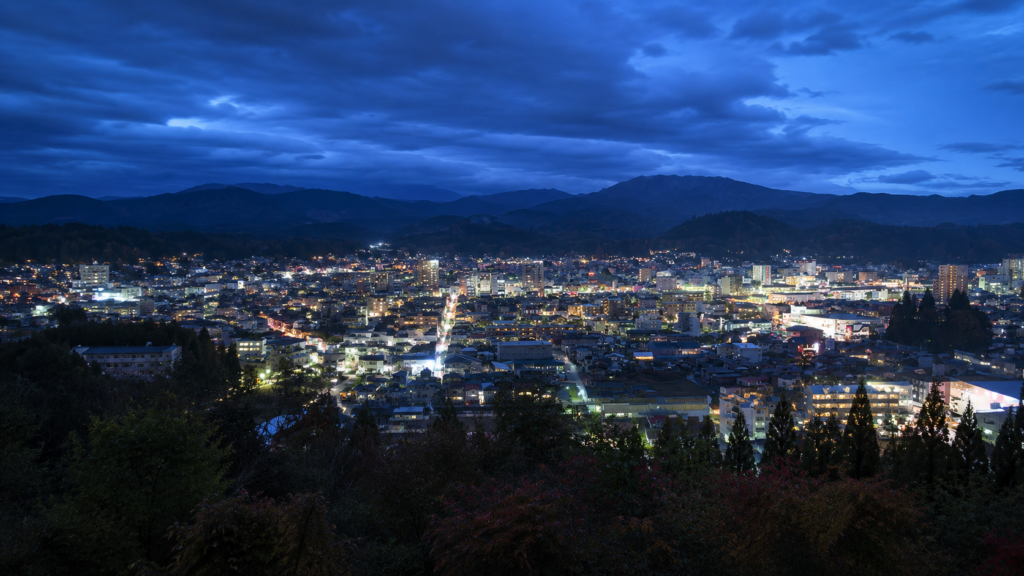
For travelers who enjoy landscape photography or simply want a view that stretches beyond the rooftops, Shiroyama Park — the site of the former Takayama Castle — offers the best elevated perspective over the city.
Getting there: The park entrance is about a 15-minute walk from Takayama Station, heading east and slightly uphill. The path to the castle ruins at the top takes another 10–15 minutes on a gentle forested trail. The full loop around the park is roughly 2 kilometers and takes about 40 minutes if you’re feeling energetic, but you only need to reach the summit viewpoint for the sunset.
What you’ll see: From the castle ruins at roughly 686 meters above sea level, the view opens up over Takayama’s compact city center. On clear days, the Northern Japan Alps are visible on the eastern horizon — a jagged silhouette that catches the last light beautifully. The park faces east, so it’s actually better suited for sunrise, but the golden hour light hitting the city rooftops from this elevation is still rewarding.
Timing: Sunset in Takayama varies significantly by season — expect sunset around 4:30 PM in December and around 7:10 PM in June. Check the day’s sunset time before heading up, and aim to arrive at the viewpoint at least 20 minutes early to watch the light change.
If you’d prefer to stay closer to the old town, the light on Kamisannomachi during the last hour before sunset is exceptional — the warm sun hits the wooden facades at a low angle, and the street is noticeably quieter than at midday. This is also the best time for photos of Nakabashi Bridge without the daytime foot traffic.
Where to Eat and Drink at Night in Takayama
While the old town’s sake breweries and souvenir shops shut down by late afternoon, a lively dining scene emerges in neighborhoods closer to Takayama Station. The key difference is location: if you’re looking for dinner after 6:00 PM, walk toward the station, not deeper into Sanmachi Suji.
Izakaya Hopping in Suehiromachi & Dekonaru Yokocho
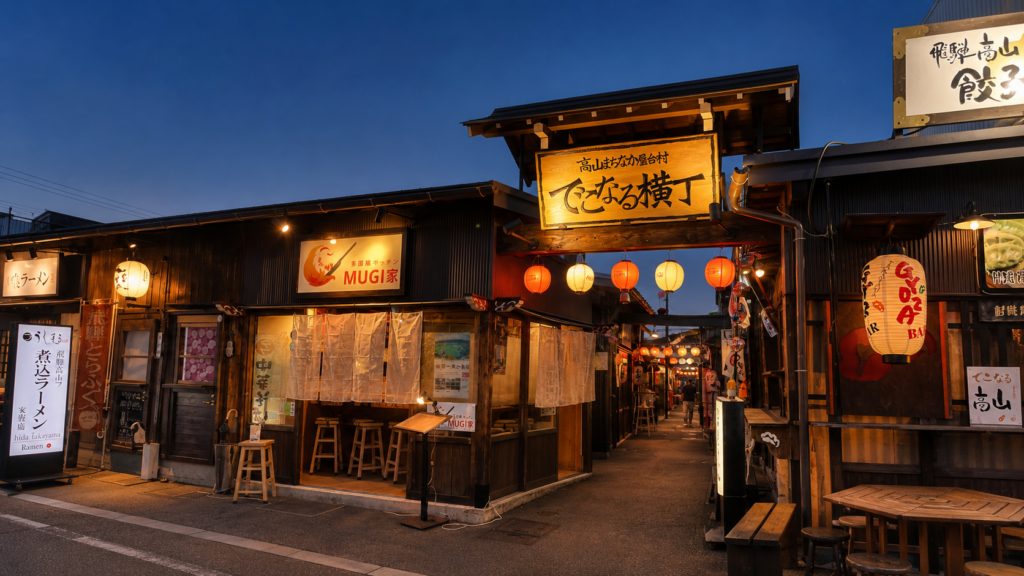
The area around Suehiromachi — a five-minute walk from Takayama Station — is where the evening energy concentrates. Unlike the old town’s quiet lanes, these streets are lined with small izakayas (Japanese-style pubs), yakitori grills, and bars with neon signs and noren curtains swaying in open doorways.
Dekonaru Yokocho (でこなる横丁) is a compact alley of retro food stalls designed to evoke a Showa-era market. It’s an easy entry point for solo travelers or anyone who wants to sample multiple small dishes. Stalls here include:
- Hida Takayama Gyoza Sohonzan — Specializes in gyoza (pan-fried dumplings). Open until around 11:00 PM.
- Sumibiyaki Sansaku — Charcoal-grilled skewers (yakitori). Good for grazing alongside a drink.
A few blocks away, Souwamachi Nichome is a narrow lane where tiny izakayas — most seating just 6–10 people — open their doors from early evening. This is as close as Takayama gets to a local after-work drinking strip. The atmosphere is casual and unpretentious, though English menus are uncommon here.
Kai’s tip: The single most useful thing to know about dining in Takayama is that the evening action doesn’t happen where you spent your afternoon. I’ve lost count of travelers who wander back into Sanmachi Suji around 7:00 PM hoping to find a restaurant, only to walk past shuttered shop after shuttered shop. The move is to head toward Suehiromachi and the station area once the sun goes down — that’s where the lights are on and the doors are open. Dekonaru Yokocho is an especially forgiving option if you arrive without a reservation, since you can eat at one stall while waiting for a seat at another.
Hida Beef Dinner — Yes, You Can Get It at Night
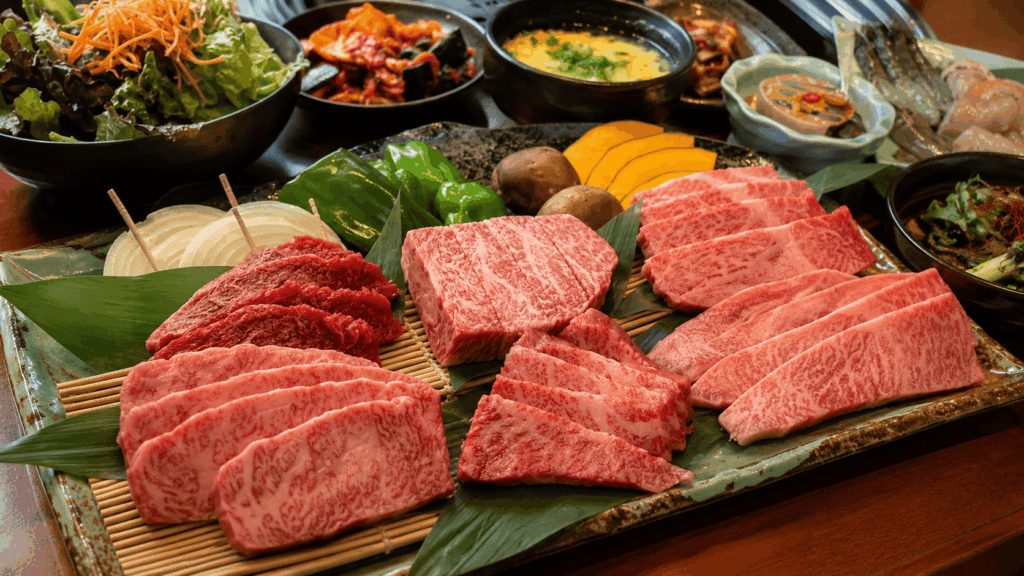
Hida beef is the star ingredient in Takayama, and it’s absolutely available for dinner — not just as a pricey teppanyaki lunch. Several restaurants in the station area and Suehiromachi serve Hida beef dishes through the evening hours.
Maruaki (丸明, a 5-minute walk from the station) is one of the most well-known options. It’s a combined butcher shop and restaurant where you can select your cut of Hida beef and have it grilled at your table. Maruaki does not take reservations — the system is first-come, first-served — and daytime waits can exceed an hour. Evening visits tend to be less crowded, especially after 7:30 PM. Expect to pay around ¥3,000–¥6,000 for a set meal depending on the cut and portion.
Other reliable dinner options for Hida beef include Hida Beef Stand Senara (a casual standing-bar style spot near Suehiromachi) and several yakiniku (Japanese BBQ) restaurants along the main street between the station and the old town. For a deeper dive into local specialties, check out our complete guide on what to eat in Takayama.
Sake Tasting in the Evening
Most of Takayama’s historic sake breweries — including the well-known Harada Sake Brewery on Kamisannomachi — close their tasting rooms by 4:00 or 5:00 PM. You can’t visit them for samples after dark.
However, many izakayas and bars in Suehiromachi and the station area carry a rotating selection of local sake by the glass. Your evening sake experience shifts from “walking between breweries for tastings” (a daytime activity) to “ordering regional sake with your meal” (a dinner activity). Some bars also offer sake flights — ask your server for a sandome (three-comparison set) of Hida-region labels.
If you want a structured tasting experience, the Takayama Sake Tasting venues (small dedicated tasting rooms near the station) sometimes operate into the early evening — check their current hours if this is a priority.
DIY Evening Stroll vs. Guided Night Tour — Which One for You?
Both approaches work, but they suit different travel styles. Here’s a straightforward way to decide:
Choose the DIY option if:
- You prefer exploring at your own pace.
- You’ve already done your research and know where you want to eat.
- You’re traveling with a partner or group and want flexibility.
- You want to keep the evening budget minimal.
Consider a guided night tour if:
- You’d appreciate historical context for the buildings you’re seeing after dark.
- You’re traveling solo and want the social aspect of a small group.
- You want dinner included without having to research and book a restaurant yourself.
- You’re interested in hearing local stories and folklore tied to the old town.
One of the most popular guided options is the Takayama Night Tour with Local Meal and Drinks, which meets at Nakabashi Bridge around 6:00 PM, walks through the illuminated old town with an English-speaking guide, and finishes with a full-course dinner at a local restaurant. It runs roughly 2.5 hours and is capped at small groups (around 8 people maximum), which keeps the experience personal. The guide handles the restaurant booking — a practical advantage in a town where some of the best izakayas have only 6 seats.
If you fall into that camp — you want Takayama’s quiet old-town atmosphere, but you also want help finding the right small bars and food stops afterward — this is the booking to compare first.
Why I’d book this one
- Recent travelers consistently point to the guide as the difference-maker, especially for finding local-feeling places that are easy to miss alone.
- The route matches the exact evening shift described here: old-town atmosphere first, then the livelier food-and-drink side of Takayama.
- Because food-and-drink details can vary by date and booking conditions, it’s worth checking the latest inclusions before choosing a time.
See live availability, start times, inclusions, and recent traveler reviews for the Takayama Private Night Walking Tour with Dinner.
For context on whether a single evening in Takayama fits your broader itinerary, the Is Takayama Worth It guide covers the bigger picture — including whether to base yourself here or visit as a day trip from another city.
Why Staying the Night Pays Off — Sunrise & Morning Market
If you’re still deciding whether to book that extra night (or figuring out where to stay in Takayama), here’s the honest case for it: the best part of staying over isn’t the evening — it’s the early morning that follows.
Early Morning at Shiroyama Park (Sunrise)
Shiroyama Park faces east, which makes it a natural sunrise viewpoint. Unlike sunset (which falls behind the city and produces a more muted light), Takayama’s sunrise hits the Northern Japan Alps directly — and on a clear morning, the alpenglow is striking.
Timing by season (approximate):
- June: sunrise around 4:30 AM — the park is already light by 4:00 AM.
- December: sunrise around 6:45 AM — a much more manageable wake-up time.
- March / September: sunrise around 5:30–5:45 AM.
The walk from the old town to the summit viewpoint takes about 25–30 minutes. The trail through the forest is unpaved with exposed roots and some uneven stone steps — wear proper shoes, especially if there’s frost or overnight rain. A flashlight or phone light is useful in the darker sections before dawn.
At the top, you’ll find the stone foundations of Takayama Castle and a wooden observation deck. The city spreads out below you, with the Japan Alps forming the eastern backdrop. The light changes quickly — the first 15 minutes after sunrise are the most dramatic.
Kai’s tip: If you’re going to make the effort to walk up to Shiroyama Park for sunrise, build the morning market into the same outing. The Miyagawa Morning Market starts setting up around the same time you’re coming back down — you can walk from the park exit to the market in about 15 minutes. This combo — sunrise at the castle ruins, then coffee and fresh fruit from the market stalls while the rest of the town is still waking up — is the single best return on investment for a one-night stay in Takayama. Most day-trippers don’t get this at all.
Miyagawa Morning Market
Running along the Miyagawa River between the Kajibashi and Yayoibashi bridges, this market is one of Japan’s few remaining morning-only river markets. It operates daily:
- April–November: 7:00 AM – 12:00 PM
- December–March: 8:00 AM – 12:00 PM
Stalls sell fresh local produce, pickles (tsukemono), Hida beef skewers and croquettes for breakfast, handmade crafts, and packaged sweets. Cash is the standard here — most vendors don’t accept cards. It’s compact enough to browse in 30–40 minutes, making it an ideal low-effort activity before checking out or catching a morning train.
Practical Tips for Your Evening in Takayama
Cash vs. Card
Larger restaurants in the station area and hotel dining rooms accept credit cards. But the smaller izakayas in Suehiromachi, Souwamachi Nichome, and at Dekonaru Yokocho are cash-only — and these are exactly the places you’ll want to eat. Carry at least ¥5,000–¥8,000 per person for an evening of food and drinks if you plan to explore the small independent spots. ATMs are available at the post office near the station and at 7-Eleven (which has English language support).
English-Friendly Options
Ajihei (in the Suehiromachi area) is a popular izakaya known for having an English menu with over 100 dishes listed. It’s a safe fallback if you want the izakaya experience without a language barrier. Dekonaru Yokocho’s food stalls also see enough international visitors that basic English communication is generally fine — pointing at the display or menu works well here.
If you join a guided night tour, the language question is handled entirely by the guide, and many tours also include dinner at a restaurant that might be difficult to book as a walk-in.
Safety & Walking
Takayama is a safe city at any hour. The streets around the old town and station are well-lit along the main routes, though some side alleys in Sanmachi Suji can be dark after the shops close — bring a phone light if you plan to explore the quieter lanes. All the areas mentioned in this guide are within a 15-minute walk of each other. No taxis or buses are needed for an evening out.
Footwear matters: The wooden sidewalks in the old town can be slippery after rain, and the Shiroyama Park trail is unpaved. Comfortable walking shoes with good grip are the right choice for a day-and-evening exploring Takayama.
Seasonal Considerations
- Winter (December–February): The old town gets dark by 4:30 PM. Snow and ice can make the Shiroyama Park trail hazardous — only attempt the sunrise walk with proper winter boots and a headlamp. The cold is dry, so layers are effective. The evening izakaya scene is as lively as ever, and the snow-covered rooftops of Sanmachi Suji under streetlights are beautiful. (Read more on what to expect in Takayama during winter).
- Summer (June–August): Daylight lasts until around 7:00 PM. The old town stays light for evening walks well after shops close. Mosquitoes can be present near the river in the evening.
- Spring & Fall: Unpredictable rain. Carry an umbrella. The lantern-lit streets are at their most atmospheric on a dry, crisp autumn evening.
Frequently Asked Questions
Is Takayama safe to walk around at night?
Yes — Takayama is a very safe city. The main streets in the old town and station area are well-lit, and crime targeting travelers is virtually unheard of. Some side alleys in Sanmachi Suji are darker after the shops close, but they’re still safe to walk through if you have a phone light. All the areas covered in this guide — Sanmachi Suji, Suehiromachi, Dekonaru Yokocho, and the station — are within a 15-minute walk of each other.
What time do shops and sake breweries close in Takayama?
Most shops, souvenir stores, and sake breweries in the Sanmachi Suji old town close between 4:30 and 5:30 PM. Sake tasting at breweries like Harada Sake Brewery typically ends by 4:00 PM. A small number of restaurants within the old town itself stay open for evening dinner service — look for lanterns lit outside a wooden facade after 6:00 PM. For evening dining and drinking, head toward the Suehiromachi and station area instead.
Are there any English-friendly restaurants or bars open at night?
Yes. Ajihei in the Suehiromachi area has an English menu with over 100 dishes and is one of the most foreigner-friendly izakayas in town. The food stalls at Dekonaru Yokocho see enough international visitors that basic English communication works fine — pointing at the display is standard practice. Some of the smaller izakayas in Souwamachi Nichome are more local-oriented and may not have English menus, but they’re still welcoming. For a completely language-free evening experience, a guided night tour handles all ordering and translation.
Do I need a reservation for dinner in Takayama?
For major Hida beef restaurants like Maruaki, reservations are not accepted — it’s first-come, first-served. Evening waits are generally shorter than lunch. For smaller izakayas with only 6–10 seats in Souwamachi Nichome, dinner can sometimes mean a 20-minute wait at the door during peak hours (7:00–8:30 PM). If you join a guided night tour, your dinner reservation is included, which bypasses this issue entirely.
Can I visit Takayama Jinya at night?
No — Takayama Jinya closes its doors to visitors by around 5:00 PM (last entry is typically 4:30 or 5:00 PM depending on the season). However, the exterior of the building is visible from the street at any hour and is worth a brief stop if you’re walking between Nakabashi Bridge and the old town.
Is Takayama worth visiting if I can only come for a day trip?
A day trip gives you enough time to see the old town, visit Takayama Jinya, shop at Sanmachi Suji, and eat Hida beef for lunch. But you’ll miss the quiet evening atmosphere of the old town after the crowds leave, the opportunity to experience the izakaya scene in Suehiromachi, and — most significantly — the early morning combination of sunrise at Shiroyama Park and the Miyagawa Morning Market. If your schedule allows, one night is the difference between “I’ve seen Takayama” and “I’ve experienced Takayama.”
Does Takayama have any seasonal night events or illuminations?
Takayama does not have year-round nighttime illuminations in the old town. The lanterns you see on Sanmachi Suji after dark are from inns and restaurants that remain open — they’re not a coordinated lighting event. During winter, the Takayama Ice Path Light Up (typically held in February) creates an illuminated path near the station, but this is a seasonal event with limited dates. The most reliable “illumination” is simply the combination of streetlights, shop lanterns, and moonlight on the wooden facades of the old town on a clear evening.
How much cash should I carry for an evening in Takayama?
Plan for at least ¥5,000–¥8,000 per person if you’re eating and drinking at smaller izakayas and bars, as many of them are cash-only. Larger restaurants near the station accept cards. ATMs are available at the post office near Takayama Station and at 7-Eleven (which has English language support).
Final Verdict — Is the Evening in Takayama Worth It?
The honest answer depends on what you’re looking for — but for most travelers, staying through the evening is where Takayama reveals its quieter, more memorable side.
Choose Takayama for an evening (and overnight stay) if:
- You appreciate atmospheric, uncrowded streets over bustling nightlife. The old town after dark is genuinely beautiful in a way that daytime crowds obscure.
- You enjoy izakaya-hopping and casual dining. The Suehiromachi and Dekonaru Yokocho areas offer a legitimate, local-scale food scene that’s easy to navigate on foot.
- You’re a photographer. The golden hour on Kamisannomachi, the blue hour at Nakabashi Bridge, and the sunrise from Shiroyama Park are all high-value photo opportunities that day-trippers miss entirely.
- You’re considering the Takayama Night Tour with Local Meal and Drinks. If the idea of a guided walk through the old town followed by a curated dinner sounds like your ideal evening, this is a well-reviewed option that solves the logistics of restaurant choice and language barriers in one booking.
You might prefer a day trip if:
- Your schedule is tight and you’re comfortable seeing the highlights between 9:00 AM and 4:00 PM. The old town during the day is still worth the visit — you just won’t experience the quieter evening side of the city.
- You’re traveling with young children who need an early bedtime. The evening options in Takayama are mostly food-and-drink focused, and the old town gets genuinely quiet after 7:00 PM.
- You’re looking for late-night club-style nightlife. That doesn’t exist here, and no guide should pretend otherwise.
For first-time visitors: Stay one night. The combination of a quiet evening walk through Sanmachi Suji, dinner in Suehiromachi, and an early morning at Shiroyama Park followed by the Miyagawa Morning Market gives you a full spectrum of what makes this town special — and none of it is available to day-trippers. (Need help planning? See our guide on how to structure your Takayama itinerary).
For solo travelers: Takayama is safe and compact enough to explore alone in the evening. If you’d like company, the guided night tour is a natural way to meet other travelers while covering the same ground with historical context.
For repeat visitors: Consider skipping the old town in the evening and heading straight for the izakaya alleys of Souwamachi Nichome — that’s where the local evening culture lives, away from the tourist trail. Or take the early morning hike up Shiroyama Park, which rewards with a completely different perspective on the city.

Hi, I’m Kai. I’m a Tokyo-based travel writer, tourism industry insider, and the author of a published guidebook for international visitors to Japan. With over 10 years of professional experience at a leading Japanese tourism company, my mission is to help you skip the tourist traps and navigate Japan’s best destinations like a local. I believe the perfect day trip is like a traditional kaiseki meal: a beautiful balance of precise planning and unforgettable seasonal discovery. When I’m not out conducting field research, you’ll usually find me drafting new itineraries with one of my favorite fountain pens!