
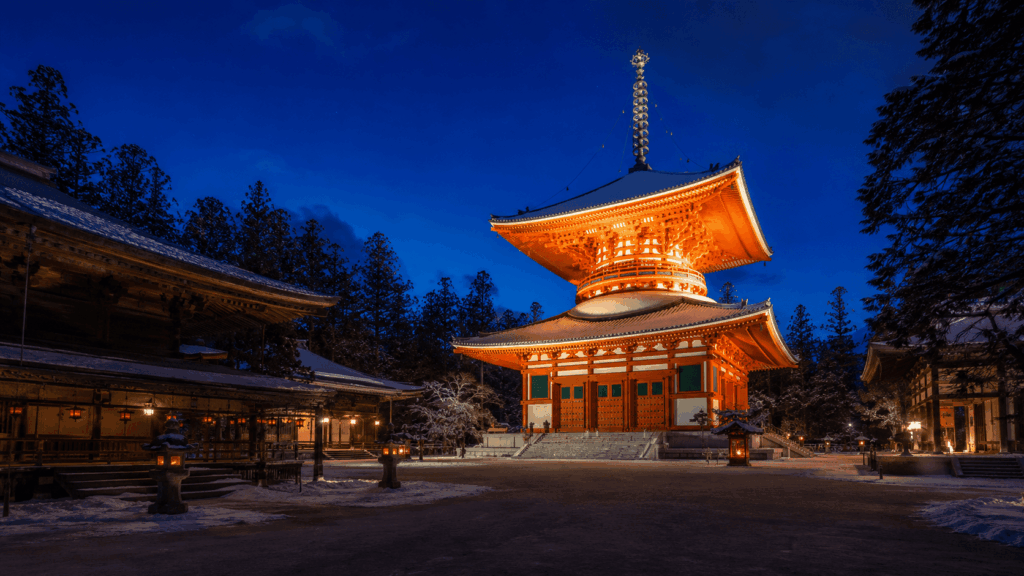
There are very few places in Japan where night transforms a World Heritage site rather than closing it. Koyasan is one of them.
But Koyasan at night is not about nightlife. There are no bars, no late-night convenience stores, and virtually nothing open after 6:00 pm except your temple lodging. The night experience here is one thing: the Okunoin cemetery path after dark.
This article answers what you can realistically do on Koyasan after sunset, whether the guided Okunoin Night Tour (¥6,000+) is worth your time and money, how it compares to walking alone, and what temple stay logistics you need to sort out before booking either option.
Comparing guided options? GetYourGuide currently lists a separately operated private-group Okunoin walk with morning and night start times. Check live night availability, current pricing, and recent traveler reviews before deciding.
Koyasan at Night: Quick Answer
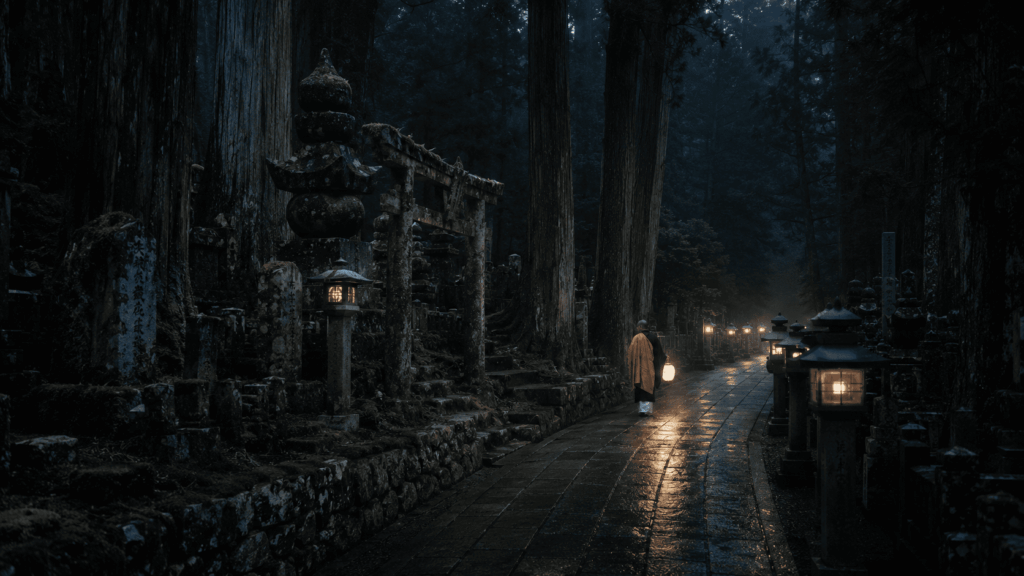
After dark on Koyasan, the main activity is a walk through Okunoin, Japan’s largest and most sacred cemetery, where Kobo Daishi (Kūkai) is believed to be in eternal meditation. You have two options:
- Guided Okunoin Night Tour (¥6,000–¥7,000, ~80 minutes) — operated by AWESOME TOURS since 2011. Daily departures at approximately 19:00 from the TAIRA Cafe & Souvenir Shop. Includes a resident guide in traditional dress, historical and religious commentary, and guided return to a bus stop. Best for first-time visitors who want context.
- Self-guided walk (free) — the Okunoin path is open 24 hours. No ticket, no guide, no booking. Best for those who have already seen Okunoin by day, prefer silence, and are comfortable navigating a dark cemetery path on their own.
Neither option is mandatory. If you are visiting Koyasan only during daytime hours, walking the cemetery by day is still a profoundly impressive experience. But if you are staying overnight, a night visit — guided or not — adds a layer of atmosphere that daytime cannot replicate.
What Is Koyasan Really Like at Night?
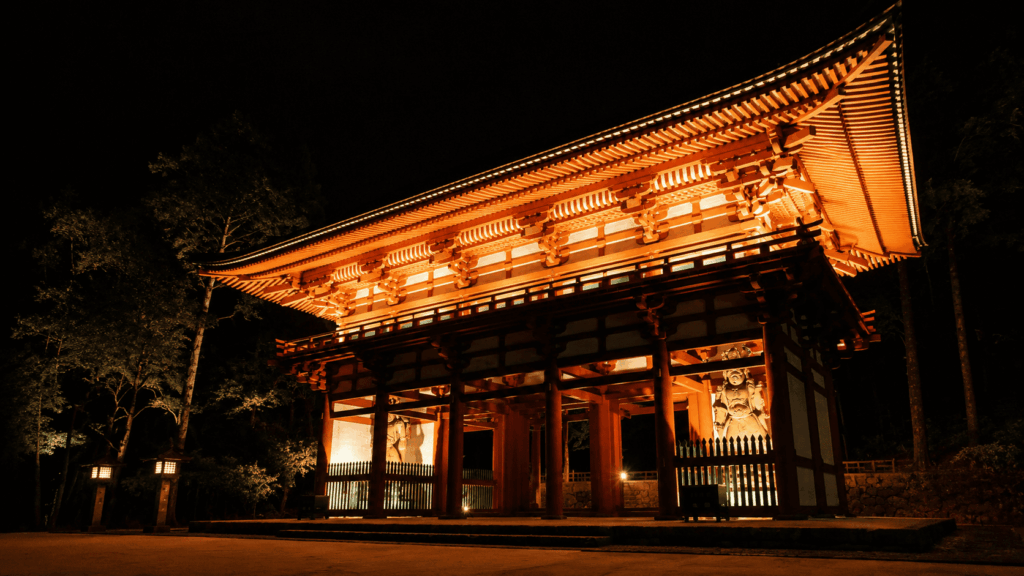
Koyasan is a temple town at 800 metres elevation with a resident population of roughly 2,000 — about 800 of whom are monks. Once the last temple meal ends around 17:30–18:00 and visitors retreat to their shukubo (temple lodgings), the streets become nearly empty. The main road from Senjuin-bashi to the Danjo Garan complex is dimly lit but walkable. Kongobu-ji, the head temple, closes by 17:00.
What surprises many first-time visitors is how quiet it gets. A recurring comment from travellers is that the silence on the main street after 19:00 feels more profound than expected — there is no traffic noise, no announcements, no street-level retail. The town essentially returns to its function as a living religious community rather than a tourist destination.
The only organized activity after dark is the walk to Okunoin. Everything else — the evening meditation service at your temple, a hot bath, an early night — happens within your shukubo.
The Main Event: Okunoin After Dark
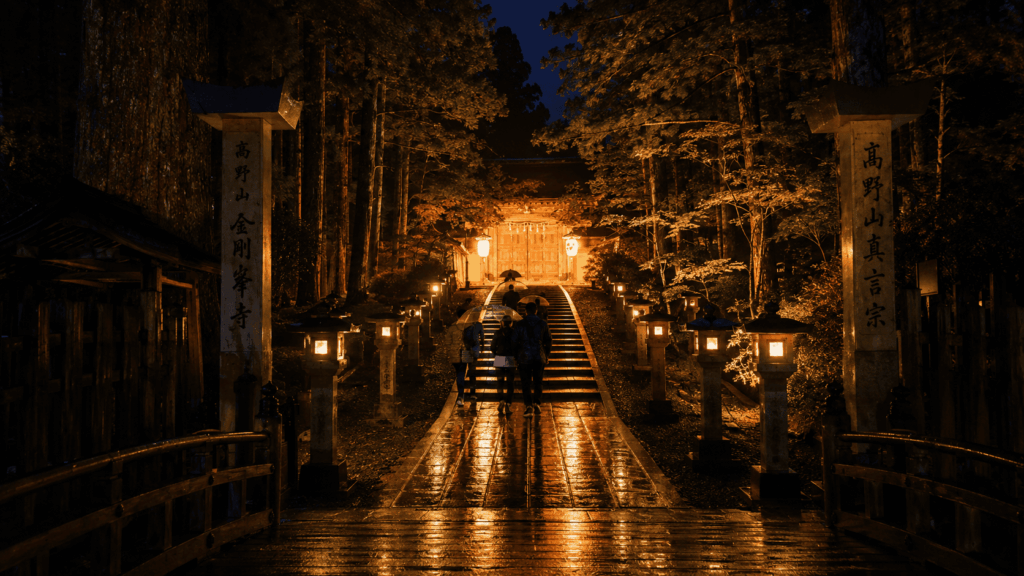
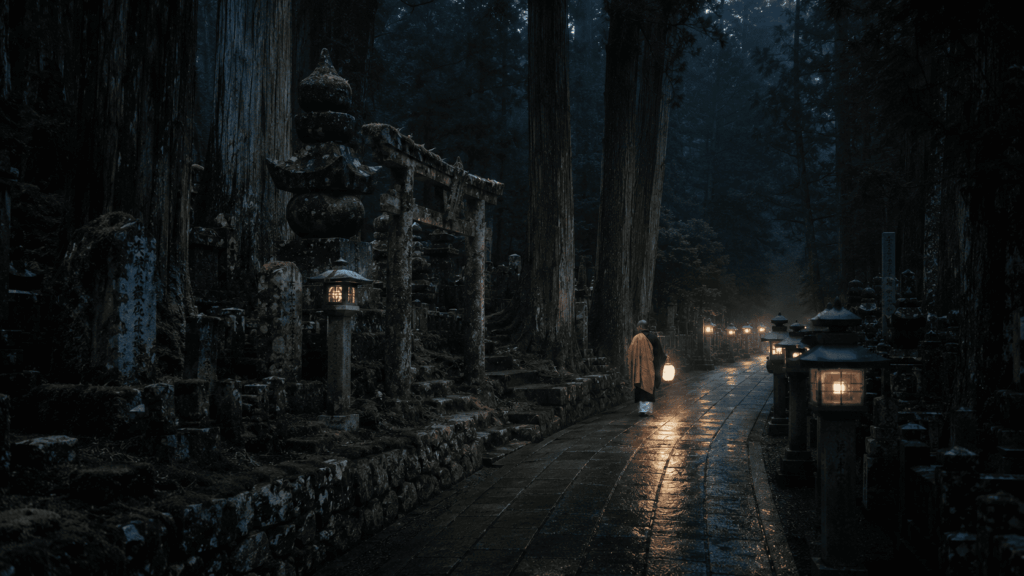
Okunoin is the spiritual heart of Koyasan: a sprawling cemetery with over 200,000 grave markers lining a two-kilometre path that leads to the Okunoin Gobyo (Inner Sanctuary), where Kobo Daishi Kūkai is believed to be in eternal meditation. The path begins at Ichinohashi Bridge and winds through towering cedar trees, moss-covered stone lanterns, and the weathered tombstones of feudal lords, corporations, and ordinary families.
At night, the main approach is illuminated by stone lanterns and overhead lights — dim enough to feel sacred, bright enough to walk without a flashlight in most sections. The portion closer to the mausoleum, especially around the Torodo area, has stronger lighting. The path before Ichinohashi is darker and more atmospheric.
According to the Koyasan Shingon Sect headquarters (Kongobu-ji), the entire Okunoin precinct is open for visitors 24 hours a day. There is no gate, no closing time, and no fee to walk the cemetery path itself at any hour.
Can You Go Inside Torodo (Lantern Hall) at Night?
No. There is an important distinction to make. While the cemetery path is open all night, the Torodo (Hall of Lanterns) — the worship hall in front of Kobo Daishi’s mausoleum — has daytime hours only: approximately 6:00–17:00 (last entry around 17:30). The same applies to Kongobu-ji (8:30–17:00) and the main halls of Danjo Garan.
This means that a night visit to Okunoin is strictly an outdoor experience. You can walk the full 2 km path, reach the mausoleum area, stand before the Torodo from the outside, and feel the atmosphere — but you cannot enter the lantern hall, see the eternal flames up close, or view the inner sanctuary buildings from inside. If seeing the indoor details of Torodo matters to you, do that first during daytime hours (see our guide to Koyasan’s best things to do).
Is the Okunoin Night Tour Worth It?
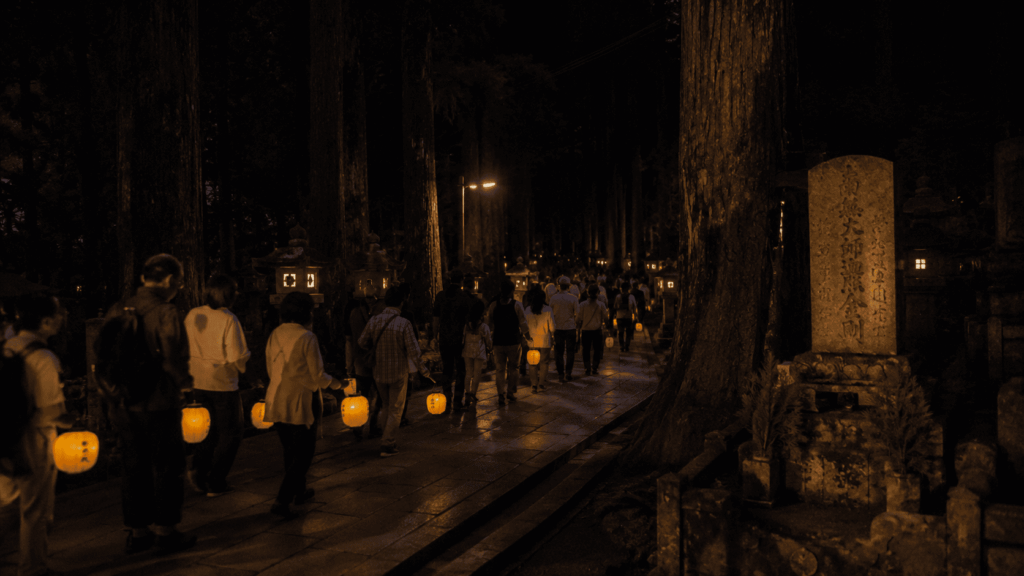
The Okunoin Night Tour is operated by AWESOME TOURS, a licensed travel agency based at Koyasan headquarters (registration no. 2-306, Wakayama Prefecture). It has been running nearly every night since 2011, and it is the only official organized night tour in Koyasan.
Here is what the tour includes, based on the operator’s current information:
| Detail | Information |
|---|---|
| Price | From ¥6,000 per adult (online booking); ¥7,000+ for on-site payment on the day. Child (6–11) pricing varies. |
| Duration | Approximately 80 minutes (1 hour 20 minutes) |
| Distance | Approximately 3 km round-trip on paved but uneven stone paths and stairs |
| Start time | Around 19:00–19:15 (meeting time written on your Tour Pass) |
| End point | Okunoin Gobyo (Inner Sanctuary) around 20:20 |
| Meeting point | AWESOME TOURS reception counter inside TAIRA Cafe & Souvenir Shop (734 Koyasan) |
| Reception hours | ① 13:00–17:00 (early check-in with a free hot drink) ② 18:30–19:00 |
| Guide | Koyasan resident with temple experience; licensed guide; wears traditional samue (monk’s work clothing) |
| After the tour | Guide leads participants to a bus stop for the return to central Koyasan (bus fare included) |
| Weather | Runs in light rain. Cancelled only under official storm warnings (refund issued) |
Who the Tour Is Best For
- First-time visitors who want to understand what they are seeing — the history of Kobo Daishi, the meaning of the tombstones, and the stories behind the cemetery’s legends
- Travelers who would feel uneasy walking a dark cemetery path alone, especially without knowing what is ahead
- Those who appreciate structure — a clear meeting point, a guide managing the pace, and someone else handling navigation
- Anyone who wants return support — the guide takes you to a bus stop after the tour, which is especially useful if your temple is not within walking distance of the mausoleum
Who Can Skip It
- Repeat visitors to Koyasan who have done the night tour before or walked Okunoin by day and feel they have absorbed enough
- Travelers who prefer silence over explanation — the tour includes guided commentary throughout, which changes the nature of the walk
- Those comfortable with night navigation — the path is lit, safe, and straightforward to walk alone if you have visited Okunoin once during the day
- Budget-conscious travellers adding ¥6,000+ per person to an already expensive temple stay; the money may be better spent on a private tour or a longer stay
- Guests staying at temples close to Okunoin (like Ekoin, a 2-minute walk from the entrance) who can easily walk to and from the cemetery at their own pace
Guided Tour vs Self-Guided Walk: Side-by-Side Comparison
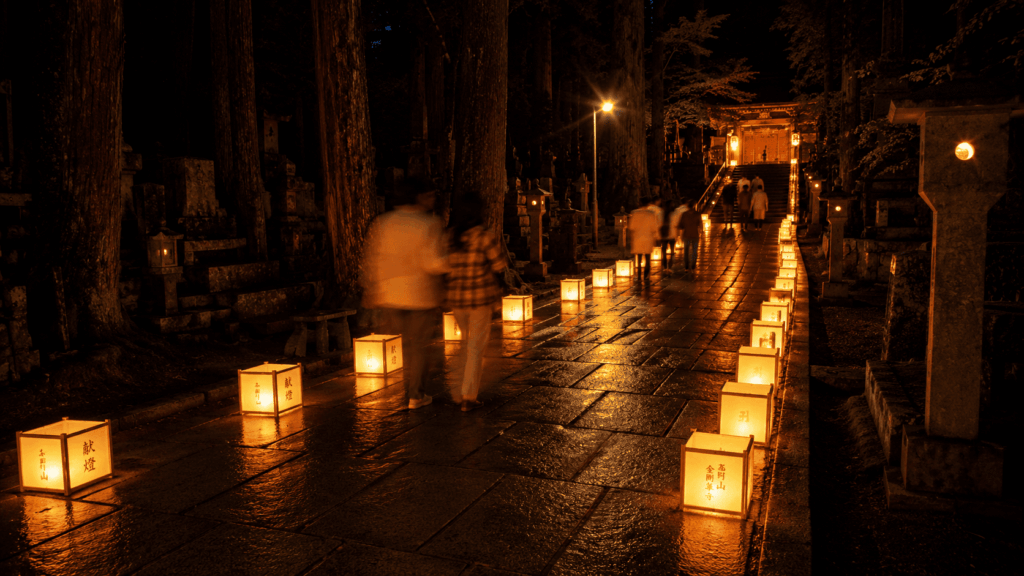
| Factor | Guided Night Tour | Self-Guided Night Walk |
|---|---|---|
| Cost | ¥6,000–¥7,000 per person | Free |
| Commentary | In-depth stories about Kobo Daishi, Shingon Buddhism, tombstone history, and local legends | None (you walk in silence, or use a self-guided audio/app if you prepare one) |
| Booking required | Yes — advance booking recommended (fills up March–November) | No booking needed |
| Pace | Group pace (led by guide) | Your own pace — stop as long as you like |
| Navigation | Guide handles all route-finding | You follow the main path (simple but darker sections) |
| Return assistance | Guide escorts group to a bus stop (bus fare included) | You walk back the same route or find your own way |
| Best for first-timers | Excellent — context transforms what you see | Good if you have walked Okunoin by day first |
| Best for photographers | Limited — flash prohibited; group pace restricts long stops | More freedom to set up shots if you have a tripod and know the route |
| Cemetery curfew compatibility | Temples with a 21:00 curfew generally fit (tour ends ~20:20 + bus travel) | Depends entirely on when you start and how long you linger |
| Weather risk | Runs in light rain; cancelled only in severe weather | Entirely your decision |
| Main drawback | Cost; group pace; cannot use flash or personal flashlight; no long photo stops | No context for what you are seeing; darker sections can feel disorienting without prior daytime visit |
If you want the night atmosphere but know that English context and route support will matter more to you than complete silence, this is the guided alternative worth comparing.
Why I’d book this one
- Recent travelers consistently mention knowledgeable guides who explain the religious background clearly and answer questions in depth.
- The listing is structured as a 1.5-hour private-group walk, which may suit couples, families, or small groups that prefer a more focused format.
- A less-positive review mentions a rushed pace and uneven structure, so checking the newest comments before choosing a date is worthwhile.
Is It Safe to Walk Okunoin Alone at Night?
Yes, the Okunoin cemetery path is safe in the conventional sense — crime is virtually unheard of, and the path is a maintained public walkway in a heavily visited World Heritage site. However, “safe” and “comfortable” are different things, and the distinction matters here.
The main path from Ichinohashi to the mausoleum is lit by stone lanterns and overhead lamps. Visibility is adequate for walking without a flashlight in the central sections. The path is paved but uneven in places, with stone stairs, weather-worn flagstones, and occasional tree roots. Rain and fallen leaves make the surface slippery year-round.
What catches many visitors off guard is the darkness after the Ichinohashi area. Beyond the first bridge, the tree canopy closes overhead, and there are stretches where the lamps are spaced well apart. If you are walking alone without having visited Okunoin during the day, it can be difficult to gauge how far you have left to reach the mausoleum or whether you are on the right path.
If you choose the self-guided option, here is what experienced travellers recommend:
- Walk the Okunoin path once during daylight before attempting it at night. This eliminates the disorientation and lets you enjoy the atmosphere rather than worry about navigation.
- Bring a phone with a flashlight even if you think you will not need it. A charged phone is also your emergency contact.
- Check the weather forecast before dark. Rain at dusk on Koyasan is common, and wet stone paths at night are genuinely slippery.
- Know your return route. The bus stops on the main road near the cemetery entrance run less frequently after 20:00. If your temple is a 15–20 minute walk from the mausoleum, factor that into your timing.
- If you feel uneasy at any point, turn back. The path is the same in reverse, and there is no shame in cutting a night walk short. The cemetery will still be there in the morning.
A note on respect: Okunoin is an active site of worship, not a tourist attraction. Visitors walking independently should maintain quiet voices, stay on the path, and avoid photographing individual grave markers or offering candles. This applies day and night, but nighttime silence makes violations more noticeable.
Clarifying the “Ekoin Night Tour” Misconception
If you have searched for “Ekoin night tour” or “Koyasan night tour Ekoin”, you are not alone — this is one of the most persistent confusions among travellers planning a Koyasan overnight stay. Here is the accurate picture:
The Okunoin Night Tour is operated by AWESOME TOURS, not by Ekoin. According to Ekoin’s official website, the temple does not operate any nightly guided tour of Okunoin. The tour is a separate business run by AWESOME TOURS, a licensed travel agency with its own reception office inside the TAIRA Cafe & Souvenir Shop, located at 734 Koyasan — approximately 50 metres from Ekoin’s entrance.
The confusion likely arises from two facts:
- The tour’s meeting point is physically adjacent to Ekoin — TAIRA Cafe & Souvenir Shop is just steps from Ekoin’s main gate, so travellers frequently associate the two.
- Ekoin offers a nearby temple stay with no curfew — as we cover in the next section, Ekoin is one of the most convenient temples for tour participants, which reinforces the mistaken belief that the tour is an Ekoin perk.
Booking the tour is completely separate from booking your temple stay. You do not need to stay at Ekoin to join the tour, and staying at Ekoin does not automatically include a spot on the tour.
Do You Need to Stay at Ekoin to Join the Tour?
No. You can stay at any temple lodging on Koyasan and still join the tour — provided your temple’s curfew allows the return time.
That said, Ekoin is the most logistically convenient temple for night tour participants, and this is worth understanding before you book your lodging:
| Factor | Ekoin | Typical Shukubo (Other Temples) |
|---|---|---|
| Distance to tour meeting point | ~2 minutes walk (next door to TAIRA Cafe) | 5–25 minutes walk or bus ride |
| Distance to Okunoin entrance | ~2 minutes (Ichinohashi Bridge is immediately adjacent) | 10–30 minutes walk |
| Curfew | None (Ekoin does not lock its gate) | Usually 21:00 (varies by temple) |
| Bath hours | 15:00–24:00 and 6:00–9:00 | Usually 16:00–21:00 |
| Dinner start time | ~17:30 (early dinner possible with prior request) | ~17:30–18:00 |
If you have not fixed your temple stay yet, compare current Ekoin room availability and booking conditions on Klook; its location is especially relevant when evening return timing matters.
Temples near Senjuin-bashi (the central bus hub) are also manageable — you can take the bus to the meeting point and then the return bus (guided or independent) back. The key is to confirm with your temple in advance whether a 20:45–21:00 return is compatible with their curfew and bath closing time.
How to Plan Dinner, Bathing, and Your Temple Curfew Around the Tour
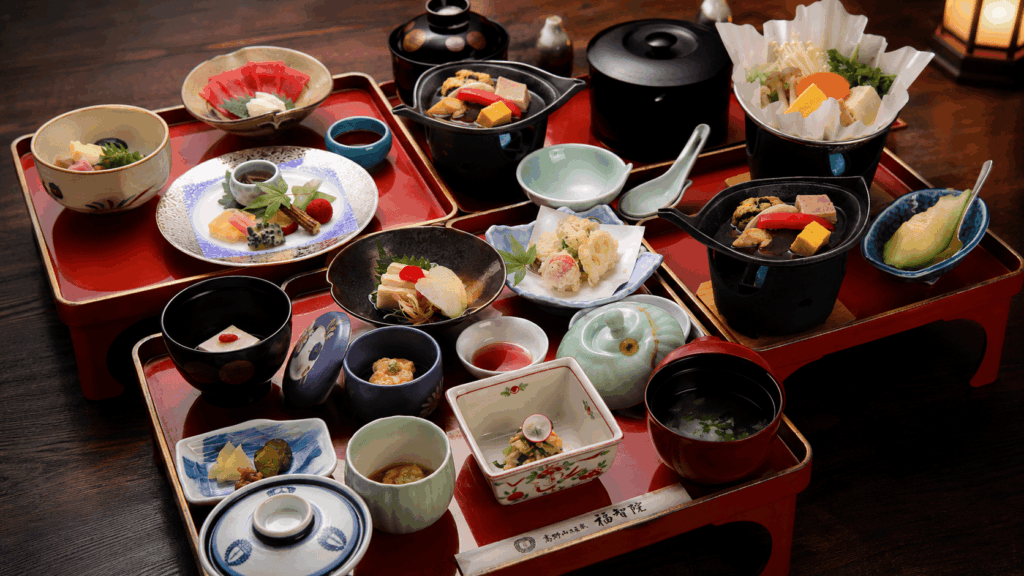
This is the practical challenge that catches more travellers than anything else. A temple stay follows a fixed evening rhythm: dinner at 17:30–18:00, bath available until around 20:00–21:00, and often a curfew near 21:00. The tour runs roughly from 19:00 to 20:20, plus travel to and from the meeting point. These three schedules can conflict if you do not plan ahead.
Here is what travellers commonly discover too late:
- The bath closes before the tour ends at many temples. If your temple’s bath closes at 20:00 or 21:00, and the tour ends at 20:20, you may return to a cold bath — or no bath at all.
- Dinner and tour check-in overlap. Dinner at most temples starts around 17:30–18:00, while tour check-in opens at 18:30. A leisurely multi-course shojin ryori (Buddhist vegetarian meal) can easily run until 19:00 — exactly when the tour departs.
- Returning to a locked gate is the worst outcome. A 21:00 curfew with a 20:20 tour end sounds safe, but add a 10–15 minute bus ride and a 5–10 minute walk from the bus stop, and you arrive at 20:45–20:55 — cutting it uncomfortably close.
What surprises many first-time visitors is that the bath timing is usually the harder constraint than the curfew. Most temples can accommodate a slightly late return if you notify them in advance, but they cannot keep the bath water heated past the posted closing time. If a hot bath after a cold night walk matters to you, check this before booking.
What to Confirm With Your Temple Before Booking (or Right After)
- Can you have dinner earlier than the standard time? (e.g., 17:00 instead of 17:30)
- What are the exact bath hours? — not just the posted time, but whether an exception is possible for tour participants
- Is there a curfew, and is it flexible? — some temples (like Ekoin) have none; others (like Renge-in and Sainan-in) enforce a strict 21:00 curfew that makes the tour impossible
- What is the expected return time from the mausoleum to your temple? — ask the staff or check a map; do not guess
- Do you need to notify the temple that you will be out during the evening? — some temples appreciate knowing so they can adjust meal timing or leave exterior lights on
A Realistic Evening Timeline (Guided Tour, Ekoin or Nearby Temple)
| Time | Activity | Notes |
|---|---|---|
| 17:00–18:00 | Dinner at your temple (shojin ryori) | If your temple is Ekoin or another close-proximity shukubo, this timing is relaxed. If your temple is farther away, allow extra time. |
| 17:00–18:30 | Bath (before the tour) | Recommended timing. If your temple’s bath closes at 20:00, bathe before the tour rather than risk returning to a cold bath at 20:20. |
| 18:30–19:00 | Check in at TAIRA Cafe & Souvenir Shop (734 Koyasan) | Show your Tour Pass. The early check-in window (13:00–17:00) is available if you prefer to confirm your spot earlier in the day. |
| 19:00–19:15 | Tour departs from TAIRA Cafe | Punctual — arrive by 18:55 at the latest. |
| 19:00–20:20 | Guided walk through Okunoin to the mausoleum | ~80 minutes. The guide manages the pace and provides commentary throughout. |
| 20:20–20:30 | Group gathers at the mausoleum; guide escorts to bus stop | Bus fare included. If your temple is close (e.g., Ekoin or Senjuin-bashi area), you may choose to walk back directly. |
| 20:35–21:00 | Return to temple | If your temple has a 21:00 curfew, you should arrive with 5–10 minutes to spare. If you are staying at Ekoin or a temple with no curfew, timing is flexible. |
Okunoin by Day vs at Night: Which Should You Choose?
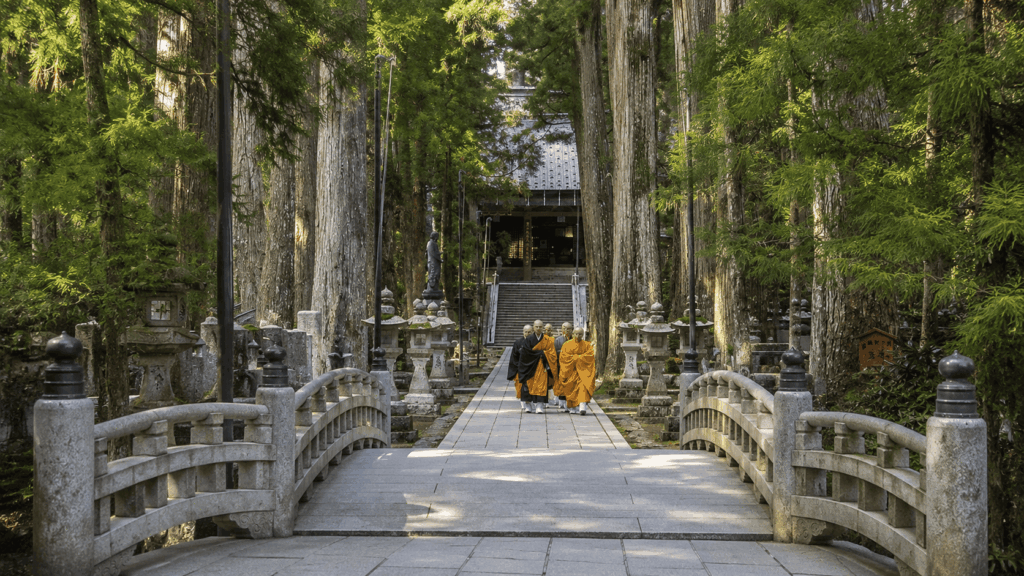
If you are staying overnight on Koyasan, you do not necessarily need to choose — you can visit Okunoin in daylight (4:00–17:00) and again after dark (24-hour access to the path). But if time is limited, here is how the two experiences compare:
| Factor | Daytime Okunoin | Nighttime Okunoin |
|---|---|---|
| Visibility of details | Excellent — you can read inscriptions, see stonework, observe moss and weathering on centuries-old monuments | Limited to what the lamps illuminate. You see shapes and outlines, not details. |
| Torodo (Lantern Hall) access | Open 6:00–17:00 — you can enter, see the eternal flames, and view the inner sanctuary | Closed — you can only see the exterior of the hall from outside |
| Atmosphere | Peaceful but not eerie. Other visitors are present, and the scale of the cemetery is fully visible. | Dramatically different. Fewer people, softer light, stronger sense of solitude. The forest feels more present. |
| Photography | Easy — good light, tripod optional, no restrictions on most areas | Challenging — flash is prohibited in the inner area. A tripod and long exposure are needed for good shots (and the guided tour does not allow tripod stops). |
| Navigation ease | Simple — the path is obvious and well-signed | Easy on the main route with lamps, but the darkness can make side paths less visible. Daytime visit first is recommended. |
| Who it suits best | Anyone who wants to understand Koyasan’s history through visible details; photographers; first-time visitors with limited time | Travellers who value atmosphere over information; those staying overnight; those comfortable walking in low-light conditions |
A common traveller approach: Walk Okunoin during the late afternoon (15:00–17:00) before the mausoleum buildings close, then return after dark for a shorter, quieter walk along the lit portion of the path. This gives you both the detail and the atmosphere without dedicating two full visits.
What to Bring and What to Wear
Koyasan sits at 800 metres, and the temperature drops noticeably after sunset even in summer. Here is a practical checklist based on conditions travellers regularly encounter:
- Grip-soled shoes — the stone path is uneven, frequently damp, and covered with fallen leaves and moss. Sneakers or walking shoes are fine; sandals and smooth-soled loafers are not.
- A warm layer — even in July, Koyasan after dark can be 10–15°C cooler than Osaka. In spring and autumn, a fleece or light jacket is essential. In winter, a heavy coat, gloves, and hat.
- A rain layer — precipitation on Koyasan is common year-round. A compact foldable rain jacket is better than an umbrella, which is awkward on the narrow cemetery path.
- A phone with a fully charged battery — for flashlight use if needed, to check your Tour Pass confirmation, and as a navigation aid for the return walk.
- Your Tour Pass — the booking confirmation includes the meeting point address, meeting time, and all essential instructions. Download it or screenshot it before you arrive (mobile reception in the cemetery area can be patchy).
- A small bag — you will be walking 3 km over uneven terrain with both hands free. A cross-body bag or small backpack works well.
- Temple curfew and bath details — have your temple’s front desk phone number saved in case of delay.
What not to bring on the guided tour: The tour operator prohibits the use of personal flashlights and flash photography during the guided portion. The group walks in near-darkness except for the guide’s directional light, which is part of the experience. Participants who want to use their phone flashlight should do so during the self-guided portions only.
Is the Tour Suitable for Children or Travellers with Limited Mobility?
Age minimum: The tour requires participants to be at least 6 years old. This is not negotiable — the route is approximately 3 km with stone stairs and uneven surfaces, and the group pace and evening darkness make it unsuitable for younger children.
Mobility considerations: The entire path is walked on foot. Strollers, wheelchairs, and walkers are not permitted on the tour. The path includes steps, slopes, and uneven flagstones that are challenging even for able-bodied walkers in wet conditions. If you have any mobility limitations, the self-guided daytime option — where you can go at your own pace, use handrails, and turn back when you choose — is a better choice.
How to Book Without Disrupting Your Stay
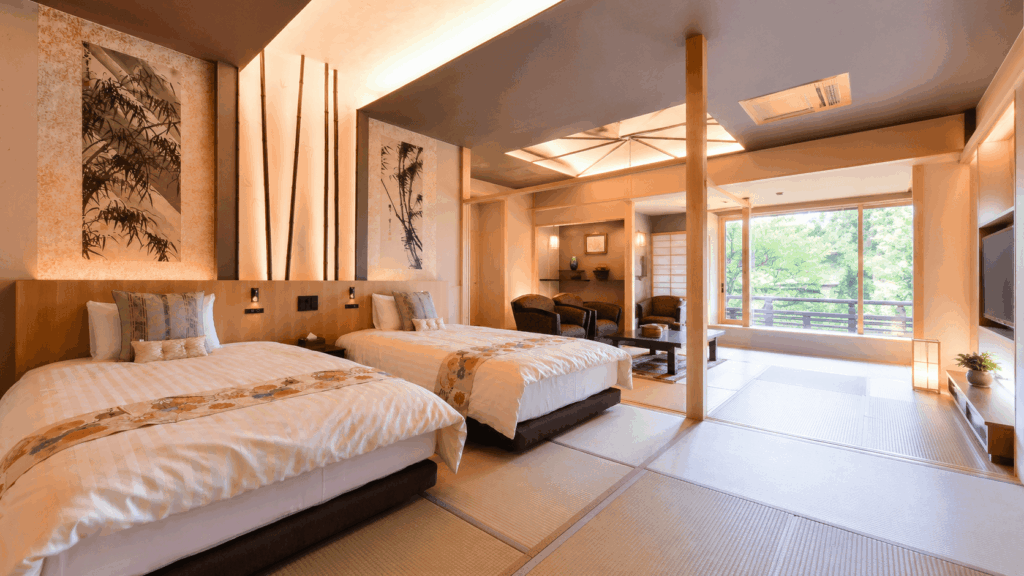
If you decide the guided tour is right for you, here is the practical sequence most travellers find smoothest:
- Choose and book your temple stay first. Knowing your temple’s curfew, bath hours, and location will determine whether the tour is feasible and which departure works.
- Check availability for the tour on the AWESOME TOURS official booking page. From March through November, tours frequently sell out — booking 2–4 weeks ahead is recommended, and longer for autumn foliage season (late October–early November).
- Book the tour using your preferred date and receive your Tour Pass by email or confirmation page. The pass includes the meeting point, meeting time, and all practical instructions.
- Contact your temple to confirm the evening logistics: confirm dinner time (can it be earlier?), confirm bath hours and whether a post-tour bath is possible, and confirm the curfew (or absence of one).
- Save the tour operator’s contact information and your temple’s front desk number. In the event of sudden weather changes or a late arrival, having both numbers gives you options.
Important: If your temple is Renge-in (蓮華院) or Sainan-in (西念院), the tour is unfortunately not possible — these temples enforce a strict 21:00 curfew, and the tour return time of approximately 20:20 plus travel makes a timely return unrealistic. If you are booked at either temple, ask about switching lodging or plan a self-guided daytime visit instead.
Frequently Asked Questions
Can I walk Okunoin alone at night without a tour?
Yes. The entire Okunoin cemetery path is open 24 hours, there is no gate, no fee, and no restriction on walking it independently at night. The main path from Ichinohashi to the mausoleum is lit by lanterns and lamps — dim but walkable. The caveat is that walking it alone without having visited during the day can feel disorienting in the darker sections. Most travellers who succeed at a self-guided night walk recommend doing a daytime scouting walk first.
Is the Okunoin Night Tour operated by Ekoin temple?
No. The tour is operated by AWESOME TOURS, a licensed independent travel agency. Ekoin temple does not run any nightly guided tour. The confusion arises because the tour’s meeting point (TAIRA Cafe & Souvenir Shop) is located immediately next to Ekoin’s entrance. Staying at Ekoin is not required to join the tour, and booking Ekoin does not automatically include a spot on the tour.
What time does the Okunoin Night Tour start and end?
The tour departs from the meeting point at approximately 19:00–19:15 and ends at Okunoin Gobyo (the Inner Sanctuary) around 20:20. After the tour ends, the guide escorts the group to a bus stop for the return to central Koyasan (bus fare included). Total duration is approximately 80 minutes covering about 3 km.
Is the night tour scary? Will I be walking in total darkness?
The walk is atmospheric but not dangerous. The main path is illuminated by stone lanterns and overhead lamps — not as bright as a city street, but enough to walk without a flashlight in most sections. The guide uses a small directional light for navigation. The experience is more solemn and contemplative than frightening. However, if you are uncomfortable with cemeteries at night in general, the self-guided daytime option may be a better fit.
Can I go inside Torodo (Lantern Hall) at night?
No. The Torodo worship hall closes at approximately 17:00 (last entry around 17:30). This is true for all indoor temple buildings on Koyasan including Kongobu-ji and the halls of Danjo Garan. A night visit to Okunoin is exclusively an outdoor experience — you can walk the path, stand before the Torodo exterior, and feel the atmosphere, but you cannot enter the building or see the eternal flames from inside.
What if my temple has a 21:00 curfew — can I still do the tour?
It depends on your temple’s location. If your temple is within a 10–15 minute bus ride from the mausoleum (most temples in central Koyasan near Senjuin-bashi), you can arrive back by approximately 20:45–20:55, which leaves enough margin. If your temple is a 20+ minute walk from the bus stop area, you may arrive too close to curfew for comfort. Renge-in (蓮華院) and Sainan-in (西念院) are known to enforce a strict 21:00 curfew that makes the tour impossible — check before booking if you are staying at either.
Can I have dinner and still make the 19:00 tour start?
Yes, but the timing is tight. Most temples serve dinner at 17:30–18:00. If your temple can serve dinner at 17:00 or 17:30 and you finish by 18:15–18:30, you have enough time to walk or take a short bus ride to the TAIRA Cafe meeting point by 18:55. The safer approach is to bathe before the tour (17:00–18:00), eat quickly, and check in at 18:30. If your temple cannot adjust the dinner timing, consider eating a lighter meal and arriving at the meeting point on time.
Is the tour worth ¥6,000+ per person?
It depends on what you value. The tour offers historical and religious context that you will not get walking alone, a structured route with a guide who manages navigation and pace, and assisted return transport. For first-time visitors who want to understand what they are seeing, travellers say it adds a layer of meaning that transforms the walk. For repeat visitors, those who prefer silence, or those who feel confident navigating the path independently, the ¥6,000+ may be better spent elsewhere — the self-guided walk is free and, for many, equally memorable.
Can children join the Okunoin Night Tour?
The tour has a minimum age requirement of 6 years old. The 3 km route over uneven stone paths and stairs, combined with the group pace and low-light conditions, makes it unsuitable for younger children. Strollers are not permitted. For families with children under 6, a self-guided daytime visit to Okunoin is the better option.
What happens if it rains on the tour date?
The tour operates in light rain. Participants should bring a rain layer — umbrellas are awkward on the narrow cemetery path. If severe weather (storm warnings) is forecast, the operator cancels and issues a full refund. The cancellation decision is communicated by email before 18:40 on the tour date. If there is any doubt, check your inbox and the weather forecast that afternoon.
Do I need to book the tour far in advance?
From March through November, tours frequently sell out, especially in autumn foliage season (late October–early November). Booking 2–4 weeks ahead is recommended during peak periods. In winter (December–February), last-minute availability is more common, but advance booking is still wise to secure your preferred date.
Final Verdict: Which Option Is Right for You?
Koyasan after dark is worth experiencing, but not everyone needs a guided tour to do it. Here is how to decide based on your travel style and circumstances:
Choose the guided Okunoin Night Tour if…
- This is your first visit to Koyasan and you want to understand the religious and historical significance of what you are seeing — the stories of Kobo Daishi, the meaning of the tombstones, and the legends of the cemetery
- You are travelling alone and would feel more comfortable in a group than walking a dark cemetery path by yourself
- You prefer a structured experience with someone else handling navigation, timing, and return logistics
- You want to be sure you see the full route without wondering if you missed something in the dark
- You appreciate being with a guide who can answer questions about what you encounter along the way
Choose the self-guided night walk if…
- You have already walked Okunoin during daylight and know the route — the night visit becomes a purely atmospheric extension rather than an exploration
- You prefer silence over commentary — walking the cemetery alone at night is a meditative experience in a way that group conversation interrupts
- You are comfortable with night navigation on uneven, dimly lit terrain and do not need return assistance
- You are on a tight budget and the ¥6,000+ per person is significant relative to your overall trip cost
- Your temple is very close to the cemetery entrance (like Ekoin, steps from Ichinohashi) and you can easily walk to and from the path on your own schedule
For first-time overnight visitors making a single choice
If you are only staying one night on Koyasan and want to make the most of the evening, the guided tour is the safer bet. It ensures you see the cemetery properly, learn its significance, and return to your temple without navigation stress. The cost is the main downside — if ¥6,000+ feels steep, the self-guided option combined with a daytime walk of Okunoin is a strong alternative.
For travellers with a tight schedule
If you arrive at Koyasan after 15:00 and have dinner at 17:30, you can still make the 19:00 tour — but you will need to skip the bath until after the tour (which only works if your temple’s bath stays open past 21:00) or bathe before dinner (17:00–17:30). If neither timing works, the self-guided walk is more flexible: you can step out after dinner, walk as far as you feel comfortable, and turn back whenever you like.
For families with children
The guided tour accepts children aged 6 and older, but the 3 km route and evening conditions can be tiring for younger kids. A self-guided daytime visit followed by an optional short evening walk (stopping at Ichinohashi or the initial lit section) is a more realistic plan for families with primary-school-aged children.
For repeat visitors to Koyasan
If you have visited Okunoin before — especially if you have done the night tour on a previous trip — the self-guided walk is the better choice. You already know the context, and the freedom to walk at your own pace and linger in places you remember adds a layer of personal connection that a group tour cannot replicate.

Hi, I’m Kai. I’m a Tokyo-based travel writer, tourism industry insider, and the author of a published guidebook for international visitors to Japan. With over 10 years of professional experience at a leading Japanese tourism company, my mission is to help you skip the tourist traps and navigate Japan’s best destinations like a local. I believe the perfect day trip is like a traditional kaiseki meal: a beautiful balance of precise planning and unforgettable seasonal discovery. When I’m not out conducting field research, you’ll usually find me drafting new itineraries with one of my favorite fountain pens!