
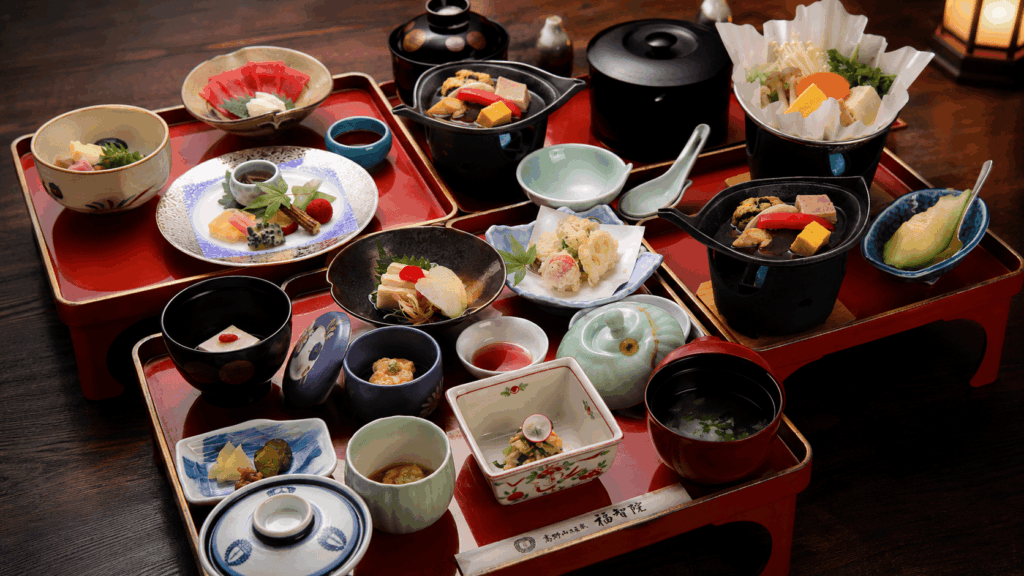
Koyasan is one of Japan’s most sacred destinations—but its dining scene works differently from what most travelers expect. Lunch options are manageable if you plan around your sightseeing route. Dinner, on the other hand, is where many first-time visitors run into trouble. This guide breaks down where to eat in Koyasan by meal type, traveler style, and location, so you can focus on the temples rather than where your next meal is coming from.
Planning Koyasan as a day trip from Osaka? A guided full-day option with a traditional shojin ryori lunch can remove both the transport and meal-planning guesswork. Check live dates, pickup details, and which option includes lunch for the Mount Koya cultural small-group day tour.
The Short Answer: Where Should You Eat in Koyasan?
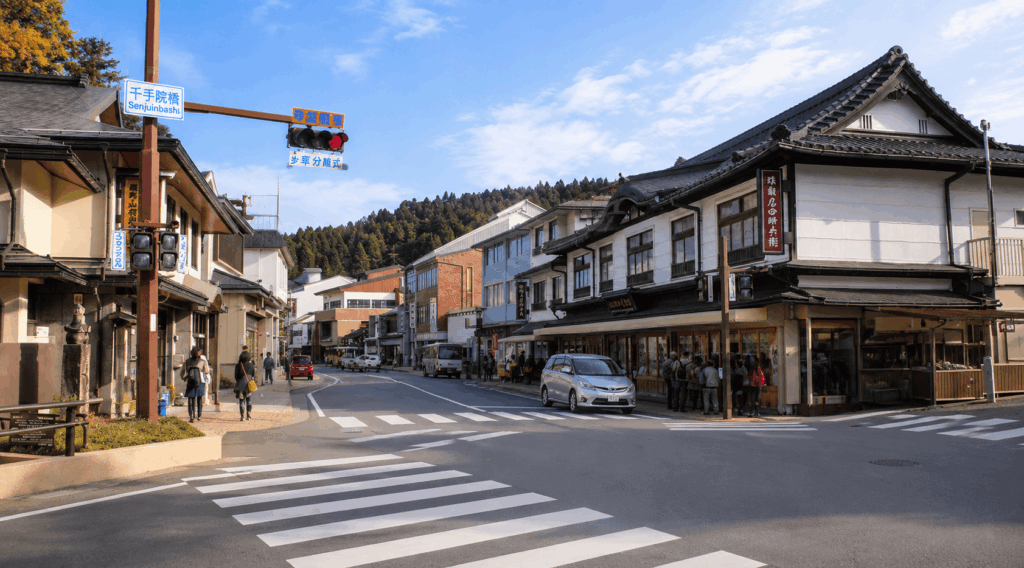
If you are visiting Koyasan as a day-tripper, plan your lunch around the Senjuin-bashi area near the main bus stop—this is where most restaurants are concentrated. Aim to eat between 11:00 AM and 1:30 PM. Most lunch spots close by 4:00 PM at the latest, and several are closed on Tuesdays and Wednesdays.
If you are staying overnight, book a temple lodging (shukubo) that includes dinner and breakfast. Traditional shojin ryori dinner served at the temple is not only a cultural experience—it is also the most reliable way to have a proper evening meal in Koyasan.
This advice is based on the most common feedback from travelers: many arrive expecting Koyasan to have the same restaurant density as Kyoto or Osaka, and find themselves with few evening choices.
Quick Guide: Choose Your Meal by Traveler Type
| If you are… | Best choice | Area | Reservation | Budget |
|---|---|---|---|---|
| A day-tripper wanting a quick, affordable lunch | Chuo Shokudo Sanbo | Senjuin-bashi / center | Not needed | ¥1,000–2,200 |
| Looking for your first shojin ryori experience | Hanabishi | Senjuin-bashi | Recommended (walk-in OK) | ¥2,000–5,000 |
| Vegetarian or vegan and want a casual café | Bon On Shya | Center | Not needed | ¥800–1,500 |
| Wanting to try goma-dofu (sesame tofu) specifically | Kadohama Gomatofu Daimon Gate | Near Daimon Gate | Not needed | ¥1,000–3,000 |
| Aiming for a full temple lunch experience | Ekoin or Nishimuro-in | Temple grounds | Required | ¥3,800–7,800 |
| Staying overnight without temple dinner | Temple Cafe Seikeiin | Center | Recommended | ¥1,500–3,000 |
| In need of a backup or emergency snack | FamilyMart Koyasan | Center | Not needed | ¥300–1,000 |
Best Places to Eat in Koyasan by Type of Traveler
Best for a First Shojin Ryori Experience: Hanabishi
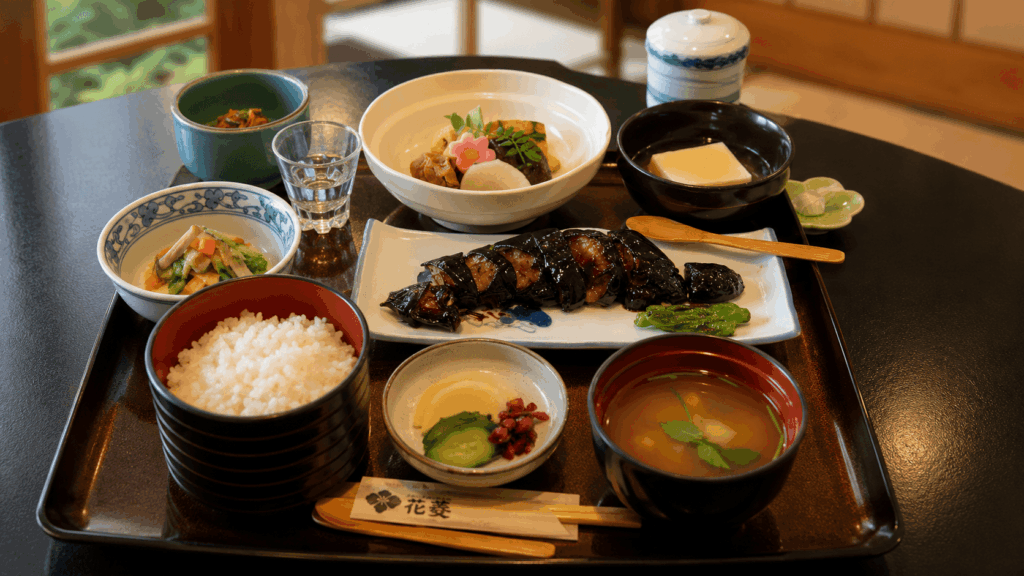
For most first-time visitors, Koyasan Cuisine Hanabishi (花菱) is the most practical choice for a proper shojin ryori lunch without a temple stay. Located right in front of the Senjuin-bashi bus stop—the main bus stop in central Koyasan—it is hard to miss and fits naturally into any sightseeing route.
Hanabishi serves traditional shojin ryori (Buddhist vegetarian cuisine) alongside other Japanese dishes, offering a balanced menu for those who want to try temple-style food without committing to a full multi-course meal. The restaurant has been a fixture in Koyasan for years and is one of the few places where walk-ins are generally accepted.
Good to know: Hanabishi is open 11:00 AM to 6:00 PM and closed on Tuesdays. In addition to regular weekly closures, the restaurant publishes irregular closing dates on its official website several months in advance. As of mid-2026, multiple closing dates were listed through November—so checking their site before visiting is worth the minute it takes. Prices were revised upward in March 2025, and the menu now reflects moderate to higher-end pricing depending on the course selected.
| Detail | Information |
|---|---|
| Hours | 11:00 AM – 6:00 PM |
| Closed | Tuesdays + irregular closing dates (check official site) |
| Budget | ¥2,000–5,000 |
| Reservation | Recommended but walk-ins accepted |
| English menu | Available |
| Vegetarian / Vegan | Shojin ryori options available; not all dishes are strictly vegan |
Best for: Travelers who want their first taste of shojin ryori in a restaurant setting, conveniently located near the main bus stop.
Not ideal for: Late afternoon diners (last orders are well before 6:00 PM) or anyone arriving on a Tuesday.
Best Casual Local Lunch: Chuo Shokudo Sanbo
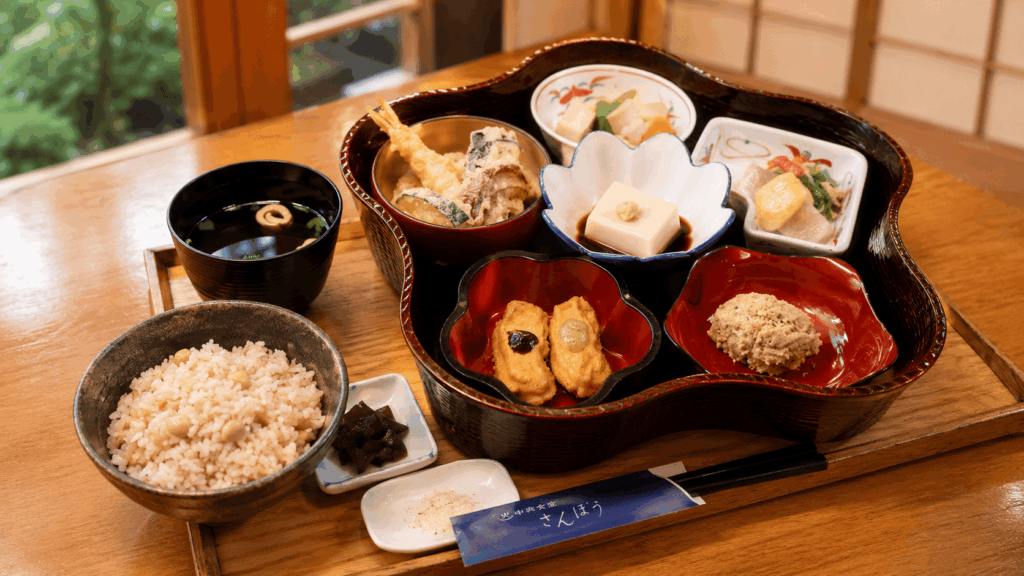
Chuo Shokudo Sanbo (中央食堂・さんぼう) is a family-run restaurant in the heart of Koyasan that serves affordable shojin-inspired set meals. If you are on a day trip with limited time and want a solid, no-surprises lunch, this is a reliable option that many travelers return to.
The menu includes tofu-based set meals, vegetarian sets, and local specialties at prices that are notably lower than most other sit-down restaurants in Koyasan. English menus are available, and the staff are accustomed to foreign visitors.
Good to know: Open 11:00 AM to 4:00 PM (last orders around 3:30 PM). Closed on Tuesdays. The restaurant operates on a first-come, first-served basis, and during peak travel months (spring and autumn), it can fill up by 1:00 PM. Arriving early for lunch is the common recommendation among frequent visitors.
| Detail | Information |
|---|---|
| Hours | 11:00 AM – 4:00 PM (LO ~3:30 PM) |
| Closed | Tuesdays |
| Budget | ¥1,000–2,200 |
| Reservation | Not accepted / First-come, first-served |
| English menu | Available |
| Vegetarian / Vegan | Vegetarian-friendly; vegan options available with clarification |
Best for: Budget-conscious travelers, solo diners, and anyone who wants a quick, filling meal between temple visits.
Not ideal for: Those seeking a formal dining atmosphere or an extensive evening menu.
Best Vegetarian Café: Bon On Shya
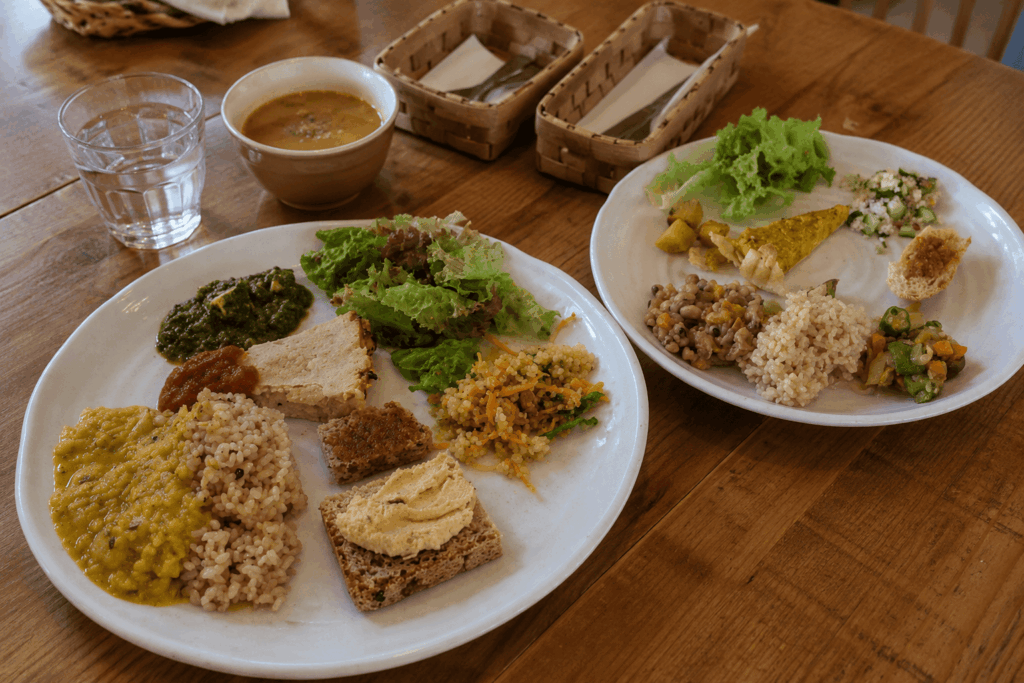
Bon On Shya (梵恩舎) is the only dedicated vegetarian café in Koyasan and a welcome find for travelers who have been living on convenience-store snacks. The menu focuses on plant-based lunch sets, homemade baked goods, and tea, with light meals that are a world away from the formal multi-course temple cuisine.
The café has a relaxed, international atmosphere and is run by owners who speak English. It is located within walking distance of the main bus stop, about 150 meters past the traffic lights on the main road through town.
Good to know: Open Wednesday through Sunday, approximately 6:30 AM to 5:00 PM, with lunch service starting around 11:30 AM. Closed on Mondays and Tuesdays. The café is a small operation, and the lunch menu may sell out before closing time if it is a busy day. A recurring observation among visitors is that arriving around 11:30 AM to 12:00 PM gives you the best choice of what is available.
| Detail | Information |
|---|---|
| Hours | Wed–Sun 6:30 AM – 5:00 PM (Fri until ~4:00 PM) |
| Closed | Mondays and Tuesdays |
| Budget | ¥800–1,500 |
| Reservation | Not needed |
| English menu | Available |
| Vegetarian / Vegan | Vegetarian café with vegan options |
Best for: Vegetarians, vegans, and anyone craving a light, café-style meal in a relaxed setting.
Not ideal for: Large groups, anyone looking for a full-course dinner, or travelers visiting on a Monday or Tuesday.
Best for Goma-Dofu: Kadohama Gomatofu Daimon Gate
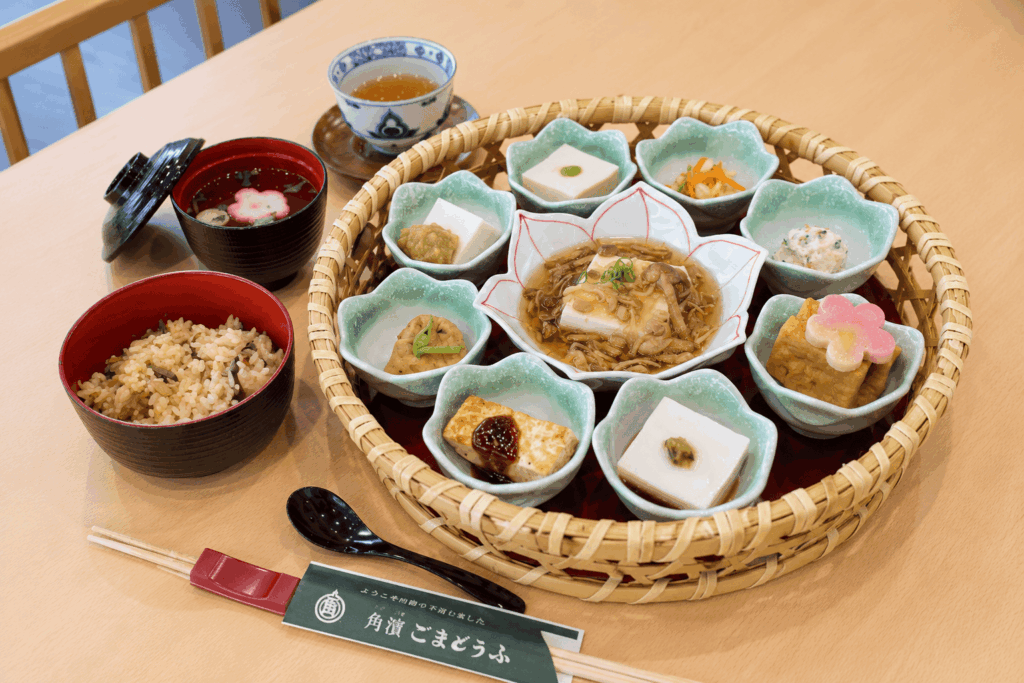
If you want to try goma-dofu (sesame tofu)—Koyasan’s most famous local specialty—Kadohama Gomatofu Daimon Gate is the place to go. This long-established restaurant, founded in 1927, is located just a four-minute walk from the Daimon Gate, the main entrance to the Koyasan temple complex. It supplies its goma-dofu to local temples, which gives you a sense of its standing in the community.
The menu includes goma-dofu sets, shojin ryori courses, and kaiseki meals, with a winter option of soy milk hot pot. There is also a small souvenir corner where you can buy packaged goma-dofu and goma-dofu baumkuchen to take home.
Good to know: Open 9:30 AM to 5:00 PM (meal service stops before closing). The restaurant offers both indoor tatami seating and a terrace for milder weather. Because it is positioned near Daimon Gate rather than the central Senjuin-bashi area, it works well as a stop if you are visiting Danjo Garan or entering Koyasan from the Daimon side.
| Detail | Information |
|---|---|
| Hours | 9:30 AM – 5:00 PM |
| Closed | Irregular (check before visiting) |
| Budget | ¥1,000–3,000 |
| Reservation | Not typically needed |
| English menu | Limited |
| Vegetarian / Vegan | Shojin ryori options available; goma-dofu is plant-based |
Best for: Anyone curious about Koyasan’s signature dish, travelers exploring the Daimon–Danjo Garan area, and those who want a lighter meal rather than a full-course temple lunch.
Not ideal for: Late-afternoon visitors or those looking for dinner (it closes at 5:00 PM).
Best Book-Ahead Temple Lunch: Ekoin or Nishimuro-in
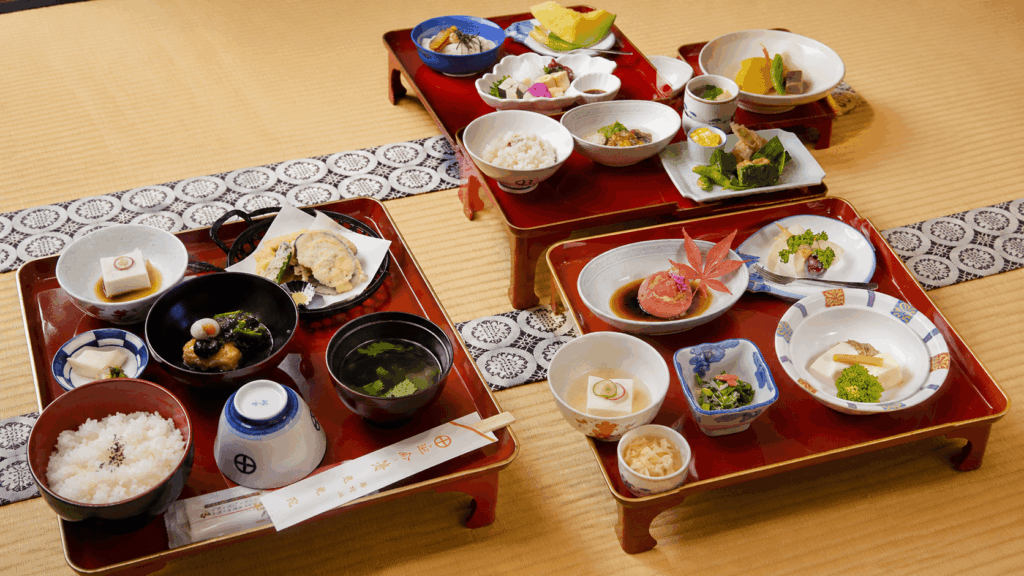
For a shojin ryori experience inside an active temple, two temples in Koyasan offer lunch to non-guests by advance reservation: Ekoin (恵光院) and Nishimuro-in (西室院). These are not restaurants but actual temple dining rooms, where the meal is part of the spiritual setting.
Ekoin offers a lunch menu with three tiers of shojin ryori courses: the Ume Meal (simple, approximately 9 dishes) at ¥3,800, the Take Meal (standard, approximately 10 dishes) at ¥5,800, and the Matsu Meal (deluxe, approximately 12 dishes) at ¥7,800. A gluten-free meal option is also available at ¥5,800. Lunch is served between 11:00 AM and 1:00 PM, and reservations are required—walk-ins are not accepted.
Nishimuro-in offers a seasonal shojin ryori lunch course in two seatings, generally at 11:00 AM and 1:00 PM. The temple emphasizes the connection between the ingredients, the vessels, and the seasonal setting. Reservations are made through the official booking platform.
Good to know: Both temples require reservations in advance—do not assume you can show up on the day. If you have a food allergy, Ekoin requests at least one week’s notice to prepare alternative ingredients. These temple lunches are best suited to travelers who have the time to sit for a full meal and want the cultural depth that comes with eating inside a functioning Buddhist temple.
| Detail | Ekoin | Nishimuro-in |
|---|---|---|
| Lunch time | 11:00 AM – 1:00 PM | Two seatings (~11:00 AM / ~1:00 PM) |
| Budget | ¥3,800 – ¥7,800 | Moderate–higher (check booking page) |
| Reservation | Required | Required |
| Gluten-free | Available (advance notice required) | Inquire directly |
| Vegetarian / Vegan | Shojin ryori—naturally vegetarian; vegan-compatible with confirmation | Shojin ryori—naturally vegetarian; vegan-compatible with confirmation |
Best for: Travelers seeking an authentic temple dining experience, those with dietary restrictions who plan ahead, and anyone wanting a memorable lunch that goes beyond just eating.
Not ideal for: Spontaneous visitors, tight schedules, or anyone who prefers a quick, casual meal.
Where to Eat Based on Your Sightseeing Route
Near Senjuin-bashi and Kongobu-ji
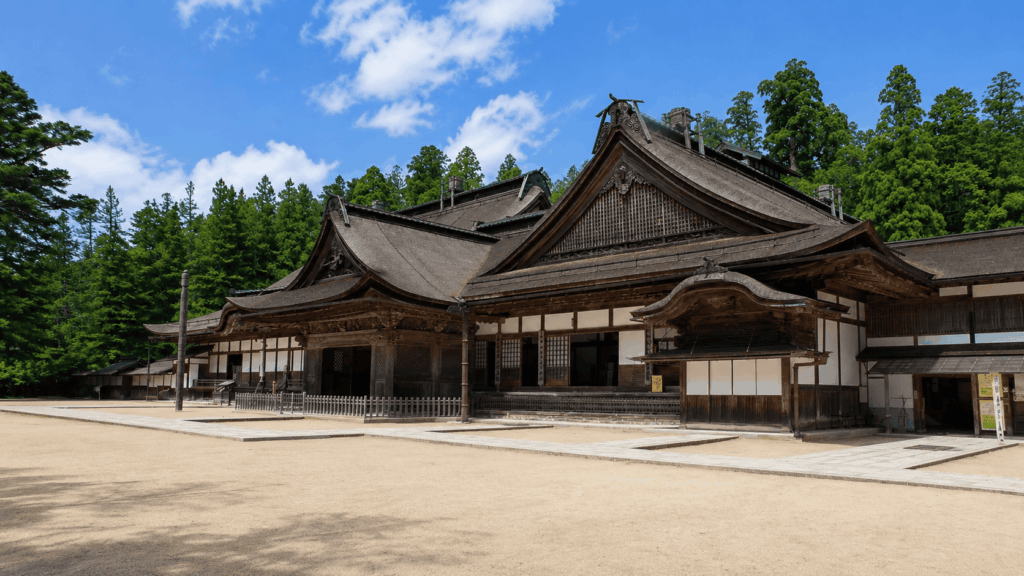
This is the most restaurant-dense area in Koyasan. The Senjuin-bashi bus stop is the main transport hub, and Kongobu-ji—the head temple of Shingon Buddhism—is a short walk away. If you base your lunch around this area, you will have the widest selection of options.
Within a few minutes’ walk, you can reach Hanabishi (right at the bus stop), Chuo Shokudo Sanbo, and Bon On Shya. This means you can have a backup plan if your first choice is full or closed. A common traveler tip that emerges from reviews is to decide on a primary option and note a secondary one in the same area—because several restaurants close on Tuesdays, and a surprising number of visitors arrive on that day without realizing it.
Walk from the bus stop: Hanabishi is immediately in front of the stop; all other options are within 3–5 minutes on foot.
Near Danjo Garan and Daimon
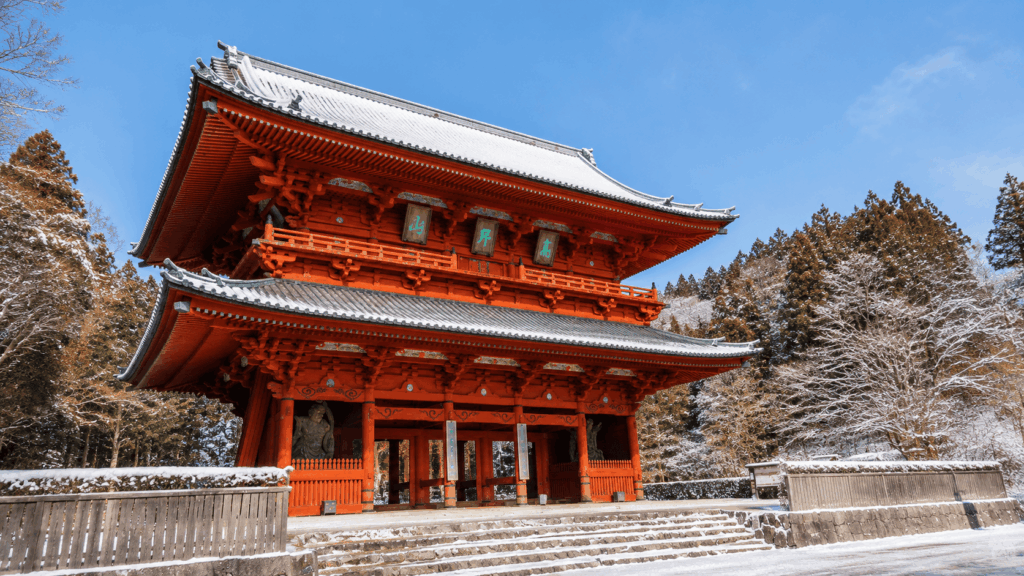
The area around Danjo Garan and the Daimon Gate has fewer dining options than the central Senjuin-bashi area, but Kadohama Gomatofu Daimon Gate is the go-to choice if you are exploring this side of Koyasan. Located about four minutes on foot from the Daimon Gate, it is the only sit-down restaurant in this immediate vicinity.
Because restaurant density is low here, a practical approach is to visit Kadohama during its operating hours (9:30 AM – 5:00 PM) and, if it is unexpectedly closed or crowded, head back toward Senjuin-bashi—roughly a 10-minute walk or a short bus ride away—where the backup options are. This is one of those details that becomes clear only when you look at the map and the hours side by side: the distance is walkable, but if you are hungry after a long visit to Danjo Garan, a 10-minute walk to find an alternate restaurant can feel longer than expected.
Walk from Daimon Gate: About 4 minutes to Kadohama; approximately 10 minutes on foot back to the Senjuin-bashi restaurant cluster.
Before or After Visiting Okunoin
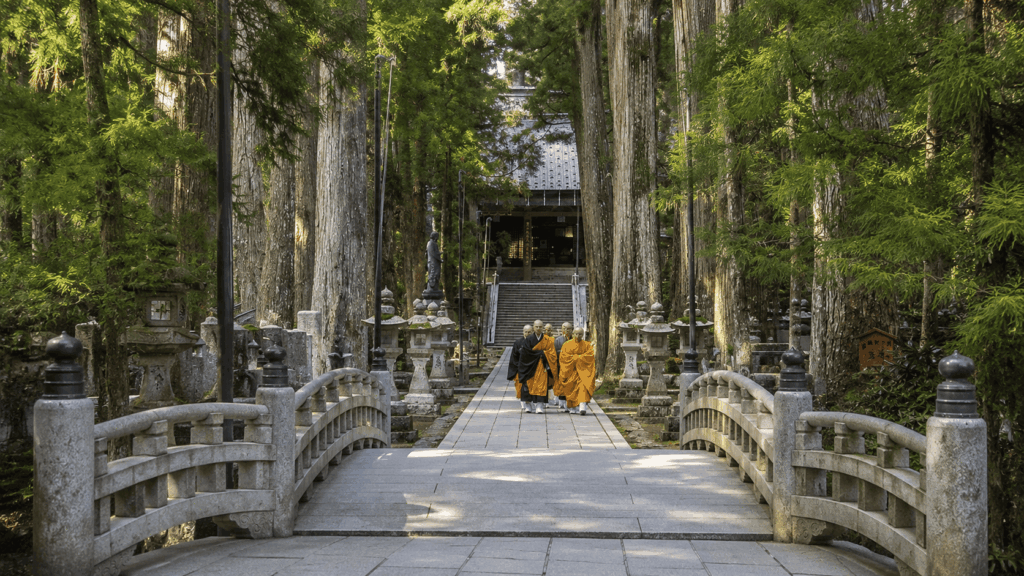
Okunoin, Koyasan’s most sacred site, sits at the eastern edge of the temple complex. There are no restaurants immediately inside the Okunoin grounds or along the main walking path through the mausoleum. If you plan to visit Okunoin—which takes most visitors 30 minutes to an hour, depending on how far you walk—your best strategy is to eat before heading there or after returning to the central area.
The closest dining options to Okunoin are in the Senjuin-bashi area, roughly a 10-minute bus ride or a 20-minute walk back. Many day-trippers make the mistake of visiting Okunoin in the late afternoon, only to find that restaurants in the center have stopped serving lunch by the time they return. A recurring tip among travelers is to plan your meal before Okunoin if you are on a day trip, and save the Okunoin walk for after 2:00 PM when lunch is behind you.
Walk from Okunoin entrance to nearest restaurants: Approximately 20–25 minutes on foot; 10 minutes by bus (Okunoin-mae stop to Senjuin-bashi stop).
Shojin Ryori, Goma-Dofu, and Other Foods to Try
What Is Shojin Ryori?
Shojin ryori (精進料理) is the traditional Buddhist vegetarian cuisine of Japan, developed in Zen monasteries and now served in temples across Koyasan. At its core, it is a plant-based cuisine that avoids meat, fish, and animal products, rooted in the Buddhist principle of not taking life.
However—and this is a point worth understanding before you order—shojin ryori as served in Koyasan is not automatically strict vegan by modern Western definitions. Many shojin ryori dishes use dashi (broth) made from kombu (kelp) and dried shiitake rather than bonito flakes, but some establishments may still incorporate fish-based stock in certain dishes. Additionally, honey and sake (rice wine) are sometimes used. If you follow a strict vegan or vegetarian diet, it is always worth confirming the details with the specific restaurant or temple before ordering.
For most travelers, trying shojin ryori in Koyasan is as much about the cultural and aesthetic experience as it is about the food itself—the careful arrangement of seasonal ingredients, the lacquerware, the silence of the temple dining hall. Approaching it with that expectation tends to yield a more satisfying experience than expecting a hearty meal.
Goma-Dofu vs. Koya-Dofu
Two local specialties appear on almost every menu in Koyasan: goma-dofu (sesame tofu) and koya-dofu (freeze-dried tofu, also spelled koyadofu). They are completely different foods, and travelers frequently confuse the two.
Goma-dofu is made from ground sesame seeds and kudzu starch (or arrowroot), giving it a smooth, pudding-like texture with a rich, nutty flavor. It is not actually tofu in the soybean sense—it contains no soy at all. Its texture is closer to a firm panna cotta, and it is typically served chilled with a small amount of soy sauce or wasabi.
Koya-dofu, on the other hand, is a traditional freeze-dried tofu product that originated at Koyasan’s temples. It has a spongy texture that absorbs broth well, and it is commonly served simmered in a light soy-based sauce. It is more akin to a protein-rich ingredient in a cooked dish than a standalone item.
Both are available at Kadohama Gomatofu Daimon Gate, and packaged versions can be purchased at the shop’s souvenir counter to take home.
Lunch in Koyasan: The Easiest Meal to Plan
Best Lunch Timing for a Day Trip
For day-trippers arriving from Osaka or Kyoto, the most common arrival time at Koyasan is between 10:00 AM and 11:00 AM. This gives you an ideal lunch window from 11:00 AM to 1:30 PM, when all restaurants are open and fully stocked.
A commonly reported pattern among visitors is this: they arrive, head straight to Okunoin or Kongobu-ji, and then realize at 2:00 PM that they have not eaten and the restaurants are closing or have run out of some menu items. To avoid this, a simple rule is to treat lunch as a fixed point in your itinerary—build your sightseeing route around a meal stop between 11:30 AM and 1:00 PM rather than treating it as something you will fit in when you get hungry.
| Arrival time | Ideal lunch window | What to watch out for |
|---|---|---|
| 10:00–11:00 AM | 11:00 AM – 1:00 PM | Busy period—popular spots may have a wait |
| 11:00 AM–12:00 PM | 11:30 AM – 1:30 PM | Good timing; most restaurants are open |
| 12:00–1:00 PM | Eat immediately on arrival | Peak lunch rush; limited seating at smaller cafés |
| After 2:00 PM | Check closing times carefully | Many kitchens close by 2:30–3:30 PM |
Do You Need a Reservation for Lunch?
The answer depends on where you want to eat and when. To simplify the decision:
- No reservation needed: Chuo Shokudo Sanbo, Bon On Shya, Kadohama Gomatofu Daimon Gate. Walk-in is standard for these places.
- Reservation recommended: Hanabishi. Walk-ins are accepted, but if you have your heart set on it, calling ahead or booking via their website gives you peace of mind.
- Reservation required: Ekoin and Nishimuro-in temple lunches. Without a reservation, you will not be seated.
A question that comes up frequently is whether you can book on the same day for lunch. For the walk-in-friendly restaurants, that is not an issue—you just show up. For Ekoin or Nishimuro-in, same-day bookings are generally not possible, so plan at least one day ahead.
If you want a proper shojin ryori experience but do not want to coordinate trains, buses, lunch reservations, and the main temple sights separately, this is the guided option worth comparing.
Why I’d book this one
- The guide-and-driver option combines a traditional shojin ryori lunch with major Koyasan sights, including Okunoin, Kongobu-ji, and Danjo Garan.
- Pickup from central Osaka removes several transport connections and makes it easier to protect Koyasan’s limited lunch window.
- Recent traveler feedback highlights knowledgeable guidance and the combination of temple food with hands-on cultural experiences.
Check the package details before confirming: the driver-only option does not include lunch, and inclusions and operating conditions vary by the option selected.
Dinner in Koyasan: Why a Temple Stay Is Usually Easier
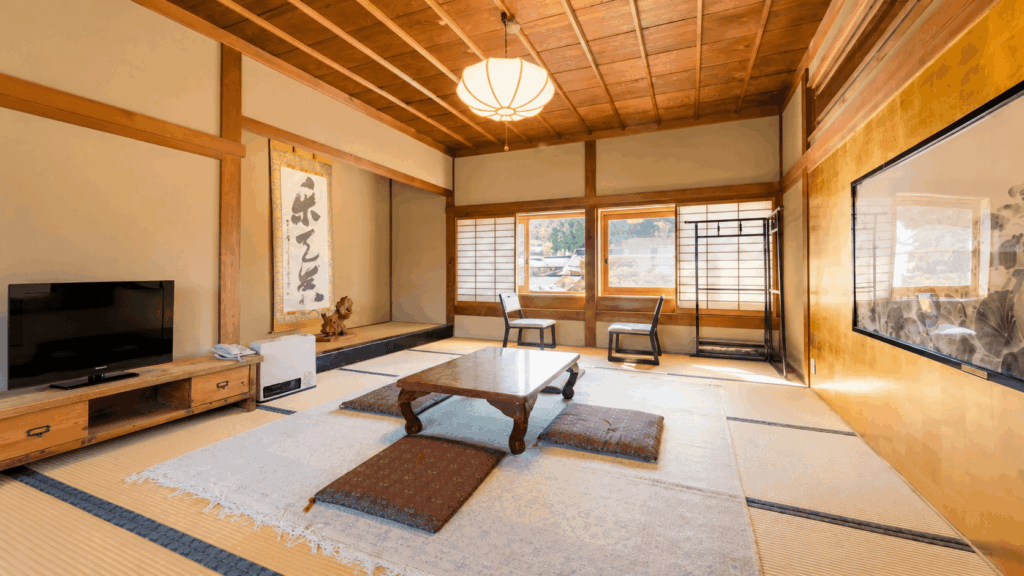
Dinner is the weak point of Koyasan’s food landscape, and it is the one aspect of dining that catches most visitors off guard. After sunset—which comes early in the mountains—the streets of Koyasan are quiet, and very few restaurants remain open for evening service.
This is not a case of a few restaurants happening to close early. The reality is that the vast majority of dining options in Koyasan’s central area are lunch-only or close between 4:00 PM and 5:00 PM. If you are staying overnight and have not arranged dinner through your accommodation, your evening meal choices will be very limited.
This is why the most common advice repeated across traveler forums is consistent: if you are staying overnight in Koyasan, book a temple stay (shukubo) that includes evening shojin ryori and breakfast. It solves the evening meal problem, adds a layer of cultural depth to your visit, and—when you compare the costs—often works out as better value than paying for a room and hunting for dinner separately.
Temple Dinner vs. Eating Out — Comparison Table
| Factor | Temple stay with dinner | Eating out independently |
|---|---|---|
| Certainty | Guaranteed—dinner is part of your booking | Low—only 2–3 restaurants confirmed open for dinner |
| Cultural experience | High—shojin ryori in a temple dining hall, often with morning prayer access | Variable—depends on the venue |
| Flexibility of timing | Fixed (usually 5:30–7:00 PM) | More flexible but narrow window (most close by 9:00 PM) |
| Cost per person (estimated) | ¥10,000–20,000 (room + dinner + breakfast combined) | ¥1,500–4,000 for dinner only (room booked separately) |
| Dietary requests | Can be arranged with advance notice (Ekoin offers gluten-free) | Limited; ask directly |
| Late arrival risk | Still served if you arrive within check-in window | High—kitchens close early |
| Best for | Overnight visitors who want a seamless, immersive experience | Those who prefer casual dining or have specific dietary needs not met by temple cuisine |
Staying overnight? Check current dates, room plans, and meal inclusions for Koyasan Onsen Fukuchiin before finalising your dinner strategy.
Where Can You Eat Dinner in Koyasan?
Despite the limited evening scene, there are a few options for dinner if you choose not to eat at a temple stay—or if you simply want a change of setting after a temple meal. These are worth knowing about, though they come with caveats.
Temple Cafe Seikeiin (成慶院) is a rare exception to the early-closing rule. A café attached to Seikeiin temple, it serves light dinner options from 6:00 PM to 9:00 PM (last orders around 8:30 PM) in addition to lunch and afternoon café hours. The menu is not a full-course shojin ryori—think smaller plates, drinks, and casual fare—but it is one of the very few places in central Koyasan where you can sit down for a meal in the evening. Closed on Wednesdays. It is located near Danjo Garan, within a comfortable walk from most central accommodations.
Sushi Kameya (すし亀屋) is an evening-only sushi restaurant open from 5:00 PM to 9:00 PM, Monday through Saturday, closed on Sundays. It offers sushi sets and Japanese à la carte dishes. Because it operates only for dinner and has limited seating, a reservation is recommended if you plan to rely on it. Note that this is a sushi-focused restaurant, not a temple-cuisine venue, so it suits a different craving.
Koyasan Guesthouse Kokuu serves a simple home-style curry dinner around 6:00 PM to 7:00 PM. Guests staying at the guesthouse are prioritized, and non-guests should inquire in advance about availability. Orders for dinner must typically be placed by 5:00 PM.
If you find yourself in Koyasan without a dinner plan and the above options are unavailable, FamilyMart Koyasan is open from 7:00 AM to 11:00 PM—it is not open 24 hours, but it can provide a backup meal of onigiri, instant noodles, sandwiches, and drinks. Many travelers have commented that knowing the convenience store is there reduces the stress of evening dining logistics, even if they do not end up needing it.
| Venue | Dinner hours | Closed | Notes |
|---|---|---|---|
| Temple Cafe Seikeiin | 6:00 PM – 9:00 PM (LO ~8:30 PM) | Wednesdays | Light meals, drinks, casual setting |
| Sushi Kameya | 5:00 PM – 9:00 PM | Sundays | Sushi-focused; reservation recommended |
| Koyasan Guesthouse Kokuu | ~6:00 PM – 7:00 PM | Check availability | Home-style curry; guesthouse guests prioritized |
| FamilyMart Koyasan | 7:00 AM – 11:00 PM | None | Backup / emergency meal only |
Is Koyasan Good for Vegetarian, Vegan, and Gluten-Free Travelers?
Vegetarian Does Not Always Mean Strict Vegan
Koyasan is often described as one of Japan’s best destinations for vegetarian travelers, and that reputation is broadly earned—shojin ryori is, after all, a plant-based Buddhist cuisine. However, there is a gap between what the term “”vegetarian”” or “”vegan”” means in a Western context and how it is interpreted in Koyasan’s kitchens.
Most restaurants and temples in Koyasan can accommodate vegetarian diets without issue. For strict vegan travelers, the situation is more nuanced. Some shojin ryori dishes may incorporate dashi made from ingredients that are plant-based (kombu and shiitake), which is fine, but others may use fish-based stock in side dishes that are not labeled as such. Honey and sake appear in certain preparations. The safest approach is to confirm with each restaurant or temple directly, using a clearly worded question in Japanese or English.
For gluten-free travelers, the main ingredient to watch for is soy sauce, which contains wheat. Many shojin ryori dishes use soy sauce in seasoning. Ekoin is one of the few temples in Koyasan that explicitly offers a gluten-free meal option, but it requires at least one week’s advance notice. For other restaurants, gluten-free options are very limited.
Questions to Ask Before Booking
To avoid confusion, here are clear questions you can ask a restaurant or temple in advance:
- “”Do your shojin ryori dishes use any fish-based broth?”” — Vegans and strict vegetarians should ask this even at temples.
- “”Are any of the dishes made with honey or sake?”” — Relevant for strict vegans.
- “”Can you provide a meal without soy sauce or gluten?”” — For gluten-free travelers.
- “”Do you need advance notice for dietary restrictions, and how far in advance?”” — Essential for temple lunches.
- “”Is your menu fully plant-based, or are there eggs or dairy?”” — For vegans.
- “”Can you confirm this in writing or via email?”” — Having a record is helpful if there is a language barrier on arrival.
Bon On Shya is the most straightforward option for vegan and vegetarian travelers in Koyasan—it operates as a vegetarian café and is accustomed to dietary questions. For those staying at a temple, be aware that the temple kitchen prepares the same meal for all guests in most cases, so individual modifications may not always be possible.
Practical Tips to Avoid Going Hungry in Koyasan
Check Opening Hours the Day Before
Several restaurants in Koyasan post irregular closing dates on their official websites or social media. Hanabishi, for instance, announces its monthly closures in advance. Checking these before you arrive—or even the night before—will save you from walking to a closed door at lunchtime. A recurring observation from visitor reviews is that the restaurants most frequently mentioned as “”unexpectedly closed”” are the ones that change their schedules month to month, not the ones with a fixed weekly holiday.
Keep a Backup in the Same Area
Because several restaurants share the same weekly closing day (Tuesday is common for many), and because some close early or run out of popular menu items, having a second option in the same walking area is a simple strategy that reduces stress. If your first choice near Senjuin-bashi is full or closed, you have two or three other restaurants within a five-minute walk. If you are near the Daimon Gate, be aware that your backup will require walking back toward the center.
Carry Cash and a Small Emergency Snack
Most restaurants in Koyasan accept credit cards, but smaller cafés and some temple lunch payments may still be cash-only. Having ¥5,000–10,000 in cash on hand ensures you will not be caught out. Additionally, carrying a small snack—an onigiri or a rice cracker—is common sense given the restaurant density. FamilyMart Koyasan (open 7:00 AM – 11:00 PM) can stock you up for the day, but note that it is not a 24-hour convenience store.
What If Your Accommodation Does Not Include Dinner?
If you have booked a room-only temple stay or a guesthouse without a meal plan, you have three options in order of increasing risk:
- Make a reservation at Temple Cafe Seikeiin or Sushi Kameya before you arrive. This is the most reliable independent dinner option.
- Check if your accommodation offers a meal add-on. Some temples can arrange dinner for non-meal-plan guests if you request it at least a day in advance.
- Prepare your dinner from FamilyMart or bring food from the city (Osaka or Kyoto) before arriving. This is the least glamorous option, but it eliminates the risk entirely.
Many travelers who stay overnight in Koyasan without temple dinner end up wishing they had booked it. If you are weighing the cost difference, compare not just the price of the meal but the convenience and the experience—eating shojin ryori in the temple where you are sleeping, in silence, with the evening temple bells—that is something no outside restaurant can replicate.
Frequently Asked Questions
Is Koyasan good for vegetarian and vegan travelers?
Koyasan is one of Japan’s better destinations for vegetarian travelers because shojin ryori (Buddhist temple cuisine) is plant-based by tradition. Most restaurants and temple stays can accommodate vegetarian diets. For strict vegans, the situation requires more caution—some dishes may use dashi made with fish stock, honey, or sake, and soy sauce (which contains wheat) is widely used. Bon On Shya (a vegetarian café) and Ekoin (which offers a gluten-free meal option with advance notice) are the most reliable choices for travelers with strict dietary requirements. Confirming directly with each restaurant before visiting is recommended.
Can you eat dinner in Koyasan without a temple stay?
Yes, but the options are very limited. As of mid-2026, confirmed evening dining options include Temple Cafe Seikeiin (light meals, 6:00–9:00 PM, closed Wednesdays), Sushi Kameya (sushi, 5:00–9:00 PM, closed Sundays), and Koyasan Guesthouse Kokuu (curry, ~6:00–7:00 PM, guesthouse guests prioritized). FamilyMart Koyasan is open until 11:00 PM as a backup. The most reliable approach is to book a temple stay that includes dinner, or make a reservation at one of the evening venues before you arrive.
What time do restaurants close in Koyasan?
Most restaurants in Koyasan close between 4:00 PM and 5:00 PM. A few accept last orders as early as 2:30–3:30 PM for lunch service. Evening-only venues are the exception rather than the rule. If you are planning a late lunch, aim to be seated by 1:30 PM at the latest to have the widest choice of open restaurants.
Do you need reservations for restaurants in Koyasan?
It depends on the venue. Hanabishi accepts walk-ins but reservations are recommended during peak seasons. Ekoin and Nishimuro-in temple lunches require advance reservations—walk-ins are not accepted. Chuo Shokudo Sanbo, Bon On Shya, and Kadohama Gomatofu Daimon Gate operate on a first-come, first-served basis. For evening dining, a reservation at Sushi Kameya or Temple Cafe Seikeiin is advisable because seating is limited.
What is shojin ryori, and is it the same as vegan food?
Shojin ryori is the traditional Buddhist vegetarian cuisine of Japan. It avoids meat, fish, and animal products, but it is not automatically vegan by strict modern definitions. Some preparations may use dashi made from dried fish, or include honey and sake. The exact ingredients vary by restaurant or temple. If you follow a strict vegan diet, confirm the details with each establishment before ordering.
Where should I eat near Okunoin?
There are no restaurants inside the Okunoin grounds or immediately at the entrance. The nearest dining options are in the Senjuin-bashi area, roughly a 10-minute bus ride or a 20-minute walk away. The common traveler recommendation is to eat before visiting Okunoin if you are on a day trip, or stop for lunch in the central area and then head to Okunoin afterward.
Are restaurants in Koyasan open on Tuesdays and Wednesdays?
Many are closed on Tuesdays. Hanabishi, Chuo Shokudo Sanbo, and Bon On Shya all close on Tuesdays. Bon On Shya is also closed on Mondays. Temple Cafe Seikeiin is closed on Wednesdays. If you are visiting on a Tuesday or Wednesday, checking your restaurant choices in advance is particularly important because your options will be more limited.
Can I buy food to take back to my temple stay?
Yes. Kadohama Gomatofu Daimon Gate sells packaged goma-dofu and snacks at its souvenir counter. FamilyMart Koyasan stocks onigiri, sandwiches, instant noodles, and drinks. Bringing food from Osaka or Kyoto before arriving in Koyasan is also a common practice among travelers who want to ensure they have something for their evening meal or breakfast.
Final Verdict: Where to Eat in Koyasan, by Traveler Type
Koyasan is not a destination where you can wander into any restaurant at any hour and expect to find a meal. The key to eating well here is planning ahead—not because the food is complicated, but because the dining hours are short and dinner options are scarce. Below is how the choices stack up for different travel styles.
For first-time visitors on a day trip: Build your itinerary around a lunch stop between 11:00 AM and 1:00 PM in the Senjuin-bashi area. Choose between Hanabishi (for a proper shojin ryori introduction), Chuo Shokudo Sanbo (for a quick, affordable set meal), or Bon On Shya (for a light vegetarian café lunch). Have a backup in mind in case your first choice is closed—Tuesdays and Wednesdays see multiple restaurant closures.
For overnight visitors: Book a temple stay with dinner and breakfast included. This is the single most practical decision you can make for your Koyasan visit. It guarantees your evening meal, gives you the full shojin ryori experience in a temple setting, and often costs less than a room-only booking plus an independent dinner when you factor in the difficulty of securing the latter.
For travelers with dietary restrictions: Plan ahead more than you normally would. Bon On Shya is the best choice for casual vegetarian and vegan meals. Ekoin can accommodate gluten-free diets with one week’s notice. For all other venues, contact them directly with clear questions about ingredients. Carry cash and a backup snack regardless.
For families or groups: Hanabishi and Chuo Shokudo Sanbo have the space and English menus to handle groups comfortably during lunch hours. Temple lunches at Ekoin or Nishimuro-in are better suited to smaller groups or solo diners who value the quiet atmosphere. For dinner, a temple stay with group dining eliminates the challenge of finding a restaurant that can seat everyone together in the evening.
For budget travelers: Chuo Shokudo Sanbo offers the best value for a sit-down lunch at ¥1,000–2,200. Bon On Shya is also affordable at ¥800–1,500 for a lighter meal. FamilyMart is the cheapest backup option. For accommodation, compare the total cost of a room-only booking plus independent dinner against a dinner-included temple stay—the latter often works out as a better value when you consider what is included.
For travelers who want to experience goma-dofu specifically: Visit Kadohama Gomatofu Daimon Gate near the Daimon. It is the most established goma-dofu specialist in Koyasan, and its location near Danjo Garan makes it an easy addition to your sightseeing route. If you want to bring some home, the shop sells vacuum-packed goma-dofu and goma-dofu baumkuchen at its souvenir counter.

Hi, I’m Kai. I’m a Tokyo-based travel writer, tourism industry insider, and the author of a published guidebook for international visitors to Japan. With over 10 years of professional experience at a leading Japanese tourism company, my mission is to help you skip the tourist traps and navigate Japan’s best destinations like a local. I believe the perfect day trip is like a traditional kaiseki meal: a beautiful balance of precise planning and unforgettable seasonal discovery. When I’m not out conducting field research, you’ll usually find me drafting new itineraries with one of my favorite fountain pens!