
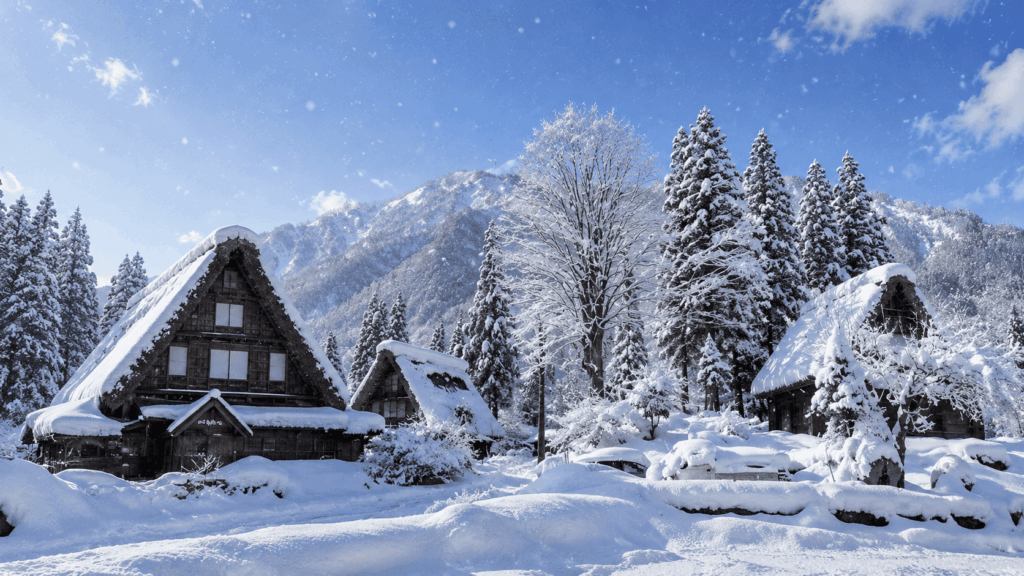
You’ve seen the postcard shot of Shirakawa-go — the steep thatched roofs buried in snow, lit up against a dark winter sky. It’s beautiful. It’s also crowded, heavily touristed, and requires an advance reservation just to see the light-up from a designated time slot.
Gokayama, an hour north into Toyama Prefecture, offers the same gassho-zukuri farmhouses in the snow — but with a fraction of the visitors. Its two UNESCO villages, Ainokura and Suganuma, sit deeper in narrower valleys, where the soundtrack is the rush of the Shogawa River rather than the hum of tour buses. The catch? Winter access requires planning, the famous light-up events are only held a few nights a year, and you cannot see them on a public bus day trip.
This guide tells you exactly when to go for guaranteed snow, how to get there in winter, and whether you need to stay overnight or join a tour — with the practical details most guides leave out.
If you already know you want Gokayama without juggling winter bus times, compare the Kanazawa departure, itinerary, and recent traveler reviews for this GetYourGuide day tour to Gokayama and Shirakawa-go before you lock in your route.
Quick Answer: Is Gokayama Worth Visiting in Winter?
Yes — if you want snow-covered gassho-zukuri farmhouses in a genuinely quiet setting. Gokayama is not Shirakawa-go’s “backup option.” It is a deliberately different experience.
Choose Gokayama in winter if:
- You want to photograph snow-covered farmhouses without crowds in the frame
- You value atmosphere and silence over shops and cafe-hopping
- You can stay overnight or join an evening tour to see the light-up
- You are basing your trip in Kanazawa, Toyama, or Takayama and have a full day to spare
Skip it if:
- You only have a half-day window — the bus journey from Kanazawa or Takaoka takes about 1–1.5 hours each way
- You expect the same level of facilities (multiple restaurants, museums, souvenir shops) as Shirakawa-go
- You need wheelchair-accessible paths through the villages — snow-covered gravel paths can be difficult
Why Gokayama in Winter — and Not Just Shirakawa-go?
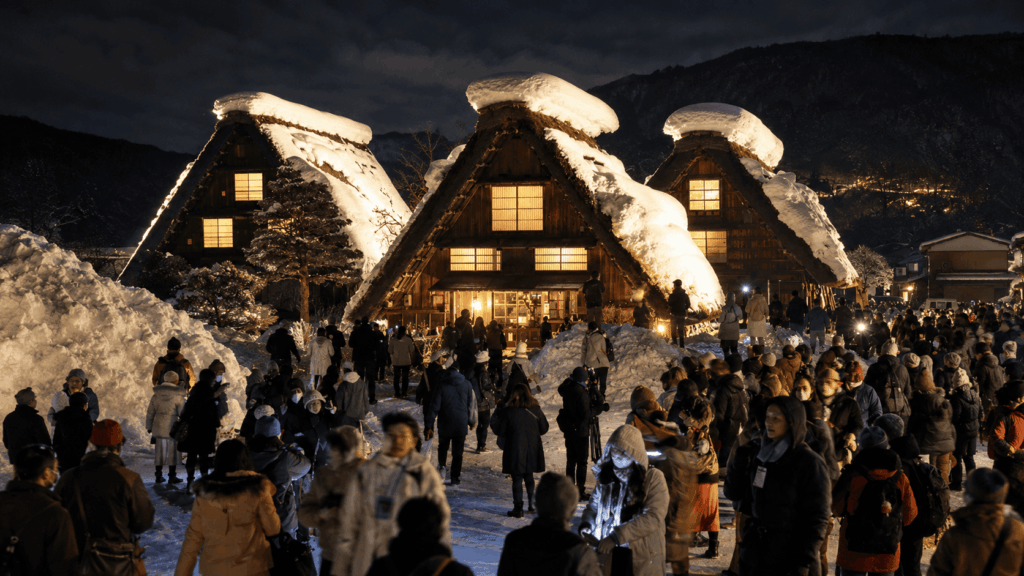
The question most travelers ask is whether Gokayama is different enough from Shirakawa-go to justify the extra travel time. The short answer: the two experiences are further apart than the 45-minute bus ride between them suggests.
| Shirakawa-go (Ogimachi) | Gokayama (Ainokura / Suganuma) | |
|---|---|---|
| Number of farmhouses | 50+ | ~20 (Ainokura) / 9 (Suganuma) |
| Crowd level (winter) | Very high — buses from Nagoya, Takayama, Kanazawa arrive from mid-morning | Low to moderate — a fraction of Shirakawa-go’s visitor numbers |
| Atmosphere | Bustling, commercial — feels like an open-air museum | Quiet, residential — people still live and work here |
| Facilities | Multiple cafes, restaurants, museums, souvenir shops | 2–3 eateries, 1–2 small museums per village |
| Winter access (public transport) | Direct highway buses from Kanazawa, Takayama, Nagoya | World Heritage Bus from Takaoka/Shin-Takaoka (1 hr) |
| Light-up access by public bus | Not possible (last bus departs before light-up starts) | Not possible (same situation) |
What surprises me most when I talk to travelers who have visited both is how different the feeling is. Standing at the Shiroyama viewpoint in Ogimachi, you are sharing the view with a hundred other people jostling for tripod space. In Ainokura, you can walk up to the hillside viewpoint — a five-minute climb from the village center — and find yourself alone with the sound of snow sliding off the roofs. That contrast is the real reason to choose Gokayama.
That said, if you have time, visiting both is straightforward. The World Heritage Bus connects them directly. Many travelers spend the morning in Ogimachi and the afternoon in Ainokura, or vice versa.
Best Time to See Snow in Gokayama (Don’t Get This Wrong)
The single biggest disappointment I hear from winter visitors to Gokayama is arriving to find patchy snow. This is entirely avoidable if you time your visit correctly.
Guaranteed snow: Mid-January through February. This is the peak of winter in the Shokawa Valley. Snow accumulation typically reaches 1–2 meters (3–6 feet) in the villages, and the gassho-zukuri roofs are fully white. Daytime temperatures hover around freezing, and the villages stay consistently snow-covered.
Risky: December. Snow does fall in December, but it melts more frequently. Warm spells can leave the ground bare or slushy, especially in early to mid-December. A visit in late December might reward you with a beautiful blanket of snow — or it might not. If snow-covered gassho-zukuri is your priority, January and February are the safe bets.
Late January to early February also overlaps with the winter light-up events in both Ainokura and Suganuma, so you can combine the best snow conditions with the illuminated evening experience.
March: Snow starts to recede, though the villages can still be partially white, especially early in the month. The light-up events are typically finished by late February.
Kai’s tip: The mistake I see most often is booking a December trip expecting a winter wonderland and finding the village half-brown. If your trip dates are flexible, aim for late January. The snow is at its deepest, the light-up events are usually scheduled around this period, and the combination of blue sky, white roofs, and late-afternoon golden light is extraordinary. If you can only travel in December, set your expectations accordingly — you may still get lucky, but don’t bank on the postcard scene.
Ainokura vs. Suganuma: Which Village Should You Visit?
Both. They are only 15 minutes apart by bus, and the World Heritage Bus stops at both. But if you have to choose one, here is what each offers.
Ainokura (相倉)
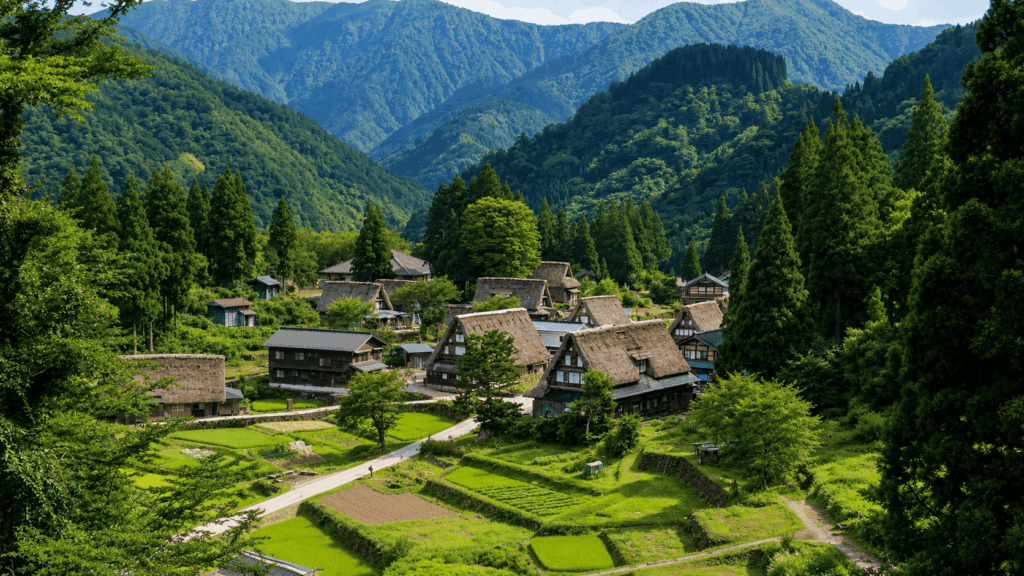
Set further back in the valley, Ainokura is the larger of the two villages with about 20 gassho-zukuri farmhouses. It is also the more remote — the bus stop (“Ainokura-guchi”) is a five-minute walk from the village entrance along a road that cuts through a forested slope. The village sits on a terraced hillside above the river, and the best view is from the high ground at the north end of the village. It is a short uphill walk (about 5–10 minutes on a snow-covered path) and well worth the effort. From here, you get the classic layered shot: farmhouses with steep roofs staggered up the slope, smoke rising from irori hearths, and forested mountains behind.
Because fewer tour groups come here, Ainokura feels genuinely inhabited. You will see residents shoveling snow from their doorways, hanging laundry in the lee of their homes, or tending to vegetables under protective covers. It is not a museum — it is a village where people live through a heavy snow season, and that authenticity is part of the experience.
Suganuma (菅沼)
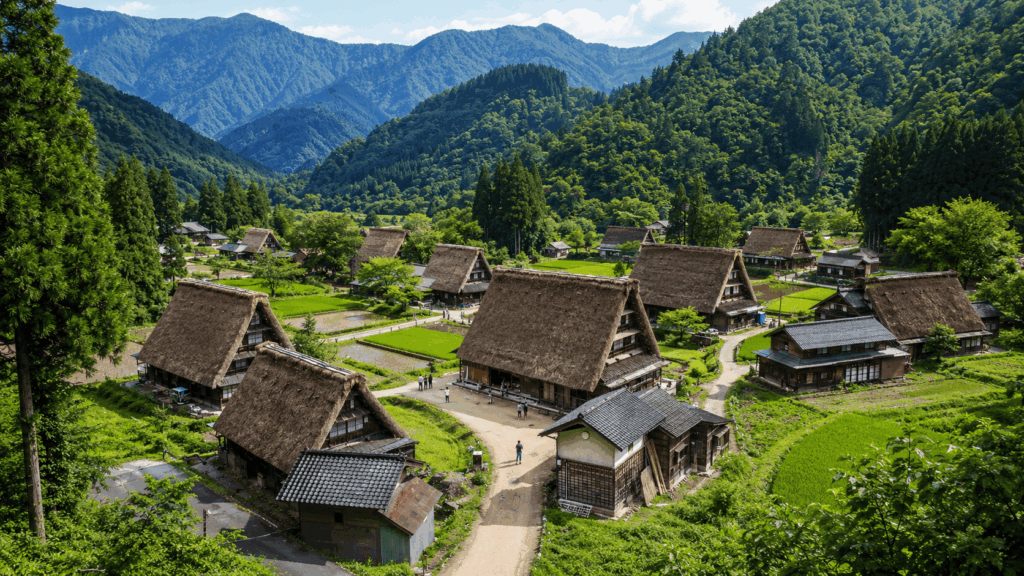
Compact and easy to navigate, Suganuma has just nine gassho-zukuri houses clustered in a tight bend of the Shogawa River. The village is connected to a parking lot and observation deck by a tunnel with an elevator at the far end. Most visitors head straight to the observation deck for the postcard view, but the best perspective is from the pedestrian path along the main road that runs above the village. From there, you can look down on the roofs at eye level, with the river and forested hills behind. It takes about 30 minutes to walk the entire village at a relaxed pace.
Suganuma also has the Gokayama Folklore Museum and the Niter Museum (combined entry 400 yen for adults), which offer a glimpse into the saltpeter and washi paper industries that sustained this remote region before tourism arrived.
If you have limited time: Visit Ainokura. It is more atmospheric and gives you a stronger sense of place. If you have a full day, start at Ainokura (allow 1–1.5 hours), then take the bus to Suganuma (allow 45 minutes to 1 hour), and continue on to Shirakawa-go if you want to see Ogimachi as well.
How to Get to Gokayama in Winter (By Public Transport)
Getting to Gokayama in winter is straightforward by public transport — but the schedule is thin enough that a missed bus can derail your whole day. Here is the route that works for most travelers (for a broader look, see our complete access guide to Gokayama).
Step 1: Reach Shin-Takaoka or Takaoka Station
The most common starting point is Shin-Takaoka Station on the Hokuriku Shinkansen. From Tokyo, take the Kagayaki or Hakutaka shinkansen — the journey is about 2 hours 40 minutes. From Kanazawa, it is 14 minutes. Alternatively, Takaoka Station (one stop south on the JR Johana Line) is served by local trains and some express buses from Kanazawa.
Step 2: Take the World Heritage Bus to the Villages
The World Heritage Bus (operated by Kaetsuno Bus) runs from Shin-Takaoka Station to Gokayama and Shirakawa-go. The route stops at Takaoka Station, Shin-Takaoka Station, Johana Station, and then the villages themselves. Key details:
- Departure point: Platform 4 at Shin-Takaoka Station (follow the bus signs from the ticket gates)
- Fare: Shin-Takaoka to Ainokura-guchi — about 1,000 yen one way. To Suganuma — about 1,200 yen
- Journey time: Shin-Takaoka to Ainokura-guchi — approximately 60 minutes. To Suganuma — about 80 minutes
- Frequency: Roughly one bus per hour from morning to late afternoon. The last bus back from Gokayama departs around 17:00 (check the current timetable)
- Reservations: Not required on most services, but buses can fill up during peak season (New Year, February weekends)
The bus stops at Ainokura-guchi — from here, it is a 5–7 minute walk down a paved road to the village entrance. For Suganuma, the bus stops right at the village entrance on the main road.
Alternative Routes
- From Johana Station (城端駅): If you take the JR Johana Line from Takaoka Station, you can transfer to the World Heritage Bus at Johana Station. Journey from Johana to Ainokura-guchi is about 35 minutes.
- From Kanazawa by highway bus: Highway buses running to Shirakawa-go and Takayama do not stop at Gokayama villages during winter (December to March). You must transfer at Shin-Takaoka or take the local route via Takaoka.
- From Shirakawa-go: The World Heritage Bus runs between Shirakawa-go (Ogimachi) and Gokayama. Shin-Takaoka to Shirakawa-go is about 90 minutes, and you can get off at Suganuma or Ainokura-guchi along the way. Fare: roughly 1,300 yen from Shirakawa-go to Ainokura-guchi.
Discount Tickets
- Gokayama Free Kippu (2,500 yen): Round-trip train fare between Takaoka and Johana, plus unlimited bus travel between Johana and Gokayama for 2 days
- Gokayama-Shirakawago Free Kippu (3,500 yen): Same as above but extends to Shirakawa-go
- World Heritage 1-Day Free Kippu (2,600 yen): Unlimited bus travel between Shirakawa-go and Gokayama for one day
These tickets are sold at Takaoka and Shin-Takaoka stations. If your itinerary includes both Gokayama and Shirakawa-go, the Free Kippu options can save you money compared to buying individual tickets.
Kai’s tip: Winter weather in the Shokawa Valley can be unpredictable. When heavy snow hits the Hokuriku Expressway, buses can be delayed by 30 minutes to an hour, and in extreme cases, services may be suspended until the road is cleared. If you are making your own way by public transport, leave a buffer — do not schedule a tight connection (like a shinkansen back to Tokyo) within two hours of your planned return. I have seen travelers panic at Shin-Takaoka because their bus from Gokayama arrived 50 minutes late and they had a pre-booked train they could not change. A little slack in your schedule avoids that stress entirely.
If that bus timetable already feels tight — especially in snow season — the guided option that fits this article best is the Kanazawa departure that combines Gokayama with Shirakawa-go in one winter-friendly day.
Why I’d book this one
- Recent travelers consistently mention strong English explanations, which helps turn the villages from “pretty snow scenes” into places with context.
- The route removes the weakest part of a DIY winter trip: coordinating rural buses, short daylight hours, and possible snow delays.
- It still leaves room to explore, so it works for travelers who want structure without feeling locked into a fully scripted day.
Check the live calendar, start times, cancellation terms, and recent reviews for the Kanazawa to Gokayama and Shirakawa-go guided day tour.
Can You See the Gokayama Winter Light-Up? (The Honest Answer)
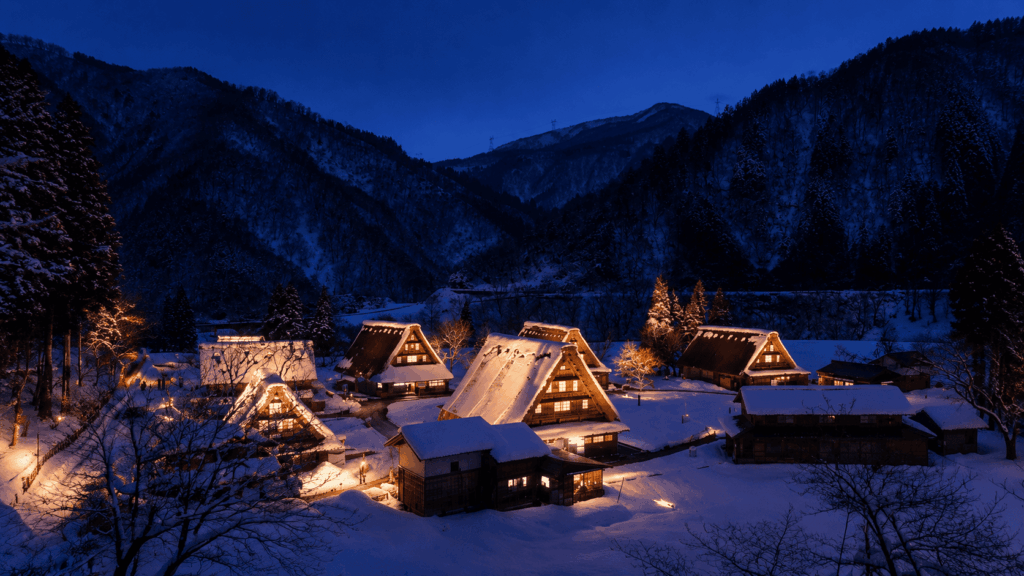
This is the question that determines your entire itinerary, and most online guides do not answer it clearly. Here is the honest situation.
The gassho-zukuri villages in both Ainokura and Suganuma hold winter illumination events — usually for 2–3 nights between late January and late February. The farmhouses are lit from below, casting warm yellow light onto the snow-covered roofs. It is a genuinely beautiful sight, and the snow amplifies the glow in a way that summer visits cannot match.
Here is the catch: the last public bus from both villages departs around 16:45–17:00. The light-up events start at sunset (around 17:00–17:30 in winter) and run until 20:00. If you arrive and leave by public bus on a day trip, you will be on the bus heading away from the village as the lights are switched on. You will not see the illumination.
To see the winter light-up, you have two options:
- Stay overnight at a gassho-zukuri minshuku in or near the village. The innkeepers will let you walk to the viewing areas in the evening. This is the option that gives you the full experience — the illuminated village at night, and the silent snow-covered village at dawn the next morning.
- Book a guided evening tour from Kanazawa, Takayama, or Toyama. These tours depart in the late afternoon, include transport to the light-up site, and return after the event ends. They solve the “no public bus after dark” problem entirely.
Light-up dates change every year. As a reference, the 2026–2027 winter season included Ainokura’s illumination on February 20–21 and Suganuma’s Cultural Property Fire Prevention Day illumination on January 26. These dates shift annually based on weather, lunar calendar, and local scheduling. Always check the official Gokayama tourism website (gokayama-info.jp) for the current season’s dates before booking your trip.
Kai’s tip: I have met travelers who scheduled their entire Hokuriku trip around the light-up, only to discover upon arrival that their bus back to Takaoka left before the lights came on. Do not let this be you. Decide before you go: “I want to see the light-up” means overnight stay or evening tour. “I want to see the villages in snow” means a day trip is perfectly fine. The two are not the same itinerary.
Where to Eat in Gokayama in Winter
Food options in the villages are limited — do not expect a row of restaurants. But the few places that exist serve food that is worth the trip alone.
Gorobei (ごろべえ) — Suganuma
Housed in a gassho-zukuri farmhouse that is roughly 200 years old, Gorobei is the main dining option in Suganuma. The specialty is the Gokayama tofu set — a tray of local tofu (dense, nutty, and nothing like the silken variety found in Tokyo), grilled river fish (iwana, or char), seasonal vegetables, and a bowl of soba noodles. The building itself is part of the experience — low beams darkened by centuries of hearth smoke, tatami seating, and a wood-burning stove in winter.
Open 10:00–17:00. Irregular closing days — check before visiting. An English menu is available, and vegetarian options exist (the tofu set works well). Budget around 1,500–2,000 yen per person for a set meal.
Sabo Tenohira (茶房 手のひら) — Suganuma
A small father-daughter-run cafe next to the Suganuma observation deck. It serves matcha, roasted green tea, coffee, and soba dango — chewy buckwheat dumplings with sweet soy glaze. A good spot for a 15-minute break and a warm drink between villages.
Dining in Ainokura
Ainokura has fewer eating options than Suganuma. Most overnight guests eat dinner at their minshuku (included in the stay), and the museum cafes serve light snacks. If you are day-tripping, plan to eat at Gorobei in Suganuma or bring a packed lunch if you are spending most of your time in Ainokura.
Staying Overnight: The Real Gokayama Experience
If day-tripping gives you the village, staying overnight gives you the place. The difference is difficult to explain until you experience it, but I will try.
At around 16:00, the last tour buses leave. The village goes quiet. Not the background hum of everyday quiet, but the kind of quiet where you can hear the snow settling on the thatch above you. Residents close their shutters. Light spills from the small windows of the farmhouses. The valley darkens, and the mountains that were visible all afternoon become black silhouettes against a navy-blue sky.
The most well-known place to stay is Gassho Minshuku Nakaya in Ainokura. It is one of the oldest gassho-zukuri structures in the village — roughly 350 years old — and has just two guest rooms. Dinner is served around the irori (open hearth) in the main room: seasonal local dishes like Gokayama-style hot pot (bo-zen), grilled iwana, and vegetables cooked over the coals. The floor creaks. The walls are hand-packed earth. You sleep on a futon laid on tatami, under thatch and beams that have held winter snow for more than three centuries.
Other minshuku options in and near the villages include guesthouses that offer similar farmhouse accommodation, though availability in winter is limited — most have only 2–5 rooms. Booking a month or more in advance for the light-up season is strongly recommended.
If staying overnight appeals to you but your itinerary does not allow a full night, the evening tours mentioned in the light-up section are a good middle ground — you get the transport, the illuminated village, and the post-dusk atmosphere, without the overnight commitment.
FAQ
Can I visit both Ainokura and Suganuma in one day by public transport?
Yes, easily. The World Heritage Bus connects the two villages in about 15 minutes. A realistic schedule is: arrive at Ainokura-guchi around 10:00, spend 1–1.5 hours in Ainokura, take the bus to Suganuma, spend 45 minutes to 1 hour there, and return to Shin-Takaoka by early afternoon. If you also want to visit Shirakawa-go in the same day, start early — aim to be on the bus out of Takaoka by 8:30.
Is renting a car better than public transport in winter?
It depends on your confidence driving in heavy snow. The roads to Gokayama are narrow, winding, and can be covered in ice and packed snow. The villages have limited parking (around 500 yen per vehicle, winter hours 9:00–17:00 at Suganuma). If you are experienced driving in snowy mountain conditions, a car gives you flexibility. If not, the World Heritage Bus is simpler and safer — you avoid the risk of getting stuck or sliding on unplowed roads.
Do I need to book accommodation far in advance for the light-up season?
Yes. Gassho Minshuku Nakaya has only two rooms, and the other minshuku in the area have similarly small capacities. For the light-up nights (typically late January to late February), rooms fill up weeks or even months ahead. Book as early as possible if you want to stay overnight.
How much time should I plan for Gokayama?
A full day (arrive by 10:00, leave by 16:00) is enough to see both villages at a relaxed pace, with time for lunch at Gorobei and a stop at the museums. A half-day (arrive around 13:00) is enough for one village and a quick look at the other — but you will feel rushed, especially in winter when daylight is short (sunset around 16:30–17:00).
What should I wear for Gokayama in winter?
The villages sit at an elevation of about 300 meters in a valley that catches heavy snowfall. Temperatures range from -5°C to 2°C (23°F to 35°F) in January and February. Wear waterproof boots with good grip — the paths are packed snow or slush, and regular sneakers will leave you with wet feet within minutes. Layered clothing, a warm hat, gloves, and a waterproof jacket are essential. An umbrella is less useful here than a hood — the snow falls straight and heavy, and you will want both hands free for photography or gripping handrails on icy slopes.
Is the Gokayama Free Kippu worth buying?
If you are starting your journey from Takaoka or Shin-Takaoka and visiting both villages, yes. The round-trip train fare from Takaoka to Johana alone costs about 1,100 yen, and the bus from Johana to Gokayama is roughly 700–1,000 yen each way. The Free Kippu (2,500 yen) covers two days of unlimited travel on that route, so you break even if you make the round trip plus any local bus journeys within the valley. If you are coming directly from Shin-Takaoka on the World Heritage Bus without using the train segment, the standard fare may work out cheaper.
Can I do Gokayama as a day trip from Kanazawa?
Yes, but it requires an early start. Take the Hokuriku Shinkansen from Kanazawa to Shin-Takaoka (14 minutes, about 2,900 yen one way if unreserved), then transfer to the World Heritage Bus. The total one-way journey is about 1 hour 15 minutes. The last bus back from Ainokura-guchi departs around 16:45, so you have about 4–5 hours in the villages. This is enough time to see both villages and have lunch, but not to linger.
Final Verdict: Should You Visit Gokayama This Winter?
Gokayama in winter is not a compromise — it is a specific choice. It trades the scale and convenience of Shirakawa-go for quiet, authenticity, and the rare experience of standing alone in a snow-covered village that has looked this way for centuries. Whether that trade-off is right for you depends on what you want from the visit.
Choose Gokayama if:
- You have visited Shirakawa-go before and want a quieter, more residential alternative
- You value atmosphere over amenities — you are happy with a simple lunch at a farmhouse restaurant and a walk through snow-covered lanes
- You are staying overnight in the area and want to experience the village after dark and at dawn
- You are a photographer who wants to frame gassho-zukuri roofs without tour groups in every shot
Choose Shirakawa-go (or visit both) if:
- This is your first trip to Japan and you want the iconic postcard view — Ogimachi delivers it with maximum impact
- You need more dining options, shops, and museum-style attractions
- You are traveling without a car and want the simplest possible bus connection from major cities
For first-time winter visitors to the Hokuriku region: Start with Shirakawa-go for the spectacle, then head to Gokayama for the contrast. The two are close enough to visit in a single day, and the shift from busy Ogimachi to quiet Ainokura tells you more about life in the gassho-zukuri villages than either place could on its own.
For repeat visitors to Japan: Skip Shirakawa-go entirely and spend the day in Gokayama. Stay overnight at a minshuku like Nakaya. The experience of arriving in the dark after dinner, stepping out into the silent snow-covered village with the farmhouse windows glowing behind you, is one of the most memorable winter experiences I know in Japan.
For travelers on a tight schedule: A day trip from Kanazawa or Takayama works well — you have enough time for both villages and a meal at Gorobei. But accept that you will not see the light-up on a day trip. If the illumination is your priority, choose the overnight stay or the evening tour.
For photographers: Aim for late January to early February, when snow is deepest and light-up events are most likely to be scheduled. Arrive early (before 10:00) to shoot the villages in morning light with fresh snow. The high ground above Ainokura (a 5–10 minute walk from the village center) gives you the classic layered composition. In Suganuma, the pedestrian path along the main road above the village provides an eye-level view of the roofs with the river and mountains behind. One practical note: wear a brightly colored jacket if you want to include a human figure for scale — against the white snow and dark brown thatch, a flash of red or blue makes the composition work.
Hi, I’m Kai. I’m a Tokyo-based travel writer, tourism industry insider, and the author of a published guidebook for international visitors to Japan. With over 10 years of professional experience at a leading Japanese tourism company, my mission is to help you skip the tourist traps and navigate Japan’s best destinations like a local. I believe the perfect day trip is like a traditional kaiseki meal: a beautiful balance of precise planning and unforgettable seasonal discovery. When I’m not out conducting field research, you’ll usually find me drafting new itineraries with one of my favorite fountain pens!