
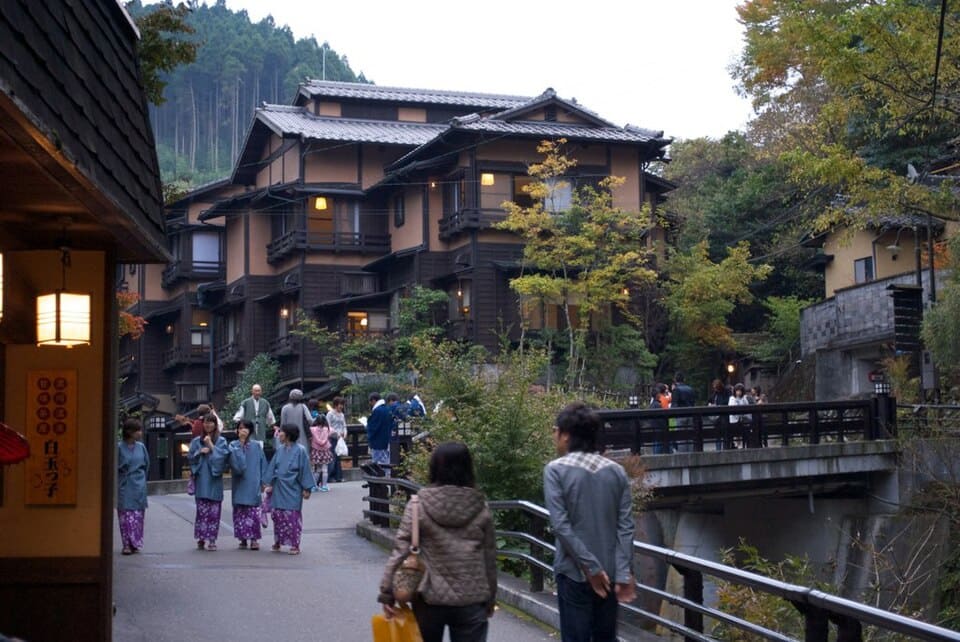
Kurokawa Onsen With Tattoos: The Short Answer
If you have tattoos and want to bathe at Kurokawa Onsen, here is the honest reality in one sentence: Most of the town’s public outdoor baths (rotenburo) used for onsen-hopping do not allow visible tattoos. But that does not mean you have to skip this stunning hot spring town. You have three real routes:
- Private rental baths (kashikiri-buro) – book a bath for your group only, available at several ryokan
- In-room private onsen – stay overnight in a room with its own outdoor bath, where the policy is entirely yours
- Cover-up stickers – for small to medium tattoos, some ryokan will accept you if the ink is concealed
This guide walks you through each route with real ryokan names, prices, and the practical details that make the difference between a stressful visit and a genuinely relaxing soak.
Planning note: If your priority is a zero-stress soak rather than testing each public-bath policy at the door, start by comparing private-onsen room options before building the day-trip plan. See current room types, dates, and recent guest reviews for Kurokawa Onsen Yumerindo Hanadomari.
The Honest Reality: Kurokawa Onsen’s Tattoo Policy
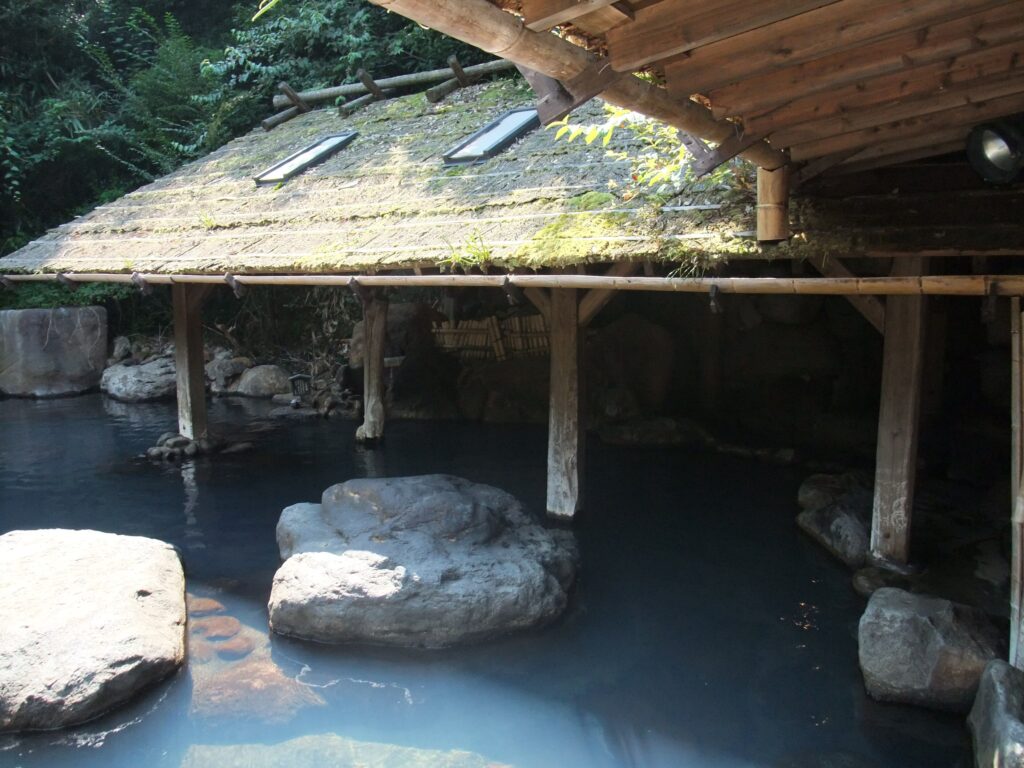
Kurokawa Onsen does not have a single town-wide tattoo ban or allowance. Each ryokan sets its own policy, which means the answer depends entirely on where you go and how you bathe.
In 2026, the Kurokawa Onsen Sightseeing Ryokan Cooperative Association confirmed the following to a traveler inquiry:
- Six ryokan explicitly allow bathing for guests with tattoos: Ryokan Wakaba, Ryokan Ichinoi, Ryokan Misato, Ryokan Yamanoyu, Fumoto Ryokan, and Ryokan Sanga.
- Three ryokan do not allow bathing even with cover-up stickers: Hozantei, Yumotoso, and Yamabiko Ryokan.
- Cover-up stickers are available for purchase at the tourist information center (Kaze no Ya), sized to conceal approximately an adult palm. For tattoos that size or smaller, most participating ryokan will permit entry with the sticker applied.
This is the most current town-wide guidance available as of mid-2026, but ryokan ownership and policies change. Always contact your chosen ryokan directly before booking to confirm their current stance.
Kai’s tip: What catches many travelers off guard is the anxiety of being turned away at the entrance. If you are planning to use cover-up stickers at a public bath, aim for early morning (before 9:00 a.m.) or late afternoon (after 4:00 p.m.). Day-trip bus groups tend to arrive around 10:00 a.m. and leave by 3:30 p.m., so those off-peak windows mean fewer eyes and a much more relaxed experience.
How the Onsen-Hopping Pass Works (Nyuto Tegata) and Where Tattoos Fit
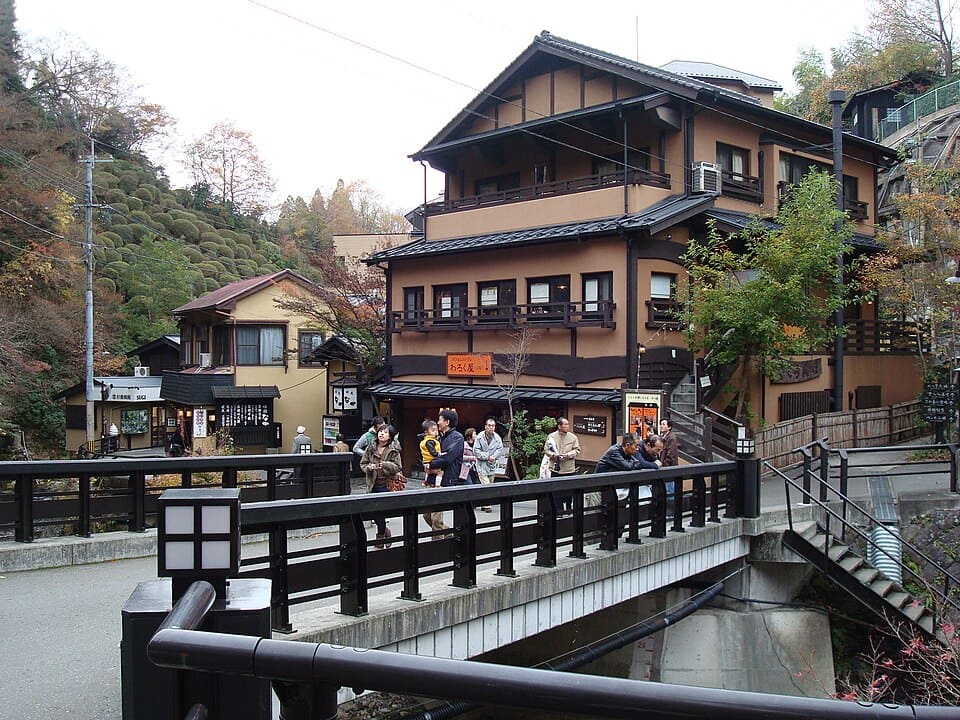
Kurokawa’s famous Nyuto Tegata (入湯手形) is a round wooden pass sold at the information center Kaze no Ya (風の舎) and at participating ryokan. It is one of the most popular things to do in Kurokawa Onsen. Here is what you need to know:
| Item | Details |
|---|---|
| Price | Around 1,500 yen per pass (subject to change) |
| What you get | Entry to three different outdoor baths of your choice from ~25 participating ryokan |
| Validity | Approximately six months |
| Where to buy | Kaze no Ya (information center, central location, open 9:00 a.m.–5:00 p.m.) or at individual ryokan |
| Extra baths | Around 500–800 yen per additional bath |
Here is the tattoo catch: The Nyuto Tegata grants you entry to the shared public outdoor baths of participating ryokan. Since most of these baths are shared facilities, the majority enforce a no-visible-tattoo policy. The pass itself does not override individual ryokan rules.
However, the six tattoo-friendly ryokan listed above do participate in the onsen-hopping scheme. If you choose your three baths from that group, you can legally use the Nyuto Tegata with visible tattoos. The information center staff can point you to which baths are open to men, women, or alternating on any given day, so ask when you buy your pass.
Route 1: Private Rental Baths (Kashikiri-buro)
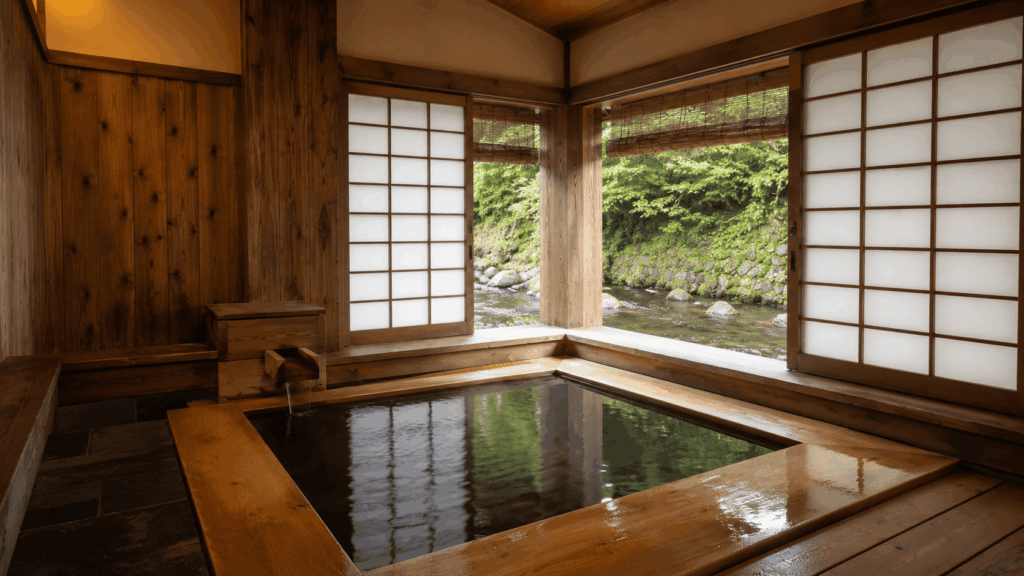
Private rental baths, called kashikiri-buro (貸切風呂), are bookable by the hour for your exclusive use. You lock the door behind you, bathe with your travel companions, and no one else enters. For tattooed travelers, this is the simplest way to enjoy a traditional onsen bath without worrying about policies.
Where to Find Private Baths in Kurokawa
| Ryokan | Private Bath Details | Notes |
|---|---|---|
| Yamabiko Ryokan | Six private family rental baths (no reservation needed – check the wooden tags for availability). Includes a large open-air “Sennin” bath. | Public baths do not allow tattoos, even with cover-ups. Private baths are available for overnight guests only. |
| Ryokan Ichinoi | Private bath available for around 1,000 yen / 45 minutes. | Listed as tattoo-friendly by the cooperative association. Open to overnight guests. |
| Shinmeikan | Cave-style private baths available for exclusive use. | Famous for its unique rock-hewn cave bath. Check direct for current pricing. |
The Day-Trip Reality for Private Baths
This is an important distinction: most private rental baths in Kurokawa are reserved for overnight guests. Day-trippers looking to book a kashikiri-buro have very few options. If you are arriving by bus from Fukuoka and planning to leave the same day, do not assume you can walk into a ryokan and rent a private bath.
Kai’s tip: If you are set on using a private bath as a day-tripper, call the ryokan in advance. I have seen travelers show up at the front desk expecting to rent a bath, only to be told they are full or reserved for guests only. A quick phone call or email in English (most front desks handle basic English inquiries) saves you the disappointment. The ryokan association’s information center (Kaze no Ya) can also help you check availability.
Route 2: Book a Room with a Private In-Room Onsen
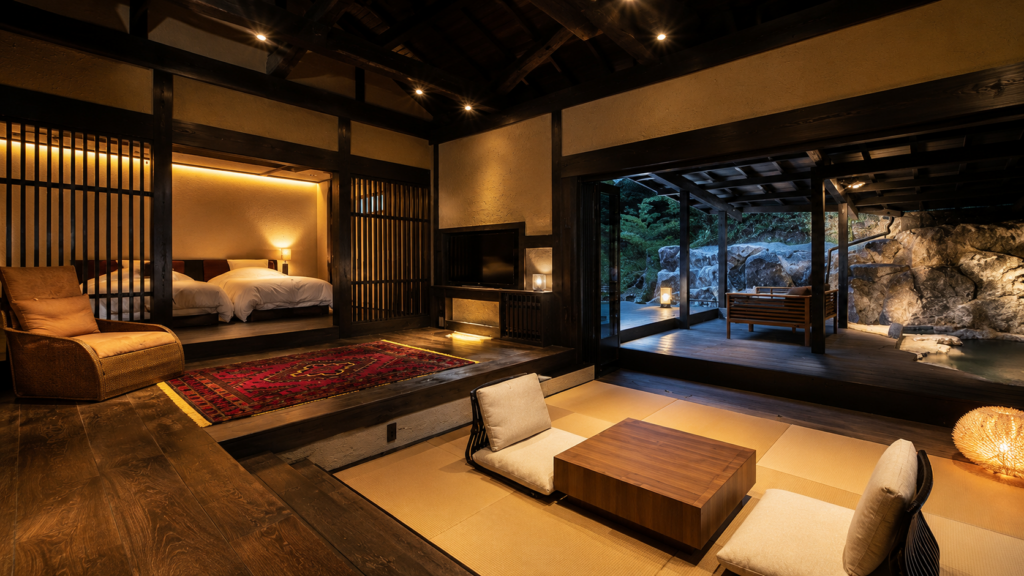
For tattooed travelers who want the fullest Kurokawa experience, staying overnight in a room with a private outdoor bath is the single best solution. You soak whenever you want, in complete privacy, with no policy to check and no awkward conversations at the entrance. If you need help picking a property, see our guide on where to stay in Kurokawa Onsen.
Yamamizuki (山みず木)
Located about 2 km from the town center along the Tanoharu River, Yamamizuki is one of Kurokawa’s most sought-after ryokan for private bathing. Eight of its 21 rooms feature a semi-open-air bath (semi-roten buro) with direct-source spring water. The baths are positioned so close to the river that you can hear the water flowing beneath you while you soak.
- Official stance on tattoos: Because select rooms have their own bath, the public policy does not affect you. The ryokan’s private facilities mean no one will question visible tattoos.
- Location note: Yamamizuki is a 20–30 minute walk from the town center, or a short drive. Staying guests can arrange a free shuttle by phone (0967-44-0336).
Kai’s tip: Yamamizuki has separate entrances for day-trippers and overnight guests, and the day-use entrance is on the right side of the building. If you are staying overnight, make sure you use the correct entrance—it saves confusion at check-in. The walk from town is uphill and along a narrow road without footpaths in places, so call ahead for the shuttle, especially if arriving in the evening or with luggage.
Sato no Yu Waraku (里の湯 和らく)
A quieter, adults-only ryokan (no guests under 12) with thatched-roof architecture, Sato no Yu Waraku offers all 11 guest rooms with their own private bath. The property features two types of day-use baths open to guests: a forest open-air bath and a cave bath built with massive rocks. Day-trippers can also use these baths for around 600 yen (10:00 a.m.–8:30 p.m., hours may vary).
- Note: Sato no Yu Waraku’s shared day-use baths switch between men and women depending on the time of day. Check with the front desk for the current schedule.
If you fall into that camp — you want Kurokawa’s mountain-onsen atmosphere but visible-tattoo uncertainty would ruin the experience — this is the room-search option to compare first.
Why I’d book this one
- Recent guests consistently mention the private onsen setting and river views, which is exactly the kind of privacy that removes the visible-tattoo question.
- It keeps the trip low-friction: you can focus on room type, meal plan, and dates instead of negotiating public-bath rules after arrival.
- The reviews tend to highlight friendly staff and a traditional ryokan atmosphere, useful if you want the Kurokawa experience without making the bath policy the centre of the trip.
Before finalising, check the exact room type rather than assuming every plan includes the same bath setup: see current availability, room photos, and recent traveler reviews for Kurokawa Onsen Yumerindo Hanadomari.
Route 3: Cover-Up Stickers – Does It Actually Work?
For small to medium tattoos—roughly the size of an adult palm or smaller—cover-up stickers (called tattoo cover seals or concealment patches) are a realistic option at many Kurokawa ryokan. Here is what you need to know based on the cooperative association’s own guidance and traveler reports.
Where to Get Cover-Up Stickers
- Kaze no Ya (information center): The cooperative association confirmed that cover-up stickers are sold here. Size is approximately enough to cover an adult palm.
- Prepare before you go: Stickers are not sold at convenience stores in Kurokawa or at the bus stop. Your safest bet is to buy them in advance from Amazon (search “tattoo cover sticker large”) or a Japanese drugstore (like Matsumoto Kiyoshi or Don Quijote) in Fukuoka or Kumamoto before heading into the mountains.
Which Ryokan Accept Cover-Up Stickers
Based on the cooperative association’s 2026 response:
- Likely OK with cover-ups: The six tattoo-friendly ryokan (Wakaba, Ichinoi, Misato, Yamanoyu, Fumoto, Sanga) plus most other participating onsen-hopping ryokan—as long as the tattoo is fully concealed.
- NOT OK with cover-ups: Hozantei, Yumotoso, and Yamabiko Ryokan. These three explicitly stated that they do not allow entry even with cover-up stickers. Respect this policy and choose another bath.
Practical Tips for Using Cover-Up Stickers
- Test the adhesive before you go. Onsen water is hot and mineral-rich. Some stickers peel off in steam. Apply a test patch at home to see if it holds under heat.
- Bring spares. If you plan to visit three baths (a full onsen-hopping course), bring at least five stickers. Heat and moisture can loosen the edges after one soak.
- Skin-colored, not decorative. Brightly colored or patterned stickers are more noticeable and may draw the attention you were trying to avoid. Stick with matte, skin-matched tones.
Kai’s tip: If you decide to try cover-up stickers at a public bath, timing matters more than you think. Day-trip bus groups roll in from around 10:00 a.m. and clear out by 3:30–4:00 p.m. During those hours, the changing areas and baths can feel crowded and exposed. Go early—before 9:00 a.m.—or later in the evening, just before the onsen closes for the day. The baths are nearly empty, the lighting is softer, and you will feel far less self-conscious applying or adjusting your stickers. A quick word of honesty: even with stickers, the final call belongs to the staff at the entrance. If they ask you to remove the sticker or decline entry, do not argue. Simply thank them and move on to your next option. The goal is a relaxing soak, not a confrontation.
Getting to Kurokawa Onsen: The Reality Check
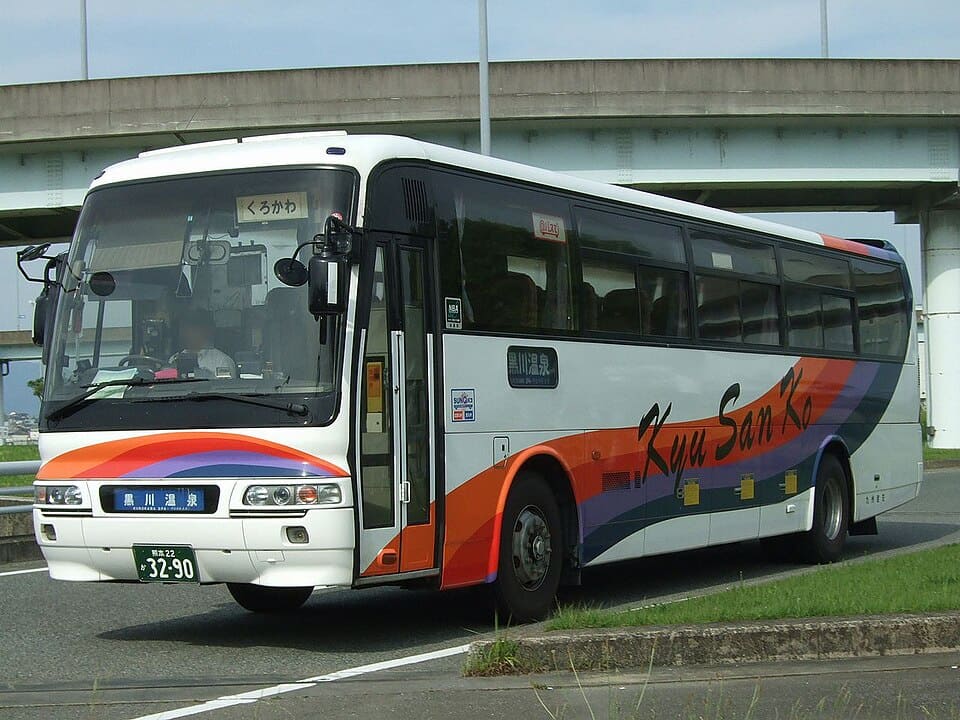
Kurokawa Onsen sits in the mountains of Kumamoto Prefecture, deep in the Aso region. There are no train tracks leading into town. Here is the honest picture of how to get to Kurokawa Onsen.
From Fukuoka (Most Common Route)
| Route | Time | Cost | Frequency |
|---|---|---|---|
| Hakata Station → Kurokawa Onsen (direct highway bus) | ~3 hours | ~3,470–3,770 yen | 2–3 buses per day |
| Tenjin Bus Center → Kurokawa Onsen (same bus) | ~3 hours | Same | Same buses |
| Fukuoka Airport (International Terminal) → Kurokawa (direct bus) | ~3 hours | Same | 3 buses per day |
- Bus operator: Sanko Bus / Kyushu Odan Bus (Nishi-Nippon Railroad group). Reservations are recommended, especially in peak seasons (cherry blossom, autumn leaves, Golden Week, New Year). Full buses are common on weekends.
- Sun Q Pass: This Kyushu-wide bus pass covers the highway bus to Kurokawa. If you plan to visit multiple onsen towns in Kyushu, it pays for itself quickly.
From Kumamoto
| Kumamoto Station → Kurokawa Onsen (direct Kyushu Odan Bus) | ~2.5–3 hours | Around 2,000–2,500 yen | Multiple daily buses |
| Kumamoto Airport → Kurokawa (direct bus) | ~1 hour 55 minutes | Around 2,000 yen | 3 buses per day |
If you are traveling with luggage, children, or a fixed ryokan check-in time, compare a private Kyushu charter before relying entirely on the highway bus schedule. Check current vehicle options and pickup details for a Kyushu private custom charter from Fukuoka.
Can You Day-Trip From Tokyo?
No, not realistically. Kurokawa Onsen is a 7–8 hour journey from Tokyo one way, requiring a flight or Shinkansen to Fukuoka or Kumamoto, followed by a bus into the mountains. A day trip from Tokyo would mean 14–16 hours of transit for a single soak. This is a destination for a minimum one-night stay, ideally as part of a larger Kyushu itinerary.
Kai’s tip: The common mistake I see first-time visitors make is trying to squeeze Kurokawa into a Tokyo itinerary. Kurokawa belongs in your Kyushu trip—fly into Fukuoka, spend 2–3 days exploring the city, then take the morning bus to Kurokawa for a night. Trying to tack it onto a Tokyo–Osaka–Kyoto route adds hours of transit that most travelers underestimate.
Day Trip vs. Overnight Stay – Which Works for Tattooed Travelers?
| Factor | Day Trip | Overnight Stay |
|---|---|---|
| Bath options with tattoos | Limited. Day-use private baths are rare. Most public baths require tattoo-free skin. Cover-up stickers are your main option. | Wide open. Book a room with a private in-room bath and you can soak anytime, with no policy concerns. |
| Time pressure | Buses arrive ~12:30 p.m. and depart ~4:30 p.m. You have roughly 3–4 hours in town. Rushed. | Arrive at 1:00 p.m., check in at 3:00 p.m., soak that evening, again in the morning. Relaxed pace. |
| Onsen-hopping | Possible but time-limited. You might fit 1–2 baths if you move quickly. | Easily fit 3 baths (the full tegata experience) plus your own room bath. |
| Meals | Lunch options at ryokan or small restaurants. No dinner possible. | Multi-course kaiseki dinner is one of Kurokawa’s highlights. |
| Crowds | Public baths are busiest between 11:00 a.m. and 2:00 p.m. | Evening and early morning baths are quiet or empty. |
| Cost | ~7,000–8,000 yen round-trip bus + ~1,500 yen tegata = ~9,500 yen | ~30,000–50,000 yen per person for a ryokan night with dinner and breakfast (private bath room costs more) |
The verdict for tattooed travelers: If you absolutely must do Kurokawa as a day trip, use cover-up stickers and focus on the six tattoo-friendly ryokan for your Nyuto Tegata visits. But the honest answer is that a one-night stay in a room with a private onsen transforms your experience from “carefully managed” to “completely free.” You wake up, walk to your private outdoor bath, and soak in mountain air without a single policy to check. For a deeper look at the pacing, check out our review on whether Kurokawa Onsen is worth a day trip.
Best Timing for a Quieter, Less Stressful Bath
Regardless of which route you choose, timing your visit makes a measurable difference to your comfort level as a tattooed traveler.
- Early morning (7:00–9:00 a.m.): The quietest slot. Most day-trippers have not arrived yet. Overnight guests who stayed late are still asleep. The baths are nearly empty.
- Late afternoon (4:00–6:00 p.m.): Day-trip buses depart around 3:30–4:00 p.m. The town quiets down around dusk. Public baths that close at 8:00 or 9:00 p.m. are at their emptiest during this window.
- Avoid (10:00 a.m.–2:00 p.m.): Peak day-tripper hours. The changing rooms are busiest, and you are most likely to encounter staff who are rushed and less flexible.
Frequently Asked Questions
Can I use the Nyuto Tegata (onsen-hopping pass) with visible tattoos?
Yes, but only if you choose your three baths from the six ryokan that the Kurokawa cooperative association has confirmed as tattoo-friendly (Ryokan Wakaba, Ryokan Ichinoi, Ryokan Misato, Ryokan Yamanoyu, Fumoto Ryokan, and Ryokan Sanga). Most other participating ryokan enforce a no-visible-tattoo rule in their shared baths. Ask the staff at Kaze no Ya (information center) when you buy your pass—they can tell you which baths are accepting on any given day.
Which ryokan in Kurokawa explicitly allow tattoos in their shared baths?
Per the cooperative association’s 2026 response, six ryokan explicitly allow visible tattoos: Ryokan Wakaba, Ryokan Ichinoi, Ryokan Misato, Ryokan Yamanoyu, Fumoto Ryokan, and Ryokan Sanga. Their policies may change, so always confirm directly before visiting. Beyond these six, booking a room with a private in-room bath (such as Yamamizuki or Sato no Yu Waraku) bypasses the policy question entirely.
Can I cover a small tattoo with a bandage or sticker and enter a shared bath?
For small to medium tattoos (roughly adult palm size or smaller), cover-up stickers are accepted at most participating ryokan except three that explicitly do not allow them: Hozantei, Yumotoso, and Yamabiko Ryokan. Stickers are sold at Kaze no Ya (the information center), but it is safer to buy them in advance from a drugstore or online and test the adhesive before you go. The final decision always belongs to the staff at the entrance.
Is Kurokawa Onsen doable as a day trip from Fukuoka?
Yes, day trips from Fukuoka are possible—the direct bus takes about 3 hours each way and costs around 3,470–3,770 yen. You arrive around 12:30 p.m. and need to catch the return bus by roughly 4:30 p.m., leaving 3–4 hours in town. This is enough for one or two quick baths and a meal, but rushed. For tattooed travelers, the limited time and narrow bath options make the day trip less satisfying than an overnight stay.
Is Kurokawa Onsen doable as a day trip from Tokyo?
No. Tokyo to Kurokawa requires a flight or Shinkansen to Fukuoka or Kumamoto (4–5 hours), followed by a 2–3 hour bus into the mountains. The round trip takes 14–16 hours of transit. Kurokawa is a destination for your Kyushu itinerary, not a side trip from Tokyo. Plan for at least one overnight stay.
How much does a private bath (kashikiri-buro) cost at Kurokawa?
Private rental baths range from around 1,000 yen for 45 minutes (Ryokan Ichinoi) up to 4,400 yen for larger or more elaborate baths. Most private baths are available only to overnight guests. Day-trippers looking for exclusive-use bathing have very few options and should call ahead.
Do I need to speak Japanese to book a tattoo-friendly room at Kurokawa?
Not necessarily. The major ryokan mentioned in this guide—Yamamizuki, Sato no Yu Waraku, Ryokan Ichinoi—handle basic English booking inquiries via email and phone. Booking platforms like Booking.com and Agoda also list many Kurokawa ryokan with English interfaces. For the most accurate information on tattoo policies, emailing the ryokan directly with a simple question (“Do you allow guests with small tattoos in your public bath?”) usually gets a clear reply, even if the English is basic.
Final Verdict: Which Route Is Right for You?
For the tattooed traveler who wants no stress, no surprises, and a truly relaxing soak
Book one night at a ryokan with a private in-room bath. Yamamizuki and Sato no Yu Waraku are excellent choices. You pay more upfront (roughly 30,000–50,000 yen per person with meals), but you gain the freedom to soak whenever you want, in total privacy, with the mountain air and river sounds Kurokawa is famous for. The kaiseki dinner and morning bath make it worth every yen. This is the single best solution for tattooed travelers.
For the budget-conscious traveler with small tattoos
Use the cover-up sticker route with the Nyuto Tegata. Buy your stickers in advance, time your visit for early morning or late afternoon when the baths are quiet, and choose your three baths from the six tattoo-friendly ryokan (Wakaba, Ichinoi, Misato, Yamanoyu, Fumoto, Sanga). A day trip from Fukuoka is feasible but tight—you will get 1–2 baths and a rushed lunch before the return bus.
For first-time visitors to Kyushu with visible tattoos
Do not try to day-trip from Fukuoka. The combination of travel time, limited bath access for tattooed guests, and the rushed pace will leave you disappointed. Instead, plan a 2-night loop: fly into Fukuoka (explore the yatai street food stalls), take the morning bus to Kurokawa for one night in a private-bath room, then continue south to Beppu or Yufuin (both of which have more lenient tattoo policies in many private baths). This turns the logistics of getting to Kurokawa into part of a broader Kyushu hot spring journey.
For couples where one person has tattoos and one does not
Book a ryokan with a private rental bath (kashikiri-buro) as an overnight guest. Ryokan Ichinoi offers private baths for around 1,000 yen, and Yamabiko Ryokan has six different private baths you can use by checking the wooden tags. This way you can soak together without anyone worrying about policies. You can also take turns using the public baths if the non-tattooed partner wants the full rotenburo experience.
For travelers on a tight schedule (one day in Kyushu)
Consider Beppu or Yufuin instead. Both are closer to Fukuoka and have more ryokan with tattoo-friendly policies clearly stated online. Kurokawa is at its best when you have at least one night to slow down and soak without watching the clock.
Kai’s tip: If I could tell a friend visiting Kurokawa for the first time with tattoos one thing, it would be this: the anxiety about the tattoo policy disappears the moment you book a room with a private bath. The cost difference between a standard room and a private-bath room is usually 5,000–10,000 yen per person. For that amount, you buy total freedom from policy-checking. I have seen too many travelers spend their first hour in Kurokawa nervously walking from ryokan to ryokan, asking “do you accept tattoos?” and feeling deflated. A room with your own onsen eliminates that entire conversation. You arrive, check in, walk to your room, and soak.
Hi, I’m Kai. I’m a Tokyo-based travel writer, tourism industry insider, and the author of a published guidebook for international visitors to Japan. With over 10 years of professional experience at a leading Japanese tourism company, my mission is to help you skip the tourist traps and navigate Japan’s best destinations like a local. I believe the perfect day trip is like a traditional kaiseki meal: a beautiful balance of precise planning and unforgettable seasonal discovery. When I’m not out conducting field research, you’ll usually find me drafting new itineraries with one of my favorite fountain pens!