
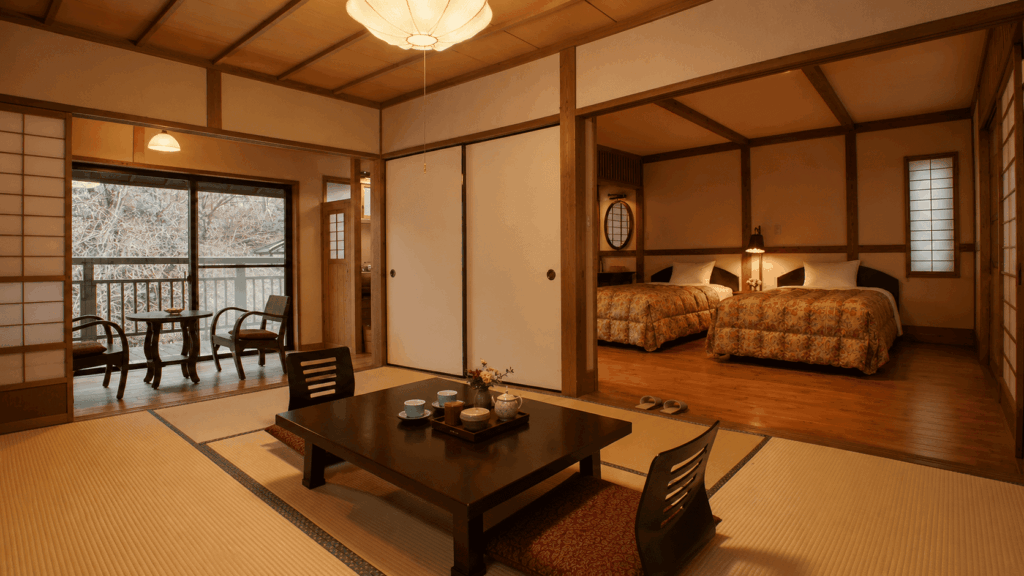
Introduction: The Kurokawa Onsen Paradox
Kurokawa Onsen — a misty mountain town of wooden ryokan, stone-paved lanes, and river-fed open-air baths in the mountains near the Aso caldera and Kuju range. It’s been drawing travelers for over 300 years, and in 2009 it earned two stars in the Michelin Green Guide Japan.
Here’s the thing that confuses almost every first-time visitor: the town operates on a philosophy called “the whole town is one ryokan.” With the Nyuto Tegata (wooden onsen-hopping pass, ¥1,500), you can use participating outdoor baths across town — currently 25 locations, subject to daily availability. So if you can bathe beyond your own ryokan, why does your choice of accommodation matter?
The answer is the central argument of this guide: your ryokan determines everything the Nyuto Tegata doesn’t cover — your private bath access, the quality of your kaiseki dinner, your room’s character, and whether you fall asleep to river sounds or step out for an evening yukata stroll. The public baths are shared. Everything else is yours alone.
Kai’s tip: The mistake I see most first-time visitors make is treating all Kurokawa ryokan as interchangeable because of the Nyuto Tegata. They’re not. Once you understand that you’re choosing between private experiences — not public baths — the decision becomes much clearer. This guide is built around exactly that framework.
Below you’ll find a quick-reference table, followed by detailed picks for couples, families, budget travelers, luxury seekers, and anyone chasing silence in the forest. If you’re short on time, start with the table.
Availability check: If private baths are your deciding factor, start by checking live dates, room types, and recent traveler reviews for Kurokawa Onsen Yamabiko Ryokan on Klook. Its private-bath setup is exactly the kind of experience the Nyuto Tegata cannot guarantee.
Quick Answer: Which Ryokan Should You Book?
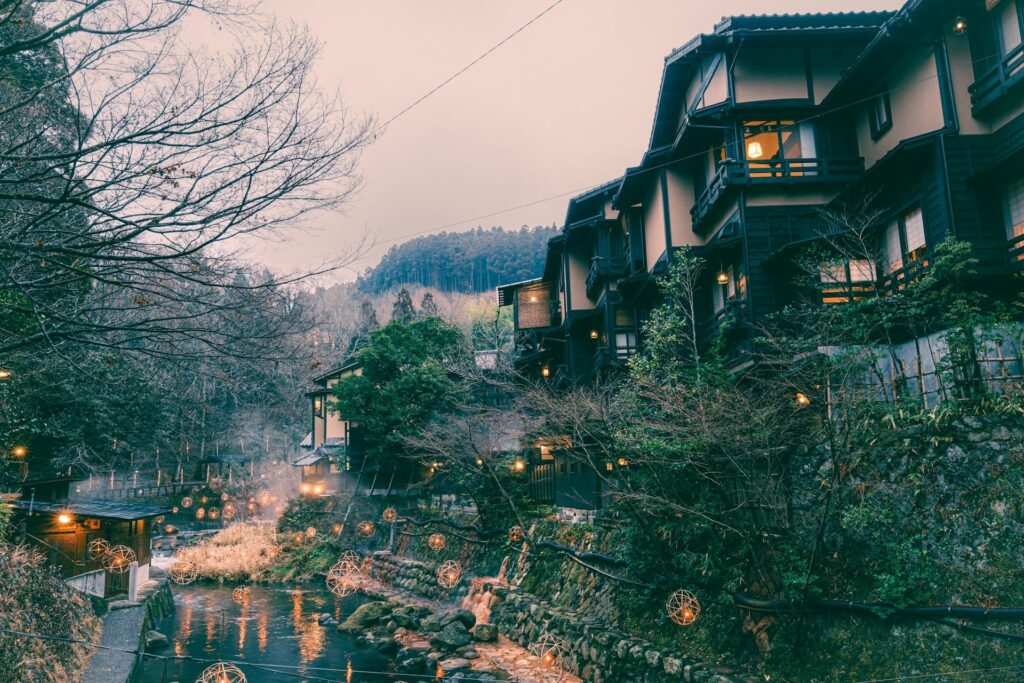
Not sure where to start? Here’s the short version. Each recommendation is explained in detail further down.
| Traveler Type | Recommended Ryokan | Why | Price Range (per person, per night) |
|---|---|---|---|
| First-timer / Atmosphere seeker | Shinmeikan | Hand-dug cave baths, 2 reservable family baths, iconic downtown location — the quintessential Kurokawa experience | ¥19,800–¥25,300 |
| Couples / Private bath lovers | Yamabiko Ryokan | 6 private family baths for overnight guests, with no reservation or fixed time slot required | ¥17,000–¥50,000 |
| Food lovers | Ryokan Wakaba | Former sushi restaurant; kaiseki built around Kumamoto specialties, plus 2 reservable private baths | ¥23,100–¥36,300 |
| Families with kids | Yumerindo or Wakaba Annex | Yumerindo: 4 guest-only family baths. Wakaba Annex: large rooms (up to 7 guests), reservable private baths, irori dining | ¥20,000–¥36,300 |
| Budget travelers | Yusai Annex | One of the lower-priced options on the official Kurokawa list; guests can also use the bath facilities at nearby Yusai | ¥13,000–¥20,000 |
| Luxury / Anniversary | Gekkoju | 10 detached rooms, all with indoor + open-air baths; 2 new villas opened in June 2026 | ¥69,900–¥122,700 |
| Seclusion / Silence | Yamamizuki, Sanga, or Hozantei | Riverside or forest settings outside the compact center — more seclusion in exchange for less walkability | ¥18,000–¥46,000 |
Price note: These are approximate current ranges shown by the Kurokawa Onsen association; actual rates vary by date, room type, occupancy, and meal plan.
How to Choose Your Kurokawa Ryokan
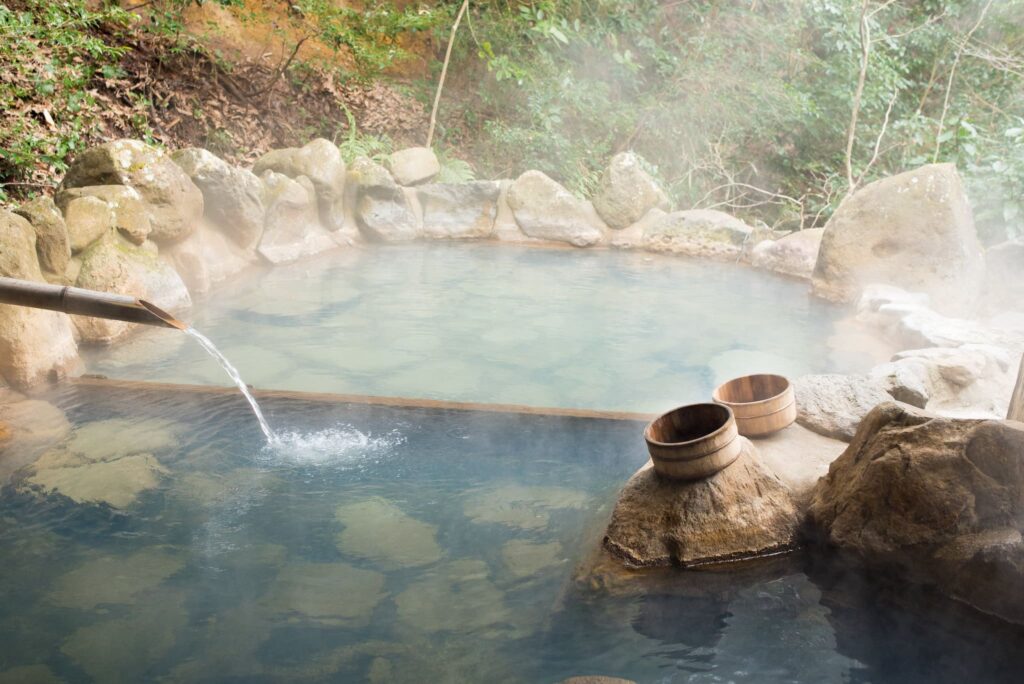
The Nyuto Tegata Changes Everything
Before you pick a ryokan, you need to understand the Nyuto Tegata — Kurokawa’s signature cedar bathing pass. Here’s how it works:
- Cost: approximately ¥1,500 for adults, ¥700 for children (prices subject to change)
- What it gives you: three uses across 25 participating outdoor baths; alternatively, one of the three uses can be spent on eligible food or souvenirs
- Where to buy it: participating ryokan or the Kurokawa Onsen association information center (Kaze no Ya)
- Validity: six months from the purchase date; bath hours and availability can vary by ryokan
Because the Nyuto Tegata exists, where you sleep does not lock you into one set of outdoor baths. You can use the same participating bath network as other visitors, although individual baths may be unavailable because of cleaning, maintenance, weather, or crowd controls. (For a deeper dive into making the most of this pass and planning your day, check out our guide on things to do in Kurokawa Onsen). This is the single most important thing to understand, because it reframes your ryokan decision entirely.
Kai’s tip: If you haven’t caught the logic yet, here it is: the Nyuto Tegata covers the public baths, so don’t choose your ryokan based on public baths. Choose it based on what the Nyuto Tegata doesn’t give you — the private (or reservable) baths that only guests can use, your kaiseki dinner, the quality of the guest rooms themselves, and the location relative to the town center. Once this clicks, your options narrow dramatically and the decision becomes straightforward.
Here are the four things that actually differentiate one Kurokawa ryokan from another:
- Private / reservable baths (kashikiri or in-room rotenburo) — the single biggest differentiator
- Kaiseki dinner quality — this is what you’ll remember most about your stay
- Room character and size — river-view? Mountain-view? Tatami or beds? Private outdoor bath attached?
- Location: downtown vs. secluded — which brings us to the next section
Downtown vs. Outskirts — The First Big Decision
Kurokawa’s ryokan fall into two geographic camps, and this single decision determines the rhythm of your entire stay.
| Factor | Downtown (Walkable) | Outskirts (Secluded / Shuttle Required) |
|---|---|---|
| Examples | Shinmeikan, Yamabiko, Oyado Noshiyu, Wakaba, Yumerindo | Yamamizuki, Sanga, Hozantei, Gekkoju, Okunoyu |
| Evening stroll in yukata | Yes — shops, restaurants, and illuminated streets (YuAkari event in winter) | No — you’re in the forest or up the river; the ryokan is your evening |
| Nyuto Tegata hopping | Easy — most participating baths are a short walk | Requires shuttle to town center, then walking |
| Scenery / quiet | Moderate — you’re in town, so some ambient noise | Excellent — river, forest, near-total silence at night |
| Car required? | No — everything is walkable | Not required (most offer free shuttle), but helpful for exploring |
| Best for | First-timers, couples wanting night strolls, families who want options | Repeat visitors, couples seeking privacy, deep relaxation seekers |
Kai’s tip: What surprises most travelers about the outskirts option is the commitment it involves. Dinner, bath time, and shuttle schedules can make spontaneous trips back into the center less practical, so confirm your ryokan’s pickup and drop-off times before you book. For some, staying on the ryokan grounds is exactly the point. For others, it feels unexpectedly confining. Ask yourself honestly: do you want a town experience or a retreat experience? There’s no wrong answer, but the wrong choice for you can dampen the whole stay.
If you’re still undecided, here’s a practical litmus test: picture yourself at 8 PM after a kaiseki dinner. Do you want to step outside in your yukata and explore (choose downtown), or do you want to slip into a private open-air bath under the stars (choose outskirts)?
Best Ryokan for Each Traveler Type
Best for First-Time Visitors & Atmosphere Seekers: Shinmeikan (新明館)
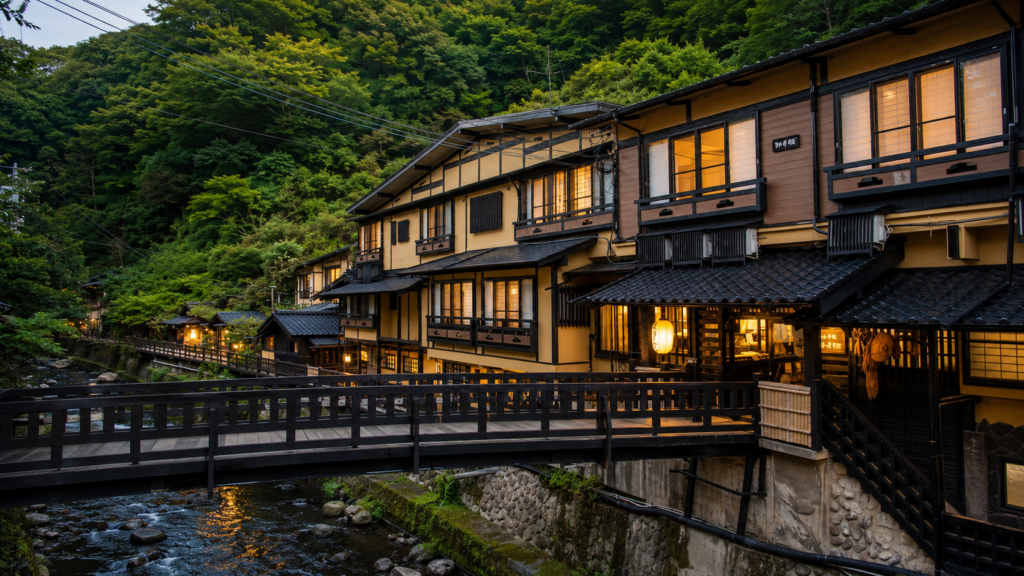
If there’s one ryokan that captures “classic Kurokawa” in a single building, it’s Shinmeikan. This is the town’s most photographed ryokan — and for good reason.
What makes it special: A hand-dug cave bath (tunneled by the owner over 10 years), outdoor and indoor baths, two reservable family baths for overnight guests, and a wooden facade that looks like it belongs on a postcard. Shinmeikan sits right in the middle of town, so you can wander the streets in your yukata, browse local shops, and visit other baths with your Nyuto Tegata without breaking a sweat.
The cave bath — hewn from rock and created by the owner over a decade — is the kind of experience you’ll describe to friends back home. For privacy, use one of the two separate family baths, which are reservable on a first-come basis for overnight guests.
| Factor | Details |
|---|---|
| Baths | Cave baths, outdoor bath, indoor baths, plus 2 reservable family baths for overnight guests |
| Private bath (kashikiri) | Yes — 2 separate family baths, reservable on a first-come basis |
| Location | Downtown — immediate access to main street and other baths |
| Tattoo policy | Policies vary by ryokan and bath; confirm directly before booking if this matters to you |
| Who it’s best for | First-timers, photography lovers, anyone wanting the “postcard Kurokawa” experience |
| Who should skip it | Travelers seeking modern rooms (Shinmeikan is traditional and some rooms show age); those who want total silence (you’re in the center of town) |
Best for Couples & Private Bath Lovers: Yamabiko Ryokan (やまびこ旅館)
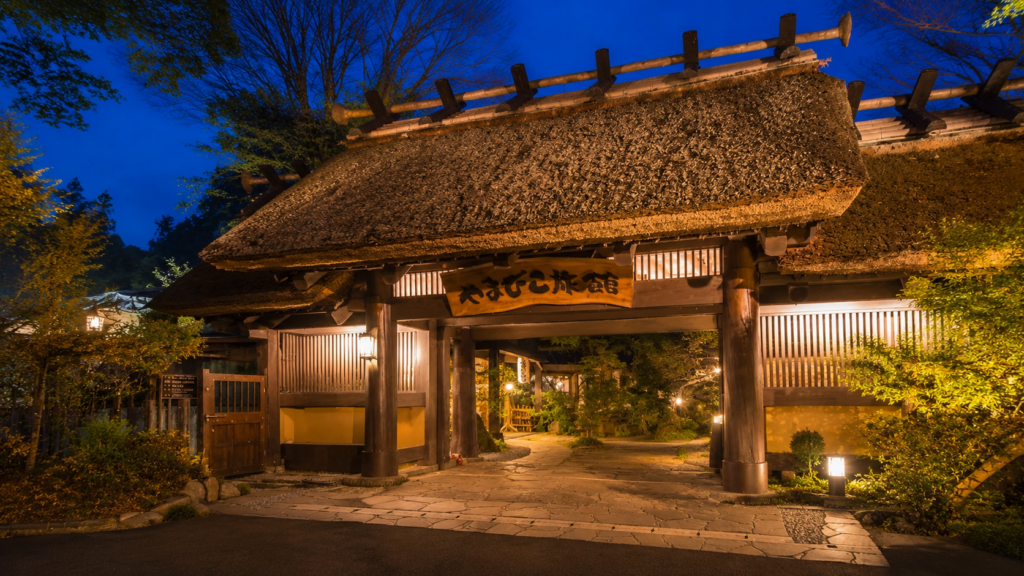
Yamabiko is a standout for one simple reason: it has six private family baths for overnight guests, and they operate without reservations or fixed time slots. You walk down to the bath area, find an open one, and use it privately.
This setup is rare even by Kurokawa standards. Many ryokan that offer private baths use reservations or time slots. At Yamabiko, overnight guests can use the family baths free of charge whenever one is available, without a fixed reservation period.
The ryokan also has large outdoor baths and indoor baths in addition to the private family baths. Rooms are traditional tatami, and the atmosphere is relaxed rather than formal. The dinner is good but not the primary draw — book here for the hot spring variety, not for a culinary experience.
| Factor | Details |
|---|---|
| Baths | 6 private family baths for overnight guests, plus large outdoor baths and indoor baths |
| Private bath (kashikiri) | Free for overnight guests; no reservation or fixed time slot, subject to availability |
| Location | Downtown — a few minutes’ walk from the main bus stop and shopping street |
| Tattoo policy | Policies vary by ryokan and bath; confirm directly before booking |
| Who it’s best for | Couples, solo travelers who want bath privacy, and anyone who prefers reserving nothing in advance |
| Who should skip it | Food-focused travelers who want the meal itself to be the main reason for choosing their ryokan |
If you fall into that camp — you want a classic Kurokawa stay, but shared public baths alone won’t satisfy you — Yamabiko is the first option worth checking.
Why I’d book this one
- The six guest-only family baths are the standout, which matches the main decision in this guide: what your ryokan gives you beyond the Nyuto Tegata.
- The riverside setting keeps the stay atmospheric without giving up the convenience of a downtown location.
- It works especially well for couples, privacy-focused travelers, and guests who want to avoid uncertainty around shared-bath rules.
Before locking in your dates, see current room availability, meal-plan options, and recent traveler reviews for Kurokawa Onsen Yamabiko Ryokan.
Best for Food Lovers: Ryokan Wakaba (旅館 わかば)
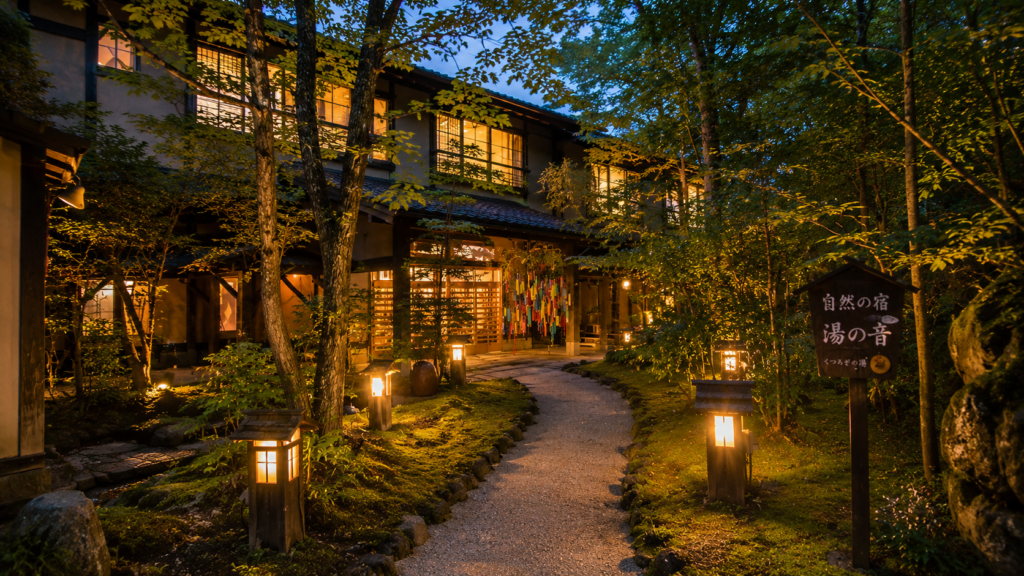
Originally a sushi restaurant, Ryokan Wakaba still puts food at the center of the stay. Its kaiseki highlights Kumamoto ingredients and regional specialties, including basashi (horse sashimi), local beef, and seasonal produce.
Dining depends on your room type. Several main-building rooms include in-room dinner, while annex guests dine in the traditional irori dining area; some detached rooms use the dining venue as well. Check the meal location attached to your specific room plan before booking.
The ryokan sits along the river, a short walk from the center. It offers two reservable private baths in addition to its shared bathing facilities. The annex rooms are especially spacious, sleeping up to seven — good for families who want the food experience without splitting into multiple rooms.
One practical note: Wakaba has stairs and no elevator. The private baths are downstairs. If you have mobility concerns or heavy luggage, this is worth factoring into your decision.
| Factor | Details |
|---|---|
| Baths | 2 reservable private baths, plus shared indoor and open-air bathing facilities |
| Dinner | Kaiseki centered on Kumamoto ingredients; dining location varies by room type, with in-room dinner on several main-building plans and irori dining for the annex |
| Location | Riverside, 5–7 minute walk to town center |
| Family-friendly | Yes — annex rooms up to 7 guests; private baths good for children |
| Mobility note | No elevator; stairs to private baths |
| Who it’s best for | Food-focused travelers, families wanting quality dining, couples who value a great meal over a scenic bath |
| Who should skip it | Travelers for whom a private open-air bath is the main priority; those with mobility issues |
Best for Families: Yumerindo (夢龍胆) & Wakaba Annex
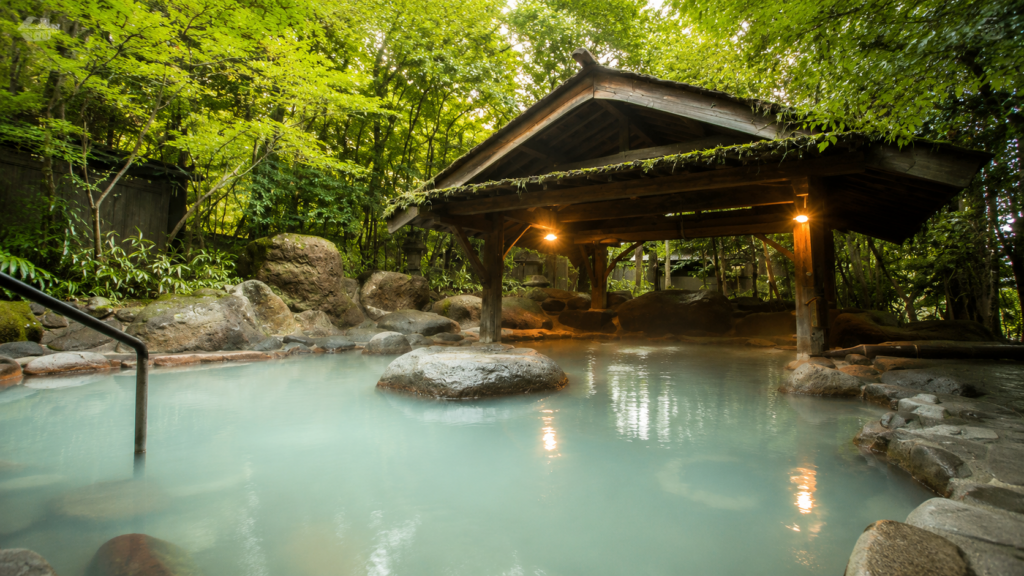
Yumerindo makes more sense as a family pick than as a budget pick today. It has four guest-only family baths — two hinoki-style and two stone-style — available by same-day reservation from 3 PM to 9 PM. The first use is free for overnight guests, which gives families a practical way to bathe together without relying on shared-bath arrangements.
For families who want more space and the food experience, the Wakaba Annex (separate building from the main Wakaba) works well. Rooms can accommodate up to seven guests, dinner is around the irori hearth, and guests can reserve Wakaba’s private baths. The annex is slightly further from the center than the main building, but still within walking distance.
Family travel tip for Kurokawa: Japanese ryokan are generally welcoming to children, but it’s worth confirming a few things at booking — meal times (many serve dinner at a fixed 6 or 7 PM slot), whether children’s meal portions are available, and which baths your family can use together. For parents who want to bathe with children privately, a reservable family bath is the simplest option.
Lower-budget option: If price matters more than having dinner included, Yusai Annex is one of the lower-priced properties on the Kurokawa Onsen association’s current accommodation list (roughly ¥13,000–¥20,000 per person). It is about a two-minute walk from the main Yusai building, and annex guests can use Yusai’s bathing facilities.
Best for Luxury & Anniversaries: Gekkoju (月洸樹)
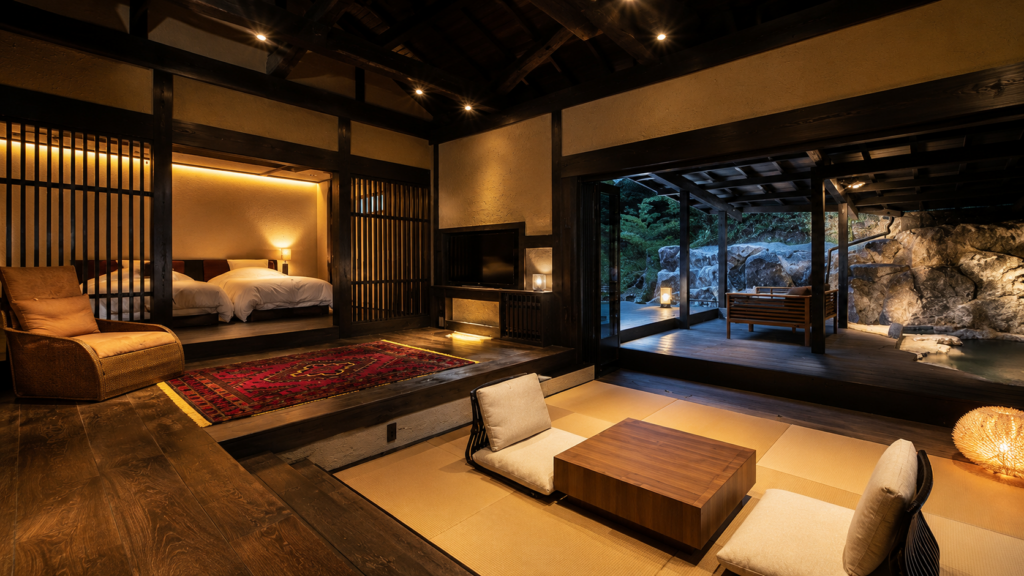
If you’re celebrating something — an anniversary, a honeymoon, or simply a deserved splurge — Gekkoju is the clearest luxury choice within Kurokawa.
Gekkoju now has 10 detached guest rooms. Two new villas, Tsukisae and Gyokurin, began accepting guests in June 2026; both add an open-air bath, indoor bath, and sauna. Every guest room has its own indoor and open-air bath, so the property is built around privacy rather than bath-hopping. In-room meal service is available, and there is also a restaurant/bar on the property.
The current Kurokawa Onsen association price range is roughly ¥69,900–¥122,700 per person, depending on date and room. This is a stay where the room itself is the destination, so it makes the most sense for anniversaries, honeymoons, or travelers deliberately choosing privacy over walkability.
Nearby luxury alternative: Takefue is another high-end option in the wider Minamioguni area, but it is not in Kurokawa’s central ryokan cluster; Takefue itself lists Kurokawa Onsen as about a 10-minute drive away. If its bamboo setting is the reason you want to stay there, treat it as a nearby alternative rather than a Kurokawa ryokan.
Best for Seclusion & Silence: Yamamizuki (山みず木), Sanga (山河), & Hozantei (帆山亭)
These three ryokan sit outside Kurokawa’s compact center, and they share a defining trait: you don’t stay here for the shopping street or the evening stroll. You stay here because you want more time surrounded by river and forest, with less emphasis on walking in and out of town.
Yamamizuki is known for its riverside open-air bathing and also offers reservable private baths. Sanga sits in a quiet wooded setting away from the center and has three family baths for overnight guests. Hozantei is positioned farther into the upper reaches of the valley, with detached rooms and a strong retreat feel.
The trade-off is clear: you trade walkability for seclusion. If you arrive by bus or want to return to the center for onsen hopping, confirm your ryokan’s shuttle arrangements in advance. But what you get in return — a stay shaped more by the ryokan grounds, river, and forest than by the shopping street — is something the downtown properties cannot offer at the same intensity.
Kai’s tip: If you’re weighing a secluded ryokan against a downtown one, ask yourself this: what does your ideal morning look like? If it’s stepping into a yukata and walking two minutes to a public bath full of other guests, choose downtown. If it’s having a river-view rotenburo to yourself at dawn — with only the sound of mist rising off the water — choose the outskirts. Both exist in Kurokawa. They’re not the same experience, and one isn’t better than the other. But they’re different enough that your choice determines your entire stay.
Practical Tips for Booking Your Kurokawa Ryokan
When to Book
Most Kurokawa ryokan start accepting reservations three to six months in advance, although the exact window varies by property. For autumn foliage (October–November), the New Year period, Golden Week, and other peak dates, book soon after your chosen ryokan opens reservations.
If you’re flexible on dates, consider booking for a weekday rather than a weekend. Rates are lower, availability is better, and the public baths are significantly less crowded.
Kai’s tip: Don’t build your bath-hopping plan around a fixed “quiet hour.” Kurokawa now publishes live day-use bath status, and individual baths can close or restrict entry for cleaning, weather, maintenance, or crowding. Check the official day-use bathing status on the day you visit, then adjust your route.
Getting to Kurokawa Onsen
Kurokawa is not on a train line, so you’ll arrive by bus or car. Current official routes include a direct Kyushu Odan Bus from Kumamoto Station (about 3 hours), a direct highway bus from Hakata (about 2 hours 45 minutes), and the Kyushu Odan Bus from Yufuin (about 1 hour 37 minutes). For current timetables, reservation details, and the full route comparison, use our dedicated guide on how to get to Kurokawa Onsen.
For this accommodation decision, the more important point is what happens after you arrive. Downtown ryokan such as Shinmeikan, Yamabiko, Noshiyu, and Wakaba are walkable from the center. If you choose a more secluded property such as Yamamizuki, Sanga, Hozantei, or Gekkoju, confirm its pickup arrangements and timing before your trip.
Tattoos and Ryokan Etiquette
Tattoo policies in Kurokawa are set by individual ryokan and can differ by bath. The Kurokawa Onsen association specifically recommends contacting the property directly if you have tattoos. For more detailed planning, read our complete guide to Kurokawa Onsen with tattoos.
- Confirm the policy directly — don’t assume that one town-wide rule applies to every shared bath.
- Prioritize private or family baths — these can be the simplest option when a ryokan’s shared-bath policy is restrictive.
- Consider an in-room bath — properties such as Gekkoju put a private bath directly in the room, avoiding uncertainty around shared facilities.
General onsen etiquette applies year-round: wash thoroughly before entering any bath, keep your towel out of the water, and don’t swim or splash. For first-time visitors, the water will feel hot (38°C–42°C is standard) — enter slowly and give your body time to adjust. Many ryokan provide a small towel (tenugui) for modesty when walking between baths.
FAQ — Kurokawa Onsen Accommodation
Can I visit Kurokawa Onsen without staying overnight?
Yes — day trips are possible, and the Nyuto Tegata (¥1,500) is designed for onsen hopping. You can purchase the pass at participating ryokan or the Kurokawa Onsen association information center and use it for up to three participating baths, subject to each bath’s day-use hours and current availability. Staying overnight still gives you more time to enjoy the town outside the day-trip window and use your own ryokan’s guest facilities. If you’re still on the fence, read our honest Kurokawa Onsen review for a closer look at the day-trip experience.
Is the Nyuto Tegata worth it if my ryokan already has good baths?
Generally, yes — even if your ryokan has excellent baths, the Tegata adds variety: one bath may be tucked into rock, another beside a river, another surrounded by forest. The point is not to replace your own ryokan’s baths but to experience several different settings. Check the day’s participating-bath status before deciding where to use your three stamps.
How many nights should I stay in Kurokawa Onsen?
One night is the standard and works well for most travelers — it gives you an evening and a full morning, which is enough for dinner, an evening stroll, an early-morning bath, and some Nyuto Tegata hopping after breakfast. Two nights is justified if you’re staying at a secluded ryokan (Yamamizuki, Sanga, Gekkoju) and want a full day to relax without rushing to check out, or if you’re combining one night downtown and one night on the outskirts for contrast.
Are Kurokawa ryokan tattoo-friendly?
It varies by ryokan and by bath. The Kurokawa Onsen association advises travelers with tattoos to contact the individual ryokan directly because policies are handled property by property. A private or family bath can be a practical alternative, but confirm the rules for your chosen accommodation before booking.
What is the best season to visit Kurokawa Onsen?
Each season offers a different character. Autumn (roughly late October to mid-November) brings red and gold foliage and is one of the periods when early booking matters most. Winter brings the contrast of cold mountain air and steaming baths, while spring brings fresh greenery and blossoms. Summer is lush and green, with cooler mountain temperatures than many lowland cities. Choose the season for the atmosphere you want rather than assuming one period is always cheapest or least crowded.
Do I need a car to get around Kurokawa Onsen?
Not if you stay downtown — Shinmeikan, Yamabiko, Noshiyu, Wakaba, and Yumerindo are all in or near the compact center, so you can reach many bath-hopping options on foot. If you stay at a secluded ryokan (Yamamizuki, Sanga, Hozantei, Gekkoju), confirm its shuttle arrangement from the bus stop. A car is useful if you plan to explore the surrounding Kuju and Aso areas, but it isn’t essential for a stay focused on Kurokawa itself.
Can I walk between all the ryokan in Kurokawa?
The downtown ryokan are concentrated in a compact area, so walking between the main street and several central properties is easy. The secluded ryokan (Yamamizuki, Sanga, Hozantei) sit outside that compact cluster, so don’t assume you can casually walk between every property. If you want to visit an outlying ryokan, check its access and shuttle options first.
Final Verdict — Which Kurokawa Ryokan Is Right for You?
Kurokawa Onsen has roughly 30 ryokan, and no single one is best for everyone. The fastest way to choose is to match the ryokan to the part of the stay you care about most:
- Atmosphere / first visit: Shinmeikan
- Private-bath flexibility: Yamabiko Ryokan
- Food: Ryokan Wakaba
- Families: Yumerindo or Wakaba Annex
- Lower budget: Yusai Annex
- Luxury / anniversary: Gekkoju
- Seclusion: Yamamizuki, Sanga, or Hozantei
The Nyuto Tegata means your own ryokan does not have to provide every bath experience. Choose the accommodation for the things the pass cannot give you — your private-bath setup, dinner, room, and location — then use the Tegata to add variety around it.
Hi, I’m Kai. I’m a Tokyo-based travel writer, tourism industry insider, and the author of a published guidebook for international visitors to Japan. With over 10 years of professional experience at a leading Japanese tourism company, my mission is to help you skip the tourist traps and navigate Japan’s best destinations like a local. I believe the perfect day trip is like a traditional kaiseki meal: a beautiful balance of precise planning and unforgettable seasonal discovery. When I’m not out conducting field research, you’ll usually find me drafting new itineraries with one of my favorite fountain pens!