
You have one day for the Seto Inland Sea art islands. Maybe a day and a half if you’re being generous. And now you’re staring at Naoshima and Teshima on a map, wondering which one deserves your limited time — or whether you can squeeze both into a single day without the whole plan falling apart.
Here’s the short answer: for most first-time visitors with one day, Naoshima is the better choice. It has more art, more variety, more iconic moments, and better infrastructure. But Teshima, despite having just one anchor museum, delivers an artistic experience that Naoshima cannot touch — a quiet, meditative encounter with light, water, and wind that stays with you long after you leave.
This guide cuts through the noise. You’ll get a straight comparison of what each island offers, a brutally honest answer on whether “both in one day” actually works, and a final verdict based on your travel style — not mine.
If you already know Naoshima is your pick: a private guide can make the island much easier to handle, especially when Chichu timing, buses, port choices, and ferry connections all matter. You can check current availability, start times, and recent traveler reviews for this Naoshima full-day private guided tour before you lock in the rest of your plan.
Naoshima vs Teshima: At a Glance
| Naoshima | Teshima | |
|---|---|---|
| Vibe | Curated art island — dense, varied, buzzy | Quiet rural island — single-minded, sensory, serene |
| Main attraction | Chichu Art Museum, Benesse House Museum, Art House Project, Kusama pumpkins | Teshima Art Museum (one museum, one installation) |
| Number of art venues | 10+ (museums, outdoor works, bathhouse, galleries) | 5–6 (including outdoor installations, archives, a needle factory) |
| Time needed to feel satisfied | Full day (5–7 hours minimum) | Half-day (3–4 hours including ferry time) |
| Crowds | Busy — Chichu sells out weeks ahead | Quiet — even on good days, you’ll have space |
| Best for | First-time visitors, architecture lovers, photographers, anyone wanting variety | Repeat visitors, meditation seekers, travelers who value one profound moment over ten good ones |
| Food and amenities | Multiple museum cafes, convenience stores, a public bath | A few restaurants (Shima Kitchen, Umi no Restaurant), limited options |
| Access from Takamatsu | Ferry 50 min / High-speed 30 min, frequent departures | Direct ferry ~35 min, or 22 min via Naoshima |
| Ticket pressure | High — Chichu requires advance reservation, often sells out | Medium — Teshima Art Museum also requires advance reservation, but less competitive |
Can You Visit Both Naoshima and Teshima in One Day?
The honest answer: technically yes, but only on certain days of the week, and it will be rushed. Most travelers who try end up feeling like they shortchanged both islands.
Here’s what makes or breaks a “both in one day” plan:
The Ferry Reality (This Is Where Plans Collapse)
The inter-island high-speed boat between Naoshima’s Miyanoura Port and Teshima’s Ieura Port runs only three times a day — at 9:20, 12:10, and 14:50 from Naoshima, and returning at 10:25, 13:10, and 15:47 from Teshima. The journey takes about 22 minutes and costs ¥630 one way.
But here’s the catch that catches many travelers off guard: these boats only run when the museums on both islands are open.
Kai’s tip: The inter-island ferry from Naoshima to Teshima does not run on Tuesdays from March through November. From December through February, it also drops Wednesday and Thursday — meaning it only operates on Mondays, Fridays, Saturdays, Sundays, and national holidays. The boat’s schedule is tied directly to the Teshima Art Museum’s open days. I’ve seen travelers arrive on a Tuesday with a perfectly planned “both islands” itinerary, only to discover the boat simply isn’t running that day. Check your chosen day against the Benesse Art Site calendar before you book anything.
So if your only available day is a Tuesday (or a winter Tuesday–Thursday), the decision is made for you: pick one island and commit.
The “Both in One Day” Timeline
If you’re on a compatible day and still want to try, here’s what the logistics actually look like:
- 7:30–8:30 — Takamatsu to Naoshima (Miyanoura). First ferry or high-speed boat.
- 8:30–11:30 — Naoshima morning: Chichu Art Museum (if you booked the earliest slot) or Benesse House Museum area.
- 12:10–12:32 — Miyanoura to Ieura (Teshima). This is the only practical midday connection.
- 12:32–15:17 — Teshima: Teshima Art Museum plus quick lunch at Shima Kitchen.
- 15:47–16:39 — Ieura to Miyanoura (or direct to Takamatsu if timing allows).
You’ll get roughly 2.5 hours on Naoshima and 2.5 hours on Teshima. That’s enough for one major venue per island — the Chichu Art Museum on Naoshima and the Teshima Art Museum on Teshima — but almost nothing else. The pumpkins, the Art House Project, Benesse House, the rice terraces — something has to give.
My take? If you have exactly one day, choose one island and give it the time it deserves. The “both in one day” plan works only if you’re comfortable with a tight schedule, already have advance reservations for both museums, and are okay with seeing just the headline acts.
Naoshima: The Art Island Powerhouse
Naoshima is the Seto Inland Sea’s headline act — and for good reason. With over a dozen art venues scattered across the island, it delivers the density and variety that most visitors want when they only have one shot at the art islands.
Why Naoshima Wins for Most First-Time Visitors
Naoshima gives you more of everything: more museums, more architectural styles, more photo opportunities, and more flexibility in how you build your day. The island has two main port areas — Miyanoura (west) and Honmura (east) — plus the Benesse House area on the southern coast, connected by a frequent shuttle bus and rental bicycles. (Read our guide on how to get to Naoshima for details on which port makes the most sense for your route.)
The must-see lineup on Naoshima includes (for a deeper dive into each spot, see our full guide on things to do in Naoshima):
- Chichu Art Museum (requires advance reservation) — Tadao Ando’s underground masterpiece built into a hillside. Permanent installations by Claude Monet (five Water Lilies paintings under natural light), James Turrell (Open Sky and other light works), and Walter De Maria (Time/Timeless/No Time — a 2.2m sphere in a room of 27 gilded wooden forms). The museum itself, almost entirely underground yet flooded with natural light, is as much the artwork as anything hanging on the walls. Admission: around ¥2,500–2,700 online. Closed Mondays.
- Benesse House Museum — The museum-hotel complex designed by Tadao Ando. The indoor-outdoor layout includes works by Bruce Nauman, David Hockney, and Andy Warhol, plus the Valley Gallery along the seaside. Admission around ¥1,300. Some galleries prohibit photography.
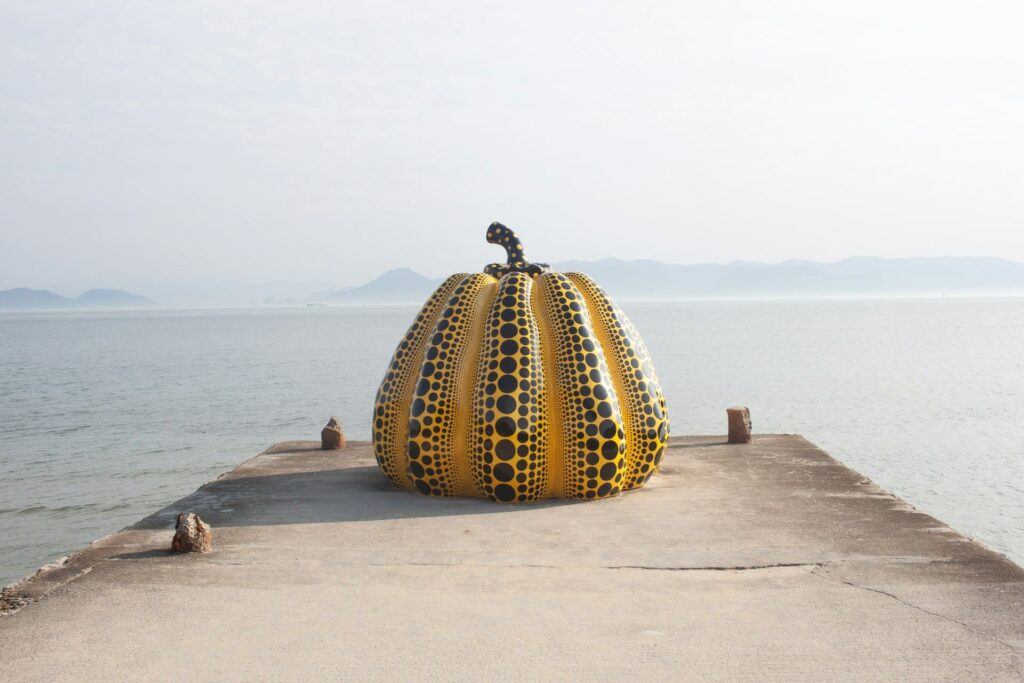
- Yellow Pumpkin and Red Pumpkin (Yayoi Kusama) — The yellow pumpkin at the end of the pier near Benesse House is arguably the most photographed spot in the Seto Inland Sea. Free, outdoor, accessible 24 hours. The red pumpkin near Miyanoura Port is a later addition and equally photogenic.
- Art House Project — Six abandoned houses in the Honmura district transformed into site-specific installations by artists including James Turrell (Minamidera — complete darkness, then slowly emerging light), Rei Naito (Kinza — one person, 15 minutes, silence, a small opening in the ceiling). Kinza requires a separate advance reservation (around ¥600 online) and is open Friday through Sunday only — one person per 15-minute slot.
- Lee Ufan Museum — Ando-designed space for the Korean minimalist’s sculptural works. Quiet, contemplative, and often overlooked.
- Naoshima Pavilion (Sou Fujimoto) — The latticed steel structure at Miyanoura Port. Free. Quick stop on arrival.
- I♥湯 (Naoshima Bath) — If you have time, this is a uniquely Naoshima experience: a public bath designed as an artwork by Shinro Ohtake with mosaics, found objects, and a glass elephant on the roof. ¥650–700.
Kai’s tip: Whether you can actually build a good Naoshima day depends entirely on one thing: do you have a Chichu Art Museum reservation or not? Chichu sells out 1 to 2 weeks in advance, especially on weekends and during peak travel seasons (spring, autumn, Golden Week, and Setouchi Triennale years). If you book Chichu for a morning slot (10:00 or 11:00), you can structure the rest of your day around the Benesse House area and the pumpkins before the crowds arrive. If you arrive without a booking, Chichu is off the table entirely — and suddenly Naoshima loses its anchor attraction. Book it the moment your travel dates are confirmed. If tickets are sold out, shift your focus to Benesse House Museum and the Art House Project in Honmura, which are still excellent — but know that you’ll miss the island’s single most important museum.
If you fall into that camp — you want Naoshima’s headline museums, but you do not want the day to become a ferry-bus-ticket puzzle — this is the guided option worth comparing before you commit to doing everything yourself.
Why I’d book this one
- Recent travelers consistently mention that the guide helped them understand both the artworks and the island context, not just move between stops.
- The private format is useful on Naoshima because your best day depends on Chichu timing, port choice, and which 3–4 sites matter most to you.
- It keeps the decision flexible: you can check live start times, cancellation terms, and recent reviews before deciding whether the guided route fits your date.
Best For…
- First-time art island visitors — The variety gives you a sampler of everything: architecture, painting, sculpture, light installations, outdoor works.
- Photographers — The Kusama pumpkins, Ando concrete, and natural light installations are objectively photogenic.
- Travelers who want value for a full day — You can fill 6–7 hours without running out of things to see.
- Anyone who dislikes “What if I’m missing something?” — Naoshima has enough density that you won’t feel like you made the wrong call.
Not Ideal For…
- Travelers seeking peace and solitude — Naoshima can feel busy, especially near the pumpkins and Chichu entrance.
- Anyone who hates advance planning — If you don’t book Chichu, you’re starting the day with your best option already gone.
- Half-day visitors — The island is too spread out to feel rewarding in under 4 hours.
Teshima: The One-Museum Island That’s Not Just One Museum
Teshima is quieter, smaller, and more rural than Naoshima. It has one blockbuster museum — the Teshima Art Museum — and a handful of satellite installations scattered across its hillsides and fishing villages. On paper, that sounds like less. In practice, it delivers something that Naoshima, for all its density, does not: a single, uninterrupted, deeply sensory encounter with art that feels less like a gallery visit and more like a pilgrimage.
That distinction matters. If Naoshima is about seeing — multiple artists, multiple works, multiple moments — Teshima is about being. It asks you to slow down, sit still, and let the art come to you.
Teshima Art Museum — An Experience, Not a Gallery
Designed by architect Ryue Nishizawa and featuring a single permanent installation by artist Rei Naito titled Matrix, the Teshima Art Museum is a concrete shell shaped like a water droplet — roughly 40 by 60 meters, with a ceiling height of 4.3 meters at its highest point. There are no columns inside. There is nothing on the walls. There are no explanatory plaques.
What you will find: water. Tiny droplets emerge from tiny holes in the concrete floor, moving slowly across the surface, merging into each other, pooling, then disappearing through other holes — a continuous cycle that never repeats the same pattern twice. Oval openings in the ceiling let in natural light, wind, the sound of birds, the smell of rain. The museum has no climate control — it breathes with the outside. On a windy day, the water ripples. On a still day, it reflects the sky above.
Visitors sit or lie on the concrete floor (it’s heated in cooler months) and simply watch. The average visit is 20 to 30 minutes, though staff won’t rush you. The experience is different every single time depending on the weather, the season, and the time of day.
Admission: Around ¥1,800 (online advance reservation) / ¥2,000 (if available on the day). Open: March–November 10:00–17:00 (last entry 16:30), October–February 10:00–16:00 (last entry 15:30). Closed: Tuesdays March–November; Tuesdays through Thursdays December–February. Advance reservation required.
Kai’s tip: The Teshima Art Museum is one of those rare places where when you visit fundamentally changes what you get out of it. On a sunny midday in peak season, the concrete floor is full of people sitting in silence — but it’s a shared silence, and the constant rustling of coats and backpacks breaks the spell. Go for the first slot of the day (10:00–10:15) on a quiet weekday, or aim for the last entry of the afternoon (15:30–16:00) when the day-trippers have cycled back to the ferry. On a rainy day, the sound of water hitting the ceiling and the movement of the floor droplets change completely — what feels serene in the morning becomes something more meditative and atmospheric. If you rush through in 15 minutes because you’re worried about catching the ferry, you will wonder what the fuss is about. Give it half an hour of not doing anything.
Beyond the Museum: What Else Is on Teshima
While the Teshima Art Museum is the island’s headline, there are several other works worth your time — especially if you have a half-day to explore.
- Teshima Yokoo House — A former house transformed into an exhibition space for the graphic artist Tadanori Yokoo. Three rooms with mirrored ceilings, mosaic floors, and a UV-lit dreamscape that feels like stepping inside a graphic novel.
- Les Archives du Cœur (Heartbeat Archive) — Christian Boltanski’s ongoing installation on the island’s southeast coast. Inside a small building by the water, you can record your own heartbeat and listen to thousands of recordings collected from around the world. It costs around ¥500 to record yours. The archive is as much about the act of listening — standing in a dark room, headphones on, hearing someone else’s pulse — as it is about leaving your own mark.
- Needle Factory — A converted sewing needle factory with subtle, quiet installations. Easy to miss, worth the short detour.
- Tom Na H-iu — A standing stone by Rei Naito (the same artist who created the Teshima Art Museum interior) that glows blue after dusk. Only reachable during certain hours — check at the port information desk.
- Shima Kitchen — A community restaurant near Ieura Port serving set lunches using locally caught fish and island-grown vegetables. Simple, honest, and one of the few meal options on the island. Around ¥1,500 for a lunch set. Cash only.
- Umi no Restaurant — A second dining option in the Karato area near the art museum. It serves seafood-focused set meals with a terrace overlooking the sea.
- The rice terraces — The hillside between the museum and Karato Port is terraced with rice paddies that turn mirror-like during planting season (late spring) and golden during harvest (autumn). The walk between the museum and port takes about 20 minutes and is as visually rewarding as the art.
Best For…
- Repeat visitors — If you’ve already done Naoshima, Teshima offers a completely different register of art experience.
- Travelers who value one profound moment — The Teshima Art Museum alone is worth the ferry ride for those who connect with meditative, site-specific work.
- Solo travelers — The island’s quiet, slow rhythm suits traveling alone well.
- Photographers interested in texture and light — The museum interior, the rice terraces, and the coastline offer subtle, non-obvious photo opportunities.
- Rainy day explorers — The museum experience arguably improves in wet weather.
Not Ideal For…
- Travelers who want variety — If you like seeing different artists, different mediums, different buildings, Teshima will feel like a one-note day.
- Large groups or families with young children — The Teshima Art Museum requires total silence. Children under elementary school age may not enjoy the experience, and there are few child-friendly diversions elsewhere on the island.
- Anyone with limited mobility — The museum is at the top of a hill with no shuttle bus service during off-peak seasons. The walk from Karato Port up the terraced slope takes 15–20 minutes uphill.
- Anyone on a tight ferry schedule — If you land at 12:30 and need to catch the 13:10 boat back (yes, some visitors try this), you barely have time to reach the museum, let alone experience it.
Naoshima vs Teshima: Making Your Choice
By now you’ve read both sides in detail. Here’s how the two islands stack up against your actual travel constraints.
| Your Situation | Choose Naoshima | Choose Teshima |
|---|---|---|
| You have one full day (6–8 hours on the island) | ✅ Excellent — use the full day to see Chichu, Benesse House, Art House Project, and the pumpkins | ❌ Overkill — 3–4 hours is enough for Teshima’s main attractions |
| You have a half-day (3–4 hours) | ❌ Too rushed — you’ll spend most of your time on buses and miss the deeper venues | ✅ Perfect — museum plus lunch plus one more stop fits comfortably |
| You’re visiting on a Tuesday (or winter Tuesday–Thursday) | ✅ Day trip on Tuesdays is possible (Naoshima museums are open) | ❌ Closed — Teshima Art Museum is closed; inter-island ferry doesn’t run |
| It’s your first art island experience | ✅ Best choice — you’ll get the full spectrum of what the Seto Inland Sea art scene offers | ❌ Save for your second visit — you’ll appreciate Teshima more after Naoshima |
| You want to do both islands | ✅ Start here in the morning, then catch the 12:10 ferry across | ✅ Visit in the afternoon after spending the morning on Naoshima |
| You haven’t booked Chichu in advance | ⚠️ Possible but weak — you lose the island’s biggest draw | ✅ Strong alternative — Teshima is less competitive on bookings |
| You’re looking for a quiet, contemplative day | ❌ Naoshima has crowds, queues, and some noise | ✅ This is exactly Teshima’s strength |
| You’re traveling with young children | ⚠️ Doable — outdoor pumpkins, Naoshima Bath, open spaces | ❌ Challenging — museum requires quiet, limited child-friendly activities |
| You want photos for social media | ✅ Yellow Pumpkin, Red Pumpkin, Ando concrete — instant recognition | ⚠️ Possible but subtle — the museum interior is hard to photograph well |
| You’re based in Okayama (via Uno) | ✅ Very easy — 20 minutes by ferry from Uno Port | ❌ Less direct — requires a change at Naoshima or a longer route via Takamatsu |
| You’re based in Takamatsu | ✅ Easy — frequent ferries and high-speed boats | ✅ Easy — direct ferry ~35 minutes, or via Naoshima |
| You care about food and amenities | ✅ Multiple cafes, museum restaurants, convenience store, public bath | ❌ Limited — two restaurants, no convenience store on island |
| Your trip falls during the Setouchi Triennale year | ⚠️ Extremely crowded — book everything months ahead | ⚠️ Also crowded, but less so than Naoshima |
One practical note on the “both islands” option in the table above: it only works if you’re comfortable with a tight schedule. You’ll get about 2.5 hours per island — enough for the headline attraction on each, but not for deep exploration. And it only works on days when the inter-island ferry is running (not Tuesdays, not winter Tuesdays through Thursdays).
What About Inujima?
A third art island — Inujima — often appears alongside Naoshima and Teshima in itinerary research. Inujima is much smaller, with the Inujima Art Project (a Seirensho art museum repurposed from a copper refinery, designed by architect Hiroshi Sambuichi) as its main draw. It requires a separate ferry from Okayama or Uno and doesn’t connect easily to Naoshima or Teshima in a single day. If you have only one day for the art islands, save Inujima for a future trip or a longer Seto Inland Sea itinerary. If you have two days, Naoshima plus Inujima is a workable pairing from the Uno or Okayama side.
Frequently Asked Questions
Is Teshima worth it if I only have one day for the art islands?
It depends on what you’re looking for. If you want variety — multiple museums, outdoor sculptures, Kusama pumpkins, and a full day of exploration — Naoshima is a better use of your single day. But if you’re drawn to the idea of a single, profound, meditative art experience that stays with you long after you leave, the Teshima Art Museum alone justifies the trip. The honest answer for most first-time visitors: do Naoshima on a first visit, and save Teshima for a return trip or a two-day itinerary.
Do I need to book Chichu Art Museum in advance?
Yes — and this is non-negotiable. Chichu Art Museum operates on a timed-entry system and requires an online reservation. Tickets often sell out 1 to 2 weeks in advance, especially on weekends, during holidays (Golden Week, autumn leaves season), and in Setouchi Triennale years. Book through the official Benesse Art Site website. If tickets are sold out for your date, consider shifting your focus to Benesse House Museum and the Art House Project instead, or switch your visit to Teshima, where the museum is less competitive on bookings.
Can I take photos inside the Teshima Art Museum?
No. Photography, video recording, and phone use are strictly prohibited inside the Teshima Art Museum. The experience is designed to be fully sensory — the movement of water, the changing light, the sounds of wind and birds — and any distraction breaks it. Staff will remind visitors at the entrance. Leave your phone and camera in your bag and sit for 20 to 30 minutes without any digital mediation. You won’t regret it.
How do I get from Naoshima to Teshima?
By inter-island high-speed boat operated by Shikoku Kisen. The route connects Naoshima’s Miyanoura Port to Teshima’s Ieura Port in about 22 minutes, costing ¥630 one way. There are three departures per day from Naoshima (9:20, 12:10, 14:50) and three returns from Teshima (10:25, 13:10, 15:47). Critical: This service does not run on Tuesdays (March–November) or on Tuesdays through Thursdays (December–February), as it’s tied to the Teshima Art Museum’s opening days. Always check the current schedule before planning your day.
Which island is easier to reach — Naoshima or Teshima?
For visitors based in Takamatsu, both islands are about equally convenient — Naoshima is a 30-minute high-speed boat or 50-minute ferry ride away, while Teshima has a direct ferry taking around 35 minutes. For visitors based in Okayama (accessing via Uno Port), Naoshima is significantly easier — just 20 minutes by ferry from Uno. Teshima from Okayama or Uno requires a ferry to Naoshima first, then switching to the inter-island boat, or a longer ferry route via Takamatsu. If you’re basing yourself in Okayama, Naoshima is the natural choice.
Which island has better food options?
Naoshima, by a wide margin. The island has multiple museum cafes (Chichu Cafe, Benesse House Cafe), a convenience store near Miyanoura Port, and the I♥湯 public bath area with restaurant options. Teshima has two main restaurants — Shima Kitchen (near Ieura Port, lunch sets around ¥1,500, cash only) and Umi no Restaurant (near the art museum, seafood sets) — plus a small cafe at the museum. Naoshima is better if food variety matters to you; Teshima requires planning your meal timing carefully. (For specific dining recommendations and tips on avoiding the lunch rush, see our guide to Naoshima restaurants.)
Is Naoshima or Teshima better for photography?
Naoshima is more naturally photogenic in the conventional sense — the Kusama Yellow Pumpkin against the sea, the geometric concrete of Ando’s buildings, the Red Pumpkin at Miyanoura Port. These are instantly recognizable images. Teshima is more challenging to photograph well: the Teshima Art Museum interior is a no-photo zone, and the island’s beauty is in subtle textures (water on concrete, rice terraces reflecting the sky, light through the ceiling opening). If you’re building an Instagram feed, Naoshima wins. If you prefer quiet observation over capturing the shot, Teshima’s value is in being present, not documenting.
What should I wear to the Teshima Art Museum?
Comfort is key. You’ll be sitting or lying on a concrete floor for 20–30 minutes (the floor is heated in cooler months, but still hard). Wear socks if you plan to go barefoot — the floor is cleaned regularly but can feel cold. Avoid noisy fabrics like rustling raincoats or nylon jackets, as the museum is completely silent and every sound carries. You’ll also need to walk up a 15–20 minute sloping path from Karato Port to reach the museum, so comfortable walking shoes are essential.
Final Verdict: Which Island Should You Choose?
After all the comparison tables and timing logistics, here’s the verdict broken down by who you are and what you need from your day on the Seto Inland Sea.
Choose Naoshima if…
- It’s your first time visiting the Seto Inland Sea art islands. The density and variety give you the best introduction to what this region does. Start with Chichu Art Museum (book ahead), walk down to the Yellow Pumpkin, explore the Benesse House Museum area, and take the Honmura bus to the Art House Project. You’ll leave feeling like you saw something substantial.
- You have one full day (6–8 hours) and want maximum value. Naoshima fills a full day naturally. Teshima, by contrast, leaves you with hours to kill after you’ve seen the art museum.
- You’re an architecture enthusiast. Four Tadao Ando buildings across the island — plus the Fujimoto pavilion at the port — make Naoshima an architecture tour in its own right.
- You want iconic photo moments. The pumpkins, the Ando concrete, the waterfront installations — these are the images that made the Seto Inland Sea famous. Naoshima delivers them.
- You’re based in Okayama (via Uno Port). The 20-minute ferry makes Naoshima the most accessible option from the Okayama side.
- You’re traveling with a group or want food variety. Naoshima’s infrastructure handles visitors better. Multiple cafes and restaurants mean you won’t be stuck with limited options.
Choose Teshima if…
- You’ve already visited Naoshima on a previous trip. Teshima offers a completely different register of art experience — quieter, more personal, less curated.
- You have only a half-day (3–4 hours) for art islands. Teshima fits this timeframe perfectly. Arrive at Ieura Port, eat at Shima Kitchen, visit the Teshima Art Museum (book the first slot), and walk the rice terraces down to Karato Port for the return ferry.
- You value one profound experience over many good ones. The Teshima Art Museum is the kind of place people describe as “life-changing” — but only if you give it the time and silence it demands.
- You want to avoid crowds. Even on busy days, Teshima feels spacious. The museum limits the number of visitors inside at any one time, and the rest of the island has a relaxed, unhurried rhythm.
- You’re traveling solo. Teshima’s quiet pace and contemplative art suit solo travelers particularly well. It’s the kind of island where being alone enhances the experience rather than detracting from it.
- You’re visiting on a rainy day. The Teshima Art Museum experience arguably improves when the weather is wet — the sound of rain on the concrete shell, the movement of water droplets, the diffuse grey light — whereas Naoshima’s outdoor works become less accessible.
Try both islands (in one day) only if…
- Your available day is not a Tuesday (and not a winter Tuesday–Thursday), and
- You have advance reservations for both Chichu Art Museum and Teshima Art Museum, and
- You’re comfortable with a tight schedule — 2.5 hours per island — and are okay seeing only the headline attraction on each, and
- You’re not traveling with young children or anyone with limited mobility.
If all four conditions are met, the combined day is logistically possible and will give you a real contrast in art experiences. The morning on Naoshima (Chichu plus the pumpkins) and the afternoon on Teshima (the museum plus a walk through the rice terraces) is a genuinely good day. But it’s a stretch, and if any one variable shifts — a delayed ferry, a longer queue than expected, a sudden rain shower — the whole day gets squeezed.
What I’d tell a friend visiting Japan for the first time
If you came to me and said, “I have one day for the art islands, what should I do?” — I’d say spend that day on Naoshima, and invest the time. Book Chichu for 10:00, walk to the Yellow Pumpkin, eat lunch at the Benesse House Cafe, take the bus to Honmura for the Art House Project, and end the afternoon at the Red Pumpkin near the port. That’s a complete day. You’ll see the highlights, you won’t feel rushed, and you’ll understand why people make the trip out here. (For a step-by-step breakdown of how to pull this off, check out our realistic Naoshima one-day itinerary.)
And I’d add: if you love that day, come back for Teshima. It’s not a consolation prize — it’s a different kind of experience. But it demands a different kind of attention, and that’s harder to give when you’re watching the clock because your ferry leaves in 45 minutes.
All prices and schedules are approximate and subject to change. Always check the official Benesse Art Site website and Shikoku Kisen ferry timetable for the latest information before your visit.
Hi, I’m Kai. I’m a Tokyo-based travel writer, tourism industry insider, and the author of a published guidebook for international visitors to Japan. With over 10 years of professional experience at a leading Japanese tourism company, my mission is to help you skip the tourist traps and navigate Japan’s best destinations like a local. I believe the perfect day trip is like a traditional kaiseki meal: a beautiful balance of precise planning and unforgettable seasonal discovery. When I’m not out conducting field research, you’ll usually find me drafting new itineraries with one of my favorite fountain pens!