
Naoshima is small — about 8 km of coastline — but it holds more art per square meter than most cities. The challenge isn’t finding things to do. It’s choosing what to do with the limited hours of a day trip, when ferries run on island time and museums require pre-booked slots.
This guide isn’t a list of everything on the island. It’s a judgment call on what’s worth your time, what you can skip, and how to plan a day that doesn’t end with you watching the last ferry pull away from the dock.
If you already know you want Chichu, the pumpkins, and Honmura without gambling on island buses or e-bike availability, it is worth checking live availability and recent reviews for this private Naoshima guide tour before you lock in your ferry times.
Naoshima at a Glance — The Short Version
If you only read one paragraph: book Chichu Art Museum first, photograph the Yellow Pumpkin early, and leave room to explore the new Naoshima New Museum of Art on the Honmura hilltop. On a day trip from Uno (20 min ferry) or Takamatsu (50–60 min ferry), you can comfortably do 2–3 major sites plus a walk through Honmura village. Anything more requires an overnight stay — or a very tight schedule that leaves no room for missed buses.
- Best for: Contemporary art lovers, architecture fans (Tadao Ando), photographers, quiet travelers
- Not ideal for: Food-focused travelers, nightlife seekers, families with very young children (some installations are pitch-dark or fragile)
- Minimum time: 4–5 hours on the island (with pre-booked Chichu and a direct ferry)
- Comfortable day trip: 7–8 hours (first ferry in, last ferry out)
Before You Go — 3 Planning Rules
Most of the stress people experience on Naoshima is avoidable. These three rules eliminate the common mistakes I see first-time visitors make.
Rule 1: Book Chichu Art Museum First — Everything Else Second
Chichu Art Museum requires a timed-entry reservation purchased in advance through the Benesse Art Site website. Walk-up tickets are not available on most days, and slots for popular time windows (10:00–11:00 AM, 1:00–2:00 PM) can sell out 2–3 days ahead during peak season. Monday is the weekly closure, with Tuesday as a substitute if Monday is a public holiday.
What catches first-time visitors out: they book the ferry, then try to add Chichu — and find all slots gone. Reverse that order. Reserve your Chichu time slot first, then schedule your ferry around it.
- Admission: Around ¥2,000–¥3,000 (online discount available)
- Time needed: 60–90 minutes inside
- Photography: Not permitted inside the galleries
Kai’s tip: The “no photography” rule at Chichu frustrates some visitors before they arrive — but almost everyone leaves understanding why. Monet’s Water Lilies in natural light, James Turrell’s Open Field, and Walter De Maria’s Time/Timeless/No Time are designed to be experienced with your own eyes, not through a screen. It’s one of the few museums where the absence of cameras makes the art land harder.
Rule 2: Most Museums Are Closed on Mondays
Monday is essentially a ghost day on Naoshima. The following museums are all closed on Mondays (or the following Tuesday if Monday is a public holiday):
- Chichu Art Museum
- Naoshima New Museum of Art
- Benesse House Museum
- Lee Ufan Museum
- Ando Museum
The Art House Project sites and Naoshima Bath “I♥湯” are generally more flexible, but if you’re arriving on a Monday, your options shrink dramatically. Plan around Tuesday–Sunday for the full experience.
Rule 3: The Last Ferry Is Earlier Than You Think
Ferry schedules change by season, but the last departure from Miyanoura Port to Uno typically runs between 17:00 and 19:00. The high-speed ferry to Takamatsu usually stops earlier. Check the current timetable before your trip and work backward from that deadline. If you miss it, staying overnight is your only option — and accommodation on the island books out weeks in advance. If you are unsure which port to use, read our guide on how to get to Naoshima.
The Must-Dos — What to Prioritize on a Day Trip
These are the sites I’d tell any first-time visitor to build their day around. If you see nothing else, see these.
① Chichu Art Museum (地中美術館)
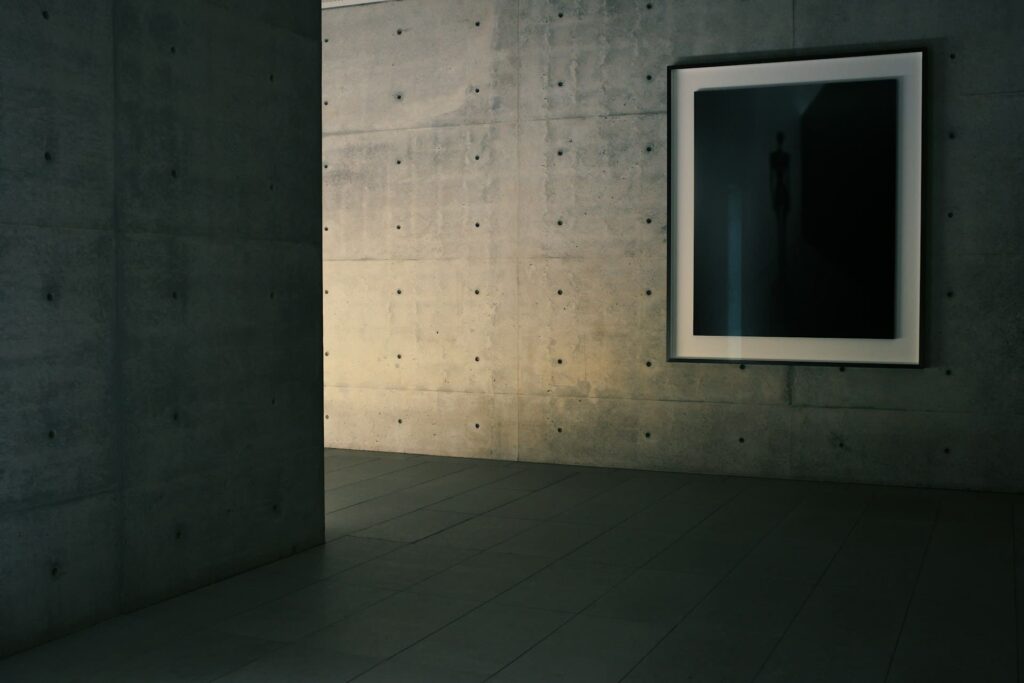
The crown jewel of Naoshima. Designed by Tadao Ando, the building itself is a work of art — buried into the hillside with concrete walls that guide natural light through underground galleries. The permanent collection includes Monet’s Water Lilies (displayed in a room lit entirely by daylight), James Turrell’s Afrum, Pale Blue and Open Field, and Walter De Maria’s monumental Time/Timeless/No Time.
- Best for: Architecture lovers, art enthusiasts, anyone seeking a contemplative experience
- Skip if: You’re here primarily for photo opportunities, or you have less than an hour
② Naoshima New Museum of Art (新直島美術館)
Opened in May 2025 on a hilltop in Honmura, this is Naoshima’s newest addition and also designed by Tadao Ando. The museum focuses on contemporary works from Japan and across Asia, with galleries that open onto views of the Seto Inland Sea. Because it’s newer, it’s often less crowded than Chichu — but that may change as word spreads.
- Best for: Contemporary art fans, return visitors looking for something new, architecture followers
- Time needed: 45–60 minutes
- Admission: Around ¥1,500–¥2,500 (check current pricing — online tickets recommended during busy periods)
③ Yayoi Kusama’s Yellow Pumpkin
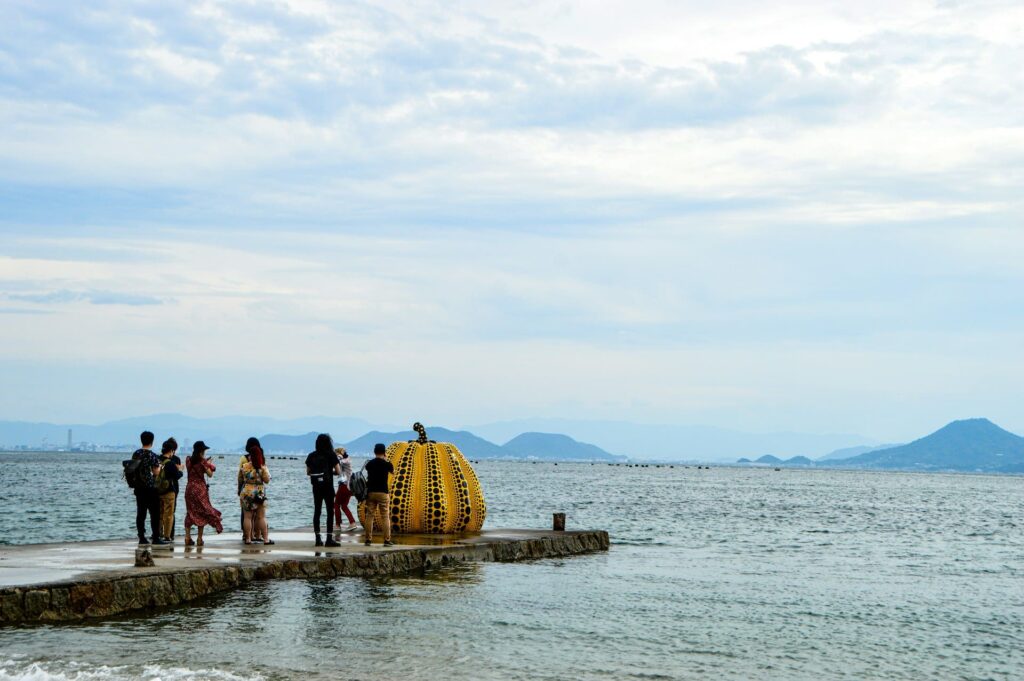
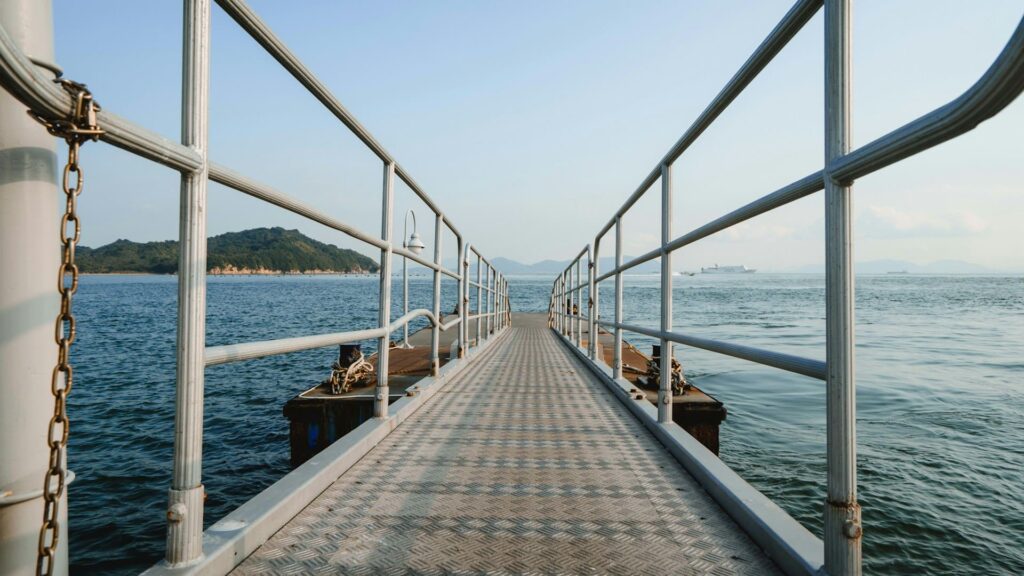
Perched on a pier at the southern end of the island, the Yellow Pumpkin is Naoshima’s most photographed icon. It’s outdoors, free to visit, and accessible 24 hours — but the light and crowd conditions change drastically by hour. Go early (before 9:00 AM) or late afternoon (golden hour) for the best photos and the shortest wait for a solo shot. By 10:00 AM, the queue for a single photo can stretch to 20 minutes.
During high tide, waves splash over the pier — keep your camera dry and watch your footing. The pumpkin was famously swept away during Typhoon Hagibis in 2019 but was restored and reinstalled in 2020. It’s back and sturdy.
- Best for: Everyone — it’s Naoshima’s signature moment
- Time needed: 15–20 minutes (more if you’re queuing)
- Cost: Free
④ Benesse House Museum
Perched on a hillside overlooking the sea, Benesse House is the original museum-residence hybrid that started Naoshima’s transformation. Designed by Tadao Ando, it combines gallery spaces with a hotel — guests staying overnight can visit during exclusive early-morning or evening hours. For day-trippers, the main galleries and the Valley Gallery annex are the accessible portions.
- Best for: Architecture enthusiasts, overnight guests, those who want to see how Ando’s style evolved from Benesse House to Chichu
- Time needed: 60–90 minutes (including Valley Gallery)
- Admission: Around ¥1,500–¥2,000
Should-Dos — If You Have Extra Time
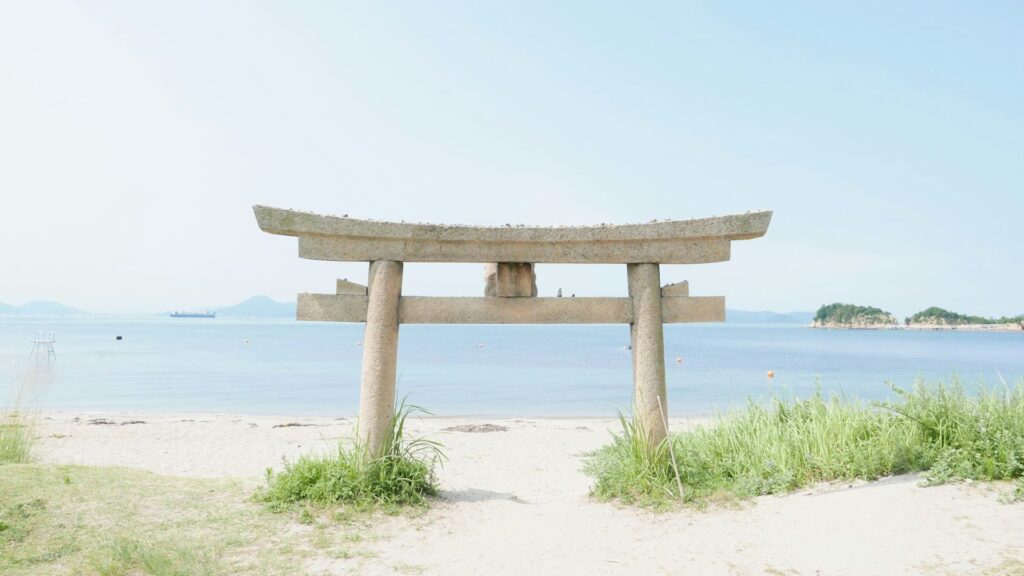
If you’ve covered the must-dos and still have a couple of hours, these are worth adding to your day. They’re not essential on a tight schedule, but each adds a different texture to your Naoshima experience.
Art House Project (家プロジェクト) in Honmura
Scattered through the old village of Honmura, the Art House Project transforms traditional wooden houses, a shrine, and a vacant lot into site-specific art installations. You walk through the quiet residential streets to find each one — part treasure hunt, part gallery visit.
- Kadoya — Free, no reservation needed. The original Art House, with an installation that floods the dark interior with reflected light from the garden.
- Minamidera — The one people talk about. You enter complete darkness — true, absolute, disorienting darkness — and wait for your eyes to adjust. James Turrell’s Black Room inside is a study in sensory perception. Requires a pass (around ¥1,000–¥1,500 for a multi-site ticket).
- Go’o Shrine — A glass-and-wood reinterpretation of a Shinto shrine by Hiroshi Sugimoto. It’s small but striking, tucked between houses.
- Kinza — Reservation-only, limited capacity. If you’re interested, book the day before through the Benesse website.
Best for: Contemporary art lovers, experiential art, those who enjoy the walk through Honmura’s narrow lanes
Skip if: You’re short on time (2+ hours for a full loop including walking), or you’re uncomfortable with complete darkness (Minamidera)
Lee Ufan Museum
An intimate museum designed by Tadao Ando for the Korean minimalist artist Lee Ufan. The building itself is restrained — concrete and steel set against a rock garden and the sea beyond. Inside, a small number of paintings and sculptures, each given enough space to breathe. It’s a quiet counterpoint to the busier sites on the island.
- Best for: Minimalism lovers, anyone seeking quiet, those who appreciate negative space in art
- Time needed: 30–45 minutes
- Admission: Around ¥1,000–¥1,500
Naoshima Bath「I♥湯」(I Love Yu)
A fully functioning public bathhouse designed by Shinro Ohtake. The exterior is a collage of found objects, tiles, and neon signs — inside, you’ll find a perfectly ordinary bath with an extraordinary setting. Towels and soap are available for a small fee. It’s a genuine local experience, not an art installation you just look at.
- Best for: Unique cultural immersion, relaxing at the end of the day, travelers staying overnight
- Time needed: 30–45 minutes
- Admission: Around ¥500–¥800
Optional — What You Can Skip (and Still Have a Great Day)
Some sites get mentioned in every Naoshima list but aren’t essential on a tight day trip. Here’s what to drop if you need to make space.
- Ando Museum: A small exhibition about Tadao Ando’s architectural process in an old wooden house. Worth a stop if you’re walking through Honmura, but not a dedicated trip. If you’ve visited Chichu and Benesse House, you’ve already experienced his work firsthand.
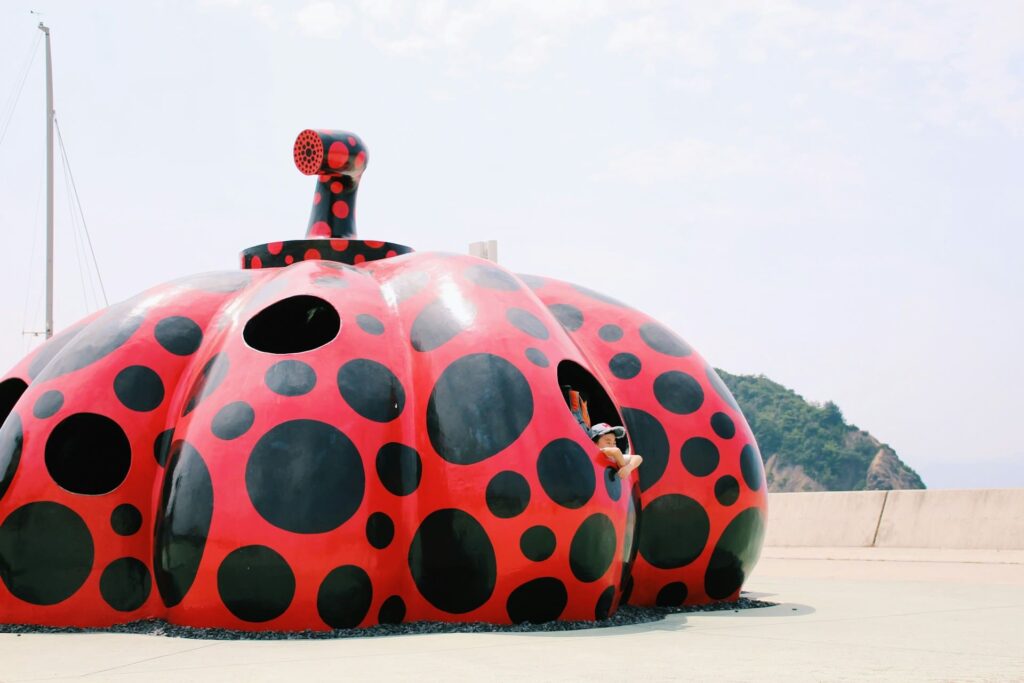
- Red Pumpkin: Right at Miyanoura Port. You’ll see it when you step off the ferry. Photograph it while walking past — it doesn’t need a separate stop.
- Sou Fujimoto’s Naoshima Pavilion: A delicate white mesh structure near the port. Interesting architecture, but a 5-minute look is enough.
- Gotanji Beach: A small beach popular with local families in summer. Nice if you want a swim, easy to skip if you don’t.
Getting Around the Island — 3 Realistic Options
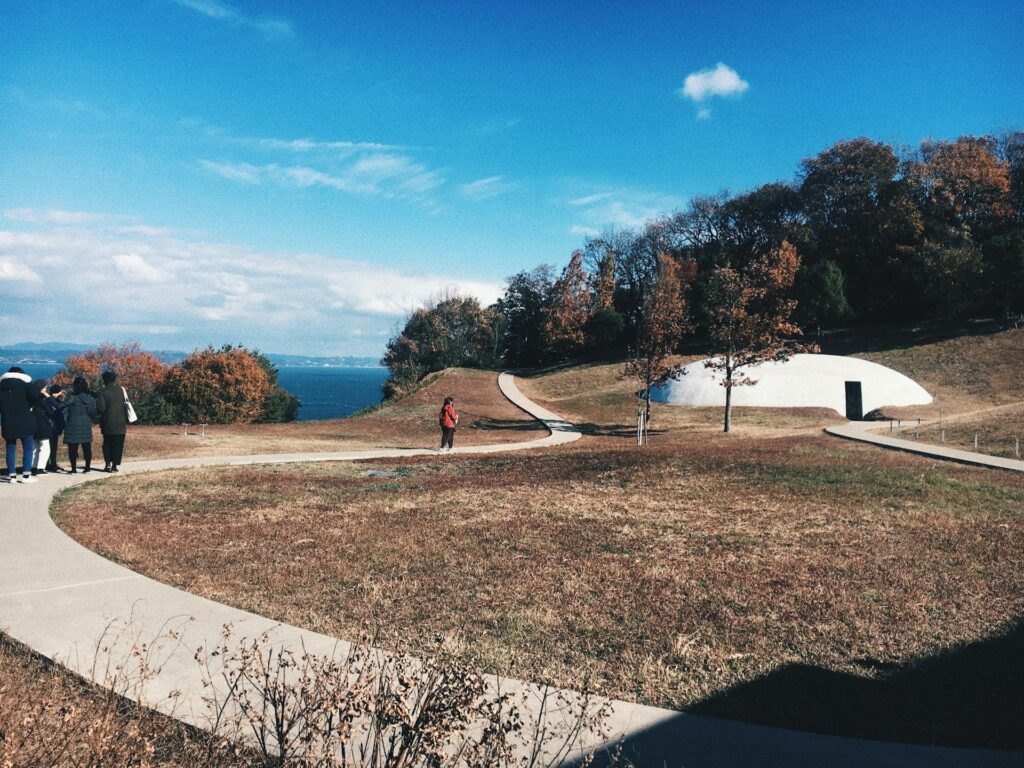
Naoshima is small — about 8 km around — but the island’s hills, narrow roads, and spread-out sites make transportation a real factor in your day. Here’s how each option works in practice.
Town Bus (町営バス)
There is one bus route connecting Miyanoura Port, Honmura village, and the museum area. It runs every 40–60 minutes, with a fare of around ¥100–¥200 per ride. If you’re only visiting Chichu and one other site, and your timing lines up, it works fine.
Here’s the catch: in peak season (spring, autumn, weekends), the bus fills up quickly. I’ve watched travelers wait through two full buses before finding space — and that 40–60 minute gap between buses becomes a real problem when your Chichu reservation has a fixed time slot and the last ferry is approaching.
Kai’s tip: The town bus is reliable in theory, but in practice it runs on “island time” — a 40-minute frequency with no backup. If you miss one, you wait. If the bus is full, you wait for the next. That wait can cost you a museum slot or the ferry home. For day-trippers with a tight schedule, I wouldn’t depend on it for more than one or two short hops. If you have multiple sites to cover, either rent a bicycle or consider a private guide who handles the timing for you.
Best for: Rainy days, travelers who can’t cycle, those visiting only 1–2 sites
Not ideal for: Tight schedules, multi-site day trips, anyone anxious about ferry deadlines
Electric Bicycle (電動自転車)
An e-bike is the best option for covering ground efficiently — if you can get one. Rental shops near Miyanoura Port and Honmura offer electric bicycles for around ¥1,000–¥2,000 per day. With pedal assist, you can handle the hills (including the climb to Chichu) without arriving sweaty.
The problem: electric bikes sell out fast. In peak season, the first ferry from Uno arrives at around 8:20 AM — and by 8:30, most e-bikes are gone. What’s left are manual bicycles with no gear shifting. And the hill from Honmura up to Chichu Art Museum? It’s a steady, steep 25-minute climb on a basic bike. I’ve seen travelers abandon their rental halfway up and walk.
Kai’s tip: If you want an e-bike, arrive on the first ferry or — better yet — reserve one the day before through your accommodation or a rental shop. Some shops accept phone reservations. Show up at 10:00 AM without a booking and you’ll likely be choosing between a manual bike and the bus.
Best for: Active travelers, photographers who want to chase the light, anyone who values independence
Not ideal for: Anyone with limited cycling confidence, rainy days, families with young children (few child seats available)
Walking (徒歩)
Walking is pleasant if you have time. Miyanoura to Honmura is a flat 15–20 minute walk along the coast. Honmura village itself is best explored on foot — the Art House Project sites are a 10-minute stroll apart.
The limitation is the hill. Honmura to Chichu Art Museum is a 25–30 minute walk up a winding road with no dedicated footpath in parts. In summer heat, it’s draining. If you’re doing a day trip without a bike, you’ll realistically visit Chichu + one Honmura site + the Yellow Pumpkin — and that’s a full day.
Best for: Overnight visitors, slow travelers, fine weather days
Not ideal for: Day-trippers with multiple must-sees, summer afternoons, anyone with mobility concerns
Where to Eat on Naoshima — Limited but Good
Let me be straightforward: you don’t come to Naoshima for the food. The dining options are limited, hours are irregular, and many restaurants close 2–3 days a week without a consistent schedule. Plan for this rather than being caught hungry—for a full breakdown of your best options, check out our guide on where to eat on Naoshima.
- Breakfast / Coffee: Hifumiyo Coffee in Honmura opens from around 8:30 AM. Good coffee and a simple breakfast menu. A solid start to the day.
- Lunch: Chuo Cafe near Honmura is the most reliable option — known for its omurice (omelette rice) and curry. Closed Tuesdays. Expect a short wait around noon.
- Snack / Dessert: A small gelato window in Honmura serves soft serve and fruit flavors. Nothing extraordinary, but welcome on a warm day.
- Dinner: If you’re staying overnight, your accommodation likely offers dinner, or you can try the restaurant at Benesse House (requires reservation). Evening options on the general island are very limited — don’t wander hoping to find something open.
Kai’s tip: Check Google Maps the morning of your visit for opening hours — many island restaurants update their schedules there. And if you have dietary restrictions (vegetarian, vegan, gluten-free), pack your own lunch from Uno or Takamatsu before you arrive. Naoshima’s menu is heavily seafood-and-meat oriented with limited alternatives.
Sample Day Trip Timeline — The “First Ferry In, Last Ferry Out” Plan
This timeline assumes you start from Uno Port (20 min ferry), have pre-booked your Chichu slot, and either have an e-bike reserved or are comfortable walking. Adjust backward if you’re coming from Takamatsu (add ~30 min each way). For a more detailed breakdown, including logistics and backup plans, see our complete Naoshima one-day itinerary.
| Time | Activity |
|---|---|
| 8:00–8:30 | Ferry from Uno Port to Miyanoura |
| 8:30–8:45 | Red Pumpkin photo at the port, pick up e-bike (pre-reserved) |
| 8:45–9:00 | Cycle to the Yellow Pumpkin (south pier) — near-empty at this hour |
| 9:00–9:15 | Photo session at the Yellow Pumpkin |
| 9:30–10:45 | Chichu Art Museum (pre-booked slot required) |
| 11:00–11:45 | Naoshima New Museum of Art (10 min walk downhill from Chichu) |
| 12:00–12:45 | Lunch at Chuo Cafe or Hifumiyo Coffee (Honmura) |
| 13:00–14:00 | Art House Project — Minamidera + Kadoya + a walk through Honmura |
| 14:15–15:15 | Benesse House Museum (quick visit — or skip if time is tight) |
| 15:30–16:00 | Return bike, final walk around Miyanoura port area |
| 16:00–16:30 | Ferry back to Uno (check final departure time) |
This plan works — but it assumes everything goes right. Your Chichu slot was booked. Your e-bike was reserved. The bus didn’t run late. One disruption and you’re cutting the Benesse House visit or running for the ferry. If the logistics feel overwhelming, you’re not alone — that’s the reality of a solo day trip on Naoshima.
If you fall into that camp — you want the art island experience, but ferry timing, museum slots, and island transport all feel like too many moving parts — this is the one booking I’d push you toward.
Why I’d book this one
- It solves the timing problem. A private guide can help shape the day around your ferry windows, museum priorities, and realistic travel time between Miyanoura, Honmura, and the museum area.
- It adds context where Naoshima can feel opaque. Recent travelers often mention that having a guide makes the art, architecture, and island history easier to connect, especially if this is your first time visiting a contemporary art island.
- It keeps the day flexible. Instead of locking yourself into a rigid checklist, you can focus on the sites that matter most to you — Chichu, Benesse House, Honmura, the pumpkins, or a slower architecture-heavy route.
Before you finalize your ferry and museum times, see live availability, start times, and recent traveler reviews for the Naoshima FullDay Private Tour with Government-Licensed Guide.
Frequently Asked Questions
Can I visit Naoshima in one day?
Yes — and most travelers do. From Uno Port, the ferry takes 20 minutes one way, making a day trip comfortable if you arrive on the first ferry and leave on the last. On a day trip from Uno, you can realistically see 2–3 major sites (Chichu, the New Museum, and the Yellow Pumpkin) plus a walk through Honmura. If you’re coming from Takamatsu (50–60 min ferry), you’ll have slightly less island time but can still cover the essentials. Staying overnight allows you to see more, including the Art House Project in full and the Benesse House Museum at quieter hours.
Do I need to book Chichu Art Museum in advance?
Yes, absolutely. Chichu requires a timed-entry reservation purchased online through the Benesse Art Site website. Walk-up tickets are rarely available, and popular time slots (especially 10:00–11:00 AM) sell out 2–3 days ahead during busy periods. Book your Chichu slot before you book your ferry — not the other way around.
Is the Yellow Pumpkin still there?
Yes. The Yellow Pumpkin was swept away during Typhoon Hagibis in 2019 but was restored and reinstalled in 2020. It’s back on its original pier at the southern end of the island, fully intact. It is accessible 24 hours a day, free of charge. For the best photos and shortest queues, visit before 9:00 AM or during golden hour in the late afternoon.
What’s closed on Mondays?
Most of Naoshima’s major museums are closed on Mondays (or the following Tuesday if Monday is a public holiday). This includes Chichu Art Museum, Naoshima New Museum of Art, Benesse House Museum, Lee Ufan Museum, and the Ando Museum. The Art House Project sites and Naoshima Bath “I♥湯” may have different schedules. If you’re planning a day trip, aim for Tuesday through Sunday to have the full range of options available.
Can I take photos inside the museums?
Generally, no. Photography is not permitted inside the galleries of Chichu Art Museum, Benesse House Museum, Lee Ufan Museum, or the Naoshima New Museum of Art. Outdoor areas and the Art House Project sites (Kadoya, Go’o Shrine) allow photography at a non-flash, non-commercial level. The Yellow Pumpkin and Red Pumpkin are outdoors and free to photograph. The rule can feel restrictive, but in practice, it makes the indoor experiences more immersive — you’re present with the art rather than framing it through a phone.
Is Naoshima worth visiting outside the Setouchi Triennale?
Absolutely. The Setouchi Triennale (most recently held in 2025, next edition expected in 2028) adds special exhibitions and performances across multiple islands, but Naoshima’s permanent collection — Chichu Art Museum, Benesse House Museum, the Art House Project, and the new Naoshima Museum of Art — is open year-round (subject to weekly closures). In fact, the island is less crowded and more enjoyable outside the Triennale years.
What time is the last ferry back to Uno or Takamatsu?
Ferry schedules vary by season and day of the week. From Miyanoura Port to Uno, the last ferry typically departs between 17:00 and 19:00. The high-speed ferry to Takamatsu usually stops earlier. Check the current timetable on the official ferry operator website the day before your visit, and build your island schedule backward from that departure time. Missing the last ferry means staying overnight — and island accommodation is limited.
Are there vegetarian or vegan options on Naoshima?
Very limited. Naoshima’s dining scene is small and heavily seafood-and-meat oriented. Chuo Cafe serves a vegetarian-friendly omurice (egg and rice), and Hifumiyo Coffee has simple breakfast items, but dedicated vegan or gluten-free menus are rare. If you have dietary restrictions, pack food from Uno or Takamatsu before you catch the ferry — the island has no supermarket or convenience store worth relying on.
Final Verdict — Who Should Go (and Who Should Think Twice)
Naoshima is one of Japan’s most unique destinations, but it’s not for everyone. Here’s a breakdown by traveler type to help you decide. For a deeper dive into making your decision, read our honest verdict on whether Naoshima is worth it.
Choose Naoshima if:
- You love contemporary art and architecture — Chichu Art Museum alone justifies the trip. Add Benesse House and the new Naoshima Museum of Art, and you have one of the most concentrated collections of site-specific art in the world.
- You value quiet, contemplative experiences — The island is slow, sparse, and designed for reflection. If that sounds ideal, you’ll love it.
- You’re a photographer (outdoor) — The Yellow Pumpkin at sunrise, Ando’s concrete against the Seto Inland Sea, the Honmura village lanes — all exceptional subjects.
- You’re an architecture follower — Tadao Ando has four buildings on this one island. It’s a compact retrospective of his career.
Consider another destination if:
- You’re looking for food, nightlife, or shopping — Naoshima has none of these in any meaningful quantity. Osaka or Kyoto will serve you better.
- You’re traveling with very young children — Some installations (Minamidera’s absolute darkness, the quiet gallery spaces at Chichu) don’t suit toddlers, and the hills can be exhausting with a stroller.
- You have limited mobility — The island’s hills, uneven paths, and spread-out sites make it challenging without a vehicle. The town bus helps but won’t solve all access issues.
- You want a packed, action-filled day — Naoshima rewards slowing down. If you’re someone who likes to check boxes quickly, you may find the pace frustrating.
For first-time visitors: Book Chichu first, photograph the Yellow Pumpkin early, and add the Naoshima New Museum of Art. That’s a solid half-day that captures the island’s essence without overreaching. If you have time after lunch, walk Honmura’s Art House Project — Minamidera is the one not to miss.
For art enthusiasts and return visitors: Stay overnight at Benesse House or a minshaku in Honmura. Having the island to yourself after the last ferry leaves is a completely different experience. Visit Benesse House during the exclusive morning hours for hotel guests, and explore the Art House Project at a slower pace without rushing for the ferry.
For day-trippers on a tight schedule: Accept that you won’t see everything. Pick 2–3 priorities (Chichu + Yellow Pumpkin + one more), pre-book everything you can, and leave 30 minutes of buffer before the last ferry. The mistake I see most often is trying to fit too much in and ending up stressed, rushed, or stranded. One great half-day on Naoshima is better than a frantic full day where nothing lands.

Hi, I’m Kai. I’m a Tokyo-based travel writer, tourism industry insider, and the author of a published guidebook for international visitors to Japan. With over 10 years of professional experience at a leading Japanese tourism company, my mission is to help you skip the tourist traps and navigate Japan’s best destinations like a local. I believe the perfect day trip is like a traditional kaiseki meal: a beautiful balance of precise planning and unforgettable seasonal discovery. When I’m not out conducting field research, you’ll usually find me drafting new itineraries with one of my favorite fountain pens!