
Tokyo in January has a reputation problem. Many first-time visitors picture a gray, half-closed city and assume they should wait for spring. In reality, January is one of the driest and brightest months on the Tokyo calendar, and the cold is more manageable than the myths suggest — provided you understand one thing: the month is not a single experience. January 1–3 revolves around New Year, January 4–7 is a transition back to regular routines, and the rest feels like normal Tokyo, only colder and clearer.
Quick answer: January is a good time to visit Tokyo if you are comfortable with cool, dry weather, want clear winter views and seasonal culture, and will check opening hours around New Year. It is a poor fit if you feel the cold deeply, want long unstructured days outdoors, or expect famous temples to be empty.
- Weather: average high 9.8°C (about 50°F), average low 1.2°C (about 34°F), low humidity, plenty of sun.
- The split that matters: January 1–3 is peak New Year, January 4–7 is a transition, and mid-to-late January is mostly normal sightseeing.
- Crowds: ordinary streets can feel quiet in the first days of the year, but Meiji Jingu and Senso-ji are at their busiest.
- Closures: some museums and department stores close on January 1 and reopen on January 2. Tokyo does not shut down.
- What to wear: removable layers, a wind-resistant outer layer, and shoes you already trust for a full day on foot.
Prefer a guided sightseeing day? If you’d rather spend your January visit exploring Tokyo than coordinating trains between districts, a guided bus tour covering Meiji Jingu, Asakusa and Tokyo Skytree is worth comparing with a DIY itinerary. Check January departure dates, the current itinerary and traveler reviews for this Tokyo sightseeing tour before deciding how to spend your day.
Is January a Good Time to Visit Tokyo?
Yes — with a caveat most monthly guides gloss over. January rewards travelers who like crisp air, long views and seasonal ritual, but it punishes anyone who plans as if the whole month were identical. The New Year peak, the days immediately afterward, and the rest of the month need different plans.
The climate numbers explain the appeal. According to the Japan Meteorological Agency’s 1991–2020 normals for Tokyo, January has a mean temperature of 5.4°C, an average high of 9.8°C and an average low of 1.2°C. Monthly precipitation is 59.7mm, relative humidity averages 51%, and sunshine reaches 192.6 hours — the highest of any month in Tokyo. This is not a dark, wet winter. It is a dry, bright, cold one, and clear air makes observation decks, distant views and photographs noticeably better.
| Factor | What to expect | Good or watch out |
|---|---|---|
| Weather | Average high 9.8°C, low 1.2°C; sunny midday, cold mornings and evenings | Good with layers; watch out after sunset |
| Rain | Around 59.7mm and low humidity — one of the driest stretches of the year | Good |
| Crowds | Quiet ordinary streets around January 1–3, packed shrines and temples | Mixed — depends on the place, not the month |
| New Year closures | Many museums and department stores closed January 1; most reopen January 2 | Watch out — check individual sites |
| Walking comfort | Cold wind on long approaches; sharp swings between street and heated interiors | Watch out — plan indoor breaks |
| Mt. Fuji and distant views | Some of the clearest skies of the year, but visibility changes daily | Good, never guaranteed |
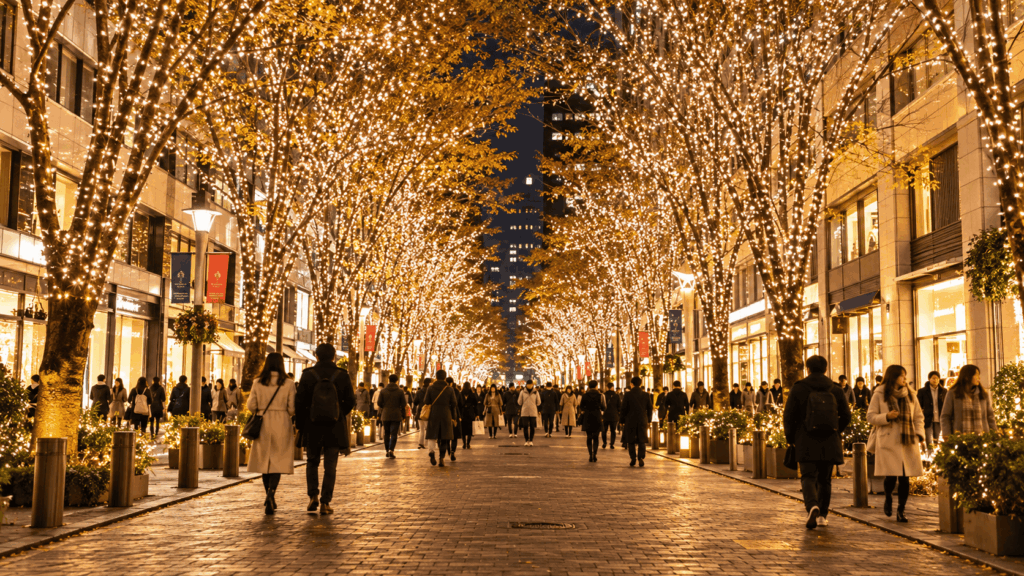
| Seasonal experiences | Hatsumode, January sumo, Setagaya Boro-ichi, the tail of winter illuminations | Good — January’s real advantage |
The Best Reasons to Visit Tokyo in January
1. The clearest light of the year. January’s sunshine figure is not a statistical curiosity; you feel it. Buildings look sharper, the midday sky holds a deep blue, and observation decks earn their ticket price. If photography or city views matter to your trip, this is a genuine advantage over spring and autumn.
2. New Year culture you cannot see in June. Hatsumode — the first shrine or temple visit of the year — turns Meiji Jingu and Senso-ji into something closer to a civic event. Meiji Jingu alone receives roughly three million visitors over the first three days of January. It is crowded, occasionally chaotic, and completely unlike the same shrine in April.
3. Events that exist only in January. The Grand Sumo January Tournament runs at Ryogoku Kokugikan from January 10 to 24 in 2027, with general ticket sales opening on December 5, 2026. Setagaya Boro-ichi, Tokyo’s best-known flea market, is held on January 15–16. Winter illuminations also linger into the first half of the month in several districts.
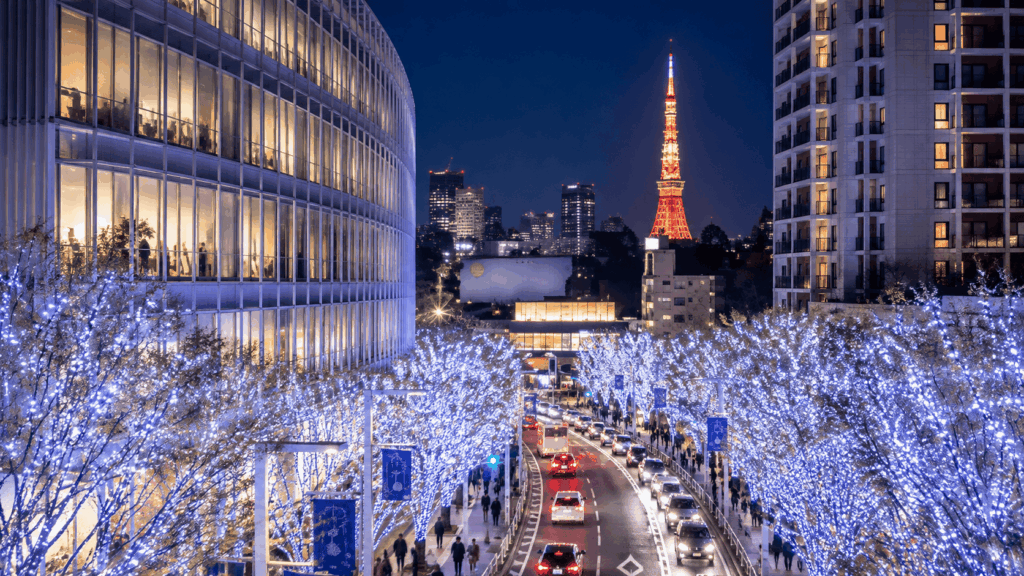
4. Fewer international visitors than peak season. Mid-to-late January generally sits below cherry blossom and autumn foliage demand, and hotel rates often reflect that. The exception is the New Year period, when domestic travel peaks and trains out of Tokyo fill up.
The Main Downsides of January
The cold is persistent rather than dramatic. Tokyo rarely gets bitterly cold by northern-hemisphere standards, but 9.8°C with wind and no sun feels very different from 9.8°C in still air. Mornings and evenings hover near freezing, and the cold follows you through long outdoor stretches.
Daylight ends early. Sunset is around 4:40pm on New Year’s Day and only reaches just after 5pm by the end of the month. That compresses outdoor sightseeing into a shorter window than most visitors expect, especially with a late start.
Famous places are not quiet. Tokyo’s overall visitor volume may dip, but Meiji Jingu and Senso-ji are first-week destinations for millions of Japanese residents. A quiet January morning at Senso-ji is possible; a quiet January afternoon is not.
Gardens and seasonal scenery are dormant. If your image of Tokyo involves flowers, green gardens or autumn color, January will not deliver it. The trade-off is structure and light rather than foliage.
The mistake I see first-time visitors make is treating January as a milder December and stacking three outdoor sights into one day. The forecast number looks harmless; the accumulated effect of wind, gravel paths and short daylight is what wears you down. Build the day around exposure, not around a checklist.
Still deciding between the winter months? Our Tokyo in Winter guide compares December, January and February for weather, seasonal events and travel experiences.
Tokyo Weather in January: How Cold Does It Actually Feel?
On paper, Tokyo’s January is mild. A mean of 5.4°C and an average high of 9.8°C sounds closer to a cool autumn day in London than to real winter. The gap between the numbers and the experience comes from wind, time outdoors, and the contrast with heated interiors.
Walk a long open approach — a shrine avenue, a riverside path, a station-to-station stretch — and wind does most of the damage. Stand in a sheltered side street with the sun on you, and the same afternoon feels pleasant enough to unzip your jacket. This is why “the warmest coat I own” is less useful than layers you can actually remove. Trains, department stores and restaurants are heated generously, so you will move between cold street and warm interior repeatedly in a single day.
On a January visit, what stayed with me about Meiji Jingu was not the temperature reading but the wind along the approach. The walk looked modest on a map and felt considerably longer in cold air, and I was glad to have a wind-blocking layer rather than a heavier coat. In Tokyo, exposure time matters more than the forecast number.
Does It Snow in Tokyo in January?
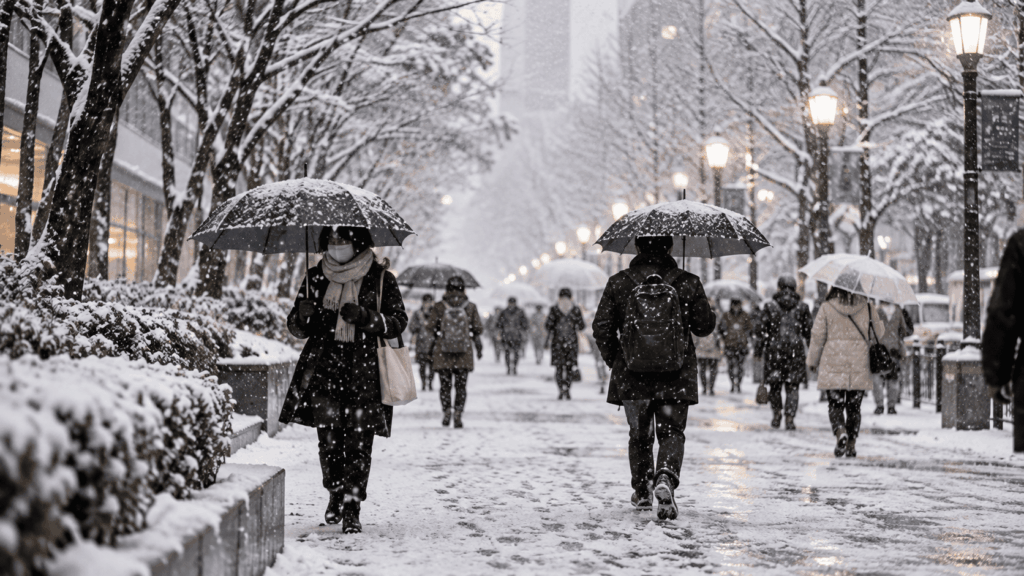
Snow is possible, and Tokyo occasionally gets a light dusting in January. It is not the norm. According to the Japan Meteorological Agency’s 1991–2020 climate normals, Tokyo averages around 8 cm of total snowfall annually, including approximately 4 cm in January. This does not mean snow remains on the ground throughout the month; most January days are dry and sunny. Do not plan a Tokyo January trip as a snow trip, and do not buy snow boots for it; ordinary waterproof shoes with decent grip handle typical conditions. If snow is forecast during your stay, pay attention — Tokyo is not built for it, and even a few centimeters can slow trains and close exposed attractions. Check 24–48 hours ahead and treat a snow day as a bonus rather than a plan.
What to Wear in Tokyo in January
The goal is not maximum warmth. It is being comfortable outside for two hours, then comfortable inside five minutes later. That means layering, a wind-resistant outer layer, and footwear that can handle a full day on your feet.
- Base layer: a normal long-sleeve top or light thermal. Heavy thermals are often too much indoors.
- Mid layer: a sweater or fleece presentable enough for a casual restaurant.
- Outer layer: a wind-resistant jacket or light down jacket with a hood. Wind protection matters more than thickness.
- Bottoms and socks: long trousers and warm socks, plus a spare pair if you expect wet conditions.
- Shoes and accessories: cushioned, broken-in walking shoes; a scarf and gloves; a hat for early mornings and open decks.
Kai’s tip: The item that changes a January day most is not the coat — it is the shoes. Tokyo sightseeing is walking-heavy even in winter, and thin-soled fashion boots feel very different after four hours on cold pavement. Bring the cushioned pair you already know you can walk in all day, and save new shoes for a shorter trip. A windproof shell over a normal sweater also beats a heavier coat that you end up carrying through every heated department store.
Shoes Matter More Than Many Visitors Expect
Most packing lists stop at “comfortable shoes” and move on. In January, footwear deserves its own paragraph, because cold ground, long approaches and hard surfaces amplify every weakness in a pair of shoes.
Meiji Jingu is the clearest example. The approach to the main shrine runs over gravel, and the grounds are large enough that the visit becomes a proper walk rather than a five-minute photo stop. You will feel a thin sole, a stiff new boot or an unfamiliar heel. The same applies to Senso-ji’s surrounding streets and the long station corridors you cross without thinking.
What works: a cushioned sneaker or walking shoe with a thick, slightly flexible sole, worn with warm socks. What does not: boots you are breaking in, smooth-soled fashion shoes, or anything you would not choose for a full day of city walking at home. If you need one pair for the whole trip, choose the pair you already trust.
Early January vs Mid-to-Late January: This Is the Difference That Matters
The most useful planning decision is not “January or another month.” It is “which part of January.” January 1–3 is the New Year peak: shrines and temples are at their busiest, some museums and shops are closed or on shortened hours, and department stores begin reopening on January 2 with their first sales. January 4–7 is a transition toward normal schedules, although major shrines can still be busy. The atmosphere is exceptional, but the first few days are not a normal sightseeing experience.
Mid-to-late January behaves much more like ordinary Tokyo. Transport runs normally, most attractions are on standard hours, and the main constraint becomes weather rather than the calendar. “Normal” does not mean “empty,” though — major sights remain popular, and the sumo tournament and Boro-ichi market add their own crowds.
| Factor | January 1–7 | Mid-to-late January |
|---|---|---|
| Hatsumode atmosphere | Peak crowds January 1–3; a festive atmosphere can continue January 4–7 | Still present at major shrines, but calmer |
| Shrine and temple crowds | Extremely heavy, especially January 1–3 | Busy at popular spots, manageable early morning |
| Store closures | Some museums and department stores closed January 1; independents vary | Most businesses back to normal hours |
| Opening-hour changes | Common; check every attraction individually | Rare outside regular winter hours |
| General sightseeing ease | Lowest January 1–3; generally easier as January 4–7 progresses | Higher — standard hours and routing |
| Seasonal atmosphere | At its strongest | Still wintry, with sumo and market events |
Kai’s tip: The New Year atmosphere does not switch off on January 4. When I have taken guests to Meiji Jingu in mid-January, the shrine still felt like a New Year destination rather than an ordinary sightseeing stop. The lesson is not to assume that “after the holidays” means “empty” — check the specific place and date, and go early if you want quieter photographs.
Will Shops and Restaurants Be Closed?
Some will be, but “Tokyo closes for New Year” is inaccurate and leads people to over-plan. What happens is a patchwork. On January 1, many museums and department stores are closed, along with a number of independent restaurants; convenience stores, hotels and most chain restaurants operate. On January 2, department stores reopen with fukubukuro lucky bags and many museums return. During January 4–7, more businesses return to regular hours, though some small shops extend their break. Temples and shrines are open throughout — they are the busiest places in the city, not the closed ones.
Check the specific places you care about rather than the city as a whole: official website first, then recent Google Maps hours, then any notice posted in the last few weeks. During New Year, listed hours are frequently out of date, and a restaurant showing as open may be on its own holiday.
Best Things to Do in Tokyo in January
January is not a month for a generic list of twenty attractions. It is a month for places where cold, clear air, seasonal ritual or indoor warmth actually add something — and after several January days in the city, those are the only places I would build a day around.
Experience Hatsumode at Meiji Jingu — but Expect a Long Walk
Meiji Jingu is the strongest January experience in Tokyo, and the one most likely to surprise visitors with its physical demands. The shrine is free, open daily, and in January runs from 6:40am to 4:20pm according to its official schedule. Around New Year, hours are extended and published separately, so confirm current times before you go.
The scale is the point. The shrine sits inside a large forest, and the approach to the main hall is a proper walk over gravel rather than a short paved path. In the first three days of January, roughly three million people visit. Even outside that peak the grounds hold a lot of people, and the atmosphere stays ceremonial rather than tranquil. Arrive early, wear the walking shoes described above, and expect cold wind to matter more than the thermometer suggests.
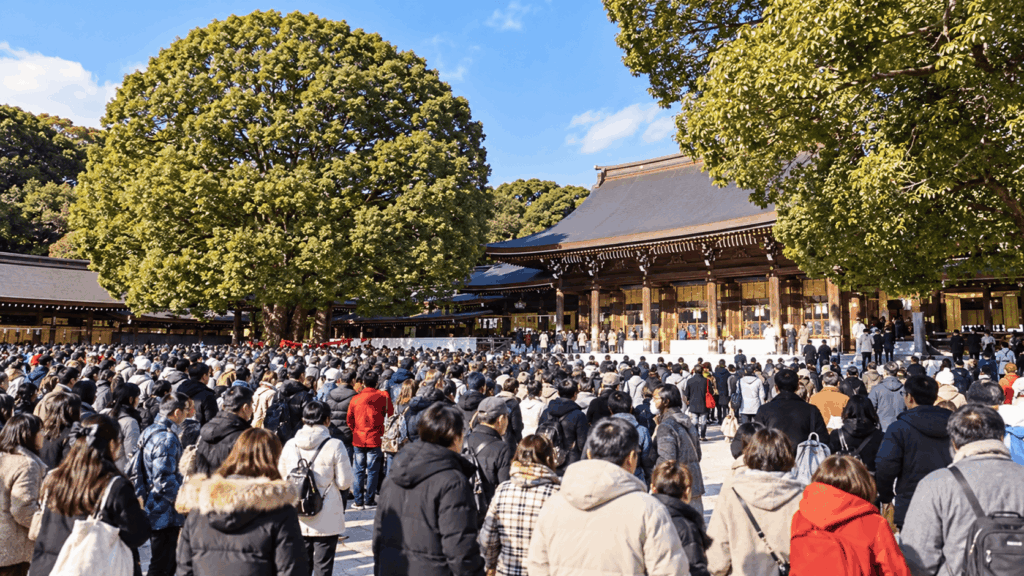
The reward is one of the most atmospheric experiences in the city: a forest, a wide gravel approach, and a crowd that is there for the ritual rather than for a photograph. I have always found the walk out more refreshing than the walk in, partly because the crowds thin and partly because the effort is over.
If you want the gate-by-gate approach, seasonal opening times and how to combine the shrine with Harajuku and Shibuya, our full Meiji Jingu guide covers it in detail.
Visit Senso-ji for Winter Energy, Not for Empty Streets
Senso-ji is where the “quiet winter Tokyo” idea collapses. The grounds are open around the clock, and the main hall operates from 6:30am to 5:00pm between October and March. In the first days of January, the approach through Nakamise-dori is packed shoulder to shoulder, and the surrounding streets are barely easier.
That is not a reason to skip it; it is a reason to change what you expect. Senso-ji in January is not a contemplative temple visit. It is a lively, slightly chaotic winter street scene, with food stalls, shops and crowds generating their own warmth. On a January visit, what stayed with me was exactly that contrast: cold air, visible breath, and a street that felt energetically alive rather than frozen.
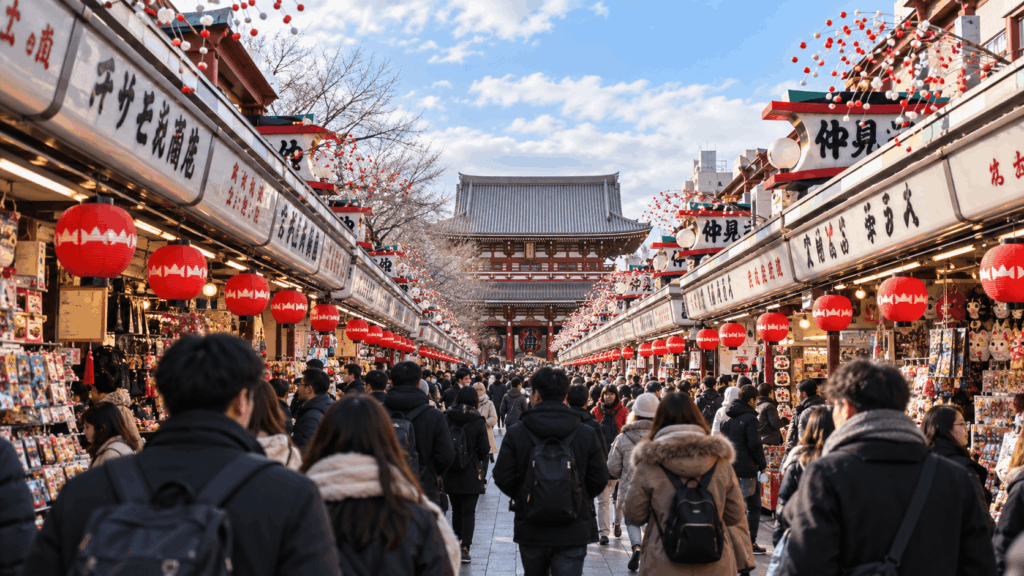
Go early for photographs of the main hall and the lantern without a wall of people. Most Nakamise shops open mid-morning and close in the early evening, so a very early visit gives you architecture but not shopping; late afternoon gives you atmosphere and lights. In dense crowds, keep bags zipped and close to your body — standard advice anywhere, and worth repeating here.
Use Tokyo Tower as a Warm Indoor Reset
Tokyo Tower is often treated as a checklist item. In January it is better used as itinerary design: a warm indoor stop that breaks up a cold outdoor day and still gives you something worth seeing.
The Main Deck at 150 meters is open 9:00am–11:00pm with last admission at 10:30pm, and adult admission is 1,500 yen at the time of writing. It contains the Skywalk Window, a glass floor that lets you look straight down. The Top Deck Tour adds the 250-meter level for 3,300 yen online or 3,500 yen at the counter, and can close in poor weather. Prices and hours change, so check the official site before your visit.
If you’re visiting independently, check current Tokyo Tower Main Deck ticket prices and options on Klook before choosing your visit. Confirm the admission inclusions and cancellation terms for your selected ticket.
Below the decks, Foot Town holds shops and restaurants, including Siddique Palace & Siddique Kebab on the second floor, a Pakistani restaurant that is useful if you need halal food in the area. On my visits, even when the observation deck was busy, moving between floors felt manageable — but I would not call the tower reliably quiet, especially on a clear weekend.
The real January value is the view. Cold, dry air clears the haze, and the city spreads out with unusual sharpness. If you have been outdoors for hours and the cold is winning, this is a sensible place to reset before dinner. If you are comparing observation decks, our Tokyo observation deck guide covers the alternatives.
Consider a January Grand Sumo Tournament
If your dates overlap, the January tournament is one of the few experiences in Tokyo that cannot be replicated at another time of year. The 2027 edition runs from January 10 to 24 at Ryogoku Kokugikan, with general ticket sales starting December 5, 2026. Lower divisions wrestle earlier in the day and the top-division bouts come in the late afternoon, so a partial-day visit works if you do not want the full schedule. Weekend tickets sell quickly; check our guide on how to see a sumo show in Tokyo to secure your seats in advance.
Check Seasonal Markets and Events Before You Go
Setagaya Boro-ichi, a flea market with several centuries of history, is held on January 15–16, roughly 9:00am–8:00pm, with hundreds of stalls along Boroichi-dori. It is a genuinely local event rather than a tourist production, and pairs well with a slow morning in the residential west of the city. Winter illuminations also run into January in several districts — Tokyo Mega Illumination, for example, continues until January 10, 2027. Dates shift every year, so confirm before building a day around any single event.
How to Plan a Comfortable Sightseeing Day in January
January sightseeing works better when you stop counting places and start counting hours outside. The cold is manageable in short doses and cumulative in long ones. A good day alternates exposure with warmth rather than trying to avoid the cold entirely: one long outdoor block in the morning while you are fresh, a warm indoor stop around lunch, a shorter outdoor block in the early afternoon, and an indoor attraction or long meal as the light goes.
Kai’s tip: January comfort is less about avoiding the cold than about managing how long you stay exposed to it. Two hours outside, then twenty minutes somewhere warm, changes the entire day. I plan my own winter days around warm reset points — an observation deck, a department store basement, a restaurant — rather than around a list of sights. That single habit is the difference between finishing the day energised and finishing it frozen.
Do Not Stack Too Many Outdoor Sights Together
The classic January mistake looks reasonable on a map: Meiji Jingu in the morning, a walk through Harajuku, Senso-ji in the afternoon, and a stroll around Ueno before dinner. Each stop is fine alone. Together they add up to six or seven hours outdoors in cold wind, much of it after the sun has dropped.
Meiji Jingu is the clearest example of walking load, because the gravel approach and the size of the grounds turn a shrine visit into a real walk. Pair it with something warm and enclosed, then go back outside for a shorter, focused block.
If you want to see several of Tokyo’s main sights in one winter day but do not want to coordinate every cross-city transfer, a guided bus tour is a useful alternative to planning the route alone. The Meiji Jingu, Asakusa and Tokyo Skytree tour is particularly relevant for active first-time visitors who want a structured introduction to the city.
Why I’d book this one
- Helpful English-speaking guidance: Recent travelers frequently praise the guides for explaining Tokyo’s history and keeping a busy sightseeing itinerary organised.
- Less transport planning: The route connects Meiji Jingu, Asakusa and Tokyo Skytree, with coach travel between sightseeing stops and an observation deck visit included in the itinerary.
- A full day with clear structure: It brings several major sights into one organised trip. The trade-off is limited time at individual stops and a considerable amount of walking, so it suits active travelers better than those who prefer a slow pace.
See live availability, departure details, what’s included and recent traveler reviews for the Tokyo guided sightseeing tour. Check the exact itinerary and cancellation conditions for your date before deciding whether the guided option fits your plans.
| Time | What to do | Why it works in January |
|---|---|---|
| Early morning | Long outdoor block — shrine, temple or park | Best light, thinnest crowds, freshest legs |
| Late morning | Warm indoor stop — cafe, museum, department store basement | Breaks exposure before fatigue sets in |
| Early afternoon | Second outdoor block, shorter than the first | Warmest part of the day, strongest sun |
| Late afternoon | Indoor attraction — observation deck, gallery, arcade | Covers the hours when temperature drops fastest |
| Evening | Long dinner rather than a walking route | Avoids the coldest, darkest hours outdoors |
If you already know which areas you want to cover and just need a route, our Tokyo one-day itinerary is a better starting point than building one from scratch.
Is January a Good Time for a Mt. Fuji Day Trip from Tokyo?
January is one of the better months for seeing Mt. Fuji from a distance, but not for the reason most people assume. The mountain is not “in season” — climbing is closed — but the air is dry and clear, and haze is less of a problem than in summer. On a clear day the mountain can be visible from Tokyo itself and from viewpoints across the Kanto plain.
Clear is not the same as guaranteed. Fuji generates its own weather, and a sunny Tokyo forecast does not mean the summit will appear. Cloud can sit on the mountain while the city basks. Anyone who promises a view is selling certainty that does not exist — so plan the day with a backup. Choose a high-pressure forecast, leave early, and accept that the day may be about the lakes, the ropeway and the scenery rather than the summit. The Fuji Five Lakes area is cold in winter, so the same layering rules apply with more margin.
Tour or DIY?
A guided day tour makes sense if you want several spots in one day without planning transport, you are traveling with people who do not want to navigate, or time is limited. Typical tours from Tokyo run around ten hours, combine stops such as Oshino Hakkai, the Hakone Ropeway, Owakudani and Lake Ashi, include an English-speaking guide, and often offer free cancellation up to 24 hours ahead — which matters in winter.
DIY makes sense if you want to react to the weather, focus on one or two places, or travel at your own pace. The trade-off is planning: highway buses, trains and local connections all need to line up, and a cloudy forecast may mean rebooking at short notice.
| Factor | Guided day tour | DIY by train or bus |
|---|---|---|
| Logistics | Handled; one meeting point, fixed route | You plan connections and tickets |
| Flexibility | Low; the schedule is set | High; change plans on the day |
| Weather response | Limited — the tour runs regardless of visibility | You can switch dates or destinations |
| Pace | Fast; multiple stops with time limits | Your own, including long stays |
| Cost | One upfront price covering transport and stops | Pay as you go; can be cheaper or pricier by route |
| Best for | First-time visitors, families, short trips | Repeat visitors, photographers, slow travelers |
One practical warning: reviews of Fuji–Hakone bus tours repeatedly mention confusion at the meeting point, especially in large stations. Arrive early, confirm the exact pickup location the day before, and keep the operator’s contact details handy. If you are leaning toward a tour, our review of the Mt. Fuji and Hakone day tour from Tokyo walks through the real schedule, the weak points and who it suits. If photography is the main goal, our guide to Mt. Fuji photo spots helps you choose a route that maximizes your chances.
Who Should Visit Tokyo in January — and Who Should Choose Another Month?
January suits you if:
- You prefer cool, dry weather to heat and humidity, and are happy to dress in layers.
- You want clear city views and better odds of seeing distant mountains.
- You are interested in New Year culture and do not mind shrine crowds.
- You are comfortable checking hours and adjusting plans around January 1–3.
- You would rather walk a lot in cold air than a little in summer heat.
Choose another month if:
- You feel the cold strongly, or you are traveling with someone who does.
- You want long, unstructured days outdoors without planning indoor breaks.
- You want to avoid closures and holiday crowds entirely.
- Flowers, green gardens or autumn color are a main reason for your trip.
- You are planning a Fuji trip as the centrepiece and would be deeply disappointed by cloud.
For most travelers, the honest summary is this: January is a very good month for Tokyo if you treat it as a winter city rather than a milder version of spring. The reward is light, air and ritual. The cost is attention — to layers, to daylight, and to the fact that the first week of the month follows its own rules.
FAQ
Is January a good month to visit Tokyo?
Yes, for most travelers who do not mind cool, dry weather. January offers Tokyo’s highest monthly sunshine hours, low humidity and clear views, plus seasonal experiences such as hatsumode and the January sumo tournament. The caveat is that January 1–3 brings the heaviest shrine crowds and some closures, while January 4–7 is a transition back toward regular schedules. Plan around those days rather than through them and January is one of the more underrated months to visit.
How cold does Tokyo feel in January?
The averages are moderate: a mean of 5.4°C, an average high of 9.8°C and an average low of 1.2°C. What makes it feel colder is wind and time outdoors. A sheltered, sunny spot at midday can feel pleasant, while a long exposed walk in late afternoon feels much colder than the forecast suggests. Layering and a wind-resistant outer layer matter more than a single heavy coat.
Does it snow in Tokyo in January?
Snow is possible but uncommon. Tokyo’s 1991–2020 climate normals show around 8 cm of total snowfall annually, including approximately 4 cm in January, but most January days are dry and sunny. You do not need snow boots for a normal January trip; waterproof shoes with decent grip are enough. If snow is forecast, check transport updates, since even a small accumulation can affect trains and outdoor attractions.
Are shops and restaurants closed in Tokyo in early January?
Some are, but the city does not shut down. January 1 has the most closures: many museums and department stores are closed, along with a number of independent restaurants. Department stores typically reopen January 2 with their first sales, and most museums return around then. Convenience stores, hotels, chain restaurants and temples operate throughout. Check the specific places you want to visit, because listed hours are often outdated during the holidays.
Is Tokyo crowded in January?
It depends where you are. Overall visitor numbers are lower than in cherry blossom season or autumn, and ordinary streets can feel unusually quiet in the first days of January. Major shrines and temples are the exception: Meiji Jingu receives roughly three million visitors in the first three days, and Senso-ji is similarly packed. Mid-to-late January is calmer at most sights, though popular places remain busy at weekends.
Is January a good time to see Mt. Fuji from Tokyo?
January gives better odds than summer, because the air is dry and clear and haze is less of a factor. It does not guarantee a view. Fuji makes its own weather, and cloud can cover the summit even on a sunny day in Tokyo. If seeing the mountain matters, build in a backup day or choose a tour with a flexible cancellation policy rather than treating the view as certain.
Final Verdict
January is a strong choice for Tokyo if you want clear light, dry weather and seasonal culture, and a weak one if you want long, effortless days outdoors. The month rewards planning and punishes assumptions — especially that winter means empty temples and a closed city.
For first-time visitors: aim for mid-to-late January. You get normal opening hours, easier routing and the same cold, clear weather without the New Year crowds. Use Meiji Jingu early one morning, Senso-ji on a separate early morning, and Tokyo Tower as an indoor reset in the late afternoon. Three outdoor-heavy days in a row is where most first trips go wrong.
For couples and small groups: early January is worth considering if atmosphere matters more than convenience. Hatsumode at Meiji Jingu, an evening in Asakusa and a long dinner make better use of the first week than ticking off sights. Book restaurants in advance and accept that some preferred places will be closed.
For families: mid-to-late January is easier. Shorter outdoor blocks, an indoor attraction in the afternoon, and a hotel near a major station will do more than any specific sight. Tokyo Tower works well here: the Main Deck, the Skywalk Window and Foot Town give you warmth, a view and food in one stop.
For travelers on a tight schedule: pick one outdoor anchor and one indoor stop per day, and do not cross the city for a second outdoor site after 3pm. January daylight is short enough that a late start costs a whole attraction rather than an hour.
For repeat visitors: early January is more interesting. Hatsumode, the Grand Sumo January Tournament at Ryogoku Kokugikan from January 10–24, 2027, and Setagaya Boro-ichi on January 15–16 give you reasons to be in the city that do not exist in other months.
For photographers: January is one of the best months for city and mountain views. Build around early mornings, keep one flexible day for a Fuji attempt, and treat cloud as a normal outcome rather than a failure. The light is the reason to come; the mountain is the bonus.
For anyone who feels the cold deeply: choose another month. Tokyo’s winter is mild on paper but persistent in practice, and a trip spent managing discomfort is not worth the clear skies. Late spring or October will suit you better.
Hi, I’m Kai. I’m a Tokyo-based travel writer, tourism industry insider, and the author of a published guidebook for international visitors to Japan. With over 10 years of professional experience at a leading Japanese tourism company, my mission is to help you skip the tourist traps and navigate Japan’s best destinations like a local. I believe the perfect day trip is like a traditional kaiseki meal: a beautiful balance of precise planning and unforgettable seasonal discovery. When I’m not out conducting field research, you’ll usually find me drafting new itineraries with one of my favorite fountain pens!