
Tokyo in winter means December, January and February: three months that share the same cold, dry air but feel quite different to travel through. The city is bright and unusually clear, the illuminations run until Christmas, and the New Year brings the busiest shrine visits of the year. What Tokyo does not reliably offer is snow.
So the useful questions aren’t “is Tokyo cold in winter?” but “which of the three months fits me?”, “how cold does it actually feel?”, and “what do I pack?”. This guide works through them in that order, because the month you choose changes what you wear and what you should expect from the city.
Considering a winter scenery day trip? If you’d rather explore the Mt. Fuji area than hope for snow in central Tokyo, check current dates, departure options and the itinerary for the Mt Fuji Top 5 Spots day tour. It’s a guided sightseeing trip, not a guarantee of snow or clear mountain views, but it gives you a way to plan a full day beyond the city.
Is Tokyo Worth Visiting in Winter?
Yes — for most city travelers, with one important caveat. Winter is one of Tokyo’s better seasons for sightseeing: the air is dry and clear, observation decks earn their ticket price, illuminations give the city a reason to be out after dark, and January adds a layer of New Year ritual you won’t see at any other time of year. The caveat is snow. Central Tokyo is not a snow destination, and a trip built around seeing it will probably disappoint.
Winter tends to work well if you:
- prefer walking around a city in 8–12°C to walking around it in 30°C
- want to see seasonal lights, Christmas markets or New Year customs
- care about skyline views — clear winter air is when Tokyo looks its best from above
- are willing to dress for the cold and carry a bag you can shed layers into
It’s a harder sell if you:
- find cold evenings genuinely unpleasant rather than merely inconvenient
- want to travel with minimal luggage and one light jacket
- are coming specifically to see Tokyo under snow
- expect the Christmas atmosphere to continue past December 25 — it doesn’t
Two practical notes shape everything else. First, daylight is short: sunset comes as early as around 4:30 p.m. in early December, so a winter day in Tokyo has a natural two-part structure — daylight for walking and views, darkness for lights and indoor stops. Second, the cold is less about the number on the forecast than about what you’re doing when you feel it, which is why the clothing section below is organized by activity rather than by temperature.
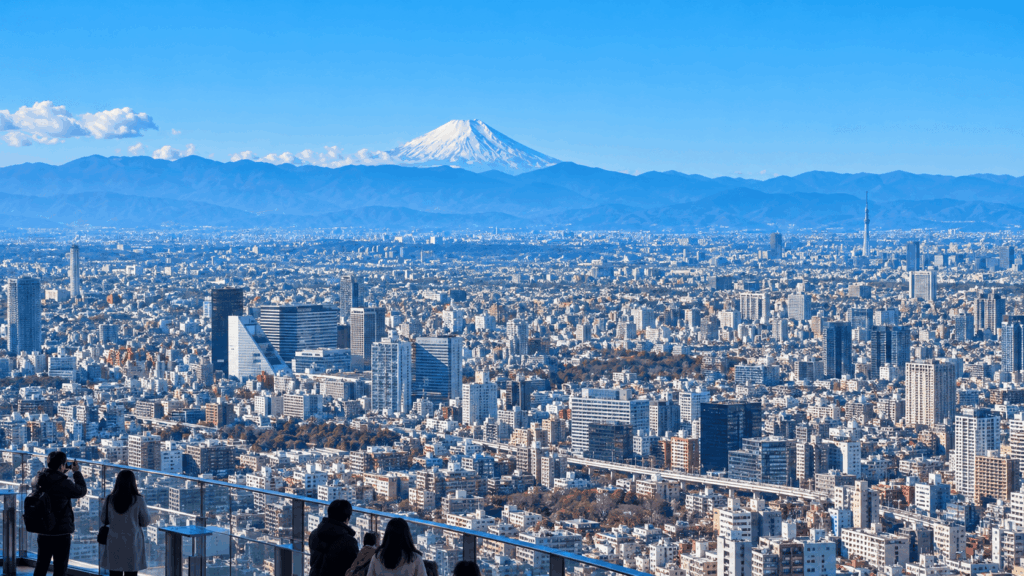
If winter scenery beyond the city matters more to you than the chance of a Tokyo snowfall, a guided day trip toward the Mt. Fuji area is a more deliberate use of a day than waiting for weather — provided you accept that visibility is never guaranteed. That option is covered in detail further down.
If you’re still deciding whether winter is the right season at all, it’s worth comparing it with spring and autumn before you lock in flights.
Tokyo Winter Weather: December vs January vs February
The three months differ less in temperature than in atmosphere. December is the festive one, January is the coldest and most ritual-heavy, and February is still full winter but with the decorations down and a few seasonal events of its own. The table below is the fastest way to pick.
| Month | Average temp | Average high / low | Snow expectation | Best for | Main drawback | Clothing note |
|---|---|---|---|---|---|---|
| December | 7.7°C | 12.0°C / 3.8°C | Very rare; monthly snowfall normal is 0 cm | Illuminations, Christmas markets, festive atmosphere | Late-December crowds and shifting opening hours | Coat plus a mid-layer; gloves for evenings |
| January | 5.4°C | 9.8°C / 1.2°C | Possible but uncommon; about 4 cm monthly snowfall normal | New Year shrine visits, clearest air, quiet sightseeing after the first few days | Coldest of the three; some venues close around New Year | Warmest coat, thermal base layer, gloves and scarf |
| February | 6.1°C | 10.9°C / 2.1°C | Possible but uncommon; roughly the same as January | True winter feel without Christmas crowds, Setsubun, early plum blossoms | Still full winter; no festive lights left | Same layering; add water-resistant shoes only if snow is forecast |
These are the Japan Meteorological Agency’s 1991–2020 climate normals for Tokyo. They describe a 30-year average, not a forecast for your dates — a given week can run several degrees warmer or colder than the monthly figure.
Tokyo in December
December is the mildest of the three on paper: an average of 7.7°C, highs around 12°C, lows around 3.8°C. It does not feel mild after dark. GO TOKYO’s winter guidance notes that the city feels colder at night and in the shade than the headline temperature suggests, and an evening at 4°C with any wind is a different experience from a sunny lunchtime at 12°C.
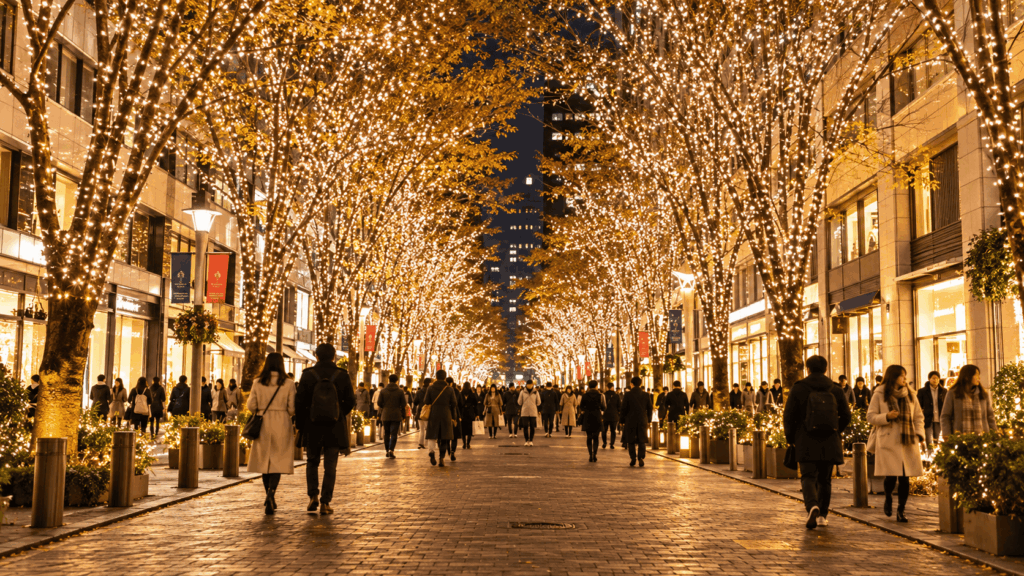
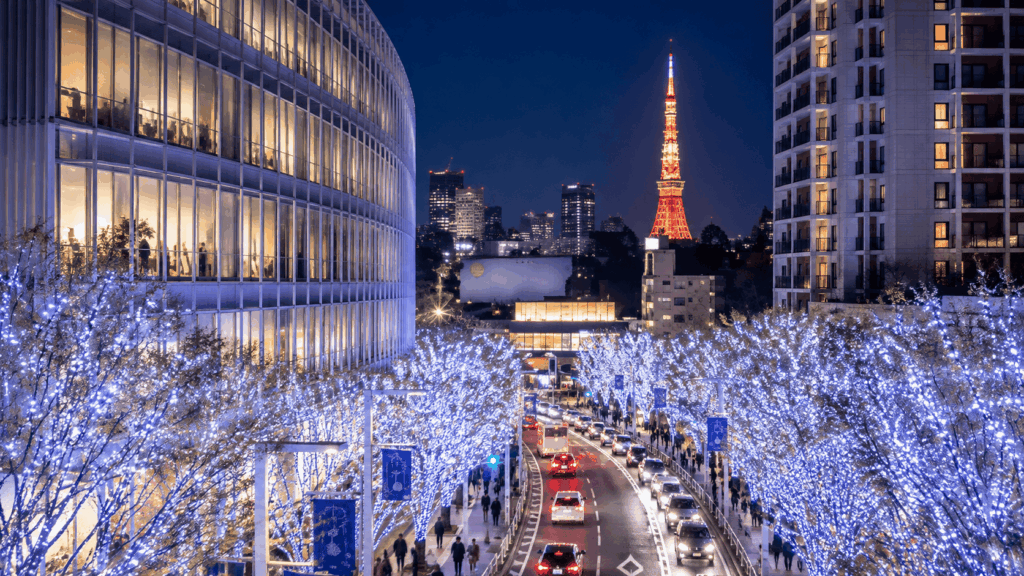
The reason to choose December is atmosphere. Most major illuminations switch on in early November and run to December 25. Roppongi Hills is the standard example for good reason: roughly 400 meters of Keyakizaka’s zelkova trees wrapped in around 800,000 white-and-blue lights, with Tokyo Tower framed at the end of the slope. The Christmas market on O-YANE Plaza usually opens in late November and runs to December 25, and entry has generally been free, though crowd-control rules can change from year to year.
The last week of December is the least predictable week of the winter. The lights finish on the 25th, the city pivots almost immediately to New Year, and individual venues adjust hours or close for a few days. Illumination dates and market rules are set annually, so confirm them on the official CHRISTMAS HILLS site before you build an evening around a specific display.
Tokyo in January
January is Tokyo’s coldest winter month, with an average temperature of 5.4°C, highs around 9.8°C and lows around 1.2°C. It also brings hatsumode, Japan’s traditional first shrine or temple visit of the year. Major sites such as Meiji Jingu draw enormous crowds around January 1–3, while ordinary sightseeing generally becomes easier as holiday schedules return to normal. However, popular shrines can still be busy later in the month.
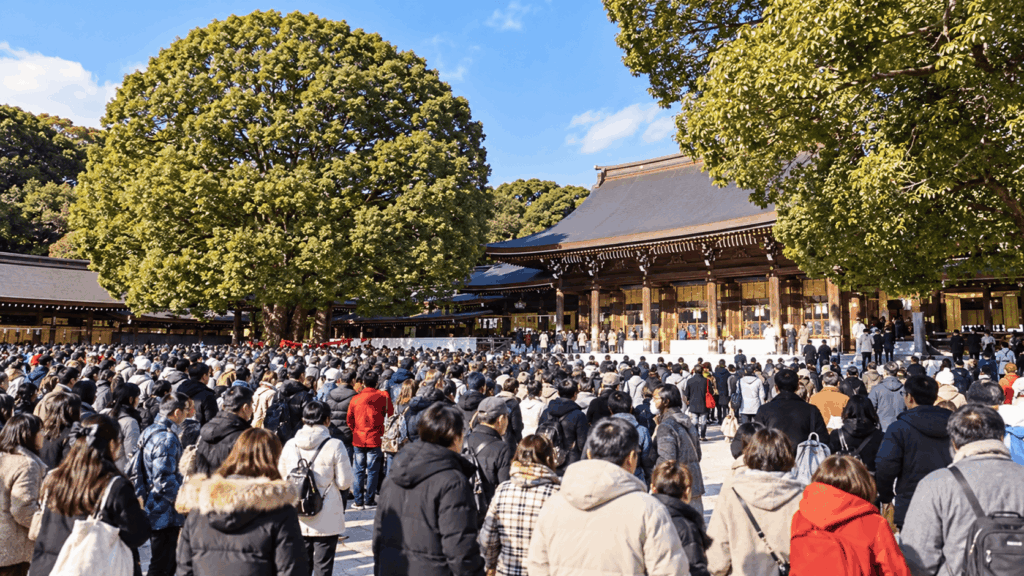
Choose January for New Year traditions, crisp winter light and clearer views from an observation deck. For the important differences between January 1–3, January 4–7 and the rest of the month — including shrine crowds, holiday closures and January-only events — see our complete Tokyo in January guide.
Tokyo in February
February averages 6.1°C, with highs around 10.9°C and lows around 2.1°C — marginally warmer than January on paper and still unmistakably winter. Treat it as winter rather than early spring: an 11°C sunny afternoon can feel pleasant, and the same day’s evening can feel raw.
What February has that the other two months don’t is a pair of quieter seasonal experiences. Setsubun falls in early February (usually February 3, though the date can shift by a day), with bean-throwing ceremonies at shrines and temples across the city; GO TOKYO points to Zojoji and Sensoji among others. Later in the month, plum blossoms begin — Yushima Tenmangu’s plum festival typically runs from early February into early March, with dates announced each year.
The drawback is simple: the Christmas lights are gone. If festive Tokyo was the main draw, February will feel like a different, more workaday city — which some travelers prefer and others don’t.
When Does It Snow in Tokyo?
The honest answer comes in three parts:
- Can it snow in Tokyo? Yes.
- Should you expect snow? No.
- Should you book a Tokyo trip to see snow? No.
| Month | Snowfall total (normal) | Days with 1 cm+ of snowfall | Days with 1 cm+ lying snow |
|---|---|---|---|
| December | 0 cm | 0.1 | 0.2 |
| January | 4 cm | 0.7 | 1.7 |
| February | 4 cm | 0.8 | 1.5 |
| Year | 8 cm | 1.9 | 4.0 |
Read the table carefully, because it’s easy to misread. The 4 cm figures are normal monthly totals spread across an entire month, averaged over 30 winters — not a single fall, and not a promise. Many of those winters produced nothing measurable at all. The more telling columns are the last two: Tokyo averages about 1.9 days a year with a centimeter or more of snowfall, and about four days a year with at least a centimeter lying on the ground.
In practice that means most winter visitors see no snow, some see a brief dusting that’s gone by the afternoon, and occasionally a single storm drops enough to disrupt transport and make the news. GO TOKYO’s guidance says the same thing in fewer words: snow generally falls in January and February, is not frequent, and rarely settles. It also notes that trains and buses run as usual in ordinary winter weather, though railway operators can announce planned suspensions in advance when heavy snow or strong winds are forecast. If snow is actually falling during your trip, check the operator’s website before you set out.
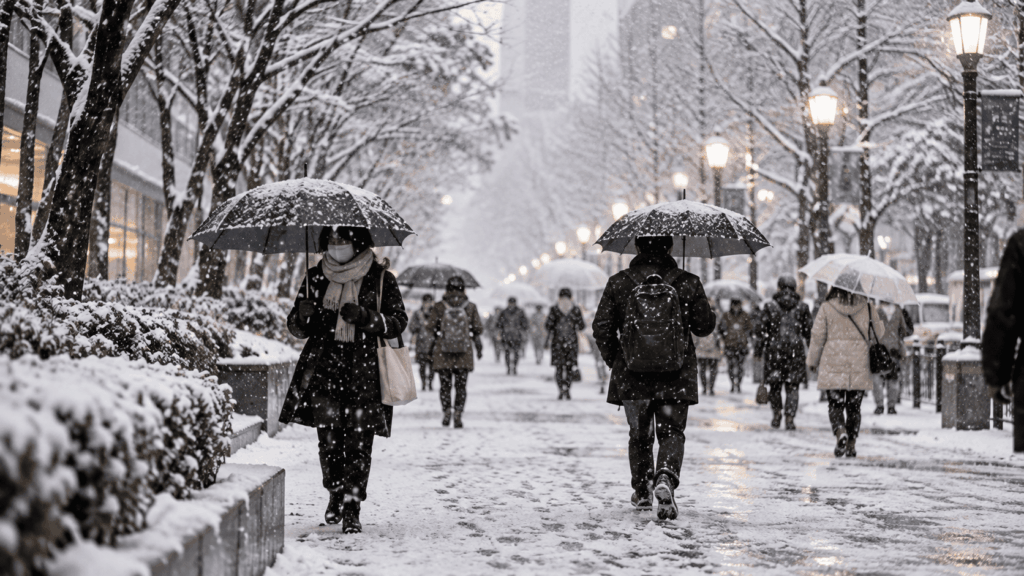
If snow does arrive, treat it as a bonus rather than a plan. Pavements turn to slush, steps and station stairs get icy, and the city slows down. Keep that day flexible instead of scheduling a tight chain of outdoor stops.
This expectation gap is the most common misunderstanding in Tokyo winter planning: people arrive having seen snow-covered scenes from Shirakawa-go, Kyoto or Hokkaido and assume the capital offers something similar. It doesn’t. If snow is the reason you’re considering winter, central Tokyo is the wrong place to chase it — the alternatives deserve a proper look, and they come after the packing question, because what you carry changes with the answer.
What to Wear in Tokyo in Winter
The principle is simpler than the packing lists suggest: build around a warm coat and layers you can remove, not around one extremely thick garment. Tokyo’s winter is cold outdoors and aggressively heated indoors — trains, department stores, museums, restaurants and cafés all run warm — so the useful question is not “how thick is my jacket?” but “what do I take off when I walk into a department store?”
GO TOKYO’s own winter guidance recommends a heavy jacket, scarf, winter cap and gloves, and suggests buying disposable heating pads at any convenience store if the cold gets to you. That’s a good baseline. The table below translates it into the situations you’ll actually be in.
| Situation | Base clothing | Add | Why |
|---|---|---|---|
| Daytime walking | Long-sleeve top, sweater or fleece, warm coat, trousers, comfortable shoes | Nothing once you’re moving | Walking generates heat; a mid-layer you can unzip or remove matters more than overall thickness |
| Evening illuminations | Same base as daytime | Gloves, scarf, warm hat | Temperatures drop after dark and you spend more time standing than walking |
| Queues and photo stops | Same base | Gloves, thick scarf, warm socks, heat pads | Standing still is when the cold actually lands — it feels colder than an hour of walking |
| Train and indoor shopping day | Lighter base layer, coat you can carry | Bag space for the coat | Indoor heating is strong; you’ll be holding your coat, not wearing it |
| Snow in the forecast | Same base plus water-resistant shoes | Waterproof outer layer | The problem is slush and wet pavements, not deep snow |
Treat this as a starting point rather than a formula. Your own tolerance for cold, and the forecast for the specific week you’re there, matter more than any monthly average.
What to Wear for Daytime Sightseeing
Daytime highs run around 10–12°C across the three months, which is mild enough that many visitors overdress and then spend the afternoon carrying a coat. Start with a sweater or fleece under a warm outer layer, and plan to open or remove the mid-layer once you’ve been walking for twenty minutes or so.
For footwear, choose comfortable, already-broken-in walking shoes with warm socks. Tokyo’s station corridors and long city blocks reward practicality, while specialist snow boots are unnecessary unless snow or ice is forecast.
What to Wear for Winter Nights and Illuminations
Evenings are where winter travel planning most often goes wrong. January and February lows sit near 1–2°C, and the gap between a sunny afternoon and a post-sunset street is not a small one. The clothing that worked at 2 p.m. is usually not enough at 7 p.m., especially if you’re standing around rather than walking.
Kai’s tip: The difference between walking through Tokyo and standing still in it is bigger than the forecast makes it look. On an evening in Roppongi when I was guiding guests along Keyakizaka, the walking itself was fine — it was the stops for photos, with cold wind coming up the slope, that chilled us far more than the walk had. Pack gloves and a thick scarf for the evening even when the daytime high looks mild, and put them on before you start photographing rather than after you notice the cold.
Popular illuminations add a second factor: crowds slow your pace. When you’re shuffling rather than striding, you generate less heat, so the same temperature feels colder than it would on an empty street.
Do You Need Snow Boots in Tokyo?
No — not for a normal Tokyo winter trip. Snow boots are the single most over-packed item in Tokyo winter luggage. Snow is uncommon, and when it does settle it usually turns to slush on pavements within hours rather than forming the kind of surface that requires a winter boot.
What’s worth having is a pair of shoes with some grip and some resistance to damp, plus warm socks. If a snow or ice forecast appears shortly before you travel, that’s the moment to consider water-resistant footwear with a proper tread — not months in advance.
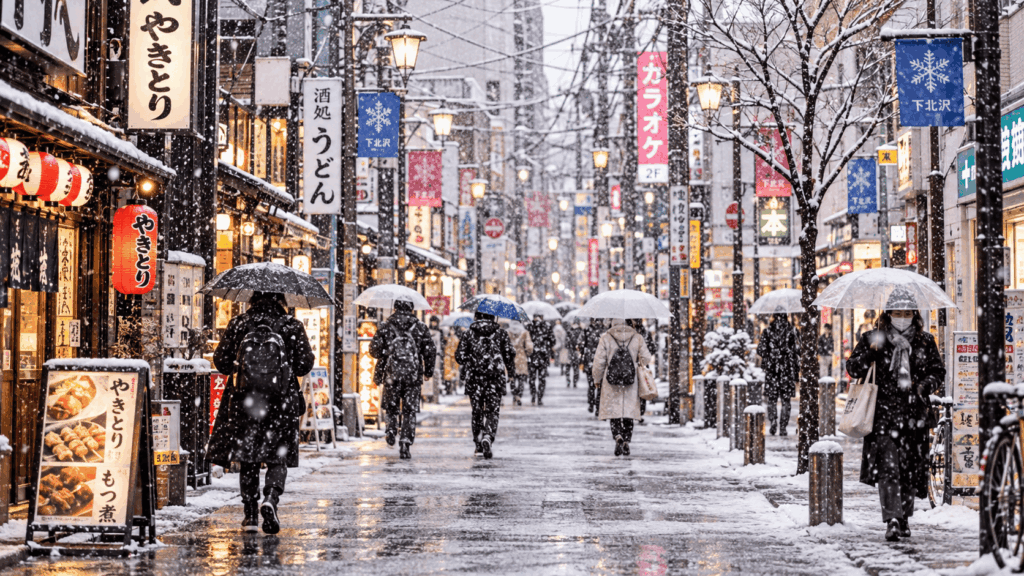
If you want a fuller packing list — base layers, what to bring for children, and how to handle laundry on a longer trip — that’s a separate question worth its own checklist.
The Best Things About Tokyo in Winter
Rather than a list of thirty attractions, it helps to think in four categories. Each one comes with a trade-off, and knowing the trade-off is what makes the difference between a good winter evening and a frustrating one.
Illuminations. Tokyo’s winter light displays are the season’s signature. Roppongi Hills’ Keyakizaka is the most photographed; Marunouchi, Omotesando and Ginza run their own versions along the streets. They’re genuinely impressive, and they’re also the most crowded thing you’ll do after dark — particularly on weekend evenings, when the best-known streets slow to a shuffle.
Clear views from above. Winter’s dry air produces the sharpest visibility of the year. Tokyo City View, on the 52nd floor of Roppongi Hills Mori Tower at 250 meters above sea level, is an indoor observation deck with floor-to-ceiling glass looking toward Tokyo Tower, Tokyo Skytree and, on clear days, the Mt. Fuji direction. The trade-off is timing: sunset is the most popular slot, and the queue is longest exactly when the light is best.
Christmas and New Year atmosphere. The Christmas market at Roppongi Hills’ O-YANE Plaza gives the season a focal point in December, and Meiji Jingu’s hatsumode gives January one of the country’s biggest annual gatherings. Both are worth planning around — and both are busiest at the times you’d instinctively choose.
Winter food and indoor breaks. Hot pot, oden and warm sit-down meals like sukiyaki are part of the season rather than an afterthought. GO TOKYO points to chanko nabe in Ryogoku and convenience-store oden as easy entry points; the practical value is that they give you a warm hour in the middle of a cold day when you need one.
Shorter daylight is the thread running through all four. A winter day in Tokyo is best built as daylight for walking and views, darkness for lights and indoor stops — not as one long outdoor itinerary with a coat on.
A Practical December Evening in Roppongi: Kai’s Real-World Example
The most useful winter skill in Tokyo isn’t layering — it’s alternating outdoor and indoor time so you’re never cold for long. Roppongi is a good place to see how that works in practice, because the pieces are close together. This particular route is for December, when the Christmas market and Keyakizaka illuminations are running; it is not a ready-made January or February itinerary.
Start at Roppongi Station. On the Tokyo Metro Hibiya Line, Exit 1C connects directly to Roppongi Hills underground, roughly a three-to-four-minute walk without stepping outside; from the Toei Oedo Line, Exit 3 is about six minutes on foot. Coming up inside the complex rather than on the street is the single easiest way to avoid an unnecessary dose of cold at the start of the evening.
Kai’s tip: I usually take the underground route from Roppongi Station precisely to stay out of the cold, but it has a trade-off: on a holiday weekend I’ve found the connecting passage and its stairs noticeably crowded, which takes some of the pleasure out of it. My habit is to reach the Christmas market on O-YANE Plaza a little earlier in the evening, get a hot drink in hand first, and only then walk out to the illuminations — arriving warm rather than arriving cold and looking for somewhere to warm up.
From the plaza, walk to Keyakizaka. The street runs about 400 meters, lined with lit zelkova trees and framed by Tokyo Tower at the far end — the composition that makes it the city’s most recognizable winter photo. Expect to stop repeatedly, and expect the stopping to be what makes you cold.
Then go inside, deliberately. Tokyo City View is on the 52nd floor of Mori Tower: indoor, glass-walled, and generally open from 10:00 to 22:00 with last entry at 21:30, though it closes between exhibitions. Admission is around ¥2,200 if you buy online and ¥2,400 at the counter. It’s worth checking the calendar before you go, since the deck closes for exhibition changes, and in the 2026–27 season a Le Petit Prince exhibition runs from November 13 to February 14 — the kind of detail that changes what you’ll see up there.
One correction to older guidebooks: the rooftop Sky Deck at Tokyo City View has been closed to the general public since April 2024. Plenty of travel content still describes going up to an open-air roof. You can’t — the observation experience is now the indoor deck, which for a winter evening is arguably the better arrangement anyway.
The sequence matters more than the specific places: outdoor lights, then a heated indoor space, then back out if you still have energy. Going up shortly before sunset and staying for the night view is the version most people enjoy, provided you don’t mind sharing the glass with a crowd at the moment the sun goes down.
This isn’t the only correct winter evening in Tokyo, and it isn’t a route to repeat mechanically. It’s an example of a structure — outdoor, indoor, outdoor — that works anywhere in the city once the temperature drops.
Winter Day Trips from Tokyo: Snow or Mt. Fuji Views?
Before choosing a winter day trip, separate three different goals: seeing snow on the ground, getting a clear view of Mt. Fuji, and seeing central Tokyo under snow. They require different plans. Snow in central Tokyo is unpredictable, and a sightseeing tour of the Fuji area is not automatically a snow trip. Decide which experience matters most before booking.
| Option | Time commitment | Transport | What you get | Weather risk | Best for |
|---|---|---|---|---|---|
| Stay in central Tokyo | None beyond your existing plans | Trains and subway, no booking | Illuminations, city views, New Year customs, food | Snow may simply not happen | Travelers who want a city trip and would treat snow as a bonus |
| Guided Mt. Fuji-area day trip | A full day, roughly 10 hours | Coach with pickup and drop-off in Tokyo | Fuji-area scenery: Arakurayama Sengen Park, Chureito Pagoda, Oshino Hakkai, Lake Kawaguchi | Fuji visibility and road conditions depend on the day; snow on the ground is not guaranteed | Travelers who value classic Mt. Fuji views over guaranteed snow |
| Snowier destination such as Echigo-Yuzawa | Most of a day | Joetsu Shinkansen, with local transport if needed | A better chance of snow-covered scenery and winter activities | Snow cover, transport and winter facilities depend on current conditions | Travelers whose priority is seeing and experiencing snow |
If You Want to See Actual Snow
Look beyond central Tokyo to a snowier destination such as Echigo-Yuzawa in Niigata Prefecture, which is accessible by Joetsu Shinkansen. The area is known for winter sports and playing in the snow, making it a more sensible choice when snow on the ground matters more than a view of Mt. Fuji. Conditions still vary, so check the official Echigo-Yuzawa tourism information, local snow reports and transport updates before leaving. Bring footwear suitable for snowy or icy ground.
If You Want Classic Winter Views of Mt. Fuji
A Fuji-area day trip is best treated as a mountain-view and sightseeing experience, not a promise of snow. Winter skies can improve your chances of seeing the mountain, but visibility and local ground conditions remain weather-dependent.
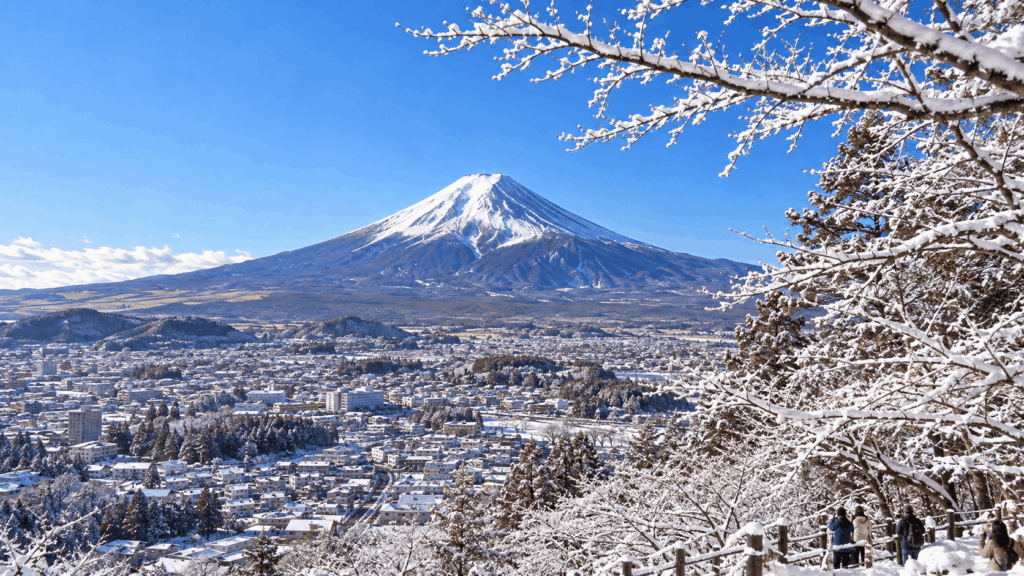
The tour most commonly used for this is GetYourGuide’s “Mt Fuji Top 5 Spots Day Tour: Arakurayama Park, Oshino Hakkai.” As currently listed, it runs about 10 hours with pickup at 08:00 from the JR Tokyo Station Marunouchi South Exit or 08:30 at Tokyo Mode Gakuen, and includes Arakurayama Sengen Park — where roughly 397 steps lead up toward Chureito Pagoda — plus Hikawa Clock Shop, Oshino Hakkai, the Lawson near Kawaguchiko Station and Oishi Park. A multilingual guide is provided, lunch is not included, the itinerary can change, and cancellation is free up to 24 hours before departure.
Be clear about what this is and isn’t. It is a Fuji-area sightseeing tour, not a snow tour: nobody can promise snow on the ground, and nobody can promise that Mt. Fuji will be visible. Winter often brings clearer air than summer, which helps, but reviews of this route split neatly between travelers who had a perfect view and travelers who saw cloud — which is exactly what “weather-dependent” means. Go for the landscape and the day out, not for a guaranteed photograph.
If you’d rather spend a day on winter scenery outside the city than hope for a Tokyo snowfall, it’s worth checking the current itinerary, pickup points and availability for this Mt. Fuji day tour before you commit to it.
For travelers who want winter scenery beyond Tokyo without coordinating trains and local buses between several stops, this is the guided day trip to compare. It suits people who want to see several Fuji-area viewpoints in one day and are comfortable with a structured coach itinerary rather than exploring entirely at their own pace.
Why I’d book this one
- Helpful guides and an organised route: Recent travelers frequently mention friendly guides and the convenience of visiting several major Fuji-area viewpoints in a single day.
- Less transport planning: The coach itinerary removes much of the work of connecting separate locations independently, although the day is long and some sightseeing stops can feel brief.
- Booking flexibility: The listing describes cancellation and pay-later options, giving travelers a chance to review the conditions before committing. Check the exact terms for your selected date.
See live availability, departure points and recent traveler reviews for the Mt Fuji Top 5 Spots day tour before deciding whether the itinerary fits your winter plans. Mt. Fuji views and snow conditions remain weather-dependent.
Common Mistakes to Avoid on a Winter Trip to Tokyo
Most winter trip problems in Tokyo come from expectation rather than logistics. These are the ones that come up repeatedly.
- Expecting a snow-covered city. Tokyo gets snow, but not often and rarely for long. Planning around it is the fastest route to disappointment.
- Dressing for the daytime walk and ignoring the evening. The afternoon high is not the temperature you’ll be standing in at 7 p.m. Gloves and a scarf are the difference between a pleasant evening and a short one.
- Wearing one extremely warm layer. A heavy coat with nothing underneath leaves you with no way to adjust when you walk into a heated department store or a packed train.
- Hitting famous illuminations at peak time without expecting crowds. The best-known displays are exactly where everyone else goes after dark. Going earlier in the evening, or accepting a slower pace, changes the experience.
- Assuming Christmas and New Year hours are the same every year. They aren’t, and neither is the “everything closes” assumption.
- Trusting old guides about the Tokyo City View rooftop. The Sky Deck has been closed to the general public since April 2024; recommendations to visit an open-air roof are out of date.
Kai’s tip: The advice I’d pass on about the New Year period is to resist the blanket assumption in either direction. Tokyo doesn’t shut down, and it doesn’t run normally either — it’s venue by venue. Some museums and galleries close for a few days around New Year, department stores may run holiday hours, restaurants vary wildly, and shrines are at their busiest. Pick the handful of places that actually matter to you and check each one, rather than planning around a general rule that will be wrong somewhere.
So, Which Winter Month Should You Choose?
Ten seconds, four options. The numbers are in the table above; this is about priorities.
Choose December if: Christmas lights and a festive city are the main attraction, and you don’t mind that the last week of the month is the least predictable for opening hours. It’s also the mildest of the three on average, which matters if cold is your main worry.
Choose January if: you want Japanese New Year atmosphere — hatsumode at Meiji Jingu, shrine crowds, the sense of the city resetting — and you can handle the coldest averages of the three. The clear air is a bonus for observation decks.
Choose February if: you want a genuine winter trip without Christmas, you’re interested in Setsubun or early plum blossoms, and you’d rather have slightly better odds of a snowfall than festive lights. Slightly better odds is still not a plan.
Choose another season if: cold evenings would significantly reduce your enjoyment, you want to travel with minimal clothing, or winter-specific events aren’t a draw for you. Tokyo in spring and autumn is easier in every practical sense.
And whichever month you pick, don’t choose it purely to see snow. Winter in Tokyo works best when you treat the cold as the frame rather than the obstacle: outdoor highlights by day, warm indoor stops when you need them, and a city that looks sharper and clearer than it does at any other time of year.
Frequently Asked Questions
Is Tokyo worth visiting in winter?
For most city travelers, yes. Winter gives Tokyo its clearest skies of the year, which makes observation decks and long views worth the ticket, and December adds illuminations and Christmas markets while January adds New Year shrine culture. The one thing winter does not reliably deliver is snow, so it’s a poor choice if a snowy cityscape is the goal. Travelers who dislike cold evenings or want to pack light may find spring or autumn easier.
What is the coldest month in Tokyo?
January. The 1991–2020 climate normals put Tokyo’s January average at 5.4°C, with average highs of 9.8°C and lows of 1.2°C — the lowest of the three winter months on all three measures. February is close behind at 6.1°C, and December is the mildest at 7.7°C. The gap between them is small enough that atmosphere and events should decide your month, not temperature.
When does it usually snow in Tokyo?
Snow, when it happens, falls mainly in January and February. It is not frequent: the normals show about 1.9 days a year with a centimeter or more of snowfall, and roughly four days a year with at least a centimeter lying on the ground. December snowfall is very rare. Snow in central Tokyo often melts or turns to slush quickly, so even a snowy day rarely gives you the postcard version of the city.
What should I wear in Tokyo in December, January, and February?
The same logic works across all three months: a warm coat over a sweater or fleece, trousers, comfortable walking shoes, and gloves and a scarf for evenings. December lets you get away with a slightly lighter coat; January calls for your warmest one plus a thermal base layer; February sits between the two but still needs full winter clothing. The variable that matters most isn’t the month but the activity — you need more for standing at an illumination than for walking between sights, and less for a day spent in heated shops and trains.
Do I need snow boots in Tokyo?
No, not for a normal winter trip. Snow is uncommon and rarely stays on the ground long enough to require specialist footwear, and most of what you’ll walk on is dry pavement. Shoes with decent grip and warm socks are enough. If a snow or ice forecast appears shortly before you travel, consider water-resistant shoes with a proper tread — but don’t buy winter boots specifically for Tokyo.
Do shops and attractions close over New Year in Tokyo?
Some museums, shops and restaurants change their opening hours around New Year, especially from December 31 to January 3, but Tokyo does not shut down completely. Hours vary by venue, so check official calendars for your dates. For the differences between the first few days of January and the rest of the month, see our Tokyo in January guide.
Final Verdict: Which Winter Trip Are You Planning?
For first-time visitors: December if you want the city at its most photogenic, January if you want the New Year experience. Either way, build the trip around one illumination street, one observation deck and one indoor cultural stop rather than trying to cover the city outdoors from morning to night.
For couples and travelers chasing atmosphere: December, and specifically an evening in Roppongi — the market at O-YANE Plaza, Keyakizaka after dark, then Tokyo City View as a warm finish. Book the observation deck for a slot before sunset so the cold part of the evening is short.
For families with young children: December before the 25th, or February. Both avoid the deepest cold of January, and both let you keep days short. Plan one outdoor block and one indoor block per day, and don’t attempt late-evening illuminations with tired children in near-freezing temperatures.
For travelers on a tight two- or three-day schedule: winter daylight is short, so treat the day as two halves. Use daylight for anything that requires being outside or looking out — Meiji Jingu, a walk through Marunouchi, an observation deck — and save the dark hours for illuminations and indoor meals.
For repeat visitors: February is the most interesting choice. Setsubun and the start of plum blossom season give you something you haven’t already seen, and the city is free of the December crowds that gather around the best-known lights.
If snow is non-negotiable: don’t build the trip around central Tokyo or assume a Fuji sightseeing tour will have snow on the ground. Choose a snowier region such as Echigo-Yuzawa and check current conditions before traveling. Pick the Fuji area instead if mountain views, rather than snow underfoot, are your priority.
If cold evenings would ruin the trip: come in spring or autumn. Winter in Tokyo is manageable rather than brutal, but it does ask you to plan around the temperature every single day, and that’s a real cost if you’d rather not think about it.
One last thing worth saying plainly: event dates, admission rules and opening hours in Tokyo are set year by year, not permanently. Illumination schedules, Christmas market arrangements, observation deck closures and New Year hours all change. Use this guide to make the decision, then confirm the specifics on the official sites for the year you’re traveling.

Hi, I’m Kai. I’m a Tokyo-based travel writer, tourism industry insider, and the author of a published guidebook for international visitors to Japan. With over 10 years of professional experience at a leading Japanese tourism company, my mission is to help you skip the tourist traps and navigate Japan’s best destinations like a local. I believe the perfect day trip is like a traditional kaiseki meal: a beautiful balance of precise planning and unforgettable seasonal discovery. When I’m not out conducting field research, you’ll usually find me drafting new itineraries with one of my favorite fountain pens!