
Sara udon is one of Nagasaki’s signature noodle dishes — but it is not the udon you are probably picturing. There is no thick white noodle in a dashi broth here. Instead, you get vegetables, seafood, and pork built around noodles in one of two distinct styles: thin, crispy fried noodles under a thick savory sauce, or thicker, chewier noodles with a different cooking method entirely.
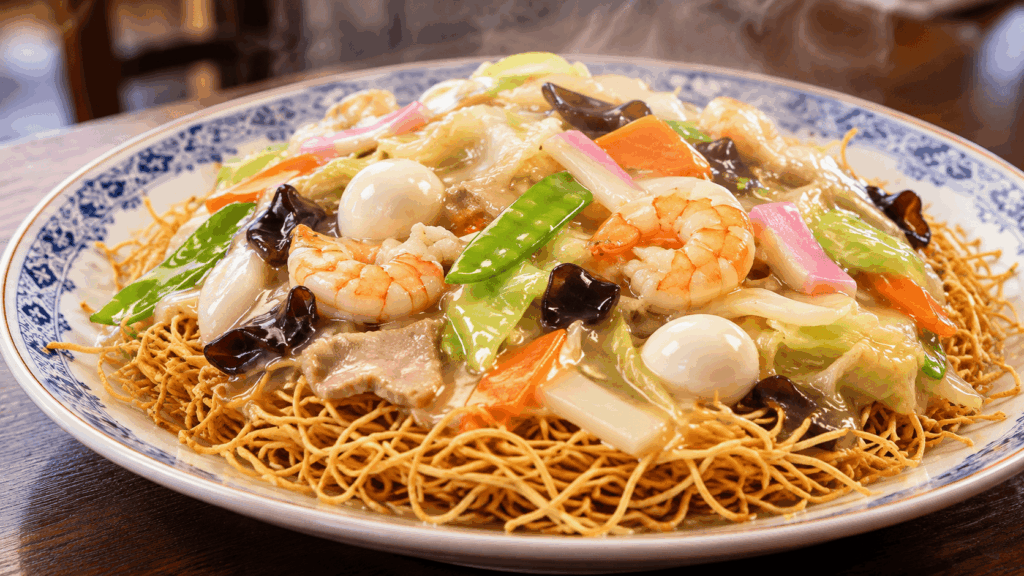
If you have time for only one or two meals during your days in Nagasaki, this guide answers the decision most visitors actually face: which style should I order, and where should I eat it?
Planning to fit a sara udon lunch into a full day of Nagasaki sightseeing? If you would rather have a local guide help shape the route, compare start times and custom itinerary options for this private licensed-guide tour. Its sample itinerary includes Shinchi Chinatown and local dishes such as sara udon and champon, although lunch costs extra.
Sara Udon in Nagasaki: Quick Verdict
- First time, and curious about “real” sara udon → Start with thin sara udon. It is the style most people picture and the easiest to understand on a first visit.
- You like chewy, substantial noodles → Order thick sara udon. It eats more like a noodle dish and less like a crispy-topped one.
- You want a warm, soupy bowl → Order champon instead, and treat sara udon as a separate dish.
- Traveling with someone else → Order two different dishes and share. This is the single easiest way to avoid choosing wrong.
If your Nagasaki day is short and you would rather fold a Chinatown lunch into a wider sightseeing route than build the plan yourself, a private licensed guide can tailor the day around your interests — we cover how that compares to going it alone later in this guide.
What Is Sara Udon?
Sara udon is a Nagasaki noodle dish, not a plate of conventional Japanese udon noodles. The standard understanding — recorded by Japan’s Ministry of Agriculture, Forestry and Fisheries (MAFF) in its regional cuisine archive and by the restaurant credited with creating it — is that sara udon was invented as a soup-less version of champon.
The story traces to 1899, when Chen Pingjun (Chin Heijun), the founder of the Chinese restaurant Shikairou in Nagasaki, created champon for the Chinese students and residents living in the city. Sara udon followed as a variation: champon noodles were grilled, cooked with the same toppings, and served on a flat plate with only a little broth worked into the noodles.

That detail — served on a plate rather than in a bowl — is usually given as the origin of the name, since noodles were normally served in a deep bowl at the time.
Why Is It Called “Udon” If It Doesn’t Look Like Udon?
This is the first thing that trips people up, and it is worth clearing up before you order. The “udon” in sara udon is largely a naming convention, not a description of the noodle. When the dish first appeared, it was made with the same thick noodles used for champon. The crispy, thin fried noodles that dominate sara udon photos today came later.
Because of that history, Nagasaki cooks are precise about the distinction: they separate thick-noodle sara udon (太麺皿うどん) from thin-noodle sara udon (細麺皿うどん). If you ask for “sara udon” in Nagasaki, the staff will often ask you which one you mean. Knowing the two names — and that both exist — puts you ahead of most first-time visitors.
Thin vs Thick Sara Udon: Which Should You Order?
This is the decision that matters most, so here it is without the usual hand-waving. Neither style is “more authentic” than the other; they are simply built for different preferences. The practical differences come down to texture, how the dish is prepared, and how it changes as you eat.
| Point of comparison | Thin sara udon | Thick sara udon |
|---|---|---|
| Noodle texture | Thin, crisp, and fried | Thick and chewy, closer to champon noodles |
| How it is prepared | Fried noodles with a starchy ankake sauce poured over the top | Noodles cooked with the toppings until the broth is absorbed rather than served as a sauce on top |
| What happens as you eat | The crispy noodles soften where they meet the sauce, so the texture changes from the first bite to the last | The texture stays fairly consistent throughout, with the focus on the noodle itself |
| Overall eating experience | Contrast-driven: crisp and soft at the same time | More uniform and substantial |
| Best for | First-timers and anyone who enjoys crunchy textures | Travelers who prefer chewy noodles and a more filling bite |
| Possible downside | If you dislike soft noodles, the lower half can feel less crisp than expected | Less dramatic texture; it is a noodle dish rather than a contrast dish |
| Historical note | A later variation of the original dish | Closer to the original sara udon, which used champon noodles |
| Kai’s recommendation | Pick this if you are deciding on your first visit | Pick this if you already know you love chewy noodles |
Thin Sara Udon — Crispy at First, Softer as You Eat
The appeal of thin sara udon is not that it stays crunchy. It doesn’t — and that is the point. The fried noodles sit under a thick vegetable-and-seafood sauce, and where the two meet, the noodles gradually soften. For the first few minutes you get a mix of crisp and tender strands in the same mouthful.
When I have taken visitors to Kairakuen in Shinchi Chinatown and ordered both styles at the same table, the thin version is almost always the one that surprises people. What catches them out is that the dish they saw in photos — all crunch — quietly turns into something softer and more comforting as they eat. If you want to experience that shift, start eating soon after it arrives rather than letting it sit.
Thick Sara Udon — Chewier and More Substantial
Thick sara udon is not simply the thin version with bigger noodles. It is prepared differently: rather than a sauce poured over fried noodles, the noodles are cooked with the toppings until the liquid is absorbed. The result is chewier and more filling, with the flavor worked into the noodles rather than layered on top.
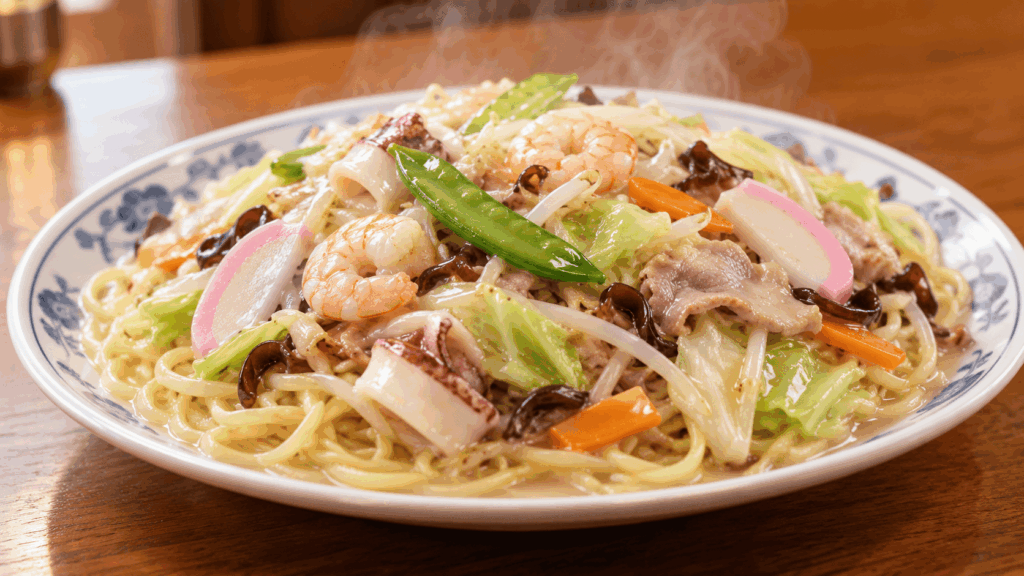
Anyone who enjoys the chew of champon noodles will likely prefer this style. Around the same table, the thick version is also the one that tends to leave people fuller — worth knowing if you are planning to eat again later in the day.
A Surprising Detail: Thick Sara Udon Came First
Here is the part that rarely makes it into short introductions. The sara udon that most photos show — thin and crispy — is the newer style. According to MAFF’s description of the dish, the original sara udon was made with the same thick noodles as champon, grilled and cooked down. The crispy thin-noodle version came afterward.
So if you have been thinking of crispy noodles as the “real” sara udon, it is worth adjusting that assumption. Both are genuine local dishes, and many Nagasaki households recognize them as clearly separate things. If history and originality matter to you, the thick style is arguably the closer descendant of the 1899 original.
Sara Udon vs Champon: Which Is Better for You?
This is the question I get asked most often by visitors planning their first Nagasaki meal, and it is a fair one — the two dishes share the same toppings and the same origin story. They are not, however, interchangeable once the bowl reaches the table.
Champon is a noodle soup: noodles served in a mild, savory broth built from pork and seafood, with the same mix of vegetables and proteins stirred through. Sara udon is not a soup. Its ingredients are concentrated around the noodles or worked into them, with texture doing much of the work.
A quick note for planning: this guide covers champon only as far as it helps you decide between the two. Nagasaki’s champon has its own history and its own restaurant landscape, which belongs in its own article — so if champon is your priority, treat this as a starting point rather than the whole picture.
| Point of comparison | Sara udon | Champon |
|---|---|---|
| Soup | No bowl of soup; a starchy sauce or absorbed broth around the noodles | A warm broth that the noodles sit in |
| Noodles | Thin fried noodles or thick chewy noodles, depending on the style | Thick noodles, similar to the ones used for the thick style of sara udon |
| Texture | Crispy-to-soft (thin) or consistently chewy (thick) | Soft and slightly chewy in broth |
| Flavor experience | Savory toppings and sauce, with texture as a main feature | Mild, rounded, warm broth you drink as much as you eat |
| Vegetables and seafood | Largely the same mix, concentrated rather than in broth | Largely the same mix, simmered in broth |
| Best for | Anyone who wants to focus on noodle texture | Anyone who wants a warm, soupy, comforting bowl |
| If you only have one meal | Pick this if sara udon is specifically what you came to try | Pick this on a cold day or if you want soup over texture |
| Good choice for sharing | Yes — pairs naturally with a champon order | Yes — pairs naturally with a sara udon order |
If You Only Have One Meal in Nagasaki
Strip away the ranking talk and the choice comes down to a few conditions:
- You came specifically for sara udon, and it’s your first time → thin sara udon.
- It’s a cold day (depending on when you visit) or you want something warm and brothy → champon.
- You know you like chewy noodles → thick sara udon.
- You’re traveling with at least one other person → order champon plus a sara udon, or thin plus thick, and split them.
Kai’s tip: If I’m guiding a group where someone eats lightly, I suggest ordering two different dishes and sharing rather than committing to one bowl each. Nagasaki’s portions are generous, and splitting a champon and a sara udon answers the “which one is better” question directly — you taste both instead of guessing.
Where to Eat Sara Udon and Champon in Nagasaki
Rather than rank restaurants, it helps to pick the one that matches what you actually want from the meal. Three well-known options come up again and again, and each is a good answer to a different question.
| Restaurant | Area | Why choose it | Best for | Queue consideration | What to verify before going |
|---|---|---|---|---|---|
| Shikairou (四海樓) | Matsugae-machi, near Oura Church and Glover Garden | Credited as the birthplace of champon and sara udon; a historic setting near the port | Travelers interested in the origin story and combining the meal with Glover Garden sightseeing | Very popular; long waits are commonly reported, and reception can close earlier than the posted last entry when busy | Current hours, closing days, and whether reception is still open that day |
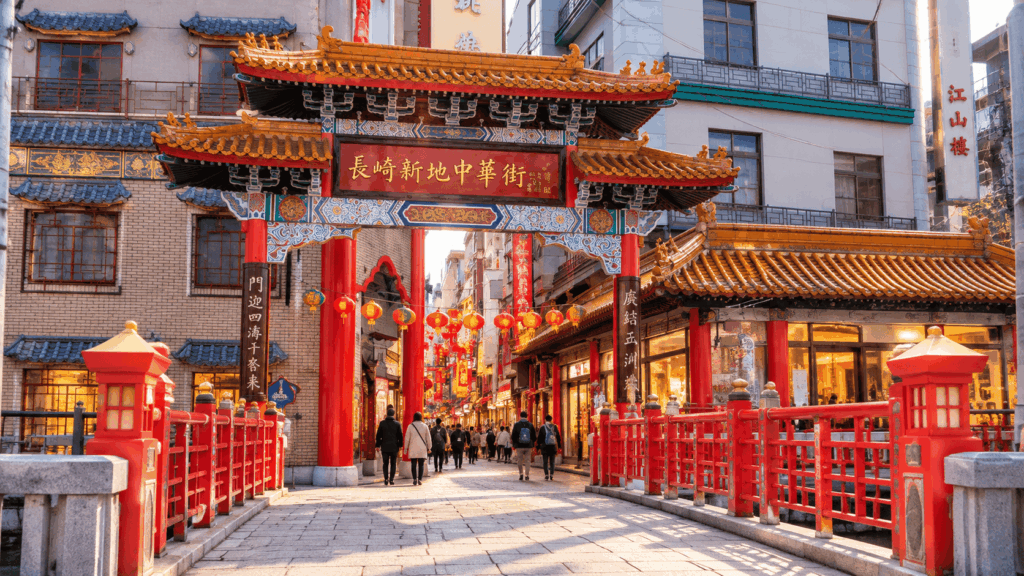
| Kairakuen (会楽園) | Shinchi Chinatown | Offers both thin and thick sara udon, making it an easy place to compare styles | Anyone who wants to try thin and thick side by side in Chinatown | Waits of a few tens of minutes around lunch are commonly reported | Current hours, irregular closing days, and whether both styles are available that day |
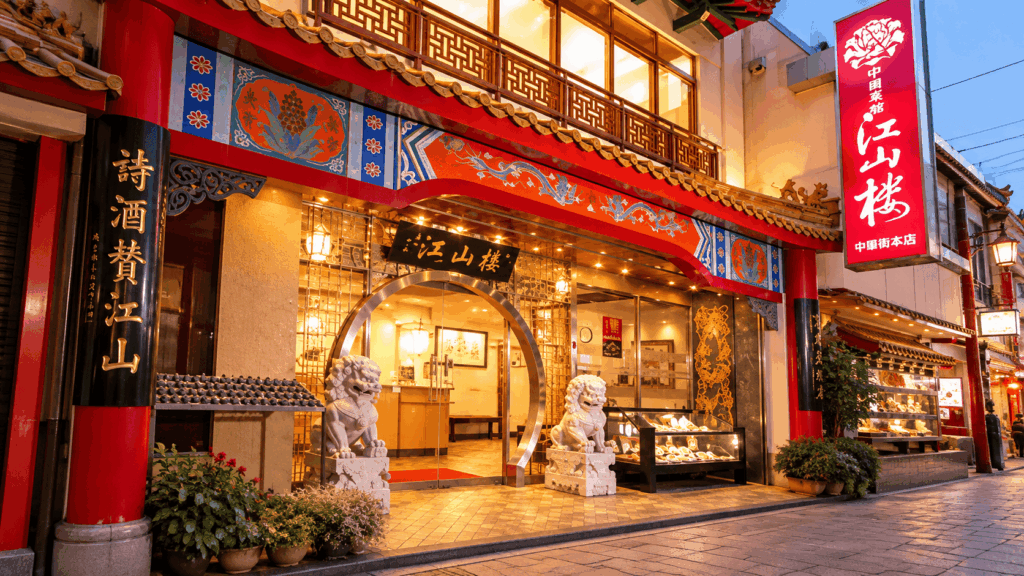
| Kozanro (中国菜館 江山楼, Chinatown branch) | Shinchi Chinatown | A well-known Chinatown option for both champon and sara udon | Travelers who want a famous Chinatown restaurant and can accept a wait | Waits in the region of 30–40 minutes are commonly reported at peak times | Current hours (opening time differs on weekdays) and closing days |
If you would rather plan the sights and the lunch stop together instead of stitching the route together yourself, it is worth comparing the current private-tour options before you commit your day to a single restaurant queue.
If the meal is only one part of a packed Nagasaki day, a customizable private tour is worth comparing with a self-planned route. This is particularly relevant if you want to see the city’s major sights while leaving room for a Chinatown lunch rather than planning every connection yourself.
Why I’d book this one
- A route shaped around your interests: Recent travelers highlight guides who adapt sightseeing plans to their priorities, making the tour useful when you have limited time and several places you want to visit.
- Chinatown fits the sightseeing plan: The sample itinerary includes Shinchi Chinatown and mentions local noodle dishes such as sara udon and champon, so a food stop can be discussed alongside the city’s historic sights.
- More clarity before committing: You can review the available start times, itinerary details, cancellation conditions, and recent traveler feedback before deciding whether a guided day is worth the extra cost.
Keep in mind that lunch, admission fees, and local transport are generally separate expenses. A particular restaurant stop or shorter queue is not guaranteed, so discuss your preferred lunch location with the guide before finalizing the itinerary.
Shikairou — Choose It for History
Shikairou is the place to go if the origin of champon and sara udon is part of what interests you. It sits near Oura Church, which makes it a natural lunch stop if you are already spending the day around Glover Garden and the port area, and the dining room is on an upper floor looking out over the harbor.
Be realistic about the trade-off. The restaurant does not take general reservations, and during busy periods reception can close earlier than the posted last-entry time. That means the meal can cost you more waiting time than you expect. Treat it as a destination in its own right rather than a quick lunch.
Kairakuen — Best Fit for Comparing Thin and Thick Sara Udon
If your goal is to understand the difference between the two styles rather than just eat one bowl, Kairakuen in Shinchi Chinatown is a practical choice: both thin and thick sara udon are on the menu, at the same price, alongside champon. That makes it easy to order one of each for the table.
When I’ve brought visitors here, ordering both styles at once turned an abstract menu decision into something everyone could taste for themselves. It is the closest thing to a side-by-side comparison you can get in a single sitting.
Kozanro — A Famous Chinatown Option, but Plan for a Wait
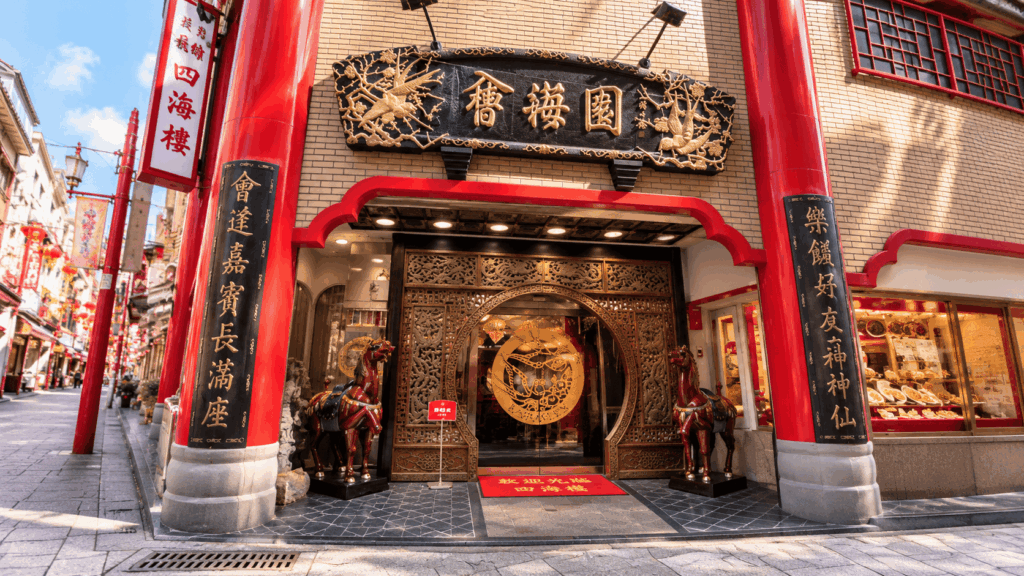
Kozanro is a well-known Chinatown name for both champon and sara udon, and if you want to eat at a restaurant with a strong local reputation, it fits that goal. The catch is the line: waits of roughly half an hour or more are commonly reported at busy times, and that is time you may prefer to spend sightseeing.
If your day is tight, weigh the reputation against the clock before you commit. The restaurant’s Chinatown location does make it easy to combine with a walk through the district, which helps offset the wait.
How to Eat Sara Udon Like a Local
Once the dish arrives, there is a local habit worth knowing. In Nagasaki, many people eat sara udon with a Worcester-style sauce or vinegar, and the city has its own long-established version made with local restaurants. You will often see a bottle on the table.
The most common approach is to start with the noodles mostly as they are, then add a small amount of sauce to taste. And with the thin style, try not to stir everything together immediately — the contrast between the still-crispy top and the softened lower layer is the whole point of ordering it.
Kai’s tip: What I suggest to visitors is to eat a few bites first and then add just a little sauce, rather than pouring it over the whole plate. The topping sauce is already seasoned, so a small amount is usually enough to shift the flavor without burying it. You can always add more, but you cannot take it back.
How to Avoid Spending Your Nagasaki Lunch in a Queue
The biggest risk to a short Nagasaki trip is not choosing the wrong dish — it is losing an hour of sightseeing to a lunch line. The popular restaurants here are genuinely popular, and the waits are real rather than a matter of luck.
A few practical approaches reduce that risk:
- Arrive before opening if the restaurant matters to you. This improves your odds, but it is not a guarantee — busy days can still fill up fast.
- Check the day’s hours before you go. Some restaurants close earlier than usual when crowded, or close on specific days that change month to month.
- Combine Chinatown sightseeing with your meal. If you are already walking the district or based in the Chinatown area, waiting is less costly than making a special trip across town for one restaurant.
- Treat fame as one factor, not the deciding one. A slightly less famous restaurant with a shorter line may leave you more time for the rest of the city.
Kai’s tip: The mistake I see first-time visitors make is treating the queue as something that starts only when they arrive. In practice, the wait becomes part of your lunch plan — I have watched long lines form at Shikairou well before its posted opening, and its reception has closed earlier than the listed last-entry time when it was busy. On another visit I waited around forty minutes at Kozanro. None of that means you should skip these places; it means you should decide in advance how much of your day you are willing to trade for one bowl.
Is Shikairou Worth the Wait?
Worth it if:
- You care about the history of champon and sara udon and want to eat at the restaurant credited with creating them.
- You are already visiting Oura Church or Glover Garden, so the location fits your route.
- You are treating the meal as part of the sightseeing rather than a quick refuel.
- You have the time to spend.
Choose another restaurant if:
- You only have half a day in Nagasaki.
- You dislike waiting in line.
- You have no particular interest in the “birthplace” angle.
- Your plan is centered on Chinatown, where several strong options sit side by side.
There is no single correct answer here. The honest version is that Shikairou offers history and setting, and the cost of that is time — so decide which one you value more before you join the line.
Frequently Asked Questions About Sara Udon
What is sara udon made of?
Sara udon is built from noodles plus a mix of pork, seafood such as shrimp and squid, and vegetables including cabbage, carrot, onion, mushrooms, and kamaboko (fish cake). The same basic ingredients are used across both styles. What changes is how the noodles and toppings are put together — a starchy sauce poured over fried noodles for the thin style, or noodles cooked with the toppings until the liquid is absorbed for the thick style.
Is sara udon actually udon?
Not in the usual sense. Sara udon is not a serving of thick white udon noodles in broth. The original dish was made with the same thick noodles used for champon, and the name is generally explained by the fact that it was served on a flat plate rather than in a bowl. The crispy thin-noodle version that most people associate with sara udon today came later.
What is the difference between sara udon and Nagasaki champon?
Champon is a noodle soup — thick noodles served in a mild, savory broth with the same mix of vegetables and seafood. Sara udon is not a soup: its ingredients are concentrated around the noodles or cooked into them, and texture plays a larger role. If you want a warm bowl of broth, champon is the answer; if you want to focus on noodle texture, sara udon is the answer.
Is thin or thick sara udon better?
Neither is better — they suit different preferences. Thin sara udon is crisp at first and softens as it absorbs the sauce, which makes it the more dramatic choice and a good first order. Thick sara udon is chewier and more filling, and tends to appeal to people who already like chewy noodles. If you are with someone else, ordering one of each and sharing removes the guesswork.
Where should first-time visitors eat sara udon in Nagasaki?
Two practical starting points are Shikairou, near Oura Church and Glover Garden, if the history of the dish interests you, and Kairakuen in Shinchi Chinatown, if you want to compare thin and thick styles at one table. Kozanro is another well-known Chinatown option worth considering if you can accept a wait. Which one is best depends on how much time you have and whether you are already sightseeing nearby.
So, Is Sara Udon Worth Trying in Nagasaki?
Yes — especially if texture is part of what you enjoy about food. Sara udon is not just a box to tick because it is a local specialty. The interesting part is that you get a real choice: do you want the crispy-to-soft experience of the thin style, or the chewier, more substantial thick style? Being able to make that choice deliberately is what separates a memorable meal here from an obligatory one.
Here is the short version, by traveler type:
- First-time visitors → order thin sara udon. It is the clearest introduction to what the dish is.
- Travelers who love chewy noodles → order thick sara udon. You will likely enjoy it more than the crispy style.
- Anyone craving a warm soup → choose champon instead, and keep sara udon for another meal.
- Two travelers → order two different dishes and share. Champon plus sara udon, or thin plus thick, both work well.
- Travelers on a tight schedule → choose your restaurant by location and queue risk, not by fame alone. A Chinatown meal folded into a Chinatown walk usually costs you less time than a special trip to a single famous spot.
- Repeat visitors → if you have had the classic crispy version before, this is a good trip to try the thick style and taste how different it really is.
If you want the full experience in one sitting rather than a single order, the simplest move is still the one I keep coming back to: sit down with someone else, order two different dishes, and compare them across the table.
For anyone who would rather spend the day seeing the best of the city than managing queues and lunch logistics, planning the sights and a Chinatown lunch together — rather than restaurant by restaurant — is often the more relaxed route.

Hi, I’m Kai. I’m a Tokyo-based travel writer, tourism industry insider, and the author of a published guidebook for international visitors to Japan. With over 10 years of professional experience at a leading Japanese tourism company, my mission is to help you skip the tourist traps and navigate Japan’s best destinations like a local. I believe the perfect day trip is like a traditional kaiseki meal: a beautiful balance of precise planning and unforgettable seasonal discovery. When I’m not out conducting field research, you’ll usually find me drafting new itineraries with one of my favorite fountain pens!