
Furano Ski Resort has two base areas — Kitanomine and Furano — and they are not interchangeable, even though both look beginner-friendly on the trail map. For a family learning to ski, the lower slopes above Kitanomine village are the stronger choice: F6 and F7 are wide, evenly pitched, and served by a four-person chair. But Kitanomine’s beginner reputation stops at the bottom of the mountain. The Kitanomine Gondola climbs almost 3km to the summit in about ten minutes, and the resort’s own lift table flags it as limited to intermediate and advanced skiers. Furano Zone also has real beginner terrain — the resort describes C1 as its best slope for beginner lessons — so if you are staying at Shin Furano Prince Hotel, there is no reason to travel. And if you plan to link the two zones on a snowboard, read the H1 section before you commit to that plan.
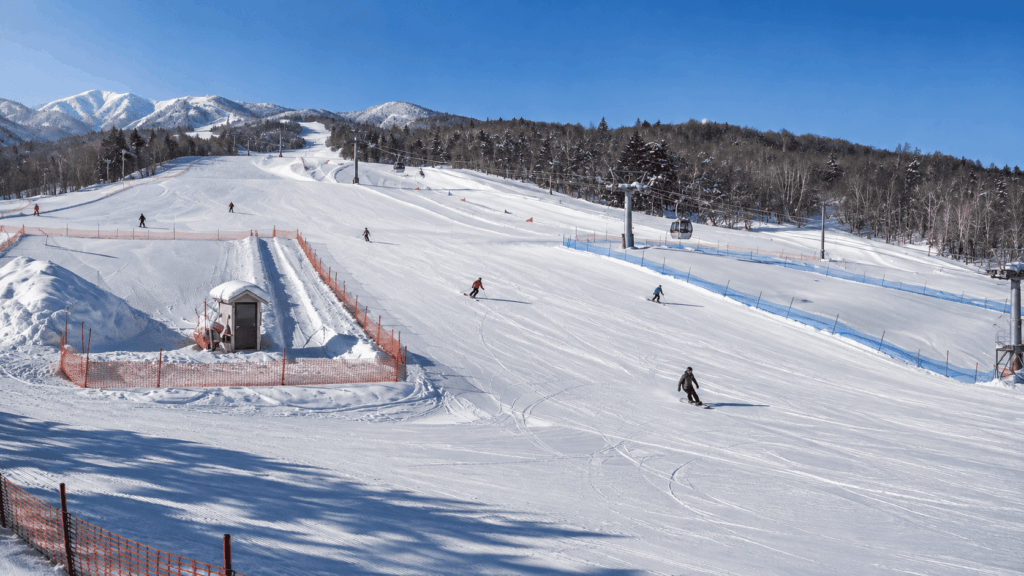
If you are still deciding whether to book a lesson, note that schools meet on both sides of the mountain, so the zone you pick should match where your instructor meets you.
If you’re new to skiing or planning a family lesson, private instruction is worth comparing before you settle on a base. Compare English-language private ski lesson options in Furano, including 3-hour and 6-hour options, and confirm the instructor’s meeting zone before booking.
Furano Zone vs Kitanomine Zone: Quick Comparison
The two zones sit on the same mountain, share one lift pass, and are joined near the summit by a connecting trail. What differs is where the learning terrain sits, how you get up the mountain, and what happens when you try to move between them.
| Comparison | Kitanomine Zone | Furano Zone |
|---|---|---|
| Beginner practice | Wide lower slopes (F6, F7, F5) reached by Kitanomine Swift Lift No.1; a short magic-carpet slope at the base | Beginner slopes at the base (C1, B2, D2) reached by Prince Romance Lift and the lower lifts; separate snow escalator area |
| Upper-mountain terrain | Gondola to the summit; upper runs are intermediate (K1) and advanced (K2, K3, K4) | Ropeway to roughly the 900m mark; long intermediate runs (A1, A2, C2) and steeper advanced terrain (A3, A4, E1) |
| Main gondola or ropeway | Kitanomine Gondola — 6 passengers, 2,968m, about 10 minutes to the top | Furano Ropeway — 101 passengers, 2,330m |
| Snowboarding between zones | Link Lift takes you out to Furano (2-person chair, 931m) | H1 brings you back to Kitanomine (1,500m, intermediate, with flat sections) |
| Best base for accommodation | Kitanomine village — hotels and pensions within walking distance of the gondola | Shin Furano Prince Hotel, ski-in and ski-out at the base of the zone |
| Lesson meeting points | Kitanomine Gondola Terminal (school desk on the lower level; FISS meeting area) | Shin Furano Prince Hotel ground floor (school desk); FISS meeting area on the Prince side |
| Early and late season | Scheduled from late December to 22 March 2027; exact opening day depends on snow | Opens in late November and runs into early May |
| Best for | Families and first-timers who want a compact base and repeated laps on the same slope | Guests staying at the Prince hotel, early or late-season visitors, and intermediates who want long top-to-bottom runs |
The resort lists 28 courses across both zones, with 839m of vertical and a longest run of about 4,000m. That is a large mountain, and the honest summary is that neither zone is “”the beginner zone”” — each has easy terrain at the bottom and demanding terrain above it. If you need the wider picture before choosing a base — lift passes, getting here, rental — that belongs in a full resort guide rather than in this comparison.
Which Zone Is Better for Beginners?
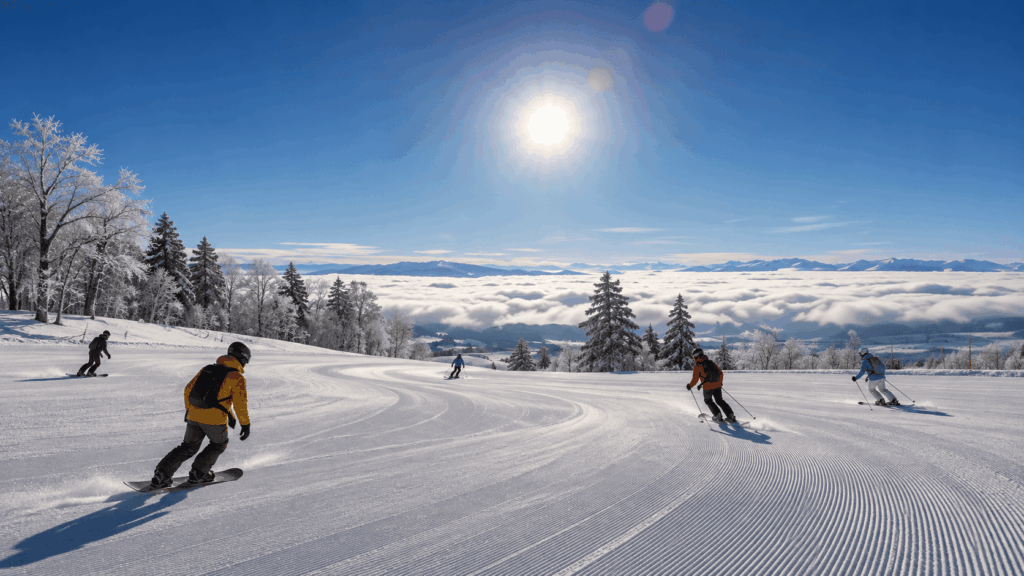
Both zones have beginner-classified slopes at the bottom, and both have a free snow escalator area for first slides. While Furano ranks among the best ski resorts in Hokkaido for beginners, the difference between these two specific zones is the shape of that terrain and what it takes to reach it.
On the Furano side, C1 (700m, average 10°, maximum 19°) is described by the resort as having ample width and being ideal for beginner lessons, while D2 (510m, average 10°) is called a quiet slope best suited to basic practice. B2 (660m, average 10°, maximum 18°) weaves through larch trees. These are genuinely useful learning slopes — the mistake is assuming that a beginner must go to Kitanomine to find them.
On the Kitanomine side, F6 and F7 are the two slopes most beginners will spend their first day on, and both are reached by the same four-person chair, Kitanomine Swift Lift No.1.
Why Kitanomine’s Lower Slopes Suit a Beginner Family
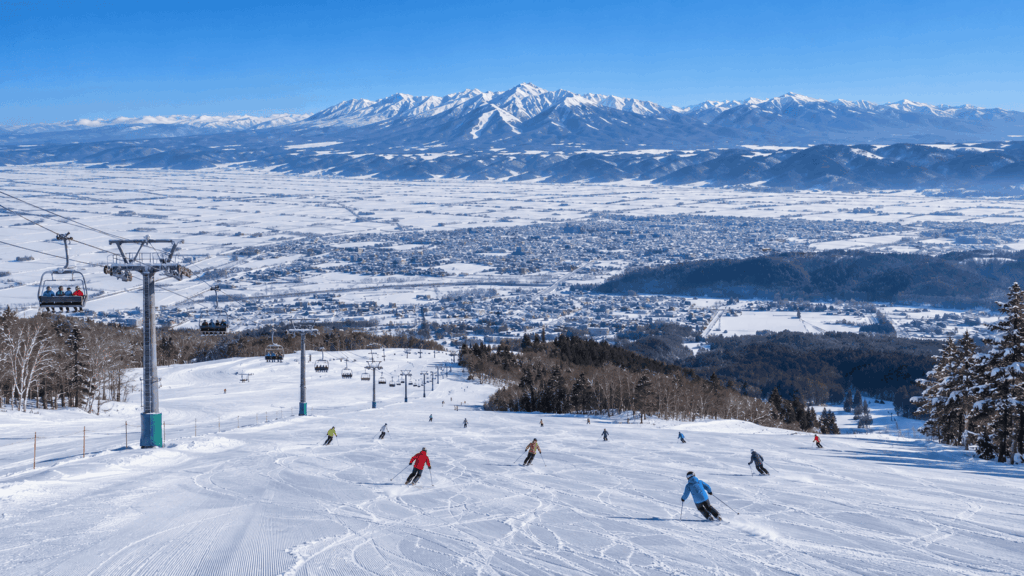
F6 runs 1,170m at an average of 9° with a maximum of 19°, and the resort describes it as a wide, single-pitch slope that is well suited to stepping up. F7 is shorter at 690m (average 10°, maximum 18°) and is recommended for people who want to practise deliberately rather than cover distance. Because both feed the same chair, a family can lap the same terrain without navigating the mountain, making it a strong contender among family-friendly ski resorts in Hokkaido.
That layout is what made the difference when I took a family of complete beginners up on the Kitanomine side a few years ago. The width mattered more than the pitch: there was room for a nervous skier to traverse across the slope while someone else came down beside them, and room to stop without being in anyone’s line. The snow was dry and light in the way central Hokkaido snow often is, which made falling over less discouraging than it usually is — though I would not claim that good snow stops beginners from falling, because it does not.
Kai’s tip: On this mountain, “”beginner area”” means the bottom of a zone, not the zone itself. Before you join the gondola queue, check which lift actually serves the slope you want — at Kitanomine that is usually Kitanomine Swift Lift No.1, not the gondola. It is the single most common mix-up I see with first-time visitors here.
When Furano Zone Makes More Sense for Beginners
If you are sleeping at Shin Furano Prince Hotel, your boots are already at the Furano Zone base. Walking a child in rental boots to another base area, or moving a car, to reach terrain that is broadly similar in difficulty is not a good trade. The same applies if your lesson is booked on the Furano side: Furano Snow School runs desks at both the Kitanomine Gondola Terminal and the hotel, and FISS lists separate meeting areas for Kitanomine and for the Prince/Furano side, so your booking already tells you which base you need.
Two other cases favour Furano. If you are travelling in late November, early December or after late March, Kitanomine may not be open at all. And if your group includes a confident skier who wants long, groomed runs while a beginner laps the bottom, the Furano side keeps both of you on the same base without a transfer.
Read the Slope Numbers, Not Just the Colour
Here is the part that trail maps do not make obvious. Furano’s “”beginner”” classification is generous. D1 on the Furano side is marked beginner and runs 795m with a maximum pitch of 26°. B1 is beginner-classified at 1,410m with a maximum of 25° — the resort itself notes that its upper section is partly intermediate. On the Kitanomine side, G1 is labelled beginner and reaches 28°.
Compare that with F1, also beginner-classified, at 1,900m with a maximum of just 17°, or F6 at 19°. All four carry the same colour on the map. So the useful question is not “”which zone is for beginners”” but “”which specific run matches the least confident person in my group today”” — and the maximum-slope column answers it far better than the colour does.
The Kitanomine Gondola Mistake Beginners Should Avoid
This is where a lot of first trips go wrong, and it is worth being blunt: having beginner slopes at Kitanomine does not mean a beginner can ride the Kitanomine Gondola to the summit and ski down safely.
The gondola is a 6-passenger lift running 2,968m to the top of the mountain in around ten minutes. In the resort’s own lift table, it carries a note that it is limited to intermediate and advanced skiers in the Kitanomine Zone. Above the gondola station, the terrain backs that up: K1 is an intermediate run of 1,320m with a maximum pitch of 29°, K2 is advanced at 34°, and K3 and K4 are also rated advanced. The upper mountain is steep, and in places narrow and winding — the kind of terrain where a beginner does not so much ski as survive, and where a wrong turn can put a nervous skier somewhere well beyond their level.
F1 is the exception people point to, and it is a genuine one: a long beginner-classified run of 1,900m at an average of 10°. But a beginner classification on one run does not guarantee a continuous, comfortable route down from the gondola exit for someone on their first or second day. Treat the summit as a goal for later in the trip, not for the morning of day one.
What beginners should do instead is simple. Stay on the lower mountain, use Kitanomine Swift Lift No.1 for F5, F6 and F7, and only move up when turning and stopping are automatic. Note also that the next lift up, Kitanomine Romance Lift No.2, is described by the resort as intended for intermediate and advanced riders — so the progression on this side is a deliberate step up, not a gradual one.
How to Get Between Furano and Kitanomine Zones
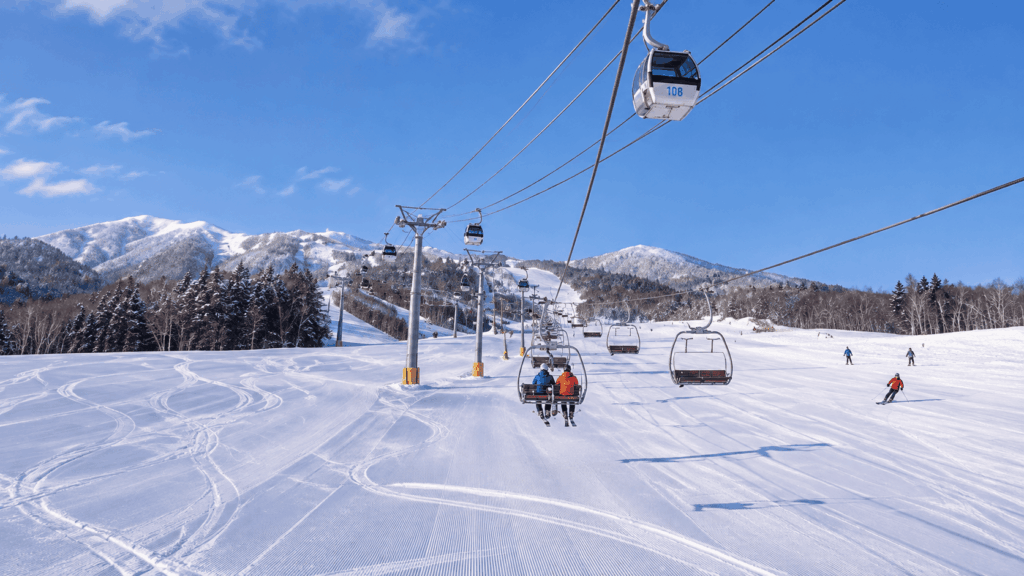
The zones are connected, and one lift pass covers both. But the connection is not symmetric: you use a different lift depending on which way you are going, and the two directions ask different things of you.
Kitanomine to Furano — Using the Link Lift
From the Kitanomine side, the Link Lift is the way across. It is a 2-person chair running 931m, and the resort describes it simply as the lift that runs from the Kitanomine side toward the Furano Zone. In practice this is the more forgiving direction: you ride across rather than ski across.
That does not make it effort-free. You still have to reach the Link Lift’s loading point on the Kitanomine side, which means skiing to it rather than arriving at it from the base, and the lift only helps if it is running that day. The practical point is that this direction is usually the easier half of the crossing, which is not something you can say about the return leg.
Furano to Kitanomine — Why Snowboarders Should Watch H1
The return leg is H1: 1,500m long, rated intermediate, average pitch 11°, maximum 25°. The resort lists it as the intermediate course connecting the Furano Zone to the Kitanomine Zone. Some third-party maps label it “”H1 Link Run””, which is the same course — use the code H1 when you are checking the official map and the snow report.
On paper H1 reads as a straightforward intermediate run. What the numbers do not tell you is that it contains flat sections, and flat sections behave very differently under skis than under a snowboard. A skier can pole or skate through them without breaking rhythm. A snowboarder who loses speed has to unstrap a foot and shuffle, or walk, and then re-strap on a slope — repeatedly, if the flat sections come in a series.
I crossed in that direction with a snowboarder in the 2025–26 season and watched exactly that happen. The riding itself was fine; the crossing was not. By the time we reached the Kitanomine side, the day had lost its shape, and we cut the afternoon short. What I took from it is that confirming two zones are connected tells you almost nothing about whether crossing between them is a good use of your day.
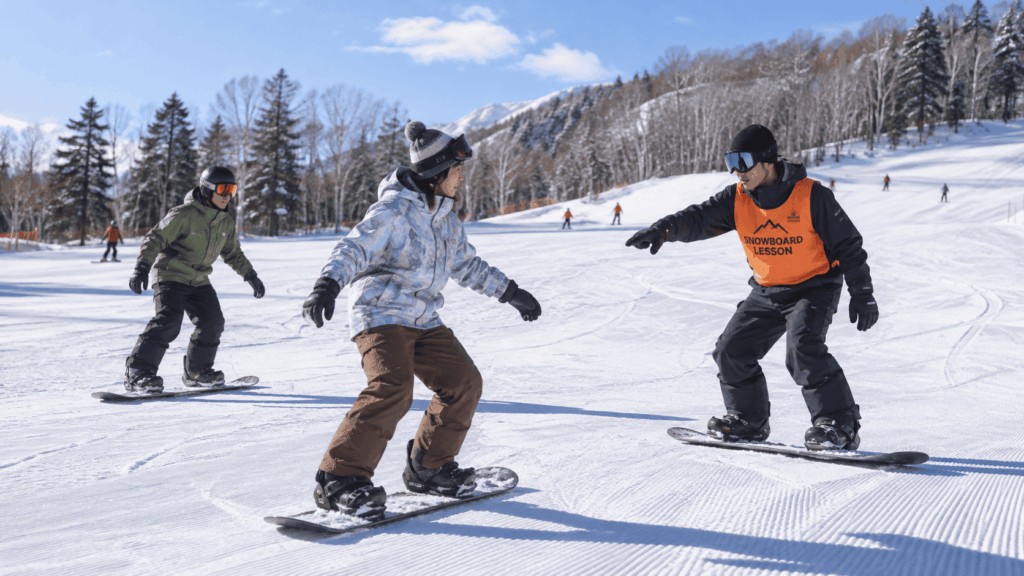
Kai’s tip: If you are on a snowboard and heading Furano to Kitanomine on H1, keep your speed through the flatter stretches and avoid stopping to wait for others mid-slope — that pause is what costs you the unstrap. If your group is mixed, agree on a meeting point at the bottom rather than travelling together.
| Direction | Main connection | Difficulty | Snowboard consideration | Recommendation |
|---|---|---|---|---|
| Kitanomine → Furano | Link Lift (2-person chair, 931m) | Ride the lift; you must first ski to its loading point | Little flat-terrain exposure on the lift itself | The easier direction; still check that the lift is running |
| Furano → Kitanomine | H1 (1,500m, intermediate, average 11°, maximum 25°) | Intermediate skiing or riding, with flat sections | Flat stretches can force an unstrap and a walk | Fine for confident riders; skip it if you are a beginner, riding with beginners, or short on energy |
There is a third option that gets left out of most comparisons: don’t cross at all. Skiing one zone properly is a legitimate plan, and for beginners, families with young children, snowboarders who dislike flat traverses, and anyone who wants to keep their legs for tomorrow, it is often the better one. Two zones on one pass is a possibility, not an obligation.
Furano Ropeway vs Chairlifts: Which Is Better When It’s Busy?
The Furano Ropeway is the big piece of infrastructure on this side: a 101-passenger cabin running 2,330m up to roughly the 900m mark. It is fast and it is comfortable, and on a clear morning the view alone justifies the ride. It is also the lift everyone queues for, and a large cabin does not automatically mean the shortest wait.
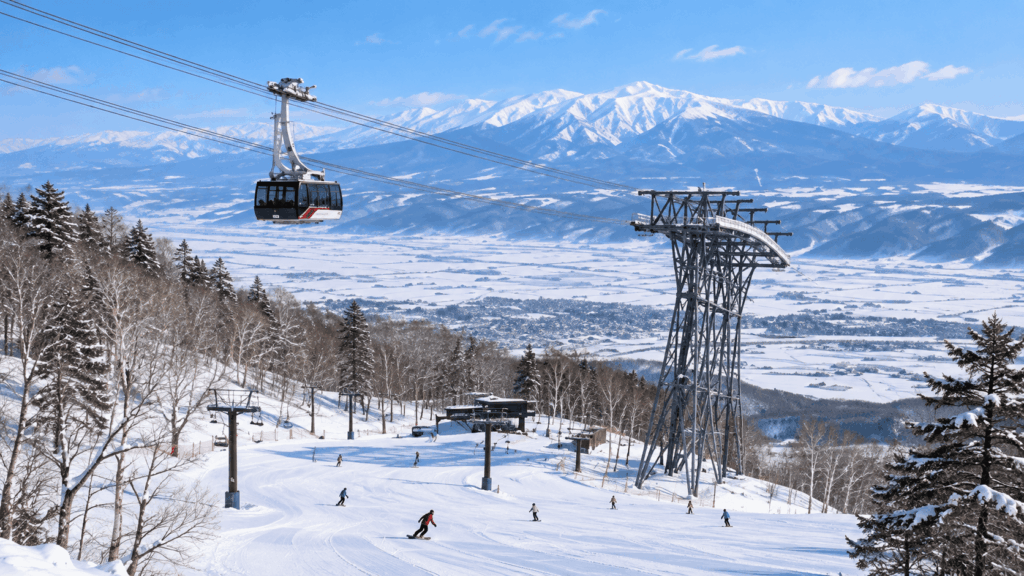
The alternatives are worth knowing by name. Furano Downhill Swift Lift No.1 is a hooded 4-person high-speed quad running 1,944m into the middle of the Furano Zone. Downhill Romance Lift No.2 (2-person, 786m) starts next to the ropeway’s top station. Downhill Romance Lift No.3 (2-person, 567m) climbs from the ropeway top toward the upper mountain and is intended for intermediate and advanced riders. Prince Romance Lift (2-person, 601m) serves beginner terrain at the base and also runs in the evening.
Which of these is the better call depends on what is actually moving that day, not on which one is biggest. If the ropeway line is long and Swift Lift No.1 is running, you can often reach similar terrain from the mid-mountain and spend your time skiing instead of standing.
One piece of recent history is worth separating from current conditions. In the 2024–25 season, Furano Downhill Swift Lift No.1 went out of service on 8 January 2025 after a failure of its backstop safety device and did not return that winter. With that lift closed, traffic concentrated on the ropeway, and waits of 45 minutes to an hour were widely reported through the rest of that season. After repairs, the lift was back in operation in December 2025 for the 2025–26 season. For 2026–27, check the live lift status on the morning you ski rather than assuming it will be running.
Kai’s tip: My rule on this mountain is to look at the queue before I look at the lift. If the ropeway line is out of the building, I check which chairs are actually running and where they drop me, then take the chair — even if it means a shorter vertical per ride. Standing still in boots is colder and more tiring than making one extra lift ride, and a route that keeps you moving usually wins the morning.
Which Zone Should You Ski? Plans for Different Travelers
Not every trip needs both zones. What follows is about matching a zone to your group, not about covering the most terrain.
Plan A — First-Time Skiers and Families
If Kitanomine’s lower slopes are open and your lesson and rental are on that side, base yourself there and stay there on day one. Use Kitanomine Swift Lift No.1 for F5, F6 and F7, lap the same pitch until stopping and turning are reliable, and treat the gondola summit as a target for later in the trip rather than the goal of the first morning. This is the setup that worked when I guided a beginner family on this side: same chair, same slope, no navigation, and the children could find their parents without a meeting plan.
If you are staying at Shin Furano Prince Hotel, skip the move entirely and use the Furano-side beginner slopes — C1, B2 and D2, reached from the base by Prince Romance Lift and the lower lifts. Do not plan a first-day crossing in either direction. The terrain is not the obstacle; the transfer is.
Plan B — Intermediate Skiers and Snowboarders
If you can link turns confidently on an intermediate run, both zones are available to you, and the classic circuit is Kitanomine up the gondola, across on the Link Lift, Furano for the middle of the day, and back on H1. Do it in that order, not the reverse, if you are on a snowboard: the flat sections are on H1, and you would rather meet them with fresh legs and daylight left.
Two checks make the difference between a good circuit and a wasted afternoon — and they are the two I now run before promising anyone a two-zone day. Confirm H1 is open that day, and note when the Link Lift and H1 last run, because a crossing attempted late in the afternoon can strand you on the wrong side of the mountain from your accommodation. If either check is uncertain, ride one zone properly. I would rather tell a snowboarder to stay put and enjoy K1 and the upper lifts than send them across and have them arrive tired.
| Traveler type | Suggested base | Plan | Main caution |
|---|---|---|---|
| First-time family | Kitanomine, if lessons and rental are there | Lap F5, F6 and F7 on Kitanomine Swift Lift No.1; no zone transfer on day one | Do not ride the gondola to the summit; confirm the magic-carpet slope is running |
| Beginner staying at Shin Furano Prince Hotel | Furano Zone, at the hotel | Start on C1 and B2 from the base; add D2 when confidence builds | Kitanomine may not be open early or late in the season |
| Intermediate skier | Either; Furano suits long runs | Ride both zones: gondola, Link Lift across, H1 back | Check H1 and the Link Lift are open, and the last lift time |
| Intermediate snowboarder | Whichever zone your accommodation is in | One zone in the morning; cross only if H1 is open and you have daylight | Flat sections on H1 cost speed and energy |
| Mixed-ability group | The zone where the weakest skier can ride from the base | Split by lift, not by zone; meet at the base for lunch | Agree a meeting point before the first run |
Where Should You Stay or Book a Ski Lesson?
The single most useful rule for this mountain is to keep your bed, your rental and your lesson in the same zone. A beginner does not need the best terrain in the resort; they need the shortest walk in rental boots.
There are two school operations and they meet in different places. Furano Snow School runs desks at the Kitanomine Gondola Terminal (lower level) and on the ground floor of Shin Furano Prince Hotel, opening from around 8:30am. FISS lists separate meeting areas for Kitanomine and for the Prince/Furano side. Whichever you book, the meeting point is the thing to confirm before you pay, because it decides your base for the whole trip.
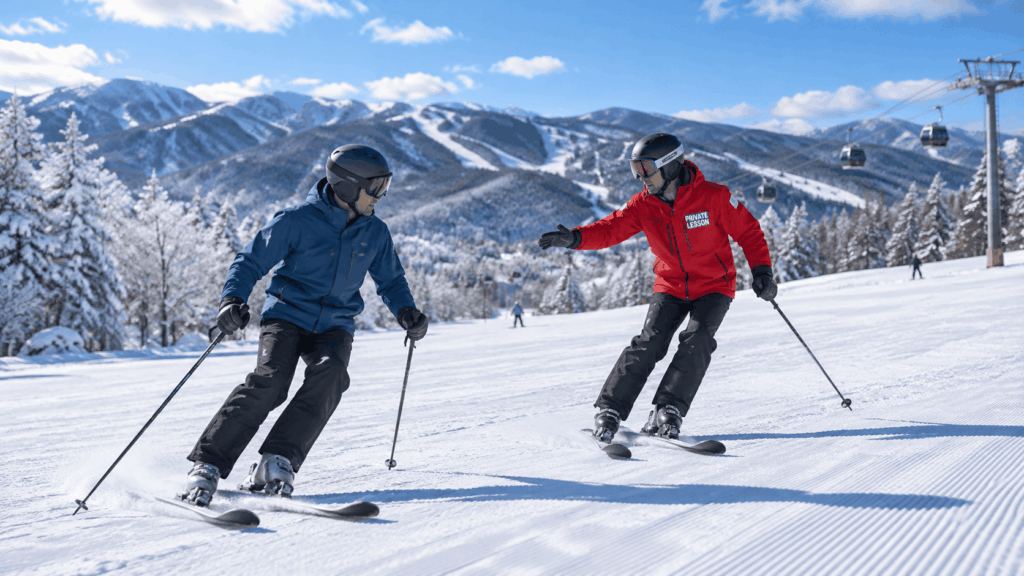
On cost, Furano Snow School’s published 2026–27 private rates start at about ¥17,000 for one hour with one person, and around ¥27,000 for two hours; two people on that two-hour lesson is roughly ¥34,000, three people about ¥41,000, with a maximum of six per group and prices varying by age and time slot. Beginner group lessons are cheaper per person but run once a day. One detail worth knowing before you book a beginner lesson: the school notes that depending on snow conditions, lessons may not be possible in the bottom area, and a lift ticket may be required.
For families who want individual instruction rather than a standard group lesson, a separate private-lesson provider is also worth comparing. This Klook-listed option is not Furano Snow School, so its meeting location and lesson arrangements need to be checked independently.
Why I’d book this one
- English-language private options: The 3-hour and 6-hour lesson choices give families flexibility over how much instruction to arrange, without committing to a full multi-day course.
- Patient instruction for children: Recent travelers mention patient teaching, clear explanations and helpful communication before their lessons — useful reassurance when booking for a nervous first-timer.
- Instruction matched to your group: A private format gives beginners more room to practise at their own pace instead of trying to keep up with a larger class.
See private lesson availability, English options, and recent traveler reviews for Furano Ski Resort. Before paying, confirm the exact meeting zone, what equipment or lift tickets are included, and whether the lesson operates on your travel dates.
If you have already booked accommodation, work backwards from it rather than moving. A guest at Shin Furano Prince Hotel is skiing out of the Furano Zone base and has no reason to commute to Kitanomine; a guest in Kitanomine village is a short walk from the gondola and should book a lesson that meets there. For the wider question of which village to stay in, that is a separate decision from which zone to ski — and is covered in our broader guide to Furano in winter.
Check the 2026–27 Opening Dates Before You Choose a Zone
This is the part where older comparison articles quietly mislead people. The two zones do not run for the same length of season.
For 2026–27, the resort’s published plan is an overall season from 28 November 2026 to 5 May 2027. The Furano Zone carries that full window. The Kitanomine Zone is scheduled to open in late December and close on 22 March 2027. The resort currently specifies late December without a fixed opening day, so confirm the actual opening on its snow report — but the shape of the season is clear, and it has consequences.
Travel in late November, early December or from late March onward, and Kitanomine may not be an option at all, whatever its beginner slopes are like. That single fact reorders the decision for a lot of people, and it is the reason I would not book a December trip around Kitanomine without checking first. If your dates fall early in the season, our guide to skiing in Hokkaido in December covers safer alternatives.
Before you commit to a zone, run through five checks: is your preferred zone open on your dates; is the connecting lift running; is H1 open; which lifts are operating today; and where does your lesson start. The first four are on the resort’s daily snow report. The fifth is on your booking confirmation.
Conditions do override plans. Snow, wind and lift faults all change what is skiable on the day, and the resort states plainly that operations are subject to change. Treat any zone plan as a default, not a commitment.
FAQ
Is Kitanomine or Furano Zone better for beginners?
Both have beginner-classified slopes at the base, so the honest answer is that it depends on where you are sleeping and where your lesson meets. Kitanomine’s lower slopes — F6 and F7, served by Kitanomine Swift Lift No.1 — are wide and well suited to a family lapping the same terrain. But the Furano side’s C1, B2 and D2 are genuinely beginner-friendly too, and the resort describes C1 as ideal for beginner lessons. If you are staying at Shin Furano Prince Hotel, using the Furano-side beginner slopes will cost you less time and effort than crossing the mountain.
Can beginners ski down from the top of the Kitanomine Gondola?
It is not recommended, and the resort’s own lift table lists the gondola as limited to intermediate and advanced skiers. Above the top station the runs are K1 (intermediate, maximum 29°), K2 (advanced, 34°), and K3 and K4 (advanced). F1 is a long beginner-classified run at 1,900m with a maximum of 17°, but one beginner-rated course does not guarantee a comfortable continuous route down from the gondola exit for someone in their first days on snow. Beginners should stay on the lower mountain and move up when stopping and turning are automatic.
Can snowboarders travel easily between Furano and Kitanomine?
You can cross, but “”easily”” depends on direction. Kitanomine to Furano uses the Link Lift, a 2-person chair of 931m, which is the more forgiving way across. Furano back to Kitanomine uses H1 — 1,500m, rated intermediate — and it has flat sections where a snowboarder who loses speed has to unstrap and shuffle. Beginners, tired riders and groups with mixed ability are usually better off staying in one zone for the day.
Is the Furano Ropeway always crowded?
No, and there is no fixed wait time to plan around. The long queues that were widely reported came from a specific situation: Furano Downhill Swift Lift No.1 was out of service from 8 January 2025 for the rest of that season, which pushed traffic onto the ropeway, and waits of 45 minutes to an hour were common during that period. The lift was operating again in December 2025 after repairs. On any given morning, check which lifts are running before assuming the ropeway is your fastest option.
Are both Furano ski zones open all season?
No. For 2026–27 the overall season is planned from 28 November 2026 to 5 May 2027, and the Furano Zone carries that full period, but the Kitanomine Zone is scheduled to open in late December and close on 22 March 2027. The resort specifies late December without a fixed opening day, so confirm the actual opening on its snow report. If you are travelling early or late in the season, plan around the Furano Zone.
Where do ski lessons meet, and which side should I book?
It depends on the school. Furano Snow School has desks at the Kitanomine Gondola Terminal and on the ground floor of Shin Furano Prince Hotel, while FISS lists separate meeting areas for Kitanomine and for the Prince/Furano side. Book the lesson that meets on the side where you are staying, and confirm the meeting point before paying — it effectively decides your base for the trip.
Final Verdict
There is no single better zone at Furano, and any article that tells you otherwise is flattening a mountain that has beginner terrain on both sides. What there is, is a better zone for your group, on your dates, with your booking.
Choose Kitanomine if you are a family or a first-timer who wants one wide slope, one chair and no navigation, and your accommodation or lesson is already on that side. F6 and F7 give you the most forgiving lap on the mountain for building confidence, and the village base keeps the walk short in rental boots.
Choose Furano if you are staying at Shin Furano Prince Hotel, your lesson meets on the Prince side, or you are travelling in late November, early December or after late March when Kitanomine is closed. C1 and B2 are real beginner slopes, and the Furano side keeps a confident skier and a nervous one on the same base.
Choose one zone and stay there if you are a beginner, riding with young children, on a snowboard and short of patience for flat traverses, or only skiing two or three days. Crossing costs time and energy that most short trips cannot spare, and one zone has more than enough terrain for a first visit.
Ride both zones if you are a confident intermediate with a full day and daylight to spare. Go Kitanomine first, cross on the Link Lift, and come back on H1 while you still have legs and light — and check that H1 and the Link Lift are running before you commit.
For first-time visitors, the sequence that causes the fewest problems is simple: sleep and learn on the same side, stay off the gondola summit until you can stop on demand, and treat the crossing as an optional extra rather than part of the plan. For families, that usually means Kitanomine’s lower slopes if they are open. For anyone with a hotel booking already in hand, it usually means the zone at your door. For repeat visitors and confident riders, the two-zone circuit is worth a day — just not the first one.

Hi, I’m Kai. I’m a Tokyo-based travel writer, tourism industry insider, and the author of a published guidebook for international visitors to Japan. With over 10 years of professional experience at a leading Japanese tourism company, my mission is to help you skip the tourist traps and navigate Japan’s best destinations like a local. I believe the perfect day trip is like a traditional kaiseki meal: a beautiful balance of precise planning and unforgettable seasonal discovery. When I’m not out conducting field research, you’ll usually find me drafting new itineraries with one of my favorite fountain pens!