
Furano in winter is worth the trip for three things: deep snow, skiing and snowboarding at Furano Ski Resort, and the wooden huts of Ningle Terrace lit up after dark. It is a much weaker proposition if what you are picturing is summer Furano with snow on top. The flower fields are gone, several seasonal food stops shut for the season, and the places you want to see are spread across a valley where the roads ice over.
The short version: February is the safer month if you want an established base of snow under your skis. December is the better month for early-winter atmosphere and holiday lights, but snow depth and open terrain vary more from year to year, especially in the first half of the month. Non-skiers can enjoy Furano, though one full day usually fills more easily than three. And the cold is not background detail — it decides how much you can realistically do in an afternoon.
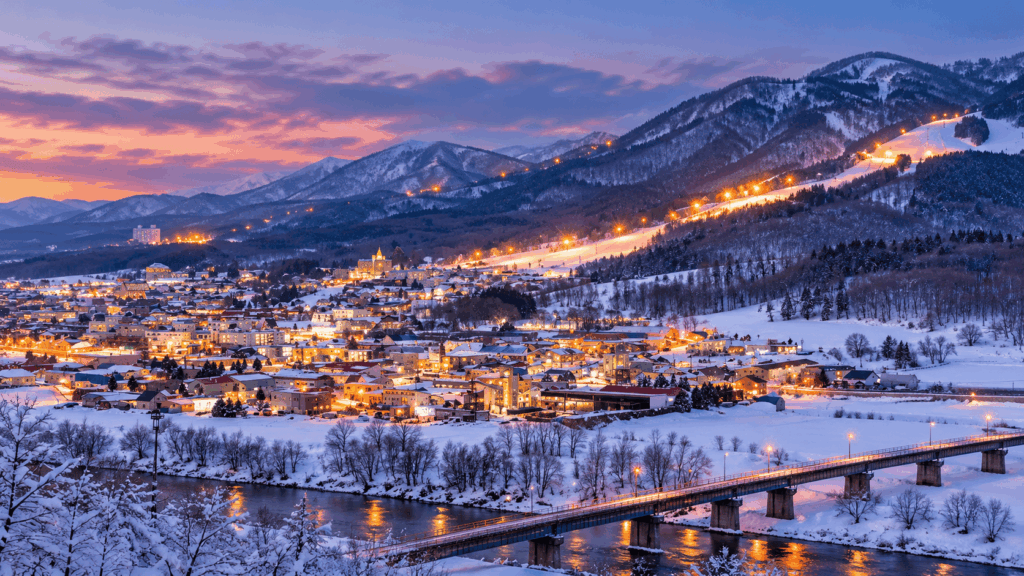
Visiting from Sapporo without winter driving? A private Furano–Biei day trip offers a way to explore the area without navigating icy rural roads yourself. For families or small groups who want more flexibility than a shared coach tour, check the suggested winter itinerary, available dates and current price for this private day trip before deciding whether it fits your plans.
Furano in Winter: The Quick Answer
Yes, Furano is worth visiting in winter — but as a snow trip, not as a sightseeing trip with snow. The winter version of this town is built around Furano Ski Resort, Ningle Terrace after sunset, and indoor pauses such as Furano Cheese Factory. Everything else is either scenery you pass through or a reason to leave town for Biei.
Best for: skiers and snowboarders, travellers who want quiet snow country rather than city neon, couples and photographers who will trade comfort for atmosphere, and anyone staying at least one night so an evening at Ningle Terrace is not a logistics problem.
Think twice if: you hate serious cold, you are expecting Farm Tomita’s flower fields, or you want to fill two or three days with town sightseeing without a car. Furano’s winter rewards a slower pace and punishes a packed checklist.
If you are based in Sapporo and the idea of driving on Hokkaido’s winter roads is what is holding you back, the honest answer is that a guided Furano–Biei winter day trip removes most of the transport planning in one move — at the cost of a long day and less freedom to change your mind.
Is Furano Worth Visiting in Winter?
Winter Furano is not summer Furano under snow. That sounds obvious written down, but it is the single most common mismatch I see in trip planning: people build an itinerary around the Furano they have seen in photos — long views over flower fields, a slow drive between photogenic stops — and then arrive in a town where the main road is packed snow, the daylight is short, and the attractions that made the area famous are simply closed.
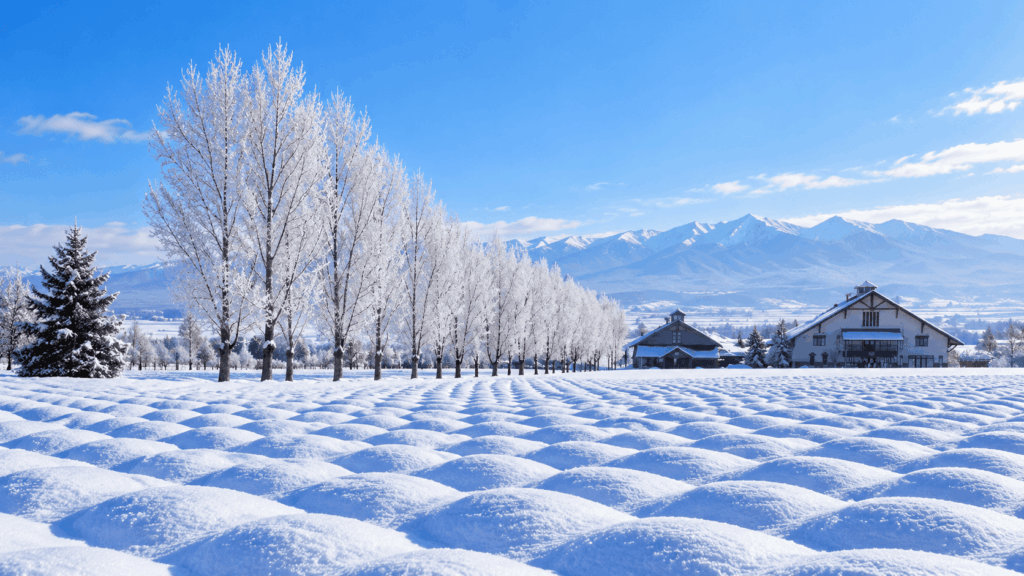
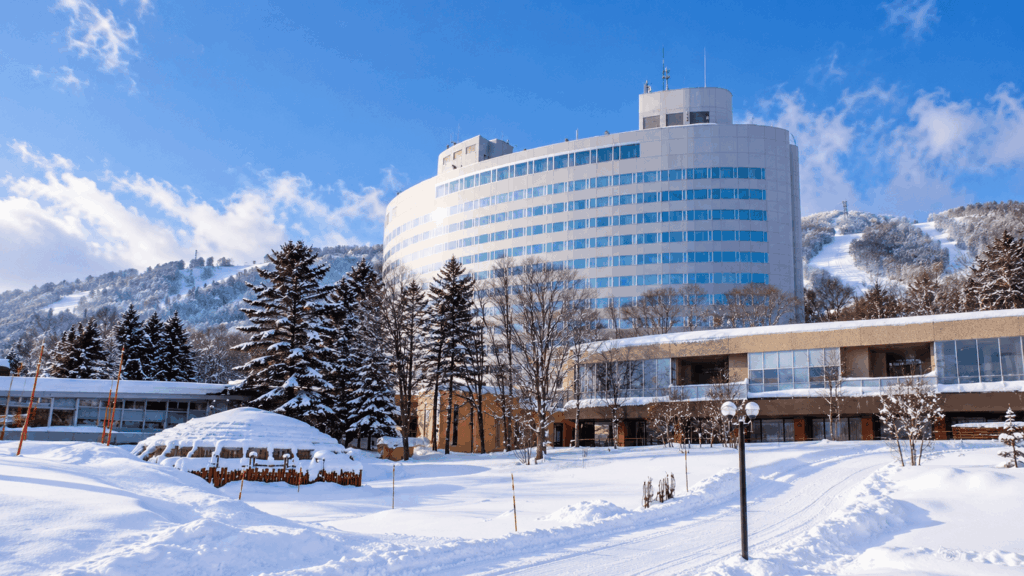
What winter actually gives you is narrower and better. The valley fills with snow that stays put for months. Furano Ski Resort sits on two connected zones above the town, with terrain that ranges from wide beginner slopes to steep, ungroomed runs, and the resort runs a live status page that tells you what is actually turning that morning. Ningle Terrace, a cluster of small craft huts in the forest beside New Furano Prince Hotel, is at its best in the hour after the lights come on. And Furano Cheese Factory gives you something that sounds trivial until you have spent three hours outdoors at -8°C: a warm room, hot food, and a chair.
So the honest verdict depends on what you are buying. If you want skiing, snowshoe-level quiet, and a lit-up forest walk in the evening, winter can be the better season here — atmospheric and quieter than peak lavender season in some places, though ski passes and resort accommodation are not necessarily cheaper. If you want the postcard Furano of lavender and rolling hills, come in July and skip this trip entirely. Snow does not turn a flower farm into a winter attraction.
One more thing worth saying plainly: this is a small town in a cold valley, not a resort village with a pedestrian strip of bars. Evenings are quiet unless you are at the ski area or at Ningle Terrace. (For a realistic look at your evening options, see our guide on what to do in Furano at night.) If you need a busy evening scene, stay in Sapporo and visit Furano as a day trip instead.
Furano in December vs February: Which Is Better?
This is the decision most people are actually making, and it can be settled with numbers rather than vibes. February gives you the deeper, more established snowpack. December gives you early-winter atmosphere and the holiday season, with more year-to-year uncertainty — particularly before mid-month. If your trip depends on skiing, February is the lower-risk choice. If your trip depends on how the place feels, December is genuinely lovely and can be quieter or more affordable on some dates, though Christmas and New Year can be busy and expensive.
| Factor | December | February |
|---|---|---|
| Average temperature | -5.1°C | -7.4°C |
| Average daytime high | -1.2°C | -2.3°C |
| Average nighttime low | -10.2°C | -14.0°C |
| Monthly snowfall | 159cm | 121cm |
| Maximum snow depth | 46cm | 73cm |
| Monthly sunshine hours | 45.7 hours | 78.5 hours |
| Ski-season certainty | Lower in early December; improves sharply after mid-month | Highest of the winter months |
| Best for | Early-winter atmosphere, holiday lights, potentially lower prices outside holiday peaks | Skiers, deep-snow scenery, photography, travellers who want the most reliable snowpack |
| Main planning risk | Thin cover and limited open terrain in some years; short daylight | Severe cold at night; less flexibility if you dislike -14°C |
These are 1991–2020 climate normals for the JMA Furano station, not a forecast for your dates. Conditions in any single season can sit well above or below them, which is why the resort’s live snow and lift report matters more than any monthly average.
Note the two numbers that contradict the usual summary. December’s monthly snowfall (159cm) is higher than February’s (121cm), because December dumps snow that then settles and compacts. What February has is depth: a 73cm base against December’s 46cm. Read the two rows together and the trade-off becomes clear — December is about snow arriving, February is about snow staying.
What Furano Is Like in December
December in Furano is real winter from day one, but the margin for error is thinner. The resort is scheduled to open on 28 November 2026, with the season running to 5 May 2027, and in the opening week you are on early-season pricing (¥7,500 for an adult one-day pass, against ¥9,000 in the regular season from 5 December). “Scheduled” is the operative word: opening dates and open terrain are decided by snow, and early December can mean a handful of runs rather than the whole mountain.
Daylight is the constraint people forget. In late December the sun sets around 4 p.m. in Furano, which means Ningle Terrace is lit by late afternoon, not that the lights come on immediately after lunch. Any outdoor plan after 4 p.m. is moving into darkness and falling temperatures. That is atmospheric if you are dressed for it, and miserable if you are not. It also means December days hold fewer outdoor hours than February days, so build in fewer stops rather than more.
One date-specific detail worth knowing if you are travelling in November 2026: Ningle Terrace is closed on 1 November, open 2–4 November (11:00–19:45), then closed for maintenance from 5–26 November. It is scheduled to reopen at noon on 27 November, with winter hours of 12:00–20:45. Individual huts keep their own hours and take irregular days off, so a lit terrace does not always mean every shop is open.
Crowds around Christmas and New Year are a genuine possibility rather than a certainty — this is a domestic holiday period as well as an inbound one. If you are set on being at Ningle Terrace on a specific evening in late December, treat it as a plan to arrive early rather than a plan to arrive exactly at sunset.
What Furano Is Like in February
February is the month when an established snow base is most likely. With a normal maximum snow depth of 73cm, the valley usually looks like the photos, though individual lifts and courses can still close for wind, visibility or maintenance. Ningle Terrace’s paths are more likely to be surrounded by substantial snow than in early December. You also get more usable light: February averages 78.5 sunshine hours against December’s 45.7, and the sun sets around 4:40–4:45 p.m. at the start of February, moving to roughly 5:15–5:20 p.m. by the end of the month.
The correction worth making here is about cold. February is colder than December, but it is not the coldest month in Furano — January is, at an average of -8.3°C, and January also delivers more snow (145cm) than February. What February wins on is accumulation and clarity. In practice: if you want the deepest base under you and the best odds of a clear, cold, blue-sky snow day, February is the month. If you want maximum snowfall and do not mind grey skies, January edges it. December is the month you choose for the season’s mood, not its statistics.
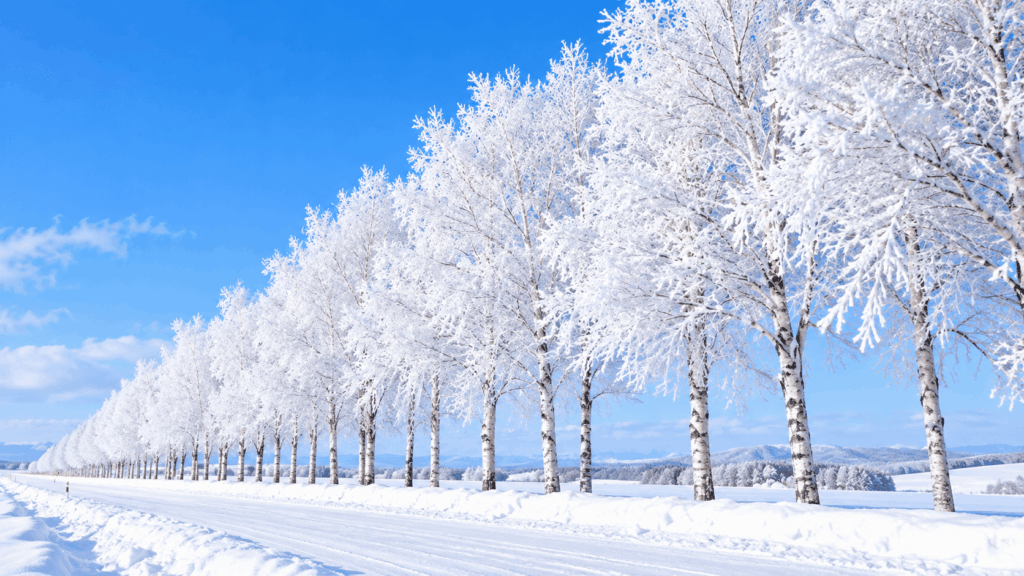
Either way, plan around the nights. February’s average low of -14.0°C is the number that decides whether an evening at Ningle Terrace is a 40-minute visit or a 20-minute one, and it is the reason a warm indoor stop before and after is part of the itinerary rather than an afterthought.
Best Things to Do in Furano in Winter
Winter Furano has three things that justify the trip and two that make the trip work. The three: skiing and snowboarding at Furano Ski Resort, Ningle Terrace after dark, and the ski-area ropeway ride if you do not ski. The two that make it work: an indoor warm-up stop (Furano Cheese Factory) and a station-side base (Furano Marche). Everything else in the valley is scenery you pass through on the way to one of those, and that is fine — but it should not be sold to you as a checklist.
Ski or Snowboard at Furano Ski Resort — and Check the Lifts Before You Leave
Furano Ski Resort is two zones joined at the summit: the Furano Zone, served by a 101-passenger ropeway, and the Kitanomine Zone, served by a six-passenger gondola. Between them there are 28 runs, 839m of vertical and a top station at 1,074m, with wide beginner terrain at the base and steep, ungroomed pitches higher up. If you are staying in Kitanomine or at New Furano Prince Hotel, you can walk to a lift; if you are downtown, you are relying on the shuttle or a bus. (If you are still deciding on accommodation, read our guide on where to stay in Furano to match your location to your transport.)
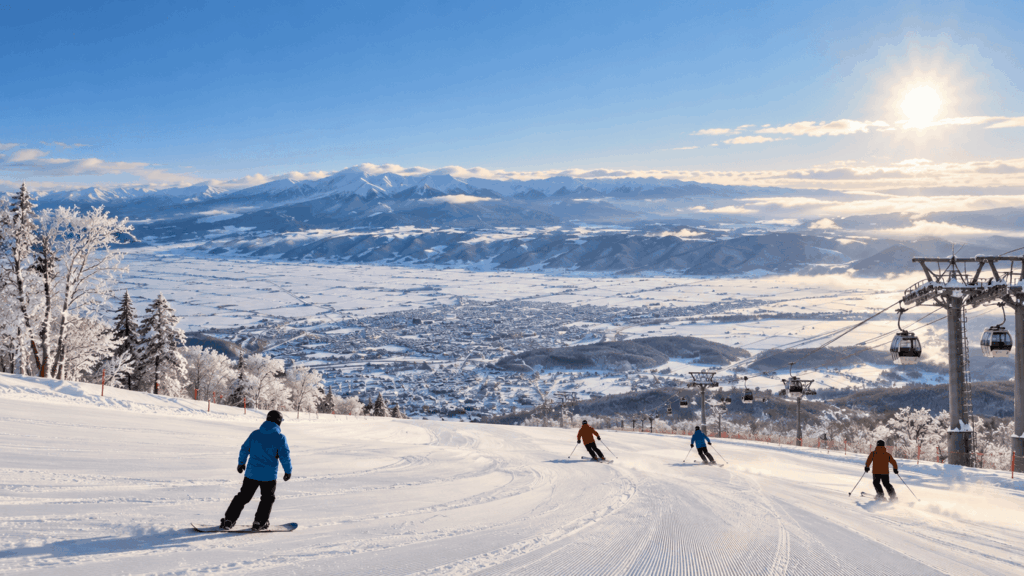
For the 2026–27 season the resort is scheduled to run from 28 November 2026 to 5 May 2027. An adult one-day pass is ¥9,000 in the regular season (5 December–22 March), ¥7,500 during the opening week and again for spring skiing from 23 March, and a four-hour pass is ¥8,200. Night skiing is ¥3,100 on weekdays and ¥3,900 on weekends, holidays and 26 December–3 January. Children of elementary school age and younger ski free. Night operations start in mid-December on the Furano side and late December on the Kitanomine side, and both end on 21 March.
What matters more than any of those numbers is that a mountain is a machine with a daily failure mode. Wind, visibility and mechanical issues close lifts, and when one closes the crowd moves to whatever is still turning.
Kai’s tip: On one of my visits the main high-speed lift was down for the day, and everyone shifted to the gondola that was still running — I stood in line for about an hour, outdoors, in temperatures well below freezing. It was not a resort-wide disaster, but it did wipe out a morning. If you only have one ski day in Furano, check the resort’s live lift and course status before you leave your hotel, and have a plan for which zone you will ski if your first choice is closed.
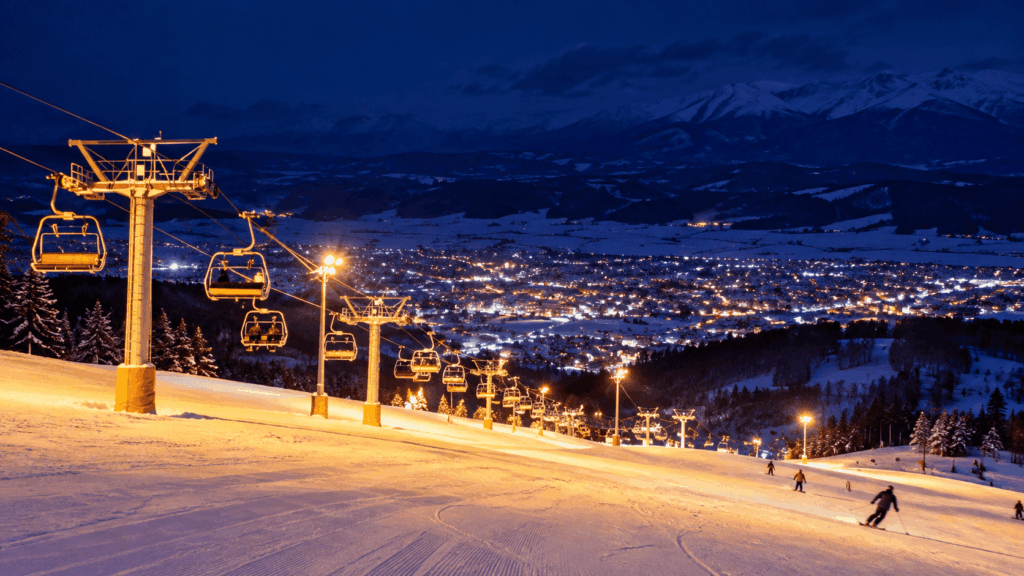
Two smaller things worth knowing. Snow quality here is genuinely good — the resort markets the valley’s own “Furano bonchi powder” — but powder is weather, not a guarantee, so treat any promise of it as luck rather than itinerary. And ski rental at the base is convenient to the point that packing your own boots is the only thing worth carrying.
Visit Ningle Terrace After Dark — and Dress for Standing Outside
Ningle Terrace is a cluster of small log huts selling crafts, set in forest beside New Furano Prince Hotel, about ten minutes by car from JR Furano Station. Entry is free. During winter it operates roughly 12:00–20:45, though individual huts keep their own hours and take irregular days off, so the terrace being open does not mean every shop is. For November 2026, it is closed on the 1st, open from 2–4 November, and then closed again for maintenance from 5–26 November, with reopening scheduled for noon on 27 November. The café Chuchu no Ie is scheduled to reopen on 20 December 2026, so do not depend on it for a warm drink earlier in the month.
Go late afternoon into early evening. The lights come on as the light goes, the snow on the hut roofs turns blue then gold, and the whole thing takes about 40 minutes if you walk it once and stop for photos. What the photos do not show is the ground: the paths run uphill and downhill through the trees, and they are packed snow and ice rather than cleared pavement.
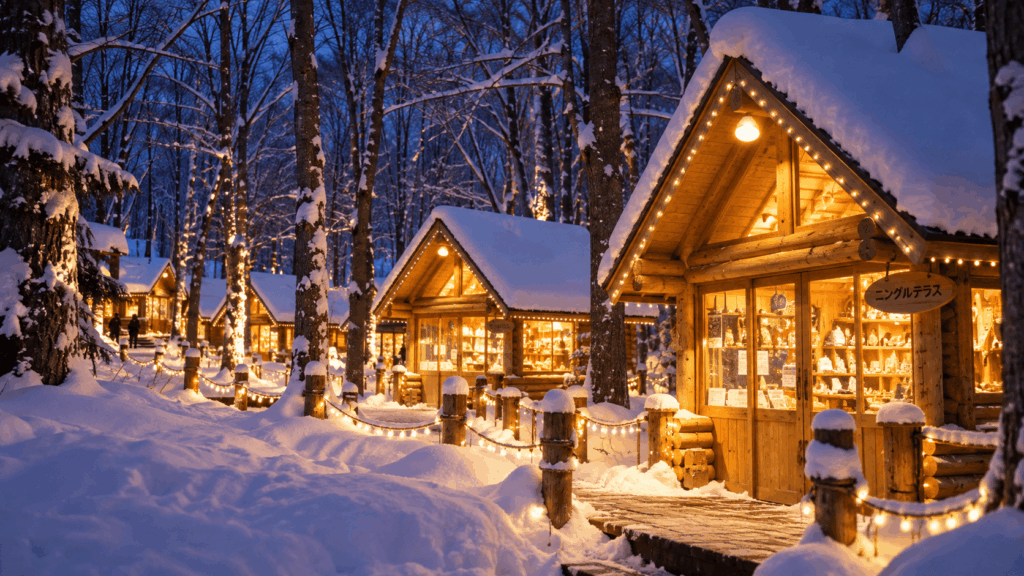
Kai’s tip: I walked Ningle Terrace one winter evening with guests, and the cold built up much faster than any of us expected — the lights are lovely, but the wind moves through the trees and you are standing still for long stretches. We ended up inside Chu Chu House with a hot baked milk before heading back out, and I now treat a warm-up stop as part of the visit rather than an emergency measure. Wear boots with real grip; the slope is short but it is slick, and I would not do it in fashion boots or sneakers.
On crowding: Christmas week and weekend evenings are the times when this place can feel busy rather than quiet. It is not a reason to skip it, just a reason not to arrive with a five-minute schedule.
Ride the Ropeway Without Skis
If the group splits — some skiing, some not — the non-skiers do not have to sit in a lobby. A round-trip ticket on the Furano Ropeway or the Kitanomine Gondola costs ¥3,700 for adults, and you can ride up for the view of the Furano basin and the Tokachi range without any ski gear at all. Go on a clear morning, take the loop at the top slowly, and come down before you get cold.
The caveat is that these are ski lifts first. Strong wind stops them, and the status page is the only reliable answer on the day. Do not build a tight connection after a ropeway ride.
Warm Up at Furano Cheese Factory
Furano Cheese Factory is not a half-day attraction, and treating it as one is how people end up disappointed. It is a working dairy facility with a shop, a pizza counter and workshops, and its real value in winter is structural: it is somewhere warm, indoors, with hot food and seats, a short drive from the ski area and the town.
Winter hours are 9:00–16:00 from 1 November to 31 March, with the Pizza Factory open 10:30–16:00. It closes for the New Year period (31 December–3 January), and its 30 October 2026 notice adds Monday closures in January and February and on the first three Mondays of March 2027. A maintenance shutdown is also scheduled in the second week of November. Check those before you build a day around it, because a Monday in February is exactly when people turn up.
One honest warning: the dedicated Ice Milk Workshop closed for the 2026 season on 22 October, so do not assume its summer soft-serve counter is operating in January. However, the Cheese Factory announced that ice milk products would continue to be sold from its main shop from 23 October, so the products have not disappeared entirely. The pizza, made with the factory’s own cheese, is the thing to order — I have waited more than twenty minutes for pizza here on a summer holiday visit, and the Margherita is what I would get again. The shop also sells a squid-ink cheese that travels well and makes a better souvenir than another keychain.
On how busy it is: on my winter visits it has felt noticeably calmer than the summer visits I have made, but that is an observation from specific days, not a rule. Budget about an hour for lunch and a warm-up, not two to three hours of sightseeing.
Use Furano Marche as Your Station-Side Base
Furano Marche sits about seven minutes’ walk from JR Furano Station and is open 10:00–18:00, with several maintenance days in roughly mid-November to early December and closures on 31 December and 1 January. Individual tenants may keep additional days off. It is a small indoor complex of food shops, bakeries, cafes and restaurants, and in winter it solves a very specific problem: the gap between arriving on the highway bus and your shuttle, or between checking out and your train. If you are travelling without a car, this is the one place downtown where you can sit down, eat, and reorganise your bags without standing in the snow.
What Can Non-Skiers Do in Furano in Winter?
Non-skiers can absolutely enjoy Furano — but the shape of the trip is different, and the honest advice is to stay one night rather than three. A realistic non-skier day here is: a late morning at Furano Cheese Factory, lunch in town or at Furano Marche, an afternoon ropeway ride or a slow walk, then Ningle Terrace as the light goes. That is a good day. It is not three good days, unless you add winter activities or use Furano as a base for somewhere else.
The somewhere else is usually Biei, and this is where people get confused. The Blue Pond and Shirahige Falls are in Biei, not Furano — a different town, on a different road, with very limited winter public transport. If you are hoping to see them, check our guide to visiting Biei in winter before finalising your itinerary. In winter most visitors see them on an organised tour, and that is a reasonable call rather than a lazy one: the roads are rural, the daylight is short, and a wrong turn costs an hour you do not have.
If you are staying in Sapporo and want Furano and Biei in one go without driving, a guided winter day trip is the practical route. Be aware of what you are buying: most of these run as long days — some depart Sapporo around midday and return late in the evening precisely so that Ningle Terrace is seen lit up, while others leave in the morning and finish before dinner. The two are not interchangeable, and the departure time tells you which kind of day you are getting.
Equally, a tour is the wrong purchase for some people. If you are sleeping in Furano, if skiing is the point of the trip, or if you want to change plans when the weather turns, book nothing and use the shuttle and the highway bus instead. You will have more control and less sitting on a coach.
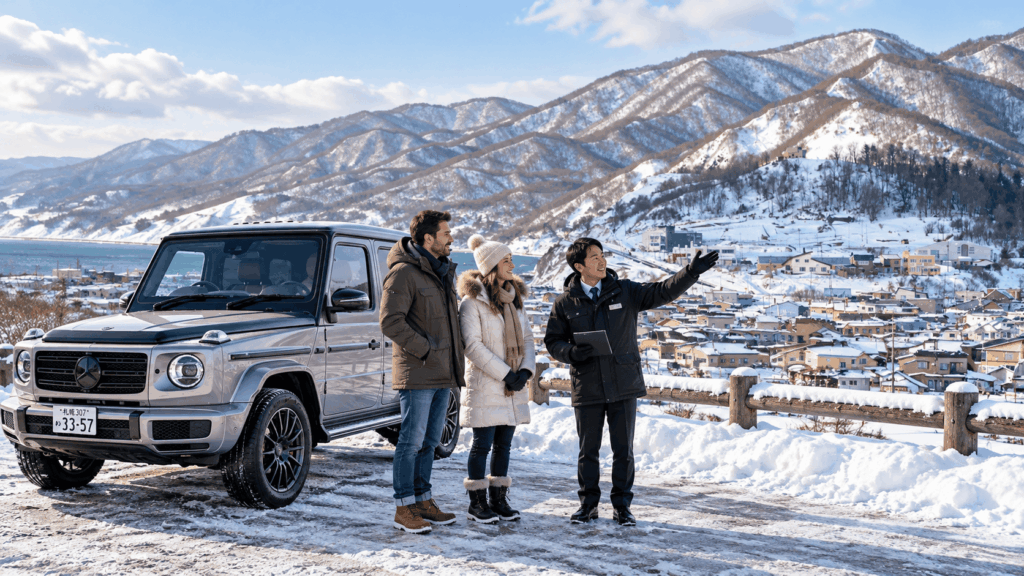
For travellers in the other camp — based in Sapporo, hoping to combine Furano and Biei, and uncomfortable with winter driving — a private day trip is worth considering. It costs more than a shared coach tour, but the flexibility and simpler transport arrangements can make sense for families or small groups.
Why I’d book this one
- Less winter-driving stress: Recent travelers mention professional drivers, punctual pickup and careful driving — particularly useful when the route involves snowy rural roads.
- More control over the day: Private transport makes it easier to discuss preferred stops and adjust the pace compared with following a fixed shared-coach timetable, subject to weather and the operator’s arrangements.
- Fewer transport connections: Hotel pickup and a dedicated vehicle remove the need to coordinate separate buses between Furano, Biei and Sapporo.
This is a private driver service, not an English-guided sightseeing tour with detailed commentary. If Ningle Terrace after dark is a priority, confirm the winter route and visit timing before booking. See current availability, itinerary options, cancellation terms and recent traveler reviews for the private Furano–Biei day trip.
Getting Around Furano in Winter: Car, Bus or Tour?
A car gives you the most flexibility, and for a family with ski gear and a Biei detour it is often the right call. But the old line that Furano is impossible without a car is out of date for the main resort corridor. Between the winter shuttle, the highway bus and the resort liner, you can now move between the station, downtown, Kitanomine and the Prince hotel area without driving — you just cannot wander the countryside on a whim.
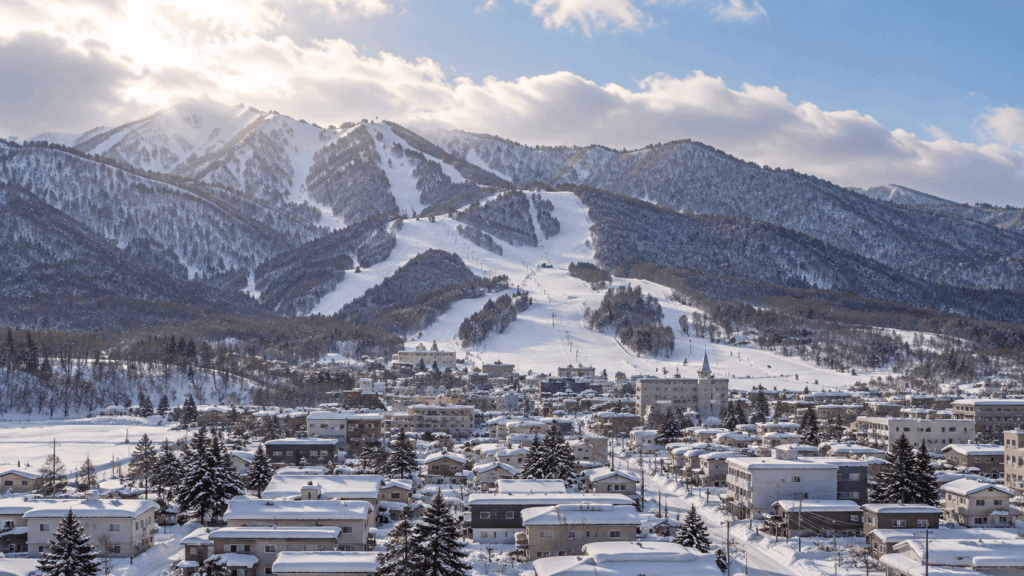
The most useful recent change is a new ski shuttle for the 2026–27 season, scheduled to run 1 December–31 March. It starts at Furano Station and calls at Jujigai, Ichiba-mae, Kisen, Hotel Naturwald and New Furano Prince Hotel, costs ¥500, and needs no reservation. The announced pattern is five departures from the station a day (8:08, 9:00, 10:00, 11:20 and 17:00), with a single return run from New Furano Prince Hotel at 12:00, and a fuller timetable is expected once service begins. Treat those times as provisional and confirm them on arrival.
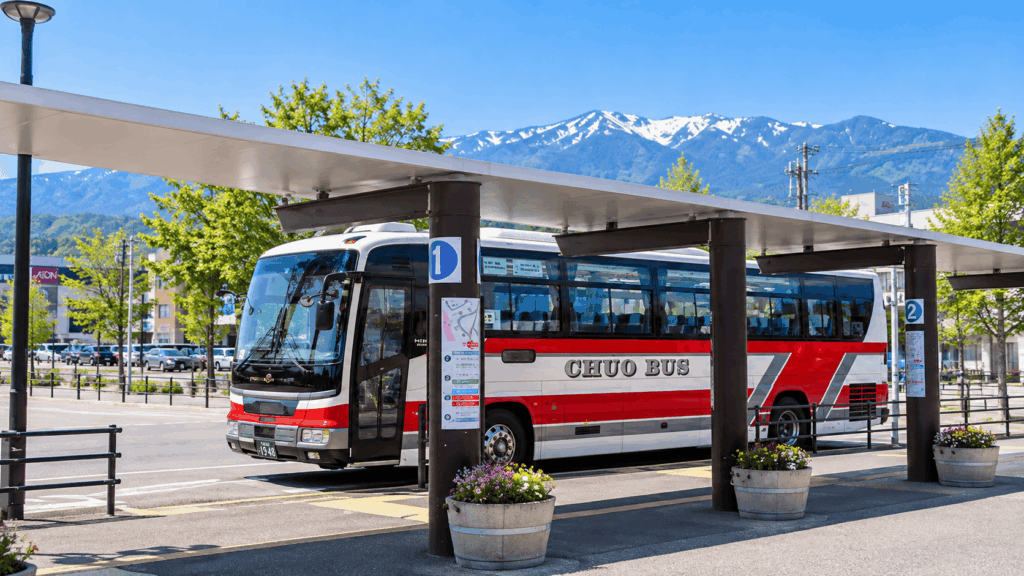
For Sapporo, the highway bus (the “Furano-go”) is the simplest non-driving option: roughly 2 hours 55 minutes from Sapporo Station to Furano Station, about ¥2,700 one way, seven departures a day, no reservation needed, IC cards accepted. (For a full breakdown of the train and bus options, see our complete guide on getting from Sapporo to Furano.) Two details are genuinely useful. It stops at Kitanomine-guchi, so skiers can get off near the gondola instead of riding into town and back out. And it is a highway bus in winter, which means snow can add time — do not book a tight connection at either end.
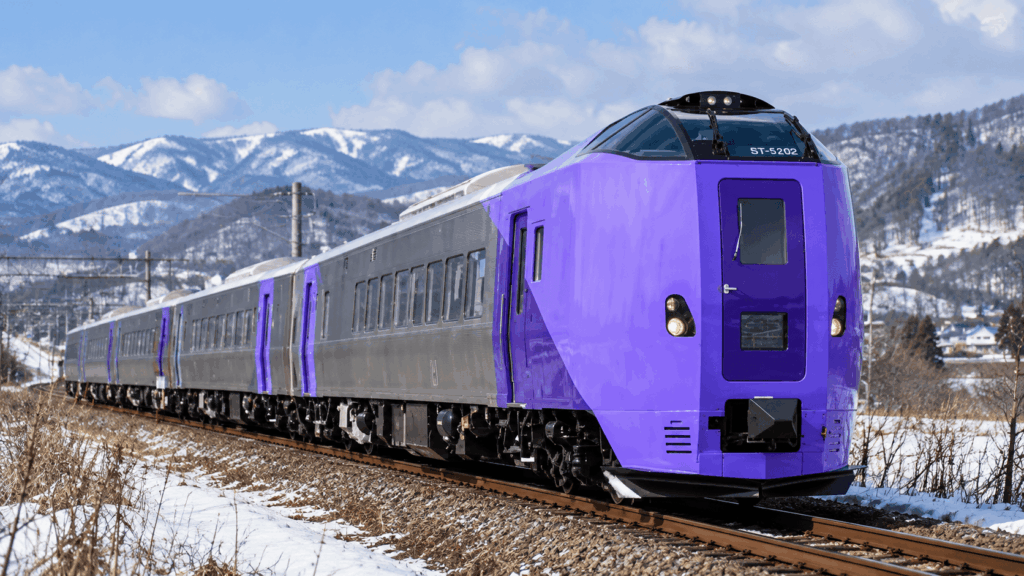
The train option is Sapporo to Asahikawa on a limited express (about 1 hour 25 minutes), then the Furano Line to Furano (roughly 1 hour 10–20 minutes). It is comfortable and scenic and it costs you a transfer and about three hours in total. For skiers there is also the Hokkaido Resort Liner ski bus from Sapporo hotels to Kitanomine, but its operating window in recent seasons has been shorter than the highway bus’s — often January into mid-March — so check the current season’s dates before you plan around it.
| Traveller type | Best approach | Suggested time | Main caution |
|---|---|---|---|
| Skier staying in Furano | Base in Kitanomine or at New Furano Prince Hotel; shuttle or walk to lifts | 2+ nights | Check live lift status each morning; one closed lift reshapes your day |
| Non-skier staying in Furano | 1 night; Cheese Factory lunch, ropeway or town, Ningle Terrace in the evening | 1 day–1 night | Three days in town alone will feel thin |
| Sapporo day-tripper | Guided winter tour, or highway bus if you are comfortable with fixed times | One long day (10–11 hours) | Little daylight left for spontaneity; late return |
| Traveller without a car | Highway bus + winter shuttle; stay near the station or Kitanomine | 1–2 nights | Last bus matters more than the first; rural stops stay out of reach |
| Family with children | 1 night; short outdoor blocks with indoor breaks; ski school if skiing | 1–2 nights | Cold shortens attention spans faster than you expect; children ski free |
Should You Rent a Car in Winter?
Only if you can honestly say you are comfortable driving on snow and ice. Furano’s winter roads are plowed and busy enough near town, but they are still packed snow with ice underneath, and rural routes toward Biei are another matter. Rental companies will fit winter tyres and will also tell you, if you ask directly, that they see the results of inexperience every season.
If flexibility is what you want and confidence is what you lack, the compromise is to base yourself in Furano and use the shuttle plus a single guided day for Biei, rather than renting a car purely because it looks convenient in a search result.
What to Wear in Furano in Winter
Furano in December averages a nighttime low of -10.2°C; in February it averages -14.0°C. Those numbers decide your packing list more than any style consideration. The mistake is treating this as a city winter: a heavy coat with ordinary shoes is a bad combination here, because you will spend more time standing on snow than walking on pavement.
- Boots: insulated, waterproof, with a grippy sole. This is the item that decides whether your trip is pleasant.
- Layers: a thermal base layer, a mid layer, and an insulated outer jacket.
- Extremities: gloves or mittens, a hat that covers your ears, a neck warmer, and wool socks.
- Optional but useful: disposable heat packs, and a spare pair of socks if you plan a long outdoor evening.
Kai’s tip: The footwear advice is not about hiking. Ningle Terrace is a short loop with a slope, and it is enough to show you why smooth-soled fashion boots are a bad idea after dark — the surface is packed snow, it is uneven, and you are looking up at lights rather than down at your feet. If you are packing for a trip where sightseeing is the main activity rather than skiing, spend the money on the boots before you spend it on the jacket.
How Long Should You Spend in Furano in Winter?
One night is the sweet spot for most first-time visitors, because it lets you do Ningle Terrace in the evening without turning the day into a 12-hour transfer. Two or more nights make sense if skiing is the main purpose; non-skiers usually need to add winter activities or a Biei day to fill a second full day.
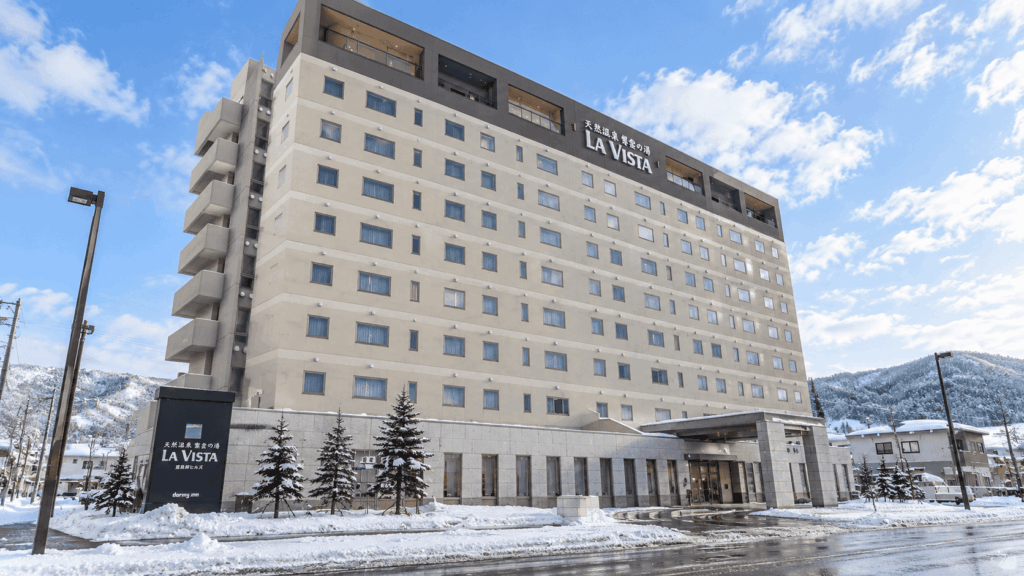
A day trip from Sapporo is workable, especially for non-skiers combining Furano with Biei, but be clear about what it costs you: roughly three hours each way, a fixed schedule, and a return to Sapporo in the evening. It is efficient. It is not relaxed.
A Sample One-Day Winter Plan for Non-Skiers
Late morning at Furano Cheese Factory for an early lunch and a warm-up (remember the Monday closures in January, February and the first three weeks of March 2027). Early afternoon in town or at Furano Marche, with a slow walk for snow scenery rather than a schedule of stops. Mid-afternoon, move toward the New Furano Prince Hotel area and find somewhere warm to sit before the light goes. Dusk at Ningle Terrace, then dinner and a shuttle or bus back. In December the light dies around 4pm, so the whole afternoon compresses; in February you gain an hour.
If you are coming from Biei on a tour, the reverse order often works better: Biei in the morning light, Furano at dusk. That is roughly how the winter day tours are built, and it is a sensible shape even if you are driving yourself.
A Sample Day for Skiers
Check the live lift and course status before breakfast, then be at the gondola or ropeway for opening. Ski through the morning, take a proper sit-down lunch rather than eating a bar in a lift line, and ski the afternoon until your legs or the light give out. Ningle Terrace in the evening is a nice ending if you have energy and a warm layer left; it is not compulsory, and after a full ski day the cold hits harder than it does on a sightseeing day.
Furano Winter Travel Mistakes to Avoid
- Assuming December is the same every year. Early December can mean limited open terrain. Check the resort’s snow and lift report in the days before you travel.
- Checking lift status after you arrive. One downed lift can send the whole mountain to one queue, and the live status page exists for exactly this reason.
- Wearing sneakers or smooth-soled boots. Snow-covered slopes after dark are not a place for fashion footwear.
- Treating Ningle Terrace as an indoor attraction. It is an outdoor walk in the trees with huts along the way. Plan a warm-up stop inside the visit.
- Stacking outdoor stops without warm-up time. Three hours outside at -8°C is a different experience from three separate hours with a warm room between them.
- Expecting summer attractions to be open or worthwhile. Flower farms and seasonal food counters are seasonal. The dedicated ice milk counter at the Cheese Factory closes for winter, although ice milk products remain on sale at the main shop.
- Relying on an old winter bus timetable. A new ¥500 ski shuttle starts on 1 December 2026, and the highway bus and resort liner schedules change by season. Use the current year’s timetable.
- Assuming late November works like December. Ningle Terrace is closed on 1 November, open on 2–4 November, then closed for maintenance on 5–26 November 2026 before reopening at noon on the 27th; the ski resort’s opening remains weather-dependent.
Furano in Winter: Frequently Asked Questions
Is Furano worth visiting in winter if you do not ski?
Yes, but with a shorter trip in mind. The winter highlights for non-skiers are Ningle Terrace after dark, the ropeway or gondola ride up for the view (around ¥3,700 round trip), Furano Cheese Factory as a warm lunch stop, and the snow scenery itself. Most non-skiers find one full day or one night is enough unless they add a Biei day or a winter activity such as snowshoeing. Planning three days of town sightseeing in Furano alone tends to leave people with empty afternoons.
Is there snow in Furano in December?
Yes — December is firmly winter here, with a normal monthly snowfall of 159cm and a normal maximum snow depth of 46cm. The caution is about reliability rather than presence: early December snow cover and open ski terrain vary from year to year, and the resort’s advertised opening date is a plan, not a promise. Check the current snow depth and lift status in the week before you travel rather than assuming last year’s conditions.
Is December or February better for Furano?
February if your trip depends on skiing or on seeing a deep, settled snowpack — the normal maximum snow depth is 73cm against December’s 46cm, and February also gets noticeably more sunshine. December if you want early-winter atmosphere and holiday lights, and you accept that the first half of the month carries more uncertainty; prices may be lower on some dates but can rise around the holidays. One correction to the usual advice: February is colder than December, but January is actually the coldest month on average, so if you want maximum cold and snowfall rather than the deepest base, January is the one to look at.
Can you visit Furano in winter without a car?
Yes for the main resort corridor. A winter ski shuttle connects Furano Station, downtown stops, Kitanomine and New Furano Prince Hotel for ¥500 with no reservation needed, and the Sapporo highway bus stops at Kitanomine-guchi as well as Furano Station. What you cannot do without a car is move freely around the countryside — Biei, the Blue Pond and similar rural stops are effectively tour-or-car territory in winter. If your plan is town, slopes and Ningle Terrace, you do not need to rent a car.
How cold is Furano in winter?
Using 1991–2020 climate normals, December averages -5.1°C with a nighttime average low of -10.2°C, and February averages -7.4°C with a nighttime average low of -14.0°C. Daytime highs sit just below freezing, so the practical issue is not extreme daytime cold but long exposure: standing outdoors in the evening at Ningle Terrace or in a lift queue feels considerably colder than the daytime number suggests. Proper boots, gloves and a hat that covers your ears matter more than an expensive coat.
Can you visit Furano as a day trip from Sapporo in winter?
Yes, and it is a reasonable choice for non-skiers who want Furano and Biei in one day. Expect a long day: roughly three hours each way, and organised winter tours often run 10–11 hours, with some departing around midday and returning late in the evening so that Ningle Terrace is seen illuminated. If you are skiing, a day trip wastes too much of the day in transit — stay at least one night near the lifts instead.
Is Ningle Terrace open in winter, and is it worth visiting at night?
It is open in winter, generally around 12:00–20:45, with individual huts keeping their own hours and taking irregular days off. Entry is free. Evening is when it looks its best, since the lights come on as the daylight goes — but it is an outdoor walk on packed snow with a slope, not an indoor shopping arcade, so go dressed for standing outside and plan a warm drink partway round. Note that it closes for a seasonal changeover in November; in 2026 it is scheduled to reopen at noon on 27 November.
Should you book a Furano winter tour in advance?
If you are committed to a specific date in December, January or February, book ahead — winter departure dates are limited and the popular ones fill. If your dates are flexible, booking a week or two out is usually enough, and it lets you check the weather first, which matters when the main draw is a clear view and a lit-up forest. Check the current cancellation terms at the time of booking, since they differ between operators.
Final Verdict: Who Should Go to Furano in Winter
Furano in winter is not a place that suits everyone, and the fastest way to be disappointed is to arrive without deciding which version of the trip you are on. Here is how I would call it by traveller type.
Choose Furano if you are skiing or snowboarding and want a mountain with real vertical, short lift lines on a normal day and a town that goes quiet at night. Choose somewhere else if your image of Hokkaido is flower fields, or if you want a dense sightseeing schedule and no car — in that case Sapporo plus a guided day trip is the better structure.
For first-time visitors to Hokkaido: do not make Furano your only winter stop. One night here, built around Furano Ski Resort or the ropeway, Furano Cheese Factory and an evening at Ningle Terrace, works well as a contrast to Sapporo. Two nights only if you ski.
For skiers: February, two or more nights, and a base in Kitanomine or at New Furano Prince Hotel so you are not dependent on a shuttle at 8am. Check the live lift status before you leave your accommodation every morning, and treat the mountain as weather-dependent rather than fixed.
For non-skiers and couples: one night, and pick your month by priority — December for atmosphere and lights with a shorter daylight window, February for a reliable snowpack, more sunshine and a later sunset. Build the day around indoor warmth rather than around a list of outdoor stops.
For families with children: one night is usually right, with short outdoor blocks separated by warm indoor breaks. Children of elementary school age and under ski free at Furano Ski Resort, which changes the economics if anyone in the family wants to try skiing for the first time.
For travellers on a tight schedule: if Hokkaido is a five-day trip, either take the guided day trip from Sapporo or skip Furano entirely. The transfer time is real, and a rushed visit here gives you the least attractive version of the place.
For repeat visitors: come in January rather than February if you want more fresh snowfall on average and a colder, often quieter version of the valley, and add a Biei day now that you have already seen the town. It is the month most people skip, and it is the one that feels most like the Furano in the photographs.

Hi, I’m Kai. I’m a Tokyo-based travel writer, tourism industry insider, and the author of a published guidebook for international visitors to Japan. With over 10 years of professional experience at a leading Japanese tourism company, my mission is to help you skip the tourist traps and navigate Japan’s best destinations like a local. I believe the perfect day trip is like a traditional kaiseki meal: a beautiful balance of precise planning and unforgettable seasonal discovery. When I’m not out conducting field research, you’ll usually find me drafting new itineraries with one of my favorite fountain pens!