
Biei is worth visiting in winter, but not for the reason most people book it. The image almost everyone arrives with is the electric-blue pond from summer photos. Once the Shirogane Blue Pond freezes and snow settles on it, that surface is gone — Biei Town’s own winter notice states plainly that the blue water cannot be seen because of snow accumulation. What replaces it is a white basin with bare larch trunks standing in it, beautiful in a much quieter way.
So the useful question is not “is Biei worth it in winter” but “which version of Biei am I going for”. If you want visible blue water against snow, Shirahige Falls is the stronger stop in daylight. If you want the pond itself, the evening illumination is what to build your day around. And if driving on Hokkaido’s winter roads is the worrying part, the scattered sights are far easier to connect on a guided day tour than on the local bus.
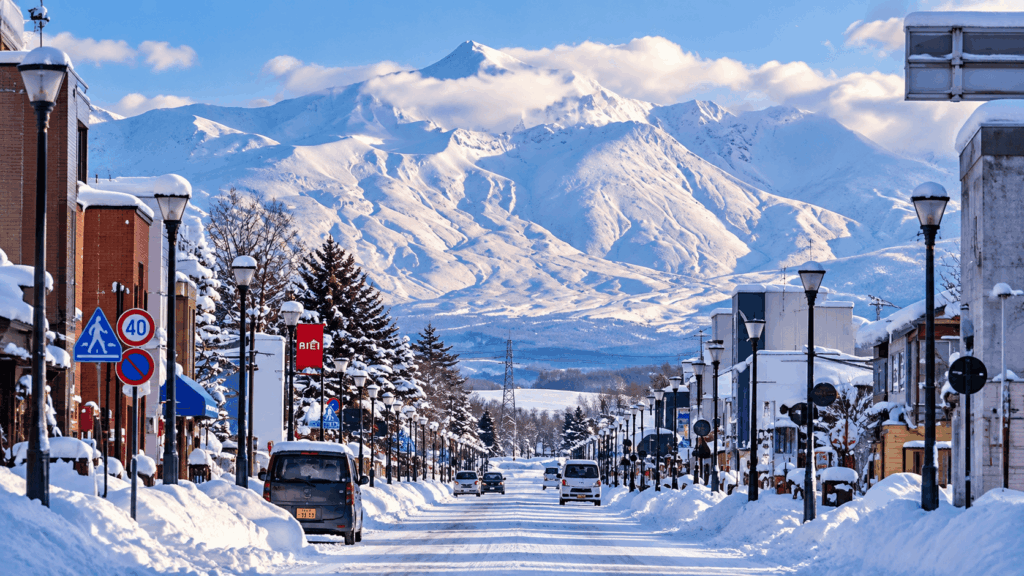
If winter driving is what makes Biei difficult to plan, a guided day tour from Sapporo is worth comparing. The Biei Best 5 winter itinerary lists snowy hill viewpoints, Shirahige Falls, and evening illumination stops. Check available dates and the exact winter itinerary before deciding.
Is Biei Worth Visiting in Winter?
Yes — for snow-covered hills, Shirahige Falls, and the Blue Pond illumination. No, if the famous blue surface of the pond in daylight is your main reason for the trip. Those are two different trips that happen to share a postcode.
- Worth it if: you want wide, empty snow landscapes, you are happy to shoot from roads and designated viewpoints, and you can stay out after dark.
- Not worth it if: the blue water from Instagram is your only goal, or you have one short Sapporo-based day with no flexibility.
- The key fact: after freeze-up and snowfall the pond’s blue surface is not visible. Put the daylight hours elsewhere and come back after sunset.
- Time needed: a full day from Sapporo, or an afternoon plus evening if you stay in Biei or Shirogane Onsen.
- Real hurdle: not reaching Biei — it is moving between the pond, the falls, and the hills that eats the day.
| Place or experience | What you actually see in winter | Best time | Best for | Main downside | Verdict |
|---|---|---|---|---|---|
| Shirogane Blue Pond, daylight | A frozen, snow-covered basin with bare larch trunks. White, not blue. | Midday, as part of a wider loop | Minimal snowscapes and quiet | No blue water; flat light on grey days | Do not build the day around it |
| Shirogane Blue Pond, illumination | Lit snow, larch silhouettes, and a lighting sequence of roughly 15 minutes | After dark; from 4:30 p.m. in December | Photographers; anyone staying overnight nearby | Bitter cold, a dark walk from the car park, weather cancellations | The version worth planning around |
| Shirahige Falls | A waterfall still running in winter, with the blue Biei River below | Daylight, before the light goes | Blue water and snow in one frame | An exposed bridge viewpoint; about 30 minutes from Biei Station | The top daytime priority |
The mistake I see most often is not logistical — it is expectation. Guests who have saved a summer photo of the Blue Pond for years arrive in January expecting that colour, and no amount of snow scenery closes the gap between the photo and the frozen pond in front of them. I now explain this before we arrive, not to lower the mood but so the daylight goes to the places that deliver in winter, and the pond gets its own slot after sunset. Recent reviews follow the same split: a minority call it disappointing because there was no blue, others describe the snow-covered version as eerie and peaceful. Both are honest; the difference is what each person came expecting.
If you are coming from Sapporo and snow driving is what is holding you back, it is worth comparing the current winter day tours before committing to a rental car — the routes are long and the daylight is short.
What Biei Actually Looks Like in Winter
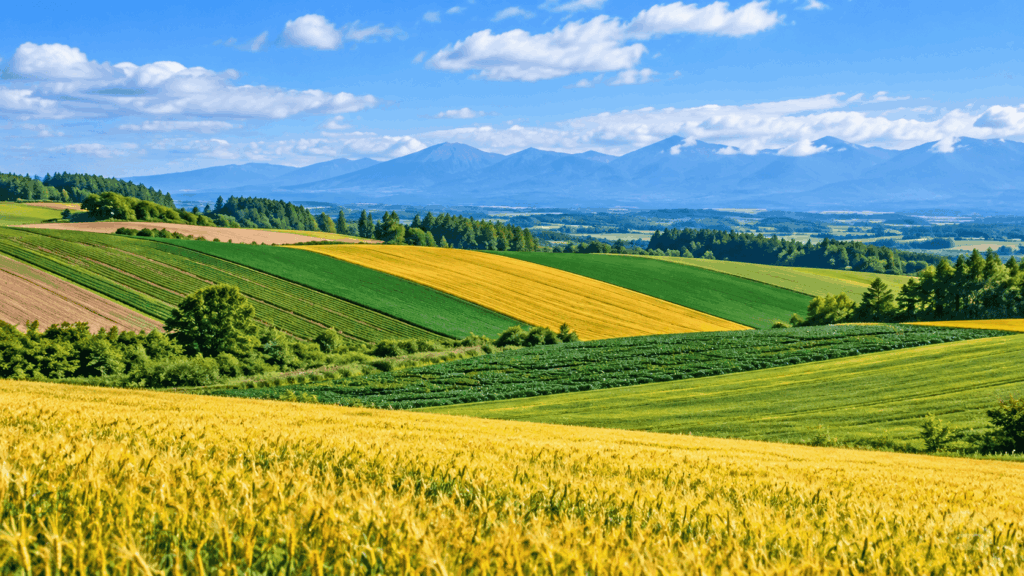
Summer Biei is colour: flower fields, patchwork farmland, long views to the Tokachi mountain range. Winter strips that away. Fields become one white surface, roads narrow between snowbanks, and the landscape reduces to a few isolated trees, a line of hills, and the mountain silhouette when the cloud lifts.
Summer reference photo: This image shows Biei’s cultivated hills before winter snow covers the farmland.
That minimalism is the appeal, and it is also why some visitors feel let down: there is less to “do” and more to look at. Pull-offs that work in summer may be buried or unplowed, and the places where you can legally stop are fewer than the photos suggest. Biei Station to the Shirogane area, where both the pond and the falls sit, is roughly 20 to 30 minutes by road in good conditions — longer when the surface is bad or a coach is unloading. I have often found the winter hills much quieter than the same viewpoints in July, though that is an observation rather than a promise: the Christmas Tree area draws concentrated traffic, and the town runs a live congestion page for exactly that reason.
Biei in December: Is There Enough Snow?
December is already proper winter here, not a shoulder season. The Japan Meteorological Agency’s 1991–2020 averages for Biei show a December mean of about -5.5°C, an average low near -10.8°C, and 182 cm of snowfall — the highest monthly figure of the year. Maximum snow depth, though, averages about 48 cm in December and peaks in February, so deep-winter scenery is more reliable later in the season.
- Early December: snow is likely but not guaranteed to be deep; the first half varies most year to year. Check conditions close to departure rather than trusting last year’s photos.
- Late December: usually a safer bet for a fully white landscape, with the illumination running nightly.
- Daylight: the sun sets around 4 p.m. mid-month, so build the afternoon backwards from sunset.
- Illumination: December lights come on at 4:30 p.m. and run to 9 p.m. — the earliest start of the season, which suits day-trippers.
None of these numbers is a forecast. They describe a 30-year average, and one warm week can change the picture. Check snow and road conditions in the days before you travel, and keep an indoor or onsen option in reserve.
Blue Pond in Winter: Don’t Expect the Famous Blue Water in Daylight
The Shirogane Blue Pond is open all year, and the car park is plowed and lit through winter. What changes is the thing you came to see. Biei Town’s official illumination page states that during winter the blue water surface cannot be seen because of snow, and asks visitors to stay within the viewing areas and never enter the pond.
Summer reference photo: The vivid blue surface shown below is the warm-season view; after the pond freezes and snow accumulates, the water is no longer visible.
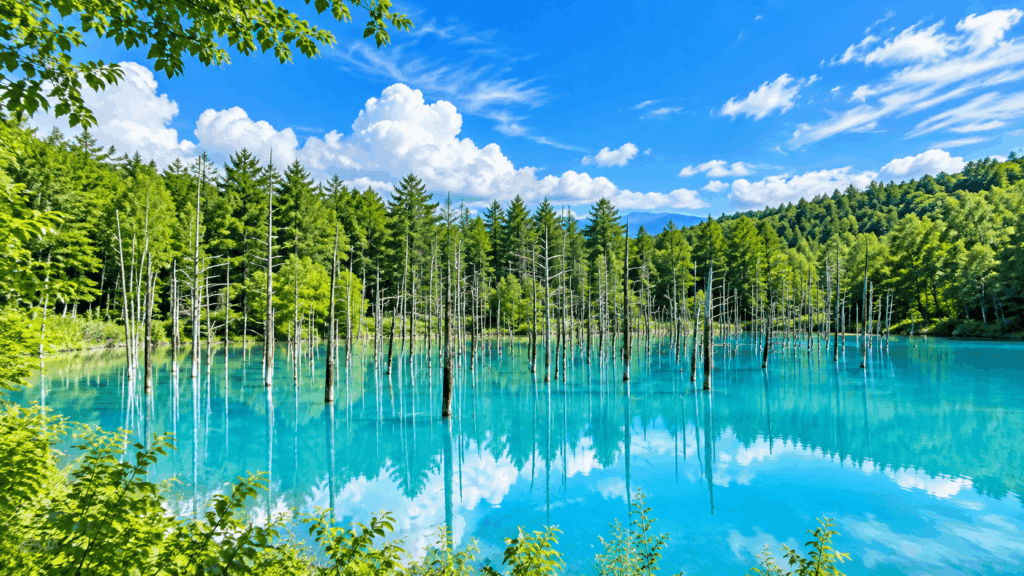
By day, once the pond is fully covered, the scene can look much more like a flat white snowfield than the blue pond in summer photographs. What remains is the shape of the basin, the dead larch trunks standing out of the snow, and the dark treeline behind. On a grey day the light is flat and contrast is low; on a clear one you get blue shadows and a clean horizon. It is a genuinely striking landscape — just not the one that made you want to come.
- Access: about 20 minutes by car or route bus from JR Biei Station; the bus stop and car park are a few minutes’ walk from the viewing area.
- Parking: 220 standard spaces, charged per vehicle (1,000 yen for a standard car as of the 2026 revision). From 23 October through April, the car park is open 8:00 a.m.–9:30 p.m., which is what makes the illumination feasible by car.
- Footing: the path and viewing area can be packed ice, not soft snow. Not a place for smooth-soled city shoes.
- Rules: stay within the designated viewing areas. The pond edge and the ground beyond the viewpoints are dangerous, and entering the pond is prohibited.
Kai’s tip: When guests have booked specifically for the Blue Pond, I tell them on the way rather than on arrival that the winter pond is a different sight: the blue surface is under snow, and what they will see is the white basin and the larch trunks. Saying it in the van gives them the rest of the drive to adjust, and it changes what they photograph — most end up working the tree line and the light instead of hunting for blue that is not there.
Is the Blue Pond Winter Illumination Worth It?
Yes, if your itinerary can be in Shirogane after dark. The important framing is that this is not an event where the blue water appears. It is a winter light installation over snow, trees, and a frozen pond, and it should be judged on those terms.
Lighting reference: The blue glow in illumination photos comes from the installed lights. It does not mean the natural blue water is visible beneath winter snow.
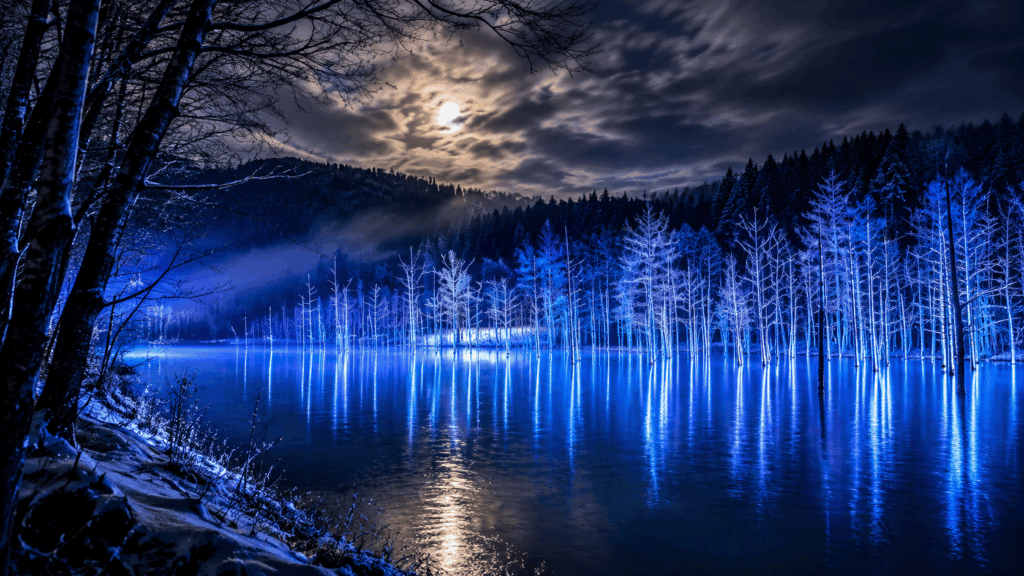
For the 2026–27 season the illumination runs nightly from October 22, 2026 to April 21, 2027, until 9 p.m. Start times shift by month: 5 p.m. in October, November, and January; 4:30 p.m. in December; 5:30 p.m. in February; 6 p.m. in March; 6:30 p.m. in April. The program tells a single story over roughly 15 minutes, and once the pond is frozen and snow-covered the operators switch to a winter version built on gradient, depth, and shadow — falling snow, stars, and the shadows of the larches rather than any hint of blue water.
Two things surprise people. The walk from the car park to the viewing area is genuinely dark; bring a small torch and watch the steps. And the cold at night is a different order from the afternoon — standing still through a 15-minute sequence is when it reaches you. Lighting can be cancelled in severe weather, with notices posted on the town website, so treat it as a plan with a backup rather than a fixed appointment. If you can only manage one visit to the pond, choose the night: the daytime version is a landscape, while the night version is an experience with a beginning and an end.
Shirahige Falls Is the Winter Stop I’d Prioritize
If you want to see blue water in Biei in winter, spend your daylight here. Shirahige Falls keeps running through the season, and the view from the Blue River Bridge takes in both the falling water and the blue Biei River below — the closest thing to the “blue Biei” image that actually survives the snow.
Autumn reference photo: This image shows Shirahige Falls before winter snow arrives; the waterfall continues to flow through winter.
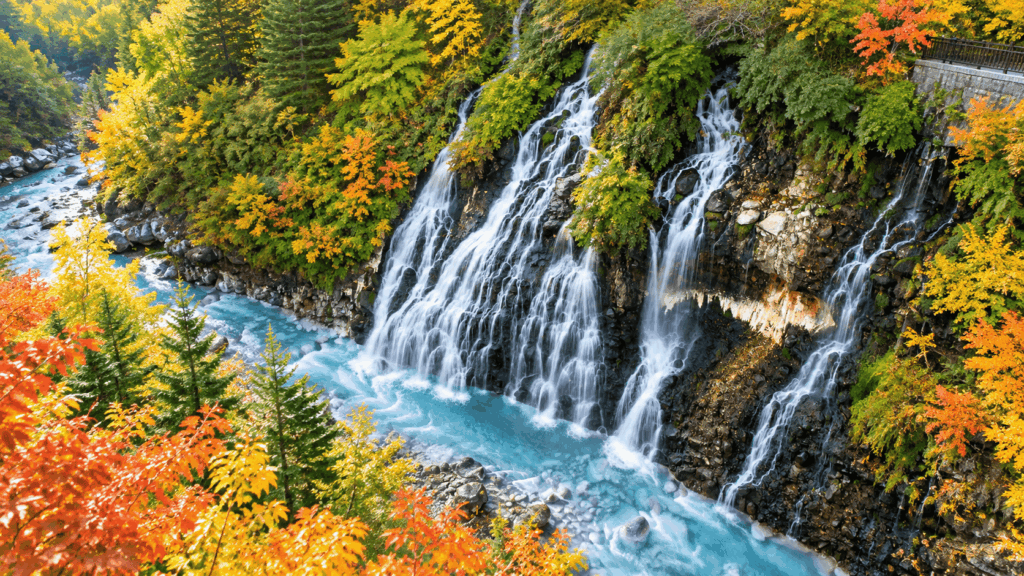
The falls are a rare groundwater-fed waterfall: water seeps from rock strata along the cliff and drops roughly 30 metres into the river. In winter the white of the water, the white of the snow, and the dark rock give the scene far more contrast than the flat white of the frozen pond, and the river below keeps its colour.
- Access: about 30 minutes by car or route bus from JR Biei Station; the Dohoku bus stop is a three-minute walk from the falls.
- Parking: free, at the public car park in front of the Shirogane Tourist Information Center.
- Viewpoint: the Blue River Bridge, directly above the falls.
- Illumination: lit year-round from sunset until 9 p.m., so it pairs naturally with the pond after dark if you have a vehicle or a tour bus.
- Time needed: 15 to 25 minutes at the bridge. It is a viewpoint, not a walk.
This is the call I make most often as a guide: when a winter group is set on the Blue Pond, I still route us through Shirahige Falls in daylight. Guests braced for a white pond tend to leave the bridge far more satisfied than they expected, because what they actually wanted — snow plus vivid water — is right there.
Why the Shirahige Falls Viewpoint Feels Colder Than You Expect
The bridge sits high above the river and is completely exposed: no shelter, no wall to break the wind, and air moving through the gorge colder than the reading in Biei town. Guests in light jackets often last a few minutes before retreating to the car, which is a shame given the drive.
Dress for wind, not just temperature. Gloves, a hat, and something covering your neck change the experience more than an extra sweater, because exposed skin is what ends the visit early. If you are uneasy with heights, note that this is a bridge over a gorge with a steep drop — fenced and safe, but not a ground-level platform, and some visitors prefer a brief look and a step back.
The Snowy Landscapes Around Biei — and Where You Must Not Walk
The Blue Pond is not the whole of winter Biei. The hills, the isolated trees, and the long views toward the Tokachi range are what most photographers come for, and in winter they are at their most graphic: dark trees on white, no colour to distract, a horizon that disappears into cloud.
What the photos do not show is ownership. Almost all of that white space is private farmland. Snow covers the boundary lines but does not change who owns the land, and Biei Town’s guidance is explicit: do not enter fields, pastures, or snow-covered farmland under any circumstances. The reason given is agricultural — crops, machinery, and the working life of the people who farm here — not merely a request for tidiness.
The Christmas Tree of Biei is the clearest example. The tree stands on private land, the road in front is residential and used by locals and school buses, and there is no car park. In the 2025–26 winter season, temporary pedestrian-only road restrictions were imposed near the tree, with parking and stopping prohibited during the regulated periods. A shuttle service from Shiki-no-Johokan, close to JR Biei Station, was also promoted. Do not assume the same dates or transport arrangements apply in 2026–27; check the town’s latest restrictions before going. Drone flights and aerial photography are generally prohibited in Biei without the necessary permissions, in part because a crash could damage farm machinery. Other viewpoints need checking before you drive to them: Shin-ei-no-Oka View Park, for instance, is closed during the snowy season and has no winter restrooms.
Kai’s tip: The part of my job that matters most in winter is not finding the shot, it is keeping people out of the field to get it. When a guest steps off the road toward the tree, I stop them before the first footprint, because snow makes the boundary invisible and “just a few steps” is exactly how the damage happens. I also point out that the road edge gives the cleaner composition anyway — no footprints in frame, and the tree reads as isolated, which is the whole point of the picture.
Can You Snowshoe Across the Biei Hills?
Not on your own, and not on farmland. Walking into the snowfields on rented snowshoes is the most common misunderstanding about winter Biei, and the one that causes friction with landowners: access here is a permission question, not a fitness question.
If walking through deep snow is the experience you want, book a guided snowshoe program run with the landowner’s consent — the Biei Tourism Association lists authorised winter experiences and certified guides, and operators change from season to season. You get the same silence and the same snow, on ground where you are allowed to be, with someone who knows where the ditches and boundaries are.
When Is the Best Time to Visit Biei in Winter?
There is no single best month, only a best month for what you want. December brings the earliest illumination start and a festive atmosphere, January the deepest winter and hardest cold, February the deepest snow base and the busiest travel period in Hokkaido.
| Month | Snow reliability | Temperature and snowfall (JMA averages) | Daylight | Illumination start | Crowd risk | Best for |
|---|---|---|---|---|---|---|
| December | Likely, but early December varies most year to year | Mean -5.5°C, average low -10.8°C, 182 cm snowfall | Sunset around 4 p.m. mid-month | 4:30 p.m. | Moderate, rising around Christmas and New Year | Festive atmosphere and an early illumination start |
| January | High | Mean -8.7°C, average low -14.8°C, 164 cm snowfall | Short days; clearest cold spells | 5 p.m. | Moderate outside New Year | Deep winter scenery for people who handle serious cold |
| February | Highest snow depth of the year | Mean -7.9°C, average low -14.7°C, 141 cm snowfall | Noticeably longer afternoons | 5:30 p.m. | High, especially around Sapporo Snow Festival dates | Maximum snow, better light, more afternoon hours |
The trade-off is straightforward. Earlier in the season you get more daylight and an earlier illumination but less certainty about snow; later you get the deep snow base and longer afternoons but harder cold and more competition for tours and hotels. If your dates are fixed in early December, go — just check conditions in the final week and accept that the landscape may be brown at the edges.
How to Get Around Biei in Winter: Car, Bus or Tour?
Getting to Biei is the easy part. From Sapporo, a limited express to Asahikawa takes around an hour and a half, and the JR Furano Line continues to Biei in roughly 35 minutes. The hard part starts when you step off the train.
The Blue Pond, Shirahige Falls, the Christmas Tree, and the hill viewpoints sit in different directions, and in winter the gaps between them matter more than the map suggests: snowbanks limit where you can stop, some pull-offs are unplowed, and daylight is gone by late afternoon. That is why so many winter visitors end up on a tour — not for convenience, but because the transport problem is the trip.
| Option | Best for | Flexibility | Winter difficulty | Main drawback |
|---|---|---|---|---|
| Rental car | Experienced winter drivers, photographers, anyone staying overnight | Highest | High — snow tyres are standard, but ice, wind, and unplowed roads are real | You are driving home in the dark on icy roads |
| Public bus (Dohoku Bus) | Confident planners, solo travellers, daytime-only visits | Low | Moderate — the bus handles the road, you handle the timetable | Sparse services; the last bus back caps your day |
| Guided day tour | First-time winter visitors, Sapporo-based travellers, anyone avoiding snow driving | Lowest | Low — someone else deals with the road | Fixed stops and timings; less time where you want it |
Dohoku Bus routes 39 and 42 connect Biei Station with the Shirogane area, stopping near both the pond and the falls.
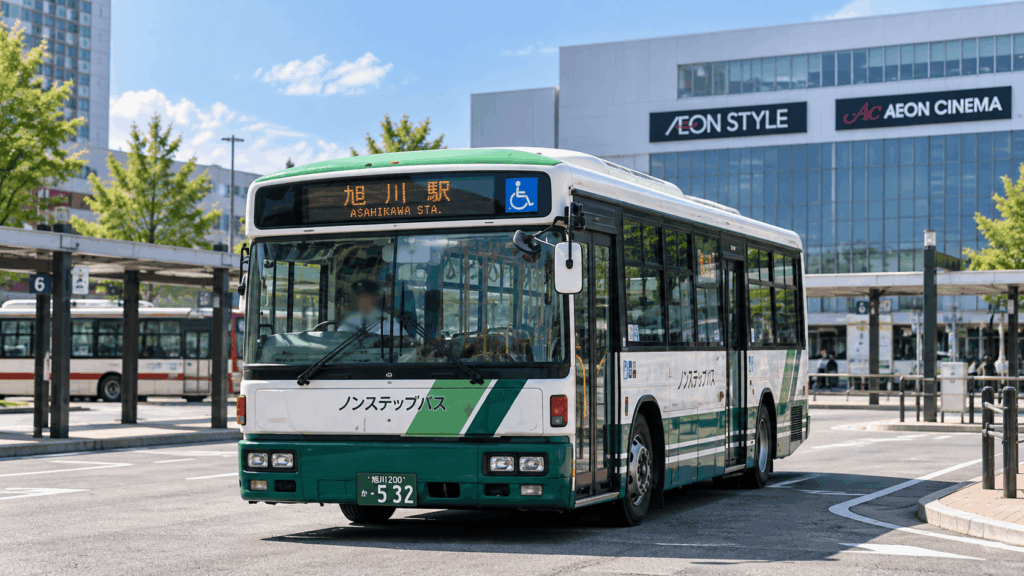
Services are infrequent, so study the last return bus before anything else — the 2026 autumn timetable has an early-evening return, which may allow a short look at the lights in some months but does not cover the full 9 p.m. illumination period. Missing the last bus in Shirogane is not a small problem. A Biei & Shirogane Area 1-Day Pass gives unlimited rides on the relevant section for a day (2,000 yen adult, 1,000 yen child as of the 2026 release) and pays for itself on a round trip plus a stop or two.
The Biei View Bus operated a winter illumination course in 2025–26, mainly on Fridays and Saturdays between mid-November and mid-February, departing from Shiki-no-Johokan near JR Biei Station and visiting the Blue Pond, Shirahige Falls and Birke Forest. That is a previous-season example, not a confirmed 2026–27 timetable. Check whether a new winter course has been announced before building a day around it.

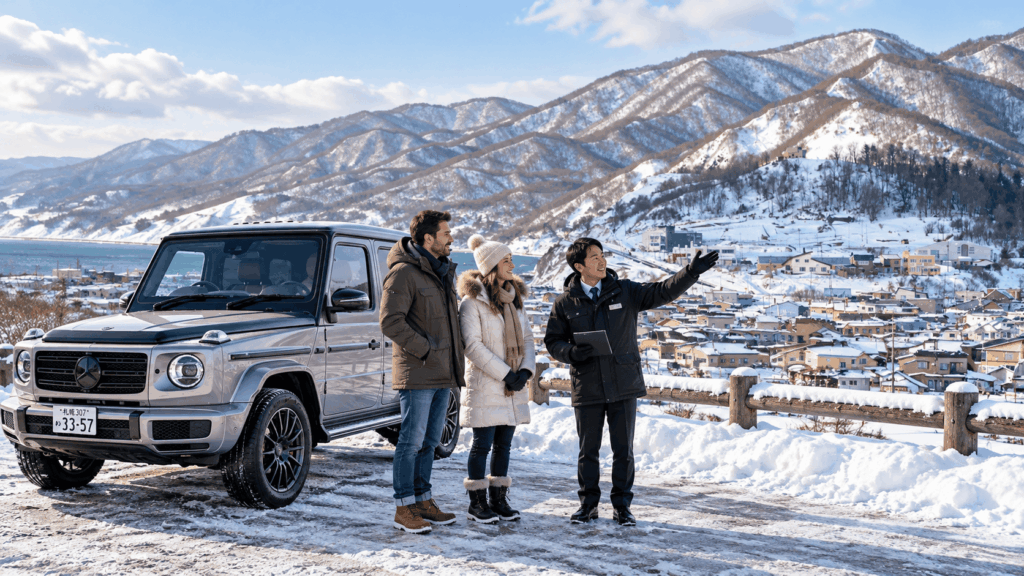
If you are not comfortable driving on Hokkaido’s winter roads, a guided Biei day tour from Sapporo is the simplest way to connect the scattered winter sights without planning around a handful of buses or navigating ice in the dark. The trade-off is real: you will see less of any single place, and you will not have the freedom to wait out a cloud or stay for a second lighting sequence. Experienced winter drivers who want the illumination at their own pace often do better with a rental car and a night in Biei or Shirogane Onsen — several Shirogane hotels run guest shuttle services to the illumination, which removes the worst of the night driving.
If you want to see Biei’s scattered winter sights without driving on icy roads or working around infrequent buses, the Biei Best 5 day tour is worth comparing.
Why I’d book this one
- Guides and coordination: Recent travelers highlight helpful guides and smooth coordination between stops, especially for places that are difficult to connect independently.
- A winter-focused route: The published winter itinerary includes snowy hill viewpoints, the Christmas Tree of Biei, Shirahige Falls, and the Blue Pond area, with evening illumination stops rather than a summer-focused flower-field route.
- Booking flexibility: The listing offers free cancellation within the stated deadline and a reserve-now-pay-later option, useful when planning around changeable winter conditions.
The trade-off is a fixed schedule, with limited time at each stop. The operator does not guarantee the Blue Pond illumination on every departure, so check the exact lighting stops before choosing your date.
Is a Sapporo Day Trip to Biei Worth It?
Possible, and long. The round trip eats a substantial chunk of daylight, which is exactly the resource that is scarcest in December and January. If the plan is to travel to Biei, look at the frozen pond for twenty minutes, and return, the value is thin.
It works when the day is a loop: hills and the Christmas Tree late morning, Shirahige Falls while there is still light, a break in Shirogane Onsen, then the illumination before the drive back. Staying overnight costs more but buys you the evening without a two-hour drive afterwards, and a second chance if the first night is cloudy. Either way, check what your tour actually includes — some Sapporo departures combine Biei with Furano’s Ningle Terrace or an animal park, which is a different trip: less Biei, more bus.
A Practical One-Day Biei Winter Itinerary
The order below puts daylight where winter actually delivers and saves the pond for after dark, avoiding the most common disappointment of standing in front of a white field at 1 p.m. expecting blue.
- Late morning — Biei town and the hills. Arrive at JR Biei Station, grab lunch or pick up supplies, then drive or ride the loop. Stop only where it is legal and safe; photograph the Christmas Tree from the road, or use the shuttle if the pedestrian-only restriction is in force.
- Early afternoon — Shirahige Falls. Be at the Blue River Bridge with at least an hour of decent light. This is the blue-water stop of the day.
- Mid-afternoon — Shirogane Onsen. Hot drink, a day-use bath if you have time, and a warm-up before standing outside again. Also the practical moment to check whether the illumination is running.
- Sunset to early evening — Blue Pond illumination. Arrive as the lights come on rather than after, and plan 30 to 45 minutes on site including the walk from the car park.
- Evening — back to Biei or Sapporo. If you are driving, be conservative on this leg: dark, cold surface, drifting snow.
In December the lights start at 4:30 p.m., so the afternoon compresses; in February you gain an hour of daylight and the sequence starts at 5:30 p.m., which makes the day less rushed. Expect the car park to fill around coach arrivals — if a tour bus is unloading, wait a few minutes rather than joining the first crush at the viewpoint.
What to Wear for Biei in Winter
This is not a city winter. What catches visitors out is not the air temperature but the standing still: twenty minutes at a bridge or a 15-minute lighting sequence at -10°C with wind is a different exposure from walking between shops in Sapporo.
- Footwear first: insulated, waterproof boots with real tread. Not fashion boots, not smooth-soled sneakers.
- Socks: wool or synthetic, plus a spare pair in your bag.
- Hands, head, neck: gloves, a beanie, and a neck gaiter or scarf — these do more than a heavier coat.
- Layers: warm base layer, mid layer, windproof shell. You will move between a heated bus, a cold viewpoint, and an onsen.
- Optional: removable ice cleats help on packed paths, but take them off indoors — they are hazardous on smooth floors.
Kai’s tip: The ground around the Blue Pond and on the Blue River Bridge is usually packed ice rather than soft snow, and it is the one thing that ends a visit early. I have watched people in ordinary sneakers take two steps off the bus and turn around. If you buy one thing before this trip, make it boots with grip and insulation — not for the cold, for the footing.
Who Should Skip Biei in Winter?
Saying this is more useful than another round of praise. Consider putting Biei lower on your list if any of these describe you:
- The pond’s blue surface is the whole reason you are going. In winter it is under snow. Shirahige Falls gives you blue water, but it is a waterfall, not the pond.
- Serious cold and icy ground would dominate the day. There is a lot of standing outside, and the footing is hard work for anyone unsteady.
- You have only a short Sapporo trip. The round trip consumes most of a day, and daylight is short.
- You would rather be in a city. Winter Biei is minimal and quiet by design, with very little indoors.
- You plan to see the pond and turn straight back. The value comes from combining the falls, the hills, and the illumination.
Reviews that call winter Biei disappointing almost always describe a mismatch of expectation rather than a bad place: a frozen pond where blue water was promised, or a day too cold and too rushed to enjoy. Read as a landscape and a set of winter experiences, it holds up well. That is why I explain the reality before arrival rather than after — guests who know what winter does to this place tend to leave pleased, and the ones who find out at the pond edge tend not to.
Frequently Asked Questions
Is Biei worth visiting in winter?
Yes, if you want snow-covered hills, a waterfall that still runs in the cold, and the Blue Pond illumination after dark. It is a poor match if the blue surface of the pond in daylight is your only goal. Think of winter Biei as a different destination rather than a snowier version of the summer one.
Is the Blue Pond still blue in winter?
No. Once the pond freezes and snow accumulates, the blue water surface is not visible — Biei Town states this directly on its winter illumination information. Daylight shows a white, snow-covered basin with bare larch trunks. The blue associated with winter visits comes from the lighting installation after dark, which illuminates snow and trees rather than water.
Is Biei snowy in December?
Usually, but not reliably from the first of the month. December averages around 182 cm of snowfall with a mean temperature near -5.5°C, so it is already full winter. Snow depth on any given date still varies year to year, and early December is the least predictable stretch. Late December is generally safer for a fully white landscape, and the illumination runs nightly throughout the month.
Can I visit Biei and the Blue Pond in winter without a car?
Yes, but your day will be shaped by the bus timetable. Dohoku Bus routes 39 and 42 connect Biei Station with the Shirogane area, and a one-day pass covers the relevant section. Services are infrequent, so identify the last return bus first. For the evening illumination, check the last return bus against the month’s lighting start time first. A tour or a Shirogane Onsen stay with hotel transport is often more practical, especially in March and April when the illumination starts later.
Do I need snow boots for Biei in winter?
Strongly recommended. The paths around the Blue Pond and the Blue River Bridge viewpoint are often packed ice rather than soft snow, and ordinary sneakers or fashion boots give almost no grip. Insulated, waterproof boots with real tread are the single most useful piece of gear for this trip — more so than an extra jacket.
Should I choose Shirahige Falls or the Blue Pond in winter?
For daylight, Shirahige Falls: it is where you can still see vividly blue water next to snow, and the walk from the bus stop is only a few minutes. For the Blue Pond, go after dark. If you have time for both, do the falls in the afternoon and the pond in the evening — that order avoids the flat white disappointment of a midday pond visit.
Is the Blue Pond winter illumination worth seeing?
Yes, if you can be there after dark and you accept what it is: a lighting installation over snow, ice, and larch trees, not an event where blue water reappears. The sequence runs about 15 minutes and uses a winter-specific program once the pond is frozen. It can be cancelled in severe weather, and the walk from the car park is dark, so bring a small torch.
Final Verdict: Is Winter Biei Worth the Trip?
Yes — for the winter version of Biei, not the summer one. The pond in daylight is a white basin, Shirahige Falls is where the blue water is, and the illumination is what makes the frozen pond worth the drive after sunset. Plan around those three facts and the day works.
Choose winter Biei if you want wide snow landscapes, you are willing to shoot from roads and designated viewpoints, and you can be in Shirogane after dark for the illumination. Choose something else if the blue surface of the pond in daylight is the entire point, or if a short Sapporo trip leaves you one rushed day with no room for weather.
First-time visitors: take a guided day tour from Sapporo if snow driving worries you, and check that both Shirahige Falls and the Blue Pond illumination are on the itinerary. If you drive yourself, do the falls in daylight and the pond after dark, and treat the Christmas Tree as a roadside stop rather than a destination.
Photographers: stay overnight in Biei or Shirogane Onsen. One night gives you two chances at the illumination and a calm early morning on the hills, which is worth more than any single viewpoint. Budget for boots with grip — the ice around the pond is the limiting factor, not the cold.
Families with children: keep it to daylight. Shirahige Falls is a short, high-value stop, and the hills are best seen from the car with brief walks. Standing still through a lighting sequence at -10°C is a hard sell for young children, and the bridge viewpoint is exposed.
Travellers on a tight schedule: skip Biei this time. The round trip from Sapporo consumes most of a day, and a compressed visit tends to produce exactly the disappointment the reviews describe.
Repeat visitors: come for what you missed — a guided snowshoe walk on land you are allowed to cross, the Birke Forest illumination on the same schedule as the pond, and a quiet morning on the hills before the coaches arrive.
Non-drivers: the daytime bus is workable with a one-day pass, but the evening is the problem. Either join a tour that includes the illumination or stay in Shirogane Onsen and use a hotel shuttle. Trying to reach the pond after dark on scheduled buses is the one plan I would talk you out of.

Hi, I’m Kai. I’m a Tokyo-based travel writer, tourism industry insider, and the author of a published guidebook for international visitors to Japan. With over 10 years of professional experience at a leading Japanese tourism company, my mission is to help you skip the tourist traps and navigate Japan’s best destinations like a local. I believe the perfect day trip is like a traditional kaiseki meal: a beautiful balance of precise planning and unforgettable seasonal discovery. When I’m not out conducting field research, you’ll usually find me drafting new itineraries with one of my favorite fountain pens!