
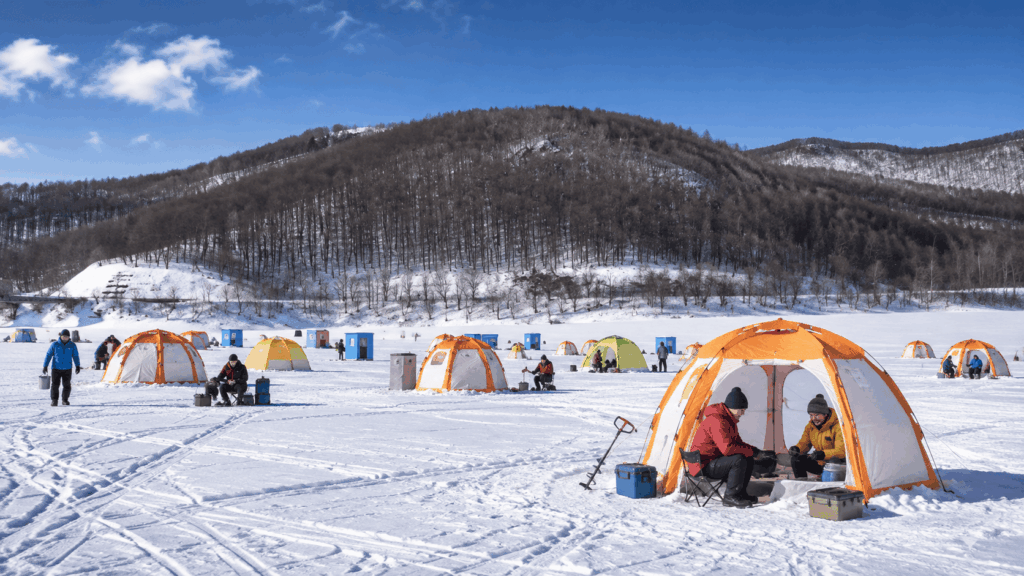
Lake Kanayama sits just off Route 237 in Minamifurano, roughly 40 minutes by road from Furano and about the same from Tomamu. Every winter its frozen surface becomes a temporary village of fishing tents, and the target is wakasagi — Japanese smelt, a fish small enough to eat whole, head and all, straight out of the fryer.
I went with a friend who had never held a fishing rod in his life. Between us we pulled close to 100 fish out of a single hole in about two and a half hours, and came away with one specific regret involving rice balls. This guide is what I would tell him before he booked: how cold it actually is, what the tours cost, and where operators quietly differ from each other.
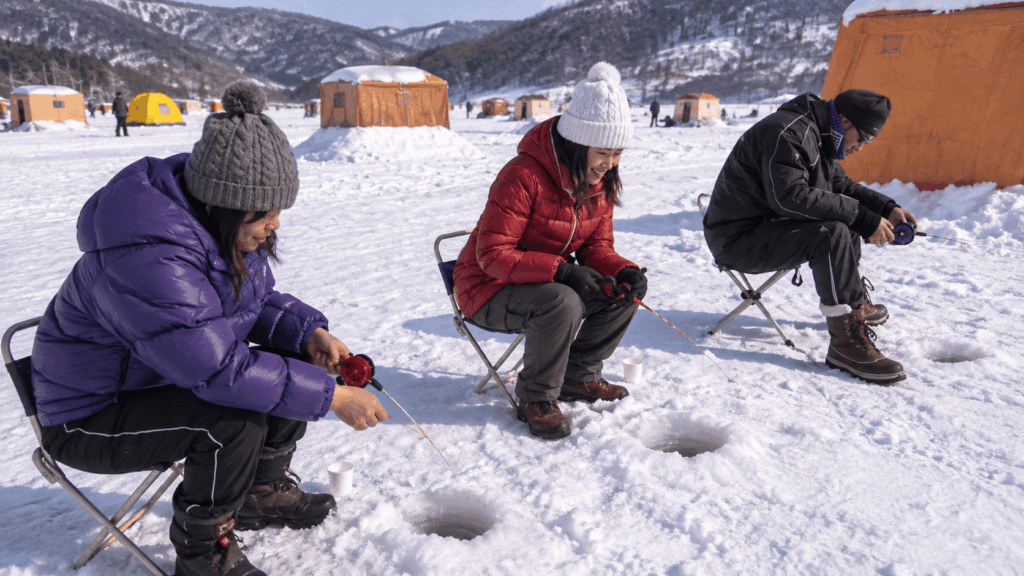
Booking check for self-arriving visitors: If you can reach Lake Kanayama independently, compare the two-hour guided fishing experience before choosing your date. Check current dates, prices and the meeting point for the Kanayama Lake ice-fishing experience on Klook.
Quick Answer: Is It Worth Booking?
Yes — if you go with a guided tour and you know what you are buying. Kanayama Lake is an approachable place for beginners to try ice fishing because guided tours supply the gear and instruction. You can also visit without a rental car if you choose a tour that includes pickup; meet-at-lake tours require you to arrange your own transport. You sit in a tent, drop a tiny bait through a hole someone else has already drilled, and a guide fixes your line when it tangles.
What it is not is a guaranteed catch. Operators say so themselves: White Koala states plainly that there is no refund if the fish do not bite, and fishing depends on dam water releases and how the schools are moving that day. Treat the catch as a bonus and the morning on the ice as the product.
The second thing to understand before you book is that “”ice fishing tour at Lake Kanayama”” describes at least seven different products, from a ¥5,500 half-day with a tent and a shared guide to a ¥43,000 private day trip from Sapporo with hotel pickup and an English-speaking guide. Heating, pickup, cooking and even the language you will be instructed in vary by operator — one local operator states outright that it cannot accept guests who do not speak Japanese.
- Time commitment: fishing sessions are often around 2 hours; some 3.5-hour programmes include transport to and from the lake.
- Typical price nearby: around ¥5,500–7,000 per adult for a half-day tour.
- Gear: rod, bait and tent are normally included; winter clothing usually is not.
- Who it suits: first-time anglers, couples, friends, families with children of school age.
Because dates, prices and inclusions change every season, the practical next step is checking the listing for your exact travel dates rather than relying on last winter’s information.
Is Kanayama Lake Ice Fishing Worth It for Beginners?
The reason this works for beginners is not that the fish are easy. It is that the whole experience has been engineered to remove the parts beginners fail at.
On a guided tour, someone else drills the hole through ice that can be well over half a metre thick, sets up the tent, and shows you how to hook the bait — a small piece of worm that has to go on a hook thinner than a hair. When your line tangles, which it will, you hand it over instead of going home. My friend, who had never fished, was landing fish within the first half hour.
The trade-off is that you are dependent on the guide’s placement and the day’s conditions. On my trip the reception desk told us before we started that the fish were not moving well that day. We still did fine, but that is one data point, not a promise. Reviews of Kanayama Lake operators tend to praise patient instruction and the warmth of the tents far more consistently than they praise the size of the catch — which tells you something about what people actually remember.
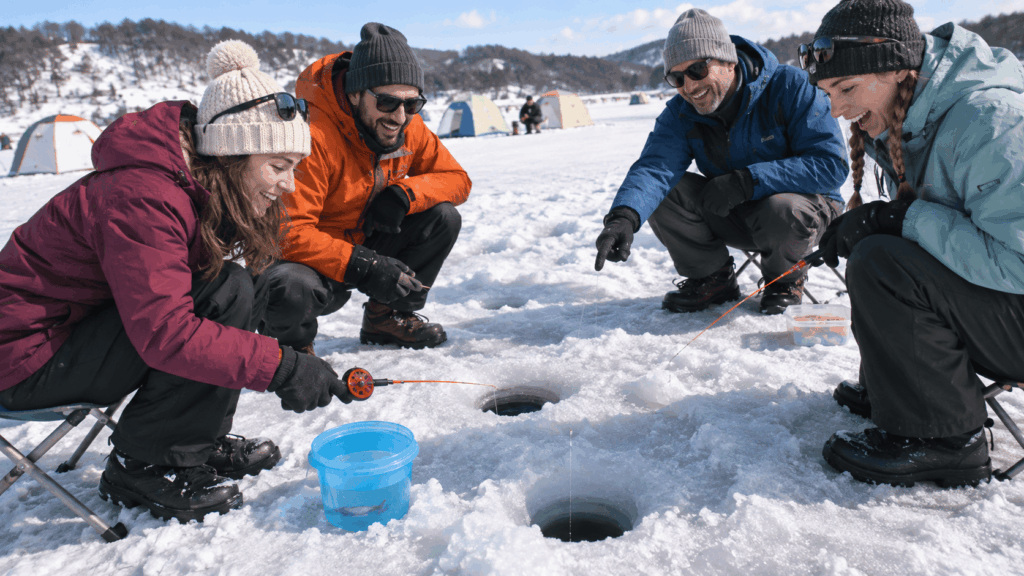
Who Will Enjoy It — and Who Should Skip It
You will probably enjoy this if you are:
- A first-time angler who wants the experience without buying equipment
- Travelling as a couple or with friends and looking for something other than skiing
- Staying in Furano or Tomamu, where the lake is within about 40–45 minutes
- Prepared to be outdoors in real winter cold for two to three hours
You might want to skip it if you are:
- Expecting a guaranteed catch, or measuring the day by how many fish you take home
- Travelling with children under five — White Koala sets its minimum age at 5, and Hoshino Resorts TOMAMU’s lake programmes are aimed at elementary school age and above
- Unable to spend hours in sub-zero conditions, even with a tent
- Booking a Japanese-only tour without Japanese — this is a real trap, and I will come back to it
- Relying on public transport to reach the lakeshore on your own
What My Kanayama Lake Ice Fishing Experience Was Really Like
One caveat before the details: this was a single trip with one operator, and I am deliberately not naming it. What follows is one version of the experience, not the standard across the lake — and the differences between versions turned out to matter more than I expected.
Getting to the Fishing Spot by Snowmobile Sled
On my tour, we did not walk out to the fishing tents. We parked near the shore, climbed into a sled towed behind a snowmobile, and were taken across the ice. Other operators may use different access arrangements. It takes a few minutes and it is the least comfortable part of the day, because you are sitting still in open wind with nothing between you and the lake.
The ice itself is a surprise the first time: not glassy, but covered in snow, tracked by vehicles, and oddly quiet once the snowmobile switches off.
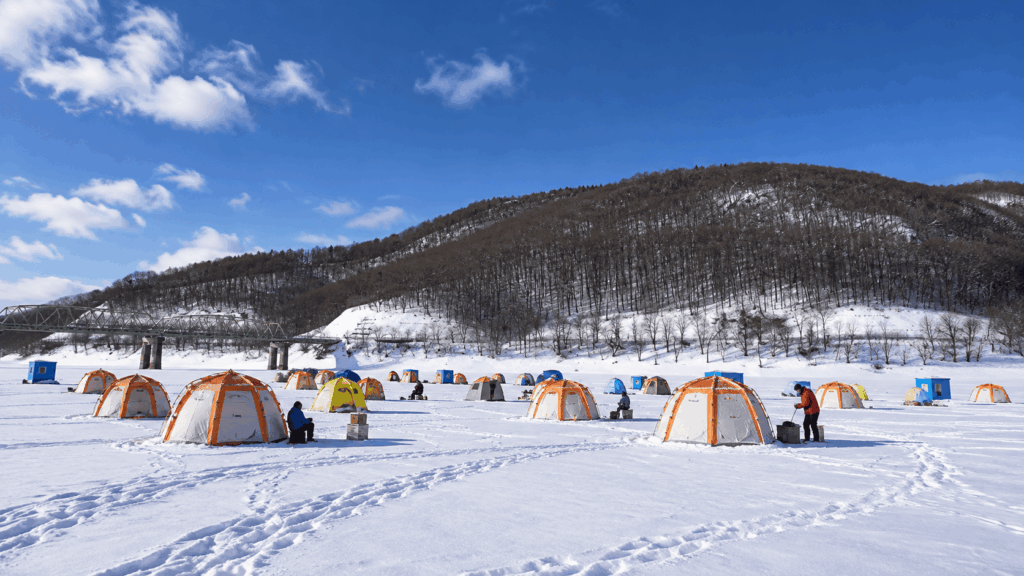
Kai’s tip: Most people over-invest in a big jacket and under-invest in hands, feet and face. The sled ride is short but it is the coldest you will be all day, and gloves you cannot operate a fishing line in are useless. Bring a thin pair for fishing and a thick pair for the ride, and use toe warmers made for winter boots according to their instructions.
How Warm Was the Heated Fishing Tent?
This is the part that surprised me most. Outside it was genuinely brutal — strong wind across open ice, the kind of cold that makes you turn your back to speak. Inside the tent, with a stove running, I took my down jacket off and sat in a hoodie. For two and a half hours. That gap between outside and inside is the single biggest reason ice fishing works as a family or couple activity in Hokkaido rather than a survival exercise.
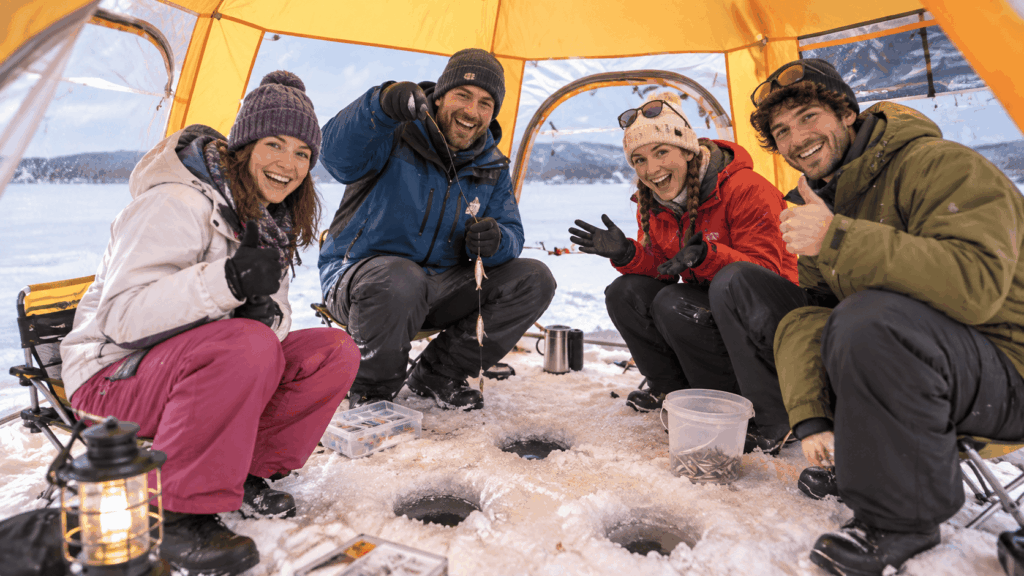
But do not assume every tent is heated. This is where Lake Kanayama operators diverge sharply, and it is rarely obvious from a booking page:
- Hoshino Resorts TOMAMU’s Lake Picnic and Ice Fishing programme explicitly advertises a heated tent.
- NRA, a local operator, advertises heated tents with a stove, plus cold-weather boots, toe warmers and a dedicated rest house with toilets at the fishing site.
- Guideline Outdoor Club states the opposite in plain language: you are inside a tent, but the temperature inside is the same as outside, so dress for the open air.
Those are three different products promising three different levels of comfort at broadly similar prices. If warmth is the thing that decides whether you enjoy this, ask the operator directly before you pay, and ask whether the stove runs all day or only when the guide checks in.
How We Caught Nearly 100 Smelt in About 2.5 Hours
The fishing itself is simple and strangely absorbing. You drop a baited hook through the hole, watch a rod tip no thicker than a chopstick, and lift when it twitches. The guide showed my friend how to bait the hook without impaling himself and how to keep the line moving in small, steady lifts — the smelt respond to movement, not to waiting.
We were told at reception that the fish were sluggish. We finished with close to 100 between the two of us in roughly two and a half hours, and a few of the larger ones were full of roe. I have no idea whether that is a normal day at Kanayama Lake, and I would not plan a trip around it — but it does show that a slow forecast is not a lost morning.
Eating Freshly Caught Wakasagi — and My Biggest Regret
On my trip, the frying set was an extra charge on top of the tour price, and staff did the cooking. That detail matters, because several operators now include tempura in the base price, so it is worth checking rather than assuming.
What came out of the oil was nothing like the frozen smelt I had eaten before. No muddy taste at all, crisp enough to eat whole, and sweet in a way that small freshwater fish usually are not. We ate them standing up, in batches, between bites of fishing.
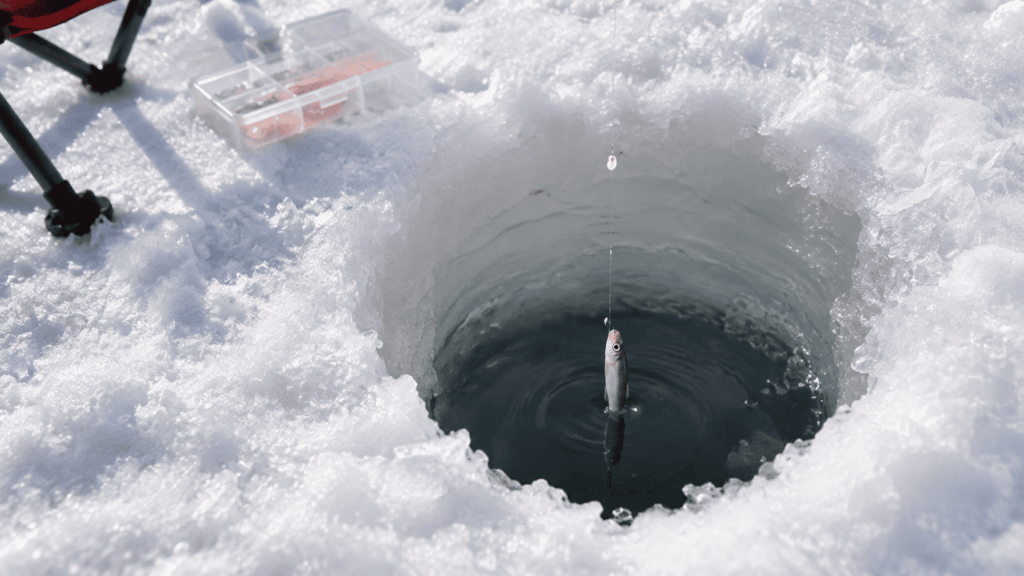
Which brings me to the regret. I did not bring rice balls, and I should have. Fried smelt on its own is a snack, not a meal, and there is nothing to buy on the ice. If your tour permits outside food — and most do, though it is worth confirming — put two onigiri in your bag before you leave Furano or Tomamu. It is the single cheapest upgrade to the day.
Kanayama Lake Ice Fishing Prices: What You’ll Actually Pay
The headline prices for a half-day on Lake Kanayama cluster tightly: roughly ¥5,000 to ¥7,000 per adult for tours that meet at or near the lake. What separates them is not the ticket price but what sits outside it — clothing rental, transport, cooking, and whether the price already includes the shuttle from your hotel.
As a rough map of the market, based on operator listings checked in October 2026 for the 2026–27 season:
- Local half-day tours: about ¥5,000–5,700 per adult, two to three and a half hours.
- Resort-run tours from Tomamu: about ¥6,500–7,000 per adult, including the shuttle from the resort to the lake.
- Private tours from Sapporo: from around ¥43,000 per person based on two people, covering a full day with hotel pickup, an English-speaking guide and winter clothing.
- Online marketplace listings: priced by date, so the rate for your specific day has to be checked on the booking page.
Two practical notes for anyone paying in a foreign currency. First, several small operators take cash only on the day — White Koala asks guests to pay in cash at the start of the tour and to bring small bills. Second, some operators take card payment in advance only, and Guideline Outdoor Club is one of them. Neither arrangement is unusual in rural Hokkaido, but arriving with the wrong one can end your morning before it starts.
What’s Included — and What Costs Extra
“”All equipment included”” is true on almost every listing, and it means less than most visitors assume. It generally covers the rod, the bait, the bucket, the chair and the tent. It does not usually cover what you wear.
| Item | What to expect | What to check before booking |
|---|---|---|
| Rod, bait and chair | Included on essentially every guided tour | Whether baiting is done for you or taught |
| Guide | Included; usually shared across several tents | Group size per guide, and how often they visit your tent |
| Tent | Standard on guided tours | Whether it is shared with strangers; some operators seat 2–3 parties together, others sell a private tent |
| Heating | Not standard. Confirmed heated tents at TOMAMU’s Lake Picnic programme and at NRA; Guideline states the tent is the same temperature as outside | Ask directly whether a stove runs in your tent |
| Winter clothing | Usually excluded. Rental typically ¥800–1,500 for a jacket and trousers | Boots, gloves and hat are often rented separately, around ¥500 each |
| Boots and toe warmers | Included at some operators (NRA lists boots and toe warmers), excluded at others | Waterproof winter boots are the item most worth confirming |
| Fried smelt | Included at White Koala, NRA and Guideline; included at both TOMAMU programmes. On my trip it was an extra charge | Whether cooking is included, and whether bad weather can cancel it |
| Transport to the lake | Included from Furano hotels on some tours, from Tomamu on the resort tours, from Sapporo hotels on private tours | Your exact hotel may fall outside the pickup zone |
| Toilets | Varies from a dedicated rest house to a portable toilet on the ice | Whether facilities exist at the fishing site at all |
The pattern worth internalising: a ¥5,500 tour plus ¥1,500 clothing rental plus ¥500 boots plus your own transport can cost more than a ¥7,000 tour that includes the shuttle and the gear. Compare the total, not the headline.
Which Kanayama Lake Ice Fishing Tour Should You Choose?
There is no single best tour here, and any article that names one is probably optimising for a commission rather than your trip. The right choice comes down to three things: where you are sleeping, whether you can drive in snow, and how much you care about warmth.
| Tour / operator | Listed price, 2026–27 | Listed duration (including transfers where applicable) | Meeting point | English | Heated tent | Best for |
|---|---|---|---|---|---|---|
| White Koala (half-day) | ¥5,500 adult with 2+; ¥7,500 solo; ¥5,000 child 5–12 | 2 hours | Kanayama Lake recreation centre car park | English-speaking staff available | Not stated | Furano-based travellers wanting a simple, low-cost half-day with free shuttle from Kitanomine and central Furano |
| NRA (half-day) | ¥5,000 adult; ¥4,500 elementary; infants free | About 2 hours | One minute by car from the former Higashishikagoe Station | Not stated | Yes — heated tent with stove | Travellers who prioritise warmth and a rest house with toilets at the fishing site |
| Guideline Outdoor Club (with shuttle) | ¥5,700 adult and child (6+) | Just under 2 hours fishing | Furano Station area or ski-area hotels; Roadside Station Minamifurano | No — Japanese only, stated explicitly | No — stated as the same temperature as outside | Japanese speakers who want hotel pickup and a small group |
| Hoshino Resorts TOMAMU: Wakasagi Ice Fishing | ¥6,500 adult; ¥5,000 child 6–11 | 3 hours 30 minutes (13:00–16:30), including transfers to and from the lake | GAO Outdoor Center, with shuttle to the lake | English available | Not stated | Guests staying at Tomamu, especially for an afternoon slot |
| Hoshino Resorts TOMAMU: Lake Picnic and Ice Fishing | ¥7,000 adult; ¥6,000 child 6–11 | 3 hours 30 minutes (09:00 or 12:45 start), including transfers to and from the lake | GAO Outdoor Center, with shuttle to the lake | English available | Yes — stated | Families and comfort-first travellers who want a heated tent and a morning option |
| Hokkaido Private Adventure | From ¥43,000 per person (2 participants) | Full day, about 8 hours door to door | Your hotel in central Sapporo | English-speaking guide | Not stated — described as a tent sheltered from the wind | Sapporo-based travellers without a car who want a private, all-inclusive day |
| Online marketplace listing (Klook) | Date-specific; check the page | Around 2 hours | Lake Kanayama — confirm the meeting point for your date | Bookable in English; confirm guide language | Not stated | Booking ahead in English with gear included, if the meeting arrangements suit you |
Prices are as listed for the 2026–27 season and were checked in October 2026. Seasonal dates, inclusions and pickup zones change; confirm them at the point of booking.
Best Option by Where You’re Staying
Staying in Furano or Kitanomine. White Koala is the simplest fit: free pickup from central Furano and the Kitanomine ski area, pickup roughly an hour before the start, English-speaking staff, and a two-hour session for ¥5,500 per adult when two or more people book. The catch is payment in cash and clothing rental on top. If you want the shuttle to collect you at your hotel door and you speak Japanese, Guideline Outdoor Club runs a similar half-day at ¥5,700 with a stop at Roadside Station Minamifurano.
Staying at Tomamu. Use the resort’s own programmes rather than trying to reach the lake independently. Both TOMAMU products meet at GAO Outdoor Center inside the resort and shuttle you to Lake Kanayama, about 45 minutes each way. The Lake Picnic and Ice Fishing version costs ¥1,000 more per adult and starts earlier in the season — from 24 December — and is the only one of the two that advertises a heated tent. The Wakasagi Ice Fishing programme runs 5 January to 20 March and departs at 13:00.
Already have a car. Meeting at the lake removes the shuttle from the equation and opens up the local operators. Drive only if you are confident on winter roads and have a properly winter-equipped vehicle — Route 237 and the approach roads may be ploughed, but snow and ice remain serious hazards, and a rental car on summer tyres is not suitable in January.
Staying in Sapporo. Hokkaido Private Adventure is the honest answer if you have no car and no Japanese: hotel pickup in central Sapporo, an English-speaking guide, winter clothing, snowmobile transfer and roughly eight hours door to door. It costs several times a local half-day, and that is the price of removing every logistical problem at once. Meals are not included, so budget for lunch separately. If the eight-hour round trip feels too long, consider ice fishing closer to Sapporo instead.
If none of these match, the marketplace listing is worth checking for your dates — but read the meeting instructions carefully, because the difference between “”meet at the lake”” and “”pickup included”” is the difference between a two-hour activity and an eight-hour day.
If you can arrange transport to the lake and want a guided fishing session without a full-day transfer package, the Klook experience is worth comparing with the local operators above.
Why I’d book this one
- Beginner support: The listing includes fishing equipment and describes help with bait preparation and technique, so you do not need previous fishing experience.
- The catch-to-table experience: Fresh smelt tempura may be available when weather conditions permit, making the fishing itself more memorable even if the catch is modest.
- Traveler feedback: A visible review praises the guide’s helpful instruction, although it dates back to 2023. Check for newer feedback and current booking conditions before deciding.
See current availability, inclusions and traveler reviews for the Lake Kanayama ice-fishing experience on Klook. This is a meet-at-lake experience, not a hotel pickup tour. Confirm heating, the guide’s spoken language and the exact meeting point before paying.
How to Get to Kanayama Lake in Winter
Lake Kanayama is in Minamifurano, in the middle of Hokkaido, and it happens to sit on the road between Furano and Tomamu. That geography is why it works so well as a half-day add-on to a ski trip or a broader winter itinerary in Furano.
- From Furano: about 40 minutes by car; allow closer to an hour if you are being shuttled with a toilet stop.
- From Tomamu: about 40–45 minutes by car or resort shuttle.
- From Sapporo: roughly 2 to 2.5 hours by road.
- From New Chitose Airport: about 1 hour 35 minutes by car.
Public transport is where people get caught out. The JR Nemuro Line section between Furano and Shintoku closed on 31 March 2024 and was replaced by buses, so Higashishikagoe Station — the stop that appears in older guides and in some operator addresses — no longer exists as a railway station. If a blog or a map tells you to take the train to the lake, it is out of date.
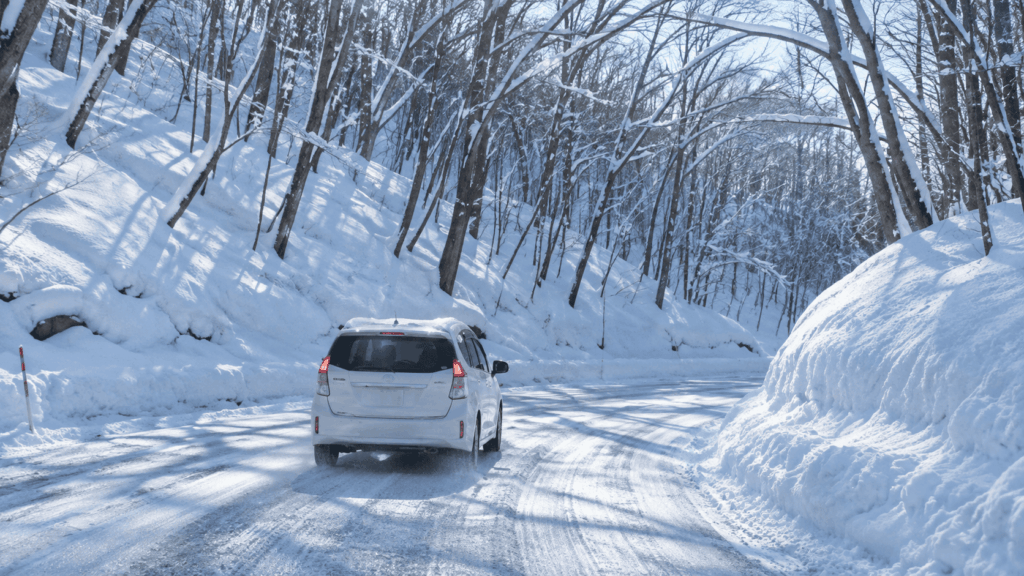
Practically, that leaves three options: a tour with pickup from your hotel or from Roadside Station Minamifurano, a rental car with proper winter tyres, or a private tour from Sapporo. If you are arriving by train or bus, plan to be collected rather than to arrive.
One last navigation warning: several operators meet at the Kanayama Lake recreation centre car park, but White Koala specifically asks guests to wait in the lot on the opposite side of the road from the lake, by the large “”LAKE KANAYAMA”” sign — not the lakeside lot and not the centre itself. Read the meeting instructions on your confirmation, not the map pin for the lake.
What to Wear and Bring for Ice Fishing at Kanayama Lake
You do not need to buy fishing gear. You do need to think harder about clothing than most people do, because the failure mode here is not “”I was cold”” — it is “”my feet were cold after 40 minutes and I wanted to leave.””
| Item | Why it matters | Status |
|---|---|---|
| Insulated, waterproof winter boots | The single item most likely to ruin your day. Snowmobiles and foot traffic leave slush on the ice, and trainers are useless | Essential — rent if you do not own a pair |
| Waterproof outer layer (ski jacket and trousers) | Wind across open ice is the real cold, not the air temperature | Essential — often rentable for ¥800–1,500 |
| Thermal base layers | Tents without heating exist; tents with heating still get cold when the stove is off | Essential |
| Thin gloves for fishing, thick gloves for the sled ride | You cannot easily bait a hook in mittens, and the exposed sled ride leaves your hands cold even in thin gloves | Essential |
| Warm hat | Helps protect your head and ears from wind while you are sitting still | Essential or rentable |
| Heat packs | Use footwear-specific toe warmers as directed, and avoid direct skin contact to prevent burns | Strongly recommended |
| Thick wet wipes | You will handle bait, fish and oil, and there may be no running water | Strongly recommended |
| Rice balls or a light snack | Fried smelt is a taste, not a lunch | Recommended — confirm food rules with your operator |
| Cash in small bills | Some operators are cash-only on the day | Depends on operator |
| Booking confirmation and pickup time | Meeting points differ between operators, sometimes within the same car park | Essential |
| A dry bag or plastic bag | For wet gloves, or for taking fish home | Optional but useful |
Bathrooms, Wet Wipes, and a Regret About Onigiri
I want to be precise about this, because it is the part of the day that gets glossed over and it is the part that determines whether you are comfortable or counting the minutes.
Where I fished, there was a portable toilet on the ice and no handwashing facility. That is not a description of Lake Kanayama as a whole — NRA, for example, advertises a dedicated rest house with toilets at its fishing site, and Guideline installs a portable toilet for its own guests. But it is common enough that you should assume nothing. White Koala goes further and tells guests outright that they cannot use the toilets at nearby facilities, and to go before the meeting time.
Kai’s tip: Go to the toilet before you leave your hotel, not when you arrive. Bring thick wet wipes rather than the thin ones — after baiting hooks and handling fish in the cold, you will want something that actually works, and there is no sink. If you are worried about the toilet situation, drink normally in the morning but stop an hour before pickup rather than dehydrating yourself all day.
And bring the rice balls. I keep coming back to this because it is such a cheap fix for such a specific disappointment: you are sitting in a warm tent with a bag of freshly fried fish, everyone around you is eating, and you have nothing to eat them with. Two onigiri bought at a convenience store in Furano would have changed the whole morning.
When Is Ice Fishing Season at Kanayama Lake?
The season runs from late December to late March, and the opening day is decided by ice, not by the calendar. Operators publish planned dates and then adjust them; some years the lake is ready before Christmas, some years the first week of January is a gamble.
| Operator | Planned 2026–27 season |
|---|---|
| Hoshino Resorts TOMAMU: Lake Picnic and Ice Fishing | 24 December 2026 – 24 March 2027 |
| Hoshino Resorts TOMAMU: Wakasagi Ice Fishing | 5 January 2027 – 20 March 2027 |
| Guideline Outdoor Club | 20 December 2026 – 22 March 2027 |
| White Koala | Late December – mid March, subject to ice conditions |
| NRA | Mid December – mid March |
| Hokkaido Private Adventure | Mid January – mid March |
Notice the gap at the front of the season: the resort’s longer programme opens in late December, while the private Sapporo day trip does not start until mid January. If you are travelling in the first week of January, your realistic options are narrower than a generic “”winter season”” search suggests.
Also note that a planned date is not a confirmed departure. Reservations for the TOMAMU programmes, for example, open on 6 November 2026 online — before that, there is nothing to book, regardless of what a search result says.
Weather, Ice Safety, and Cancellations
Ice fishing is weather-dependent in ways that are worth taking seriously rather than worrying about.
Heating carries a real risk. Minamifurano Town explicitly asks anyone using a stove inside a fishing tent to ventilate roughly once an hour to prevent carbon monoxide poisoning, and the town has dealt with serious incidents on this lake. If your tent has a stove, follow the guide’s ventilation routine rather than closing everything up against the cold. This is not a reason to avoid ice fishing; it is a reason not to treat the tent as a sealed room.
Bad weather cancels things. Tours can be called off for insufficient ice, storm-force wind or heavy snow, and operators usually make the call on the morning of the tour. Cooking can also be cancelled separately from the tour itself — Hokkaido Private Adventure notes that fish may not be cooked in very stormy weather, and White Koala says the same about its tempura. You still get the fishing; you may not get the meal.
No fish is not a refund. White Koala states clearly that there is no refund if the fish do not bite, and that is standard. Cancellation terms are separate and stricter than most travellers expect: at White Koala, free cancellation up to eight days before, then 30% within seven days; at Guideline, 100% from the day before. Book only once your dates are firm.
Kai’s tip: Do not read too much into the day’s forecast at the desk. We were told the fish were sluggish before we started and still ended up with close to 100 between two of us — and I have heard the opposite story from other visitors, where a promising morning produced almost nothing. Keep the line moving in small lifts, change depth before you change spots, and let the guide move you if your hole goes quiet. On a two-hour tour you cannot afford to fish patiently and badly for an hour.
Kanayama Lake Ice Fishing FAQ
Can complete beginners try ice fishing at Kanayama Lake?
Yes, and beginners are the core of the market here. Guided tours include the rod, bait and tent, staff drill the hole, and guides show you how to bait the hook and work the line. My companion had never fished and was catching within half an hour. What is not guaranteed is the catch itself, and no operator refunds a quiet day.
How much does ice fishing at Kanayama Lake cost?
Half-day tours meeting near the lake run about ¥5,000–7,000 per adult for the 2026–27 season, with children around ¥4,500–6,000. Add clothing rental of roughly ¥800–1,500 if you need it, plus transport. A private day trip from Sapporo with hotel pickup and an English-speaking guide starts around ¥43,000 per person based on two people.
Can you eat the fish you catch?
Usually yes, as tempura or fried smelt, but the arrangement varies. White Koala, NRA and Guideline include cooking in the tour price; on my trip it was an extra charge, and several operators note that cooking can be cancelled in bad weather even when the tour goes ahead. Confirm whether cooking is included when you book.
When can you go ice fishing at Kanayama Lake?
Roughly late December to late March, with the exact opening set by ice conditions rather than the calendar. For 2026–27, Hoshino Resorts TOMAMU’s longer programme runs 24 December to 24 March and Guideline runs 20 December to 22 March, while private tours from Sapporo typically start in mid January.
Can you get to Kanayama Lake without a car?
Not easily on your own. The JR line between Furano and Shintoku closed in March 2024, so there is no station at the lake. Your realistic options are a tour with pickup — from Furano hotels, Roadside Station Minamifurano, Tomamu’s GAO Outdoor Center, or your Sapporo hotel — or a rental car with winter tyres.
Do I need to speak Japanese to join a tour?
Not for all of them, but check before you pay. White Koala advertises English-speaking staff and both TOMAMU programmes list English as available, while Guideline Outdoor Club states plainly that guests who cannot communicate in Japanese cannot join. Some smaller local operators say nothing about language at all, which is worth treating as a question rather than an answer.
Final Verdict: Who Should Book, and Which Tour
I would go back. Not because of the fish — 100 smelt between two people is a story, not a standard — but because of the two hours themselves: the snowmobile haul across the ice, the absurd comfort of a warm tent in the middle of a frozen lake, and eating something I had pulled out of a hole twenty minutes earlier. That combination is hard to find anywhere else in Hokkaido in February.
Choose Kanayama Lake if you want a genuine winter activity rather than another snow-viewing stop, you are staying in Furano or Tomamu, and you are willing to spend two to three hours outdoors in exchange for something you cannot do at home.
Look elsewhere if you want guaranteed results or full-service comfort without asking questions. A ski resort’s indoor activities, or a shorter snowmobile session, will deliver more reliably for those priorities.
For first-time visitors: book White Koala if you are based in Furano and paying cash is no obstacle; book one of the TOMAMU programmes if you are staying at the resort, and pick Lake Picnic and Ice Fishing if a heated tent matters to you.
For families: check ages first. White Koala accepts children from 5, both TOMAMU programmes are aimed at elementary school age and above, and Guideline sets a 6+ minimum. At TOMAMU, children below the eligible age may accompany adults free of charge without fishing equipment; the child fee applies if they use the equipment.
For travellers on a tight schedule: a two-hour tour plus 40 minutes each way from Furano is a half-day, not a day. Do not attempt this as a stop between Furano and Sapporo on the same afternoon.
For repeat visitors or anyone without a car in Sapporo: the private day trip is expensive but removes every failure point at once — transport, language, clothing, gear. If you have already done the cheap version once, that is the upgrade that changes the experience.
Whatever you book, pack the wet wipes, use the toilet before you leave, and put two rice balls in your bag. The fishing will look after itself.
Hi, I’m Kai. I’m a Tokyo-based travel writer, tourism industry insider, and the author of a published guidebook for international visitors to Japan. With over 10 years of professional experience at a leading Japanese tourism company, my mission is to help you skip the tourist traps and navigate Japan’s best destinations like a local. I believe the perfect day trip is like a traditional kaiseki meal: a beautiful balance of precise planning and unforgettable seasonal discovery. When I’m not out conducting field research, you’ll usually find me drafting new itineraries with one of my favorite fountain pens!