
Winter is the season most people picture when they imagine Shirakawa-go: steep thatched roofs under a metre of snow, smoke rising from a handful of houses, and a valley quiet enough to hear snow sliding off a roof. It is also the season where the gap between the photograph and the reality of getting there is widest. Snow is not guaranteed on your dates, the roads are not a normal Japanese driving experience, and the village runs on a schedule that starts at 8:00 and effectively ends at 17:00.
This guide is built around the four decisions that determine whether a winter visit works: which month, what time, which transport, and what you wear. Get those right and Shirakawa-go in winter is one of the most rewarding places in Japan. Get them wrong and you will spend two hours being cold, queueing for a shuttle, and photographing the back of someone’s parka.
Quick answer: Yes, Shirakawa-go is worth visiting in winter — if snow-covered gassho-zukuri farmhouses are the reason you are going. Choose January or February if snow is the priority (January for fresh snowfall, February for the deepest accumulation), and treat December as a gamble until the last week of the month. Aim to arrive between 8:00 and 9:00 a.m., allow two to three hours in the village, and wear waterproof, insulated boots with real grip. If you have little experience driving on snowy mountain roads, take the highway bus or a guided tour rather than a rental car. The Winter Light-Up is a separate, reservation-only event — not something you can turn up for after dinner.
Prefer to leave the winter transport to someone else? If you’re staying in Kanazawa, a morning guided tour is worth comparing with the highway bus. It removes the need to drive or arrange separate bus tickets while giving you an early visit to the village. Check departure times, available dates and traveler reviews for the Kanazawa morning Shirakawa-go tour before deciding which option fits your plans.
Is Shirakawa-go Worth Visiting in Winter?
Yes, with one condition: you have to want the snow more than you want comfort. Ogimachi is a UNESCO World Heritage Site because its gassho-zukuri houses — the steep, hand-like thatched roofs built to shed heavy snow — are still lived in rather than preserved as a museum set. In winter that architecture finally makes obvious sense. The roofs that look picturesque in summer are doing hard structural work in February, and the village looks like what it is: a mountain community built to survive.
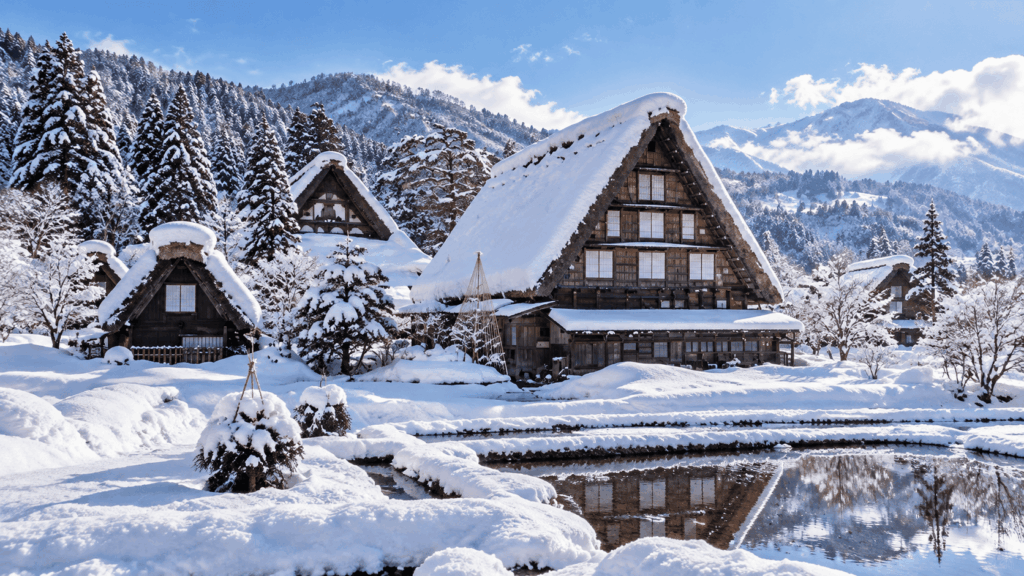
What surprises most first-time visitors is how much of the visit happens outdoors. You walk from the bus terminal into the village, along streets of packed snow, between houses, out to Deai Bridge, and back. There is very little “inside” unless you deliberately build it in, which is why the experience swings so sharply on footwear and timing. The mistake I see most often is treating Shirakawa-go as a scenic stop rather than a winter outing: arrive at midday, walk for forty minutes, take the same photograph from the same corner as everyone else, and leave wondering what the fuss was about. If you are still debating whether to make the journey, read our honest answer on whether a day trip is worth it.
It is also worth being honest about the snow. Recent visitors consistently mention that the village is beautiful in winter but that conditions vary enormously from year to year — some seasons bring roof-deep snow by early January, others leave bare ground into the new year. A winter visit does not guarantee fresh snowfall, and no month guarantees the postcard. What you can control is when you arrive, how long you stay, and whether you are dressed for the day you actually get.
Who Will Love It — and Who Should Skip It
You will love winter here if you care about snow photography, traditional architecture, and the atmosphere of a working mountain village; if walking outdoors in sub-zero temperatures for two or three hours sounds like part of the experience rather than a cost; and if you are willing to start your day early.
You should probably skip it — or come in another season — if icy surfaces make you nervous, you do not want to carry serious winter gear, or you need transport to run exactly to schedule. Snow slows buses, closes the observatory, and suspends shuttles. If a disrupted itinerary would ruin the trip, spring or autumn gives you the same village without the risk.
December vs January vs February: Which Month Should You Choose?
The three winter months are not interchangeable. The figures below are 1991–2020 climate normals for Shirakawa from the Japan Meteorological Agency — long-term averages, not a forecast for your dates. They are the most reliable way to see the difference between “it snows a lot” and “the snow is deep”.
| December | January | February | |
|---|---|---|---|
| Snow reliability | Low in early December, high from late December | High | High |
| Average temperature (high / low) | 5.9°C / −1.7°C | 2.8°C / −4.4°C | 3.8°C / −5.0°C |
| Snowfall vs snow depth | 201 cm of snowfall; deepest snow averages 84 cm | 340 cm of snowfall; deepest snow averages 148 cm | 251 cm of snowfall; deepest snow averages 173 cm |
| Crowds | Moderate, with spikes around New Year | Heavy on weekends, public holidays and Light-Up dates | Heavy on weekends, public holidays and Light-Up dates |
| Best for | Flexible travellers who accept a lower chance of full snow cover | Travellers chasing fresh snowfall | Travellers who want the deepest snow on the roofs |
| Main downside | You may get patchy snow or none at all | Coldest mornings and the busiest event days | Deep cold, ice underfoot, and the same event-day congestion |
| Verdict | Book late December if you can, and keep plans flexible | The best all-round bet for a classic snow scene | The best bet for depth — and the harshest conditions |
December — Winter Arrives, But Snow Is Not Guaranteed
The Shirakawa-go Tourist Association notes that the first snow is usually observed in early December, but that the village stays under snow cover roughly from late December to late February. That distinction matters. A visit in the first half of December can be brown fields with a dusting on the mountains; a visit in the last week can be a full winter scene. If your dates are fixed in early December, go for the village and the architecture, not for the snow photograph.
The trade-off is real, though: December is generally calmer than January and February, accommodation is easier to find, and the roads have not reached mid-winter condition. If you want the winter atmosphere with a slightly quieter village and can accept a lower chance of deep snow, the second half of December is a reasonable compromise.
January — The Best Bet for Fresh Snowfall
January has the highest average snowfall of the three months at 340 cm, which is why it produces the version most people are hoping for: snow falling, roofs loading up, and the village resetting itself every few days. It is also the month when one storm can transform the place overnight.
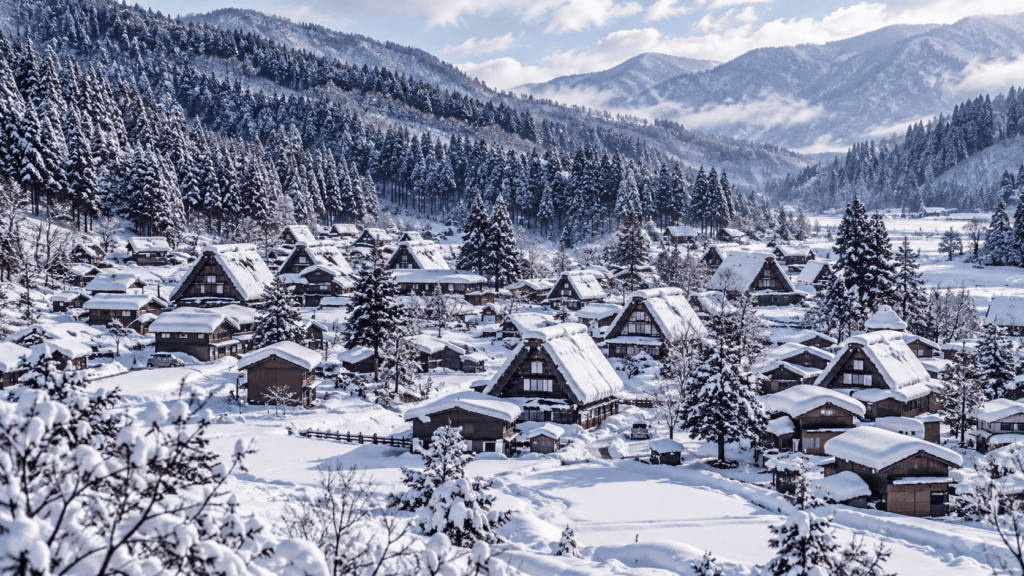
The catch is concentration. Weekends, the Coming of Age Day holiday weekend, and the four Winter Light-Up evenings bring coach tours and day-trippers into a village with one main street. If your dates are flexible, choose a weekday, and check whether your visit collides with a Light-Up date before booking transport — the event changes access rules for the whole afternoon.
February — The Deepest Snow, Still Bitterly Cold
February’s snowfall average is lower than January’s, but its deepest snow average is the highest of the three at 173 cm. That is the difference between fresh powder and a village buried for weeks: by February the snowpack is established, the roofs are carrying their full load, and the landscape has the compacted, sculpted look that photographs so well.
It is also the coldest month on paper, with an average low of −5.0°C, and ice underfoot is more persistent than in December. Year-to-year variation remains large — a mild February can look very different from the images you saw online — so build your expectations around the village rather than a specific photograph.
How Cold Is It, and What Should You Wear?
Shirakawa sits in a mountain valley in Gifu, and winter here is not the same winter as Tokyo or Kyoto. Average highs sit just above freezing in January and February, and average lows drop to −4.4°C and −5.0°C. Those are averages, which means mornings well below that, with a wind running down the valley that makes standing still unpleasant. What actually ends a winter visit early is wet feet, cold hands, and standing in one place while the sun goes behind the ridge — so plan for damp and wind, not just for “cold”.
What to Wear in Shirakawa-go in Winter
Dress in layers you can open and close, and treat the following as the minimum rather than the ideal:
- A warm base layer and an insulating mid-layer
- A proper down or insulated winter coat that blocks wind
- Gloves and a warm hat — you will take your gloves off constantly for your phone
- Waterproof, insulated boots with a grippy sole
- Thick socks, and a spare pair in your bag
Ordinary fashion sneakers are the single most common mistake. Packed snow is walkable; slush, refrozen footprints, and the shaded edges of the street are not. Waterproofing matters more than bulk, and grip matters more than style.
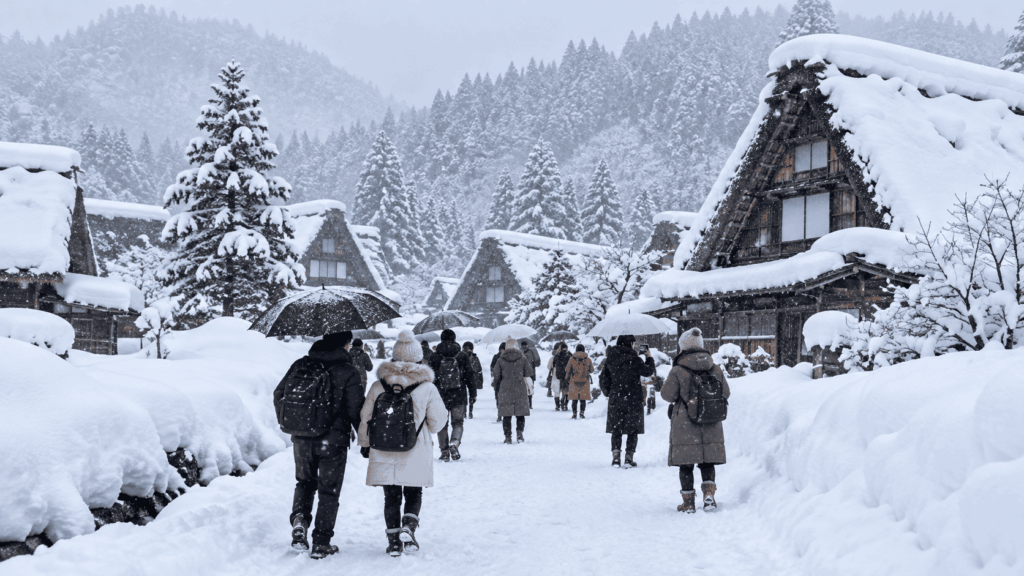
Kai’s tip: I once spent a morning in the village with a traveller who had dressed for a Tokyo winter — a wool coat, ordinary shoes, no gloves — and watched the cold grind them down within the first hour. The lesson was not “bring more layers”. It was that wet feet and wind end a winter visit far faster than the temperature reading does, which is why I would put boots ahead of a second jacket on any packing list.
Bring Boots or Rent Them at the Bus Terminal?
There is a limited rental service inside Shirakawago Bus Terminal for exactly this problem: rubber boots in sizes 23.0–27.0 cm, about three pairs per size, available 8:30–17:00, costing ¥1,000 for the day (¥1,500 for two days). You cannot reserve them, and they are not rented during Light-Up event periods.
Treat this as an emergency fallback, not a plan. Three pairs per size disappear quickly on a snowy weekend, and an early arrival puts you in competition with everyone who had the same idea. Bring your own boots if you own a pair that is genuinely waterproof.
What Time Should You Arrive to Avoid the Crowds?
The village is a lived-in community, and the official guidance is that sightseeing takes place between 8:00 and 17:00; the main car park keeps the same hours. That is the practical limit on “early”. Arriving at dawn does not get you into the village sooner — it gets you waiting in a car park for it to open.
Within those hours, the difference between 8:30 and 12:30 is significant. Coach tours from Kanazawa, Takayama and Nagoya tend to land in the late morning and around lunchtime, and the main street narrows to a slow-moving line of people. If you are travelling independently, aim to be walking into Ogimachi between 8:00 and 9:00 a.m. — which is achievable: the first bus from Takayama arrives at 8:40, and the 8:10 departure from Kanazawa reaches the village at 9:25.
Kai’s tip: The change around midday is not subtle. I have watched the village go from near-empty streets to a steady stream of coach groups within about an hour, and the difference in how easy it is to walk, stop, and frame a photograph is dramatic. If you can only manage one early start on your trip, spend it here rather than on a city market.
A Realistic 2–3 Hour Winter Route
Two to three hours is the official guidance for the village, and it is about right in winter — assuming you are not queueing for the observatory for half of it. (For a broader look at structuring your day, see our guide to planning a Shirakawa-go itinerary.) A sensible order:
- Start at Shirakawago Bus Terminal or Seseragi Park Parking and walk into the village. The approach is snow-covered; this is your first footwear test.
- Walk the main lanes of Ogimachi while the streets are still quiet, toward Deai Bridge and the open area beyond it.
- Check the observatory shuttle early at the stop beside Wada House. If the queue is already long, decide now whether the view is worth the time.
- Visit one open gassho-zukuri house — this is also your warm-up stop.
- Return through the village streets at a slower pace, crossing Deai Bridge if you have not already.
- Add the Open-air Museum Gassho-zukuri Minkaen only if you still have an hour and the weather is cooperating.
If time runs short, cut in this order: the observatory first, then Minkaen, then the second open house. Do not cut the walk itself — the village streets are the point. If you plan to eat during your visit, check our shortlist of what to eat in Shirakawa-go to see how it fits into a tight schedule.
How to Get to Shirakawa-go in Winter
The decision is less about cost than about your experience with snow. If you have driven regularly on snowy mountain roads, a rental car gives you the most freedom. If you have not, this is not the route to learn on: it involves highway driving, mountain roads, and a car park that can back up with queueing traffic.
| Highway bus | Guided tour | Rental car | |
|---|---|---|---|
| Best for | Independent travellers who do not want to drive | Travellers who want winter driving and logistics removed | Experienced winter drivers who want flexibility |
| Flexibility | High once you are there; fixed departure times | Low — the schedule is set for you | Highest |
| Winter driving required | No | No | Yes, including studless tyres |
| Reservation risk | Moderate — popular morning departures fill up | Low if booked ahead | Low, but winter-equipped cars are limited |
| Early arrival potential | Good — 8:40 arrival from Takayama, 9:25 from Kanazawa | Good — in the village by mid-morning | Good, subject to the car park opening at 8:00 |
| Cost tendency | Around ¥2,900 one way per person | Higher per person, but includes transport and a guide | Highest once fuel, tolls and ¥2,000 parking are added |
| Main downside | You are tied to a timetable, and delays are common in snow | Limited free time in the village | You are responsible for the hardest driving of your trip |
Highway Bus — Best for Independent Travellers Who Don’t Want to Drive
The Takayama–Shirakawa-go–Kanazawa route is run jointly by Nohi Bus and Hokutetsu, with most departures requiring a reservation. Journey times are roughly 50 minutes from Takayama Nohi Bus Center and 1 hour 15 minutes from Kanazawa Station. Fares are scheduled to be revised on 1 December 2026 to ¥2,900 one way on both sectors.
Two things to plan around. First, the morning departures are the ones that fill: the 7:50 from Takayama (arriving 8:40) and the 8:10 from Kanazawa (arriving 9:25) are exactly the services that give you the quiet village, so book early rather than hoping for a walk-up seat. Second, the operator warns that snow, highway closures and car-park queues can delay buses by two hours or more, in both directions. Do not book a tight onward connection, especially a flight or the last train of the day.
The bus terminal has coin lockers, and the tourist association can hold luggage nearby between 8:00 and 17:00 if they are full, which makes a bus-based day trip from Takayama or Kanazawa genuinely practical.
Guided Tour — The Simplest Winter Option
If the appeal of a tour is not “someone talks at me about history” but “I do not want to drive on snow or assemble a winter timetable”, this is the option that removes both problems at once. The Kanazawa: World Heritage Shirakawa-go Morning Guided Tour, operated by Japan Panoramic Tours, leaves from the Kanazawa Station west side at 8:00 (check-in 7:50), reaches the village in about 80 minutes, gives you roughly two hours and twenty minutes in Shirakawa-go, and finishes near Kenrokuen Garden around 13:00. It runs about five hours in total, with an English- and Japanese-speaking guide and multilingual audio commentary.
It suits travellers based in Kanazawa who want an early start without organising buses, and anyone whose main worry is the drive. It does not suit travellers who want four or five hours to wander or wait for light — reviewers commonly mention that the early departure makes the village feel manageable, and just as commonly mention wishing they had more time there. Both things are true.
Two clarifications. This is a daytime tour; it is not a Winter Light-Up tour and will not have you in the village in the evening. And the village time is guided rather than fully independent, so if you want to disappear down a side lane for forty minutes, a bus and your own schedule may serve you better.
If you fall into the other camp — you want to experience the snow-covered village without handling winter roads or piecing together bus reservations — this Kanazawa morning tour is the one option worth looking at more closely.
Why I’d book this one
- An early start that makes the visit manageable: Recent travelers appreciate the morning departure and the opportunity to explore Shirakawa-go before the busiest part of the day, although the time in the village is limited.
- English-language context rather than just transport: Traveler feedback frequently highlights helpful guides and explanations that make the traditional houses and village history easier to understand.
- A straightforward half-day commitment: Transport and guiding are arranged together, with a return to Kanazawa around early afternoon. Check the current cancellation and payment conditions on the booking page before choosing your date.
See live availability, current prices, tour details and recent traveler reviews for the Kanazawa morning Shirakawa-go guided tour. Compare the available dates and village time with your own plans, especially if you want more freedom to explore independently.
Rental Car — Only If You’re Comfortable in Serious Snow
A car lets you arrive at 8:00, leave when the light goes, and stop wherever you like on the way. It also puts you on the road that causes the most problems for visitors. The village asks drivers to use studless winter tyres as a rule from mid-November to early April, and rental companies in the region supply winter-equipped cars — confirm this explicitly when booking, because “4WD” is not the same as “winter tyres”.
Parking is at Seseragi Park Parking: ¥2,000 for a standard car, open 8:00–17:00 with last entry at 16:30. The observatory car park is closed, so you cannot drive up to the viewpoint. If you are confident on snow and ice, a car works well. If you are not, the money you save will not feel like a saving on the descent into the valley.
How to Get to the Observatory in Winter
The Ogimachi Castle Site observation deck is the view you have seen in every second photograph of the village, and access is more restricted than most guides suggest. The car park at the top has been closed since December 2023, so there are only two ways up: the shuttle bus, or walking.
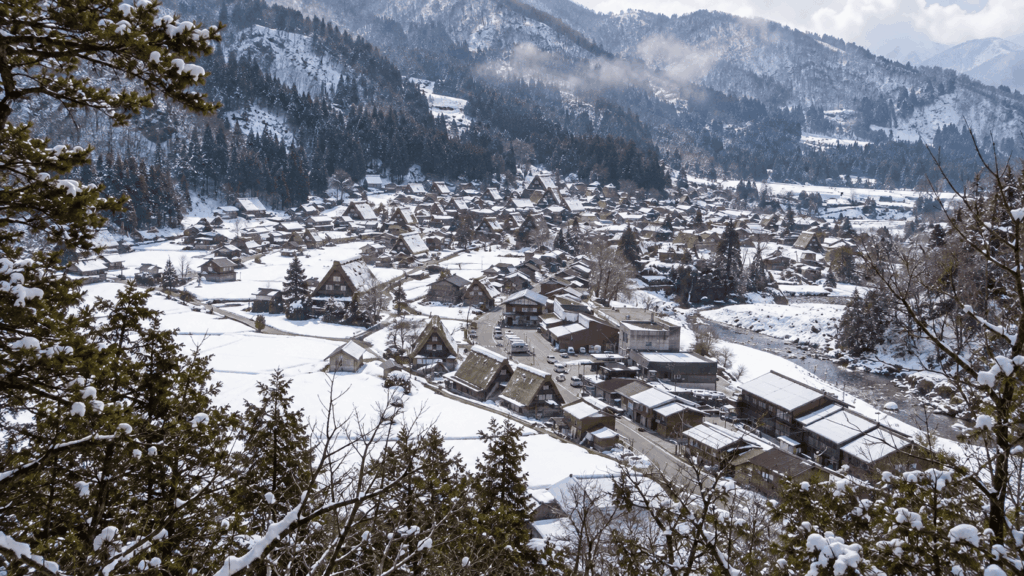
The shuttle leaves from the stop beside Wada House, about 200 metres from the bus terminal. It runs roughly every 20 minutes from 9:00 to 15:40 uphill and 9:10 to 16:10 downhill, costs ¥300 one way in cash, and takes about ten minutes. Note the gap: there is no uphill service through the 12:00 hour, with the next departures at 13:20 and 13:40. Arriving at the stop at 12:10 means waiting.
Walking is possible via the slope behind Wada House — around 600 metres, 15 to 20 minutes uphill. In winter, however, sections of the walking route can be closed when snow is sliding off roofs or being cleared, and the shuttle itself can be suspended in poor visibility or heavy snow. Do not treat the walk as your guaranteed fallback; check the day’s status at the terminal or the tourist association before you commit.
Kai’s tip: The shuttle is small and the queue moves more slowly than it looks. I once let a full bus go rather than wedge the group I was with onto it, and the reset cost us the rest of our planned loop. If you only have two hours, decide before you join the queue that the view is worth losing something else — because the queue will make that decision for you otherwise.
What If the Shuttle Is Full?
You have three sensible options, in this order:
- Wait for the next departure. With 20-minute intervals, one missed bus is manageable if you have three hours in the village.
- Skip the observatory. With two hours, the village streets and one open house will give you a better visit than forty minutes of queueing.
- Do not substitute a closed walking route. If the slope is shut for snow clearing or falling snow, that is a safety decision, not a suggestion.
Don’t Just Photograph the Village — Go Inside
The most common regret among winter visitors is that they photographed the village from outside and left. A gassho-zukuri house is not a decorative shell; it is a working response to this climate, with a steep roof designed to shed snow, upper floors once used for silkworm rearing, and a central hearth that has been doing structural as well as domestic work for generations.
Stepping inside changes the visit twice over. You get the explanation — why the roof is that shape, how silk production paid for it, how a family lived around a single heated room — and you get twenty minutes out of the wind at the point in the day when your hands have stopped working properly. What stays with me from winter visits is not the view from the observatory but the heat of a hearth inside one of these houses, and the steepness of the stairs up to the upper floor. It is also worth remembering that people still live in Ogimachi: these are homes first and sightseeing sites second.
Wada House or Minkaen — Which Fits a Short Visit?
Wada House is the easiest addition to a short loop: it sits inside the main village, is open 9:00–17:00 with irregular closing days, costs ¥400 for adults, and is cash only. If you have two hours, this is the one to choose.
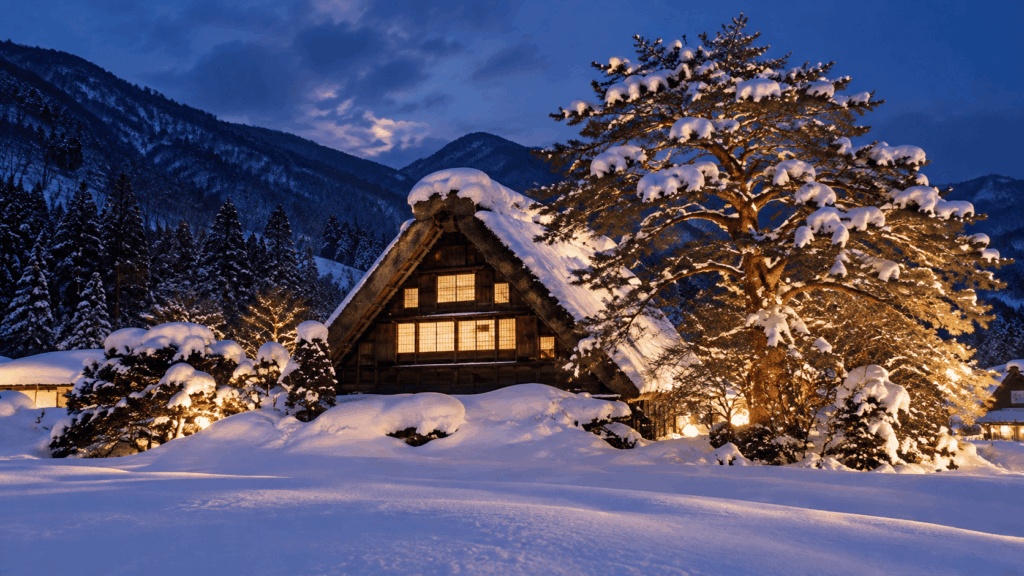
Open-air Museum Gassho-zukuri Minkaen is a separate collection of relocated traditional buildings, better for understanding construction and village life as a system. It costs ¥800 for adults and ¥400 for school-age children, and in winter it opens 9:00–16:00 with last entry 20 minutes before closing. It is closed on Thursdays from December to March (or the preceding day if the Thursday is a public holiday). With only two hours in the village, it usually does not fit.
Winter Light-Up Is Not a Regular Nightly Event
This is the most expensive misunderstanding in Shirakawa-go winter planning. The village is not lit up every evening. The Winter Light-Up is a ticketed event held on a handful of dates, and for the 41st event in 2027 those dates are 11, 17, 24 and 31 January, 17:30–19:30.
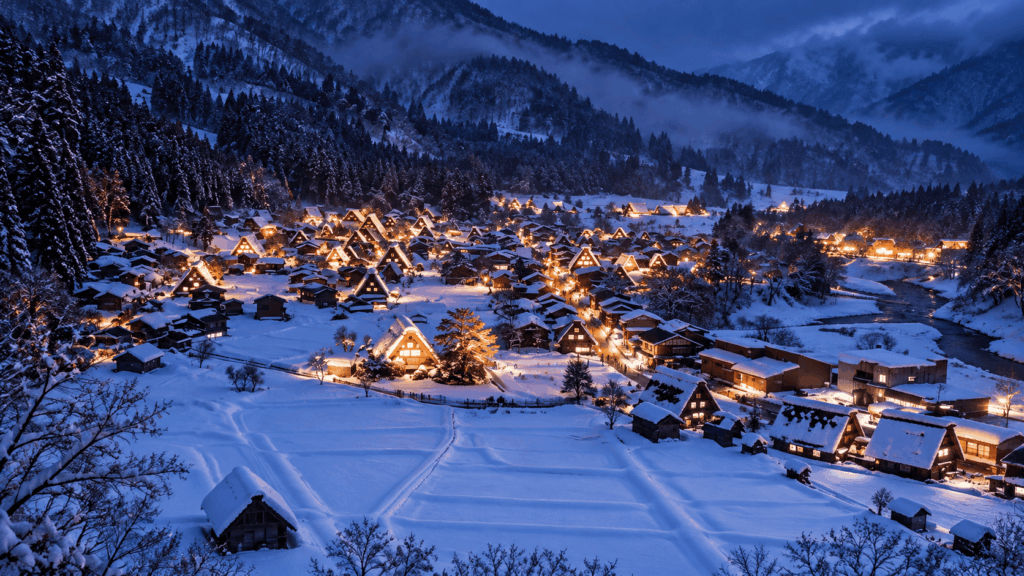
It is fully advance-reservation only, with an admission-ticket system and no same-day sales. Arriving without a reservation means being turned away, even on the night. There is also a separate observatory ticket: an admission ticket lets you walk the illuminated village but not go up to the viewpoint, and observatory tickets are not sold on their own — they come through specific accommodation packages or designated bus-company tours.
Event days also change the daytime rules. Gates go up at 15:30, and anyone without an event ticket cannot enter the village after that. Day visitors arriving by scheduled bus need a service that gets them in by 15:20, and car parking for daytime visitors closes to new entries at 15:00. The walking route to the observatory shuts at 16:10 on event days, and the boot rental at the bus terminal does not operate during event periods.
Dates are announced each autumn for the coming season, so check the tourist association’s current event page rather than assuming this year’s pattern will repeat. And if your trip is built around the Light-Up, book the event first and the transport second — not the other way round.
A Winter Plan That Works for Most First-Time Visitors
If you want one plan rather than a menu, this is the version I would give a friend visiting for the first time:
- Pick January or February if snow is the reason for the trip; late December if your dates are already fixed and you want a calmer village.
- Target an 8:00–9:00 a.m. arrival, using the early bus from Takayama or Kanazawa, or a morning tour.
- Allow two to three hours in the village, and decide on the observatory in the first twenty minutes rather than the last.
- Go inside one open house — Wada House for a short visit, Minkaen if you have an extra hour and it is not a Thursday.
- Wear waterproof boots and a real winter coat. Rent boots at the terminal only if you have no alternative.
- Take the bus or a tour unless you genuinely drive on snow at home. Build slack into whatever comes after.
If that list sounds like more logistics than you want on a short trip — particularly the winter driving and the bus reservations — the Kanazawa morning tour solves both in one booking, at the cost of a fixed schedule and less wandering time. That is the trade to make consciously rather than by default.
Frequently Asked Questions
Does Shirakawa-go have snow in December?
Often, but not reliably. The first snow is usually observed in early December, while the village typically stays under continuous snow cover from late December to late February. A visit in the first half of December can mean patchy snow on the mountains and brown fields in the village; the last week is much more likely to look like the photographs. If snow is your main reason for going, December is the weakest of the three winter months.
Is January or February better for Shirakawa-go?
They are strong for different reasons. January has the highest average snowfall (340 cm), so it is better for catching snow falling and roofs reloading. February has the deepest average snowpack (173 cm), so it is better for the buried, sculpted look — at the cost of colder mornings and more persistent ice. Choose January for fresh snow, February for depth. Neither guarantees a particular scene, since snowfall varies widely year to year.
Do I need snow boots for Shirakawa-go?
Yes, in any month when snow is on the ground. Waterproof, insulated boots with a grippy sole make the difference between a comfortable two-hour walk and a miserable one, because the streets are packed snow, slush and refrozen footprints rather than clear pavement. Ordinary sneakers are not adequate. There is a limited rental at Shirakawago Bus Terminal (23.0–27.0 cm, about three pairs per size, 8:30–17:00, ¥1,000 for the day), but it cannot be reserved and does not operate during Light-Up event periods.
Can I drive to Shirakawa-go in winter?
You can, and people do every day — but it is a genuine winter mountain drive, not a normal Japanese road trip. Studless winter tyres are expected as a rule from mid-November to early April, and rental cars need to be booked specifically as winter-equipped. If you do not regularly drive on snow and ice at home, the highway bus or a guided tour is the more sensible choice.
Is Shirakawa-go lit up every night in winter?
No. The Winter Light-Up is a ticketed event held on a few dates only — for the 41st event, 11, 17, 24 and 31 January 2027, from 17:30 to 19:30. It is fully advance-reservation only, with no same-day sales. An admission ticket allows you to walk the illuminated village but not to go up to the observatory, which requires a separate ticket obtained through specific accommodation packages or designated bus tours.
How many hours do you need in Shirakawa-go?
Two to three hours covers the main village loop and one open house at a reasonable pace. Add an hour if you want the observatory and Minkaen as well. With only two hours, prioritise the village streets and Wada House over the observatory queue — most visitors who feel rushed have spent their time waiting for the shuttle rather than walking.
Can you visit the observatory in winter?
Yes, by shuttle bus or on foot, but access is more limited than it looks. The car park at the top is closed, so the options are the shuttle from beside Wada House (roughly every 20 minutes, 9:00–15:40 uphill, ¥300 one way in cash, no uphill service during the 12:00 hour) or the 600-metre slope behind Wada House, which takes 15–20 minutes. In winter, sections of the walking route can be closed for falling snow or clearing work, and the shuttle can be suspended in heavy snow or poor visibility.
Final Verdict
There is no single best month or best way to visit Shirakawa-go in winter, only the version that fits your priorities. Decide which of these describes you before you book anything.
- Choose January or February if snow-covered gassho-zukuri roofs are the whole point of the trip. January for fresh snowfall, February for the deepest accumulation. Accept the cold and the event-day crowds as part of the deal.
- Choose December if you want a calmer village and can live with a lower chance of full snow cover — ideally in the last week of the month rather than the first.
- Take the highway bus if you want to wander independently and are happy to plan around fixed departures. Book the early Takayama or Kanazawa service, and do not schedule anything tight afterwards.
- Take the Kanazawa morning tour if winter driving and timetable-building are the parts you would rather not handle. You trade freedom for a guaranteed early arrival and someone else managing the road.
- Rent a car only if you already drive confidently on snow. The freedom is real, but so is the responsibility, and the observatory car park is closed regardless.
- Skip winter entirely if ice makes you anxious, you cannot carry proper boots and a winter coat, or a disrupted itinerary would spoil the trip. The village is extraordinary in any season, and spring or autumn removes most of the risk.
- If you are coming specifically for the Light-Up, treat it as a separate trip with its own booking sequence: event ticket first, then transport, then accommodation. A standard daytime tour will not put you in the village at 17:30.
What I would tell a friend visiting for the first time is this: the difference between a good winter visit and a disappointing one is rarely the weather. It is whether they arrived at 8:30 or at noon, whether their feet were wet by ten o’clock, and whether they went inside a house or only photographed it from the street. Snow you cannot control. Those three things you can.

Hi, I’m Kai. I’m a Tokyo-based travel writer, tourism industry insider, and the author of a published guidebook for international visitors to Japan. With over 10 years of professional experience at a leading Japanese tourism company, my mission is to help you skip the tourist traps and navigate Japan’s best destinations like a local. I believe the perfect day trip is like a traditional kaiseki meal: a beautiful balance of precise planning and unforgettable seasonal discovery. When I’m not out conducting field research, you’ll usually find me drafting new itineraries with one of my favorite fountain pens!