
Kanazawa in winter is worth the trip — just not for the reason most people book it. The city does not sit under a guaranteed blanket of snow. Snow usually starts around late December and can fall into February, and January has historically been the strongest bet for snow on the ground. But a snowy month is not the same as a snowy travel day. When I walked through Kanazawa with overseas visitors in February 2026, expecting the postcard version, there was no snow on the streets or in Kenrokuen at all.
The trip still worked. The yukitsuri — the rope cones that protect the garden’s pines — were up and genuinely striking without a white backdrop, the winter seafood was the best I’ve eaten in the city, and the cold, quiet streets had their own appeal. If seeing a snow-covered Japan is a non-negotiable goal of your trip, central Kanazawa is the wrong place to pin that hope on by itself. Add a snowier area such as Gokayama or Shirakawa-go to the itinerary instead.
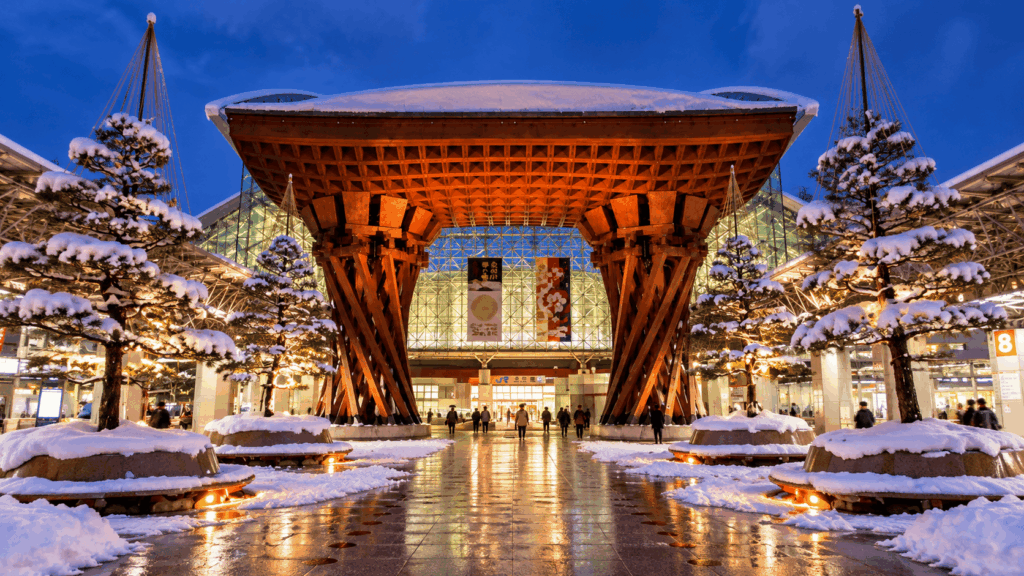
- Best month for snow: January, historically — about 22.7 days with snowfall and an average deepest snow depth of 27 cm (JMA 1991–2020 normals)
- Best month for atmosphere: February, when Kenrokuen holds its winter illumination
- Best month for crab: December, if you want kobako crab — the season ends December 29
- What to pack: waterproof shoes with grip matter more than heavy snow boots
- If snow is essential: plan a day trip toward Gokayama or Shirakawa-go rather than relying on the city
Want to see the snowier side of the region?
If a mountain-village winter landscape is a priority and you have a full day to spare, a guided trip from Kanazawa to Gokayama and Shirakawa-go is worth comparing with the DIY bus route. Snow is never guaranteed, so check the itinerary and available dates before deciding.
See the Kanazawa day tour itinerary, departure options, and traveler reviews →
Is Kanazawa Worth Visiting in Winter?
Yes, with one condition attached: go for winter itself, not for a snow guarantee.
Winter is when Kanazawa’s food is at its most interesting, when Kenrokuen’s pines wear their rope cones, and when the Higashi Chaya District is quiet enough to hear your own footsteps on the stone. Those things happen whether or not it snows. What does not happen on demand is the scene on the tourism posters — a garden, a castle wall and a row of teahouses all buried in fresh snow.
On my February 2026 visit, the ground was bare from Kanazawa Station through Omicho Market and up to Kenrokuen. The visitors I was with had built the stop around snow photos, and I had to reset their expectations on the walk up. What rescued the day was the Karasaki Pine under its cone of ropes: even without snow, the structure is a piece of winter engineering you won’t see elsewhere, and it photographs well in flat grey light. That is the honest version of winter in Kanazawa — a season of specific, man-made and culinary pleasures, with snow as a bonus rather than a promise.
Best for:
- Travellers who care more about winter food than winter photos
- Anyone who wants to see Kenrokuen’s yukitsuri, which is a winter-only sight regardless of snow
- Photographers comfortable with grey skies, rain and uncertain conditions
- People who enjoy a quieter, colder version of a city they may have seen in summer photos
- Travellers willing to reshuffle plans the morning of, based on the weather
Not ideal for:
- Travellers whose main reason for coming is guaranteed snow
- Anyone who finds walking on wet, slippery surfaces difficult or stressful
- People who dislike repeated cold outdoor sightseeing with short daylight
- Rigid itineraries with no room to move an outdoor day indoors
When Does It Snow in Kanazawa?
Kanazawa’s snow season runs roughly from late December through February. The city sits on the Sea of Japan side of Honshu, where cold air picks up moisture over the sea and dumps it as snow — the same pattern that buries Niigata and Toyama. What surprises visitors is not that it snows, but how often it snows without the city turning white.
| Kanazawa, 1991–2020 normals | December | January | February |
|---|---|---|---|
| Average high | 10.2°C | 7.1°C | 7.8°C |
| Average low | 3.5°C | 1.2°C | 1.0°C |
| Monthly snowfall | 24 cm | 67 cm | 53 cm |
| Average deepest snow depth | 11 cm | 27 cm | 22 cm |
| Days with snowfall | 14.5 | 22.7 | 19.9 |
| Sunshine hours | 68.9 | 62.3 | 86.5 |
Read those numbers together and a useful picture appears. In January, snow falls on roughly three days out of four — yet the average deepest snow depth for the month is only 27 cm, and the official tourism board notes that even when snow accumulates it is usually just a few centimetres, and that snow rarely stays on the ground for long in the city centre. The reason is partly infrastructure: main roads and pavements downtown have underground water systems that melt snow as it settles. You will seldom walk on snow in central Kanazawa. You will often walk on wet pavement.
The other number worth noticing is sunshine. January averages around 62 hours of sun for the entire month; December is barely better at 69. Winter here is not only cold, it is dark. That matters for photography, for mood, and for how long you can comfortably stay outside.
Weather in a single winter can swing wildly. In late January 2026, 37 cm of snow fell on Kanazawa in six hours — the heaviest six-hour total on record for the city. When I visited the following month, there was no snow on the ground at all. Both of those are Kanazawa. Planning around one of them is a gamble.
Snowfall Is Not the Same as Snow Cover
This is the distinction that decides whether your trip feels like a success or a disappointment, and most winter guides skip it.
Snowfall is what comes out of the sky over a month. Snow cover is whether the ground under your feet is white on the two or three days you happen to be there. A month can record 67 cm of snowfall and still hand you a bare Tuesday. Snow melts, rain washes it away, temperatures hover just above freezing, and the city’s snow-melting system does the rest. Kanazawa’s January figures — heavy snowfall, modest average snow depth — describe exactly this pattern.
So the useful question is not “does it snow in Kanazawa in January?” It does. The useful question is “will it be lying on the ground on the morning I walk to Kenrokuen?” Nobody can answer that more than a few days ahead, and that is the whole reason this article exists.
Kai’s tip: Treat the morning of your visit, not the month you booked, as the real decision point. I check the forecast the night before and again at breakfast, because a wet city at 9 a.m. can turn white by noon, and the reverse happens just as often. If you have only one full day in Kanazawa, keep it flexible enough to swap a museum afternoon with a garden morning at short notice.
Kanazawa in December vs January vs February
All three months are winter, but they are not interchangeable. December is about food and the run-up to New Year. January is the statistical best bet for snow, and the least comfortable month to be outdoors. February keeps most of January’s snow potential while adding the illumination and noticeably longer days.
| December | January | February | |
|---|---|---|---|
| Snow odds | Lowest of the three | Highest, historically | Still good, but variable |
| Daylight and mood | Short days, festive streets | Darkest month, few sunny hours | Days lengthening, brightest of the three |
| Seasonal food | Kobako crab until December 29 | Kano crab, cold yellowtail, oysters | Kano crab, oysters, late-season seafood |
| Winter events | City illuminations, New Year preparations | New Year period, closures January 1–4 | Kenrokuen winter illumination on selected nights |
| Main downside | Rain more likely than snow cover | Market and restaurant closures around New Year; least sunshine | Snow-free days still happen |
| Best for | Food travellers, anyone avoiding deep cold | Snow chasers willing to accept grey skies | Travellers who want snow potential plus atmosphere |
Kanazawa in December
December is the month I would choose for eating, not for snow. The kobako crab season — the small female snow crab that locals prize — closes on December 29, so early-to-mid December is your last realistic window for it. The city also feels like it is preparing for something: shopfronts get busy, illuminations go up around Omicho, Korinbo and Katamachi, and the streets have more local energy than in the dead of January.
Snow is possible, especially in the second half of the month, and the city averages 14.5 days with snowfall. But the average deepest snow depth is only 11 cm, and early December in particular often delivers rain rather than the white streets people picture. If your dates are fixed in early December and snow is the goal, adjust the goal.
Kanazawa in January
January is the strongest statistical choice for snow: 67 cm of snowfall on average, 22.7 days with snow falling, and an average deepest depth of 27 cm — the highest of the three months. It is also the month that most tests your tolerance for being outside. The average low is 1.2°C, sunshine drops to about 62 hours, and the light is flat for days at a time.
The practical trap in January is the calendar rather than the weather. Omicho Market is effectively closed from January 1 to 4, with shops reopening from January 5, and many restaurants and small businesses take New Year holidays too. Arriving on January 2 hoping for a crab breakfast is a plan that fails quietly. If you want January’s snow odds without that risk, aim for the second week onward.
Kanazawa in February
February keeps most of January’s snow potential — 53 cm of snowfall, 19.9 days with snow, 22 cm average deepest depth — while being the brightest of the three winter months at around 86 hours of sunshine. It is also the month when Kenrokuen holds its winter illumination. For the 2027 season the garden is lit on February 6–10, 13, 20 and 27, from 18:00 to 20:45, with free entry during illumination hours; the dates shift from year to year, so confirm them before you build a trip around one night.
February is where I would put my own experience, and it is a caution as much as a recommendation. My visit fell in a completely snow-free stretch: no snow on the streets, none in the garden, nothing on the castle grounds. If I had sold that trip to my companions as a snow trip, it would have been a failure. As a winter food and garden trip with a night-time illumination, it was excellent. February gives you the most ways to win — as long as snow isn’t the only way you’ve defined winning.
What Winter in Kanazawa Actually Feels Like
The temperature numbers undersell the difficulty. Kanazawa’s winter lows are close to Tokyo’s, and the tourism board makes the point that you don’t need expedition-grade clothing. What the numbers don’t capture is the wet. Cold, damp air, pavement that stays dark with moisture all day, and a wind that finds the gap between your scarf and your collar. This deep chill is why booking a Kanazawa hotel with a private onsen is one of the best investments you can make for a winter trip.
Two places taught me this faster than any weather chart. The ground floor of Omicho Market, where the arcade funnels cold air straight through and the chill comes up through the concrete — I lasted about twenty minutes before my fingers stopped cooperating with my camera. And the stone paving of the Higashi Chaya District after a bout of rain and sleet, which looks beautiful and behaves like a skating rink in the shaded stretches.
There is also the local weather theatre: sudden claps of thunder in winter, known locally as buri-okoshi, or “yellowtail-waking thunder”, sometimes followed by hail that turns to snow. It is startling the first time and, after a few days, oddly enjoyable. Just don’t mistake a bright-looking sky for a settled one.
You May Need Waterproof Shoes More Than Snow Boots
For city sightseeing, the priority is waterproofing and grip, not bulk. Central Kanazawa’s main roads and pavements are heated by underground water systems, so snow melts quickly and you rarely walk on snow itself. What you walk on is wet stone, wet tile and slush at the crossings. Smooth-soled fashion boots and canvas sneakers are the wrong tools; a waterproof walking shoe or a low boot with a decent tread is the right one.
If you arrive and the city is under a heavier fall than expected, you don’t need to have packed for it. The Kanazawa Tourist Information Center inside Kanazawa Station lends rubber boots free of charge — men’s sizes roughly 24.5–29 cm and women’s roughly 21.5–26 cm. Availability isn’t something to build a plan around, but it takes the panic out of a surprise snowfall.
Kai’s tip: I would rather carry one pair of waterproof shoes that packs flat than check a bag for snow boots I use twice. On my February trip the boots would have been dead weight; the wet pavement was the only thing that mattered. The exception is a heavy-snow forecast or a trip up into the mountains — that’s a different decision, and worth a different pair of shoes.
What to Wear in Kanazawa in Winter
Think in layers you can remove, because winter sightseeing here is a loop of cold street, overheated shop, cold street, heated café. A warm base layer, a sweater or fleece, and a windproof outer layer covers the daytime. Add gloves and a scarf — not optional if you plan to stand still for photos.
Evenings need more than daytime. After sunset the temperature drops quickly and the damp air makes it feel sharper than the thermometer suggests. On the night of the illumination I was glad of a proper down jacket over everything else, and I would have been miserable in the coat I’d worn comfortably at midday.
What Kenrokuen Is Really Like in Winter
Kenrokuen is the reason most people picture Kanazawa in winter, and it is worth managing the visit properly rather than drifting in at random.
In winter the garden opens at 8:00 and closes at 17:00, from October 16 to the end of February. Admission is ¥320 for adults and ¥100 for children aged 6 to 17, with free entry for visitors 65 and over. There is also a free early-morning window: from November to February the gates open at 6:00 at no charge, but you must leave 15 minutes before normal opening, and only two entrances are open — the Renchimon and Zuishinzaka gates. That early slot is the single best trick for seeing the garden without crowds, and for catching fresh snow before footprints arrive.
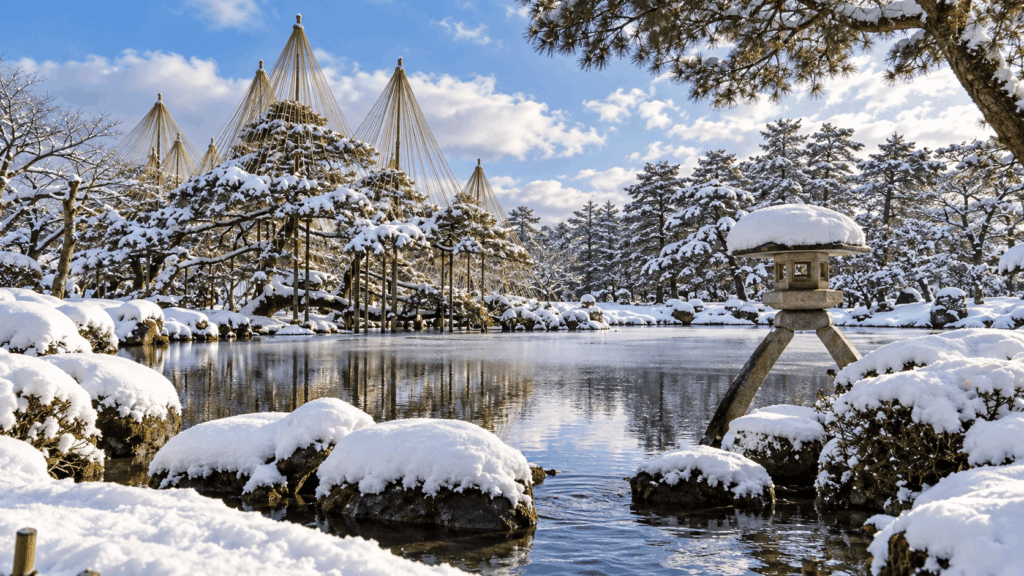
The yukitsuri are the winter centrepiece. The work begins around November 1, starting with the Karasaki Pine, and takes about six weeks to complete across the garden. The ropes stay in place until mid-March, which means the cones are there in December, January and February alike — you are not dependent on a particular month to see them.
Is Kenrokuen Still Worth It Without Snow?
Yes, and this is the part I would tell a friend before anything else. The yukitsuri is a structure, not a weather event: dozens of ropes fanning out from a single point above the pine, tied by hand, designed to shed snow that may never come. Seen against bare branches and grey sky, it looks like a piece of temporary architecture. My February visit had no snow at all and the Karasaki Pine was still the thing I photographed most.
What you should adjust is the expectation of a white landscape. If your mental image is the garden fully covered, a snow-free visit will feel like a compromise. If your mental image is the cones themselves, you’ll be fine. The rest of the garden in winter is subdued — bare trees, dark water, fewer flowers — and the pleasure is in the quiet rather than in colour.
Daytime or Winter Illumination?
They are different products. Daytime gives you detail, comfortable temperatures and the freedom to linger; the light is flat but the garden is legible. The illumination gives you atmosphere — the cones lit from below in warm orange against a dark sky — and a much colder body.
Kenrokuen’s winter illumination runs on selected February nights, from 18:00 to 20:45, with entry free during illumination hours. For the 2027 season those nights are February 6–10, 13, 20 and 27. Because the dates change each year, check the current schedule before you plan an evening around it.
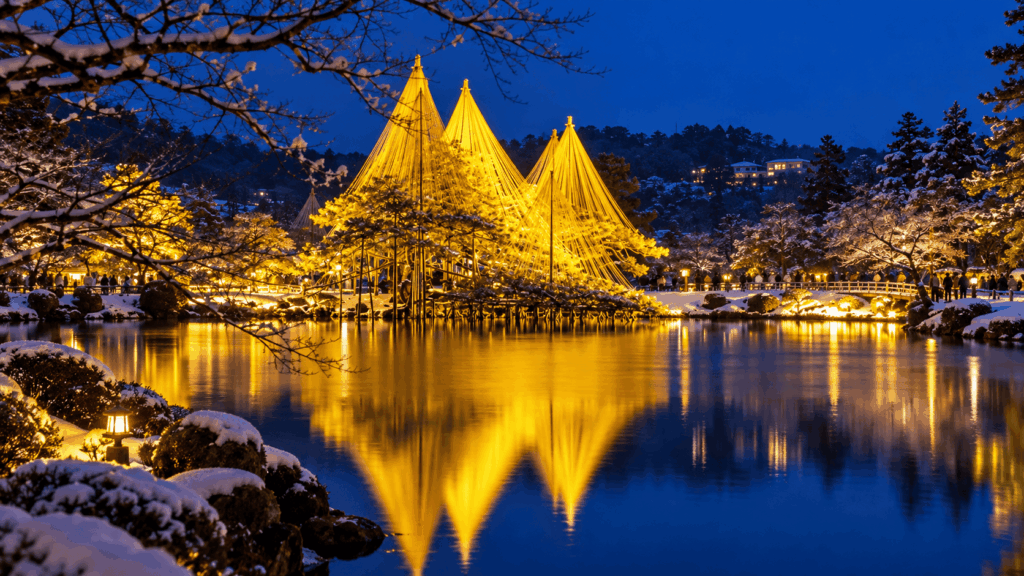
Kai’s tip: There is a bottleneck at the Nijibashi bridge area, just inside the Katsurazaka gate, where everyone stops for the same Karasaki Pine composition. On my February visit that spot had roughly a 15-minute line, and it was the only place in the garden where I queued. Approach from the Katsurazaka side, see the line before you commit to it, and decide whether the angle is worth the wait — it usually is once, at dusk, before the crowd thickens.
Winter Food Is One of the Best Reasons to Visit Kanazawa
If snow is the unreliable part of a winter trip, food is the reliable one. Kanazawa’s winter table is the strongest argument for coming in this season at all, and it does not care what the weather does.
The centre of it is Omicho Market, a covered warren of stalls and small restaurants a short bus or taxi ride from the station. Most shops run roughly 9:00 to 17:00, though hours vary by stall. Omicho Ichibakan, the modern building inside the market, opens around 9:00 and closes mid-afternoon. The seasonal calendar is specific: kobako crab runs only until late December, Kano crab continues to March 20, and winter also brings Noto oysters, cold yellowtail and Kanazawa-style oden.
My own routine, formed on a cold February morning, was to skip the ground-floor browsing and go straight upstairs to Omicho Kaisendon-ya Hirai in the Ichibakan building. The ground floor was too cold to enjoy properly; the second-floor restaurant was warm and calm. I ordered a seafood bowl and added grilled nodoguro and gas-ebi on top. It cost noticeably more than a standard bowl — expect something in the ¥2,000–4,000 range before add-ons, with prices moving over time — and I would do it again without hesitation. The nodoguro was rich in a way that made the plain bowl feel like an appetiser; the gas-ebi was sweet and firm and unlike the shrimp I’d had elsewhere in Japan.
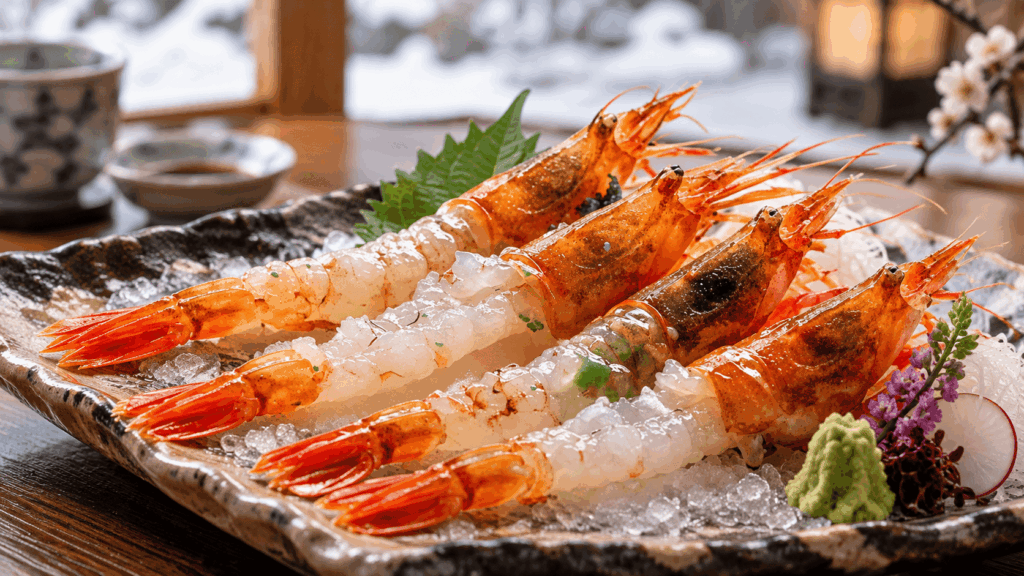
Two practical notes. Hirai’s Ichibakan branch generally runs 11:00–17:00, opens at 10:30 on weekends and holidays, closes early on Wednesdays, and is shut on January 1 — confirm before you go, since restaurant hours shift. And if your trip lands over New Year, know that Omicho Market is effectively closed from January 1 to 4, with normal trading resuming around January 5.
Gas-Ebi: A Good Example of What Makes Kanazawa Food Special
Gas-ebi is worth understanding because it explains why eating here is different from eating in Tokyo. The shrimp spoils and discolours quickly, which is why it has long been called a “phantom shrimp” and is rarely distributed far from the coast where it’s landed. That perishability is the point: you are eating something that mostly doesn’t travel, in the place where it does.
I’d be careful about calling it a winter specialty, though. Sources describe its season as stretching into spring and early summer as well, so treat it as a local ingredient to look for rather than a winter-only one. If you see it on a menu, order it — that advice holds in any month.
Higashi Chaya District in Winter: Beautiful, but Watch Your Step
The Higashi Chaya District is the most photogenic quarter of the city and, in winter, the most treacherous underfoot. The wooden teahouse facades and the dark stone paving look superb in cold light, especially with a dusting of snow on the roofs. The same paving, once wet, is genuinely slippery in the shaded sections where sun never reaches.
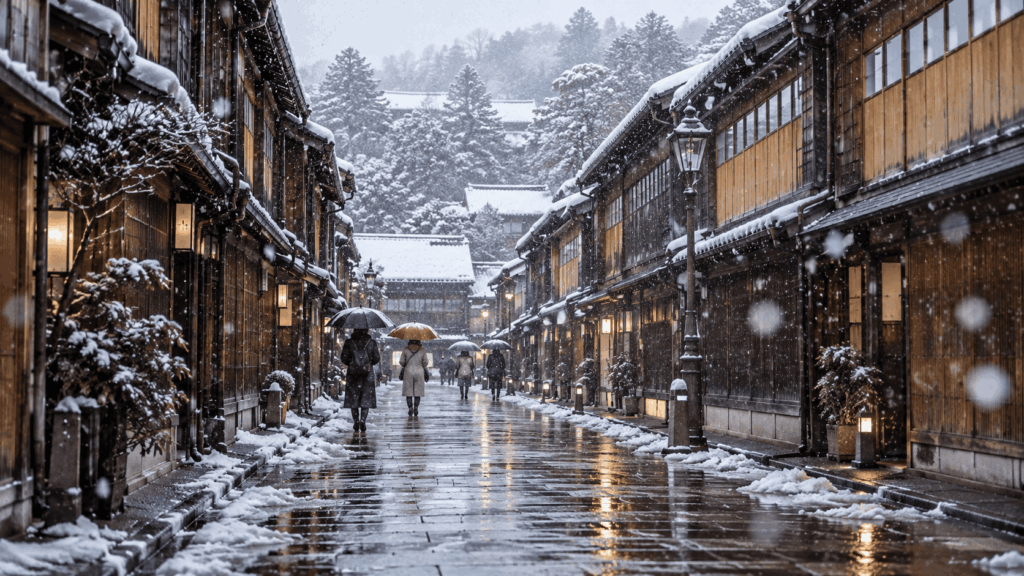
I walked it after a spell of rain and sleet and spent more time watching my feet than the buildings. The fix is simple: slow down, take the centre of the lane rather than the cambered edges, and wear something with tread. It is not a reason to skip the district — just a reason not to treat it as a five-minute photo stop.
Winter also changes the rhythm of a visit here. Outdoor time adds up faster than you expect, and the district rewards a break rather than a march. We ducked into a converted machiya café when the cold had worn us down, and ate gold leaf soft-serve ice cream in a heated room while the street outside stayed grey. It was the single best decision of the afternoon, and it cost us nothing but time.
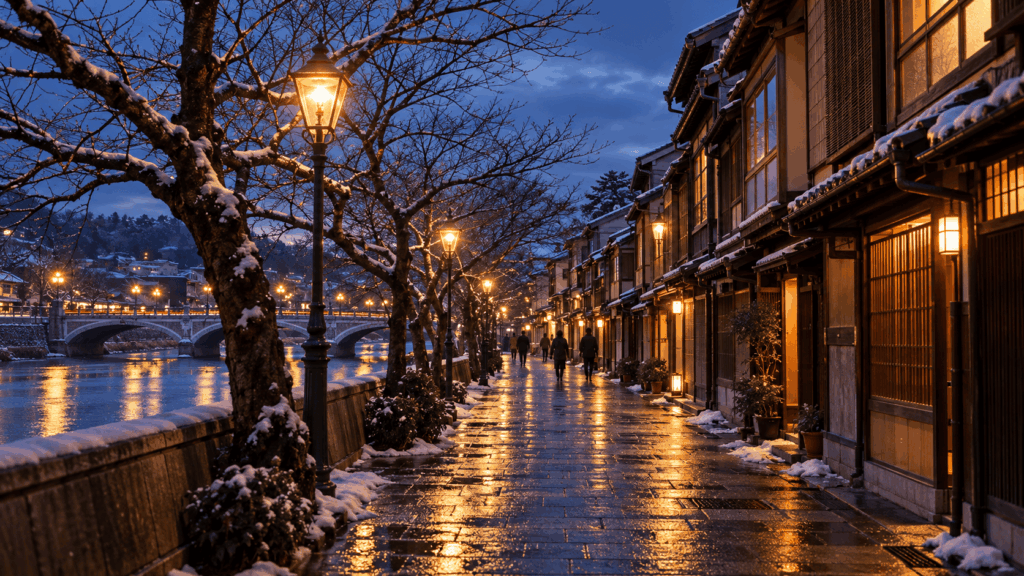
Many of the teahouses and cafés are small, and some require reservations for tea ceremonies or full meals. If a particular experience matters to you, book it before you arrive rather than hoping to walk in.
How to Plan a Kanazawa Winter Day Around the Weather
The most useful thing you can do for a winter trip is refuse to lock the days in advance. Kanazawa rewards a morning-of decision: check the forecast, look out of the window, and pick the order of your day accordingly.
| If there is fresh snow | If it is raining or there is no snow | |
|---|---|---|
| First stop | Kenrokuen at opening, or the 6:00 free early entry | Omicho Market for a warm breakfast, then Kenrokuen mid-morning |
| Photo priority | Karasaki Pine and the castle walls before footprints appear | Yukitsuri close-ups, teahouse facades, market interiors |
| Lunch strategy | Eat late, indoors, near the garden | Seafood bowl upstairs at Omicho, or a sit-down set meal |
| Indoor backup | Keep it as a reward for cold hands | Museum or gallery in the afternoon, with closing days checked |
| Footwear | Grip first; borrow boots at the station if needed | Waterproof shoes; avoid smooth soles on stone |
| Optional add-on | Kanazawa Castle Park while the snow is still clean | Higashi Chaya with a café stop, or a shorter garden visit |
If Fresh Snow Is Forecast
Move the garden to the front of the day and push everything indoors to the afternoon. Snow in the city is time-sensitive: it gets walked on, melts at crossings, and turns to grey slush within hours. Kenrokuen at opening — or on the free 6:00 entry — gives you the clean version. The Kotoji Lantern and the Karasaki Pine are the two compositions most people want, and both are close to the main entrances.
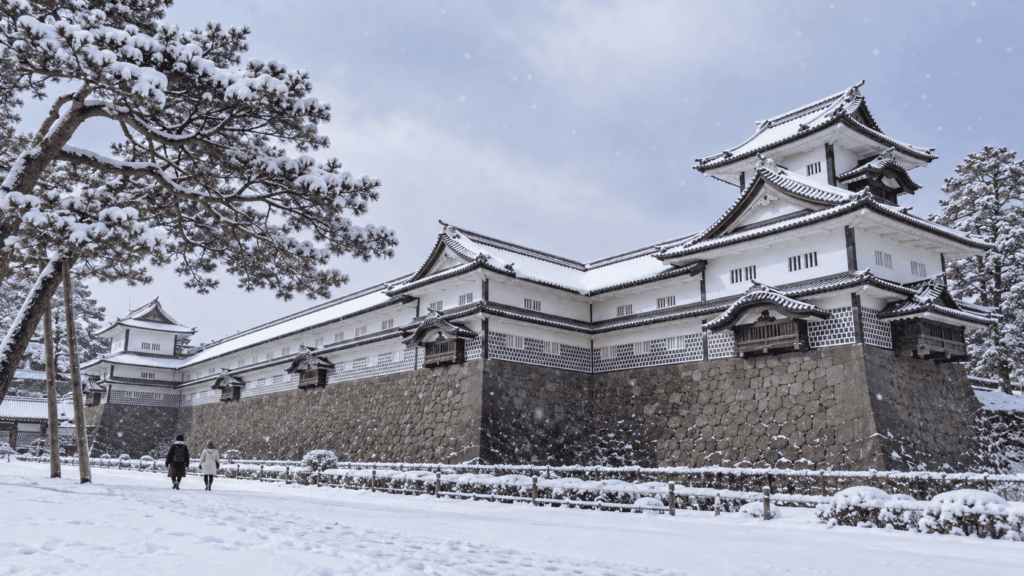
Kanazawa Castle Park next door is the natural second stop, since the lawns hold snow better than the garden paths and the stone walls look their best under a white sky. Don’t assume early means empty, though. Even at opening there will be other photographers, and on a heavy-snow morning locals turn out too.
If It Is Raining or There Is No Snow
Don’t write the day off, and don’t force a full garden circuit either. Go to Kenrokuen for the yukitsuri specifically, accept a shorter visit, and spend the saved time eating and warming up. The garden is a 30–60 minute stop in bad weather, not a half-day.
Pair it with Omicho Market for lunch and a café or museum in the afternoon. The 21st Century Museum of Contemporary Art is the obvious indoor anchor, but check its calendar: it closes on certain days and is scheduled to shut for large-scale renovations from May 2027 to March 2028. Smaller options work just as well — the Shiinoki Cultural Complex near the castle has a free ground-floor lounge with views of the stone walls, and the D.T. Suzuki Museum is built around a contemplative indoor space that suits a grey day.
If your itinerary is still open and snow is the thing you came for, this is the point to consider adding a day trip rather than hoping the city delivers.
Should You Add Shirakawa-go for More Reliable Winter Scenery?
If a snow-covered landscape is one of your top reasons for visiting Japan, don’t stake it on central Kanazawa. The city’s own tourism board says as much: snow doesn’t usually accumulate much downtown, and for a true winter landscape it points visitors toward the Gokayama area in Nanto and the Shiramine area of Hakusan, both reachable from Kanazawa Station.
That is the honest logic behind a side trip. It isn’t that Shirakawa-go guarantees snow — it doesn’t, and no one should promise you that — but it sits in a much snowier belt, at higher elevation, with gassho farmhouses designed for exactly the kind of snowfall Kanazawa’s city centre rarely keeps. Your odds improve; the certainty doesn’t. If you’re on the fence about whether Shirakawa-go is actually worth the trip just for snow, read our honest assessment before committing.
| Self-guided by bus | Organised day tour | |
|---|---|---|
| Booking | Reserved bus seats, often needed well ahead in winter | One booking covers transport and stops |
| Time on the ground | You choose how long to stay in each village | Fixed itinerary, roughly a full day from 8:30 to early evening |
| Language | You manage signs, timetables and connections yourself | English-speaking guide included on the main tours |
| Flexibility | High, until weather disrupts a connection | Low, but someone else handles disruption |
| Winter reliability | Depends on road and bus conditions | Also weather-dependent, but logistics are the operator’s problem |
| Best for | Confident travellers with time to spare | Short trips, first-time visitors, anyone who wants the day solved |
The tour I’d point to is the full-day Kanazawa departure covering Inami, Gokayama and Shirakawa-go, with an English-speaking guide, departing Kanazawa Station around 8:30 and returning in the early evening. It includes transport, temple admission and a paper-making experience, with lunch excluded; free cancellation is typically available up to 24 hours ahead, and paper-making is suspended over the New Year period. Product details, prices and operating days change, so confirm the current listing before you commit.
If you want to reach both Gokayama and Shirakawa-go without managing winter bus connections yourself, this is the guided option worth a closer look.
Why I’d book this one
- More context than a self-guided visit: Recent travelers frequently highlight the guides’ historical knowledge, useful cultural explanations and willingness to answer questions along the way.
- Several stops without separate transport bookings: The itinerary combines Inami, Gokayama and Shirakawa-go, including a traditional craft experience. The trade-off is a fixed schedule with less freedom to linger in each village.
- Booking flexibility worth checking: Free cancellation and pay-later options may give you room to adjust your plans, subject to the conditions shown for your chosen date.
My role in recommending it is narrow: I didn’t go on this tour, and I’m not describing it from experience. What I can tell you is that after a snow-free February in Kanazawa, a day in a snowier valley is the move I would have made with two more days in the region. For logistics on buses and timing, check our guide to planning your Shirakawa-go itinerary.
Who Should Visit Kanazawa in Winter — and Who Shouldn’t?
Kanazawa in winter is a good fit if you are:
- A food-first traveller who wants crab, yellowtail, oysters and a proper seafood bowl
- Interested in the yukitsuri as a winter sight in its own right
- Comfortable with grey skies, wet streets and short daylight
- Willing to reorder your day based on the morning’s weather
- Travelling at a pace that allows warm indoor breaks between outdoor stops
It is a poor fit if you are:
- Relying on snow as the main event of the trip
- Unsteady on wet or slippery surfaces, or travelling with someone who is
- Planning a tightly scheduled trip where a rained-out afternoon can’t be moved
- Expecting long, bright days of outdoor sightseeing
One comparison worth addressing directly, because it comes up whenever someone weighs a winter itinerary: should you simply stay longer in Kyoto or Tokyo instead? Kyoto in winter is colder than people expect and busier than Kanazawa by a wide margin; Tokyo is milder and drier but gives you no equivalent of the yukitsuri or this seafood. Kanazawa’s case is specific rather than general — you come for the garden’s winter engineering and the food, not for a broad sightseeing checklist. If neither of those excites you, the extra days are better spent elsewhere.
Frequently Asked Questions
Does it snow in Kanazawa in December?
Yes, though December is the weakest of the three winter months for snow on the ground. Kanazawa averages 14.5 days with snowfall in December and 24 cm of snow across the month, but the average deepest snow depth is only 11 cm, and early December often brings rain instead. Snow becomes more likely in the second half of the month. If you are visiting in the first week of December, plan for a cold, damp city rather than a white one.
Is January or February better for snow in Kanazawa?
January has the stronger historical record: about 22.7 days with snowfall, 67 cm of snow across the month, and an average deepest depth of 27 cm, compared with 53 cm and 22 cm in February. The catch is that January is also the darkest month, with only around 62 hours of sunshine. February is slightly brighter and is when the Kenrokuen winter illumination takes place. Neither month guarantees snow during a two- or three-day stay.
Do I need snow boots in Kanazawa?
For sightseeing in the city centre, usually not. Main roads and pavements have snow-melting systems, so you rarely walk on snow — but the surface stays wet and slippery, which makes waterproofing and grip more important than insulation or height. A waterproof walking shoe or low boot with tread is the practical choice. If you arrive during a heavy snowfall, the tourist information centre inside Kanazawa Station lends rubber boots free of charge. Heavy snow forecasts, mountain excursions and village stays are a separate calculation.
Is Kenrokuen worth visiting in winter without snow?
Yes, mainly for the yukitsuri. The rope cones are installed from around November 1 and remain until mid-March, so they are present whether or not it snows. Without snow the garden is muted — bare trees, dark water, flat light — and visitors expecting a completely white landscape will feel the gap. Visitors interested in the cones, the quiet and the winter structure itself generally come away satisfied. The free 6:00 early entry from November to February is the best way to see it without crowds.
Are shops and restaurants open in Kanazawa over New Year?
Less than you might hope. Omicho Market is effectively closed from January 1 to 4, with normal trading resuming around January 5, and many restaurants and small shops take holidays in the same window. Kenrokuen remains open through the period, and the station area stays busy, so the city is not shut down — but a market breakfast on January 2 is not going to happen. If your dates are fixed around New Year, plan those days around the garden, museums and hotel dining instead.
What can I do in Kanazawa in winter if there is no snow?
Build the day around food and interiors. Omicho Market for a seafood bowl, a long lunch, then the Higashi Chaya District with a café stop in a converted machiya, and a museum in the afternoon. Do the garden as a short, focused visit for the yukitsuri rather than a full circuit. If you have a spare day and snow matters to you, use it for a trip toward Gokayama or Shirakawa-go, where the odds of a winter landscape are better.
The Short Version, by Traveller Type
If this is your first trip to Japan and Kanazawa is one stop on a longer route: come in February if your dates allow. You get the best balance of snow potential, the illumination and longer days, and the garden’s yukitsuri will be up regardless. Keep one day unplanned so you can chase a snowy morning if it arrives, and don’t book a rigid schedule that punishes a wet afternoon.
If snow is the whole point: don’t make central Kanazawa your snow destination. Book the city for food and the garden, then add a day trip toward Gokayama or Shirakawa-go, which sits in a much snowier belt. Even there, treat snow as likely rather than certain, and don’t build the trip’s success on a single photograph.
If you are travelling with family or with anyone unsteady on their feet: choose December or February over January, favour the warmer end of the day for outdoor stops, and keep the walking distances short. The Higashi Chaya District’s wet stone paving is the main hazard, and it is manageable with proper shoes and a slower pace. Build in café breaks rather than pushing through a full afternoon outdoors.
If you are on a tight schedule of two nights or fewer: pick one month and stop optimising. Do Kenrokuen early, eat at Omicho at lunch, and walk Higashi Chaya in the late afternoon before the light goes. Skip the day trip — a Shirakawa-go tour consumes a full day and would leave you with no time for the city itself.
If you are a photographer chasing winter scenes: January gives you the most snow days and February gives you the illumination plus slightly better light. Use the 6:00 free entry at Kenrokuen, expect a queue at the Nijibashi bridge viewpoint, and keep a second morning free in case the first one is grey. The snow-melting streets mean the city centre rarely looks like the postcards — the garden and the castle grounds are where the white survives.
If you have been to Kanazawa before, in another season: winter is worth a return specifically for the food and the yukitsuri, and it is a genuinely different city — quieter, darker, more local. Come in February for the illumination, eat crab and yellowtail, and treat the snow as a possible bonus rather than the reason for the trip.

Hi, I’m Kai. I’m a Tokyo-based travel writer, tourism industry insider, and the author of a published guidebook for international visitors to Japan. With over 10 years of professional experience at a leading Japanese tourism company, my mission is to help you skip the tourist traps and navigate Japan’s best destinations like a local. I believe the perfect day trip is like a traditional kaiseki meal: a beautiful balance of precise planning and unforgettable seasonal discovery. When I’m not out conducting field research, you’ll usually find me drafting new itineraries with one of my favorite fountain pens!