
Ikeshima is the island that Gunkanjima tourists rarely hear about: a coal-mining island off the Nagasaki coast where you can still ride an electric trolley into a real mine tunnel, watch retired miners demonstrate the machines they once operated, and walk through the overgrown remains of a company town. It is harder to reach than Gunkanjima, less polished, and not for everyone. But for travelers who want to step inside an industrial-heritage story instead of viewing one from a boat, it is one of the most unusual day trips from Nagasaki.
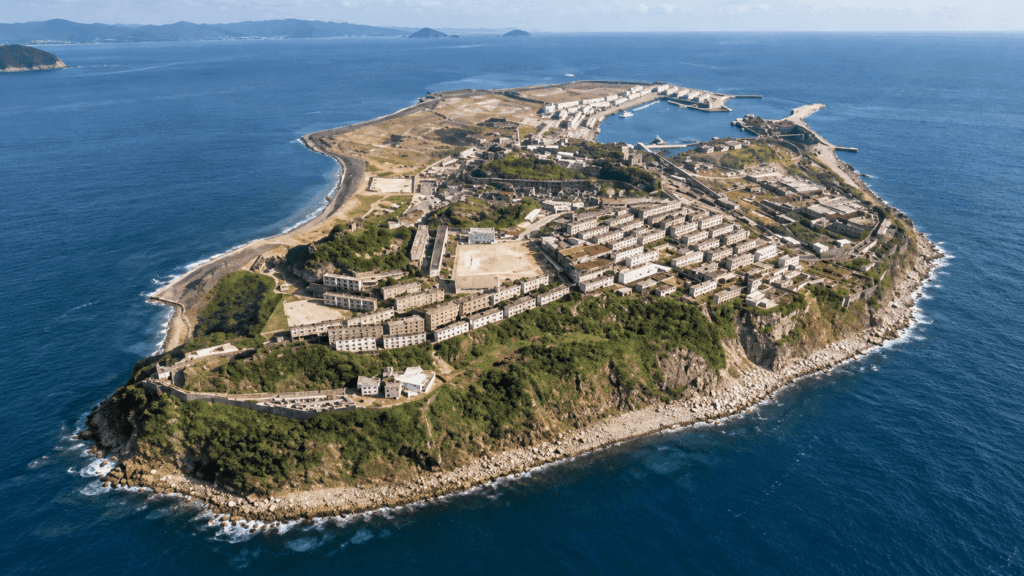 An aerial perspective reveals the remnants of Ikeshima’s coal mining heritage and its dramatic island landscape.
One urgent detail before you plan: the guided mine experience that makes Ikeshima special is scheduled to end in late March 2027, when the aging facility closes. The island itself stays open, but the underground tour will not. If you are reading this before that date and the idea appeals to you, treat it as a now-or-never visit rather than a someday trip.
Still deciding between Ikeshima and Gunkanjima? If you would rather have an English-guided day combining Hashima Island’s famous ruins with Mount Inasa than tackle Ikeshima’s ferry connections and Japanese-language mine tour, compare the itinerary, available dates, and current prices for this private guided day tour. It is a different experience from entering Ikeshima’s mine, but worth considering before choosing which island fits your trip.
Is Ikeshima Worth Visiting?
Yes — for a specific type of traveler, and honestly no for everyone else. Ikeshima rewards people who care more about entering a real mine and feeling the remains of a coal-mining community than about seeing Japan’s most dramatic offshore ruins. If your Nagasaki plan is built around convenience, iconic views, or maximum independent photography time, Gunkanjima will serve you better.
What makes Ikeshima genuinely rare is that you go underground. On the guided tour you put on a helmet and headlamp, ride a mine trolley toward the tunnel entrance, and walk into the dark workings of a pit that operated until 2001 — the last coal mine in Kyushu. Former miners act as guides, and at one point the machinery is switched on and demonstrated in front of you. That physical, slightly gritty experience is the whole point of the visit, and it is the thing no photograph of either island can really convey.
Choose Ikeshima if you are drawn to industrial heritage, abandoned places, or the human story behind Japan’s postwar boom, and you can give it most of a day.
Skip it or pick Gunkanjima if you only have half a day, you want simple logistics, you strongly need an English-led tour, or you expect to wander and photograph freely. The Ikeshima experience is guided, Japanese-centered, and more structured than many visitors assume.
If you already know Ikeshima is for you, start by checking current tour availability and booking through the official Nagasaki Saruku page — reservations open about a month ahead and sell out quickly.
Ikeshima vs Gunkanjima: Which Should You Choose?
This is the comparison most travelers actually need. Both islands were coal communities off Nagasaki, both are tied to the same UNESCO industrial-heritage narrative, and both are sometimes called “ruins islands” — but the experiences are almost opposites. Gunkanjima (Hashima) is seen from a boat and a single elevated walkway; Ikeshima is entered on foot and by trolley. One is a half-day excursion from Nagasaki Port with an instantly recognizable skyline. The other is a longer, clunkier journey that ends inside a mountain.
| Comparison | Ikeshima | Gunkanjima (Hashima) |
|---|---|---|
| Best for | Travelers who want to go inside the mining story | Travelers who want the iconic offshore ruins |
| Access difficulty | Higher: bus from Nagasaki Station + ferry from Konoura or Seto Port; connections need planning | Lower: cruises depart from Nagasaki Port with set itineraries |
| Typical time commitment | Most of a day (roughly 7–8 hours door to door from central Nagasaki) | Half a day (cruise and landing tour around 2.5–3 hours, plus transfer) |
| Can you enter a mine? | Yes — trolley ride plus walking inside a former pit tunnel | No — the mine shaft on Hashima is not open to visitors |
| Can you walk through residential ruins? | Limited — parts of the old apartment town can be walked on your own, but many buildings are off-limits | No — you stay on a fixed, guided walkway; buildings are viewed from outside |
| Iconic ruined skyline | Less dramatic from the water; impact builds as you walk inland | The famous concrete skyline — the visual payoff is immediate |
| Freedom to explore | Tour is guided, but you can walk the island’s public roads before or after | Tightly guided; no independent wandering |
| Photography | Stills allowed, but free photo time during the tour is short; video and tripods are banned | Plenty of photo stops on the walkway; weather can cancel the landing entirely |
| Weather and transport dependency | Ferries are weather-dependent; small local boat also rests on Sundays | Landing is frequently cancelled in rough weather; cruises may switch to boat-only |
| Best choice for first-time Nagasaki visitors | Only if industrial immersion is your priority | Usually the safer, easier, more spectacular pick |
 Hashima Island, also known as Gunkanjima or Battleship Island, is famous for its abandoned coal mining buildings off the coast of Nagasaki.
Reviewers on both sides describe this split in almost identical terms: Gunkanjima’s wow factor is the view of the island itself, while Ikeshima’s satisfaction comes from the physical act of going underground with the former miners. Neither is “better” — they answer different questions. For me, the deciding moment was standing inside the tunnel entrance on Ikeshima and realizing that Gunkanjima had shown me everything from the outside, while Ikeshima was letting me in.
If the logistics of Ikeshima sound like more than your trip can absorb, compare current Gunkanjima cruise-and-landing options from Nagasaki Port instead — typical landing tours cost around ¥4,000–5,000 per adult including the separate ¥650 Nagasaki City landing fee.
If you are leaning toward Gunkanjima but want more than a standard half-day cruise, a private guided day trip combining Hashima Island and Mount Inasa is an alternative worth comparing. It is particularly relevant if English-language context and having a full day’s sightseeing arranged matter more to you than keeping costs down.
Why I’d book this one
- More than a single cruise: The listed itinerary combines Hashima Island with Mount Inasa, giving travelers two contrasting views of Nagasaki’s history and landscape in one day rather than planning them separately.
- English-guided, private format: The advertised English-language guiding and private-group structure suit visitors who want historical explanations and a more personalized experience instead of navigating a mainly Japanese-language excursion independently.
- Booking flexibility: The listing advertises flexible reservation and cancellation options, which can be useful when arranging a Nagasaki itinerary. Check the exact terms, what’s included, and how weather-related cruise or landing changes are handled before confirming. Traveler reviews are not yet available for this particular listing, so there is no established review track record to rely on.
Before deciding: See live availability, departure details, inclusions, and cancellation conditions for the Mount Inasa and Hashima Island private guided tour. This is a full-day alternative to the standard cruise, not a way to enter Ikeshima’s coal mine, and landing on Gunkanjima remains dependent on sea conditions.
What the Ikeshima Coal Mine Tour Is Actually Like
The Ikeshima Coal Mine Experience Facility runs three guided courses, all meeting at Ikeshima Port’s pier: a morning course (11:00–13:00), an afternoon course (13:15–15:15), and an afternoon course with an island sightseeing option (13:15–16:45). Prices are around ¥2,720 for adults and ¥1,360 for elementary and junior high students, with the option course at ¥3,170 / ¥1,580. Children below elementary school age cannot join. Payment is cash only, on the day.
Whatever the course, the structure is the same: a short video and overview, then the underground section — helmet and headlamp on, into the trolley, and through the workings of the mine with retired coal miners as your guides. The morning course also includes a roughly 20-minute lunch break after the introduction, and it is worth knowing in advance that there is nowhere to buy food on the island.
Inside the Tunnel: Trolleys, Helmets and the Former Miners
The strongest part of Ikeshima is not a view — it is the sequence of small physical details that starts the moment the tour moves underground. You are fitted with a helmet and headlamp, then loaded onto the same kind of electric trolley that once carried miners toward the face. It clicks along the track into the dark, and the group continues on foot through the tunnel with the former miners explaining how each section was used.
What stayed with me longest was the machinery demonstration. The guides switch on real equipment that was used in the pit, and visitors are allowed to handle a huge rock drill and feel how heavy and awkward it is. Standing in that damp, dark space, watching men who had actually worked there talk about their shifts, felt completely different from any ruins photography I have done in Japan. Gunkanjima showed me what a coal-mining island looked like. Ikeshima showed me what it felt like to work inside one.
This is a guided, group experience rather than a self-guided museum walk. You follow the flow of the tour, listen to the explanations, and move together through the tunnel. The former miners are the heart of it — their demonstrations and stories are what make the visit memorable — but those explanations are delivered in Japanese, a point I will come back to later in this guide.
One Honest Downside for Photographers
If your main goal is to shoot the ruins at your own pace, adjust your expectations before you book. The mine tour is explanation-heavy: the guides talk through each area, and the free time for photography is much shorter than most visitors imagine. The facility also prohibits video recording and tripod use during the tour, so the underground section is a phone-and-small-camera experience in practice.
What surprises many photographers is that the better photo moments on Ikeshima happen outside the tour — the abandoned apartment blocks, the overgrown lanes, and the quiet port area can all be photographed freely during the time you have before or after your course. Plan for that split, and the island still delivers plenty of images. Expect the tour itself to be an experience you record in memory more than through a viewfinder.
Morning or Afternoon Ikeshima Tour?
The short answer: if you only care about the underground experience, the morning course works well. If you also want to walk the old apartment town and feel the island’s atmosphere, plan for the afternoon. The tour itself is nearly identical — the real difference is how much of the island you get to see around it.
| Morning course | Afternoon course | Afternoon + option | |
|---|---|---|---|
| Tour time | 11:00–13:00 | 13:15–15:15 | 13:15–16:45 |
| Best for | The mine experience alone; an earlier return to Nagasaki | Mine tour plus independent walking of the old town | The fullest day: mine tour plus a guided walk of normally restricted island areas |
| Island walking time | Very little — the recommended return ferry to Konoura leaves around 13:17 | Plenty before the tour if you arrive on an earlier boat, plus time after 15:15 | Covered by the guided option; little free time left |
| Main downside | No real chance to explore ruins after the tour | You arrive early and wait, or risk a tight ferry connection | Long day; return ferry choices after 16:45 are limited |
| Who should choose it | Travelers on a schedule who want the tunnel and nothing else | Photographers and ruins walkers — most first-time visitors | Industrial-heritage fans who want the deeper island story |
The official recommended connections make this trade-off concrete. For the morning course, the suggested ferry from Konoura Port leaves at 10:30 and arrives at Ikeshima around 10:56 — just in time for the 11:00 meeting. The recommended return ferry to Konoura departs at roughly 13:17, which means you have about fifteen minutes between the 13:00 finish and departure. For the afternoon course, the official suggestion is the 12:44 ferry from Seto Port, which arrives at 13:12 — only three minutes before the 13:15 meeting. That is cutting it far too fine for comfort; if you choose the afternoon course, the practical approach is to take an earlier boat and use the gap before 13:15 to walk the town.
Kai’s tip: If you want to see the abandoned apartment blocks, treat the afternoon course as your default and arrive on the morning boat from Konoura. On my visit I took the morning course, and the connection was so tight that I finished the tour and had to head straight back to the pier — the recommended ferry leaves barely fifteen minutes after the 13:00 finish. The travelers who had the day planned the other way were using the hours before the 13:15 meeting to walk the ruins, which is exactly how I would do it next time.
How to Get to Ikeshima from Nagasaki
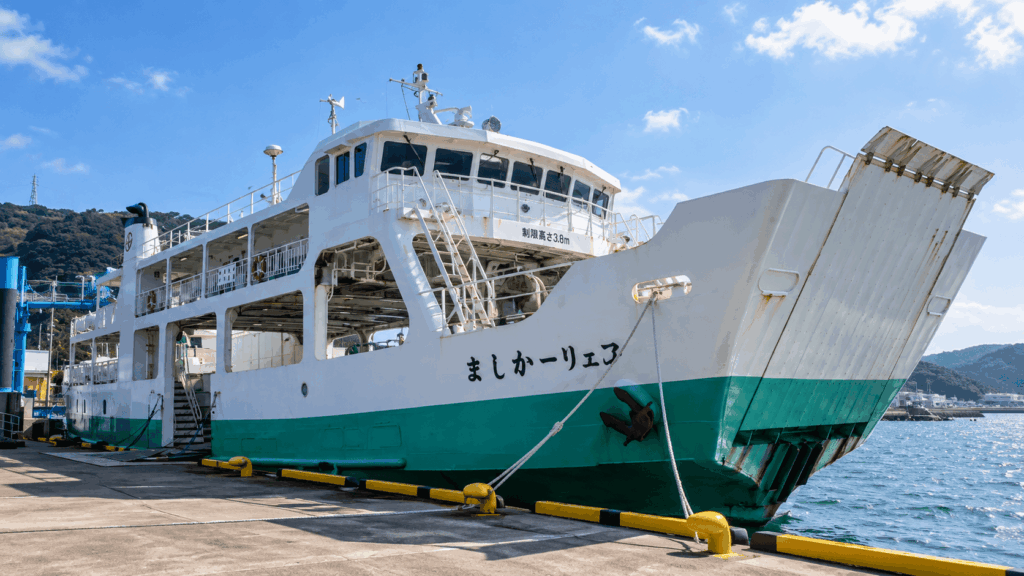 A local ferry provides access to Ikeshima, a former coal mining island near Nagasaki known for its industrial heritage.
Ikeshima is reachable from central Nagasaki by public transport, but it is a real expedition: allow roughly two hours each way including the ferry. On my visit the journey took me close to two hours door to door each way, and the day still felt worth it — but only because I had checked every connection in advance. The route has three parts: a bus from Nagasaki Station to a mainland port, a ferry across to the island, and a short walk from Ikeshima Port to the tour meeting point.
The Route from Nagasaki Station, Step by Step
1. Bus from Nagasaki Station (about 70–80 minutes). Take a Nagasaki Bus (Saikai Kotsu) service toward Oseto / Itanoura from Nagasaki Station. Some services run direct; others require a transfer at Sakuranosato Terminal. For Konoura Port, get off at the Kaminoura (神の浦) bus stop and walk about five minutes to the port. For Seto Port, stay on to the NTT Oseto (NTT大瀬戸) stop and walk about five minutes. Local bus times are published on the Sotome tourism site “Sotomeguri” — check it rather than relying on general navigation apps, which do not always list these routes correctly. If you are still planning your base, choosing where to stay in Nagasaki near the station makes this early departure much easier.
2. Ferry to Ikeshima. From Konoura Port, the Saikai Engan Shosen ferry takes about 26 minutes and costs ¥470 (¥240 for children); the smaller local boat Shinei Maru takes about 15 minutes for ¥370 (¥160) but carries only 12 passengers, rests on Sundays, and is more likely to be cancelled in rough weather. From Seto Port, the ferry takes about 28 minutes and costs ¥500 (¥250). Ferry fares and times are as of September 2026 — and note that the operator revises the Seto–Ikeshima–Konoura timetable from 1 October 2026, so confirm current times before you travel.
3. Walk to the meeting point. The tour gathers at the Ikeshima Port pier, and the experience facility is a few minutes’ walk from the ferry landing. Helmet fitting and the tour itself start from there.
Konoura Port vs Seto Port
For travelers using public transport from Nagasaki, Konoura Port is usually the easier choice: it is the standard connection for the morning course, the bus ride is straightforward, and the walk from the stop is short. The catch is that Konoura has no shops or convenience stores around the terminal, so buy anything you need before you leave the city.
Seto Port sits on the Saikai City side of the channel and is the port the organizers recommend for the afternoon course. It has more services around it — shops and convenience stores are within walking distance — and the ferry runs more frequently through the day, which gives you more return options. It is also the more practical port if you are driving, since you can bring a car across on the ferry; check current vehicle fares and parking details with the operator.
In short: morning course + public transport → Konoura. Afternoon course, car access, or a need for food before departure → Seto. Whichever you choose, check the timetable against your tour time first.
Check the Return Ferry Before You Lock In the Tour
The mistake I see visitors make — and the one that shows up constantly in reviews — is planning the outbound journey and assuming the way back will take care of itself. On Ikeshima the return is the fragile half of the day. After the 13:00 or 15:15 finish, the number of usable departures drops quickly, the small Konoura boat does not run on Sundays, and the final ferries leave in the late afternoon. If you miss one, you are not stranded for the night — the island’s only lodging, Ikeshima Chuo Kaikan, exists partly for that situation — but you would rather not test it.
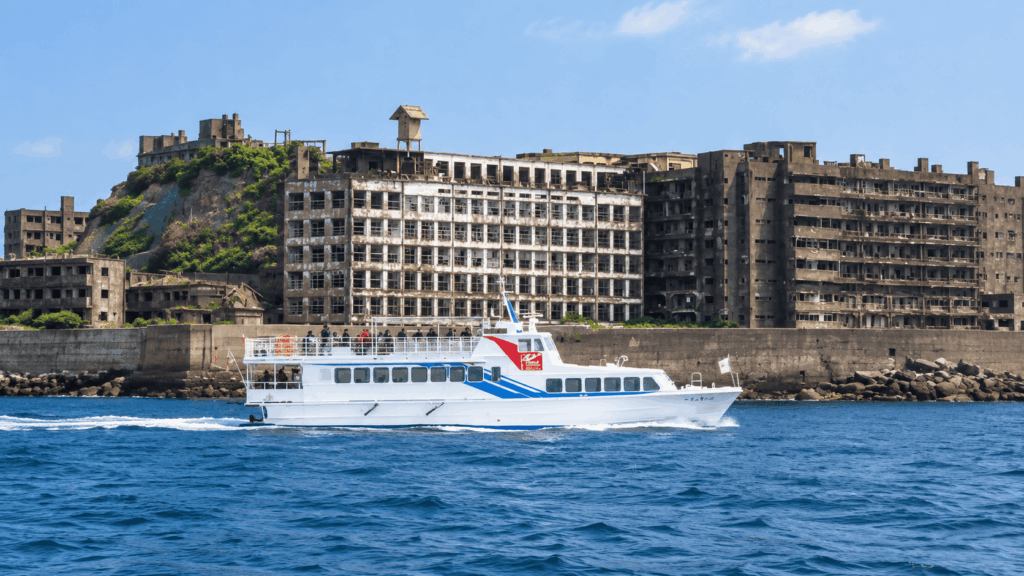 A ferry passes the abandoned residential buildings of Ikeshima, offering a striking view of the island’s mining history.
Kai’s tip: Decide in this order: tour date first, return ferry second, outbound ferry third. When I planned my own visit I fixed the morning boat and the tour, then discovered the return options after 13:00 were far fewer than I had assumed. Do it backwards — find the tour time that ends with a realistic ferry home, then build the morning connection around it. And remember that weather cancellations happen, so leave a little slack in your Nagasaki plans rather than booking your evening on the same day.
Walking Around Ikeshima: Ruins, Silence and What Remains
The mine tour is the headline, but Ikeshima’s other life waits above ground: the abandoned apartment blocks built for miners and their families, the overgrown lanes between them, and the quiet that settles over streets that once held thousands of people. When I walked through the residential area, the blocks were half-buried in summer growth, and even on a weekend I met almost no one. It is not dramatic in the way Gunkanjima’s skyline is dramatic — it is stranger and quieter than that, closer to walking through a company town that simply stopped.
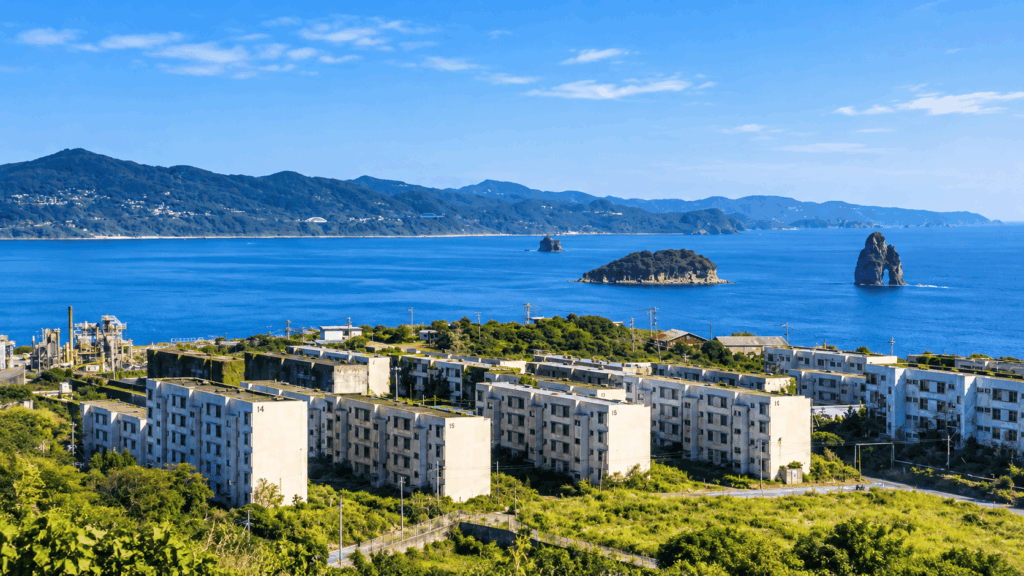 Ikeshima’s former mining community features aging apartment buildings set against the beautiful coastal scenery of Nagasaki.
Two cautions. First, Ikeshima is not an abandoned island in the strict sense: people still live here, and the tour and ferries exist alongside an ordinary community. Keep to public roads and treat the ruins as something to photograph from outside — many buildings are fenced off, structurally unsafe, or private, and the official guidance is clear that you should not enter them. Second, the island’s residential areas are spread out, so the walking time you have matters. That is why the afternoon-versus-morning decision above is not a detail — it decides whether you actually get to see this side of Ikeshima at all.
Is Ikeshima Really a “Cat Island”?
Somewhere along the way, Ikeshima picked up a reputation as a cat island, and travel content repeats it. The honest version: cats do live here, and you may well meet a few, but nobody should cross two ferries expecting crowds of them. On my visit I counted roughly ten cats over a full day of walking — friendly enough, but hardly a feline spectacle. Sightings vary by season, time of day, and luck. Come for the coal mine and the ruins; treat any cats you meet as a bonus, not the reason for the trip.
What to Bring Before You Take the Ferry
The rule of this day trip is simple: assume nothing is sold on the island, and prepare on the mainland side. The official Q&A for the experience facility is blunt about it — as of 2023 there were no shops or restaurants on Ikeshima, and there is no convenience store at Konoura Port either. The nearest food options are around Seto Port, on the other side of the channel from where most morning-course visitors depart.
Food and Water
Carry a packed lunch, snacks, and a full bottle of water. The morning course includes a lunch break of about 20 minutes after the introductory video, but it is a break, not a shopping window — and the afternoon course has no built-in meal stop at all. If you want to eat the famous coal-miner bento, it can be ordered only with the morning course on Saturdays and Sundays and must be requested in advance through the booking process, so plan ahead rather than hoping to buy one on the spot.
Kai’s tip: Buy your food and water in Nagasaki city before you board the bus, not at the port. It is the single piece of advice I give every traveler heading to Ikeshima: there is nowhere to buy lunch on the island, the terminal at Konoura has no shop, and a 20-minute break is not enough time to go hunting for a meal. A convenience-store stop near Nagasaki Station takes two minutes and turns the day from stressful into comfortable. Pack cash in the same bag while you are at it — the tour is cash-only, and you do not want to be counting coins at the ticket window.
Bring Cash
Tour payment is cash only, collected on the day — no credit cards, no mobile payments. Ferry tickets are also bought with cash (the small Shinei Maru collects on board). Do not count on finding an ATM once you leave the city; the practical move is to withdraw what you need in Nagasaki and carry it with you. Beyond money, the useful items are comfortable walking shoes (you will stand and walk inside the mine), a light layer for the cool tunnel air, and rain gear if the forecast is uncertain — ferries are the first thing to stop when the weather turns.
Can You Enjoy the Ikeshima Tour Without Speaking Japanese?
Yes, with an honest caveat. The core of the tour — the trolley ride, the darkness of the tunnel, the machinery demonstrations, the physical weight of a real rock drill — needs no translation. Those moments are visual and bodily, and travelers with no Japanese consistently describe the underground section as the highlight. What you will miss is the detail: the former miners’ stories, the explanations of how each machine worked, the historical context. Reviews from non-Japanese visitors repeat the same pattern: the experience is enjoyable, but the guiding is overwhelmingly in Japanese.
As of September 2026, the organizers do not advertise a regular English-language course, and I could not confirm any guarantee of English interpretation — so do not book assuming one. If language matters to you, write your question in the message field when you reserve, or contact the facility directly. Even without answers in English, the tour is worth taking for the physical experience alone; just set your expectations for the commentary.
Tour Price, Booking and Current Restrictions (2026–2027)
Everything below is as of September 2026 and changes frequently — confirm it on the official Nagasaki Saruku booking page before you commit to travel plans.
- Prices (per person): morning and afternoon courses ¥2,720 for adults (high school and older), ¥1,360 for elementary and junior high students; afternoon + option course ¥3,170 / ¥1,580. Cash only, paid on the day.
- Age limit: children below elementary school age cannot join any course.
- Booking: online only through the Nagasaki Saruku site. Individual reservations open about one month ahead of the tour month and close at 23:59 the day before. Same-day participation is not accepted, and demand currently far exceeds availability — the official page warns that spots are hard to get.
- Closed days: Mondays, the second and fourth Thursdays of each month, and the New Year period (29 December – 3 January).
- Photography: still photos are allowed, but video recording and tripod use are prohibited during the tour.
- Lunch option: the coal-miner bento is available only with Saturday and Sunday morning courses, by advance order.
If Ikeshima sounds like your kind of day, the smart first step is not transport — it is the tour calendar. Find an open date, book it, and only then arrange the ferry connection around it through the official booking page.
The Mine Experience Is Scheduled to End in March 2027
One final and important clarification: it is the coal-mine experience facility that is scheduled to close at the end of March 2027, not the island. Ikeshima remains an inhabited community with regular ferries, and the residential areas stay accessible. What disappears is the underground tour — the trolley ride, the tunnel walk, and the demonstrations by the former miners. Because this is currently the only place in Japan where you can enter a real coal mine in this way, demand is likely to rise as the end date approaches. If this article has convinced you the tour is worth the journey, do not file it under “someday” — check the official dates and book while the mine is still open.
Frequently Asked Questions
Is Ikeshima worth visiting from Nagasaki?
For most travelers, yes — if you match the experience to the right expectations. Ikeshima is worth the effort when you want to go inside a real coal mine, ride the trolley, watch former miners demonstrate their machinery, and feel a working-class history that Gunkanjima only shows from a distance. It is less worthwhile if you want easy logistics, iconic views, or lots of independent photography time. Note also that the mine experience is scheduled to end in late March 2027, which makes this a time-sensitive decision.
How do you get to Ikeshima from Nagasaki Station?
By bus and ferry, in three stages. Take a Nagasaki Bus (Saikai Kotsu) service toward Oseto / Itanoura from Nagasaki Station — around 70–80 minutes, sometimes with a transfer at Sakuranosato Terminal — and get off at the Kaminoura (神の浦) stop for Konoura Port or the NTT Oseto (NTT大瀬戸) stop for Seto Port. From Konoura, the ferry takes about 26 minutes (¥470); from Seto, about 28 minutes (¥500). The tour meets at Ikeshima Port pier, a few minutes’ walk from the landing. Allow roughly two hours each way, and remember that ferry times are revised from 1 October 2026 — confirm the latest timetable before you go.
Is Ikeshima better than Gunkanjima?
Better is the wrong question — they are different experiences. Choose Gunkanjima for the instantly recognizable ruined skyline, the easier half-day cruise from Nagasaki Port, and views you cannot get anywhere else. Choose Ikeshima for the opposite reason: you do not just view the ruins, you enter a mine tunnel with retired miners as guides, which no tour of Gunkanjima offers. If you have room in your Nagasaki trip for only one, decide based on whether you want to photograph an icon or step inside a story.
If Gunkanjima is your choice but you only need the cruise rather than a full private guided day, check current departure options, prices, and traveler reviews for the Battleship Island cruise on Klook. Confirm the language arrangements and weather-related landing conditions before booking.
Can you visit Ikeshima without speaking Japanese?
Yes. The underground experience — the trolley ride, the dark tunnel, the machinery demonstrations — is physical and visual, and non-Japanese speakers consistently enjoy it. The honest caveat is that the guiding itself is overwhelmingly in Japanese, and as of September 2026 no regular English-language course is advertised. If you want to understand the miners’ stories in detail, ask the facility directly before booking or travel with a translation app ready.
How much time do you need on Ikeshima?
Plan for most of a day from central Nagasaki: roughly two hours each way by bus and ferry, plus the two-hour tour. With the morning course you can realistically be back in Nagasaki by mid-afternoon, but you will have almost no time to walk the ruins. If you want to explore the abandoned apartment town as well, take the afternoon course and arrive on an earlier boat — that version of the day comfortably fills from mid-morning until early evening. Because this trip takes up so much time, it is worth factoring into your overall itinerary when deciding how many days in Nagasaki you need.
Final Verdict: Who Should Choose Ikeshima
Ikeshima is not a compromise version of Gunkanjima. It is a different kind of destination — less convenient, less polished, and for the right traveler, far more memorable. What I would tell a friend planning a Nagasaki trip is simple: go to Gunkanjima for the pictures you already know, and go to Ikeshima for the memory you do not yet have — the moment the trolley stops in the dark and a retired miner switches on a machine he once operated for a living.
 Visitors on a Gunkanjima landing tour can observe the island’s historic ruins from designated viewing areas.
Choose Ikeshima if you want to enter a former mine, love industrial heritage and less-touristed places, can give the day real time, and want more from ruins than a dramatic exterior.
Choose Gunkanjima instead if you only have half a day, want simple logistics from Nagasaki Port, prioritize the iconic skyline, need maximum independent photography time, or strongly require an English-led experience.
- For first-time Nagasaki visitors: Gunkanjima is usually the safer pick — it is easier to book, closer to the city, and visually spectacular. If you are still prioritizing your itinerary, check our guide to the best things to do in Nagasaki and add Ikeshima only if the mine itself is what drew you to this article in the first place.
- For families: Ikeshima works for children of elementary school age and older who find tunnels and machines exciting — but younger kids cannot join any course, the day is long, and food must be carried from the mainland. Gunkanjima’s boat ride and skyline are an easier family outing overall.
- For travelers on a tight schedule: Take the Ikeshima morning course via Konoura Port and accept that you are there for the mine, not the ruins. You can be back in Nagasaki by mid-afternoon with the underground experience done.
- For repeat visitors and industrial-heritage fans: Ikeshima is the one to prioritize before March 2027. You have seen the icons; this is the rare chance to stand where the miners stood, with the men who worked there as your guides.
Hi, I’m Kai. I’m a Tokyo-based travel writer, tourism industry insider, and the author of a published guidebook for international visitors to Japan. With over 10 years of professional experience at a leading Japanese tourism company, my mission is to help you skip the tourist traps and navigate Japan’s best destinations like a local. I believe the perfect day trip is like a traditional kaiseki meal: a beautiful balance of precise planning and unforgettable seasonal discovery. When I’m not out conducting field research, you’ll usually find me drafting new itineraries with one of my favorite fountain pens!