
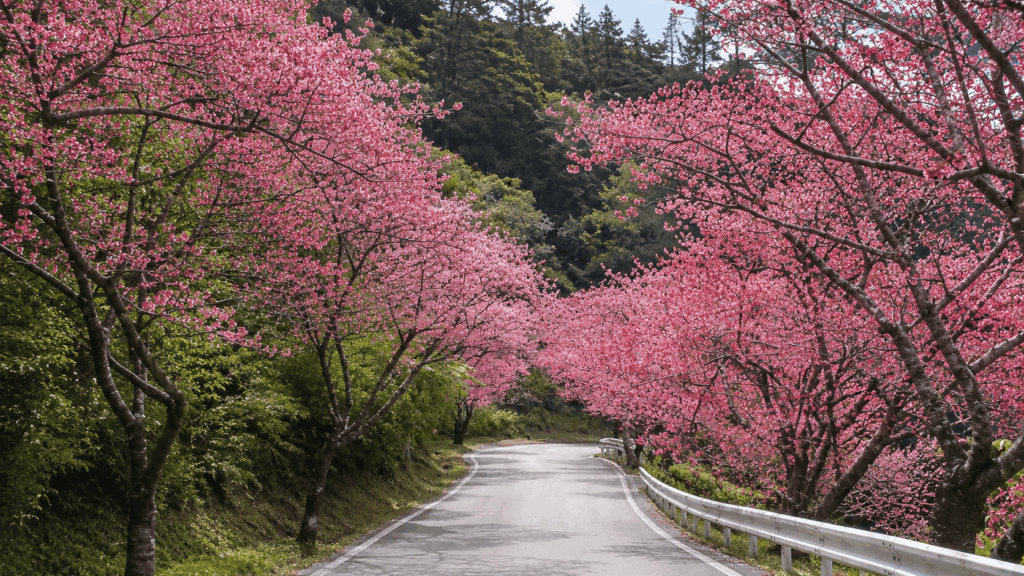
Cherry blossoms in Ishigaki are a winter experience — not the March–April sakura season most travelers associate with Tokyo and Kyoto. If you are planning an Ishigaki trip around cherry blossoms, the reliable window in an average year runs from late January to mid-February, and the most distinctive place to see them is the Arakawa Kanhizakura Wild-Growth Site, where roughly 300 wild Kanhizakura trees grow in a subtropical forest setting rather than a manicured park.
The catch is that bloom timing shifts noticeably from year to year, so the season needs to be treated as a flexible window with a last-minute check before you go — not as a fixed calendar promise. Travelers regularly ask me about seeing “the Ishigaki cherry blossoms in April,” and the honest answer is that they would be about two months late.
Not planning to drive? A private island tour can give you more flexibility to adjust the day around the latest bloom status without being tied to a bus timetable. If Arakawa is your priority, confirm with the operator that it can be included before booking, then check live availability and recent traveler reviews for this private English-guided Ishigaki tour.
Quick Answer: When and Where to See Cherry Blossoms in Ishigaki
Ishigaki’s cherry blossoms are Kanhizakura (also written hikanzakura), a deep-pink, bell-shaped variety that blooms in mid-winter instead of spring. According to the Japan Meteorological Agency, the normal first bloom is around January 18 and the normal full bloom is around February 10, based on 1991–2020 averages. In practice, timing swings by weeks from year to year — in 2026, for example, the first bloom was observed on February 4, about 17 days later than normal.
- Plan for winter, not spring: late January to mid-February is the most reliable window in an average year.
- April is too late: do not plan an April Ishigaki trip around cherry blossoms.
- Arakawa for the wild experience: the Arakawa Kanhizakura Wild-Growth Site is a nationally designated natural monument with around 300 wild trees growing in a forest along the Arakawa River.
- Banna Park for an easier stop: the maintained forest park on Mount Banna has cherry trees plus viewpoints over the city and coast, and it is free to enter.
Best for: first-time winter visitors who want a subtropical sakura experience that looks and feels completely different from Tokyo or Kyoto.
Skip if: your dates are fixed outside the winter window, or you are expecting Somei Yoshino-style avenues of pale blossoms — Kanhizakura is a different flower, not a smaller version of the same thing.
| When you visit | What you can expect | Best for |
|---|---|---|
| Mid-January | First blooms on some trees; full bloom is not guaranteed this early in an average year | Travelers who want quiet island time and are fine checking daily bloom reports |
| Late January to early February | Around the seasonal peak in an average year (normal full bloom: around Feb 10) | Most first-time visitors |
| Mid-February | Often still attractive, but petals start falling; in late years (such as 2026) this is peak | Flexible itineraries that can shift plans by a few days |
| Late February onward | Mostly leafed out, with only scattered late blooms | Only as a bonus stop — never as a planned highlight |
| March–April | The bloom season is over | Other Ishigaki activities |
When Is Cherry Blossom Season in Ishigaki?
The official figures come from the Ishigaki Local Meteorological Office, which observes a Kanhizakura specimen tree near the city. “First bloom” is recorded when 5–6 flowers open on the specimen tree, and “full bloom” when roughly 80% of the buds have opened. The normal dates, based on 1991–2020 averages, are:
- Normal first bloom: around January 18
- Normal full bloom: around February 10
Recent years show how much the timing can move:
- 2026: first bloom February 4 (+17 days vs normal), full bloom February 18 (+8 days) — one of the latest seasons on record in recent years.
- 2024–2025 season: local media reported that no full-bloom observation was announced for the specimen tree at all that year — a reminder that some winters never produce a textbook peak.
What this means in practice: treat “late January to mid-February” as a planning anchor, not a guarantee. If your trip dates are fixed, choose the earlier part of that window and be ready to adjust which spot you visit based on what is actually flowering.
Can You See Cherry Blossoms in Ishigaki in April?
In a normal year, no. Kanhizakura in Ishigaki has finished blooming by early March at the latest, and by April the trees are fully leafed out. A few individual trees may hold scattered blooms longer than the specimen tree, but you should not plan an April trip around cherry blossoms. If sakura is a must for your Japan trip, April is better spent in mainland Japan (Tokyo, Kyoto, or further north), where Somei Yoshino is at its peak.
Why You Should Check the Bloom Status Before You Go
Because the official dates are an average, not a promise, the single most useful thing you can do before booking is to check the current bloom status for Ishigaki — not a general “Okinawa cherry blossom” forecast. The Japan Meteorological Agency publishes first-bloom and full-bloom dates for Ishigaki as they are observed, and Ishigaki-focused tour operators and local news usually post updates once the trees start opening.
Kai’s tip: On a late-February visit some years ago, I brought a group from Tokyo up to the Arakawa site expecting to catch the tail end of the season. We were too late — the trees had mostly leafed out, and the few remaining blossoms were easy to miss against the green hillside. The mistake travelers make is assuming that “winter sakura” means a long, forgiving season. In reality, a shift of just two or three weeks in either direction changes the experience completely, so check the latest reports in the week before you fly and keep your Ishigaki day flexible.
What Makes Ishigaki Cherry Blossoms Different From Tokyo and Kyoto?
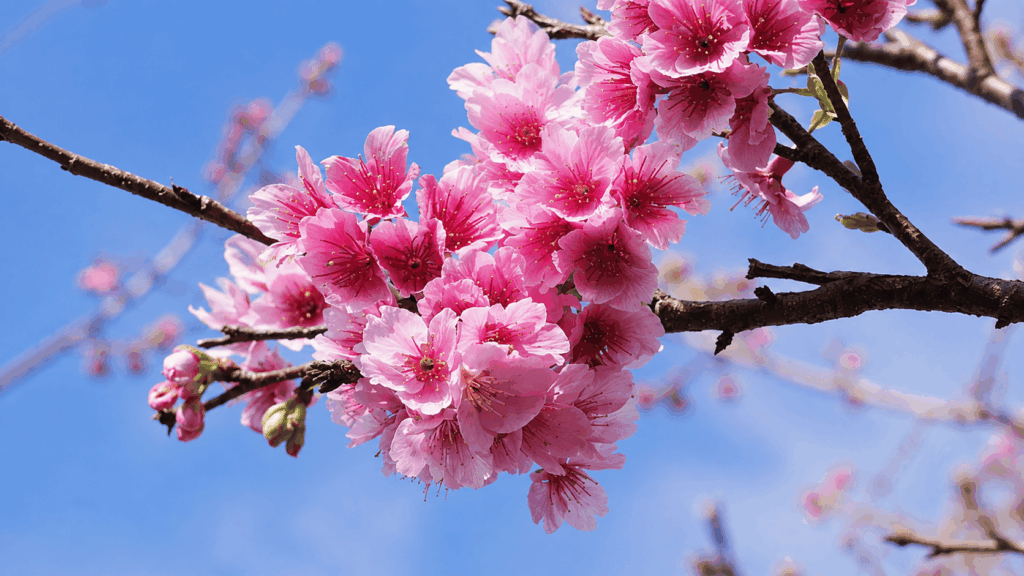
Almost everything. The cherry tree in Ishigaki is Kanhizakura (scientific name Cerasus campanulata, also known in English as the Taiwan cherry or bellflower cherry), and it has little in common with the Somei Yoshino that defines cherry-blossom season in Tokyo and Kyoto.
- Color: Kanhizakura is a strong pink — noticeably deeper than the pale pink, almost white blossoms of Somei Yoshino. Note that blossoms on Ishigaki tend to be slightly lighter in color than those on Okinawa’s main island or Amami, according to the Agency for Cultural Affairs, but the difference from mainland Japan’s Somei Yoshino is still dramatic.
- Shape: Kanhizakura flowers are bell-shaped and hang downward, where Somei Yoshino petals open flat and face outward.
- Timing: Kanhizakura blooms in mid-winter (January–February), while Somei Yoshino blooms in late March–April in central Japan.
- Setting: On Ishigaki, the most famous Kanhizakura grows wild in a forest valley, not along a groomed avenue or park path.
People who have only seen Tokyo’s cherry blossoms are usually caught off guard by how different this flower is — the color is so much stronger that it reads more like a subtropical flowering tree than the delicate “sakura” they pictured. That is exactly why Ishigaki’s cherry blossoms are worth planning around: it is a genuinely different flower in a genuinely different landscape, not a pale imitation of the mainland experience.
A Simple Photography Tip for Kanhizakura
Kai’s tip: Because the blossoms hang downward like small bells, the most flattering angle is from underneath the tree, looking up into the canopy — you get the dark-pink bells against the sky or the green hillside behind them. Most visitors photograph from eye level and end up with shots of the undersides of flowers against a busy background. Get low, put the tree between you and the sun, and you will see why this flower photographs so differently from Somei Yoshino.
Arakawa Kanhizakura Wild-Growth Site: The Most Distinctive Place to See Sakura in Ishigaki
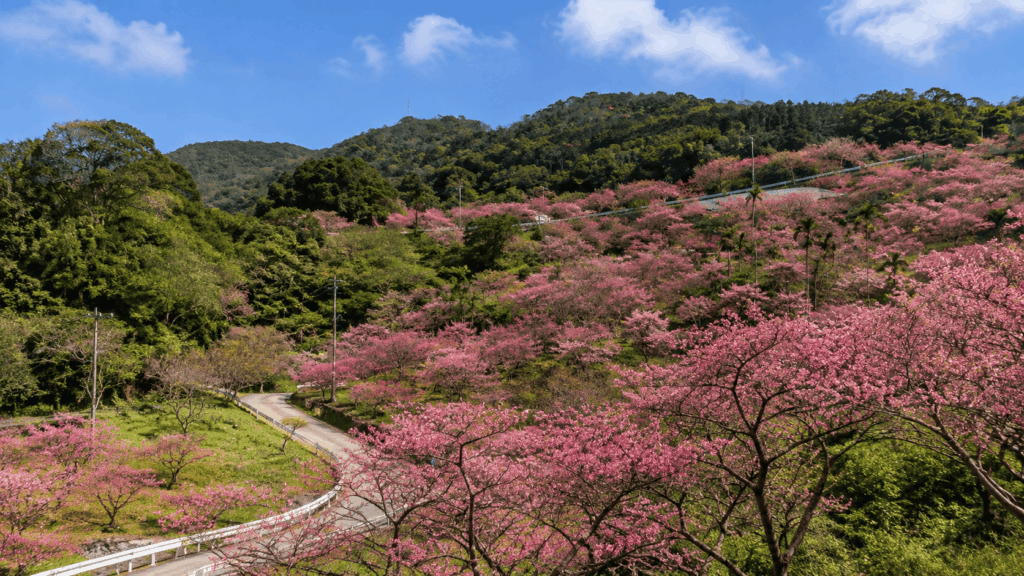
If you want the experience that makes Ishigaki’s cherry blossoms worth a winter trip, head to the Arakawa Kanhizakura Wild-Growth Site in the upper reaches of the Arakawa River, on the northern slope of Mount Omoto. This is a nationally designated natural monument — registered in May 1972 by the Agency for Cultural Affairs — where roughly 300 Kanhizakura trees grow wild in a subtropical forest. It is not a park with a mowed lawn and a cherry avenue; it is a mountain valley where the trees grow naturally among evergreen forest.
This is the single most important expectation to reset before you go: “about 300 trees” does not mean a tunnel of blossoms like Somei Yoshino along a riverbank in Kyoto. The trees are scattered through the valley, and the experience is closer to a wild woodland walk where the pink blossoms appear between the green of the subtropical forest. For the right traveler, that wildness is exactly the appeal.
What the Arakawa Experience Is Actually Like
The site sits along the Arakawa River on the northern side of Mount Omoto, on the edge of the island’s mountain forest. You reach the trees on foot from the parking area, following a path along the river — not a paved promenade. The ground is uneven in places, and some sections of the path can be muddy or slippery after rain.
When the Kanhizakura is at its peak, the valley shows the deep pink bells against the green hillside in a way that has no equivalent in mainland Japan. What surprised me most on my visits is how the flowers fall whole — the small bell-shaped blossoms drop intact and gather on the ground under the trees, which makes the contrast of pink against the dark forest floor even stronger than the view from the path. It is a quiet, atmospheric spot: a natural observation walk rather than a crowded viewing party.
A few things worth knowing before you go:
- Access: the site is on the north side of the island, roughly a 50-minute bus ride from the Ishigaki Bus Terminal, or a shorter drive if you have a car. A small free parking area is available near the trailhead.
- Walking conditions: expect an uneven, natural path along the river. Sturdy footwear matters far more here than at Banna Park.
- Seasonal timing matters more than anywhere else: visitors who arrive outside the bloom window consistently report that the trees are hard to identify against the green forest — the site is most rewarding when the blossoms are actually out, so check the latest bloom status before making the trip.
- What else is nearby: the site is in the same general area as the villages and coastal roads of northern Ishigaki, so it works well combined with a drive along the north coast rather than as an isolated detour.
What Shoes Should You Wear?
Because the walk to the trees follows a natural riverside path with uneven ground, wear shoes you are comfortable walking in on rough terrain. Sneakers or light hiking shoes work well; sandals, heels, and fashion loafers are a bad idea here.
Kai’s tip: Over the years I have walked this path with travelers more than a few times, and the ones who struggle are never the ones who planned for the forest — they are the ones who treated the site like a city park and came in sandals or smooth-soled shoes. The walk is not long, but the ground is uneven and can be slippery after rain. A pair of sturdy sneakers is the difference between enjoying the valley and watching your footing the whole time.
Arakawa vs Banna Park: Which Is Better for Cherry Blossoms?
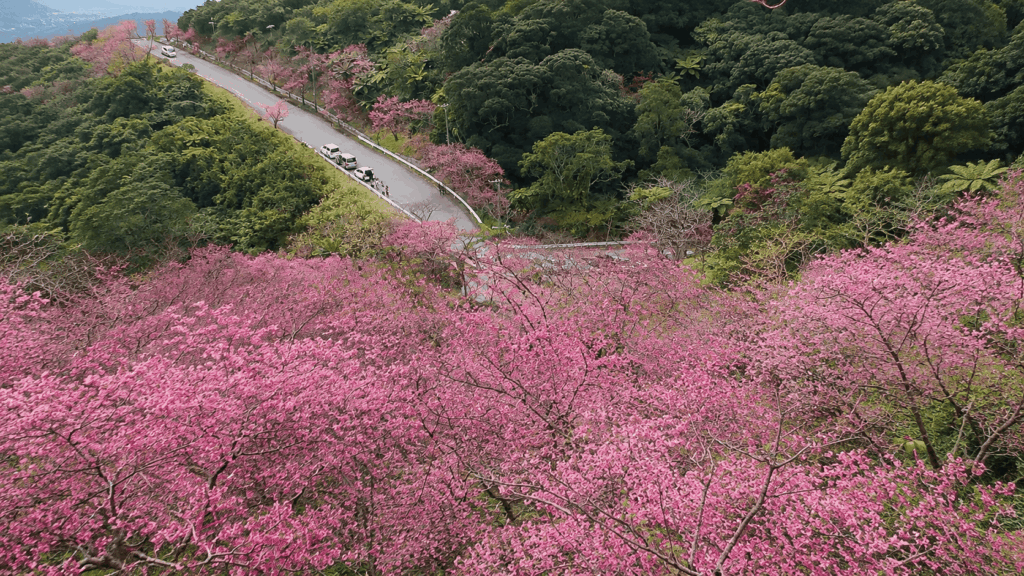
Banna Park is the easier, more conventional option: a maintained forest park on Mount Banna, roughly 230 meters above the city, with viewpoints over Ishigaki’s coastline and town. Entry is free, parking is available, and the cherry trees are part of a larger, well-kept park landscape. In an average year, the Kanhizakura there is at its best from late January to early February.
Neither option is “wrong” — they suit different trips:
| Arakawa Kanhizakura Wild-Growth Site | Banna Park | |
|---|---|---|
| Setting | Wild mountain valley along a river; nationally designated natural monument | Maintained forest park on Mount Banna with viewpoints |
| The trees | Roughly 300 wild Kanhizakura scattered through the forest | Cherry trees within a larger park landscape (bloom spot varies by year) |
| Walking conditions | Uneven natural path along the river; sturdy shoes recommended | Park paths and roads; easier for casual footwear |
| Facilities | Minimal — small parking area, no developed park facilities | Parking, viewpoints, park facilities; free entry |
| Photography | Deep pink bells against green forest; a wild, textured setting | Blossoms plus wide views over the city and coast |
| Best for | Travelers who want the distinctive wild-grown experience and are comfortable on a natural trail | Families, casual visitors, or anyone combining sakura with a viewpoint stop |
My honest advice: if you have come to Ishigaki specifically for cherry blossoms, Arakawa is the stronger choice — it is the place that looks and feels like nowhere else. Banna Park is the sensible backup: it is easier to reach, easier to walk, and still gives you Kanhizakura, so it is a good plan B if the Arakawa bloom is past its best or your group prefers an easier outing.
How to Plan a Winter Cherry Blossom Stop in Ishigaki
Cherry blossoms in Ishigaki are best treated as a seasonal stop inside a winter itinerary rather than the whole reason for the trip. The island has plenty to offer in January and February — diving, snorkeling, beaches, the northern coast, and local food — so the practical approach is to book your Ishigaki dates in the winter window and decide on the day which blossom spot to visit, based on the latest reports.
Do You Need a Rental Car?
Not strictly — Arakawa is reachable by bus from the Ishigaki Bus Terminal (roughly 50 minutes), and Banna Park is a short trip from town. But a rental car makes the decision much easier in practice. Because bloom timing shifts from year to year, the smart move is to stay flexible about which spot you visit; with a car you can check the morning’s bloom reports and choose Arakawa or Banna Park without being locked into a bus timetable. It also lets you combine the site with the north coast in the same drive, which is how most visitors see the area efficiently.
Car rental prices on Ishigaki start at a moderate daily rate and vary with season and vehicle type, so compare availability for your dates rather than relying on a fixed figure.
What If You Do Not Want to Drive?
If you prefer not to drive, your options for getting around Ishigaki without a car are the public bus (workable but time-bound) or a private tour. Several private Ishigaki tours with English-speaking drivers and guides are listed on booking platforms, and they can usually be customized around your interests. One thing to check before booking: not every private tour includes the Arakawa wild-growth site in its standard route, since the site is a natural area outside the main sightseeing loop — confirm with the operator that the stop is included, and check the current bloom status before your tour date.
If you want the flexibility of a car without doing the driving — especially when the day’s bloom report may change your route — this is the private option worth comparing. If Arakawa is the priority, ask the operator whether it can be included before you finalize the booking.
Why I’d book this one
- Recent travelers consistently mention flexible itineraries and good communication before the tour.
- Reviews also highlight useful local explanations and guides who adapt the day around guests’ interests and changing conditions.
- A private format makes it easier to discuss priorities in advance instead of following a fixed sightseeing loop.
What Is Ishigaki Weather Like During Cherry Blossom Season?
January is the coolest month on Ishigaki, but “cool” by Okinawan standards is still mild. According to the Japan Meteorological Agency’s normals, January averages around 18.9°C during the day, with daily highs near 21.5°C and lows around 16.7°C. February is similar, with temperatures climbing slightly. For more details on seasonal conditions, check our broader guide on the best time to visit Ishigaki.
Two things catch visitors off guard:
- The wind. Winter on the southern islands brings strong northerly winds, and the wind chill makes the air feel noticeably cooler than the thermometer suggests. A light jacket or fleece is useful even when the sun is out.
- It is not tropical beach weather every day. There will be warm, sunny afternoons, but also cloudy, windy days — the bloom window overlaps with the island’s cooler, less predictable stretch of the year.
Coming from a Tokyo winter, where the same weeks mean single-digit temperatures, the contrast is striking: you can be in a light jacket watching deep-pink blossoms against a green hillside while friends on the mainland are still weeks away from their sakura season. That is the appeal of Ishigaki’s cherry blossoms — winter flowers in a subtropical setting, provided you time the visit around the island’s calendar, not the mainland’s.
FAQ
When exactly do cherry blossoms bloom in Ishigaki?
In an average year, the first bloom is around January 18 and full bloom is around February 10, according to the Japan Meteorological Agency’s 1991–2020 normals. The catch is that actual timing moves by weeks from year to year — in 2026, full bloom was February 18, more than a week later than normal. If your dates are fixed, late January to early February is the safer end of the window, and you should still check the latest bloom reports in the week before you go.
Can I see cherry blossoms in Ishigaki in April?
In a normal year, no. Kanhizakura has finished blooming by early March at the latest, and the trees are fully leafed out by April. A few individual trees can hold scattered blooms a little longer, but an April trip should never be planned around cherry blossoms on Ishigaki — if sakura is a must, April is the season for mainland Japan instead.
Is Arakawa worth the trip, and how is it different from Banna Park?
Arakawa is the more distinctive experience: a nationally designated natural monument where roughly 300 wild Kanhizakura trees grow in a forest valley along the river, with an uneven natural path and minimal facilities. Banna Park is the easier option — a maintained forest park on Mount Banna with viewpoints, free entry, and park paths. If you came specifically for cherry blossoms, Arakawa is the stronger choice; if you want an easy stop with views, Banna Park is the better fit. More travelers than you would expect make the trip to Arakawa during the bloom window and find it worth it — but only when the blossoms are actually out, so time it carefully.
Do I need a rental car to see the cherry blossoms?
No, but it helps. Arakawa is reachable by bus from the Ishigaki Bus Terminal (roughly 50 minutes), and Banna Park is a short trip from town. The practical advantage of a car is flexibility: bloom timing shifts every year, and with a car you can check the morning’s bloom reports and pick Arakawa or Banna Park on the day, without being locked into a bus timetable.
What should I wear to see the cherry blossoms?
Bring layers for the wind — January averages around 18.9°C but strong northerly winds make it feel cooler — and wear sturdy sneakers or light hiking shoes for Arakawa. The path along the river is uneven and can be slippery after rain, so sandals or smooth-soled shoes are a bad idea there.
Can I enjoy Ishigaki in winter if the cherry blossoms do not cooperate?
Yes — and this is worth planning around. January and February are still good months for the island’s beaches, diving and snorkeling, the northern coast, and local food. The cherry blossoms are a seasonal highlight, not the whole reason to visit, so keep the rest of your itinerary independent of the bloom status. If you want to hedge further, stay flexible about which blossom spot you visit rather than which week you travel.
Final Verdict: Is Ishigaki’s Cherry Blossom Season Worth Planning Around?
Ishigaki’s cherry blossoms are worth seeing — if you visit in winter, and if you go in with the right expectations. Kanhizakura is a deep-pink, bell-shaped flower that blooms in mid-winter in a subtropical landscape, and it looks and feels nothing like the pale Somei Yoshino of Tokyo and Kyoto. That difference is the whole point, and it is why the island deserves its own cherry-blossom guide instead of being folded into the mainland sakura conversation.
What I would tell a friend visiting Ishigaki for the first time: do not plan around a fixed promise of “mid-January to early February.” Use the official normals (first bloom around January 18, full bloom around February 10) as your anchor, book your dates in that window, and check the actual bloom reports in the week before you fly. Then pick your spot on the day.
- Choose Arakawa if you want the experience that has no equivalent in mainland Japan: wild Kanhizakura in a forest valley, a natural monument, a quiet walk along the river. Wear sturdy shoes and check the bloom status first.
- Choose Banna Park if you want an easy, free stop with cherry blossoms plus wide views over the city and coast — especially good for families or casual visitors.
- For first-time visitors: plan for late January to early February, make Arakawa your primary target, and keep Banna Park as your backup if the timing is off.
- For families: Banna Park is the sensible choice — easier walking, parking, and facilities, with the bloom as a bonus on top of the viewpoints.
- For travelers on a tight schedule: a rental car is the most efficient way to combine a blossom stop with the north coast in one half-day, and it lets you react to the latest bloom reports.
- For repeat visitors: come back in a different year — the timing swings enough from winter to winter that no two seasons look the same, and Arakawa rewards the traveler who can be flexible.
Bottom line: if you can travel in winter, Arakawa’s wild Kanhizakura is one of the most distinctive sakura experiences in Japan. Just remember that the season is a moving target — treat the window as a plan, not a promise, and check the blooms before you go.
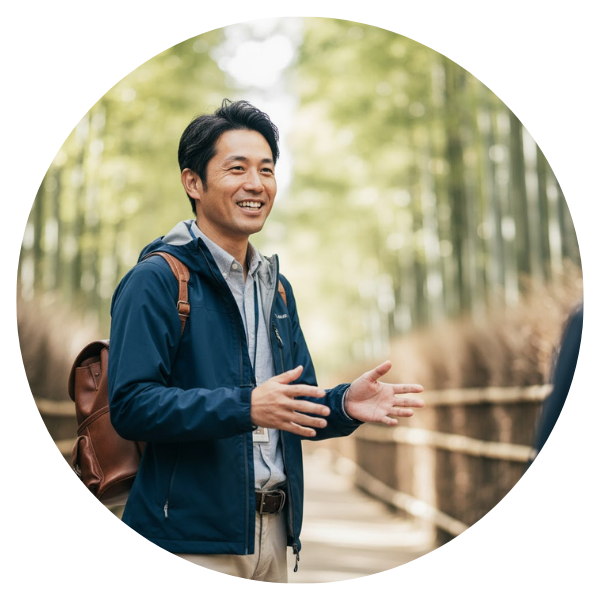
Hi, I’m Kai. I’m a Tokyo-based travel writer, tourism industry insider, and the author of a published guidebook for international visitors to Japan. With over 10 years of professional experience at a leading Japanese tourism company, my mission is to help you skip the tourist traps and navigate Japan’s best destinations like a local. I believe the perfect day trip is like a traditional kaiseki meal: a beautiful balance of precise planning and unforgettable seasonal discovery. When I’m not out conducting field research, you’ll usually find me drafting new itineraries with one of my favorite fountain pens!