
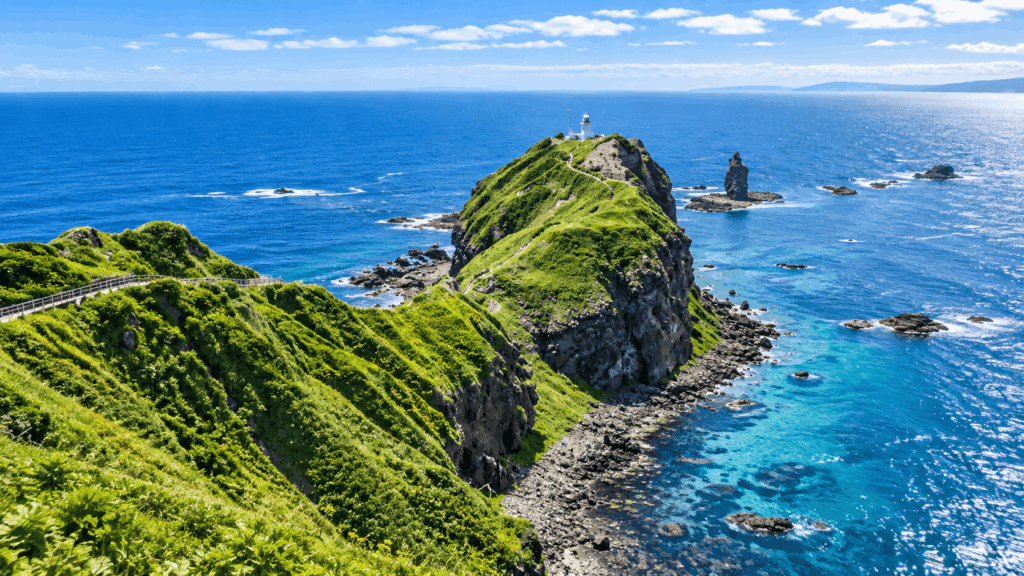
Shakotan Peninsula is one of the few places within day-trip range of Sapporo where the coast still looks wild: black rock, near-vertical cliffs, and water that shifts from turquoise to deep navy depending on the light. It is also a long way from the city, and the walking at the far end is more demanding than the photos suggest.
This guide answers three questions in order: whether the peninsula justifies a full day, which transport option actually fits you, and how to sequence Cape Kamui, Shimamui Coast and a seafood lunch without the day collapsing on you.
Prefer not to drive? A guided day trip can take care of the long coastal journey while covering Cape Kamui and Shimamui Coast. Check current departure dates, itinerary details, and guide-language options for this Shakotan day tour before deciding between a rental car and a tour. Check which coastal stops operate on your dates, especially during the 2026–2027 Cape Kamui trail closure.
Shakotan Peninsula Day Trip: The Quick Answer
Yes, Shakotan works as a day trip from Sapporo — but treat it as a full day, not a half-day add-on. The drive is roughly 100–110 km each way depending on your starting point and route, or about 2 to 2.5 hours one way via the expressway to Yoichi and then National Route 229 along the coast. What you get for that is a genuinely dramatic shoreline, not a manicured viewpoint.
- Build the day around three things: Cape Kamui, Shimamui Coast and one proper seafood lunch. Adding more stops usually makes the day worse, not better.
- Getting there: a rental car gives you the most freedom; a guided day tour from Sapporo is the realistic option if you do not want to drive; public transport is possible but the timetable dictates your day.
- Walking at Cape Kamui: the trail to the tip is about 770 m when open, roughly 20 minutes each way at a steady pace. Allow closer to an hour from the car park once you add photos, wind and the walk back up.
- Current access (as of October 2026): the section from the Nyonin Kinsei Gate to the tip of Cape Kamui is closed for construction from 5 October 2026 until early April 2027. The path beside the car park and the viewpoint plaza remain open, so you can still see the cape and Kamui Rock.
- Best for: travellers who rank coastal scenery, photography and seafood above city sightseeing, and who can give the day eight to ten hours.
Prefer not to drive in Hokkaido? Day tours from Sapporo cover Cape Kamui and Shimamui Coast with the long coastal drive handled for you — worth comparing before you commit to a rental car.
Is Shakotan Worth a Full Day from Sapporo?
The honest answer depends less on distance than on what you want from a day out. Shakotan is not a place with a cluster of attractions. It is one long, beautiful coastal road with two or three genuinely memorable stops at the end of it. If that is the kind of day you enjoy, the drive pays you back. If you need constant stimulation, it will feel like a lot of sitting.
What the Day Actually Gives You
The coastline here is different in character from anything closer to Sapporo. Otaru is charming but urban: canals, warehouses, glass shops. Shakotan is the opposite — cliffs dropping straight into the Sea of Japan, rock formations offshore, and almost no development between the small fishing settlements. National Route 229 itself, which wraps around the peninsula, is part of the attraction rather than just a means of getting there.
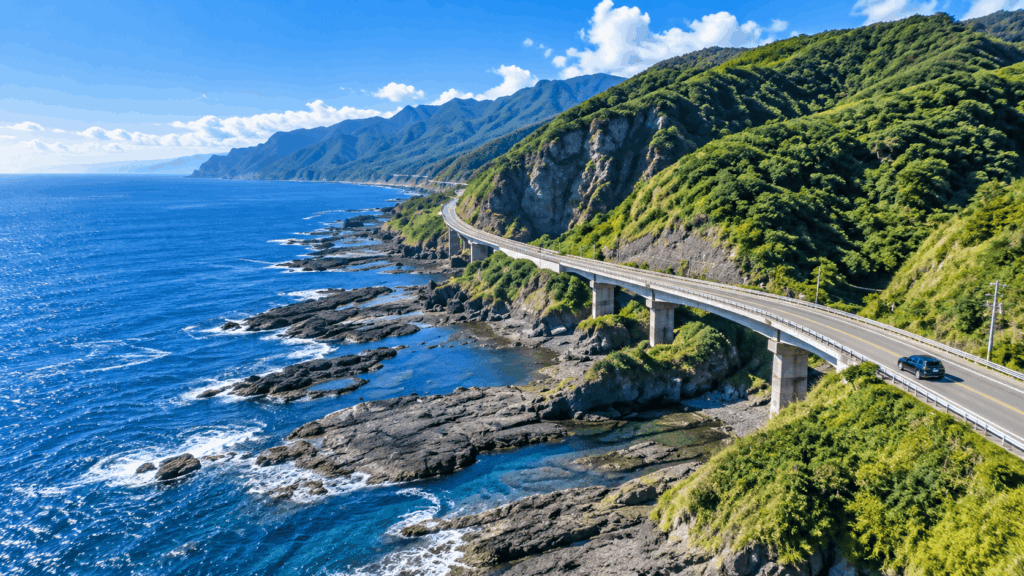
The colour people call Shakotan Blue is real, but it is not a guarantee. It reads strongest in bright, high sun and calmer water; on an overcast or windy day the same water looks grey-green. If vivid blue is the entire reason for your trip, check the forecast rather than the calendar — no month promises it.
Who Should Skip It
Reconsider Shakotan if any of these apply:
- You only have half a day. A rushed version means arriving at Cape Kamui with no time to walk, which defeats the purpose.
- Coastal scenery is a nice-to-have, not a priority. Otaru, Lake Toya or a Noboribetsu onsen day will give you more variety per hour of travel.
- Nobody in your group wants a long drive. Two to two and a half hours each way is the reality, and the return leg is in the dark for much of the year.
- The trail at Cape Kamui is the only reason you are going, and someone cannot manage uneven, sloping ground. In that case Shimamui Coast alone may satisfy you — see the comparison further down.
- The forecast is heavy rain or strong wind. You can still salvage a food-focused day, but the scenery payoff drops sharply.
The mistake I see most often is people judging the trip purely by driving time and planning nothing for after they arrive. Cape Kamui is not a car-park viewpoint: you get out and walk, often into wind, and that is where an over-scheduled day falls apart. During the current construction closure, this means the open car-park-side paths and viewpoint plaza, not the closed trail beyond the Nyonin Kinsei Gate.
How to Get to Shakotan from Sapporo: Car vs Tour vs Bus
This is the decision that shapes everything else, because it determines whether you can reorder the day when the weather or the queues change. (If your main goal is simply reaching the cape, you can also compare specific options in our detailed guide on getting to Cape Kamui.)
| Option | Best for | Flexibility | Time commitment | Main drawback | Verdict |
|---|---|---|---|---|---|
| Rental car | Travellers who want to choose their own lunch spot and change order on the day | High — you can swap Cape Kamui and Shimamui, or add Cape Ogon, at will | Roughly 2–2.5 hours each way; a 9–10 hour day in total | Long coastal driving, and you cannot both admire the view and drive | Best overall for scenery-focused travellers |
| Guided day tour | Anyone who does not want to drive in Japan, or wants zero planning | Low — stops and timings are fixed for the group | Typically 10–11 hours door to door | Time at each cape is set by the itinerary, sometimes very short | Best no-driving option |
| Public transport | Budget travellers with a flexible schedule and patience | Low — some services require phone booking the day before | Most of a day, with little slack for delays | Connections and reservation rules; cash fares | Possible, but the weakest choice for one day |
Rental Car — Best for Flexibility
Driving yourself is the only way to treat the peninsula as a sequence you can rewrite. If Cape Kamui is blowing a gale at midday, you can push it to late afternoon and eat first. If the restaurant you wanted has sold out, you can drive to the next town. That adaptability is the real value, more than the cost saving.
The route is straightforward: expressway from Sapporo towards Yoichi, then National Route 229 following the coast around the peninsula. Tolls vary by where you join the expressway and which interchanges you use — budget roughly ¥1,000–1,800 one way and confirm with your rental company’s toll option. Parking at Cape Kamui is free, but the lots fill on fine summer weekends and holidays.
What I noticed driving up from Otaru is how much the day depends on being able to reverse the order of stops. The coast road rewards whoever is willing to abandon the plan; a fixed schedule does not.
Guided Day Tour — Best If You Don’t Want to Drive
If the thought of two-plus hours of coastal driving in an unfamiliar country is the thing stopping you, a tour removes that problem entirely. Standard departures leave Sapporo Station in the morning and return in the evening, with an English-speaking guide on most products, and many allow free cancellation up to 24 hours before.
The trap is assuming every “Cape Kamui tour” gives you the same time at the cape. They do not. On one widely sold 10-hour itinerary listed in October 2026, the allocation was roughly one hour at Cape Kamui, twenty minutes at Shimamui Coast, forty minutes at Cape Ogon and two hours of free time in Otaru — a sensible shape, but only if you know it in advance. Other products fold in fruit picking, a distillery visit or a seafood lunch, which further compresses the coast.
Before booking, compare these specifics rather than the headline price:
- Time allocated at Cape Kamui — an hour is workable in good weather; less than that and you may only reach the gate.
- Whether Shimamui Coast is included — some itineraries skip it entirely.
- Lunch arrangements — included seafood lunch versus free time to find your own.
- Guide language — English is common but not universal on every departure.
- Cancellation terms and weather policy — coastal wind cancels stops more often than city tours.
- Seasonal itinerary changes — winter routes drop or replace coastal stops.
Prices in October 2026 sat roughly in the US$40–115 range per person for shared tours, with private departures starting higher. Treat that as a shape, not a quote: rates move with season, inclusions and how far ahead you book.
If you are leaning towards letting someone else handle the Route 229 drive, a guided Shakotan day tour is the simplest way to see Cape Kamui and Shimamui Coast without planning buses or parking.
For travellers who want both coastal viewpoints in one day but would rather not handle the driving or connections, the Otaru, Yoichi Distillery & Cape Kamui (Shakotan) Day Trip is one option worth examining. Its listed route combines the coast with stops around Yoichi and Otaru, so the key question is whether that balance suits your priorities.
Why I’d book this one
- Guided context and organisation: Recent traveller feedback highlights helpful communication, local information and the convenience of having the day’s transport organised. Check the guide language for your chosen departure rather than assuming every explanation will be in English.
- Several stops without complicated connections: The listed itinerary includes Cape Kamui and Shimamui Coast alongside Yoichi and Otaru. That makes it a practical alternative to coordinating buses, although time at each viewpoint is limited by the group schedule.
- Booking flexibility: The listing advertises flexible booking arrangements, including cancellation and pay-later options. Confirm the exact terms, departure format and inclusions for your selected date before committing.
One important limitation: the Cape Kamui trail from the Nyonin Kinsei Gate to the tip is closed for construction from 5 October 2026 until early April 2027. A tour booking does not override that restriction. Check the operator’s seasonal itinerary and the town’s current trail status before choosing a date.
Public Transport — Possible, but the Timetable Owns Your Day
You can reach Shakotan without a car, and the local authorities have kept a connecting service running since the old regional bus line was discontinued. But the service pattern is designed for residents, not for visitors trying to tick off three coastal stops in one day.
Here is how it actually works, based on the town’s own bus guidance:
- Sapporo to Otaru by train, then the Hokkaido Chuo Bus Shakotan Line from Otaru Station to Bikuni Terminal — about 1 hour 20 minutes.
- Bikuni Terminal onwards is served by the Shakotan Town Community Bus, which connects with the Chuo Bus at the terminal and continues towards Cape Kamui.
- Some departures are reservation-only. Those services must be booked by phone by 17:00 the day before. Same-day booking is not accepted, and the reservation desk is open 09:00–17:00.
- The next day’s operating schedule is announced at 18:00 the previous evening via the town’s information app and local terminals; consult the current timetable and confirm any reservation-required service.
- Fares are cash or pre-purchased ticket strips, and the town specifically asks passengers to have small coins ready. Do not assume a transport IC card covers it.
- The published 2026 summer timetable runs from 1 April to 30 November, with different arrangements outside that window.
None of this makes a car-free trip impossible. It makes it inflexible: you cannot wait out a squall, you cannot linger at Shimamui because the light has suddenly turned, and a long queue at a uni restaurant can cost you the connection back. For a one-day visit with scenery as the goal, that is the trade most travellers regret.
What I would tell a friend considering the bus is this: it works beautifully if you pick one destination — Cape Kamui, say — and accept that the day is about the journey. It works badly if you are trying to see the whole peninsula.
A Realistic One-Day Shakotan Itinerary
Both versions below assume a rental car and an early start. Times are ranges rather than a schedule, because the two variables you cannot control — wind at the cape and queues at lunch — will move everything by twenty minutes here and there.
Pattern A — Cape Kamui First
This is the version I would choose on a clear morning, because the cape is at its best before the tour coaches arrive and before the wind builds in the afternoon.
- 07:30–08:00 — Leave Sapporo. Expressway towards Yoichi, then National Route 229. Add a ten-minute stop at a roadside station if you need coffee; the coastal section has few facilities.
- 10:00–11:15 — Cape Kamui. Park, walk the open section of trail, and use the viewpoint plaza. If the tip is accessible on your dates, budget the full hour. Windproof layer on, even in summer.
- 11:45–13:00 — Lunch. Either the Cape Kamui side or back towards Bikuni, depending on where you want to eat. Order uni early in the meal if you want it — see the lunch section below.
- 13:30–14:15 — Shimamui Coast. Short walk, tunnel, viewpoint. Fifteen to twenty minutes at the rail is usually enough, plus the walk back.
- 14:45–15:30 — Optional: Cape Ogon. A gentler, lower viewpoint near Bikuni; a good add if the weather is holding and nobody is tired.
- 16:00 onwards — Return. Either straight back to Sapporo, or a short Otaru stop if you left early and still have energy.
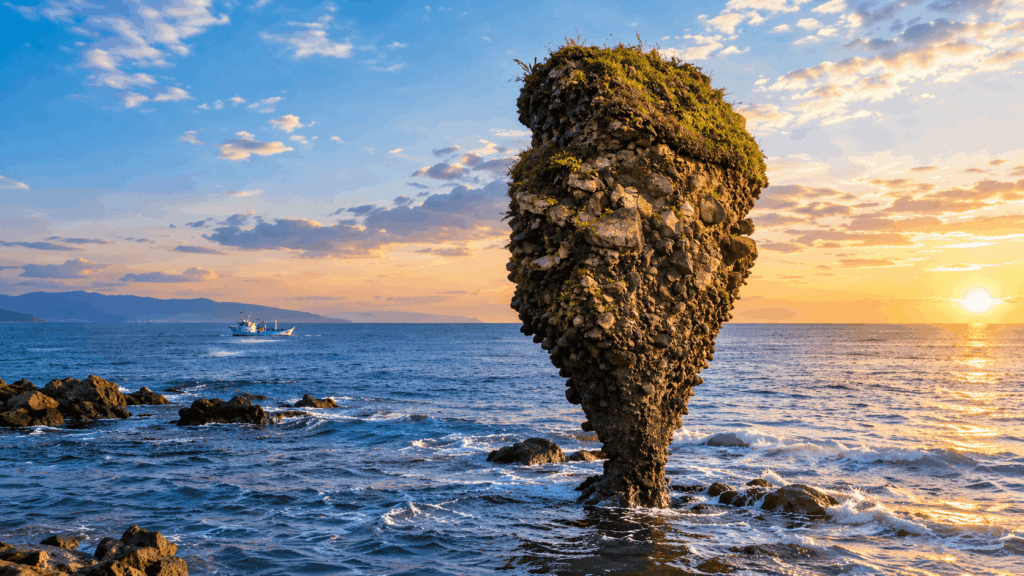
Pattern B — Uni Lunch First
Flip the order if uni is the reason you are going, or if the forecast suggests wind picking up later in the day. Restaurants in the uni season can run out, and the small ones operate on very short hours.
- 07:30 — Leave Sapporo and drive directly to the Cape Kamui / Bikuni area without sightseeing stops.
- 10:45–11:45 — Eat first. Arriving before the noon rush is the single biggest factor in whether you get what you came for.
- 12:15–13:30 — Cape Kamui. Midday light is fine for the cliffs; the trade-off is more people and, often, more wind.
- 14:00–14:40 — Shimamui Coast.
- 15:00 — Optional stop (Cape Ogon, Yoichi or Otaru) and return to Sapporo by early evening.
In winter, compress both patterns: the Cape Kamui park entrance gate operates on reduced hours (10:00–15:00, last entry generally 14:00) from December to March, the tip trail remains closed during the 2026–2027 works, and daylight on the coast runs out early.
Should You Add Otaru to the Same Day?
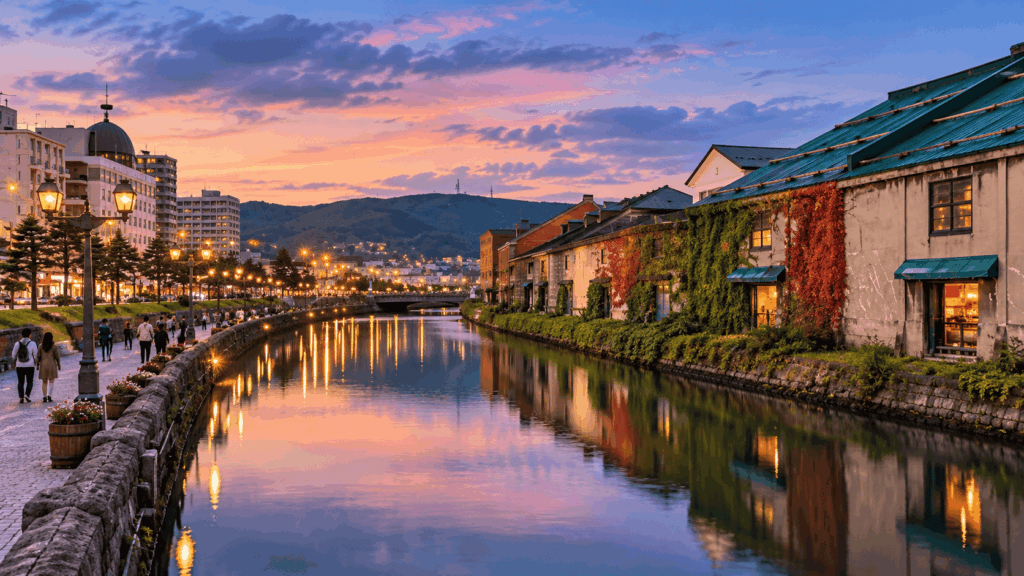
Otaru is the obvious temptation because it sits on the way, and it is a reasonable addition only under specific conditions: you left Sapporo by 07:30, you skipped Cape Ogon, and you are content with thirty to sixty minutes around the canal rather than a proper look at the town.
Try to do both properly and the day becomes a sequence of arrivals and departures. Otaru deserves its own half-day — the canal, the glass workshops and the sushi streets reward unhurried time — and Shakotan deserves the daylight hours. If you have two, give each its own day and you will enjoy both more. For that separate visit, check our realistic Otaru day trip itinerary.
Cape Kamui: What the Walk Is Really Like
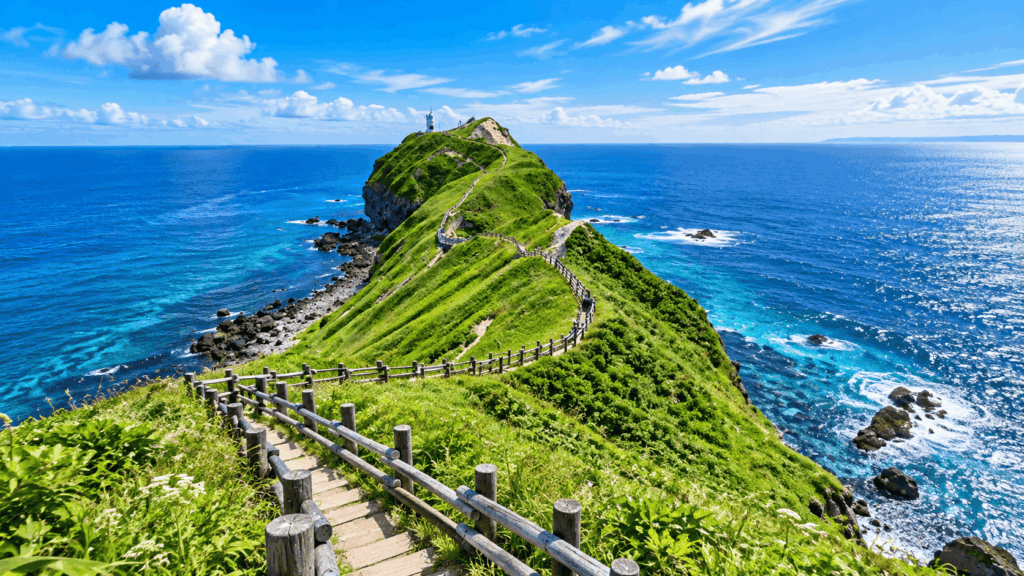
Cape Kamui is the reason most people make this drive, and it is worth being clear about what it involves. The car park is not the destination. From the parking area you follow the Charenka Trail — a narrow path with real ups and downs — out along a ridge with water on three sides, towards the lighthouse and Kamui Rock.
Because of that, the visit has two costs, not one: the drive there, and the time and effort once you arrive.
How Long the Walk Takes
When open, the trail measures about 770 m from the Nyonin Kinsei Gate to the tip. At a steady pace that is roughly 20 minutes each way, which is the figure most guides quote. The Shakotan Tourism Association puts the round trip at around 40 minutes; the town’s own guidance suggests allowing about an hour from the car park to the tip and back.
Those numbers are not in conflict — they describe different things for a fully open trail. Forty minutes is walking. An hour is walking plus stopping at the rail, taking photos, waiting for a gust to pass, and the gentle climb back. Plan on the hour if you intend to reach the end, and less if you are content with the gate and the first viewpoints.
Wind, Footwear and the Gate
When the route is open, the path is exposed for almost its entire length, and the wind here is not a background detail. It shapes how long people stay and, occasionally, whether they get out at all. The town is explicit that the Nyonin Kinsei Gate can be closed for safety when conditions deteriorate, including after it has opened earlier in the day, so a morning that looks fine is not a guarantee for the afternoon.
Kai’s tip: On my visit the wind decided the walk, not my legs — my cap was within a gust of going over the cliff edge, and the path has enough broken, uneven surface that sandals or smooth soles would have been a mistake. I now tell anyone going that this is a stop where you budget an hour and wear proper trainers, even if you are only planning to reach the gate.
Practicalities worth knowing before you go:
- Gate hours change by month. Roughly 08:00–17:30 in April and August–October, 08:00–18:00 in May and July, 08:00–18:30 in June, 08:00–16:30 in November, and only 10:00–15:00 from December to March.
- Hours can be shortened without notice for rain or wind, so do not plan to arrive in the last hour of the day.
- Footwear matters more than layers. Trainers with grip are the sensible minimum; the ground is packed earth and rock, not pavement.
- Parking is free but limited at peak times; on a fine summer weekend, arriving after 11:00 can mean waiting for a space.
What Is Open During the 2026–2027 Closure
From 5 October 2026 until early April 2027, the trail from the Nyonin Kinsei Gate to the tip of Cape Kamui is closed for construction work on the safety fencing. The 770 m ridge walk shown in older photographs is not available during this closure. The town notes that the closure period includes the usual winter shutdown and may shift with weather and construction progress.
What remains open is more than nothing: the path beside the car park can still be walked, and the viewpoint plaza above it still looks out over the cape and Kamui Rock. You will not get the full three-sided panorama from the tip, but you will see the shape of the place and the colour of the water. In snowy conditions the road to the car park is cleared daily, but the paths inside the park hold snow — bring boots rather than trainers if you are visiting between December and March.
If the cape itself is the main draw for you, this is the one detail to check before fixing your dates. The town publishes an official trail status page and updates it as conditions change; it is a better source than any tour listing you will see online.
Shimamui Coast: The Easier Scenic Stop
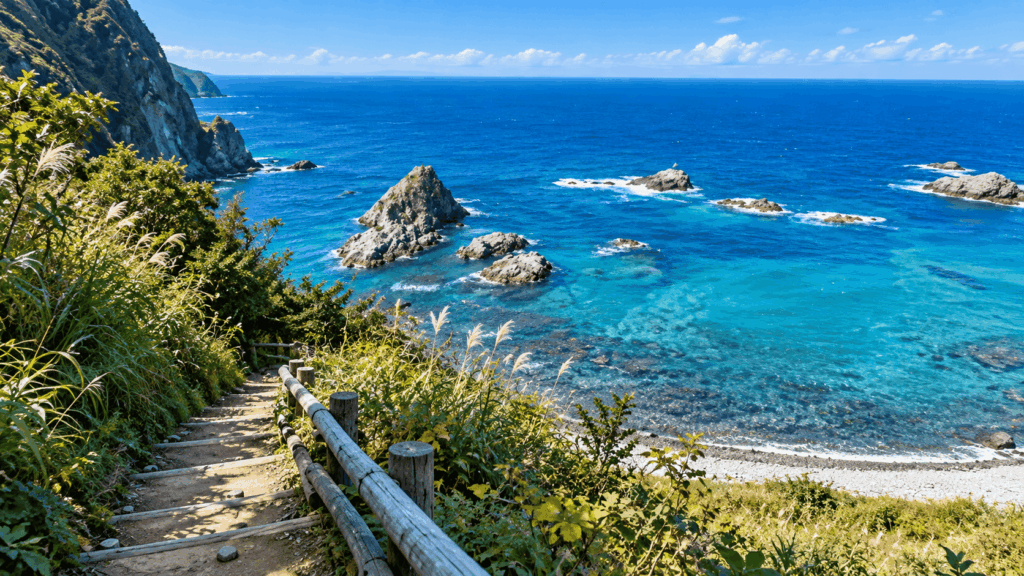
Shimamui Coast sits on the far side of Cape Shakotan, a short drive from Cape Kamui, and it delivers its view in a completely different way. From the car park you climb a gentle slope, enter a narrow pedestrian tunnel — about 30 m long, unlit and noticeably cool — and then the coast opens up in front of you with no warning at all.
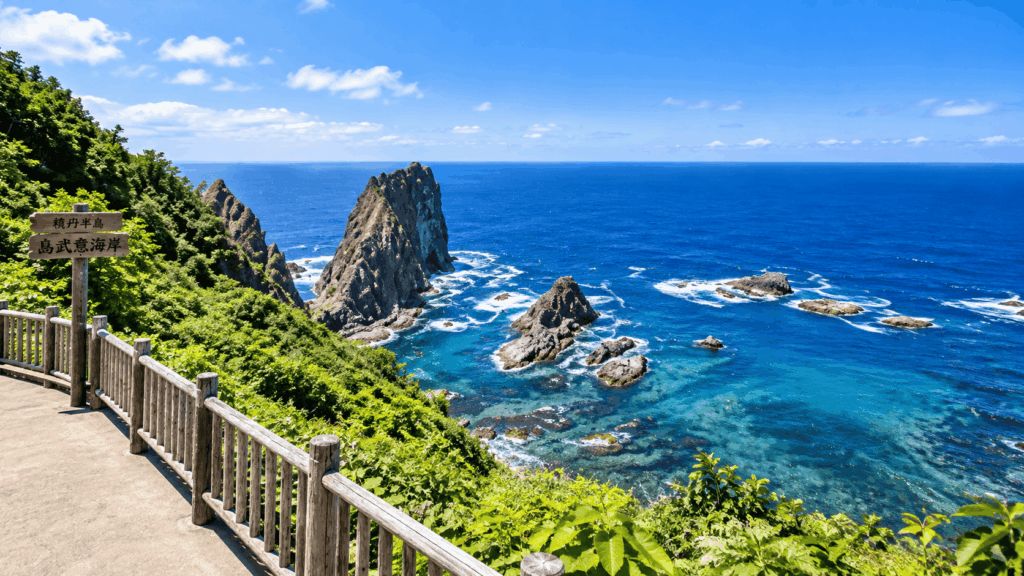
That sudden reveal is the whole point, and it is the reason I still rate this stop highly even though it asks almost nothing of you. The walk from car to viewpoint is a few minutes, the ground is straightforward, and the railing delivers a view over cliffs and a rock-strewn cove that photographs beautifully in flat light as well as sun.
Two things to set straight before you go:
- The observatory is open, and it is where the classic view comes from.
- The trail down to the shore is closed for repair work until early April 2027. Photos of the descent show a route you cannot currently use. Older guides still describe Shimamui as the one place where you can stand at the water’s edge below the cliffs; right now, you cannot. Go for the view from above, not for the beach.
Access note: The steps pictured below descend towards the shore, but that descent is closed through early April 2027; the lookout above is open.
Kai’s tip: Because the tunnel hides everything until the last second, Shimamui works best as your second stop, not your first. I use it as the short, high-payoff stop after Cape Kamui has taken the morning — twenty minutes here recovers the scenery when legs or schedule are running out, and it never feels like a lesser version of the cape.
The surrounding Cape Shakotan area has its own short nature trail, but access there changes with wildlife and maintenance notices — bear sightings have closed sections of it in autumn 2026. Check the town’s trail status page on the morning of your visit rather than relying on any listing.
Cape Kamui vs Shimamui Coast: Which Should You Prioritize?
Access update (October 2026): The Cape Kamui walking distances and times below describe normal conditions. The route beyond the Nyonin Kinsei Gate is closed until early April 2027. Shimamui Coast’s viewpoint is open, but its descent to the beach is closed.
These two get framed as rivals, which misses the point. They are not competing for the same job: one is an experience you work for, the other is efficiency.
| Cape Kamui | Shimamui Coast | |
|---|---|---|
| Walking required | 770 m each way on an uneven, undulating path | A few minutes on a gentle slope, then a flat tunnel |
| Time needed | 40 minutes at a brisk pace; allow an hour with stops | 15–30 minutes including the walk back |
| Terrain | Packed earth and rock, narrow in places, railings on the exposed side | Paved-ish path and tunnel; stable underfoot |
| Wind exposure | High — the ridge is open for most of its length | Low — the tunnel and viewpoint are sheltered |
| View style | You are out on the headland looking back at the coast; a 300-degree horizon | You look down into a cove from above; a compressed, framed view |
| Best for | Travellers who enjoy walking and want the full headland experience | Anyone short on time, travelling with children or older companions, or visiting when the cape is closed |
| Better for limited mobility | No — the gate and viewpoint plaza are reachable, the tip is not | Potentially easier, but check slope and tunnel accessibility |
A quick way to decide:
- Choose Cape Kamui first if the weather is good, you have an hour to spare, and nobody in the group struggles with slopes.
- Choose Shimamui first if time is tight, if someone in the group wants minimal walking, or if the cape’s trail is closed on your dates.
- If you can, do both viewpoints. They take less than two hours combined when the routes are open, but the full Cape Kamui trail is closed until early April 2027.
Should You Plan the Day Around Uni Lunch?
If sea urchin is one of the reasons you are coming, then yes — lunch is not a break in the itinerary, it is a constraint you design around. Shakotan’s uni is genuinely local: the season runs roughly June to August, with murasaki uni (the paler, milder one) as the main catch and ezobafun uni, the deeper orange “red” uni, in far shorter supply and priced accordingly.

Outside that window, many restaurants simply do not serve fresh local uni. Inside it, the popular places operate on rules that surprise visitors:
- Some open only during the uni season, and only on days when the owner has been out fishing — Rinkousou’s dining room near Cape Shakotan, for example, operates for only about one or two lunchtime hours on days when the owner catches uni or there is local uni stock; confirm the daily opening announcement before travelling.
- Others close early when they sell out. In peak season, last orders at some Bikuni-area restaurants fall in the mid-afternoon, not the evening.
- Queues form before opening. The better-known places around Bikuni and the Cape Kamui road are small, and the wait is outdoors.
Names worth knowing when you are choosing where to aim: Nakamuraya in the Bikuni area, Ushio near the Cape Kamui approach, and the Rinkousou dining room by Cape Shakotan. They are not interchangeable — hours, season and whether they serve at all vary — so check the day before rather than assuming.
Kai’s tip: I arrived before 11:00 and still found about fifteen people ahead of me, though we were seated in roughly twenty minutes. The lesson was not about that particular queue; it was that the red uni ran out while we were eating, and that the whole stop was about the food rather than lingering. If uni is the point of your day, eat before the sightseeing, not after it.
If Cape Kamui Is Closed or the Weather Turns
A closed gate does not invalidate the day. Shakotan is one of the few day trips from Sapporo where a bad-weather version still works, provided you reorder rather than cancel. My order of substitution:
- Stay at Cape Kamui for the view you can get. The path by the car park and the viewpoint plaza usually remain open even when the trail to the tip does not.
- Drive to Shimamui Coast. Sheltered, quick, and the view holds up in cloud — arguably better than in harsh midday sun.
- Turn the day towards food. A long seafood lunch in Bikuni is a legitimate reason to have driven this far, and it is weather-proof.
- Add Cape Ogon near Bikuni for a lower, easier viewpoint if the wind is manageable.
- Stretch Otaru or Yoichi instead. A distillery tour, the canal and an early dinner make a coherent wet-weather day (check out things to do in Yoichi for ideas).

Two things to keep in mind. First, restrictions on this coast are seasonal and local — bear sightings, rockfall, fence repairs and snow all close paths for short periods, and the town posts updated openings and closures. Second, tour itineraries can change with trail conditions too, so an operator advertising a walk to the tip is not evidence that the tip is open; check the official status before you book, not after.
When Is the Best Time to Visit Shakotan?
For most travellers, late spring through early autumn is the sweet spot: the coast road is clear, the gate hours are longest, the light is strong, and uni is in season from June to August. July and August give you the best odds of vivid water, but also the crowds and the fullest car parks, especially at weekends and during Japanese holiday periods.
September and October are quietly excellent: fewer people, softer light, longer shadows on the cliffs, and the first autumn colour inland. You lose the uni season, so if the food is the priority, this is the trade-off to weigh.
Winter is a different proposition. The park entrance gate normally operates from 10:00 to 15:00 (last entry around 14:00), snow sits on the paths, and the wind is sharper. The trail beyond the Nyonin Kinsei Gate is also closed during the 2026–2027 construction period. The coastline in snow is striking, but this stops being a casual scenic drive and becomes a winter driving day — not something to attempt casually on unfamiliar roads.
I would not try to pick a date based on Shakotan Blue. The colour depends on sun angle, cloud and water conditions on the day, and locals talk about it as something you get lucky with rather than something scheduled.
Frequently Asked Questions
Can you visit the Shakotan Peninsula as a day trip from Sapporo?
Yes. It takes a full day rather than a half-day: roughly 2 to 2.5 hours of driving each way, plus two to three hours on the peninsula itself. A rental car or a guided day tour from Sapporo are the two workable options; public transport gets you there but leaves little room to move between Cape Kamui, Shimamui Coast and a restaurant in the same day.
How long do you need at Cape Kamui?
When open, the trail to the tip is about 770 m and takes roughly 20 minutes each way at a normal pace. The tourism association quotes around 40 minutes for the walk to the tip and back, while the town suggests allowing about an hour from the car park when the full route is open. In practice, an hour covers walking, photos and the wind. If the trail to the tip is closed for construction — as it is from 5 October 2026 until early April 2027 — you can still walk the path by the car park and use the viewpoint plaza, which takes far less time.
Can you visit Cape Kamui without a car?
Yes, but it is slow and rigid. You would take the train to Otaru, the Hokkaido Chuo Bus to Bikuni Terminal (about 1 hour 20 minutes), then the Shakotan Town Community Bus towards Cape Kamui. Some departures are reservation-only and must be booked by phone by 17:00 the previous day — same-day booking is not accepted — and fares are paid in cash or with ticket strips, so bring coins. The next day’s schedule is only announced at 18:00 the evening before, which makes advance planning awkward.
Is Cape Kamui difficult to walk?
It is not a technical hike, but it is not a paved observation deck either. The path climbs and dips, is narrow in places, and sits fully exposed to coastal wind. Many reasonably mobile visitors can manage it at their own pace when it is open, but the uneven slopes and wind can still be challenging. Travellers with knee problems, very young children or a fear of heights on open ridges should treat the gate area and viewpoint plaza as the destination instead. Grippy trainers are a better choice than sandals or smooth-soled shoes.
Is Cape Kamui better than Shimamui Coast?
They do different jobs. Cape Kamui is the bigger experience: normally a longer, wind-exposed walk with a headland panorama at the end (currently closed beyond the gate). Shimamui Coast is the efficient one: a few minutes on foot, a dark tunnel, then a sudden framed view over the cove. If you have time and good weather, do both — they are a short drive apart and take under two hours together. If you are short on time, travelling with someone who cannot manage slopes, or visiting while the cape’s trail is closed, Shimamui is the sensible pick.
Is uni available outside summer?
Mostly not, in the form people come for. Shakotan’s uni season runs roughly from June to August, with murasaki uni as the main catch and the scarcer ezobafun uni available within a narrower window. Outside the season, many local restaurants do not serve fresh local uni at all, and several only open during it. Within the season, popular places can sell out or close early, so plan lunch for before noon rather than mid-afternoon.
Final Verdict: Is Shakotan Right for Your Trip?
Shakotan is worth a full day from Sapporo if dramatic coastline is something you actively want, not something you would mildly enjoy. The drive is long, the stops are few, and the best moments depend on weather you cannot control. What makes it work is treating it as a coastal day with three anchors — Cape Kamui, Shimamui Coast and a proper seafood lunch — rather than a checklist of sights.
Choose Shakotan if: you want the wildest coastline within day-trip range of Sapporo, you are happy to drive or join a tour, seafood matters to you, and you have a full day to give it. With a car, the version that works best is an early start, Cape Kamui first while the wind is low, lunch before the rush, then Shimamui as a short second stop.
Choose another day trip if: you have only half a day, the forecast is poor and scenery is your sole reason for going, long drives wear you down, or you would rather spend the time on Otaru’s streets, Lake Toya or an onsen. Those are shorter, more varied days, and refusing to force Shakotan into them is the better call.
For first-time visitors to Hokkaido: Shakotan gives you something the city and Otaru cannot — the scale of the Sea of Japan coast. Do Cape Kamui and Shimamui, eat uni in Bikuni, and skip the extra stops. One well-paced day beats three rushed ones.
For families and travellers with limited mobility: base the day on Shimamui Coast rather than Cape Kamui. The observatory is a few minutes from the car park through a short, unlit tunnel; the slope and surface still need checking for individual mobility needs, and the view is arguably better framed. At Cape Kamui, stay with the car-park path and viewpoint plaza; do not promise anyone the tip. Note that the shore trail at Shimamui is closed until early April 2027, so the day is about looking down at the coast, not standing on it.
For travellers on a tight schedule: if this is your only free day and you also want Otaru, choose one. Driving to Shakotan and back plus a token Otaru stop leaves you with two half-experiences. If you keep Shakotan, consider a guided day tour: the 10-hour itineraries that include Cape Kamui, Shimamui and Otaru exist precisely for this situation, though you should check how long each stop actually gets.
For repeat visitors and non-drivers: the guided day tour is the version that makes sense — someone else handles Route 229, and you spend your attention on the coast rather than the road. Compare current itineraries before booking, since stops and Cape Kamui access change with the season and with trail conditions, and the official trail status is the source that matters on the day.

Hi, I’m Kai. I’m a Tokyo-based travel writer, tourism industry insider, and the author of a published guidebook for international visitors to Japan. With over 10 years of professional experience at a leading Japanese tourism company, my mission is to help you skip the tourist traps and navigate Japan’s best destinations like a local. I believe the perfect day trip is like a traditional kaiseki meal: a beautiful balance of precise planning and unforgettable seasonal discovery. When I’m not out conducting field research, you’ll usually find me drafting new itineraries with one of my favorite fountain pens!