
Two of Sapporo’s most visitor-friendly places to ride a snow tube without ever clipping into skis are Hitsujigaoka Snow Park, on the hill above the city’s southeastern edge, and Takino Snow World, in the hills at the end of the subway line. Adults are welcome at both, and neither asks for any technique beyond sitting down and holding on. (If you are actually looking for downhill action, see our guide to the best ski resorts near Sapporo.)
The choice comes down to what you want out of the day. Hitsujigaoka is the easy one — a short run, a warm building to retreat into, and a view over the city that justifies the trip on its own. Takino is the one for an actual rush: a course that runs up to 200 m, plus a forest full of quieter snow to walk into afterwards.
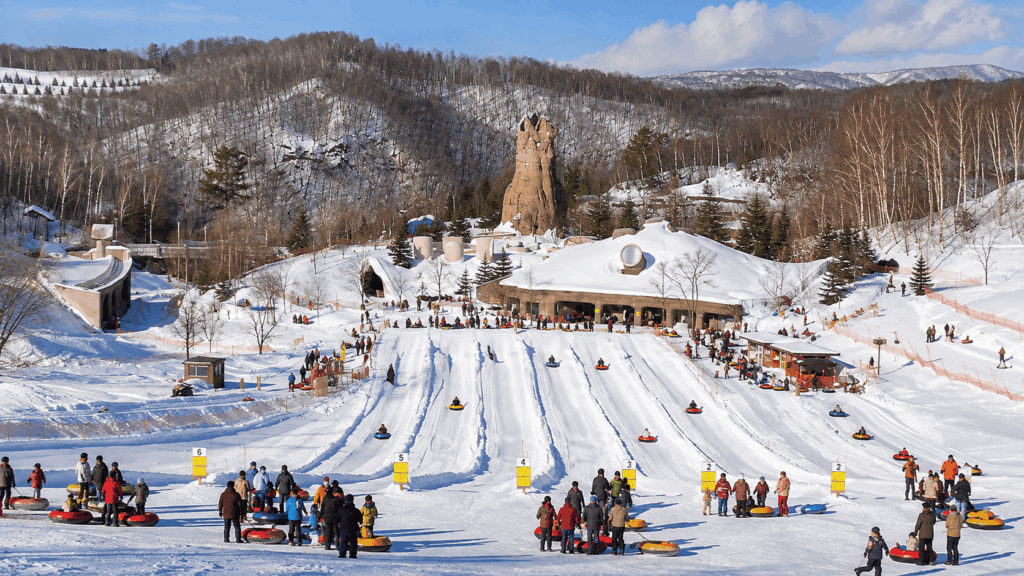
One warning before you choose. Takino’s winter season opens on December 23, 2026, but the 200 m course usually does not open until late January. If your trip falls in December or the first half of January, read the season section before you commit to anything.
Prefer a planned winter outing to coordinating buses yourself? A Takino snow-tubing and Sapporo Kokusai sightseeing tour combines snow play with other winter stops. Check the Takino and Sapporo Kokusai tour itinerary, available dates, and current prices before deciding — the full 200 m tubing course still depends on snow conditions.
Takino vs Hitsujigaoka: Which Snow Tubing Spot Should You Choose?
These are two particularly convenient, well-documented snow tubing choices in Sapporo, though other parks also offer tubing or sledding. The question here is not which of these two parks is better. It is a question of how much of your day you are willing to spend getting there, and how much speed you need in return.
The Quick Verdict for Adults
For a short, low-risk snow experience that fits between other sightseeing, choose Hitsujigaoka. It is a 45-minute trip from Sapporo Station, the standard snow-play activities are included in admission, and an hour is enough to feel like you did something with the snow.
For the ride itself — the length, the speed, the reason adults bother — choose Takino. The trade-off is real: about 25 minutes more travel each way, a course that may be shortened, and queues on weekends. Book it for a half day or more, not as a quick stop.
Skip both if you are expecting a theme-park attraction with multiple rides, if you cannot spend extended time outdoors in sub-zero temperatures, or if your trip lands in late December and you have no flexibility to move the visit later.
If Takino is the one you want but the thought of working out the subway and bus connections puts you off, there is a winter sightseeing bus that solves exactly that problem — it is compared with the DIY route further down.
At-a-Glance Comparison
| Feature | Hitsujigaoka Snow Park | Takino Snow World |
|---|---|---|
| Best for | First-time snow, short stops, views and photos | Adults who want a longer, faster ride plus forest time |
| Tubing run length | About 80 m (as reported by Sapporo’s snow activity site; not stated on the park’s 2027 page) | Up to 200 m — the full length is not available every day |
| Admission | ¥1,000 adults; ¥500 elementary and junior high; preschoolers free | Free (parking ¥500 per car) |
| Tube rental | Free, included in admission | Free |
| Winter operating period | January 8 – March 7, 2027, 10:00–15:00 | December 23, 2026 – March 31, 2027, 9:00–16:00 |
| Snow tubing availability | Daily during the event period, snow permitting | Daily once the sledding slope opens, but the 200 m course typically starts in late January |
| Getting there by public transport | Subway to Fukuzumi, then bus 84 (about 10–12 min); allow 45 min from Sapporo Station | Subway to Makomanai, then bus 106 (about 32 min); allow 70 min from Sapporo Station |
| Other winter activities | Cross-country skiing, snowshoes, sleds, mini snowman making, kamakura, paid snow sculpture workshop | Cross-country skiing (paid), snowshoeing, sleds, family ski slope, snow play in the forest zone |
| Main drawback | Short run, exposed to wind, no cold-weather gear rental | Long journey, full-length course not guaranteed, weekend queues |
| Recommended visit length | 1–3 hours, plus travel | Half a day or more |
Everything in this table reflects what both parks had published as of October 2026. Dates, prices and course conditions move with the snow, so treat the specifics as a starting point rather than a promise.
Hitsujigaoka Snow Park: Best for Easy Access and Scenic Snow Play
Hitsujigaoka works because it removes the two things that usually ruin a snow day for a first-time visitor: a long journey and a long list of extra charges. You ride one subway line to its terminus, take a short bus up the hill, pay once at the gate, and the regular snow-play equipment — tubes, sleds, cross-country skis, ski boots, poles and snowshoes — is covered. A separate snow-sculpture workshop costs extra.
The setting is the reason it feels like more than a municipal snow patch. This is the hill with the Clark Statue, the bronze figure of Dr. William S. Clark that appears on every Sapporo postcard, and the view from the slope takes in the city and the white curve of Daiwa House PREMIST DOME. You are playing in snow with a city spread out below you.
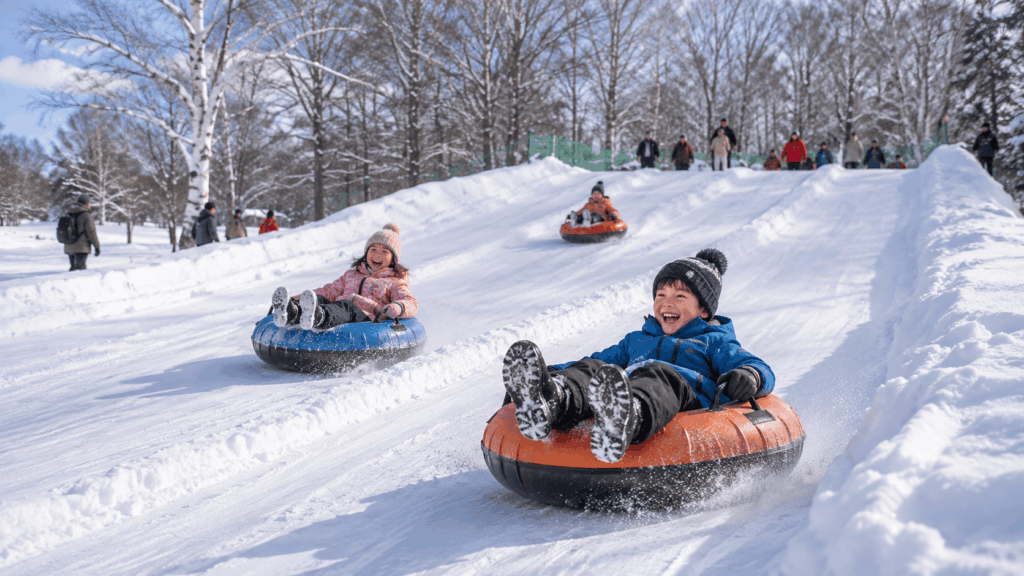
What the 80 m Tubing Run Feels Like
The run is short. Around 80 m, according to Sapporo’s snow activity listings — the park’s own 2027 page describes the tube sledding but does not publish a length, so treat the figure as approximate. What that means in practice is that one ride is over quickly, and the appeal is doing it several times rather than savouring a single long descent.
For adults, that is not automatically a problem. It is a problem only if you arrived expecting the 200 m experience at Takino. Read the 80 m as a snow-play sampler: enough speed to make you laugh, short enough that you can hand the tube to a child behind you and go again in a couple of minutes.
Two-person tubes exist, and the park describes them as a way for parents and children to ride together. Whether two adults can share one is not stated anywhere official, so ask at the slope rather than assuming.
Snow Views and What Your Ticket Covers
The ¥1,000 adult admission is not just a tube ticket. Inside the gate you can use cross-country skis on the pasture, snowshoes, sleds on the mini slide, the kamakura, and the mini snowman-making station, with equipment lent free. For a traveler who did not pack winter gear beyond a coat, that is the single biggest practical advantage of this park over Takino.
The exceptions are worth knowing. A paid snow sculpture workshop runs February 4–11, 2027 and requires a reservation, so “everything is included” has a limit. And the free rental stops at equipment: there is no rental of ski wear, gloves or other cold-weather clothing, which is the one gap you have to close yourself.
When the cold wins, there is a heated building with food that is better than it needs to be — Jingisukan, grilled corn, soft serve, specialty coffee from Sapporo-roasted Miyataya beans, and Sapporo Classic draft beer. A twenty-minute thaw in there is what makes a two-hour visit comfortable rather than endurance.
The Drawback: Wind and Cold
Hitsujigaoka sits on open ground, and the exposure is the thing that surprises people. A clear, sunny afternoon downtown can feel like a different season on that slope once the wind picks up.
Kai’s tip: This is the snow-play spot I recommend most often to travelers with only half a day to spare, and the view from beside the tubing slope is a large part of why — you can pick out the city and the dome while you are standing there. What catches people out is the wind. Even on a bright day it can feel much colder up on that hill than it did at your hotel, so sort out your neck, hands and footwear before your first run rather than after you have already got cold.
Practically, that means a neck warmer or scarf, waterproof gloves rather than knit ones, and boots with grip. If you are coming from a country without snow, buy these after you land — the park’s own advice is a home center or large supermarket in Sapporo, which is cheaper and more reliable than hoping your hotel lends them.
Takino Snow World: Best for Adults Who Want a Bigger Thrill
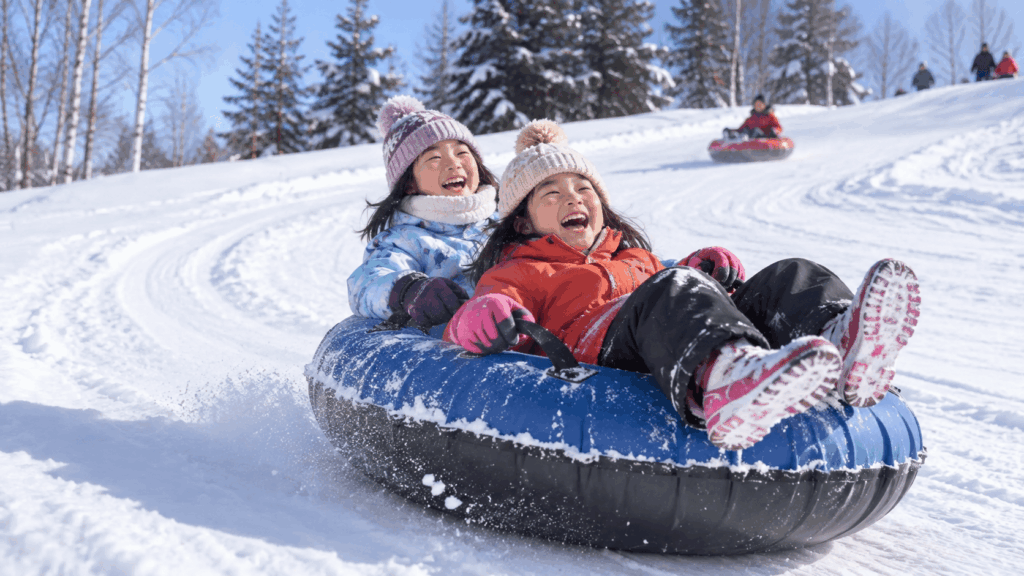
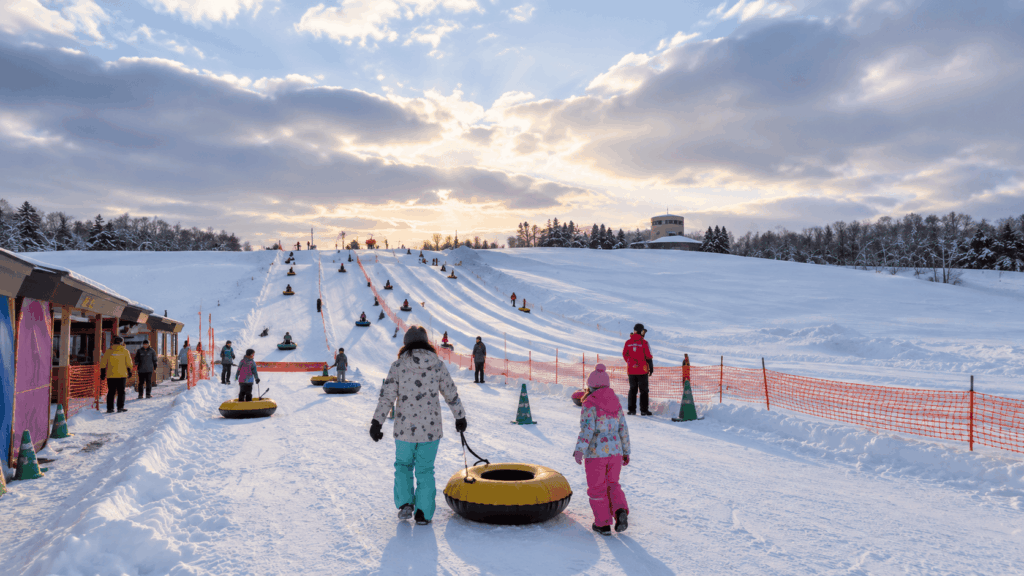
Takino is where the snow tubing actually feels like an activity rather than a photo opportunity. The sledding slope sits inside a national government park several times the size of Hitsujigaoka, and the tube course runs up to 200 m — one of the longest in Japan, according to the park. When it is fully open and the rope tow is running, you get pulled back to the top without trudging up, and you can stack up a dozen runs without thinking about your legs.
It is also free. Winter admission costs nothing, the tube costs nothing, and the rope tow, when it operates, costs nothing. What you pay instead is time: this is a 70-minute journey each way from Sapporo Station, and the park is large enough that getting between areas takes longer than the map suggests.
What Makes the 200 m Run Different?
Length changes the character of the ride. On a short slope, the tube barely gets going before it stops; on the long course, there is a stretch in the middle where you are genuinely moving and the snow is coming past your face. For adults who have done the polite version of snow play before, this is the part that makes the trip worthwhile.
The catch is that 200 m is the maximum, not the standard. On any given day the sledding slope may run several 200 m lanes plus a shorter 100 m lane, or fewer, depending on snow depth and how the surface is holding up. On January 19, 2026, for example, the park listed roughly 200 m × 2–4 lanes plus one 100 m lane, and noted that the number of usable lanes changes day to day.
If you arrive on a day when only the shorter course is open, the experience changes. It is still a real tube ride, but the thing you came for — the long, fast descent — is not on offer, and no ticket price makes up for that. This is why the season section below matters more than any comparison of run lengths.
Rope Tow, Queues, and the Best Time to Arrive
The rope tow is the quiet hero of the whole setup. It drags you from the bottom of the sledding slope back to the start, which is the difference between ten runs and three. It is also the first thing to fail when the snow is thin: on January 19, 2026, with the 200 m course already open, the tow was still out of service because of insufficient snow, and visitors were walking up to the start instead.
Queues are the other variable. Weekends and holiday periods draw local families, and the line for the long course can build through the middle of the day.
Kai’s tip: When people tell me they want real speed rather than a gentle slide, Takino is the park I point them to — and the advice I give with it is to decide how many runs you actually want before you arrive, then work backwards from that. A weekday, or the first hour after the course opens on a weekend, feels like a different place from mid-afternoon. Do not count on arriving at eleven and sliding straight on.
Note that the tube course keeps its own hours, which are shorter than the park’s. Last season the sledding slope ran 9:15–15:30 while the park was open 9:00–16:00, and the course could close earlier than 15:30 if it got busy. Plan your arrival around the course, not the gate.
If the main slope is heaving and you are with people who do not need the 200 m thrill, there is a gentler tube corner in the Keiryu Zone, near Lodge Yukizasa, with free tube rental and usually far less waiting. It is a mild slope for smaller children and nervous first-timers, not a substitute for the long course — but it is worth knowing it exists.
Beyond Tubing: Cross-Country Skiing and a Quiet Forest
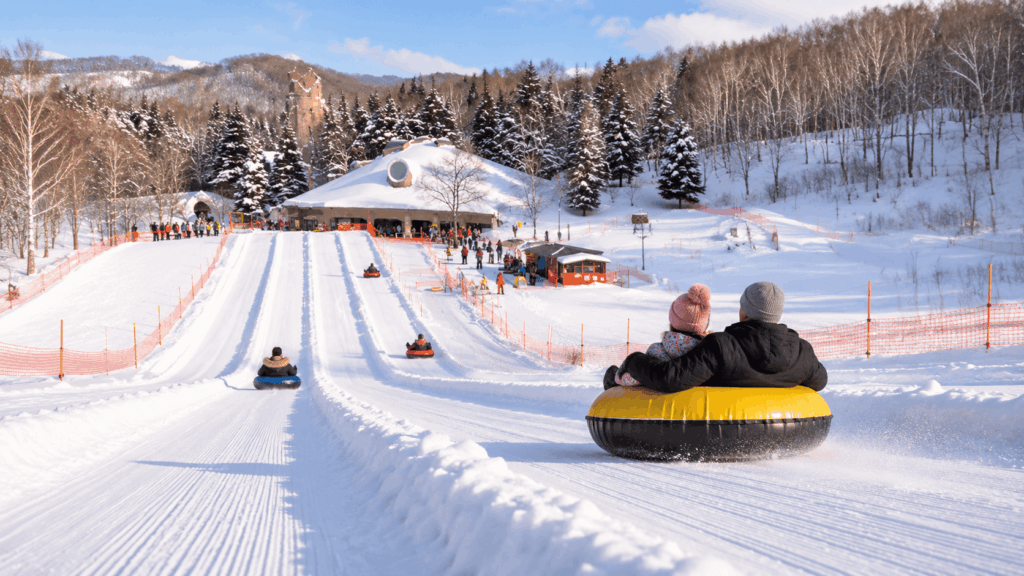
The reason I suggest Takino over Hitsujigaoka to adults with a full half day is not the tube alone. It is what sits around it. The sledding slope is loud, bright and full of shrieking children; one zone over, the forest is silent apart from snow dropping off branches.
The combination I suggest most often is tubing first, while you are warm and the queue is short, then cross-country skis or snowshoes afterwards. The contrast is the point: you get the adrenaline and the stillness in the same afternoon, which is hard to arrange anywhere else within reach of central Sapporo.
- Cross-country skiing: ¥1,500 for adults, equipment included, rented at the Country House
- Snowshoeing: free rental at the Country House, the Morino Koryukan and the park information desk
- Ski wear: ¥4,000 for adults, ¥3,000 for children
- Snow boots: ¥1,500; gloves, hats, goggles: ¥1,500 each
Food and warmth are handled at the Country House, which has a 100-seat restaurant, a kids’ space and a shop. Nearer the tube slope, Kitchen Kinotan serves light meals daily, and there is a rest area at the East Entrance. The forest is not directly beside the tube slope, so check the park map for walking times before you promise anyone you will do both.
When Can You Go Snow Tubing in Sapporo? 2026–27 Season
Both parks have published their dates for the coming winter. The dates are the easy part. What matters more is the gap between “the park is open” and “the long course is rideable”, which is where most ruined itineraries come from.
- Hitsujigaoka Snow Park: January 8 – March 7, 2027, 10:00–15:00 daily
- Takino Snow World: December 23, 2026 – March 31, 2027, open every day, 9:00–16:00
- Takino’s 200 m tube course: typically opens from late January, according to the park
Read by travel date, that produces four quite different trips:
- Late December: Hitsujigaoka has not opened yet. Takino is open, but expect a shortened course at best — do not build a day around the 200 m run.
- Early January: Hitsujigaoka opens on January 8. At Takino, the long course is still a gamble; check the day before you go.
- Late January to February: both parks are live and this is the window to aim for. Conditions still change daily.
- March: Hitsujigaoka runs to March 7, Takino to March 31. Late-season snow gets heavy and wet, and course availability depends on how the surface holds up.
Why Takino’s Opening Date Doesn’t Guarantee the 200 m Run
Three separate things have to be true before you get the ride you are imagining: the park has to be open, the 200 m course has to be open, and the rope tow has to be running. They do not switch on together, and the park is unusually honest about this.
The 2025–26 season is the clearest illustration. The sledding slope was still limited to a short course in late December. The 200 m course did not open until January 18, 2026. And on January 19 — the day after it opened — the rope tow was still out of service because there was not enough snow, so visitors were walking up to the start. The park listed the course as roughly 200 m × 2–4 lanes plus one 100 m lane, with the number of usable lanes changing from day to day.
None of that is unusual or badly managed; it is simply what a snow course on a hill in Hokkaido is like in midwinter. But it means a December booking at Takino is a bet on the weather, not a reservation of the 200 m experience.
What to Check Before You Leave
On the morning of your visit, confirm six things rather than one: that the park is open, that the tube course is open, how much of the course is usable, whether the rope tow is running, whether weather has suspended operations, and what time the last bus back leaves. The park publishes course and tow status on its official site and social channels, and updates them through the day.
A five-minute check before you leave the hotel is the difference between a good day and a two-hour round trip to look at a closed slope. The park’s own status page is the place to do it — not a blog post, including this one.
How to Get to Sapporo’s Snow Tubing Parks
Both parks are reachable on public transport, and neither needs a car. The difference is how much of your day the journey eats. Timings below are riding time; add 10–20 minutes per transfer for waiting, walking through stations and finding the right stop.
Getting to Hitsujigaoka by Subway and Bus
From Sapporo Station, take the Toho Subway Line to its terminus at Fukuzumi Station — about 14 minutes. Follow the signs to the bus terminal and go to platform 4, where the bus bound for Hitsujigaoka Observation Deck (route 84, the Hitsujigaoka Line) leaves. The ride takes about 10–12 minutes and drops you at the observation deck gate, where you pay the admission fee.
The fare is ¥240 for adults and ¥120 for children, and IC cards work. Buses run roughly one to three times an hour through the day. Parking at the park is free if you are driving. The timetable currently published by the park covers services up to December 10, 2026, so confirm the winter schedule before relying on a specific departure.
Getting to Takino by Subway and Bus
From Sapporo Station, take the Namboku Subway Line to Makomanai Station — about 18 minutes. The bus terminal is right outside; the Chuo Bus Takino Line (route 106) leaves from platform 2 and takes about 32 minutes to the park. Get off at Suzuran Park Chuoguchi (Central Entrance) or Suzuran Park East Entrance (Higashiguchi) — both are on the central-zone side, which is where the sledding slope is.
The fare is around ¥600 for adults and ¥300 for children each way, as listed on the park’s 2026 access page. Services are infrequent compared with city buses — roughly hourly for much of the day — so the timetable, not the map, dictates your schedule. The park’s published timetables cover the green season, so check the winter version before you travel.
Kai’s tip: The mistake I see most often at Takino is researching the outbound bus and treating the return as a problem for later. Do it the other way round. Find the last two buses back to Makomanai before you leave your hotel, and photograph the timetable at the stop when you arrive, because the walk from the sledding slope to the bus stop takes longer than you think when you are cold and carrying a tube. Missing the second-to-last bus turns a good day into a long, dark wait.
One structural point if you are combining parks: the bus link between Fukuzumi and Makomanai was discontinued in April 2026. Doing Hitsujigaoka in the morning and Takino in the afternoon means riding back into the city centre and out again, which adds well over an hour. Pick one park per day.
Is a Sightseeing Bus Worth It?
Hokkaido Chuo Bus runs a winter sightseeing service, the Takino Snow World and Snow Moai course, that takes the whole transfer problem off your hands. It runs from January 23 to March 14, 2027, departing Sapporo Station at 9:10 and returning at 15:16, with about three hours free at Takino and a 45-minute stop at the snow-covered Moai statues and Hill of the Buddha at Makomanai Takino Cemetery on the way back. It costs ¥3,900 for adults and ¥2,000 for children, and meals are not included.
Three conditions matter more than the price. The tour only operates if someone has booked by 18:00 the previous day, so it is not something you can decide on the morning of. It is cancelled outright if Takino closes because of insufficient snow. And the Hill of the Buddha charge (¥1,000 for junior high age and up) is separate.
| Option | Route or meeting point | Time commitment | Cost | Best for | Main limitation |
|---|---|---|---|---|---|
| Hitsujigaoka by subway and bus | Sapporo Station → Fukuzumi (14 min) → bus 84 (10–12 min) | About 45 minutes each way | ¥240 bus each way, plus subway fare, plus ¥1,000 admission | Short visits, first-time snow, tight schedules | Short run; the park is only open 10:00–15:00 |
| Takino by subway and bus | Sapporo Station → Makomanai (18 min) → bus 106 (32 min) | About 70 minutes each way | Around ¥600 bus each way, plus subway fare; park entry free | Flexible pacing, half-day visits, lowest total cost | Hourly buses; you own the return timing |
| Takino by rental car | Central Sapporo → Makomanai route, 30–35 min | Fastest door to door | Rental cost plus ¥500 parking | Groups of three or more, winter-driving confidence | Snow and ice driving; parking fills on busy weekends |
| Takino by sightseeing bus | Sapporo Station, 9:10 departure | About 6 hours round trip, roughly 3 hours at Takino | ¥3,900 adults, ¥2,000 children | Travelers who would rather not manage connections | Fixed schedule; must book by 18:00 the day before; cancelled if the park closes |
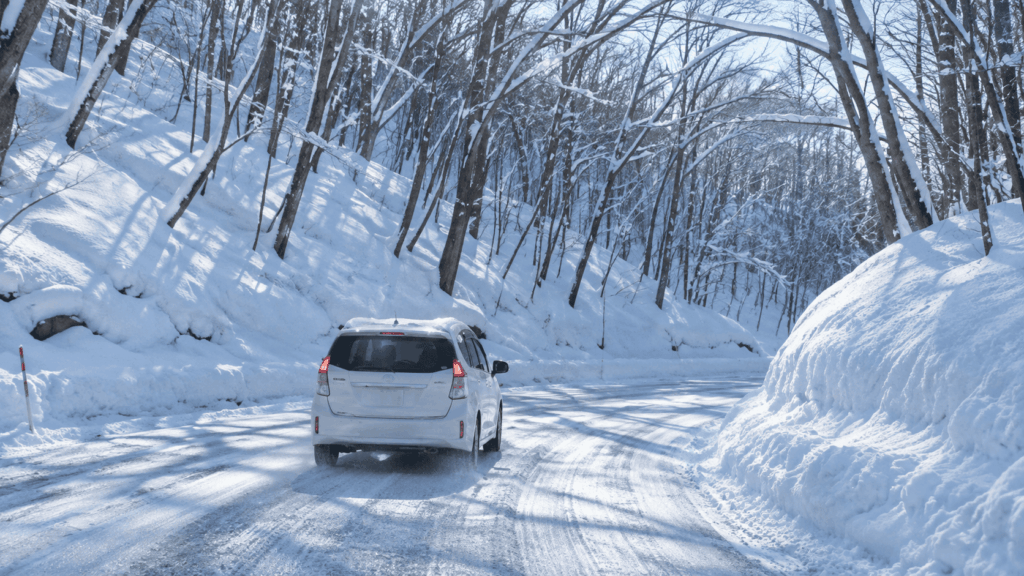
If the transfers and the return leg are the part you would happily pay to avoid, the sightseeing bus is the option worth pricing up before you decide — but read the booking deadline and cancellation conditions first, because they are stricter than a normal tour.
For a simpler bus-based option, compare current dates, route details, and prices for Klook’s Takino SnowWorld & Hill of the Buddha day tour. Check the exact stops, booking deadline, and cancellation conditions for your selected departure.
Snow Tubing Costs: What’s Free and What’s Not?
“Free” is the word that causes the most confusion about Sapporo snow tubing, because both parks use it and they mean different things by it.
Is Snow Tubing Really Free?
At Takino, yes — almost. Winter admission is free, tubes are free, the rope tow is free when running, and snowshoe rental is free. What is not free: parking (¥500 per car), cross-country ski rental (¥1,500), ski wear (¥4,000), snow boots (¥1,500), and gloves, hats or goggles at ¥1,500 each. If you arrive dressed for the weather with your own boots, a family can genuinely spend a full day here for the price of the bus.
At Hitsujigaoka, the model is different: you pay once at the gate — ¥1,000 for adults, ¥500 for elementary and junior high students, free for preschoolers — and the tubes, sleds, cross-country skis, boots, poles and snowshoes are all included. What is excluded is anything you wear: there is no rental of coats, ski wear or gloves. A paid snow sculpture workshop in early February is the one activity inside the gate that costs extra.
So the honest comparison is not free versus paid. It is fixed price versus variable price. Hitsujigaoka is a predictable ¥1,000 plus transport. Takino can be almost nothing, or considerably more than ¥1,000, depending on what you rent and whether you are driving.
DIY vs Paid Transport — What Are You Actually Paying For?
The sightseeing bus at ¥3,900 is roughly three times the cost of doing Takino independently by subway and bus, and it does not include the tube ride, because the tube ride is free anyway. What you are buying is the connections, the guaranteed seat, the return leg, and the 45-minute stop at the Moai statues and Hill of the Buddha on the way home.
That is a fair trade for some travelers and poor value for others. If you want to slide for three hours and leave, the bus works. If you want to tube in the morning, walk a forest trail in the afternoon and eat when you feel like it, the fixed three-hour window will frustrate you and the DIY route will cost a fraction as much. Neither choice is wrong; they suit different people.
For travelers who want more than transport alone — snow tubing at Takino, winter scenery, and other stops in one planned day — the Takino Suzuran Hillside Park and Sapporo Kokusai day tour is the more complete option worth comparing. It suits visitors who would rather combine several Hokkaido winter experiences than spend the day managing transfers themselves.
Why I’d book this one
- Snow tubing is part of the advertised experience: The itinerary includes Takino’s snow-play area, so the visit is directly relevant to travelers who want to try tubing rather than spend the whole day skiing. The full 200 m course remains dependent on snow conditions.
- More than a transfer: The listed itinerary pairs Takino with Sapporo Kokusai’s gondola experience and a Hokkaido-style meal, making it a broader winter sightseeing day instead of simply paying for a ride to the park.
- Fewer transport decisions: Hotel pickup and English-language arrangements are listed among the tour details. Check the options for your selected departure, along with how much time is actually spent at Takino, what’s included, and the cancellation terms.
See the Takino and Sapporo Kokusai tour’s current itinerary, start times, availability, and booking conditions before choosing it over an independent visit.
How to Plan Your Snow Tubing Visit
Short Visit: Hitsujigaoka in About 1–2 Hours
The park’s own guidance is that an hour is enough if your focus is photos and light snow play, and two to three hours if you work through most activities. Both figures exclude travel, which is another 45 minutes each way. For a trip that already includes the Clark Statue and the viewpoint, budget two hours on site and treat the tubing as the fun part of a sightseeing stop rather than the whole outing.
Half-Day Snow Adventure: Takino Tubing Plus a Forest Activity
The version of Takino that justifies the journey looks like this: arrive close to opening, tube while the queue is short and you are still warm, eat at the Country House or grab something near the slope, then spend the afternoon on cross-country skis or snowshoes in the forest zone.
Be realistic about the logistics. The forest zone is not adjacent to the sledding slope, equipment pick-up and return take time, and the last bus leaves in the late afternoon. Two activities in one visit is achievable; three is optimistic. Check the park map for walking distances before you commit, and treat the forest as the flexible half of the plan — the part you drop if the day runs short.
How to Avoid the Worst Crowds
Weekdays are calmer than weekends at both parks, and the first hour after opening is consistently the quietest part of the day. Beyond that, the useful habit is checking the park’s live status before you travel rather than after you arrive: a course that has been running all morning may close early if the surface deteriorates, and a queue that looks manageable at 10:00 can double by noon. No one can promise you a wait of a specific length, which is why arriving early is the only advice that reliably holds.
What to Wear and Know Before You Go
Essential Clothing for Snow Tubing
You do not need ski technique, but you do need to be dressed for standing around in snow. The essentials are waterproof gloves rather than knit ones, a neck warmer or scarf, a hat or earmuffs, boots with grip, trousers that can get wet without soaking through, and a warm coat. Spare socks are worth packing; wet feet end more snow days than cold ones do.
Where you can fill gaps differs. At Hitsujigaoka, winter clothing such as coats and gloves is not available to rent, so you arrive equipped or you buy on the way — the park suggests a home center or large supermarket in Sapporo, which is cheaper than outfitting yourself at home. At Takino, ski wear, boots, gloves, hats and goggles can be rented at the Country House for a fee, but quantities are limited, and on a busy weekend the sizes you need may already be out.
Safety, Age Rules, and Snow Conditions
Tube riding itself is simple, and staff at both parks control the top of the slope. Follow their instructions on when to launch and where to clear the run-out; the main risks are collisions at the bottom and people standing in the wrong place. Children ride on the same course, so keep an eye on anyone small in the finish area.
On age rules at Takino, the conditions published with the sightseeing bus are a useful reference: single riders must be four or older, and children aged three and under ride with a companion aged ten or above. Confirm the current rules at the slope, since they can differ from what a tour operator prints.
Finally, accept that weather can override everything. Heavy snow, wind or a deteriorating surface can close a course with little notice, and both parks say so openly. Build your Sapporo itinerary so the snow day is movable, and check the official status on the morning you plan to go.
Frequently Asked Questions
Can adults go snow tubing in Sapporo?
Yes. Neither park treats tubing as a children’s activity, and adults ride the same courses. The difference is what each one gives you. Hitsujigaoka is a short run on a hill above the city, which suits adults who want a taste of snow play without losing half a day. Takino is the one to choose if you want the long descent to actually feel fast. Adult couples and groups of friends are common at both, and you will not be the only people there without children.
Is snow tubing free in Sapporo?
At Takino, the tube, the rope tow and winter park admission are all free; you pay only for transport, parking if you drive, and any gear you rent. At Hitsujigaoka, tubing is included in the admission fee of ¥1,000 for adults, so it is not free, but there are no additional charges once you are inside for tubes, sleds, skis or snowshoes. The trap is assuming “free” covers clothing: Hitsujigaoka does not rent winter wear, while Takino charges separately to rent ski wear and gloves.
Can you go snow tubing in Sapporo in December?
Only partially, and this is the single most common planning mistake. Hitsujigaoka does not open until January 8, 2027, so a December visit there is not possible. Takino opens on December 23, 2026, but its 200 m course usually does not open until late January — in the 2025–26 season it opened on January 18, 2026, and the rope tow was still out of service the next day. A December trip can still include snow play at Takino, but not the long run.
Do you need to book snow tubing in advance?
The tubing itself is walk-up at both parks; you pay admission or walk in and queue. What needs booking is transport if you use the sightseeing bus, which requires a reservation by 18:00 the previous day and does not run otherwise. If you are taking the subway and local bus, no reservation is needed. Because operating rules can change, confirm the current policy on the park’s official site rather than relying on older guides.
How much time should you allow for snow tubing near Sapporo?
For Hitsujigaoka, allow about two hours on site plus 45 minutes of travel each way — an hour is enough for photos and a few runs, two to three hours if you try several activities. For Takino, treat it as a half day or more: 70 minutes each way, plus time on the slope, plus a walk or a ski in the forest if you want the trip to be worth the journey. Add buffer for waiting, because local buses run roughly hourly.
What if the 200 m course is closed when I visit Takino?
It still works as a day out, but not as the day you planned. Shorter lanes may still be open if snow conditions allow; some other park activities may also be available, but check their status individually. Admission remains free, so the main loss is the ride you came for. If the long course is the whole point, build flexibility into your itinerary and go on a different day rather than accepting a shortened run — the course status is published daily, so you can usually tell a day ahead.
Final Verdict: Which Snow Tubing Spot Fits Your Trip?
There is no overall winner here, because the two parks are answering different questions. Hitsujigaoka answers “how do I get a real snow experience without losing a day?” Takino answers “where do I go if I actually want the ride to be exciting?” Pick the question that matches your trip.
- Choose Hitsujigaoka if you have half a day or less, you are travelling with someone nervous about snow, or you want the Clark Statue and the city view in the same stop. The fixed ¥1,000 and the included equipment make it the low-risk option.
- Choose Takino if you are travelling as a couple or a group of friends who want speed, and you can give it a full half day. Going in the late January to February window, early in the day, is the version of this trip most people are hoping for.
- For first-time visitors to Japan with a packed itinerary, Hitsujigaoka fits more naturally — it slots in beside other Sapporo sightseeing instead of replacing it.
- For families with small children, both work, but differently. Hitsujigaoka’s short slope and heated building are easier with very young children; Takino’s gentler tube corner in the Keiryu Zone and its forest snow play suit families who can stay longer. (If you also plan to hit the slopes, see our guide to family-friendly ski resorts in Hokkaido.)
- For travellers on a tight schedule, Hitsujigaoka is the only realistic choice. Takino’s 70-minute journey each way plus hourly buses does not compress well.
- For repeat visitors who have already done the Sapporo highlights, Takino is the better use of a day — the combination of the long run and a quiet forest walk is not something you find in the city.
Whichever you choose, the same three checks decide whether the day works: is the course you want actually open, is the rope tow running, and what time is the last bus back. Get those right and the rest — the queue, the cold, the cost — is manageable.
If you are looking for other winter activities that do not require skiing, ice fishing near Sapporo and dog sledding near Sapporo are excellent additions to your itinerary.
Details in this guide were checked against the two parks’ official information and the bus operator’s published tour details in October 2026. Opening dates, course conditions, fares and rental prices change every season, so confirm the current figures before you travel.

Hi, I’m Kai. I’m a Tokyo-based travel writer, tourism industry insider, and the author of a published guidebook for international visitors to Japan. With over 10 years of professional experience at a leading Japanese tourism company, my mission is to help you skip the tourist traps and navigate Japan’s best destinations like a local. I believe the perfect day trip is like a traditional kaiseki meal: a beautiful balance of precise planning and unforgettable seasonal discovery. When I’m not out conducting field research, you’ll usually find me drafting new itineraries with one of my favorite fountain pens!