

Lake Toya is one of Hokkaido’s most photographed caldera lakes, and its sunsets—when the sky turns orange over Nakajima Island and the surrounding volcanoes—are a main reason travelers build a stop here into their itinerary. But finding the right spot depends on two things most guides don’t separate: whether you have a car, and whether you are happy with coloured sky or need to see the sun itself hit the horizon.
This guide breaks down every Lake Toya sunset location by what it realistically offers: which spots face the sunset directly, how to reach them with or without a car, when to arrive, and when a sunrise plan or a lakeside hotel stay may actually serve you better.
If you’re coming from Sapporo without a car and want to stay at Lake Toya into the evening, an afternoon tour is one way around the last-bus problem. Check current dates, Lake Toya stop timing, and cancellation terms for the Lake Toya Fireworks, Farm & Showa-shinzan Tour.
Where Is the Best Place to Watch the Sunset at Lake Toya?
The answer splits by transport. If you have a car, the north shore’s Yuhiga Mieru Nagisa Park (Sunset-View Shore Park) is the only spot in the area officially named for its sunset view, and it faces the right direction. If you are traveling without a car, the most practical option is the Toyako Onsen lakefront promenade, where you can step out of your hotel and walk along the lake within minutes—but you may not see the sun itself sink below the horizon depending on the season and your exact position. For travelers who specifically want sunrise, Tsukiura on the west side of the lake is the dedicated early-morning option.
A common misconception is that Silo Observatory serves as a sunset viewpoint. It offers a superb elevated panorama, but its operating hours (closing at 18:00 in summer) make it impractical for evening golden hour in the peak travel season.
Quick Answer by Traveler Type
| Spot | Best For | Sun or Sky? | Car Needed? | Main Drawback |
|---|---|---|---|---|
| Yuhiga Mieru Nagisa Park | Drivers who want the sun on the horizon | Direct sunset | Yes | Far from Toyako Onsen hotels; limited bus access after dark |
| Toyako Onsen lakefront | Car-free travelers staying overnight | Sky colour / residual light | No | Nakajima Island and your exact position may block the sun disk |
| Silo Observatory | Elevated panoramic views (mid-afternoon) | Landscape panorama | Yes | Closes at 18:00 in summer; not viable for sunset |
| Tsukiura | Sunrise photography (west-side vantage point) | Direct sunrise | Yes | Out of the way; not a sunset spot |
| Ukimido Park | Foreground composition with the floating pagoda | Sky colour | Yes | Small park; sunset direction depends on season |
If you are already booked into a lake-view hotel in Toyako Onsen, the practical trade-off is simple: you trade a guaranteed horizon view for the convenience of stepping outside your door. For many travelers, that trade is worth making—especially if you plan to photograph the blue hour after sunset, when the sky cools and the lake turns deep indigo.
Yuhiga Mieru Nagisa Park — The Dedicated Sunset Spot
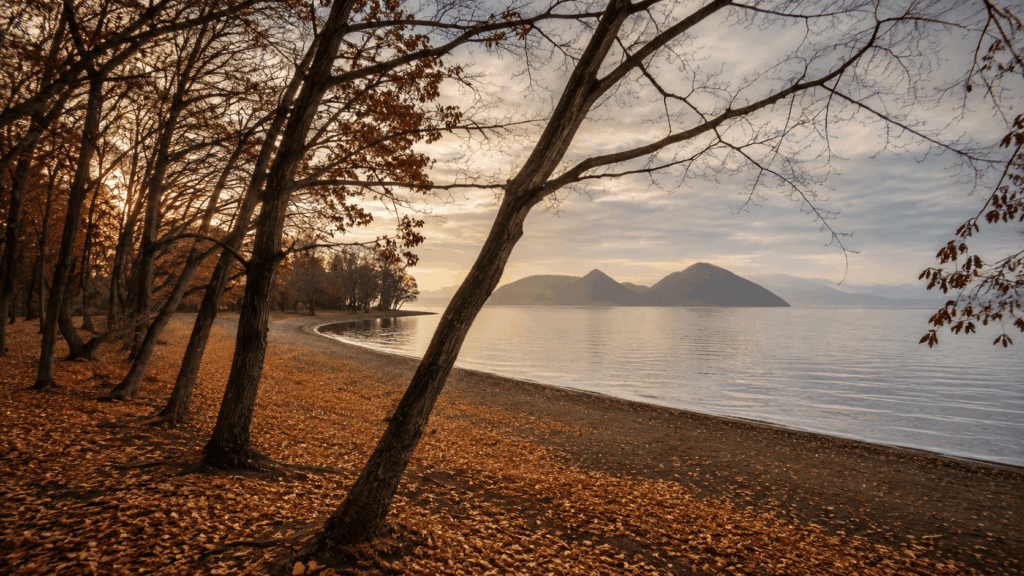
Located in the Takarada area on the north shore of Lake Toya, Yuhiga Mieru Nagisa Park (also referred to as Yuhi-no-Mieru Nagisa Park or Sunset Viewing Shore Park) is the one spot in the Lake Toya area whose name directly references its purpose. The park sits on the north side of the lake, and during summer and autumn months, the sun sets in the west to northwest—meaning the shoreline here faces into the sunset rather than looking across the lake at it.
The park includes a 1.8 km walking course that runs along the shore toward Takarada, passing a campsite and a bird observation point along the way. Photographers tend to position themselves along this stretch to frame Nakajima Island off to one side while keeping the western horizon open.
A common mistake first-time visitors make here is underestimating the return journey. In July, sunset is around 19:12—but the last Donan Bus heading back toward Toyako Onsen or Toya Station passes through before dark during the summer months. If you drive, you have full flexibility. If you rely on the bus, plan to arrive at least 45 minutes before sunset so you have time to walk the course, photograph the golden hour, and still make the last bus connection.
How to Get There
- By car: Approximately 15 minutes from Toyako Onsen. Take Route 230 north along the lake, then turn toward Takarada. Free parking available at the park.
- By public bus: Donan Bus runs from Toyako Onsen to the Takarada area (Takarada bus stop). One-way fare from Toya Station to Toyako Onsen is ¥400 (adult), 26 minutes. Buses run roughly hourly, but confirm the timetable for your travel date—services drop significantly in the afternoon, and the last bus from Toyako Onsen toward Toya Station departs before 19:00.
- Walking from Toyako Onsen: Not realistic—it is roughly 4 km along the lakeshore road with no continuous pedestrian path.
The Best Lake Toya Sunset Plan Without a Car
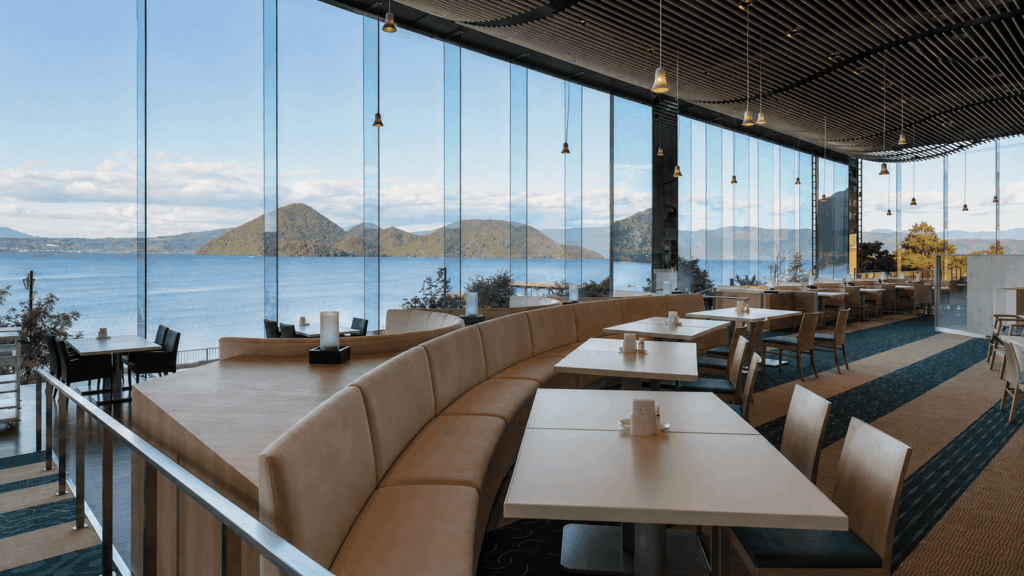
If you are visiting Lake Toya without a car, the most practical sunset plan involves accepting one trade-off: you will likely not see the sun disk drop behind the horizon from a north-facing position. Instead, your sunset experience will be built around sky colour, the reflection on the lake surface, and the blue hour that follows.
The centre of this plan is the Toyako Onsen lakefront. The main promenade runs along the southern shore of the lake, directly in front of the hotel district. From here you look north across the water toward Nakajima Island and the hills beyond. During summer, the sun sets in the northwest—meaning it goes down behind the hills to your left as you face the lake, and Nakajima may partially block the final moments of direct sunlight depending on where you stand.
One practical adjustment: walk east along the promenade past the main hotel cluster toward the Gurutto Chokoku Park sculpture area. As you move further from the centre, the angle opens up and you lose some of the foreground obstruction. The sculptures themselves—there are 58 installed around the lake—make natural foreground anchors for long-exposure shots of the fading light.
Toyako Onsen Lakeside Promenade
The lakeside path runs for several kilometres through the Toyako Onsen district. Key points along the walk include:
- Gurutto Chokoku Park (Toyako Gurutto Sculpture Park): 58 outdoor sculptures placed along the lake. About 18 are concentrated in the Toyako Onsen section, making for an easy sunset walk with built-in photo subjects.
- 100th Anniversary Toyako Onsen Monument: A stone monument near the centre of the promenade that frames the lake and Nakajima in a single composition.
- Toyako Visitor Center: A useful landmark near the bus terminal where you can check weather forecasts and pick up a walking map.
The advantage of this plan is flexibility. You can step out of your hotel 10 minutes before sunset, walk to a spot that works for the light conditions of that evening, and be back inside before the temperature drops. The disadvantage is that on many evenings, especially in July and August when the sun sets far to the northwest, you are watching the reflection of the sunset rather than the event itself.
Should You Book a Lake-View Hotel?
A lake-view room at Toyako Onsen changes the sunset equation significantly—not because it guarantees you a direct view of the sun setting, but because it removes the stress of timing and transport. You can watch the light change from your window or balcony, step out for a closer view when the colour peaks, and return to warmth and dinner immediately after.
THE LAKE VIEW TOYA Nonokaze Resort is the most frequently recommended lakeside property in Toyako Onsen, with all guest rooms facing the lake. The hotel’s official site states that all rooms offer views of the lake, though room orientation relative to the exact sunset direction varies. For summer visits, the northwest-facing rooms on upper floors give the most direct line toward the sunset position.
What makes an overnight stay valuable beyond the view is the second chance it gives you: if the evening sky is overcast, you have the next morning to try for a sunrise reflection instead—something a day-tripper cannot do.
If you’d rather stay overnight and give yourself both a sunset and sunrise attempt, check current room options and dates for THE LAKE VIEW TOYA Nonokaze Resort.
Lake Toya Sunset vs Sunrise — Which Is Better?

The short answer is that they serve different itineraries. Sunset at Lake Toya gives you warm light over the lake surface with Nakajima as a silhouette, and it pairs naturally with an evening soak at your hotel. Sunrise gives you sharp, low-angle light hitting the western hills and the lake from behind the mountains—but it requires an early start and a car to reach the dedicated viewpoint.
Local photographer Noro Keiichi, whose work appears on the official HOKKAIDO LOVE! tourism site, specifically recommends Lake Toya’s sunrise over its sunset for photography. His reasoning is that the morning light hits the western side of the caldera from behind Tsukiura, creating layered shadows across the lake surface that the evening light does not reproduce from the northern shore. This is a matter of preference—but it is worth noting that a photographer who has shot the lake extensively favours the morning window.
If you are staying overnight in Toyako Onsen, you do not have to choose. You can photograph the sunset colour along the lakefront promenade on the evening of your arrival, and attempt the sunrise at Tsukiura the next morning before checkout. That combination is the strongest argument for booking a lake-view room rather than visiting Lake Toya as a day trip.
Why Tsukiura Is the Main Sunrise Option
Tsukiura (also referred to as Tsukiura Observatory or Tsukiura Viewpoint) sits on the west side of Lake Toya, roughly 10 minutes by car from Toyako Onsen. From this position, you look east across the lake toward the sunrise—and because the observatory is raised above the shoreline, you get a clear sightline over the water.
The viewpoint is part of the Lake Toya Eight Views (Toya-ko Hakkei), a collection of scenic locations around the lake recognised for their photographic value. Tsukiura is listed for the combination of the lake, the hills, and the morning light. Behind the viewpoint rises Mt. Poromoi, which frames the composition on the western side.
A practical detail worth noting: sunrise at Tsukiura works best in late summer and autumn, when the sun rises far enough south to clear the northern ridge. In June and early July, the sun rises almost north-east, which can place it behind the treeline from this spot. Check the sunrise azimuth for your travel dates on a site like timeanddate.com, and if the direction is too far north, consider photographing from the Toyako Onsen lakefront instead—the morning light reflecting off the lake surface still produces strong colour even without seeing the sun disk.
Best Lake Toya Photo Spots Beyond Sunset

Not every photographic opportunity at Lake Toya revolves around the sunset hour. Three locations around the lake offer strong compositions at other times of day, and can serve as alternatives if the evening sky is uncooperative. For a broader list of daytime activities, see our guide on the best things to do in Lake Toya.
Silo Observatory for Elevated Panorama
Silo Observatory sits on a ridge above the lake, roughly 15 minutes by car from Abuta-Toyako IC. From here you get the widest single-frame view of the entire caldera—Nakajima, the southern shoreline, and the hills beyond are all visible in one take.
This is not a sunset spot. The observatory is open 8:30–18:00 from May to October (8:30–17:00 November to April), and in July the sun sets after 19:00. You would need to leave before the best light arrives. Instead, aim for mid-afternoon or late morning, when the sun is high enough to illuminate the lake surface evenly. The elevated angle also works well after rain, when cloud shadows move across the lake and create contrast that is difficult to find from shore level.
Admission is free. Parking is available at the site. There is no public bus direct to the observatory—you need a car or a taxi from Toyako Onsen (approximately ¥2,000–2,500 one way).
Ukimido Park for a Strong Foreground
Ukimido Park (also written as Ukimido Park or Fukuido Park, located at 194 Toyamachi) is named for the two-storey pagoda that appears to float on the lake surface when photographed from the shore. This is one of the most recognisable compositions at Lake Toya, and it does not depend on sunset light—any time of day with interesting sky works because the pagoda itself provides the foreground structure.
The park is small and open 24 hours, with free parking. It is on the east side of the lake, roughly 10 minutes by car from Toyako Onsen. For a photo that includes both the pagoda and Nakajima in the same frame, position yourself at the centre of the shoreline path rather than directly in front of the pagoda.
Gurutto Chokoku Park and the Onsen Monument
Already mentioned in the car-free plan, Gurutto Chokoku Park deserves its own note here because the sculptures change character depending on the light. In the evening, the bronze and stone figures catch warm low-angle light. In the morning, the same sculptures face away from the sun and become silhouettes against the reflective lake surface. The 100th Anniversary Toyako Onsen Monument near the centre of the promenade is a practical spot to mount a tripod—the stone base is level and the surrounding path is wide enough to avoid foot traffic on busy weekends.
When to Arrive for Sunset at Lake Toya
Timing at Lake Toya matters more than at many other sunset locations because the lake is surrounded by hills on three sides. The sun drops behind the caldera rim earlier than the official sunset time on open water, especially in the shoulder seasons.
In summer (June–August), sunset is between 18:50 and 19:18 depending on the exact date. But the golden hour—the period when the light turns warm and soft—starts roughly 60 minutes before that. If you arrive at the listed sunset time, you have already missed the best light on the lake surface.
Plan to arrive at your chosen spot at least 45 minutes before the sunset time for your date. This gives you time to settle into a position, compose your shot, and photograph the changing light from golden through orange to the blue afterglow. The blue hour after sunset lasts roughly 25–30 minutes at Lake Toya, and in clear conditions the lake surface takes on a deep navy tone with sharp reflections of the hills.
Check the Sun Direction, Not Just the Sunset Time
The direction of sunset changes significantly through the year. In June, the sun sets around 300° (northwest). By September, it shifts to around 265° (west), and by December it drops to around 235° (southwest). This changes which shoreline gives you an unobstructed view.
Use a site like timeanddate.com to check both the sunset time and the sunset azimuth for your specific travel dates. If the azimuth indicates the sun sets behind a hill or island from your planned spot, shift position along the shore or choose an alternative location.
Weather, Wind, and a Realistic Backup Plan
Lake Toya is surrounded by mountains that generate their own microclimate. Even on days when the regional forecast shows clear skies, clouds can build over the caldera in the late afternoon. The wind is another factor—when the lake surface is choppy, the reflection dissolves and the colour becomes less dramatic.
A realistic backup plan for an overcast evening has three layers:
- Layer 1: Walk the Toyako Onsen promenade anyway. Even without direct sunlight, the lake surface takes on a muted grey-silver tone that works for monochrome compositions, especially with the sculptures as foreground subjects.
- Layer 2: Visit Ukimido Park. The pagoda provides enough visual structure that an even sky still produces a usable photo—and the open atmosphere means you can judge whether the light is changing before committing to a longer drive.
- Layer 3: Skip the sunset entirely and aim for the next morning’s sunrise through your hotel window. This is where an overnight stay acts as insurance: you effectively have two attempts at good light instead of one.
Three Practical Lake Toya Sunset Itineraries
Rental-Car Sunset Plan
Duration: 1.5–2 hours | Best for: Drivers with one evening available
- Arrive at Yuhiga Mieru Nagisa Park 60 minutes before sunset. Park at the lot near the Takarada entrance.
- Walk the 1.8 km course toward the west end of the park. The best compositions appear in the last 15 minutes before the sun reaches the horizon, with Nakajima silhouetted against the orange band.
- After the sun drops, stay for 20–25 minutes of blue hour if the sky remains clear. Then drive back to Toyako Onsen for dinner (10–15 minutes).
- If the evening is overcast, skip the park and drive directly to Ukimido Park (10 minutes from Toyako Onsen) for a foreground-based composition instead.
No-Car Overnight Plan
Duration: Flexible | Best for: Travelers staying in Toyako Onsen without a car
- Check in to a lake-view hotel in Toyako Onsen. Confirm the room’s orientation relative to the sunset direction for your travel date.
- 45 minutes before sunset, walk from your hotel to the Gurutto Chokoku Park area. Position yourself near the 100th Anniversary Monument or further east past the main hotel buildings.
- Photograph the changing sky colour and the reflection on the lake surface. Even without a direct sunset view, the blue hour after sunset produces saturated colour across the entire lake.
- Walk back to your hotel for dinner and an onsen soak. If the evening is clear, step back out after dinner to check for star reflection on the lake—on moonless nights Nakajima’s silhouette against the stars can be equally striking.
Sunset and Sunrise Photography Plan
Duration: Two sessions (evening + next morning) | Best for: Overnight visitors with a car
- Evening: Follow the Rental-Car Sunset Plan above (Yuhiga Mieru Nagisa Park).
- Next morning: Set an alarm 60 minutes before sunrise. Drive to Tsukiura (10 minutes from Toyako Onsen). Photograph the sunrise from the observatory area.
- Return to your hotel for breakfast and checkout by 10:00. You have captured both ends of the day with fewer than 2 hours of dedicated photography time in total.
Is the Lake Toya Sunset Worth Planning Around?
If you are already spending a night in Toyako Onsen as part of a Hokkaido road trip—yes, absolutely. The sunset (or sunrise) takes less than 90 minutes of your evening or morning, and the light over the caldera on a clear day is genuinely different from what you get at other Hokkaido lakes. The combination of Nakajima, the volcanic skyline, and the reflective lake surface creates compositions that look distinct from Lake Shikotsu or Lake Mashu.
If you are considering a dedicated trip from Sapporo just for the Lake Toya sunset—the answer is more cautious. Sapporo to Toyako Onsen by bus takes 2 hours 45 minutes each way (¥3,700 one way), and the last bus toward Sapporo leaves Toyako Onsen well before sunset in the summer months. To photograph the sun set and still get back to Sapporo the same evening, you would need to drive, and even then you face a 2-hour return drive in the dark. The sunset itself is good—but it is not a once-in-a-lifetime event that justifies a six-hour round trip by public transport.
If you want the Lake Toya evening without an overnight stay or a two-hour drive back to Sapporo, this is the tour option that fits the transport problem described above.
Why I’d book this one
- It leaves Sapporo in the afternoon and keeps Lake Toya for the evening rather than treating it as a midday photo stop.
- The small-group transport removes the need to plan around the last public bus or drive back to Sapporo after dark.
- You can check live dates, start times, cancellation terms, and recent traveler feedback before deciding.
A pattern that emerges consistently from visitor feedback is that the regret is rarely about the sunset being underwhelming—it is about not having enough time to walk the shoreline afterward. The blue hour at Lake Toya, when the sky turns deep blue and the hotel lights begin reflecting on the lake, often produces better photographs than the sunset itself. If you leave immediately after the sun drops, you miss the better half of the evening. Stay for the full 30 minutes after sunset, and if you are staying overnight, you can walk back at your own pace without watching the clock.
Frequently Asked Questions
Can I see the sunset from Toyako Onsen without a car?
Yes—but with an important distinction. From the Toyako Onsen lakefront promenade, you can see the sky turn orange and the lake surface reflect the sunset colours, but depending on the season and your exact position along the shore, Nakajima Island and the surrounding hills may block the direct view of the sun disk hitting the horizon. If your goal is the warm sky and blue hour after sunset, the promenade works well. If you need to see the sun itself, you need to reach the north shore (Yuhiga Mieru Nagisa Park), which requires a car or a carefully timed bus journey.
Which side of Lake Toya is best for sunset?
The north shore. The sun sets in the west to northwest (depending on the season), so the north shoreline—particularly the area around Yuhiga Mieru Nagisa Park in Takarada—faces the sunset directly. The south shore (Toyako Onsen side) looks north across the lake, so you are watching the sunset from the side rather than head-on.
Is Silo Observatory good for sunset?
Not for the sunset itself. Silo Observatory closes at 18:00 during summer months, and the summer sun sets between 18:50 and 19:18. The observatory is better suited for mid-afternoon elevated panoramic shots of the entire caldera. After closing time, the surrounding outdoor area may still be accessible, but this is not officially confirmed—check the latest details before relying on it as a late-afternoon spot.
Is Tsukiura a sunset or sunrise spot?
Tsukiura is primarily a sunrise spot. It sits on the west shore and looks east across the lake, meaning it faces the morning sun. Local photographer Noro Keiichi (featured on HOKKAIDO LOVE!) specifically recommends Tsukiura for sunrise photography. Do not plan to visit Tsukiura for sunset—you will be looking away from the sun.
How long does the sunset last at Lake Toya?
The golden hour—when the light is warm and soft—begins roughly 60 minutes before sunset. The best colour on the lake surface appears in the final 15–20 minutes before the sun disappears behind the caldera rim. The blue hour after sunset lasts approximately 25–30 minutes. In total, plan for about 90 minutes from the start of golden hour through the end of blue hour if conditions are clear.
What is the best month for Lake Toya sunset?
Late August through October tends to produce the most reliable evening colour. The sun sets far enough south that it clears the northern ridges more cleanly, the air is typically less hazy than mid-summer, and the autumn colours on the surrounding hills add an extra layer to the composition. That said, clear evenings occur throughout the year—the key variable is cloud cover, not the month.
Can I photograph both sunset and sunrise at Lake Toya in one visit?
Yes, but only if you stay overnight in Toyako Onsen and have a car. The Sunset and Sunrise Photography Plan in this guide covers both: photograph sunset at Yuhiga Mieru Nagisa Park on arrival evening, then drive to Tsukiura the next morning for sunrise. The total dedicated photography time across both sessions is under 2 hours. Without a car, reaching Tsukiura before sunrise is impractical because there is no early-morning bus service.
Final Verdict — Choose Your Lake Toya Sunset Plan
Choose the rental-car sunset plan if…
- You are road-tripping through Hokkaido and have a car for the day.
- Seeing the sun disk drop behind the horizon is important to you.
- You are comfortable driving back to your accommodation after dark (the road along the lake is well-lit in the Toyako Onsen section, but unlit on the north shore).
Choose the no-car overnight plan if…
- You are using public transport between Sapporo, Noboribetsu, or Hakodate.
- You are already staying in a lake-view hotel in Toyako Onsen—the convenience of stepping outside your door outweighs the less-direct sunset angle.
- You want the option to photograph the blue hour without worrying about the last bus.
Choose the sunset and sunrise photography plan if…
- You have a car and one full night in Toyako Onsen.
- You are comfortable with an early start (sunrise at Tsukiura requires being in position by 04:00–04:30 in summer).
- You want to create a before-and-after photo set: evening warm light at the north shore, morning sharp light at the west shore.
For first-time Hokkaido visitors…
Lake Toya sunset is worth fitting into your itinerary if you are already passing through—but do not reorganize your entire Hokkaido route around it. The sunset at Cape Soya or along the Shakotan Peninsula coast offers a different, more open-ocean experience that is equally impressive. Use this guide to make an informed call on the day: if the evening forecast is clear, head to Yuhiga Mieru Nagisa Park (drivers) or step out onto the Toyako Onsen promenade (pedestrians). If the sky is overcast, shift your photographic effort to Ukimido Park or the sculpture park instead.
For photography-focused travelers…
Book a lake-view room at a hotel like THE LAKE VIEW TOYA Nonokaze Resort, bring a tripod, and plan for both the sunset and blue hour sessions on your arrival evening. The 25–30 minutes after sunset, when the lake surface turns deep indigo and the hotel lights begin to reflect, consistently produce stronger photographs than the sunset itself—and being able to walk back to your hotel without rushing makes that window much easier to capture.

Hi, I’m Kai. I’m a Tokyo-based travel writer, tourism industry insider, and the author of a published guidebook for international visitors to Japan. With over 10 years of professional experience at a leading Japanese tourism company, my mission is to help you skip the tourist traps and navigate Japan’s best destinations like a local. I believe the perfect day trip is like a traditional kaiseki meal: a beautiful balance of precise planning and unforgettable seasonal discovery. When I’m not out conducting field research, you’ll usually find me drafting new itineraries with one of my favorite fountain pens!