
If you are staying near Nagasaki Station and want to see Mount Inasa at sunset and after dark, here is the short version: take a local bus to the Ropeway-mae stop, walk a few minutes to Fuchi-jinja Station, and ride the Nagasaki Ropeway to the summit. On paper, the route is simple. What really decides whether the evening works is when you arrive and how you plan your way back down.
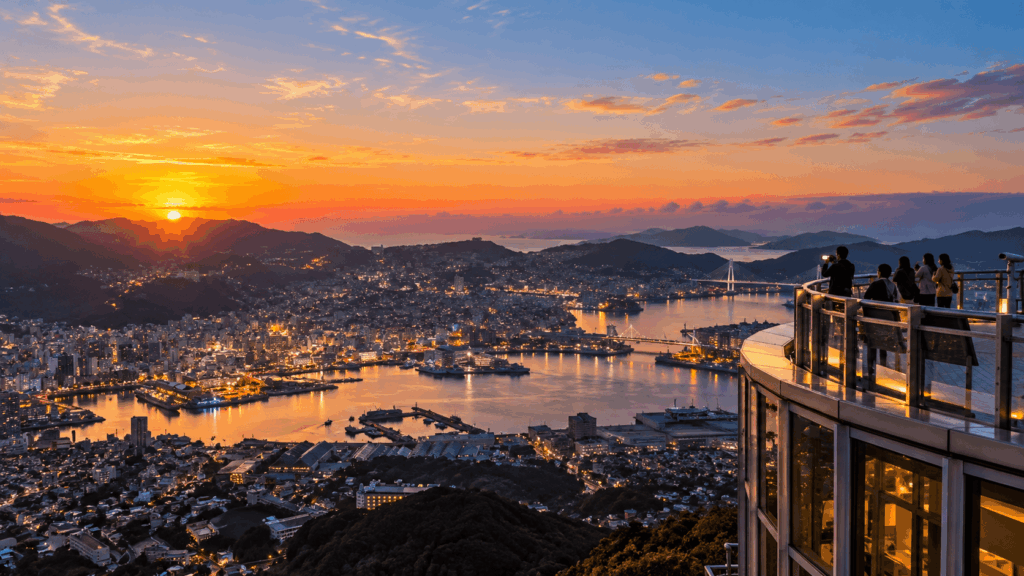
Mount Inasa’s observation deck sits at 333 m and gives you a 360-degree view over Nagasaki Harbor and the city. The ropeway is the standard way up for visitors without a car, and it drops you about a three-minute walk from the deck. For most first-time visitors, the bus-and-ropeway combination is the default answer to “how do I get to Mount Inasa.” If you would rather avoid the transfer and the evening queue entirely, a taxi or a direct night-view transfer are the two realistic alternatives — I compare all of them below.
One important note before you start planning: the Inasayama Slope Car is currently out of service for maintenance, with no confirmed restart date, so ignore older guides that send you up by slope car. More on that further down.
Prefer a guided evening instead of planning every stop yourself? An English-speaking night tour combines Mount Inasa with other Nagasaki highlights and has a scheduled return to Nagasaki Station. Compare available dates, the itinerary, and recent traveler reviews for the Nagasaki night tour before deciding whether it suits your evening better than going independently.
The Best Way to Get to Mount Inasa: Quick Verdict
For most travelers, the simplest route is the local bus to Ropeway-mae, followed by the Nagasaki Ropeway. It is cheap, it runs through the evening, and it requires only one transfer. If you value a door-to-door ride and a hassle-free return more than saving money, a taxi or a direct night-view transfer is the better fit.
In practice, the transport itself is rarely the problem — the timing is. Aim to reach the summit roughly an hour before sunset, and decide how you are getting down before you go up.
| Option | Best for | Transfers | Approx. hassle | Main downside | Our verdict |
|---|---|---|---|---|---|
| Local bus + Ropeway | Most first-time visitors without a car | 1 (bus to ropeway) | Low to medium | Ropeway queues can build after dark | Best all-round default |
| Free shuttle + Ropeway | Evening arrivals who book ahead | 1 (shuttle to ropeway) | Low | Runs only in the evening and needs a reservation | Great if your timing fits |
| Taxi | Groups, luggage, tight timing | 0 | Low | Higher cost; summit vehicle restrictions on busy nights | Best when convenience matters more than price |
| Direct night-view tour or transfer | Travelers who want the return handled for them | 0 to 1 | Low | Depends on the product; getting to the meeting point may not be included | Good if you would rather not plan the trip down |
| Bus + Slope Car | Nobody, right now | 2 | Medium | Currently suspended | Not available at the moment |
How to Get to Mount Inasa from Nagasaki Station by Bus and Ropeway
This is the route I would give a friend visiting for the first time. It has three steps: a bus, a short walk, and the ropeway.
Step 1 — Take a Bus to Ropeway-mae
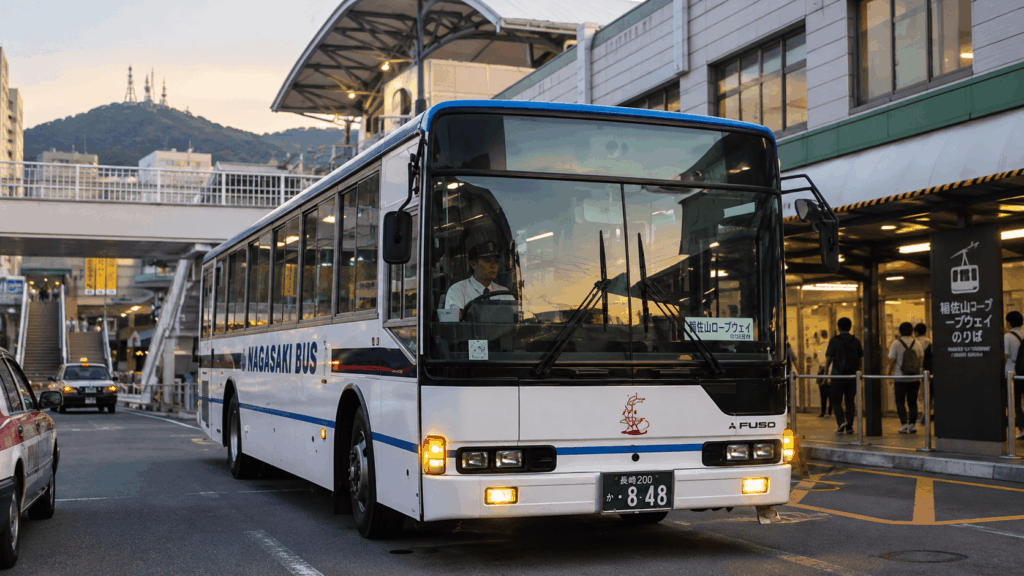
Go to the Nagasaki Ekimae bus stop in front of JR Nagasaki Station and take Nagasaki Bus route No. 3 or No. 4, bound for Shimo-ohashi, Koebaru, or Aigawa. Get off at the Ropeway-mae (Ropeway Front) stop. The fare is around ¥190 for adults (checked April 2026). Pay when you get off, and have coins or a transport IC card ready — IC cards such as Suica, ICOCA, and the local Nagasaki card are accepted on these routes.
Where to look: the stop name you want is Ropeway-mae. If you are unsure, ask the driver or staff for “Ropeway-mae” and they will point you to the right bus. Journey time is roughly 15 to 20 minutes depending on traffic.
Step 2 — Walk to Fuchi-jinja Station
From the Ropeway-mae stop, it is about a two-to-three-minute walk to the lower ropeway station, Fuchi-jinja Station. Signage points the way, and the station is next to Fuchi Shrine. Buy your ropeway ticket at the counter inside. This is also where the free shuttle (see below) drops off.
Step 3 — Ride the Ropeway to Inasa-dake Station
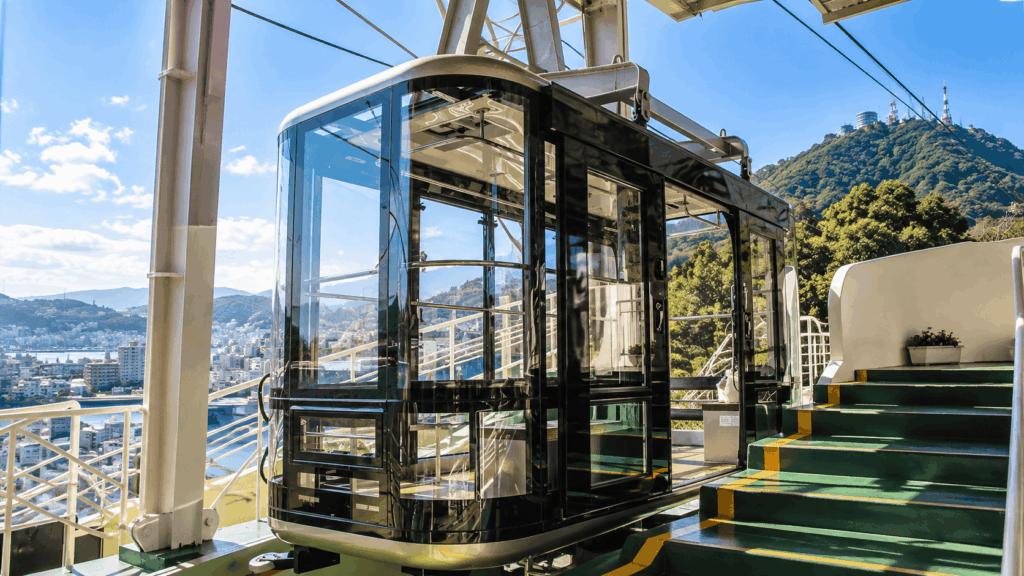
The ropeway runs from Fuchi-jinja Station to Inasa-dake Station at the summit. The ride takes only about five minutes, and gondolas depart roughly every 15 to 20 minutes. The ropeway operates from 9:00 to 22:00, and the last uphill departure is generally around 21:00 — confirm the exact time on the official site for your date.
Fares for adults are about ¥1,900 round trip or ¥1,040 one way (April 2026 prices; they were revised in 2026, so older guides often show lower numbers). From Inasa-dake Station it is another short walk of about three minutes to the observation deck.
The ropeway itself is short and scenic, but treat it as your transport, not the main event. On clear evenings the view from the summit is the reason you came. If you have a choice of position, standing at the glass on the way up is worth a minute of effort — but don’t build the evening around getting the perfect window shot.
Riding the Ropeway When It Is Busy
The catch with the ropeway is the queue, not the ride. It is usually calm in the daytime and early evening, then slows down as people head up for the sunset and the lights come on. My rule of thumb for guests is to be through the ticket gate before the rush rather than arrive with it, and to keep an eye on how the lines are moving when you come back down. If the down line already looks long when you reach the summit, that is your signal to think about the return.
Is the Free Ropeway Shuttle Bus Easier?
The Nagasaki Ropeway Free Shuttle Bus is a genuine perk, but it is often misunderstood. It is a free ride between several central hotels (and Nagasaki Station) and Fuchi-jinja Station — it does not include the ropeway fare, and it does not take you to the summit by itself.
A few things to know before you rely on it:
- It runs in the evening only — currently listed as roughly 19:00 to 22:00.
- Advance reservation is required. Booking opens at 12:00 noon on the day of travel and closes 30 minutes before each departure.
- Seats are limited, and you may not get on if the bus is full.
- The Nagasaki Station shuttle stop is at the east exit traffic square, which is not the same as the local bus stop.
- You still pay the separate ropeway fare.
In short, the shuttle is convenient if your timetable lines up with the evening departures and you book early. It is not a magic “free ride to the top.” For daytime trips, the local bus is the way to reach Fuchi-jinja Station. Check the official booking page for the current timetable and seat availability.
Should You Take a Taxi to Mount Inasa Instead?
A taxi is the simplest option if you want to skip the transfer and go roughly door to door. It makes the most sense for groups of two or three (the cost is shared), travelers with luggage or limited mobility, and anyone who wants to protect a tight sunset window. From central Nagasaki a taxi to the summit typically runs a few thousand yen; a taxi to Fuchi-jinja Station costs less and you continue by ropeway.
One caution: the summit area has vehicle restrictions. The summit observation parking lot is unavailable between 18:00 and 22:00 on Saturdays, Sundays, public holidays, and designated restriction days, and access can be limited at busy times. So a taxi can often reach the summit, but not always, and the rules can change on peak nights. If you plan to be dropped off at the top, tell the driver your destination and confirm the current situation on the day.
When I take guests up for the evening, I sometimes choose a taxi rather than the ropeway if cutting the transfer and wait time matters more than the fare. It is not because the ropeway is a problem — it is that the ropeway queue is the one part of the evening you cannot fully predict.
Important: The Inasayama Slope Car Is Currently Suspended
If you have read older blogs about Mount Inasa, you have probably seen the “bus plus slope car” route. For now, that route is not available. The Inasayama Slope Car is out of service for maintenance, and the operator has not announced a restart date. The ropeway is running normally, so you can still reach the summit — you just do it by gondola rather than by slope car.
For reference, when the slope car is running it links Chufuku Station at the Inasayama Midway Parking Lot to the summit in about seven minutes, with fares around ¥600 one way and ¥1,000 round trip (adults, 2026 prices). The midway parking lot itself is free. Because the slope car is stopped, the practical alternative from the midway area is to walk to the summit, which is roughly 800 m and about 15 minutes on a slope — fine for many people, but not the first choice for a night-time visit, and not something I would recommend as your main plan on a dark, windy evening.
Before you travel, check the official Inasayama Park and Nagasaki Ropeway sites for the current status. Slope car operations are also subject to weather closures even when running.
What Is the Best Time to Visit Mount Inasa?
The short answer: arrive at the observatory about an hour before sunset. That single piece of timing solves most of the problems people worry about, because it lets you watch the daylight view turn into sunset, then into the blue hour, and finally into the full night view — all in one visit, without a second trip up the mountain.
Kai’s tip: When I take guests to Mount Inasa, I aim to be at the observatory about an hour before sunset. That is not just a preference for sunsets — it is the only reliable way to see the whole sequence of daylight, sunset, twilight, and city lights without rushing. Arriving at full darkness and leaving an hour later gets you one version of the view; arriving early gets you three or four.
The exact sunset time changes through the year, so don’t plan around a fixed clock time. Look up the sunset time for Nagasaki on your travel date and work backward about an hour for your arrival, then allow extra time for the bus and ropeway before that.
| Arrival timing | What you see | Crowd risk | Best for |
|---|---|---|---|
| About 60 minutes before sunset | Daytime city and harbor, then sunset, blue hour, and the lights coming on | Builds through your visit | Best overall — you catch the whole sequence |
| Around sunset | Sunset and the first city lights | Higher | If your schedule only allows a later arrival |
| After full darkness | The classic night view at its brightest | Highest, especially on the way down | If you mainly want the night view and have a secure way back |
Sunset vs Blue Hour vs Full Night View
Each stage of the evening looks different, and they are worth planning for:
- Sunset — you can still see the shape of the harbor, the hills, and how the city sits among them. This is when the landscape reads most clearly.
- Blue hour — the brief window right after sunset when the sky still holds color and the city lights start to glint. For many people this is the most photogenic stage, because you get both the sky and the lights.
- Full night view — the classic Nagasaki nightscape, brightest and most dramatic. It is also the busiest, and the time most likely to affect your trip back down.
Watching the sunset gives you something the pure night view cannot: as the light fades, the lit city gradually spreads across the slopes around the harbor, and the calm water between them catches the reflection. If you can stay for the transition, stay for it.
Check the Weather Before You Go
Mount Inasa is a viewpoint, so the weather is not a detail — it is the whole experience. On a clear evening the view is the reason the place is famous. If the summit is wrapped in low cloud or fog, or it is raining heavily, you can climb all the way up and see almost nothing.
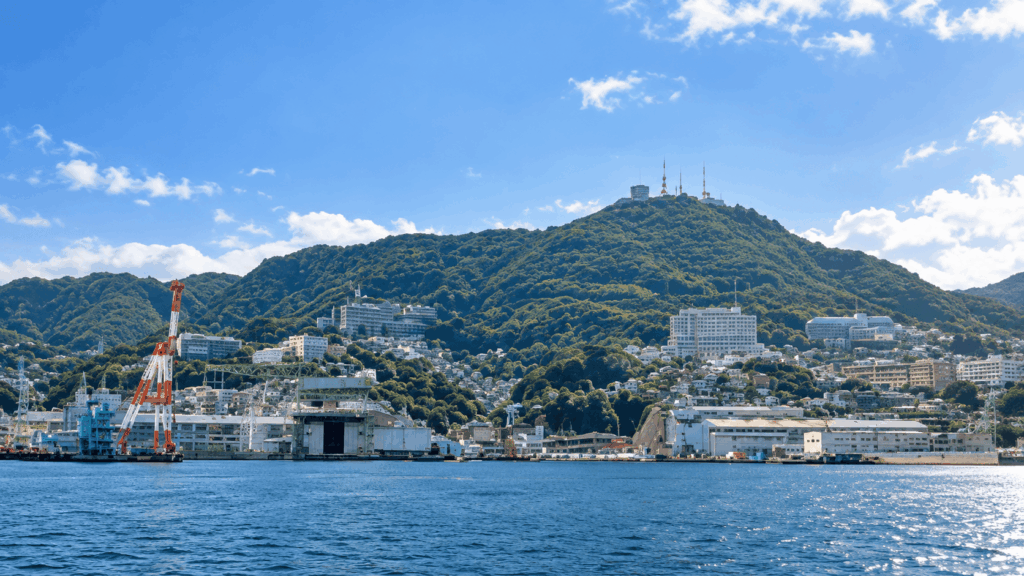
Kai’s tip: When I am heading up, I look at the summit from the foot of the mountain first. If there is cloud sitting on the top, that tells me a lot about what the view will be like, and sometimes it is worth waiting or coming back another evening. It does not mean every cloud is a dealbreaker — thin, broken cloud can even improve a sunset — but a solid cap of cloud over the summit is a warning sign.
Before you set out, check a live camera feed of the observatory and the local forecast. If the summit is hidden, consider skipping the trip that night rather than spending the time and money to reach a white-out. The mountain will still be there tomorrow. Note that visibility is decided by conditions on the day, not by the season.
What the Night View Is Really Like
The observatory sits at 333 m and gives you a 360-degree view, with Nagasaki Harbor and the city spread below and the surrounding hills framing the scene. The deck itself is free to enter; you pay for the transport to get there. Inside there is a covered observation area and, at certain times, seasonal lighting displays such as the night-view lantern, where patterns appear to float over the city lights below.
When it is clear, the view genuinely lives up to its reputation. As the lights come on, they spread across the slopes around the harbor and reflect off the water, and the whole basin fills with light. It is the kind of view people remember from a trip to Nagasaki.
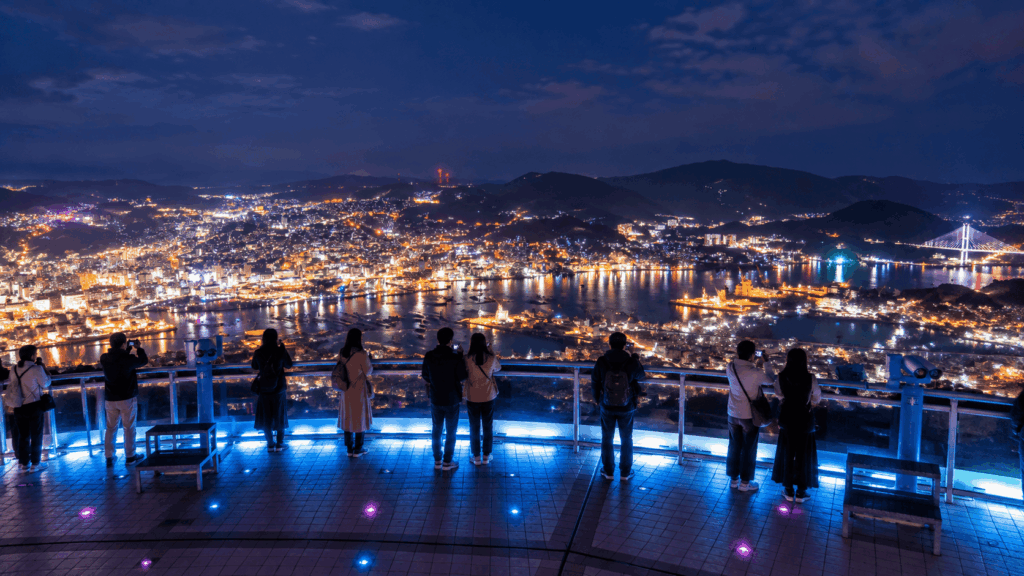
It is worth being honest about the other side of it, though. Recent visitors who loved the view also mention the ropeway getting crowded around sunset and after dark, the occasional foggy night where you see little, and the feeling that the gondola ride is harder to enjoy when it is packed. The summit, not the ride, is the experience — and its quality depends heavily on the weather. None of that is a reason to skip Mount Inasa; it is a reason to check the conditions and plan your timing.
Who Will Think Mount Inasa Is Worth It?
Worth it if: you have a clear evening, it is your first visit to Nagasaki, you enjoy photography or city skylines, and you can give the sunset-to-night sequence a couple of hours. Harbor city views are its strength, and on a good night it is one of the highlights of a Nagasaki trip.
Maybe skip it if: the summit is under thick cloud, you have a dinner or train reservation right after, you really dislike crowds, or city night views are not your thing. In those cases the time and the return logistics are harder to justify.
Expect Crowds After Dark — Especially When Heading Down
Here is the part of a Mount Inasa evening that catches people out: the queue for the ropeway down. It is often quiet going up and early in the evening, but after the night view hits its peak, a lot of people decide to leave at once. The operator itself warns that waiting times can grow after late afternoon, and visitors regularly mention it too. How long you wait varies a lot by day, so treat it as a risk to plan for rather than a fixed number.
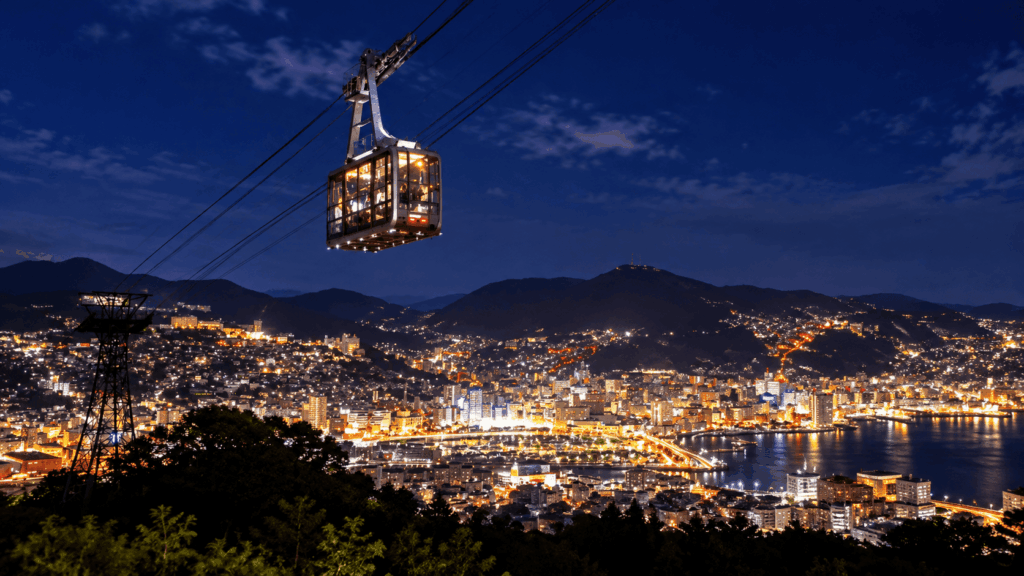
Kai’s tip: On an evening I guided, the line for the ropeway down after the peak of the night view ran close to an hour. By the time we reached the foot of the mountain, the connecting bus toward Nagasaki Station that we had planned to catch was gone, and we ended up walking to a tram stop further away — tiring at the end of a long day. It happened once, not every time, but it changed how I plan these evenings. My rule now is simple: plan your way down before you go up.
Before you ascend, check four things: the ropeway’s closing time and last descent, the local bus timetable from Ropeway-mae back toward the station, whether the free shuttle has seats you can book, and whether a taxi is a realistic option at the time you expect to leave. Deciding this at the summit, with a long line in front of you, is much harder than deciding it before you go up.
Should You Leave Before It Is Completely Dark?
If your priority is an easy return, leaving before it is completely dark is a reasonable trade. Once the city lights are fully on and you have seen the view at its brightest, you can start heading down while the queues are shorter, rather than staying until everyone else decides to leave. You give up a little of the deepest glow of the night view, but you gain a calmer trip home. There is no guarantee the queue will be short on any given night, so if a smooth return matters more than squeezing out the last few minutes, this is a sensible choice — or else line up another way down in advance.
If you would rather not build your whole evening around ropeway queues and the last bus, a direct night-view option that handles both directions is worth looking at before you commit to the DIY route.
Another option, particularly if you also want to explore Nagasaki with an English-speaking guide, is a scheduled evening tour rather than a dedicated door-to-door transfer. If that sounds closer to your travel style, the Nagasaki Mt. Inasayama & Glover Garden Night Tour is worth comparing with a self-planned visit.
Why I’d book this one
- More than just a viewpoint: The itinerary combines Mount Inasa with other Nagasaki highlights, giving first-time visitors historical context alongside the night scenery.
- A defined evening itinerary: The published tour starts and finishes at Nagasaki Station, which makes it easier to see how the evening fits into your wider travel plans instead of organising each stop independently.
- Useful traveler feedback: The limited available reviews mention a helpful, knowledgeable guide and memorable views. There is also feedback that the itinerary can feel tight, so it is worth checking whether the pace suits you.
Before choosing this over the DIY route, check the scheduled Mount Inasa visit time and exactly which transport and admission costs are included. The listing describes walking and tram travel, so do not assume it provides private vehicle transfers or lets you bypass ropeway queues. If your main goal is to spend a full hour at the summit before sunset, make sure the tour’s timing matches that plan.
Bring an Extra Layer — Even on a Mild Day
A small bit of preparation that can make or break the evening: warmth. Downtown Nagasaki and the 333 m summit can feel different once the sun goes down, especially when the wind picks up at the top. A light layer that you can put on when you are standing around after dark — even in warmer months — will keep you comfortable far longer than you might expect.
A few recent visitors have noted that the summit felt windier and colder than the city below, so pack accordingly. If you plan to stay for the full sunset-to-night sequence, which means standing or sitting outdoors for an extended time, a jacket or sweater is easy to carry and easy to appreciate. If you tend to feel the cold, add a windproof layer too.
A Simple Mount Inasa Evening Plan from Nagasaki Station
Here is a straightforward plan that ties everything together. It is built around the sunset time on your date rather than fixed clock times, so it works in any season.
- T minus 90 to 120 minutes — leave central Nagasaki or Nagasaki Station. Allow a buffer for the bus, the walk to Fuchi-jinja Station, and the ropeway. If you are taking the local bus, add a little extra in case of traffic.
- T minus 60 minutes — arrive at the summit observatory. This gives you the daylight view before the sunset begins.
- T — sunset. Watch the light change over the harbor and the city.
- T plus 20 to 40 minutes — blue hour and the first lights. Stay long enough to see the city lights come up and the reflections on the water.
- Then — start your descent. Check the ropeway line, bus times, and any booked shuttle or taxi before you commit to staying longer.
If it is a clear evening and you have the time, this plan lets you see the whole arc of the view. If the day is cloudy or you have limited time, cut it short or save the visit for another evening — the mountain rewards good conditions far more than a rushed trip. Once you are back down, you can dive straight into Nagasaki’s nightlife and late-night food options in the city center.
FAQ: Getting to Mount Inasa
What is the easiest way to get to Mount Inasa from Nagasaki Station?
For most visitors, the easiest route is a local Nagasaki Bus (route No. 3 or No. 4) from the Nagasaki Ekimae stop to Ropeway-mae, a short two-to-three-minute walk to Fuchi-jinja Station, and then the Nagasaki Ropeway to the summit. It is inexpensive, runs through the evening, and needs only one transfer. If you would rather not deal with the transfer and the evening queue, a taxi or a direct night-view transfer is simpler but costs more.
What time should I go to Mount Inasa for the night view?
Rather than a fixed time, aim to reach the observatory about an hour before sunset on your travel date. That way you see the daylight view, the sunset, the blue hour, and the city lights all in one visit. Sunset changes through the year, so look up the sunset time for Nagasaki for your date and work backward from there, allowing extra time for the bus and ropeway.
Can you take a taxi to the top of Mount Inasa?
Often yes, but not always, and the rules can change. The summit area has vehicle restrictions: the summit observation parking lot is unavailable between 18:00 and 22:00 on Saturdays, Sundays, public holidays, and designated restriction days, and access can be limited at busy times. A taxi can frequently reach the summit or drop you at Fuchi-jinja Station for the ropeway, but confirm the current situation on the day rather than assuming a drop-off at the very top.
Is the Mount Inasa Slope Car running?
As of October 2026, the Inasayama Slope Car is out of service for maintenance, with no announced restart date. The ropeway is operating normally, so you can still reach the summit — by gondola rather than by slope car. Ignore older guides that send you up by slope car, and check the official Inasayama Park and Nagasaki Ropeway sites for current status before you travel.
Is the Mount Inasa night view worth it?
On a clear evening, yes — especially on a first visit to Nagasaki and if you can spend an hour or two from sunset into the night. The harbor-and-city view from 333 m is genuinely memorable. It is less worthwhile when the summit is under thick cloud or fog, when you are short on time, or when you want to avoid crowds entirely. Check the weather and plan your trip down before deciding.
Final Verdict: Who Should Go to Mount Inasa — and How
There is no single “best” way to reach Mount Inasa — there is a best way for your evening. Here is how I would split it.
- Choose bus + ropeway if you are a first-time visitor without a car, you want the lowest cost, and one transfer does not bother you. This is the default for most people, and it works well if you arrive about an hour before sunset.
- Choose a taxi if you are traveling as a pair or a small group, you have luggage or mobility considerations, or you want to protect a tight sunset window and skip the transfer. Just confirm the summit vehicle restrictions for your day.
- Choose a direct night-view tour or transfer if the return is the part you least want to deal with. If you would rather not build your evening around ropeway queues and the last bus, having both directions handled for you is the trade that makes sense.
- For families, the ropeway is the straightforward choice for getting up, but plan the descent early and keep an eye on the down queue after dark — a shorter stay with an easier exit usually beats staying for the very last of the lights.
- For travelers on a tight schedule, do the sunset-to-blue-hour window, then leave before the full-dark rush. You still get the best of the view without risking a long wait on the way down.
- For repeat visitors, skip the ropeway queue by going earlier, or pick a different viewpoint for a change of angle — Mount Inasa is at its best when you are not fighting the crowd.
Whatever you choose, the two things that matter most are not on any transport map: check the weather before you commit, and plan your way down before you go up. Get those right, and the view looks after itself.

Hi, I’m Kai. I’m a Tokyo-based travel writer, tourism industry insider, and the author of a published guidebook for international visitors to Japan. With over 10 years of professional experience at a leading Japanese tourism company, my mission is to help you skip the tourist traps and navigate Japan’s best destinations like a local. I believe the perfect day trip is like a traditional kaiseki meal: a beautiful balance of precise planning and unforgettable seasonal discovery. When I’m not out conducting field research, you’ll usually find me drafting new itineraries with one of my favorite fountain pens!