
Biei rewards a full day — provided you have a car. The planning mistake I see most often is treating the Blue Pond as the whole destination and everything else as filler, then discovering that the pond itself takes twenty minutes and the day has another eight hours in it. The shape that works is the reverse: see the pond early, add the waterfall five minutes up the road, get the flower fields done before lunch, and leave the afternoon for the hills that give Biei its name.
This itinerary is built for the green season, assumes you are starting from Biei itself, and treats driving time, parking queues and walking fatigue as real costs rather than footnotes. If you are coming from Sapporo without a car, the second half of this guide explains why the transport decision matters more than the stop list.
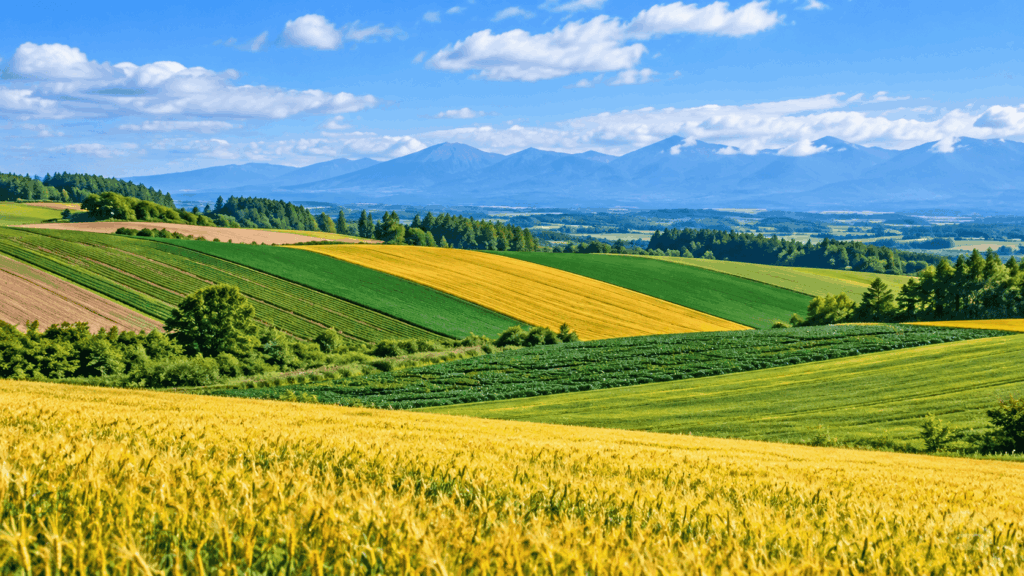
Visiting Biei from Sapporo without a car? A small-group day tour can cover the Blue Pond, Shirahige Falls and the flower fields around Biei and Furano without the train-and-bus connections. You give up the flexibility of an early-morning visit, but the transport is handled for you. Check Biei–Furano tour dates, stops and current options from Sapporo before deciding whether the fixed schedule works for your trip.
The Short Answer
With a rental car: yes, Biei is worth a full day, and the order below is the one that keeps the day intact. Without a car: you can still see the main stops, but you are choosing between a fixed-schedule sightseeing bus and a guided tour from Sapporo rather than assembling buses yourself.
- Best order: Shirogane Blue Pond first, Shirahige Falls second, Shikisai-no-Oka before lunch, Biei’s hills in the afternoon.
- Time at the Blue Pond: 20–30 minutes is usually enough. The risk is not the visit, it is the queue to park.
- What to cut if you fall behind: Shirahige Falls, then the northern hill loop. Do not cut the flower fields if you came for them.
- What not to expect: a guaranteed shade of blue. Rain and snowmelt dilute the colour, and the pond is honest about it.
- Who should skip this plan: anyone hoping to see Biei in half a day from Sapporo, and anyone visiting in winter, when this route does not apply.
Is Biei Worth a Day Trip?
Biei is worth a day because the scenery changes type four times inside a short drive: volcanic water at the Blue Pond, a waterfall fed by the same mineral load, a cultivated flower hill, and then farmland that looks nothing like either. That variety is the reason to give it a day. The Blue Pond on its own is not — it is a small pond behind a car park, and travellers who build a whole day around it consistently describe the visit as shorter than expected.
The travel arithmetic is the other half of the decision. From Sapporo, the reliable route is a limited express to Asahikawa followed by a local train on the Furano Line to Biei, which puts you in town in roughly two hours ten minutes to two and a half hours, one way, for somewhere in the region of ¥6,000. Note that limited express services between Sapporo and Asahikawa switched to all-reserved seating in March 2026. Reserve your seat in advance where possible; same-day purchase and unassigned-seat tickets are possible, but neither guarantees a seat. A day trip is therefore possible, but it is a long day with a hard finish, not a casual outing.
If your only goal is a photograph of the Blue Pond, take a tour or skip Biei altogether and put the hours somewhere else. If you want the sequence — mineral water, waterfall, flower hill, farmland — the day pays for itself.
The Best Biei Day Trip Itinerary
The table below is a model, not a timetable. Start times shift with the season, with how far you are travelling, and with whether you are driving. What should not shift is the sequence: the pond is the one stop where arriving late costs you real time.
| Time | Stop | Suggested Time | Why It’s Here | Key Tip |
|---|---|---|---|---|
| 7:30–8:30 | Shirogane Blue Pond | 20–30 min on site | Beats the 10:40–16:00 congestion window and the parking queue | Arrive before 9:00 if you can; the car park fee is ¥1,000 per car since July 2026 |
| 8:45–9:15 | Shirahige Falls | 15–20 min | Ten minutes up the road, and it explains where the blue comes from | Free parking at the Shirogane Kanko Center; the view is from the bridge |
| 10:15–12:00 | Shikisai-no-Oka | 60–90 min | Flower fields are better before the midday heat and the tour buses | Decide on walking, the Norokko or a cart before you enter, not after 40 minutes on your feet |
| 12:15–13:15 | Lunch | 45–60 min | Keeps the afternoon free for landscape rather than queues | Keep it simple; this is not the day to chase a specific restaurant |
| 13:30–16:30 | Patchwork Road & Panorama Road area | 2–3 hours | The farmland scenery is the reason Biei exists as a destination | Drive and stop; do not treat the named trees as a checklist of photo stops |
| 16:30 onward | Return, or one last stop | — | Light softens and the day-trippers leave | If returning to Sapporo by train, leave margin for the connection at Asahikawa; if driving, allow time for the road home |
7:30–8:30 – Start at Shirogane Blue Pond
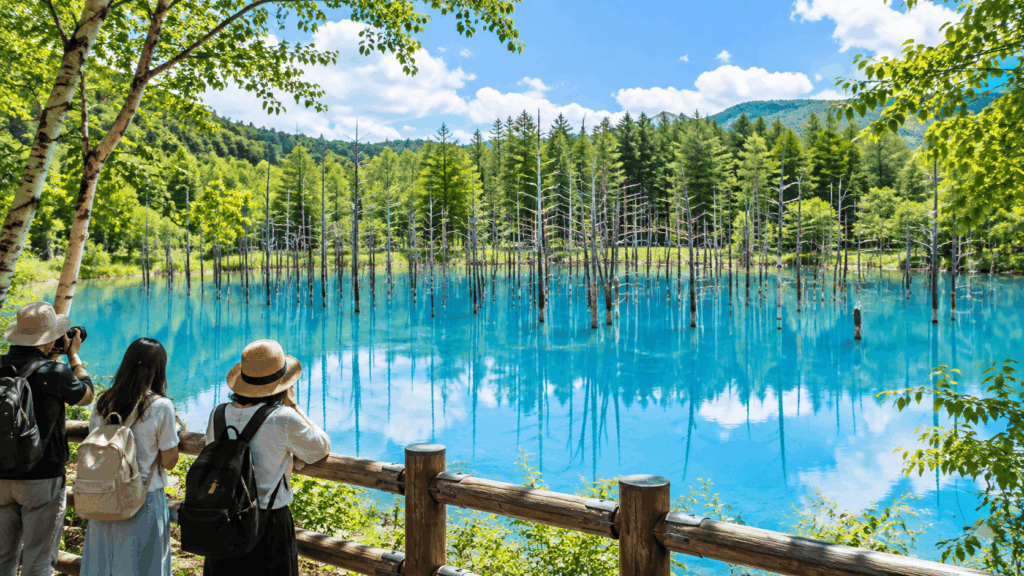
The Blue Pond is about 20 minutes by car from Biei Station, up the road towards Shirogane Onsen. The car park holds roughly 220 cars and, since 1 July 2026, costs ¥1,000 for a standard car; the car park is open from 7:00 to 19:00 from May through 22 October, and from 8:00 to 21:30 from 23 October through April. Check the current hours before an early or evening visit. From the car park it is a short walk of a few minutes to the water.
The timing advice is not folklore, it is published. The Biei Tourism Association warns that the area around the pond is heavily congested between 10:40 and 16:00, that the access road itself backs up in the afternoon, and that on sunny days the worst of it falls between 13:00 and 15:00. Their guidance is that 7:00–9:00 and after 16:30 are comparatively smooth, and they note waits of 30 minutes to an hour to enter the car park even on weekdays depending on weather and day of the week. Arriving at opening is the difference between a ten-minute stop and an hour of queuing before you have seen anything.
Kai’s tip: The reason I front-load the pond is not the photograph, it is the rest of the day. When I have arrived later, the time disappeared in the approach road and the car park rather than at the water, and everything after it — the waterfall, the flower fields — got compressed to protect the drive back. Seen early, the pond costs you half an hour and you still have a full day in hand. Seen at midday, it can cost you two hours and the afternoon.
What Blue Pond Really Looks Like
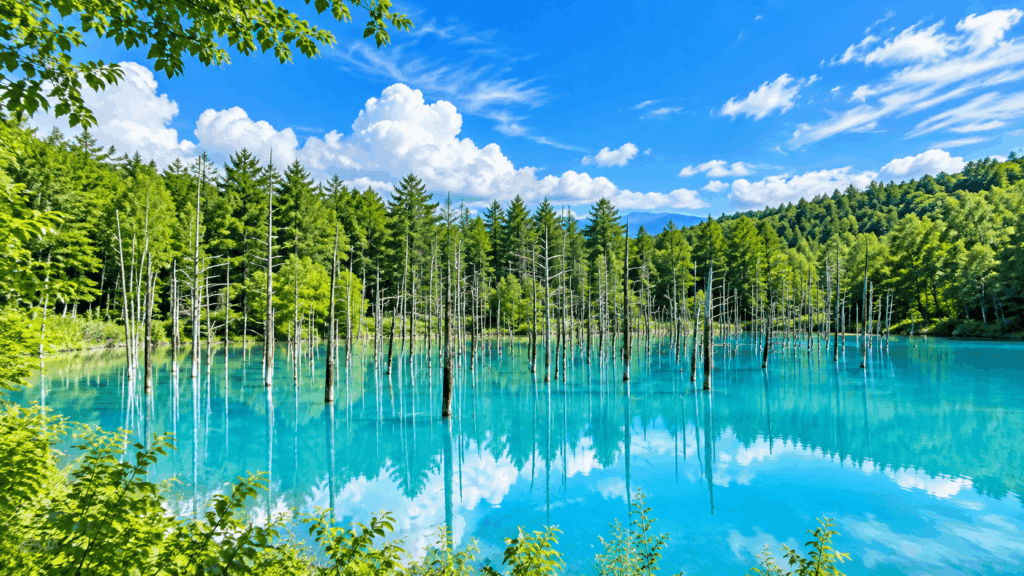
The pond was not designed. It formed as a by-product of erosion-control works on the Tokachidake side, when water pooled behind a dam and drowned a stand of larch, leaving the pale dead trunks that appear in every photograph. The blue comes from aluminium-containing water draining into the Biei River system; colloid particles scatter sunlight, short wavelengths dominate, and the white soil under the pond bounces light back up. It is a genuinely odd piece of chemistry rather than a filter.
Which is also why the colour is conditional. The tourism association states plainly that after the spring snowmelt or heavy rain, the mineral concentration is diluted and the pond may look muddy or not blue at all. On a grey, wet day I have seen it read as a flat grey-green sheet with the dead larches doing all the work — still atmospheric, but nothing like the wallpaper image. That is not a reason to skip it; it is a reason not to make the whole trip contingent on one shade of blue. Treat the pond as one stop in a landscape, and a flat day costs you a photograph rather than a day.
8:45–9:15 – Add Shirahige Falls
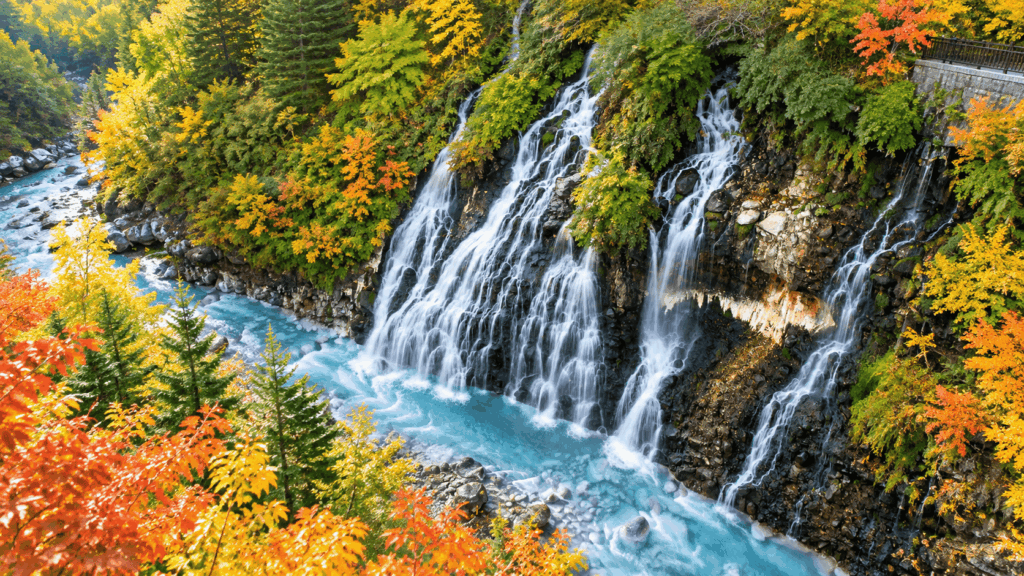
Shirahige Falls sits in the middle of the Shirogane Onsen settlement, roughly five to ten minutes further up the road from the pond. It is a submerged-flow waterfall: groundwater emerges through layers of rock in the cliff face and falls into the Biei River, which is why the streams appear to come directly out of the rock. You view it from the Shirogane Bridge — sometimes called the Blue River Bridge — rather than walking to a base, so the stop is short by design. There is free parking near the Shirogane Kanko Center, and no admission fee.
Fifteen to twenty minutes is enough, and it earns its place because it closes the loop on the colour you just saw: this is the mineral water that feeds the pond. It is also the first thing to cut if you are running late, since nothing here requires a booking and the view does not change through the morning.
10:15–12:00 – Shikisai-no-Oka Without Exhausting Yourself
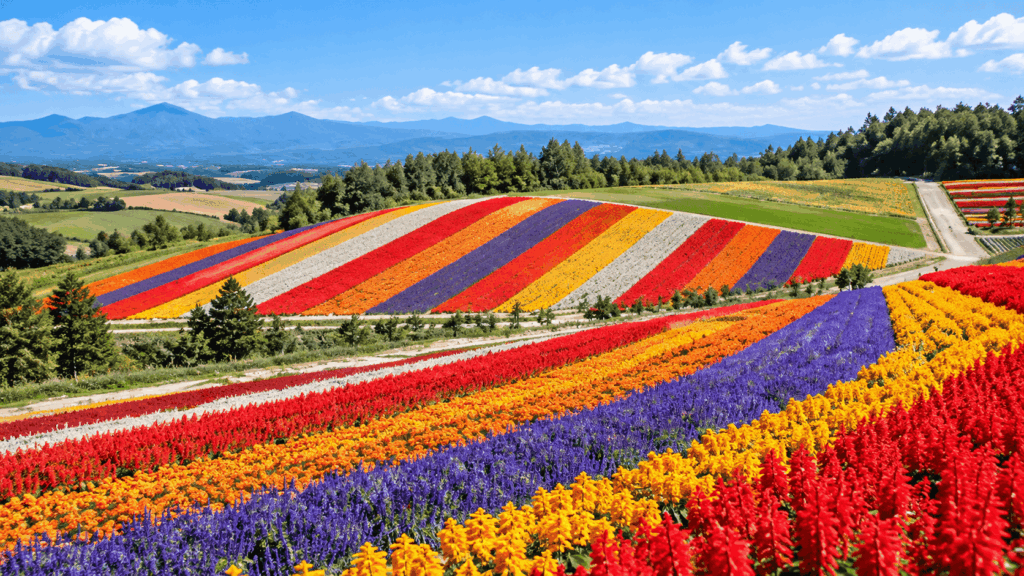
Shikisai-no-Oka is about 12 minutes by car from Biei Station, on the Furano side of town, and it is much larger than the photographs suggest: roughly 15 hectares of hillside, with slopes between the flower beds and very little shade. Admission is charged only from July to September, at around ¥800 for high school age and above and ¥500 for school-age children; parking costs ¥500 per car from June to September and is cash only. In June to September the gates run from 8:40 to 17:30, with last entry at 17:15.
The park is laid out so that the best views are uphill from the entrance, which is exactly the problem. A full walk of the main beds is 60–90 minutes of up-and-down in open sun, and it lands in the middle of a day trip where you still have an afternoon of driving ahead of you.
Kai’s tip: On a visit with a companion who was not a confident walker, we set off around the beds on foot and ran out of enthusiasm about two-thirds of the way round, in full sun, with the car park still uphill. Nothing was wrong with the garden — the garden is lovely — but we had spent the energy we needed for the afternoon on a loop we could have ridden. Since then I treat the Norokko or a cart as buying back the afternoon rather than as an unnecessary extra, and I decide before entering rather than after my legs have voted.
Walk, Norokko or Cart – Which Should You Choose?
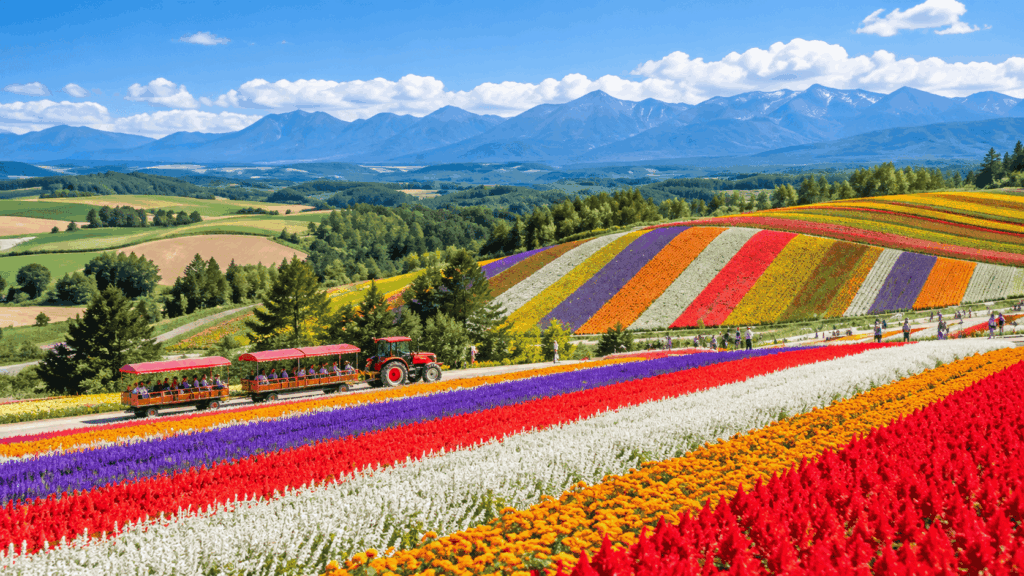
Three options, three different buyers. The Norokko is the tractor-pulled bus that loops the grounds in about 15 minutes; the cart is a four-seat vehicle you drive yourself for a fixed period; walking is free and gives you the most control over where you stop.
| Option | Cost Basis | Best For | Advantages | Downsides |
|---|---|---|---|---|
| Walking | Included in admission | Fit travellers with time and a specific photo list | Stop wherever you like; no waiting | 60–90 minutes on slopes with little shade; hard on knees and on a tight schedule |
| Shikisai Norokko | Around ¥500 for high school age and above, around ¥300 for school-age children | First-time visitors, families, older travellers, anyone on a one-day loop | 15-minute loop, seated, runs in rain, no effort | Fixed route and pace; you see the beds from the track rather than standing among them |
| Cart (4-seater) | Around ¥2,500 per vehicle for 15 minutes; around ¥500 per extra 5 minutes | Small groups who want to stop and photograph repeatedly | Your own pace, your own route, four people per vehicle | Requires an ordinary driving licence to operate; watch the time limit |
Two practical notes. The cart requires a Japanese ordinary driving licence, so international visitors should confirm at the ticket counter whether their permit is accepted before paying — the rule is stated, the treatment of foreign permits is not spelled out, and the queue behind you is not the place to find out. And the Shikisai Norokko is not the JR Furano–Biei Norokko train: the sightseeing train on the Furano Line ended its run in September 2026, while the tractor bus inside the garden still operates through the green season. Travellers regularly confuse the two when planning.
There is also a buggy on a dedicated 700 m course from age 16, at around ¥800 for one seat and ¥1,200 for two. It cannot enter the flower beds, so it is a way to move around rather than a way to see the flowers.
12:15–13:15 – Lunch, and Why It Should Stay Simple
Lunch on a Biei day trip is a logistics decision, not a destination. Somewhere around Biei Station or on the road back from Shikisai-no-Oka, 45 to 60 minutes, and then move. The reason is arithmetic: the afternoon hill loop is the part of the day that most rewards unhurried driving, and a 90-minute lunch in the middle of it is usually paid for out of the scenery.
If you eat at the garden itself, note that the upstairs Phlox Hall restaurant closes on Wednesdays, and its last-order time may be earlier than the park closing time. Check the day’s food-service hours before counting on a late lunch. Otherwise, keep the budget of time in mind and treat the meal as fuel for the hills.
13:30–16:30 – Spend the Afternoon in Biei’s Rolling Hills
The afternoon is where Biei stops being a list of photogenic points and becomes a landscape. Patchwork Road runs through the farmland northwest of the station, where fields of different crops sit side by side on the slopes; Panorama Road takes you along the ridge with wide views back across the basin. Neither is a single viewpoint with a car park and a sign — that is the point.
The right way to do this is to drive slowly, take the pull-offs that exist, and accept that the best frame of the afternoon will probably be somewhere you did not plan to stop. The wrong way is to treat the named trees as a checklist. The Ken & Mary Tree, the poplar made famous by a 1970s car commercial, still stands and is genuinely striking, but it sits on working farmland: you photograph it from the road, you do not walk into the field, and you do not stop in the middle of the lane. The same rule applies across the whole hill area — the fields are private land, and the fact that they are beautiful does not change that.
If you have time for one detour, take it slowly rather than adding a fifth stop. Three hours in the hills at 30 km/h is a better use of the afternoon than five photo spots at speed.
Getting Around Biei: Car, Bus or Tour?
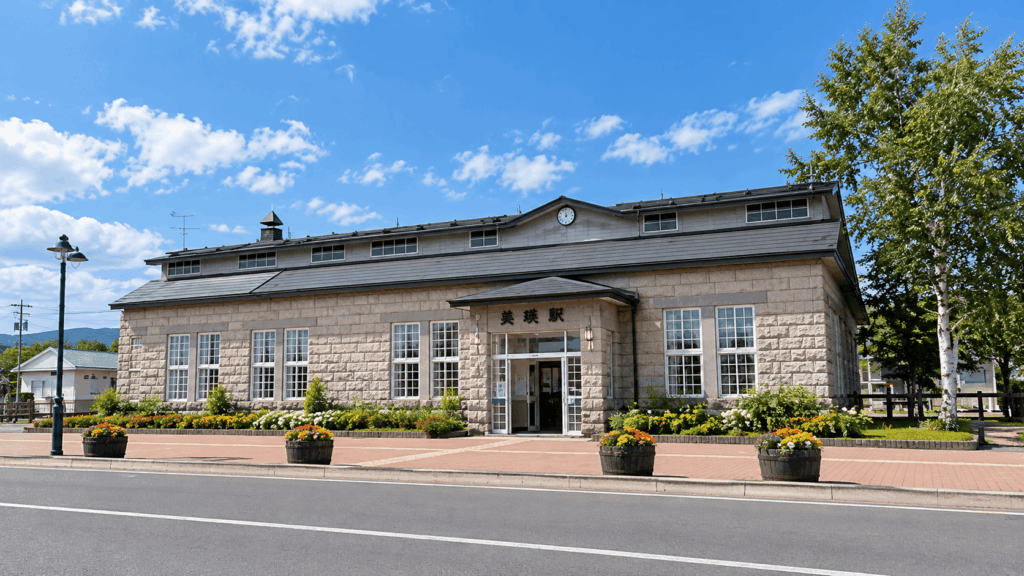
This is the decision that actually determines your day, and it is the part most guides soften. Biei’s main stops are spread across a valley with a limited bus network, so “you can reach Biei by train” and “you can see Biei in a day by train” are two very different statements. If you haven’t finalised your route yet, check our guide on navigating from Sapporo to Biei. The table below compares the realistic options on the axes that matter: how much of the day you control, how much planning it takes, and what you give up.
| Option | Best For | Flexibility | Planning Effort | Main Drawback | Verdict |
|---|---|---|---|---|---|
| Rental car | Anyone who wants the itinerary above as written | High — stop where and when you like | Moderate: book ahead in summer, check snow rules out of season | You drive, you park, and in peak season you queue at the pond like everyone else | The only option that makes an early Blue Pond visit genuinely easy |
| Biei View Bus | Biei-based travellers who will not drive | Low — fixed route and fixed times | Low: one booking covers the transport problem | Seasonal operation, and you follow the group’s clock | The most practical no-car option if you are already in Biei |
| Guided tour from Sapporo | Sapporo-based travellers, and anyone combining Biei with Furano | Low — the operator sets the stops | Lowest: no driving, no connections, no navigation | You arrive at the Blue Pond mid-morning, inside the busy window | Best for logistics, worst for early light |
| Public bus + train | Confident, patient travellers with one or two specific stops | Medium, but constrained by timetable gaps | High: you are assembling the day yourself | Mid-morning arrivals and long waits between stops | Workable for the pond; hard work for a full loop |
| Taxi / hired car | Small groups splitting a fare, or a single transfer | High for one leg | Low, but availability is limited | Cost adds up fast; vehicles are few in peak season | Useful as a transfer, expensive as a strategy |
Best Option – Rental Car
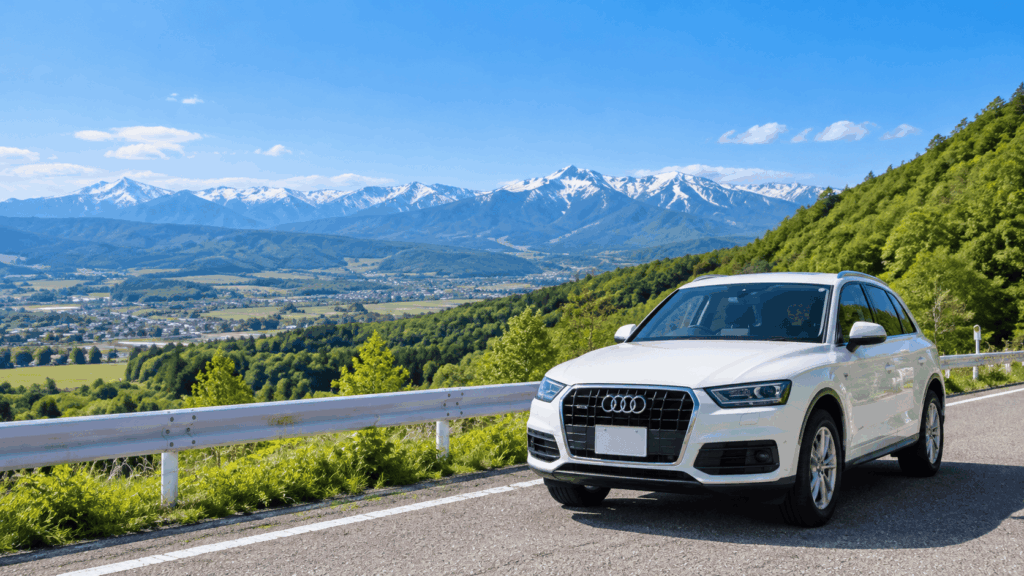
A car is what makes the itinerary in the first half of this guide possible without compromises. It gets you to the Blue Pond before 8:00, lets you decide at Shirahige Falls whether to stay or move on, and turns the afternoon hills into a drive rather than a series of waits. Parking is straightforward if not free: the pond charges ¥1,000 per car since July 2026, and Shikisai-no-Oka charges around ¥500 in June to September, cash only.
Book ahead for July and August. Biei is a small town with a limited fleet, and the travellers who struggle are usually the ones who assumed they would sort out a car on arrival. If you are visiting outside the green season, check the rental terms for winter tyres and driving conditions before you commit to this plan at all.
Best No-Car Option – Biei View Bus

If you are staying in Biei and not driving, the Biei View Bus is the option that removes the planning problem in a single booking. In the 2026 season it ran two courses from the Shiki-no-Johokan information centre, one minute’s walk from JR Biei Station. The morning course departed at 9:40 and returned at 12:45, covering the Blue Pond with about 35 minutes on foot, Shirahige Falls with about 20, and Shikisai-no-Oka with about 45. The afternoon course ran 14:10 to 17:10 in the reverse order, with a slightly different time split.
Fares in 2026 were around ¥4,500 in June and October and around ¥5,000 in July to September for adults, and in the July–September period the Shikisai-no-Oka admission was included. Bookings open 90 days ahead and close four days before departure at 17:00, and cancellation fees start ten days out, so this is not a decision to leave until the morning of. The important caveat is that it is a seasonal service: the 2026 summer service ended after 12 October, and next season’s dates and fares are published separately, so check the current year’s schedule rather than assuming last year’s times.
What you give up is control. The morning course puts you at the Blue Pond around 10:00, close to the 10:40–16:00 period the tourism association flags as congested, and 45 minutes at Shikisai-no-Oka is enough to see the main beds but not to walk them thoroughly. For travellers who want the landscape without the driving, that is a fair trade. For travellers who want the empty 7:30 pond, it is not.
Best From Sapporo – Guided Day Tour
From Sapporo, the guided day tour solves a problem you cannot solve yourself: the distance. A typical small-group tour leaves Sapporo Station’s north exit bus terminal around 8:00, reaches the Blue Pond at about 10:30 for roughly half an hour, stops at Shirahige Falls for about 20 minutes, passes the Jet Coaster Road, gives an hour at Shikisai-no-Oka with admission included, adds around 50 minutes at Farm Tomita on the Furano side, and returns to Sapporo around 18:00. Transport, tolls and the flower garden ticket are handled; you do not touch a steering wheel or a timetable.
The trade-off is honest and worth stating plainly. A tour arriving at the pond at 10:30 is arriving just before the period most associated with congestion, and half an hour there includes the walk from the bus. You will see the pond; you will not see it quiet. If your reason for visiting Biei is the early-morning version of the Blue Pond, the tour cannot give you that, and no amount of convenience changes it.
If you are staying in Sapporo, are not driving, and want Biei and Furano in one day, this is the option that makes the day work. Inclusions, stop order, group size and language support differ between operators and change by season, so read the current itinerary rather than relying on a description from a previous year.
Why I’d book this one
If you’re staying in Sapporo and want the Blue Pond, Shirahige Falls and Furano’s flower fields in one day without driving, the Sapporo: Biei and Furano Flower Fields and Blue Pond Tour is a practical option to compare with the DIY route. It is particularly suited to travellers who want several major stops in one day but do not want to manage the connections themselves.
- Less time managing transport: Recent travelers frequently highlight the convenience of having the long drive and transfers handled, leaving more attention for the scenery rather than the route.
- Helpful driver-guides: Traveler feedback often mentions friendly, organized guides and smoother movement between stops. The level of commentary can vary, so check recent reviews if detailed English-language explanations matter to you.
- A clearer one-day package: The listed itinerary includes Shikisai-no-Oka admission and combines Biei with Furano. Check the selected date for exact inclusions, departure details and cancellation or payment conditions before committing.
See live availability, departure details and recent traveler reviews for this Biei–Furano tour.
The important limitation remains the timing: this is a convenient sightseeing day, not a way to see the Blue Pond before the crowds. If arriving at the pond around 7:30 is your priority, a rental car and an overnight stay near Biei fit that goal better.
What Public Transport Actually Looks Like
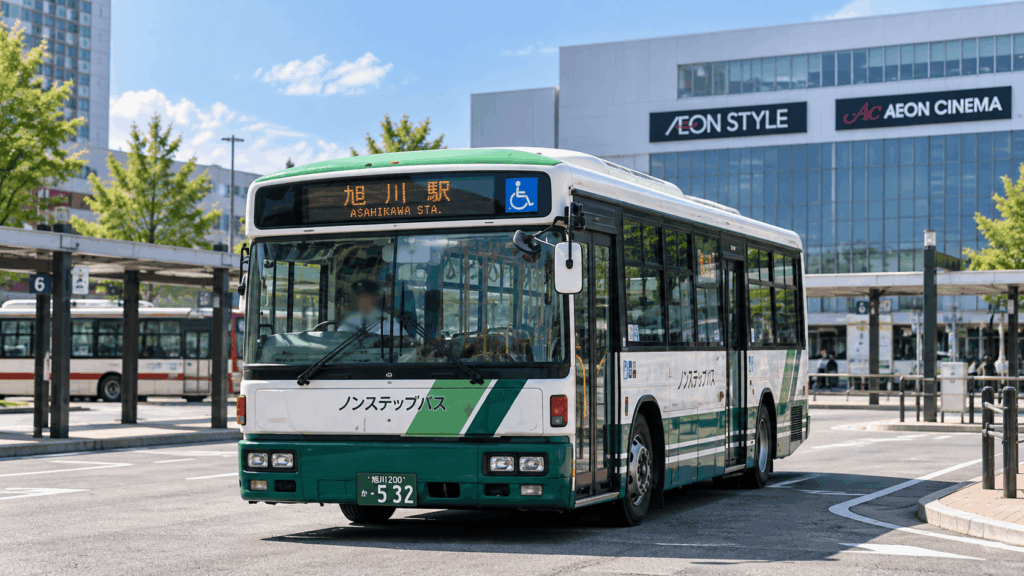
You can reach the Blue Pond by bus (for full transport options, see our guide on how to get to the Blue Pond from Sapporo), and the early departure can be genuinely useful: in the published 2026 timetable, the Dohoku Bus Biei–Shirogane line leaves Biei Station at 6:55 and reaches the Blue Pond entrance at 7:17, which puts you there before the crowds. Verify the service for your travel date. The fare is around ¥800 one way, and a Biei–Shirogane one-day pass covering unlimited rides in the area costs around ¥2,000 for adults. Later departures run through the morning — 8:14, 9:00, 10:34 — with the 10:34 arriving at 10:56, precisely the point at which the car park starts backing up.
The problem is what happens after. The Blue Pond and Shirahige Falls sit on the same line, but Shikisai-no-Oka is in the opposite direction, towards Furano, and connecting the two by scheduled bus means returning to Biei and starting again. Do that once and you have spent your flexibility; do it twice and the afternoon is gone. A taxi covers the gap — Biei Hire, three minutes from the station, quotes roughly ¥6,660 for a small car to the Blue Pond — but that is a transfer price, not a touring strategy, and vehicles are limited in peak season.
So the realistic verdict on public transport is this: use it for the pond and the waterfall if you are staying in Biei and want an early start, and use the Biei View Bus or a tour for anything wider. Assembling the full loop from timetables is possible, and I would not talk anyone out of trying it, but it is a day built around buses rather than around Biei.
Should You Combine Biei and Furano in One Day?
You can, and with a car or a tour it is a reasonable day. What you cannot do is combine them and still give Biei’s hills three unhurried hours. The arithmetic is simple: Furano’s flower farms sit roughly half an hour to forty minutes beyond Biei by road, and a stop at Farm Tomita plus the drive eats the block you would otherwise spend on Patchwork Road and Panorama Road.
The version that works: treat Furano as the flower stop and Biei as the landscape stop, and accept that one of them gets a shorter visit. A tour does exactly this, which is why tours suit travellers who want to see the famous farms rather than the farmland. The version that does not work: trying to do both by public transport in a single day, where the connections consume the margin you were counting on.
My own rule, having spent a day inside Biei and still run short of time because of driving and walking, is that one hill town per day is the honest allocation (if you choose Furano instead, follow a dedicated Furano day trip itinerary). If you only have one day in the area and the flower fields are the priority, take the tour and let someone else do the driving. If the fields are a bonus rather than the point, stay in Biei and go slower.
Best Time of Year for a Biei Day Trip
This itinerary is a green-season plan, roughly late April to October, and it is at its best in July and August when the flower fields are at full colour. Those are also the most crowded and the hottest weeks, which is the trade you are making. June and September give you most of the scenery with fewer people; October still drives well and Shikisai-no-Oka drops its admission and parking charges from 1 October, though the beds are thinner.
Spring has one specific catch: the snowmelt that makes the hills green also dilutes the Blue Pond, so an April or May visit can produce a pond that is grey rather than blue. That is the season behaving as documented, not bad luck.
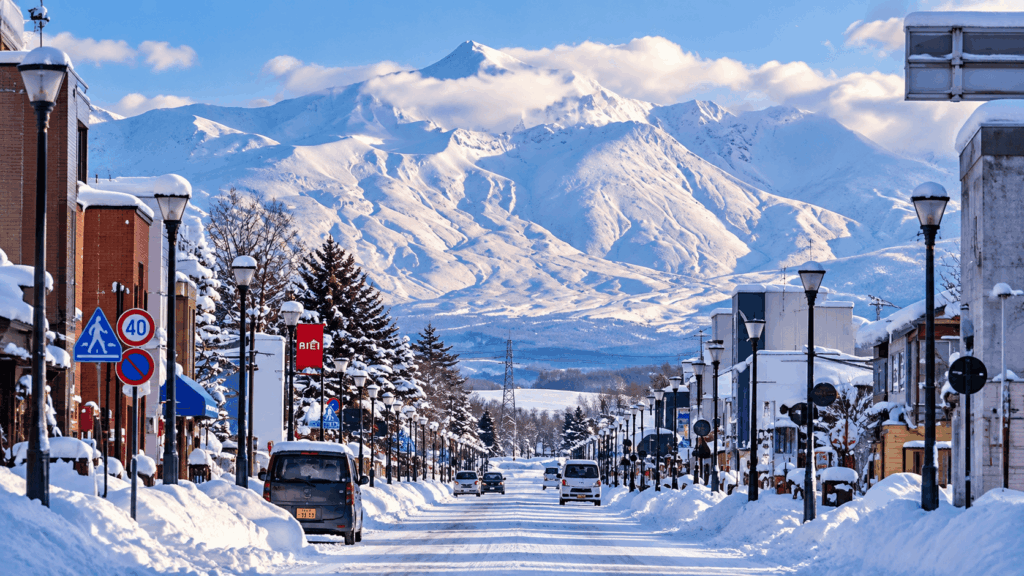
Winter is a different trip, not this one—for that, see our winter guide to Biei. Snow cover means you cannot see the blue water at all, the pond runs a winter illumination instead, and driving conditions on the Shirogane road are a separate skill set. If you are visiting between November and March, plan around the illumination and winter transport rather than trying to adapt this route.
Kai’s tip: What surprised me most on a summer visit was not the heat but the absence of shade — the flower hill is open, the paths between beds are exposed, and there is nowhere to step out of the sun for twenty minutes. I now carry a hat and more water than I think I need, and I keep cash for the garden rides and parking rather than assuming a card will work. None of that is dramatic advice; it is the difference between finishing the afternoon in the hills and finishing it in the car.
Practical Tips That Make a Biei Day Trip Easier
- Build in slack. A schedule blocked out in ten-minute increments breaks at the first parking queue. Leave 20–30 minutes unassigned between the pond and the flower fields.
- Carry cash. Parking at Shikisai-no-Oka, the garden rides and several small transactions in the area are cash-based.
- Do not enter the fields. Farmland and pasture around Biei are private land, and the flower beds at Shikisai-no-Oka are off-limits for photographs. The view is from the paths.
- Do not plan around a specific restaurant. Kitchen closing times and weekly closures in a town this size will derail a tight schedule faster than traffic will.
- Book the Sapporo–Asahikawa limited express. All limited express cars use reserved seating; booking ahead is recommended, although same-day tickets and unassigned-seat tickets remain possible.
- Keep your booking confirmations offline. Reception at the pond and in the hills is uneven, and a screenshot of a QR code is more reliable than a browser tab.
- Check the pond’s live congestion information before you leave. Biei publishes a camera-based congestion map for its main sites, which is more useful than any blog’s description of how busy it was.
If I were doing this day again with a first-time visitor, the change I would make is not another stop — it would be fewer stops and a longer afternoon in the hills. The day is not short of things to see. It is short of unplanned time.
Who This Biei Itinerary Is – and Isn’t – For
This plan suits you if you like landscape more than attractions, you have a car or are willing to book a sightseeing bus, you can give Biei a full day rather than a half, and you are travelling between late April and October.
This plan does not suit you if you want to see Biei and be back in Sapporo by early afternoon, you are looking for restaurants and shopping rather than fields, you are visiting in winter, or the Blue Pond is the only thing you care about — in which case a tour stop of 30 minutes will do everything this itinerary does, for less effort.
One expectation worth correcting before you go: Biei’s reputation is built on empty farmland, and parts of the day deliver that. Shikisai-no-Oka does not. On a summer morning it is a busy commercial garden with coach parties, alpaca feeding and a queue for the tractor bus, and travellers who arrive expecting silence sometimes read that as a disappointment. My own impression was closer to a well-run attraction than a quiet field, and I would rather say so than let the photographs set the expectation. It is still worth the stop — just not for solitude.
If you are in Biei without a car, the sightseeing bus is the version of this day that fits. If you are in Sapporo without a car, the guided tour is. Both give up the early-morning pond and the unhurried hills; neither gives up the scenery.
Frequently Asked Questions
Can you visit Biei in one day?
Yes, and a day is the right unit of time for it. With a rental car you can cover the Blue Pond, Shirahige Falls, Shikisai-no-Oka and a couple of hours in the hill country without rushing, provided you start early enough to clear the pond before the congestion window opens at 10:40. The day only becomes tight if you add Furano, or if you try to do the same route on scheduled buses.
Can you visit Biei without a car?
You can, but you are choosing a fixed schedule over freedom. The Biei View Bus covers the pond, the waterfall and the flower fields in one morning or one afternoon loop, which is the simplest no-car solution for travellers staying in Biei. From Sapporo, a guided day tour removes the transport problem entirely. Scheduled buses will get you to the Blue Pond early — the 6:55 departure from Biei Station arrives at 7:17 — but connecting the pond to Shikisai-no-Oka by public transport means backtracking through town.
Is Biei worth visiting from Sapporo for a day?
If landscape is the reason you came to Hokkaido, yes. The journey is roughly two hours ten minutes to two and a half hours each way via Asahikawa, and the Sapporo–Asahikawa limited express now uses reserved seating. Buying a reserved seat in advance is recommended, though same-day tickets and unassigned-seat tickets may be available. That makes it a long day with a fixed finish. Without a car, the guided tour is usually the more efficient use of those hours than assembling trains and buses yourself.
What time should I arrive at the Blue Pond?
Aim to be there between 7:00 and 9:00. The Biei Tourism Association identifies 10:40 to 16:00 as the congested period, with the worst of it between 13:00 and 15:00 on sunny days, and notes that entry to the car park can take 30 minutes to an hour even on weekdays. Late afternoon after 16:30 is also comparatively quiet, but that only works if you are staying nearby rather than driving back to Sapporo.
How long do you actually need at the Blue Pond?
Twenty to thirty minutes on site is enough for most visitors: the walk from the car park takes a few minutes, the path around the water is short, and there is not much else to do once you have looked. The variable is the queue to get in, not the pond. That is why the timing advice matters more than the duration advice.
Should I visit Biei and Furano on the same day?
With a car or a guided tour it is feasible, and many tours do exactly that. What you lose is the unhurried afternoon in Biei’s hills, because the drive to Furano and a stop at the flower farms consumes that block. If the famous flower farms are your priority, combine them and treat Biei as the scenic drive. If the farmland landscape is what you came for, give Biei the day on its own.
Is Shikisai-no-Oka manageable if I can’t walk far?
Yes, and this is the main reason the garden offers rides. The Shikisai Norokko loops the grounds in about 15 minutes for around ¥500, seated, and it runs in rain. A four-seat cart at around ¥2,500 for 15 minutes lets a small group move at their own pace, but it requires an ordinary driving licence, so international visitors should confirm at the ticket counter before paying. Neither option requires you to walk the slopes.
What happens if it rains on the day?
The day still works, with one adjustment to your expectations. Rain can dilute the Blue Pond’s colour, and the tourism association says as much, so a grey pond is the weather behaving normally rather than a failed visit. Shikisai-no-Oka’s tractor bus operates in rain, and the hill roads are still worth driving, though the pull-offs will be muddier and the views shorter. What you should not do is cancel the pond and drive straight to the flower fields on the assumption that the colour will be better there.
Final Verdict
Follow this itinerary if you have a car, you are staying in or near Biei, and you want the version of the day where the pond is quiet and the afternoon is unscheduled. The sequence — pond early, waterfall next, flower fields before lunch, hills after — is the part that matters; the exact clock times are the part that does not.
Take the Biei View Bus instead if you are based in Biei without a car and would rather not spend the day reading timetables. You will reach the pond around mid-morning rather than at dawn, and 45 minutes at Shikisai-no-Oka is a look rather than a walk, but the transport problem disappears in one booking.
Take a guided tour from Sapporo if you are day-tripping from the city, not driving, and want Furano’s flower farms as well. It is the only option that makes that combination realistic. Go in knowing that your Blue Pond stop lands inside the busy window and that the early-morning version of the pond is not on offer.
For first-time visitors: do the full loop and use the Norokko at Shikisai-no-Oka. The garden is bigger and steeper than it looks, and the ride buys you the afternoon.
For families: the same advice, plus the alpaca enclosure at Shikisai-no-Oka as a way to break up the flower viewing. Budget cash for parking and rides, and expect the day to run shorter than planned rather than longer.
For travellers on a tight schedule: cut Shirahige Falls first and the northern hill loop second. Keep the pond and the flower fields, because those are the two stops that justify the drive from Sapporo.
For repeat visitors: skip Shikisai-no-Oka altogether, arrive at the pond at opening, and spend the rest of the day on Panorama Road and the back lanes. The second visit is where Biei’s farmland starts to matter more than its named viewpoints.
For photographers: the pond before 9:00, the flower beds before the sun gets high, and the hills in the last two hours of light. If the pond comes out grey, the hills will still save the day — which is the whole argument for not building the trip around a single colour.

Hi, I’m Kai. I’m a Tokyo-based travel writer, tourism industry insider, and the author of a published guidebook for international visitors to Japan. With over 10 years of professional experience at a leading Japanese tourism company, my mission is to help you skip the tourist traps and navigate Japan’s best destinations like a local. I believe the perfect day trip is like a traditional kaiseki meal: a beautiful balance of precise planning and unforgettable seasonal discovery. When I’m not out conducting field research, you’ll usually find me drafting new itineraries with one of my favorite fountain pens!