
There is no single best onsen in Furano. The hot springs that show up under that search are spread across three different areas — Furano town, the ski resort side, and the Tokachidake mountains above Kamifurano — and the right choice depends on whether you want a cheap bath after dinner or a reason to drive into the mountains for an afternoon.
For a straightforward day-use soak near town, Highland Furano is the practical pick. If you are skiing at Furano Ski Resort, Shisai no Yu is the easiest option by a wide margin. If the onsen itself is meant to be the highlight of the day, the answer moves up the mountain to Hakuginso and the Tokachidake area. Fukiage Onsen is a different category of experience altogether.
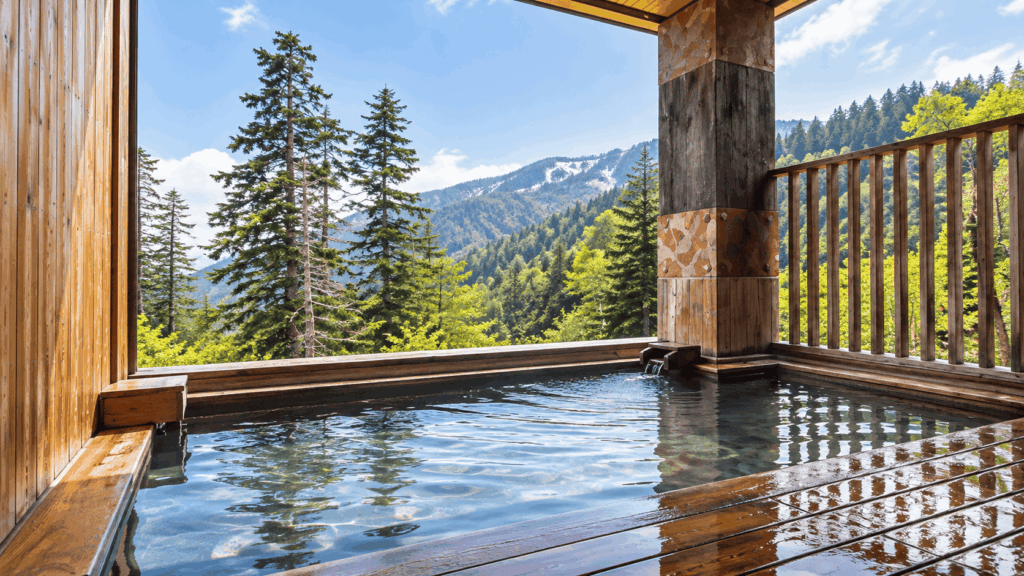
One thing to settle before anything else: the Tokachidake area has been affected by volcanic activity through autumn 2026, and Fukiage Onsen is currently closed. Details and current status are covered below, but do not plan around a mountain onsen without checking the latest official information first.
Quick Verdict: The Best Furano Onsen Depends on What You Want
- Cheapest, easiest day-use bath near Furano town: Highland Furano — around ¥650, about 14 minutes by car from Furano Station, open from early morning until late.
- Staying at Furano Ski Resort or skiing: Shisai no Yu, inside the Shin Furano Prince Hotel. The most expensive day-use option, and the most convenient.
- Want a lot of different baths: Furano La Terre in Nakafurano, with 15 bath types across two large bathing areas.
- Want a proper mountain onsen and will drive for it: Hakuginso in the Fukiage hot spring area, roughly 40–50 minutes from Furano.
- Want the raw, free, outdoor hot spring experience: Fukiage Onsen — currently closed, mixed-gender, no changing room. Read the section below before deciding.
- Want mountain views and would rather sleep there than drive back: Ryounkaku or Kamihoroso at Tokachidake Onsen.
What all of these have in common is a trade-off. Every onsen on this list asks you to give something up — money, time, privacy, comfort, or driving confidence on a mountain road. The comparison below is built around those trade-offs rather than a ranking, because a ranking that puts one bathhouse first for everyone is not useful when the alternatives are this different.
If you are still deciding between a day trip and staying somewhere with a bath, it is worth comparing onsen hotels in Furano before locking in a plan built around driving back in the dark.
Furano Onsen at a Glance
Prices are per adult for day use. Everything here was checked in October 2026; onsen prices and opening hours in this area change more often than you would expect, and the status column in particular can move quickly.
| Onsen | Best for | Area | Day use | Adult price | Outdoor bath | Car needed? | Status (Oct 2026) |
|---|---|---|---|---|---|---|---|
| Highland Furano | Easy, affordable day use near town | Furano (Shimanoshita) | 6:00–23:00 (last entry 22:00) | Around ¥650 | Yes — compact | Recommended | Open; closed for maintenance in November 2026 |
| Shisai no Yu | Ski resort convenience | Shin Furano Prince Hotel | 13:00–23:30 (last entry) | ¥1,700 | Yes | No if staying at the hotel | Open; maintenance closures possible |
| Furano La Terre | Bath variety | Nakafurano | 10:00–22:00 (last entry 21:00) | Around ¥1,000 | Yes | Recommended | Open; some baths suspended for maintenance |
| Hakuginso | Mountain onsen experience | Fukiage, Kamifurano side | 10:00–22:00 (last entry 21:00) | ¥700 | Yes | Effectively yes | Closed until 31 Oct; reopening planned 1 Nov 2026 |
| Fukiage Onsen | Raw outdoor hot spring | Fukiage, Kamifurano side | 24 hours in normal operation | Free | Yes — the entire bath | Yes | Closed; reopening date not announced |
| Ryounkaku | Mountain setting plus a proper stay | Tokachidake Onsen | 8:00–19:00 (last entry 18:30) | ¥1,000 | Yes | Yes | Open (irregular closing days) |
| Kamihoroso | High-altitude views | Tokachidake Onsen | 10:00–15:00 (last entry 14:00) | ¥1,000 | Yes | Yes | Open |
Two rows deserve a second look before you read further. Highland Furano closes the entire building for maintenance each November, which catches out travellers who arrive in early November expecting a soak. Hakuginso has been closed since September 2026 and is scheduled to reopen on 1 November — a plan announced by the facility, not a confirmed reopening. Neither is the kind of thing you want to discover at the car park.
Which Furano Onsen Fits Your Trip?
Distances in this area are deceptive. A place can look close on a map and still take 45 minutes because the road climbs and narrows. Use driving time, not kilometres, when you compare.
| If this sounds like you | Choose |
|---|---|
| You want a cheap bath without planning your day around it | Highland Furano |
| You are skiing at Furano Ski Resort and want to walk to the bath | Shisai no Yu |
| You want several different baths and a proper sauna | Furano La Terre |
| You are willing to drive 45 minutes for a mountain setting | Hakuginso |
| You want the free, natural, mixed outdoor bath experience | Fukiage Onsen — only once it reopens |
| You have never used a Japanese onsen before | Shisai no Yu or Furano La Terre |
| Mixed bathing is a dealbreaker | Avoid Fukiage; choose any of the others |
| You are not comfortable driving a mountain road in winter | Stay in the Furano or Nakafurano area; skip Tokachidake |
| You do not have a car | Shisai no Yu or Furano La Terre |
Highland Furano – Best for an Easy, Affordable Day-Use Onsen
Highland Furano sits in woodland at Shimanoshita, about 14 minutes by car from Furano Station, with around 250 free parking spaces. Day use runs from 6:00 to 23:00, with the last entry at 22:00, and costs around ¥650 for adults — ¥550 if you arrive between 6:00 and 8:00. There is a large indoor bathing area, a small outdoor bath, a sauna and a jacuzzi, and the spring is a weak alkaline cold mineral spring, clear and colourless.
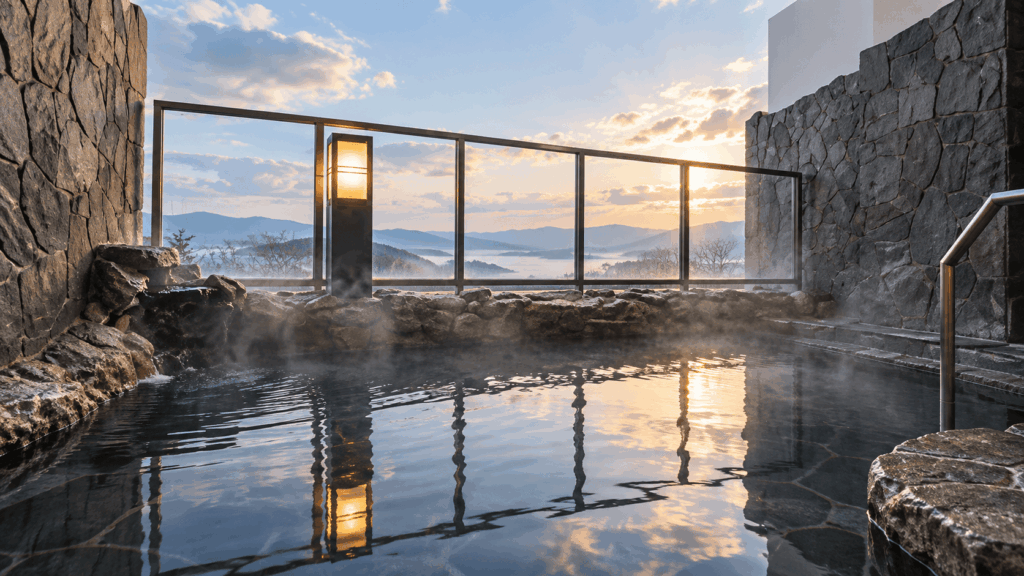
The mistake I see people make with this place is arriving with resort expectations. It is not a luxury onsen hotel and it does not try to be. What it is, is a practical, local-feeling bathhouse surrounded by forest, priced so that you can use it more than once during a stay.
What the Outdoor and Indoor Baths Are Actually Like
The outdoor bath is the part that surprises people, and not always in the way they hoped. During my stay it felt genuinely compact — with four adults in it, the distance between people stopped feeling like space. Official photographs frame it well, but they do not tell you how quickly it fills.
The indoor bath is the opposite. It felt considerably roomier than the outdoor one, with a hotter bath and a milder bath side by side, and the milder one was the better choice for a long soak. If your idea of a good onsen is lying in an outdoor bath watching the landscape for half an hour, this is not the place for that. If your idea is a long, quiet soak in hot water after a day of driving, the indoor bath does the job well.
Small Details That May Matter More Than You Expect
The building shows its age. What it does not feel is neglected — the cleaning was clearly being kept up during my visit, and the changing area and washing stations were in good condition. The showers are the push-button type that cut out after a short interval, which is awkward if you are washing long hair and have to keep pressing the button with soap in your eyes.
Kai’s tip: The outdoor bath is small enough that timing changes the experience far more than at a large resort bath. When it is empty, the forest setting does most of the work; when a few regulars are already in, the same bath feels noticeably tighter. If the outdoor bath is the main reason you are coming, go on a weekday and aim for the morning slot rather than the evening, when local users tend to arrive after work.
The guest-room Wi-Fi was poor during my stay — weak enough that I moved to a shared space to get a usable connection. Other guests have reported similar issues, though it is the kind of thing that varies by room and by period, so treat it as a reason to have a backup plan rather than a fixed feature of the hotel.
The Forest Location Is Part of the Experience
Highland Furano is not in the middle of town, and the approach road makes that obvious. On the drive in I saw a fox cross ahead of the car, and the next morning there was a deer visible near the outdoor bath. That is one visit’s experience, not a promise — wildlife around here is unpredictable and you should not book a room expecting a nature documentary. But the setting is real, and it is the main thing this place offers that a town-centre bathhouse cannot.
If you are weighing up whether to stay here rather than just visit, the honest summary is that Highland Furano rewards people who want nature and value more than polish. Anyone expecting a dramatic open-air bath should look at the Tokachidake options instead.
Shisai no Yu – Best for Ski Resort Convenience
Shisai no Yu is inside the Shin Furano Prince Hotel, which makes it the default choice for anyone staying at the resort or skiing at Furano Ski Resort. Day use runs from 13:00, with the last reception at 23:30, and costs ¥1,700 for adults — by some distance the most expensive day-use bath on this list. In July and August the day-use window shortens to 13:00–18:00.
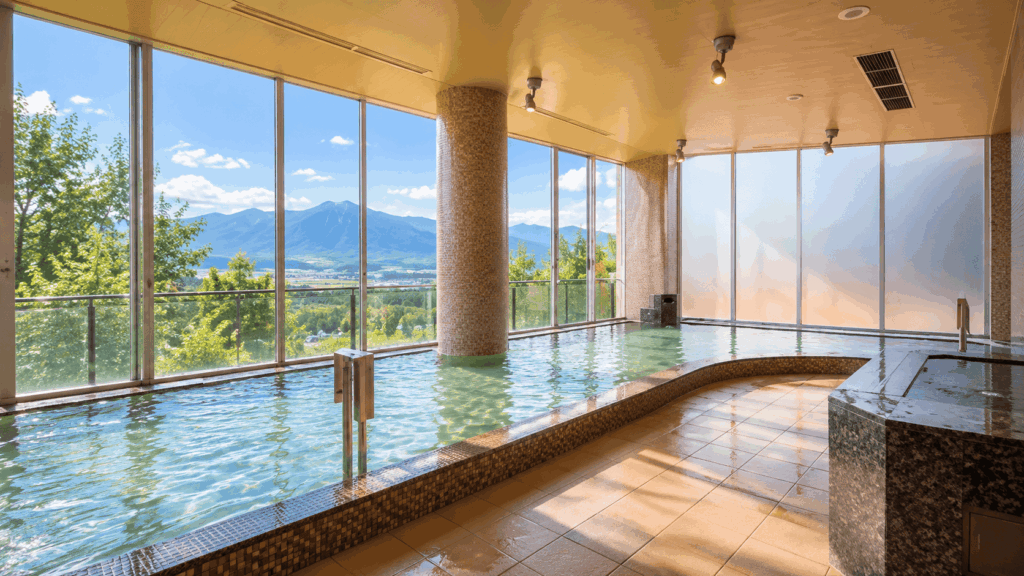
What that money buys is a well-kept facility with an indoor bath featuring jet functions, an outdoor bath, a Finnish-style sauna built with old pine, a cold plunge, and a lounge with large windows. Towels are handed over at the onsen reception, and shampoo, conditioner and body soap are provided in the bathing area, so you can turn up without a bag.
Hotel guests pay around ¥800 and can also use the bath in the morning from 5:30 to 9:30, which is the detail that matters most if you are skiing. Being able to walk down from your room before breakfast, or after a day on the slopes, is worth more than the price difference suggests.
Two practical notes. The hotel states that guests with tattoos may face some restrictions, so if that applies to you, ask before you pay rather than after. And this is a large hotel with a comparatively modest bathing area, so peak periods can feel busy — the repeated complaint in reviews is not quality but crowding at the busiest times of day.
If the onsen matters to you mainly as a comfortable end to a ski day, this is the simplest option in Furano. If you are chasing scenery or a sense of place, the ¥1,700 is better spent elsewhere.
Furano La Terre – Best if You Want More Bath Variety
Furano La Terre is in Nakafurano, about 15 minutes from central Furano along Route 237 and around a five-minute walk from JR Nishinaka Station — which makes it one of the few proper onsen in the area you can reach on foot from a train. Day use runs from 10:00 to 22:00 with the last entry at 21:00, and costs around ¥1,000 for adults, including towel and bath towel rental. There is parking for around 300 cars.

The draw here is choice. The Japanese-style and Western-style bathing areas together hold 15 bath types, and the two sides alternate between men and women daily, so a single visit only shows you half of them. There is a sauna, a cold bath, and a mix of jet and bubble baths alongside the actual hot spring water. If you are travelling with children, or with someone who gets bored of sitting in one bath, this is the most forgiving option on the list.
Two caveats. Some of the baths have been suspended for equipment maintenance, so the advertised 15 is not what you will necessarily find on the day. And this is a spa resort rather than a mountain onsen — the setting is convenient and comfortable, not atmospheric. Reviews tend to agree on both points: people value the variety and the included towels, and nobody describes it as a place with a sense of place.
Hakuginso – Best for a Proper Mountain Onsen Experience
Hakuginso sits at Fukiage in the mountains above Kamifurano, about 20 minutes by car from Kamifurano Station and roughly 40–50 minutes from Furano. Day use normally runs from 10:00 to 22:00 with the last entry at 21:00, and costs ¥700 for adults. Inside there are hinoki and rock-lined indoor baths, an outdoor bath, and a sauna where löyly is possible — the combination that makes people drive up here instead of using a town bath.
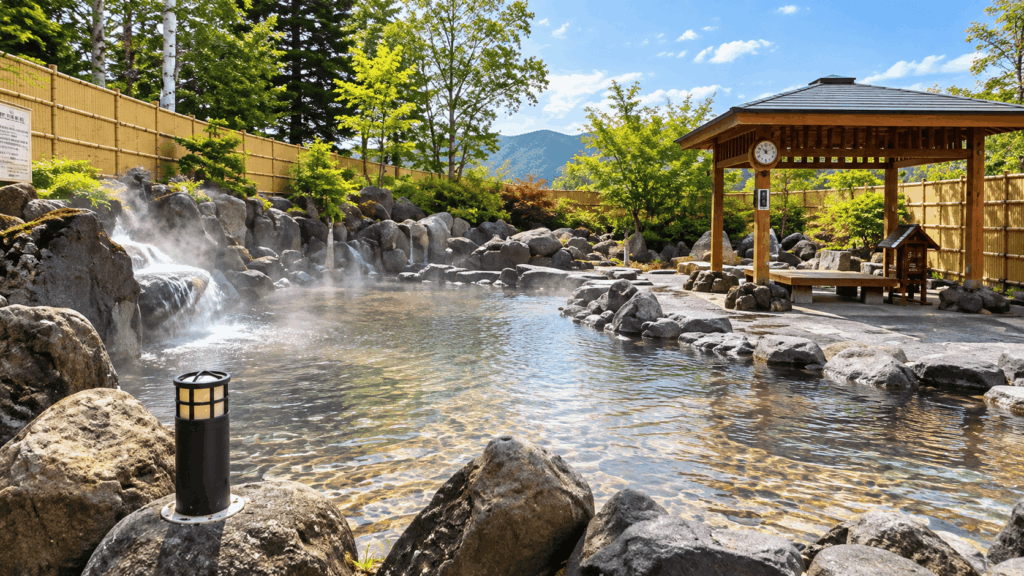
This is the onsen to choose if the bath is the reason for the drive rather than a stop on the way somewhere else. The setting is genuinely mountainous, the water is an acidic calcium-sodium sulphate chloride spring, and the outdoor bath is the centrepiece rather than an afterthought. Parking for around 100 cars is free.
The current situation matters more than usual here. Hakuginso has been closed since September 2026 because of volcanic activity at Tokachidake, and the facility announced on 19 October that it plans to reopen on 1 November. That is a plan, not a confirmed reopening. If your trip falls anywhere near that date, confirm directly with the facility before building a day around it.
Two things travellers get wrong. First, the accommodation here is self-catering — this is not a ryokan with dinner and breakfast, and booking it expecting a hotel stay will not work out. Second, the repeated complaint in reviews is crowding at weekends and after hiking parties come down, along with concern about the winter drive. Both are worth taking seriously: this is a small facility at the end of a mountain road.
Fukiage Onsen – Amazing for the Right Traveler, a Bad Choice for the Wrong One
Fukiage Onsen — the open-air bath usually written up as Fukiage Roten no Yu — is the reason many people search for hot springs near Furano in the first place. In normal operation it is free, open 24 hours, and completely open to the sky. It is also mixed-gender, has no changing room, and is a five-minute walk from Hakuginso.
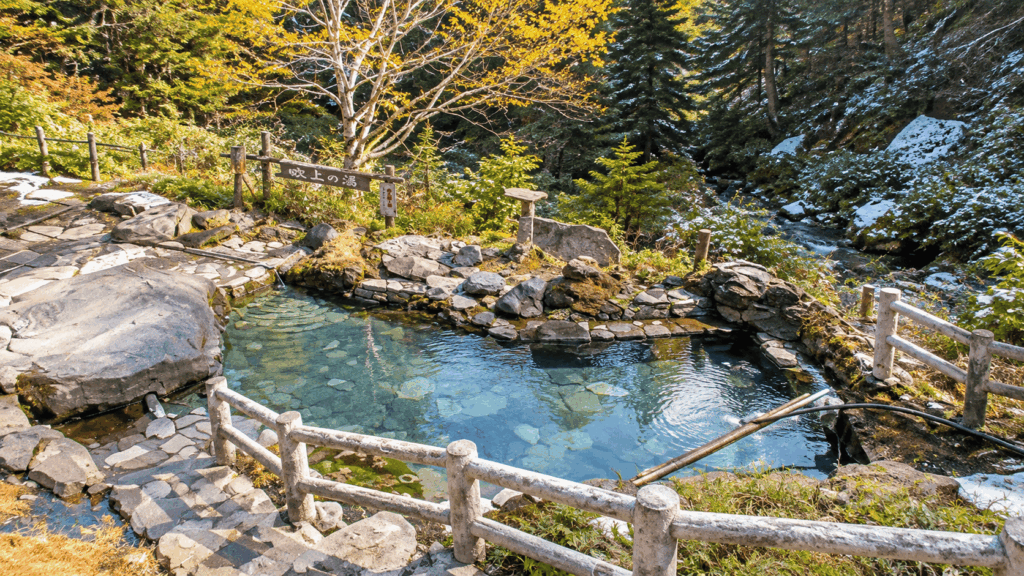
That combination is either the best thing you will do in Hokkaido or a wasted drive, depending entirely on what you expected. This section is written so you can tell which one you are.
What “”Wild Onsen”” Actually Means Here
There is no building. There is no reception, no lockers, no shower, no mirror, no place to leave a bag except the ground beside the bath. Women are advised by the local tourism association to wear a swimsuit or wrap a towel, and the practical version of that advice is to arrive already wearing the swimsuit under your clothes — changing on site means changing in the open.
Bring one small bag, a towel to dry off with, and a plastic bag for anything wet. Leave the rest in the car. The path from the parking area is unpaved and can be slippery, so shoes matter more than they would at a normal bathhouse.
What you get in return is a genuinely natural hot spring at 47°C, fed directly from the source with no added water and no heating, in a setting that no commercial facility in this area can reproduce. The water is an acidic sodium-calcium chloride spring. If that trade — no privacy, no facilities, real hot spring — sounds acceptable, this is a memorable place. If any part of it sounds like a problem, it is a long drive for a bath you will not enjoy.
Check the Current Status Before You Drive There
As of October 2026, Fukiage Onsen is closed. It was shut on 12 September 2026 when the volcanic alert level for Tokachidake was raised to 3. The level was lowered to 2 on 16 October, but the Kamifurano Tokachidake Tourism Association has continued to list the bath as temporarily closed with no reopening date announced. The alert level coming down and the bath reopening are two separate decisions, and only one of them has happened.
There is a second detail that catches people out: the local town bus is running, but as of mid-October it was not stopping at the Fukiage Onsen or Hakuginso stops. Even once the bath reopens, the bus stop situation needs checking separately.
Kai’s tip: Treat “”free and open 24 hours”” as information about normal operation, not about today. When a facility like this closes for volcanic activity or snow, the websites that rank for it often keep describing the version that existed before. A single phone call to the facility or the local tourism association settles it faster than any search result, and it is worth making that call before committing to the drive up from Furano.
If Fukiage is closed during your trip — as it is in late October 2026 — Ryounkaku and Kamihoroso at Tokachidake Onsen are alternatives for day-use bathing, subject to their opening hours and road conditions. Hakuginso is nearby, but it remains closed through 31 October, with reopening planned for 1 November 2026 rather than confirmed. Check its latest official notice before treating it as an option. These baths are not the same wild onsen experience, but they offer outdoor bathing in the same mountain landscape.
Ryounkaku and Kamihoroso – Better if Mountain Views Matter More Than Convenience
At Tokachidake Onsen, roughly 45 minutes by car from Furano, two traditional lodges accept day visitors. Ryounkaku runs day use from 8:00 to 19:00 with the last entry at 18:30, charges ¥1,000 for adults, and has indoor baths drawing on two different spring types, plus an outdoor bath with views over the Tokachidake range — the women’s outdoor bath is cave-style. It closes on irregular days, so check before setting out. Kamihoroso has a shorter day-use window — 10:00 to 15:00, last entry 14:00 — at the same ¥1,000, and sits at around 1,280 metres.
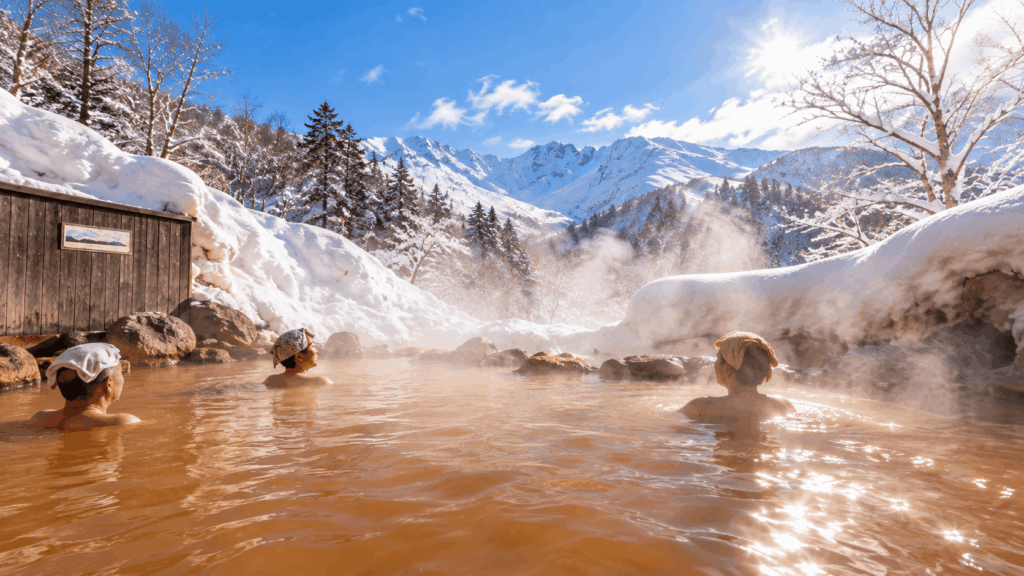
If Ryounkaku is your choice for a day-use soak, you can check the current admission ticket details and booking options on Klook before heading up the mountain. Confirm the facility’s opening status and road conditions separately.
Both are at the top of a mountain road, and both are better as places to stay than places to visit. A day trip means roughly 90 minutes of driving for an hour in the bath. Staying means you get the evening and the early morning, when the baths are quiet and the mountain light is the reason people come up here at all. Reviews of this area consistently rate the scenery very highly and treat the distance as the cost of it.
If the mountain onsen is the point of the trip, staying overnight near Tokachidake rather than driving back down to Furano in the evening is the more relaxed option — and it is worth comparing onsen stays near Tokachidake before you commit to a day-trip plan.
Do You Need a Car for Furano Onsen?
No, but the options shrink considerably without one, and the ones that remain are all on the Furano and Nakafurano side. If you are still figuring out your main transport route, check our comparison of the best ways to travel from Sapporo to Furano.
Shisai no Yu is inside a hotel on the ski resort, so if you are staying there you can walk to it. Furano La Terre is about a five-minute walk from JR Nishinaka Station on the Furano Line, which makes it the most realistic car-free day-use onsen in the area. Highland Furano is 14 minutes by car from Furano Station and has no practical public transport link — a taxi is the realistic option, and worth booking for the return as well.
For the Tokachidake side, there is a town bus from Kamifurano Station up to the Tokachidake Onsen area, taking around 40 minutes and costing roughly ¥500. It runs only a few times a day. That is not zero public transport, but it is not a service you can treat casually either: you are planning your bath around the return departure, not the other way around.
Kai’s tip: The harder half of a day-use onsen trip is usually the drive back, not the drive out. In winter it is dark by late afternoon, the mountain roads have few streetlights, and snow that was not falling on the way up may be falling on the way down. Work backwards from sunset when you pick your entry time, and give yourself a fixed cutoff for leaving the bath rather than deciding in the changing room.
Winter Driving Changes the Recommendation
In summer, the Tokachidake options are a scenic 45-minute drive. In winter, they are a decision about your driving experience. The final stretch up to Ryounkaku is a steep five-kilometre climb, and the facility itself advises four-wheel drive and winter tyres. That is advice from the people who drive it every day, not a generic warning. For a broader look at navigating the snowy season, see our guide to Furano in winter.
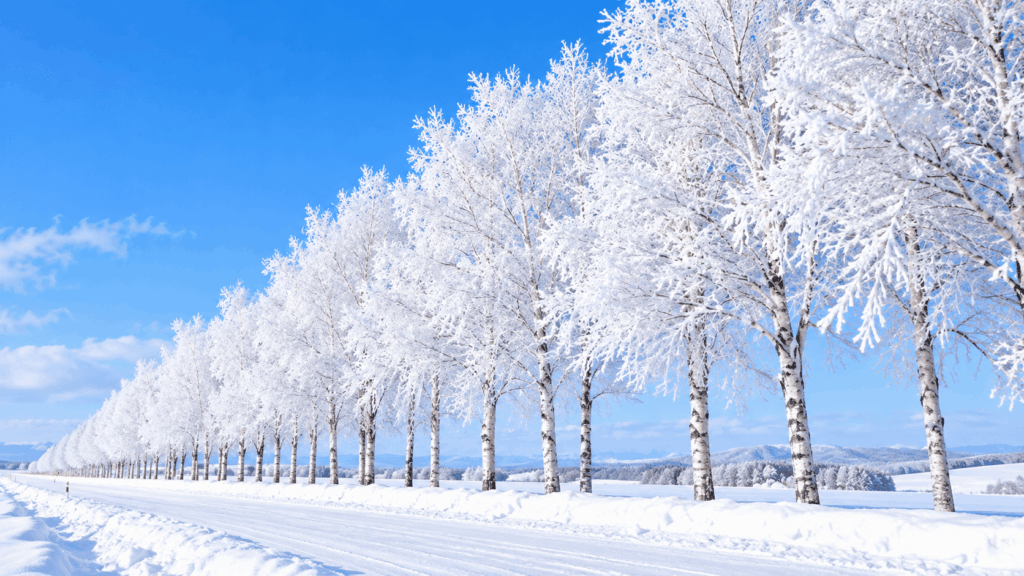
There is also a road closure to know about. The Route 966 connection between the Shirogane gate and the Bogakudai gate, which links the Biei and Shirogane side to this area, closed for the winter on 19 October 2026. In practice that means you approach from the Kamifurano side via Route 291, and you cannot cut through from Biei or Shirogane Onsen. Navigation apps are not always quick to reflect this.
The honest recommendation for winter: if you are not confident on snow and ice, stay on the Furano and Nakafurano side and use Highland Furano, Shisai no Yu or Furano La Terre. The mountain onsen is not worth a rented car with all-season tyres on a road you are not comfortable on. If you have no car at all and want to see the Furano and Biei landscape, a guided day tour is a more sensible use of a day than trying to chain together infrequent buses — just be aware that these tours are sightseeing, not onsen trips, and a hot spring visit is not part of the standard itinerary.
For travelers starting from Asahikawa who want to explore Furano and Biei without driving, a private guided day trip offers a different solution. It is best suited to those who want to enjoy the wider landscape with local context rather than spend the day coordinating rural transport. This is a sightseeing experience, not an onsen tour, and a hot spring visit is not included in the standard itinerary.
Why I’d book this one
- Helpful English-speaking guidance: Recent travelers mention the guide’s local knowledge, communication and willingness to accommodate their interests, although the number of reviews is still limited.
- Less transport planning: A private car and a flexible itinerary make it easier to explore places around Furano and Biei without relying on infrequent buses or driving unfamiliar roads.
- Check the details before committing: The booking page lets you review available dates, pickup arrangements, cancellation conditions and recent traveler feedback before deciding whether the experience fits your plans.
Common Mistakes That Ruin a Furano Onsen Trip
- Judging distance in kilometres. Tokachidake Onsen is not far from Furano on a map, but the road climbs, narrows and slows you down. Plan in driving time.
- Assuming Fukiage Onsen is open. It has been closed since September 2026 with no reopening date announced. Check before you drive.
- Arriving in Furano in early November without checking Highland Furano’s maintenance closure. The whole building shuts for part of November each year.
- Booking Hakuginso expecting a full-service ryokan. The lodging is self-catering.
- Turning up at Fukiage without knowing it is mixed-gender with no changing room. This is the single most common reason people leave disappointed rather than delighted.
- Planning the outward journey and not the return. Especially on the Tokachidake bus, and especially in winter.
Frequently Asked Questions
What is the best onsen in Furano for a day trip?
For most travellers based in Furano town, Highland Furano is the most practical day-use onsen: it is about 14 minutes by car from Furano Station, costs around ¥650, and stays open from early morning until late. If you want variety rather than convenience, Furano La Terre in Nakafurano has 15 bath types and is a five-minute walk from JR Nishinaka Station. If you are skiing, Shisai no Yu inside the Shin Furano Prince Hotel is the easiest option, though at ¥1,700 it is the most expensive on this list.
Can you visit a Furano onsen without staying overnight?
Yes — in normal operation, every onsen covered here accepts day visitors without requiring an overnight hotel booking. However, as of late October 2026, Fukiage Onsen remains closed, and Hakuginso is closed through 31 October, with reopening planned for 1 November but not yet confirmed. Day-use hours differ among the other options: Highland Furano and Furano La Terre stay open into the evening, while Kamihoroso closes its day-use reception at 14:00 and Ryounkaku at 18:30. Always check the current operating status before setting out.
Is Fukiage Onsen mixed-gender?
Yes. There are no separate men’s and women’s baths and no women-only hours. There is also no changing room, so the local tourism association advises women to wear a swimsuit or wrap a towel, and the practical approach is to arrive already wearing the swimsuit under your clothes. If mixed bathing is not something you are comfortable with, the other onsen on this list all have gender-separated bathing areas.
Do you need a car to visit onsen near Furano?
Not for all of them. Furano La Terre is walkable from JR Nishinaka Station, and Shisai no Yu is inside a hotel on the ski resort. Highland Furano has no useful public transport link, so a taxi from Furano Station is the realistic option. For the Tokachidake area there is a town bus from Kamifurano Station, but it runs only a few times a day, so you plan around the return departure rather than the other way round.
Is Fukiage Onsen currently open?
No. It closed on 12 September 2026 when the volcanic alert level for Tokachidake was raised, and although the level was lowered on 16 October, the facility has remained closed with no reopening date announced as of late October 2026. Check with the Kamifurano Tokachidake Tourism Association or the facility directly before planning a visit — the alert level and the bath’s opening status are decided separately.
Final Verdict: Which Onsen Should You Choose?
There is no single best onsen in Furano, and any article that names one for everybody is guessing at your trip rather than answering your question. What follows is the version I would give a friend, sorted by the trip they are actually taking.
- If you are staying in Furano and want one easy bath: Highland Furano. Around ¥650, 14 minutes from the station, open until 23:00. Accept that the outdoor bath is small and the building is dated, and you will be satisfied.
- If you are skiing at Furano Ski Resort: Shisai no Yu. Walking from your room to a Finnish sauna after a day on the slopes is worth the ¥1,700, and hotel guests pay around ¥800.
- If you are travelling with family or want options: Furano La Terre. Fifteen bath types, towels included, and a five-minute walk from a train station make it the least stressful choice with children.
- If the onsen is the reason for the day: Hakuginso. A 40–50 minute drive, ¥700, a proper mountain setting and a löyly sauna — but confirm the reopening, because it is planned for 1 November 2026 and not yet confirmed.
- If you want the raw experience and know what you are getting into: Fukiage Onsen, once it reopens. Free, mixed-gender, no changing room, genuinely wild. Not a substitute for a bathhouse and not a place to take someone who has not agreed to the terms.
- If you would rather sleep at the onsen than drive back from it: Ryounkaku or Kamihoroso at Tokachidake Onsen. Around 45 minutes from Furano, ¥1,000 for day use, and considerably better as an overnight than as a round trip.
- If you have no car: Furano La Terre or Shisai no Yu. Do not build a Tokachidake plan around a bus that runs a few times a day.
- If you are visiting in winter and are not confident on snow: stay on the Furano side. The mountain onsen will still be there on a future trip.
For a first visit to the area, Highland Furano is the low-risk answer and the one most people will be happy with. For a repeat visit, or a trip where the hot spring is the point rather than the reward, the drive up to Tokachidake is what makes Furano’s onsen scene different from anywhere else in Hokkaido — as long as you check what is actually open before you go.
Hi, I’m Kai. I’m a Tokyo-based travel writer, tourism industry insider, and the author of a published guidebook for international visitors to Japan. With over 10 years of professional experience at a leading Japanese tourism company, my mission is to help you skip the tourist traps and navigate Japan’s best destinations like a local. I believe the perfect day trip is like a traditional kaiseki meal: a beautiful balance of precise planning and unforgettable seasonal discovery. When I’m not out conducting field research, you’ll usually find me drafting new itineraries with one of my favorite fountain pens!