
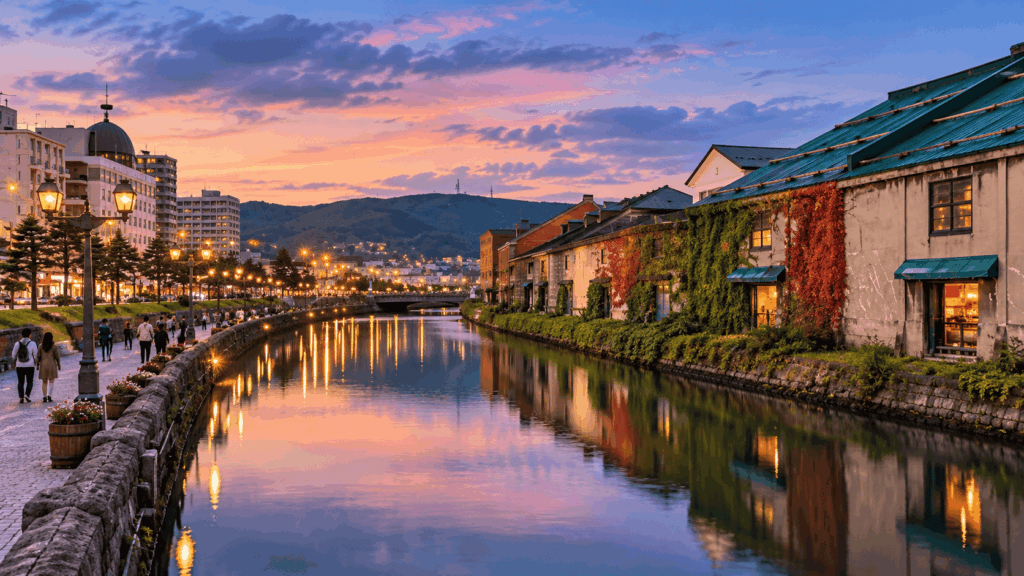
If you only have time for one Otaru Canal cruise, take the departure that leaves shortly before sunset. You spend the first half of the trip seeing the stone warehouses in daylight, then watch the gas lamps and the warehouse lights take over the water before the boat comes back to the jetty. That is the version most first-time visitors remember.
It is worth being precise about what that is, and what it is not. Otaru Canal Cruise publishes a day timetable and a night timetable — there is no separate “sunset cruise” on the schedule — and 40 minutes on a narrow, warehouse-lined canal is a different experience from an open-sea sunset trip. This guide compares the three realistic choices (daylight, the pre-sunset window, and full night), then covers prices, booking pressure, winter conditions and what happens when the weather turns.
Planning a full Otaru day from Sapporo? If you would rather explore the canal district and historic streets with an English-speaking local guide, a private Otaru day trip is worth comparing. The canal boat ticket is not included, so this is for a broader guided visit rather than a cruise-only booking. See the private Otaru day trip itinerary, availability, and traveler reviews.
Which Otaru Canal Cruise Time Is Best?
The short answer: for a first visit, aim for a departure that starts in daylight and finishes after the lamps come on. The exact time depends on the date, because sunset in Otaru moves from around 16:00 in early December to around 19:20 in late June. Everything else is a trade-off between detail, warmth, atmosphere and how tightly your day is scheduled.
- Day (departures from 10:00 to 16:30, as of October 2026): best for seeing the warehouses clearly, taking easy photos, and keeping your schedule flexible.
- Magic hour (the last daylight departure or two): best overall for first-timers, because you get both versions in one 40-minute loop.
- Night (17:00 to 19:00 departures in autumn): best for reflections and atmosphere, but colder and much harder for building detail.
| Cruise | Best for | Main advantage | Main drawback | Photography | Booking pressure | My pick |
|---|---|---|---|---|---|---|
| Day | Architecture, families, tight itineraries | Warehouse texture and canal detail are easiest to see | No lamps, no reflections; flat light around midday | Easiest exposure; good for detail and colour | Lowest, though weekends and holidays still fill up | If you came for the buildings, not the mood |
| Magic hour | First-time visitors, couples, one-shot trips | Daylight and lit lamps in a single loop | The window is short and moves with the sunset | Most varied, but the hardest to expose correctly | Highest — these are the departures that sell out | Best overall for a first visit |
| Night | Atmosphere, reflections, repeat visitors | Full illumination and a quieter feel on the water | Cold; building detail disappears into black | Reflections and lamp glow; no tripods, high ISO | High on weekends, holidays and event periods | If you have been before, or only want the mood |
Prices, departure times and lighting hours in this guide were checked in October 2026. They change with the season, so confirm your date on the official timetable before you plan around a specific departure.
Day Cruise: Best for Clear Views and a Flexible Schedule
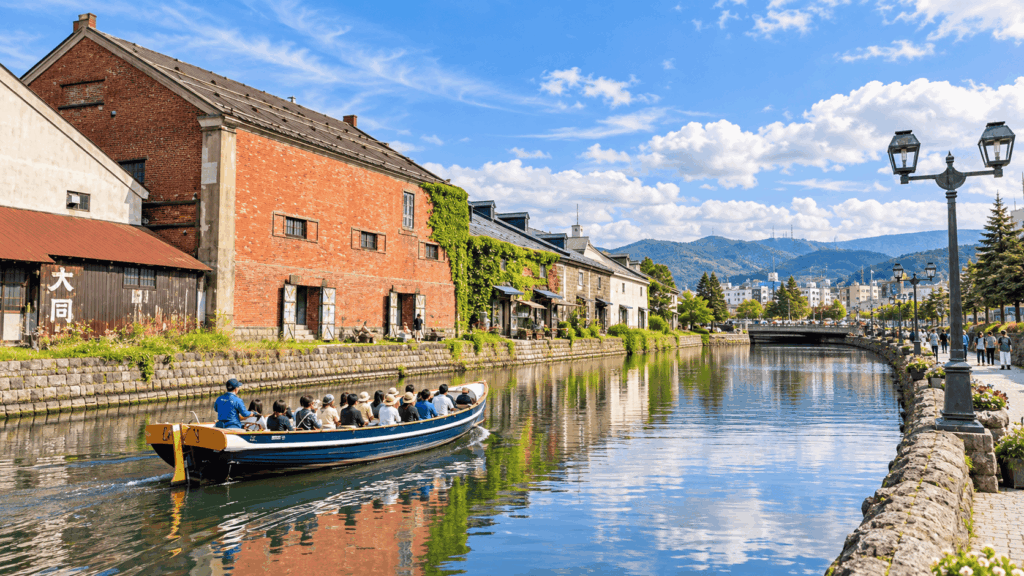
The daytime cruises are not the budget version of the night ones — they are simply a different subject. Between roughly 10:00 and 16:30 the boat runs every 30 minutes, which makes the day cruise the easiest thing to slot into an Otaru day trip: you can walk Sakaimachi Street first, eat, then take whatever departure is next. In clear weather you can actually read the canal — the mortar between the stones, the loading doors on the warehouses, the way the water widens as you reach the North Canal.
Midday is the least flattering light of the day, and in summer the sun can be directly overhead and harsh on the water. If you are shooting, the departures after about 15:00 give you softer, angled light on the warehouse facades even before the lamps come on. If you are travelling with children, or you have a train to catch, this is also the least risky choice: more departures means more room to absorb a delay.
Magic Hour: Best Overall for First-Time Visitors
This is the option I would choose for almost anyone on their first visit to Otaru.
The reason is not that the sunset is spectacular. It is that the canal changes character inside a single 40-minute loop. You leave in usable daylight, pass the stone warehouses with their detail still visible, reach the harbour side, and come back into a canal where the gas lamps have switched on and the warehouse lighting has started to reflect off the water. You get the before and the after without paying for two cruises or standing on the promenade for an hour in between.
What you have to do is work backwards from the sunset rather than pick a round number. Sunset in Otaru is around 16:40 in late October, around 16:00 in early December and around 19:20 in late June, and the timetable shifts with it: the last daylight departure is not a fixed time across the year. Look up the sunset time for your date, then choose the departure that leaves 20 to 40 minutes before it. In late October, that usually means the 16:00 or 16:30 sailing; in midsummer it will be much later in the evening, and the summer timetable runs later accordingly.
Kai’s tip: When I take first-time visitors, I aim for the last daylight departure rather than the middle of the afternoon or full dark. What catches people out is how fast the canal flips: the warehouses are still legible for the first ten minutes, and by the time you come back past the Chuo Bridge the lamps are doing most of the work. If you can only take one cruise, take the one that ends in the dark.
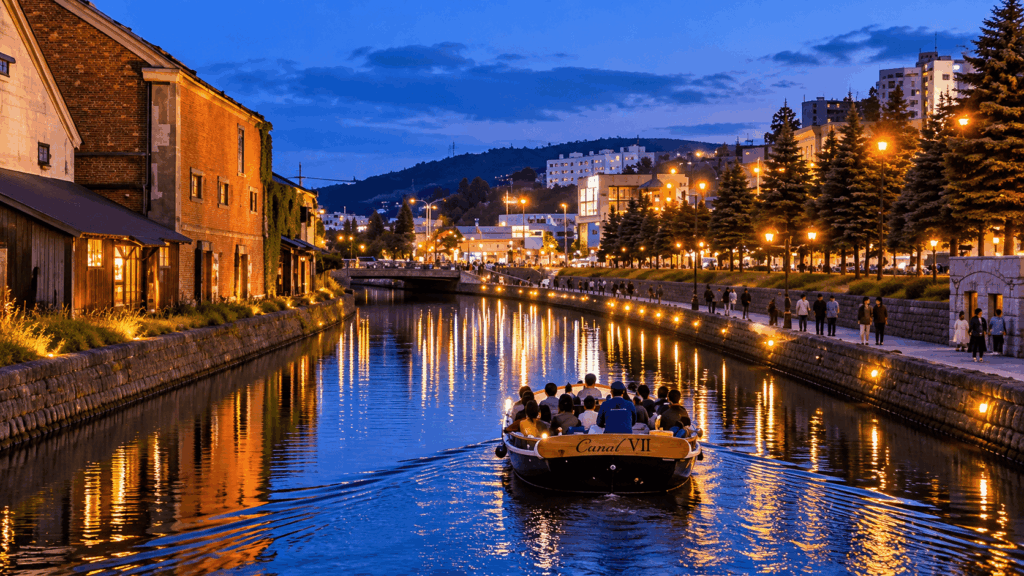
Two caveats before you build your day around this. The window is narrow and popular, so it is also the departure most likely to be full on a weekend or holiday. And the light is genuinely difficult: the sky stays bright while the canal goes dark, so phone cameras tend to expose for the sky and lose the lamps. Lock exposure on the warehouses and accept a slightly blown sky, or you will end up with 30 photos of a grey rectangle.
Night Cruise: Best for Reflections and Atmosphere
Once it is properly dark, the canal becomes a different place. The lamps and the warehouse lighting are still on during these sailings, so even a late departure has something to look at. From water level the reflections stretch further than they do from the footpath, and the boat is quiet enough that you can hear the water against the hull.
What you give up is information. After dark you are looking at silhouettes and light, not architecture: the loading doors, the stonework and the signs on the warehouses are essentially gone. If you are visiting Otaru specifically for its Meiji and Taisho-era buildings, a night cruise will show you the mood but not the buildings. It is also the coldest option by a wide margin, because you are sitting still on water after the sun has gone.
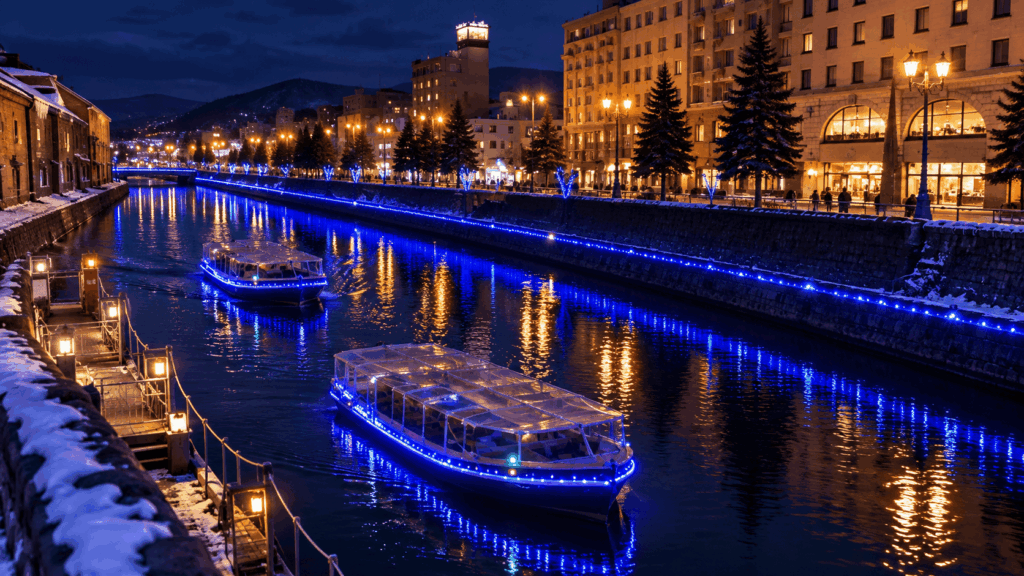
Night cruises start at 17:00 in late October, which is already after sunset, and run to 19:00 — but again, these times move with the season, and winter schedules are shorter. If the whole point of your trip is the lit canal and you do not care about daylight, take the earliest night departure you can: you get the illumination while there is still a trace of blue in the sky, and you are off the water before the temperature drops further.
What “Sunset” Really Means on the Otaru Canal
Search results and social posts often describe an Otaru canal “sunset cruise”, and it is easy to book one expecting the sun to sink into the sea in front of the boat. That expectation is worth correcting before you choose a departure.
The official timetable does not sell a sunset product. It sells day cruises and night cruises, with the boundary falling around sunset, and the boat’s route is a loop: out from the Chuo Bridge towards the Otaru Port side, back through the wider North Canal, then south along the main canal. The canal section is a narrow channel with stone warehouses on both banks, so your sightlines are short by design — it is not an open-horizon boat trip where the sun tracks across the bow for 40 minutes.
Depending on the date and where the boat is in the loop, you may well get warm colour on the water and on the warehouse walls. In autumn and winter the sun sets to the west-southwest, and in early summer it swings much further north, which changes which stretch of the route catches the light. But the reliable thing you are buying is the transition, not a guaranteed sun-on-the-horizon shot.
So treat “sunset cruise” as shorthand for “the departure that overlaps sunset” — and choose it for the light changing on the buildings and the lamps coming on, which happens whatever the cloud cover is doing.
What Actually Happens in the 40 Minutes
The boat leaves from the jetty beside the Chuo Bridge, which is about a 10-minute walk from JR Otaru Station down Chuo-dori. You are asked to assemble 15 minutes before departure, which sounds like padding until you see the boarding process: life jackets are compulsory, seats are assigned by the captain rather than chosen, and everyone files on from the front of the boat.
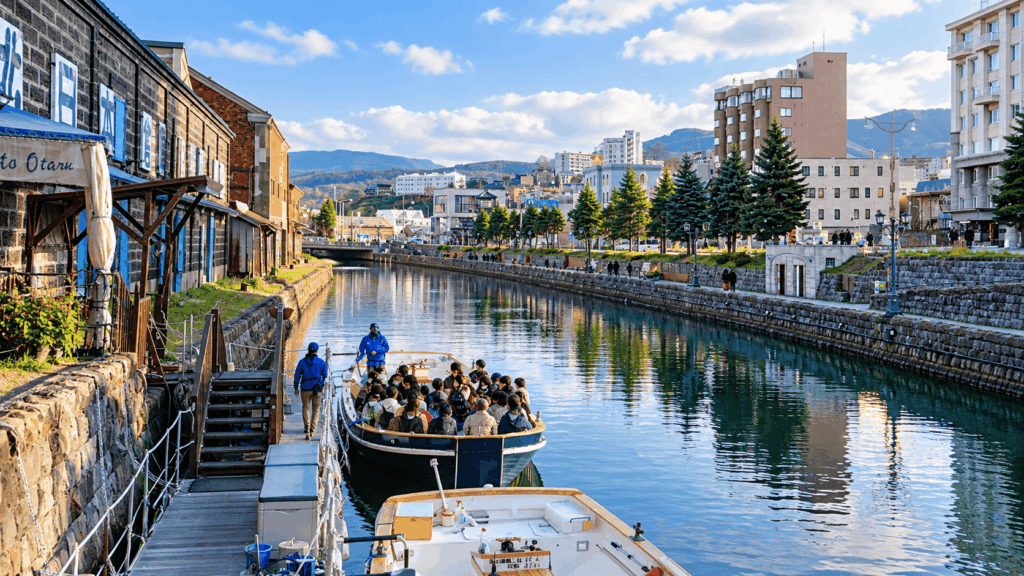
Once you are away, the route is a loop rather than a straight out-and-back. The boat heads from the canal towards the Otaru Port side, turns back through the wider North Canal, then runs south along the main canal towards the Asakusa Bridge end before returning to the jetty. In poor sea conditions the harbour stretch can be dropped and the boat stays inside the canal — the price and the 40 minutes do not change, so it is worth knowing that before you board on a windy day.
The commentary is in Japanese, delivered live by the captain, with recorded audio guides in English, Chinese and Korean and free earphones at the ticket centre. The motion is gentle: this is a slow, stable boat on sheltered water, not a thrill ride, which makes it a reasonable option for people who normally worry about seasickness.
The Low Bridges Are More Memorable Than They Look
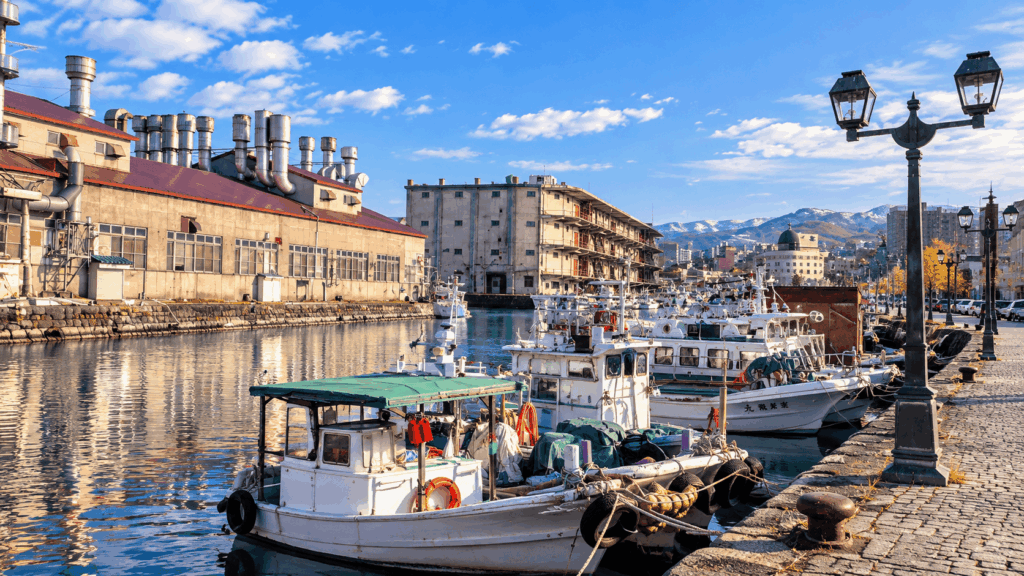
Nobody mentions the bridges when they describe this cruise, and they are the part most passengers react to. The canal is crossed by a series of road bridges, and the clearance underneath depends on the water level. On a high tide the underside of a bridge can come close enough that people instinctively duck, even though there is no danger and the captain is not remotely concerned. A few seconds later you are through and looking at a completely different bank.
It is a small thing, but it is exactly the kind of detail you cannot get from the promenade: from the footpath the bridges are just bridges, and from water level they are the frame you pass through.
You May Spot Herons and Gulls (But This Is Not a Wildlife Tour)
Grey herons stand motionless along the canal edges, and gulls work the harbour stretch. They are wild birds going about their day, not a scheduled attraction: on some sailings you will see several, on others almost none. Visitors occasionally ask whether the heron that has not moved for five minutes is real, which tells you something about how still they hold themselves.
Treat any birdlife as a bonus rather than a reason to book, and keep your expectations set to “working canal with wildlife in it” rather than “nature cruise”.
Tickets, Prices and Reservations
As of October 2026, the adult fare is ¥1,800 on day cruises and ¥2,000 on night cruises. Children aged 6 to 12 are ¥500, and preschool children are also ¥500, with one preschool child free per paying adult. The fare is the same whether or not the harbour section is included.
Online tickets go on sale 60 days before departure and can be bought up to one hour before sailing; the ticket counter next to the Chuo Bridge sells until 15 minutes before. E-tickets need to be shown on your phone — screenshots are not accepted. For changes to an online reservation, use the My Page link in your confirmation email up to one hour before departure; changing from a day cruise to a night cruise requires contacting the operator.
Do You Need to Book in Advance?
It depends entirely on whether you care which departure you take.
- If a specific departure matters — the pre-sunset sailing, a night cruise on a Saturday, anything during Golden Week or the New Year holidays — book online in advance. The operator itself says it is normally very busy at night, at weekends and on public holidays.
- If you are flexible — a weekday, a wide-open afternoon, no train to catch — same-day tickets are often available, and buying at the counter 15 minutes before is normal practice.
The useful detail is what happens when your preferred sailing shows as full: the operator says one to 30 additional seats can appear on the day because of cancellations and changes to which boat is used. There is no waiting list, so the practical move is to check the website again on the morning of your visit or ask at the counter, rather than assuming the trip is off.
Two Booking Details People Miss
Changes are easier before tickets are issued. If you booked online, the operator allows eligible reservation changes through the My Page link in your confirmation email until one hour before departure. Once a ticket has been issued or exchanged, customer-requested time changes and refunds are not accepted. If the operator cancels for weather, you get a refund — through the online payment system for web bookings, or at the counter that day if you paid there. The restrictions on customer-requested changes and refunds are intended to prevent resale, so book a departure you can realistically make.
There is more than one similarly named canal cruise in Otaru. The official Otaru Canal Cruise site carries a warning about a company offering a similar service under a similar name, and asks customers to confirm which operator they are booking with before paying or turning up. The ticket centre for Otaru Canal Cruise is the one next to the Chuo Bridge. Whichever boat you choose, check the operator name on your confirmation — this is the single most common way visitors end up at the wrong jetty.
Otaru Canal “Opening Hours” — What Is Open When
There is no opening time for the canal itself. The promenade is a public walkway, open year-round and free, and people are on it well before sunrise and after midnight. What does have hours is everything around it, and the three sets of times get mixed up constantly:
- The promenade — open all day, every day, free.
- The gas lamps — the main canal promenade lamps are lit from sunset until midnight year-round. The North Canal promenade lights are sensor-controlled outside June to August; in those summer months, they run from 18:00 until 04:00.
- The warehouse illumination — from sunset until 22:30, year-round.
- The cruises — fixed departures from the published timetable, roughly 10:00 to 16:30 for day cruises and 17:00 to 19:00 for night cruises in autumn, with fewer and earlier sailings in winter.
The practical consequence: if you arrive in Otaru after 22:30, the warehouses will be dark even though the gas lamps are still on. If you want both, be on the canal before the illumination switches off.
Summer vs Winter on the Water
The canal is a wind corridor between buildings and then open water at the harbour end, so what you feel on the boat is rarely the same as what the weather app promised for the street.
| Season | What it feels like on the water | What to wear or bring | Main issue |
|---|---|---|---|
| Summer (Jun–Aug) | Warm, but exposed to sun and reflection off the water; breeze once moving | Hat, sunglasses, water; a light layer for the evening | Late sunset means night starts much later; midday glare |
| Early autumn (Sep) | Pleasant on land, noticeably cooler once the boat is moving | An extra layer you can put on mid-cruise | People underdress for the water |
| Late autumn (Oct–Nov) | Cold wind, especially on the harbour stretch | Coat, scarf; gloves by November | Short daylight; last daylight departures come early |
| Winter (Dec–Mar) | Below freezing, colder in motion; boats have heated seats and a clear vinyl canopy | Down jacket, gloves, hat, warm shoes | Snow, ice underfoot, and weather cancellations |
| Spring (Apr–May) | Cool but improving; wind still bites on the water | Jacket or fleece, layers | Big temperature swings between departures |
Summer: Glare, Breeze and a Late Sunset
Summer is the easiest season to dress for and the hardest to plan the light for. There is no shade on the boat, the water throws light back at you, and the sun does not set until around 19:20 in late June, so a night cruise in midsummer is genuinely late rather than early evening. Bring a hat and something to drink; the operator sells Otaru Beer at the ticket centre in summer if that is your preference.
Rain is not automatically a cancellation — from April to November, disposable rain ponchos are handed out free in light rain, and the cruise runs. A wet day is often the quietest day on the water.
Autumn and Winter: Colder Than the Promenade
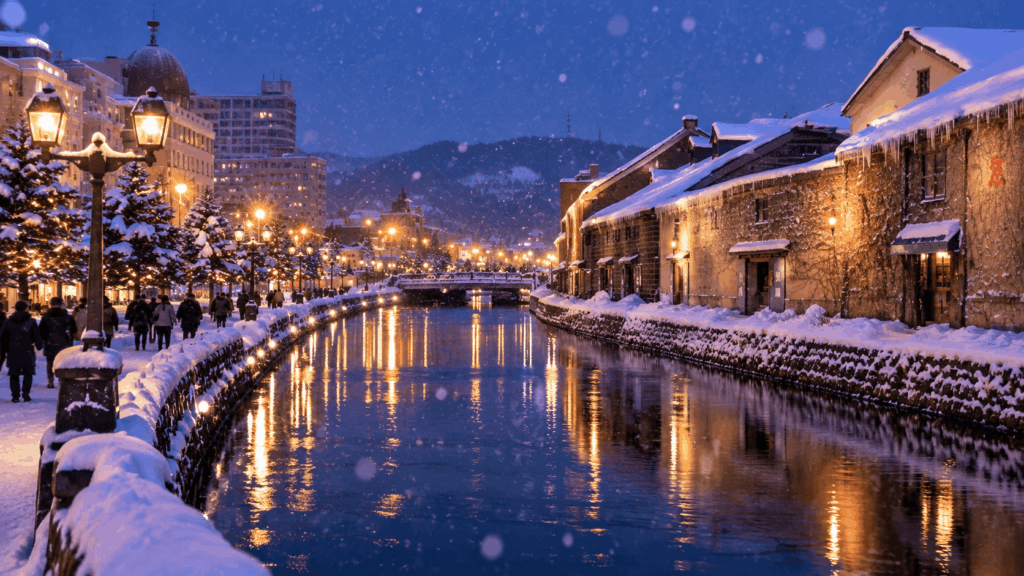
September is the month that catches people out. The town is still mild, the forecast looks fine, and then the boat clears the buildings and the wind hits you on open water. It is not dangerous, just consistently colder than the street you walked down ten minutes earlier. From December the boats are fitted with heated seats and a clear vinyl canopy, which changes the experience considerably — you are sitting in a sheltered, warm seat looking out at snow falling past the plastic.
Kai’s tip: On autumn and winter trips I always carry one more layer than I think I need, and I hand it to whoever is coldest. The heated seats are genuinely effective — better than most people expect from an open boat — but they warm the seat, not the air around your face and hands. The gap between surprisingly comfortable and I want to go inside is usually gloves and a hat, not a thicker jacket.
Winter sailings are shorter in number and finish earlier, so a winter visit needs more planning around the timetable than a summer one. Snow on the promenade also slows everything down: allow more walking time between the station, the canal and Sakaimachi Street than the map suggests.
What to Wear on a Winter Cruise
- Down or equivalent insulated jacket — the canopy blocks wind and snow, not cold air.
- Gloves and a hat — the two items people most often leave in the hotel.
- Scarf — useful where the canopy meets the seating.
- Shoes with grip — the jetty and steps get icy; this matters more than warmth.
- Something for your camera — batteries drain fast in the cold, and moving between a warm cabin and cold air fogs the lens.
Can the Cruise Be Cancelled on a Sunny Day?
Yes, and this is the thing most visitors do not plan for. The operator runs as long as it is safe, but sailings can be cancelled for strong winds, heavy rain or snow, unusually high or low water levels, or poor visibility. Blue sky is not the deciding factor — wind and swell are.
Decisions are normally made at least an hour before departure, and sudden weather can cancel a sailing with little notice. The current status is published on the official site’s operating status section, which is the only place worth checking on the day; the ticket counter will not reserve seats by phone or email for a sailing you have not booked.
Kai’s tip: I have had an afternoon sailing called off on a clear, cold day because of wind, with the sun still out over the harbour. What made it painless was that we had not built the day around the boat: we walked the canal, went up Sakaimachi Street, and treated the cruise as the optional middle. If the cruise is the fixed point of your day, check the operating status before you leave Sapporo rather than after you arrive.
How to Plan Around a Possible Cancellation
The simplest insurance is ordering. Put the cruise in the middle of your Otaru time rather than at the end, and keep a walkable plan on both sides: the canal promenade and the Asakusa Bridge area on one side, Sakaimachi Street and the warehouse district on the other. If the boat is cancelled you have lost 40 minutes of your day, not your day.
If you are coming from Sapporo on a fixed schedule, the risk profile changes: a cancelled cruise plus a return train can turn a relaxed day trip into a rushed one. In that case, book an earlier departure than you think you need, so a cancellation still leaves you time to rebook a later sailing.
Is the Otaru Canal Cruise Worth It?
It is worth it for some travellers and genuinely skippable for others. The honest version is that the canal is free to walk, and walking it gives you most of the classic views — the warehouse row, the gas lamps, the Asakusa Bridge perspective that appears on every poster. What the boat adds is a change of level and a change of pace: you see the canal from the waterline, pass under the bridges, get out to the harbour, and sit down for 40 minutes instead of threading through crowds on the promenade.
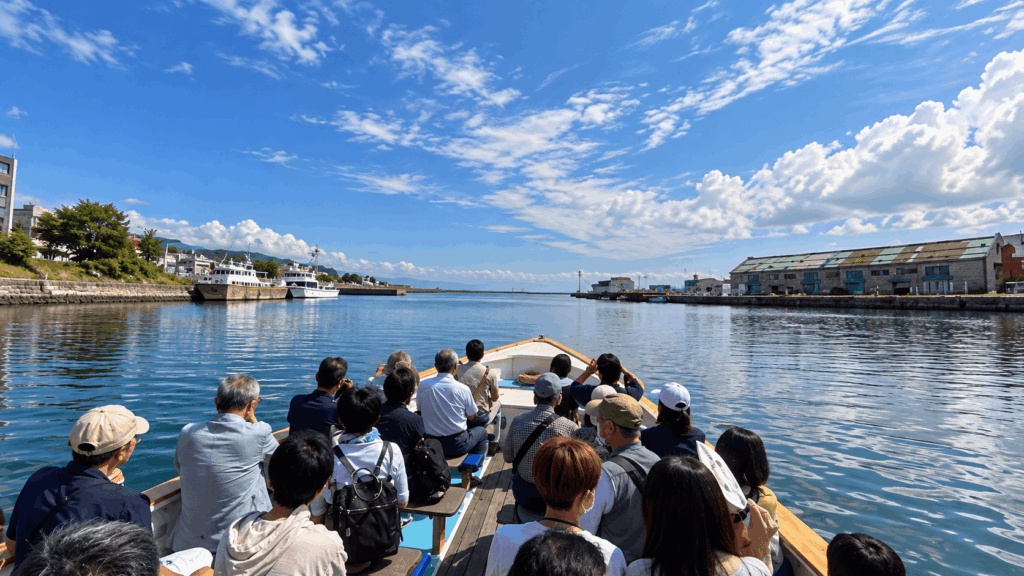
It is worth it if you are on your first visit to Otaru, want the lit canal without standing in the cold for an hour, are travelling as a couple, or simply have a spare 40 minutes and want a different angle on a place you have already walked.
Skip it if you have only two or three hours in Otaru and want to prioritise eating and Sakaimachi Street, feel the cold badly and are considering a midwinter night sailing, get restless sitting still, or are travelling with someone who cannot manage the steps down to the jetty.
What I would not do is treat it as compulsory. Otaru works perfectly well as a walking town, and a traveller who spends their cruise money on seafood and a coffee instead has not missed anything essential. The cruise is a good use of 40 minutes, not a rite of passage.
Cruise vs Walking the Canal
The promenade runs along the canal from the Asakusa Bridge area north to the Chuo Bridge and beyond into the North Canal, and it is free, flat and open at any hour. The comparison is less about which is better than about what you are actually trying to see.
| Canal cruise | Walking the promenade | |
|---|---|---|
| Cost | ¥1,800 day / ¥2,000 night per adult | Free |
| Time | About 40 minutes, plus 15 minutes’ assembly | 30 to 60 minutes depending on how far you walk |
| Viewpoint | Water level, under the bridges, out to the harbour | Eye level along the warehouse facades and the classic photo spots |
| Mobility | Steps down to the jetty; not wheelchair accessible | Flat paved path; easy with a stroller or a suitcase |
| Weather exposure | Fully exposed, or under a vinyl canopy in winter | You can duck into shops, cafés and the information centre |
| Best for | A different angle, a rest, the harbour stretch | Photos of the warehouse row, browsing, flexibility |
If you are short on time, walk from the Asakusa Bridge towards the Chuo Bridge at dusk — that is the stretch the postcards come from, and it costs nothing. If you have already done that and want more, the cruise is the logical next step rather than a replacement.
English Support and Practical Tips Before You Board
You can do this cruise without any Japanese. Every boat on the regular schedule is fitted with an audio guide in English, Chinese and Korean, earphones are free, and the ticket process is straightforward. The captain’s live commentary is in Japanese only, so the audio guide is doing the actual explaining — put the earphones in at the start rather than halfway round.
A few practical points that are easy to miss:
- No toilets on board. Use the facilities at the ticket centre or the public toilets nearby before you board.
- Luggage. The operator will not store bags. Lockers are available at the Otaru International Information Center, about a one to two-minute walk from the jetty.
- Seating. You cannot choose your seat or your boat; the captain assigns them, and on a full sailing you may be asked to share a bench.
- Accessibility. Boarding involves roughly 10 steps down to the jetty and 4 more onto the boat, so the cruise is not wheelchair accessible.
- Life jackets. Wearing one is a legal requirement, and staff will show you how.
- Food and drink. Bringing snacks and drinks on board is fine; visibly intoxicated passengers will be refused.
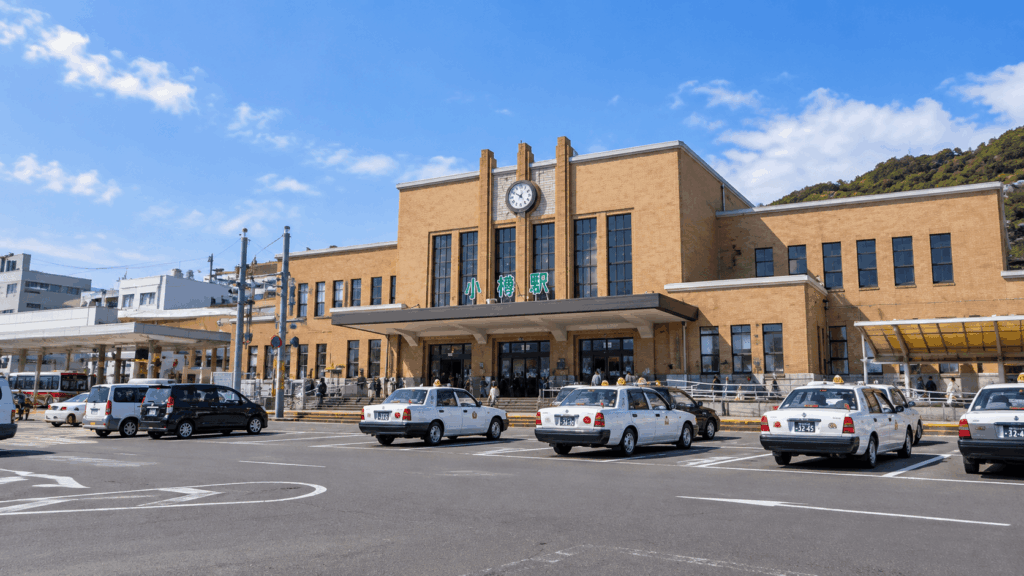
- Getting there. From JR Otaru Station, walk straight down Chuo-dori towards the port for about 10 minutes; the ticket centre is beside the Chuo Bridge, with the Otaru International Information Center a minute or two further on.
FAQ
What is the best time of day for an Otaru Canal cruise?
For a first visit, choose the departure that leaves 20 to 40 minutes before sunset, so you see the warehouses in daylight and the gas lamps and warehouse lighting come on before you dock. Because sunset in Otaru moves from about 16:00 in early December to about 19:20 in late June, this is not a fixed time — check the sunset time for your date, then match it to the published departures. If you care more about architecture than atmosphere, an afternoon day cruise is the better choice.
Is the Otaru Canal cruise better during the day or at night?
They show you different things rather than one being superior. Day cruises make the stone warehouses, the canal edges and the harbour stretch easy to read, and the light is simple to photograph. Night cruises give you reflections and lamp glow, but the buildings turn into silhouettes and the boat is considerably colder. Most travellers who can only take one cruise are best served by the departure that spans sunset.
Do you need to book the Otaru Canal cruise in advance?
If you want a specific departure — the pre-sunset sailing, a weekend night cruise, or anything during Golden Week and the New Year holidays — book online in advance. Online sales open 60 days ahead and close one hour before departure. If your timing is flexible, particularly on a weekday, same-day tickets at the counter are often available up to 15 minutes before sailing, and extra seats sometimes appear on the day even when a sailing showed as full.
Does the Otaru Canal cruise run in winter?
Yes. Winter boats are fitted with heated seats and a clear vinyl canopy, and the canal looks completely different under snow. The trade-off is a reduced schedule: fewer departures and earlier last sailings than in summer, plus a higher chance of weather cancellations. Dress for below-freezing air rather than for the heated seat, and allow extra walking time because the promenade and jetty can be icy.
Can the cruise be cancelled even when the weather looks fine?
Yes. Cancellations are decided on wind, swell, water level and visibility rather than on whether the sky is blue, so a clear cold day can still lose an afternoon sailing. The operator normally decides at least an hour before departure and posts the status on its website. If the operator cancels, you are refunded. For your own changes, check the confirmation email: eligible online reservation changes can be made until one hour before departure, but customer-requested time changes and refunds are not accepted after tickets have been issued or exchanged.
How long is the cruise, and where does it leave from?
About 40 minutes, departing from the jetty beside the Chuo Bridge, roughly a 10-minute walk from JR Otaru Station. You are asked to assemble 15 minutes before departure for life jackets and boarding, so budget closer to an hour in total. In poor sea conditions the harbour section of the route may be skipped, but the duration and price stay the same.
Is the cruise suitable for children, and is it accessible?
Children are welcome and travel for ¥500 between the ages of 6 and 12, with one preschool child free per paying adult; the boat is slow and stable, which suits most families. It is not wheelchair accessible, however — boarding involves about 10 steps down to the jetty and 4 more onto the boat — and the steps also make strollers awkward. There are no toilets on board, so use the facilities at the ticket centre first.
Will I understand anything without speaking Japanese?
Yes. All boats on the regular schedule carry recorded audio guides in English, Chinese and Korean, with free earphones provided at the ticket centre. The captain’s live commentary is in Japanese, so the audio guide is what actually explains the canal, the warehouses and the bridges. Ticketing can be done online in English or at the counter, and staff are used to international visitors.
Final Verdict: Which Otaru Canal Cruise Fits Your Trip?
There is no single best departure — there is a best departure for the kind of day you are having. Here is how I would decide.
If this is your first time in Otaru
Take the last daylight departure: in late October that is likely the 16:00 or 16:30 sailing, and in summer it moves much later with the sunset. You get the warehouse row in usable light, the harbour stretch, and the lamps coming on for the return leg. Book it rather than gamble on the counter, because this is the departure that fills first.
If you are travelling mainly for photographs
Split your time instead of trying to do everything on one boat. Shoot the warehouse facades from the promenade near the Asakusa Bridge in the afternoon, then take a day cruise for the water-level angle and the bridge undersides. A night cruise will give you reflections but not detail, and the exposure range at dusk is genuinely difficult without a tripod, which you cannot use on board.
If you are a couple and the atmosphere is the point
Take the earliest night departure rather than the last one. You still get full illumination — the gas lamps stay on until midnight and the warehouses until 22:30 — but you keep a trace of blue in the sky and you are off the water before the temperature drops further. It is the same ¥2,000 fare as a later sailing with a better view of the sky.
If you are visiting with children
Choose a mid-afternoon day cruise and treat it as one item in a walkable loop rather than the centrepiece. More departures means less pressure if you are running late, the fare is low for children, and the bridge passages tend to be the part they remember. Skip the winter night sailings unless the children are comfortable in serious cold.
If you have only three or four hours in Otaru
Walk the canal and skip the boat. The promenade from the Asakusa Bridge to the Chuo Bridge delivers the classic views for free, and your remaining time is better spent on Sakaimachi Street and lunch. A 40-minute cruise plus 15 minutes of assembly is a real slice of a short visit.
If you have been to Otaru before
Take a night cruise, or a winter one. The daylight version will feel familiar; the lit canal from water level, or the canal under snow with the canopy up, will not. This is also the version worth doing if you have already photographed the postcard view and want something that does not look like everyone else’s Otaru album.
If you are coming from Sapporo for the day
Decide what you are optimising for. If the cruise is the reason for the trip, book it directly and build the day around a mid-afternoon departure with slack on either side. If you would rather not manage the trains, the canal timing and the rest of the sightseeing yourself, a guided day tour from Sapporo that includes the canal cruise removes the scheduling risk — at the cost of flexibility and time at each stop. Neither is wrong; they suit different travellers.
Not every guided Otaru tour includes the boat, though. If exploring the town with a knowledgeable local guide matters more than having your canal cruise arranged for you, the following private day trip is a different option worth considering.
Why I’d book this one
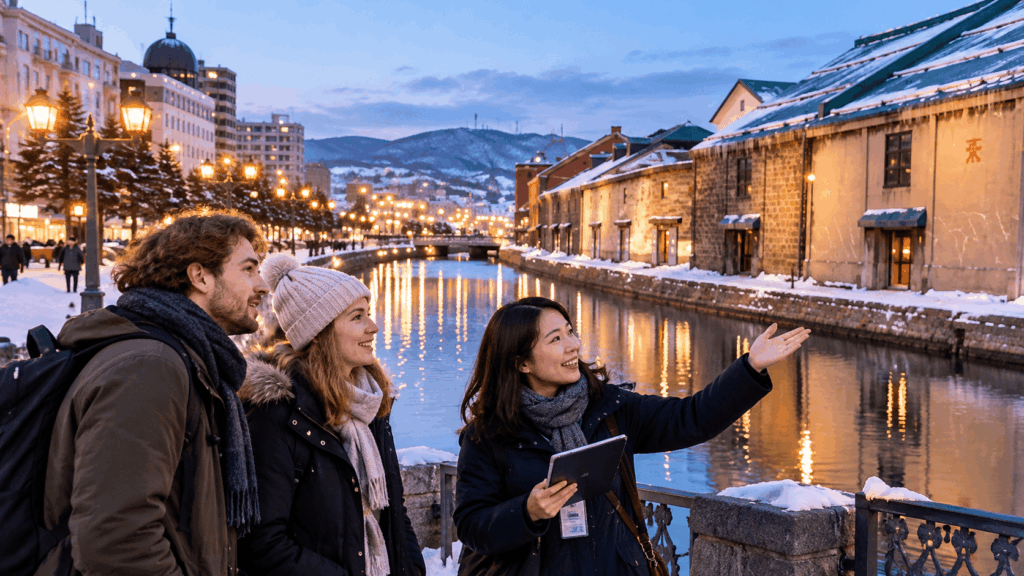
- More context than sightseeing alone: Recent travelers praise the guides’ local knowledge and the explanations that bring Otaru’s historic streets, architecture and culture to life.
- A day shaped around your interests: The private itinerary offers flexibility to focus on places that interest you, from the canal district to traditional shops and local crafts, rather than following a large group’s fixed sightseeing schedule.
- Less transport planning: Return train tickets between Sapporo and Otaru are included. You can also check the latest cancellation and payment conditions before committing.
One important distinction: This private guided tour does not include the Otaru Canal Cruise ticket. If the sunset sailing is your priority, arrange that booking separately and check whether its departure time fits your guided itinerary.

Hi, I’m Kai. I’m a Tokyo-based travel writer, tourism industry insider, and the author of a published guidebook for international visitors to Japan. With over 10 years of professional experience at a leading Japanese tourism company, my mission is to help you skip the tourist traps and navigate Japan’s best destinations like a local. I believe the perfect day trip is like a traditional kaiseki meal: a beautiful balance of precise planning and unforgettable seasonal discovery. When I’m not out conducting field research, you’ll usually find me drafting new itineraries with one of my favorite fountain pens!