
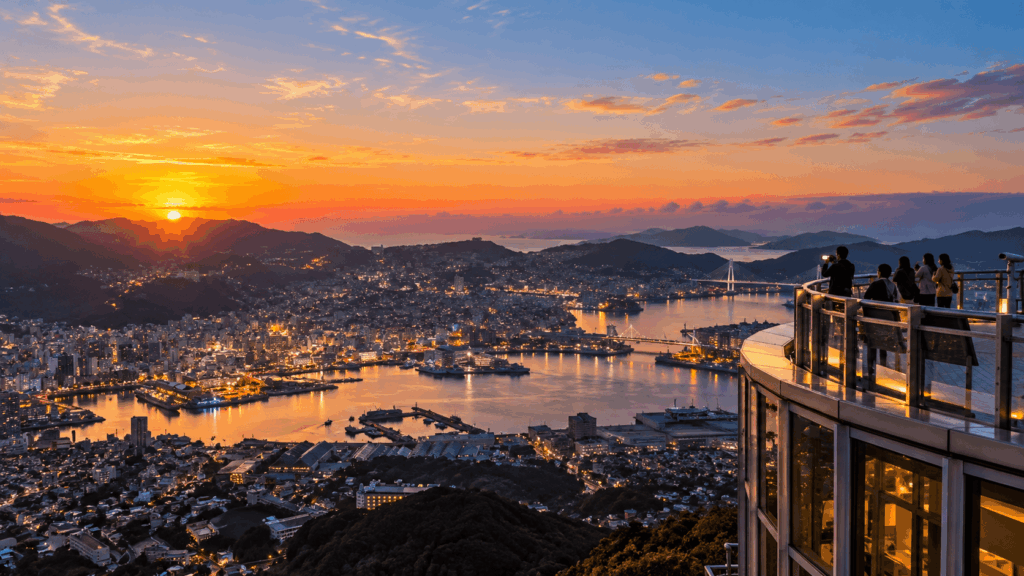
Nagasaki’s nightlife is compact rather than huge — and that is exactly why one well-planned evening works. There is no need to chase big clubs here. The best night in Nagasaki is a sequence: a sunset-to-night view from Mt. Inasa, dinner and drinks around Shianbashi, a plate of hitoguchi gyoza, and then a tram or taxi back to your hotel.
If you only have three hours, or if food and drink matter more than the view, skip Mt. Inasa and go straight to Shianbashi. Either way, plan around one fixed point: Nagasaki’s trams stop running relatively early, so decide early whether tonight is a tram night or a taxi night.
Prefer local bars without the guesswork? If you’d rather explore Nagasaki’s drinking scene with an English-speaking guide than choose your first stops alone, a three-hour guided bar-hopping tour is worth comparing with a self-guided night. Check current start times, what’s included, and availability for the Bar Hopping Tour in Nagasaki.
Quick Answer: The One-Night Nagasaki Plan at a Glance
If you read nothing else, this is the short version. Nagasaki is worth one well-planned evening if you want harbor night views, local izakaya food and small bars — not a large-club party district. First-time visitors do best with the Mt. Inasa + Shianbashi combination. If your priority is eating and drinking rather than the view, go straight to Shianbashi.
| Plan | Best for | Suggested start | Main experience | Main downside |
|---|---|---|---|---|
| Mt. Inasa + Shianbashi | First-timers who want both the view and the food | Before sunset (check the seasonal sunset time) | Sunset-to-night view, then izakaya and small bars | Less drinking time; more transport to manage |
| Shianbashi only | Food-and-drink-first travelers; shorter evenings | Around 18:00–19:00 | Izakaya, small bars and hitoguchi gyoza, mostly on foot | No harbor night view |
| Guided evening tour | Travelers who would rather not handle transport, timing or language | Afternoon (one common window is roughly 16:30–22:00) | Mt. Inasa and several Nagasaki sights with an English-speaking guide | Not a bar-hopping tour; less freedom to stay out late |
Is Nagasaki Nightlife Worth It?
Yes — with the right expectations. Nagasaki does not have the scale of Tokyo or Osaka. There is no endless grid of late-night clubs, and no all-night party district. What it does have is a compact, distinctive night scene: a celebrated harbor night view, small izakayas serving local seafood, casual bars, and evening food, all concentrated in walkable districts.
The right way to frame it is not “big city nightlife” but food, drinks and atmosphere in one neighborhood. If you are looking to dance until dawn, you will likely be underwhelmed. If you want a proper izakaya dinner, a couple of small bars, and a genuinely local-feeling evening within a few minutes’ walk, Nagasaki is quietly excellent.
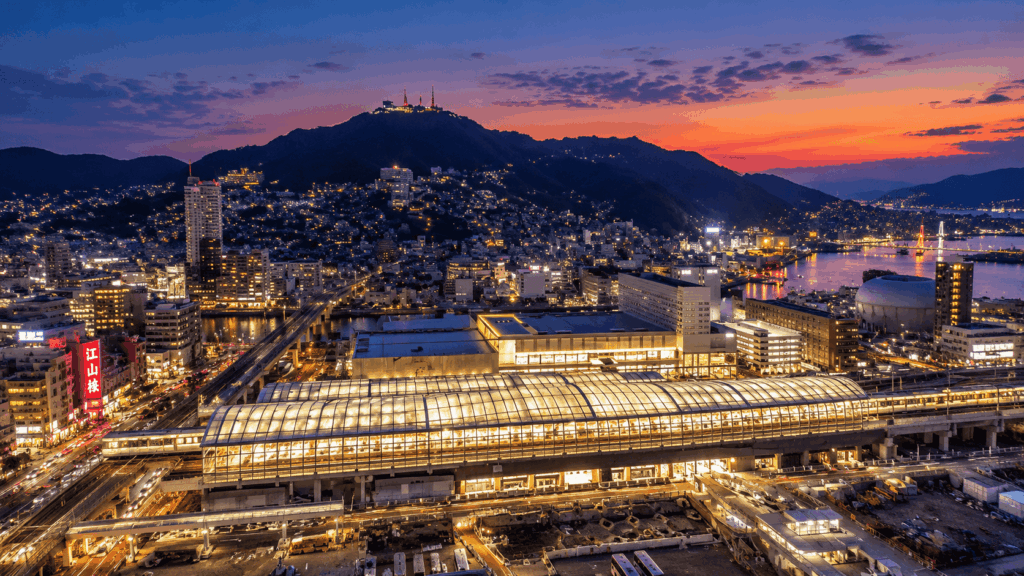
The main districts to know are Shianbashi and the neighboring Hamamachi shopping arcade, which sit close to Motoshikkui-machi and Doza-machi. For travelers, Shianbashi Yokocho — the narrow alley associated with the Shianbashi Yokocho Association — is the single area worth memorizing. Nagasaki Station, by contrast, is more about convenience and an easy walk back to station-area hotels than nightlife itself.
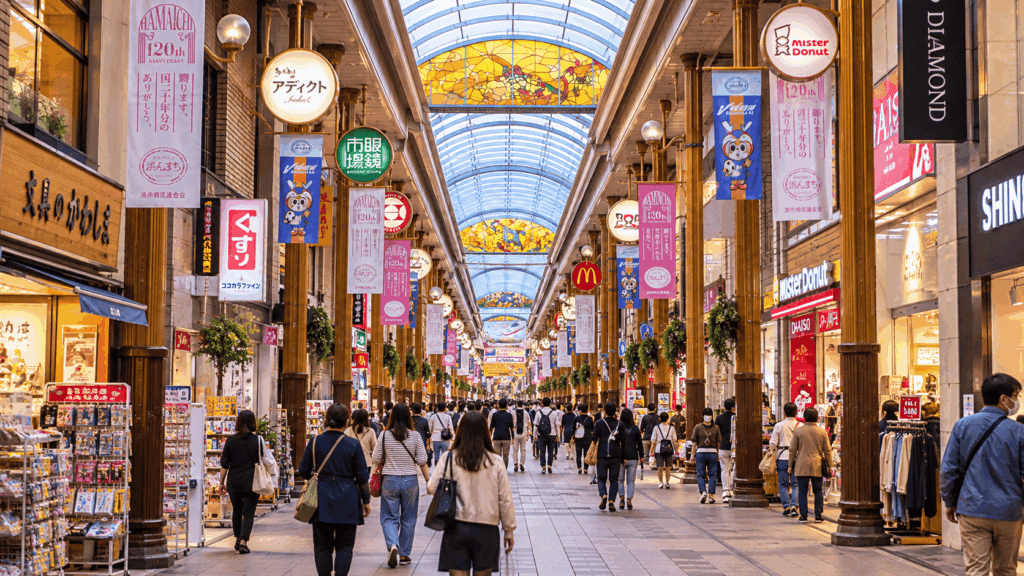
One observation from planning these evenings: travelers who go up to Mt. Inasa early and then move to Shianbashi tend to describe the night as more “Nagasaki” than those who chase a single bar list. The view sets the mood; the neighborhood does the rest. I would not claim it suits everyone — see the sections below on who should adjust their plan.
The Best Way to Spend One Night in Nagasaki
For a first visit, this is the sequence that is hardest to get wrong. It assumes roughly four to six hours, and you can slide each block earlier or later to match the season’s sunset time. (If you haven’t finalized your itinerary yet, see our guide on planning how many days you need in Nagasaki.)
- Before sunset — head up to Mt. Inasa for the transition from daylight to city lights.
- Around 20:00 — move down to Shianbashi and settle in for dinner.
- After dinner — pick one small bar for a second drink, on foot.
- Before it gets too late — fit in hitoguchi gyoza if you still have room; many specialists close well before midnight.
- Around last-tram time — decide between the tram and a taxi, based on how late you plan to stay out.
The key trade-off is this: adding Mt. Inasa costs you dining and drinking time. It is worth it for first-timers with clear weather who care about the view. If you have only one evening and the food and bars are your priority, it is perfectly reasonable to skip Mt. Inasa entirely and go straight to Shianbashi.
| Priority | Best plan | Why |
|---|---|---|
| Night view | Mt. Inasa + Shianbashi | You see the sunset and the harbor lights, then eat and drink afterward |
| Drinking and food | Shianbashi only, from around 18:00 | Maximum time for izakaya, bars and gyoza without transport logistics |
Start Before Sunset at Mt. Inasa
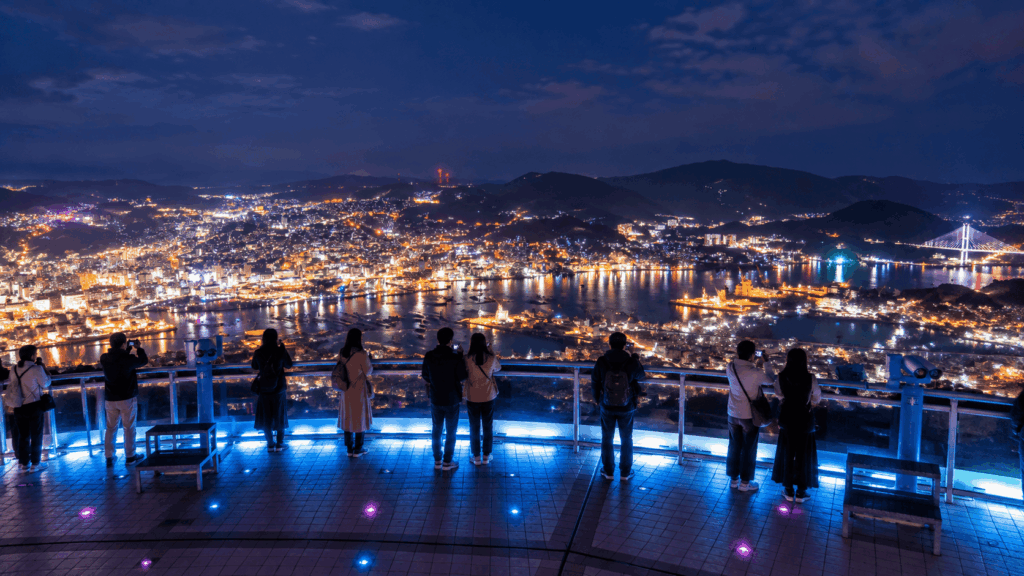
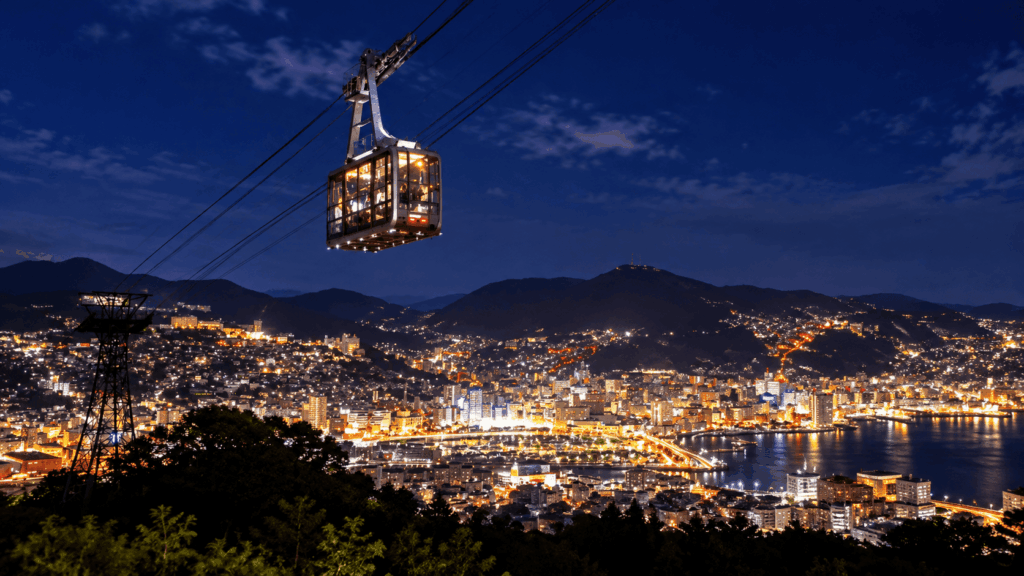
The common mistake is to treat Mt. Inasa as a pure “night view” stop and only go up once it is fully dark. If the weather is clear, arriving before sunset gives you three things in one visit: the daytime harbor, the sunset itself, and the moment the city lights come on. That progression is what makes the trip up feel worth the time.
The Mt. Inasa Observatory (Inasayama) is reached either by the Nagasaki Ropeway or by the Inasayama Slope Car, and the two have different fares and access points, so check our detailed guide on how to get to Mount Inasa to see which one suits your route. Both normally operate until around 22:00. As of late 2026, a ropeway round trip is about ¥1,900 and a slope car round trip about ¥1,000 for adults — but both figures change, so confirm the current details before you go.
A few timing notes that matter more than people expect. The Nagasaki Ropeway periodically suspends service for maintenance, and past suspension windows have fallen in early summer, so check operating dates if you are traveling in June or July. The Inasayama Slope Car also spent part of 2026 out of service and only resumed in stages later in the year, so its operation is worth verifying rather than assuming.
Kai’s tip: The mistake I see most first-timers make is arriving only after the city is fully lit. If the sky is clear, aim to be at the observatory before sunset. You get the daylight harbor, the sunset, and then the lights coming on across the city — all in one visit. It turns the trip up the mountain into a progression instead of a single snapshot, and it is the version of Mt. Inasa I would send a friend to see first.
Move to Shianbashi for Dinner and Drinks
Once you come down from Mt. Inasa, the question becomes “where, specifically?” For a first visit, the answer is almost always Shianbashi. It concentrates dinner, izakaya, small bars and evening food within a walkable area, so you can change venues without long taxi rides between each stop. That is the practical advantage over spreading your night across the city.
The alternative base is the area around Nagasaki Station. It is not a nightlife district in the same way, but if your hotel is by the station and your priority is an easy walk home, it can make sense to eat there and take a short tram or cab to Shianbashi only if you want more. Choose Shianbashi for the night out itself; choose the station area for convenience on the way back. If you are still deciding on a base, our guide on where to stay in Nagasaki breaks down the pros and cons of each neighborhood.
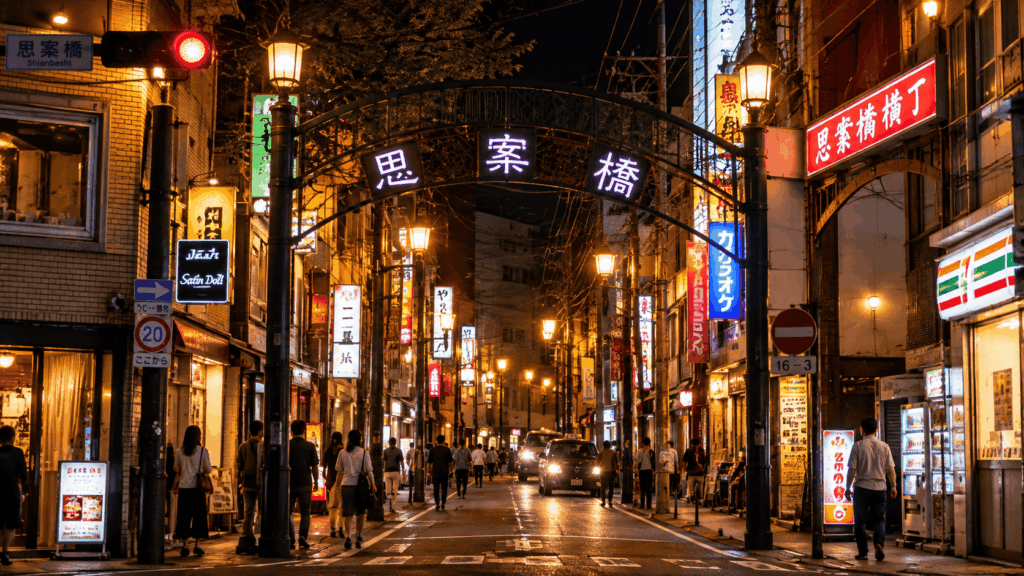
Walking Shianbashi Yokocho and the surrounding lanes — the ones near Motoshikkui-machi and Hamamachi — is part of the experience. The narrow paths, small signs and izakaya entrances packed together are the atmosphere people come for. You do not need a reservation at a specific famous place to enjoy the area; sometimes the smallest unmarked counter is the most memorable.
Shianbashi: The Best Area for Nagasaki Nightlife
If you remember one place name for a night out in Nagasaki, make it Shianbashi. It is the central nightlife area travelers should know, anchored by the Shianbashi tram stop and spreading outward through Motoshikkui-machi and toward Doza-machi. The names matter because the area is not a single street — it is a cluster of lanes and small buildings, which is why it rewards a little orientation before you arrive.
One common misunderstanding: Shianbashi Yokocho is not the whole neighborhood. It is the best-known alley within it, and the Shianbashi Yokocho Association’s English site listed more than 60 member shops as of late 2026 — a mix of izakaya, bars, snack bars, Chinese food and gyoza specialists. The surrounding streets hold many more. Treat the yokocho as your starting point, not your boundary, and the choice opens up considerably.
The trade-off for first-timers is between predictability and spontaneity. Picking a well-reviewed place in advance lowers stress; walking the lanes and choosing by eye gives you a more local feel but an uncertain result. Both are valid. What you should not assume is that every shop will handle English — support varies from place to place, so use the guidance below on how to choose.
Kai’s tip: The thing that catches people out in Shianbashi is thinking they need to lock in every stop before they arrive. The lanes are small and walkable, and I have found that looking at a shop’s entrance for a moment — whether there is a food menu posted, whether there are seats visible, whether it looks calm — tells you more than a review written months ago. If a place feels too small or too loud, the next door is ten seconds away.
Izakaya With an English Menu: The Low-Stress Option
If you do not speak Japanese, the single most reassuring move is to make your first stop a restaurant that currently publishes an English menu, rather than relying on reviews that simply say a place is “English-friendly.” A confirmed menu means you can order without guessing, which takes the pressure off the first meal and lets you relax into the evening.
A reliable example is Kamadojaya, a long-established izakaya (founded in 1978) about a three-minute walk from Shianbashi Station. It publishes an English menu and English-language information, and its specialties lean into regional cooking — a Dutch-style hot pot, a Nagasaki take on Western noodle dishes, seasonal sashimi, and whale dishes that are specific to the city. Prices and opening hours should be confirmed before you go, as they change.
It also helps to know that “English support” is not one thing. A practical three-level way to think about it:
- Level 1 — Official English menu confirmed: safest for language-anxious first-timers. You can order from a printed menu and take your time.
- Level 2 — Tourist-used, simple ordering: the staff may not speak much English, but the menu is simple or illustrated, and a translation app plus pointing works fine.
- Level 3 — Tiny local bar, unclear English support: best for travelers who enjoy spontaneity and are comfortable with some uncertainty.
Start at Level 1 if you are nervous, and drop to Level 2 or 3 later in the night once you are settled. This is not a ranking of quality — it is a ranking of how much you have to manage while you order.
A small, honest note from personal experience: in a counter-only izakaya in Shianbashi, a chef once handed over the English menu, then pointed at the day’s local fish and gestured at how he would prepare it. Ordering worked without much shared language at all. That is a real possibility — but it is not a guarantee, and it is not true of every shop in the area.
Small Bars for a Second Drink
After dinner, the natural move is not to book a second venue in advance but to walk the lanes and pick one small bar that looks right. This is where Shianbashi is at its best: a standing bar, a tiny counter, or a quiet room with a handful of seats. English support varies here more than at restaurants, so choose according to your comfort level rather than assuming.
For orientation rather than endorsement: Tatanbaa is a well-known standing bar in the area, and Barakamon sits a very short walk from Shianbashi and, in listings as of late 2026, stays open very late — which is useful if you want one more drink after dinner. Other small bars appear in the Shianbashi Yokocho Association’s directory; treat those listings as a starting map and confirm details on the night.
One practical distinction that trips people up: a bar that stays open until 2:00 or 5:00 does not mean the food kitchens do. Late-opening bars and late-serving restaurants are two different things. If you want to eat after midnight, plan for it specifically — see the next section.
What to Eat Late at Night in Nagasaki
The search “late-night food in Nagasaki” usually comes with an assumption: that at 1:00 a.m. there will be somewhere obvious to eat. In reality, Nagasaki’s late-night options are narrower than that. The honest answer is that the city’s signature evening food — hitoguchi gyoza — is not a midnight dish. The famous specialists often close well before midnight, sometimes as early as 22:00.
That does not make them less worth eating; it changes when you slot them in. Instead of treating gyoza as your post-midnight snack, make it a second or third stop during the evening, while kitchens are still open. For a genuinely late finish, you may need to look at noodle shops or whatever is still serving in the areas near your hotel.
| Option | Nagasaki-specific? | Heaviness | Typical closing time | Best point in the evening |
|---|---|---|---|---|
| Hitoguchi gyoza | Yes — a local signature | Light; easy to share | Often around 22:00–23:00 (varies by shop) | Second or third stop, before it gets too late |
| Later-night noodles | Less so, but convenient | Heavier | Can run later into the night | True midnight finish |
Hitoguchi Gyoza: A Nagasaki-Style Final Food Stop
Hitoguchi gyoza are small, bite-sized, pan-fried dumplings — crisp on the outside and gone in a couple of bites, which makes them easy to eat even after a full dinner. They pair well with beer, and they suit anyone who wants to end the night on something lighter than a heavy bowl of ramen.
Two well-known Shianbashi names are Unryutei (雲龍亭) and Shianbashi Hountei (思案橋 宝雲亭), and it is worth understanding that their hours are not the same. As of late 2026, Unryutei’s Shianbashi-area branch listed roughly 18:00–22:00 and closed on Sundays, while Hountei in Shianbashi has historically opened around 17:00 and closed nearer 23:00 with irregular days off. So Hountei can work slightly later, but neither should be assumed to be open past midnight. Confirm the day and the hours before you build your night around either one.
From personal experience, the appeal is the format as much as the flavor: a small, crisp, beer-friendly plate; a dip with a little yuzu-kosho for some bite; and the theatre of watching the staff fold dumplings at speed behind the counter. It is the kind of stop that feels specific to Nagasaki rather than generic.
How Late Does the Nagasaki Tram Run?
This is the single most useful thing to sort out before you start drinking. The Nagasaki Electric Tramway is cheap and easy — the fare is a flat ¥150 for adults and ¥80 for children across the network — but the last trams run relatively early, and the exact time depends on the stop, the direction and the day. Do not memorize a single “last tram” time for the whole city.
As a working rule, from around 23:00 the trams are finishing rather than starting. That makes roughly 22:30–23:00 the window in which you should be checking your specific onward tram, not a promise that one will come. If you plan to stay out past that, assume a taxi. Trams are the cheaper option while they run; a taxi is the easier option once they stop.
| Time of night | Best transport assumption | What to check |
|---|---|---|
| Before around 22:30 | The tram is usually practical | Which line and direction serves your stop |
| Around 22:30–23:00 | Check the tram, prepare for a taxi | The exact departure time for your stop and direction |
| After 23:00 | Taxi is increasingly the realistic choice | The distance and rough cost back to your hotel |
Do Not Treat 11:30 p.m. as a Universal Last Tram
A frequent piece of misinformation is that Nagasaki’s last tram is universally around 11:30 p.m. It is not. The final departure varies by stop, by direction and by day, and the network’s timetable was revised in 2026 in a way that reduced some evening service. Treating one number as a city-wide rule is how people end up stranded.
The fix is simple: before you go out, look up the last departure for the exact stop and direction you will use to get home — for example, from Shianbashi back toward Nagasaki Station or your hotel area — using the official Nagasaki Electric Tramway timetable. Note the time and check it again on your travel date, since schedules can change with the season.
Kai’s tip: When I map out an evening for people, I have them do one thing before the first drink: write down the last tram that actually serves their stop and their direction, not the city in general. The number is often earlier than they expect, and it is the difference between a relaxed last bar and a rushed one. If the time feels tight, decide then to finish with a taxi rather than gambling on the tram.
When a Taxi Is the Better Choice
A taxi is the right assumption if any of the following applies to you:
- You want to visit more than one or two bars.
- You plan to stay out after around 23:00.
- Your hotel is outside easy walking distance of Shianbashi.
- It is raining, which makes waiting for a tram and walking back less pleasant.
Nagasaki is a compact city, so taxi rides between the central districts are generally short in distance, but fares build up and vary with traffic and time. Because rates change, it is better to check the distance and expected cost for your specific route on the night rather than rely on a fixed figure. If you are drinking, budgeting for one taxi home is often the simplest way to remove the whole last-tram question from your evening.
Mt. Inasa Before Shianbashi: Is It Worth the Extra Time?
This is the biggest decision in the whole plan, because Mt. Inasa is a genuine highlight but it also costs you dining and drinking time. Here is a straightforward way to choose.
Worth it if:
- It is your first visit to Nagasaki.
- The forecast is clear.
- You are traveling as a couple and want the view as part of the experience.
- Night views matter to you.
- You want to see the sunset-to-lights transition, not just the finished panorama.
Skip it if:
- It is rainy or cloudy.
- You only have about three hours for the whole evening.
- Food and bar-hopping are clearly your priority.
- You have already seen Mt. Inasa.
Two practical warnings. First, access is not unlimited: the summit parking area restricts general vehicles during weekend, holiday and peak periods in the early evening, so private cars are guided to the mid-slope lot and the slope car in those windows — it is not a simple “drive up anytime” destination. Second, the ropeway has periodic maintenance closures, and the slope car returned to service only gradually in 2026, so confirm what is running before you commit your evening to it.
What turned Mt. Inasa from a “nice view” into a good decision for me was timing rather than the view itself: arriving before dark and watching the harbor fade and the city lights come up made the whole trip feel like an event. If you only want the postcard shot, going up late is fine — but if you have the flexibility, the earlier arrival is the version I would choose.
Self-Guided Night vs an English-Guided Evening Tour
The honest question is not “which is better” but “which suits the night you actually want.” If your ideal evening is choosing your own izakaya, moving at your own pace, and staying out as long as you like, self-guided is the right call. If the part that stresses you is the logistics — timing the sunset, finding the transport, and dealing with a language barrier after dark — a guided evening tour removes most of that in one go.
As one concrete option, a Klook product — Nagasaki Mt. Inasayama & Glover Garden Night Tour — combines Mt. Inasa with several Nagasaki sights, runs for roughly 5.5 hours (a common window being 16:30–22:00), includes an English-speaking guide, and lists free cancellation with advance notice. It is operated by H.I.S. Co., Ltd. Details such as price, route and cancellation conditions change, so check the current listing before booking.
To be clear about what it is not: this is a sightseeing and night-view tour, not a bar-hopping tour. If your main goal is to eat and drink through Shianbashi, staying self-guided will suit you better. The tour is the better fit when the night view and the major sights matter more than the late-night food and bar scene — or when you simply do not want to manage the transport and timing yourself.
| Factor | Self-guided | English-guided evening tour |
|---|---|---|
| Flexibility | High — change plans freely | Fixed itinerary and times |
| Transport | You arrange trams and taxis | Handled for you |
| Language | You rely on menus and apps | English-speaking guide |
| Cost | Lower and pay-as-you-go | Higher, but bundled |
| Nightlife depth | Best for Shianbashi eating and drinking | Limited — not a bar-hopping tour |
| Finish time | You decide | Set by the tour, typically earlier |
There is also a different kind of guided option worth considering if the bars themselves are your priority. The sightseeing tour above focuses on Nagasaki’s landmarks and night view, while a dedicated bar-hopping tour is designed around visiting local drinking spots. It suits travelers who want company, local context and help navigating unfamiliar bars rather than a fixed sightseeing route.
Why I’d book this one
- Three local bar stops: The Bar Hopping Tour in Nagasaki takes you to three drinking spots, so you can sample more of the local scene without having to choose every venue independently.
- An English-speaking guide: Having someone explain local drinking customs and help bridge language gaps can make smaller, unfamiliar bars feel more approachable.
- A manageable evening commitment: At roughly three hours, the experience is shorter than the sightseeing tour above. You can check the meeting point, what’s included, and the cancellation conditions before deciding whether it fits your plans.
If you prefer choosing every bar yourself or want to spend the evening at your own pace, stick with the self-guided plan. The guided option makes the most sense when local bar culture and a more structured introduction matter more than complete flexibility.
Nagasaki Nightlife Tips for First-Time Visitors
These are the practical points that decide whether the evening runs smoothly.
- Check the weather before committing to Mt. Inasa — clouds can erase the whole point of going up.
- If you want both the sunset and the night view, arrive at the observatory before sunset, not after.
- Do not assume every izakaya has an English menu. Start with a confirmed one if you are nervous.
- Keep a translation app ready, and be ready to point at a menu.
- Carry some cash; not every small venue takes cards.
- Check opening days before choosing a specific restaurant — irregular closings are common.
- Eat hitoguchi gyoza earlier rather than later, since the specialists often close before midnight.
- Before your first drink, note the exact last tram for your stop and direction.
- If you plan to stay out late, assume a taxi for the trip home.
The experience I keep coming back to is a small izakaya where the menu and a few gestures were enough to order a satisfying meal without shared fluency. Japanese is genuinely helpful here, but it is not essential — what helps most is a little flexibility and a willingness to start somewhere simple and adapt from there.
Frequently Asked Questions
Is Nagasaki good for nightlife?
Yes, if you want izakaya food, local seafood, small bars and a harbor night view. It is less suited to travelers looking for large nightclubs or an all-night party district, because Nagasaki’s scene is compact and food-focused rather than club-focused. The realistic expectation is one well-planned evening built around Mt. Inasa and Shianbashi, not a vast circuit of venues.
What is the best nightlife area in Nagasaki?
Shianbashi is the main area to know. It concentrates izakaya, small bars and evening food within a walkable cluster around the Shianbashi tram stop, which makes it easy to move between venues on foot. The neighboring Hamamachi arcade and the streets near Motoshikkui-machi and Doza-machi are part of the same general zone. The station area is convenient for an easy walk home, but it is not the nightlife district itself.
Can I visit a Nagasaki izakaya without speaking Japanese?
Yes, but English support varies by shop, so choose carefully. The lowest-stress approach is to make your first stop a restaurant that currently publishes an English menu, then relax into simpler or smaller venues later once you are more comfortable. Keep a translation app ready and be willing to point at a menu. Smaller bars may have less English support than larger restaurants.
What time is the last tram in Nagasaki?
There is no single city-wide last-tram time. It depends on the stop, the direction and the day, and evening service was reduced in a 2026 timetable revision. As a rule of thumb, trams are finishing rather than starting from around 23:00, so check the exact last departure for your stop and direction on the official Nagasaki Electric Tramway timetable before you go out. If you plan to stay out later, assume a taxi instead.
What can I eat late at night in Nagasaki?
Hitoguchi gyoza is the signature local option, but be aware that the well-known specialists often close before midnight — some as early as 22:00 — so it works better as a second or third stop than a true midnight meal. For a genuinely late finish, look for noodle shops or whatever is still serving near your hotel, and confirm closing times in advance since they vary by shop and day.
Final Verdict: Which Kind of Nagasaki Night Is Right for You?
Choose the Mt. Inasa + Shianbashi plan if you are a first-time visitor in clear weather, you want the sunset-to-lights view, and you still have time for izakaya and small bars afterward. This is the version of a Nagasaki night most people picture, and it is hardest to get wrong.
Choose Shianbashi only if food and drink are your priority, your time is limited, or the evening is cloudy. Going straight to the izakaya and bar lanes means more time eating and drinking, with no transport to manage between the mountain and the neighborhood.
Choose an English-guided evening tour if the logistics are the part you would rather not handle. If you want the night view and the main sights without working out transport, timing and language yourself, a guided tour removes most of that friction. Just remember that it is not a bar-hopping tour.
For first-time visitors: go up to Mt. Inasa before sunset, move to Shianbashi around 20:00, start at a confirmed English-menu izakaya, then walk the lanes and finish with hitoguchi gyoza while the kitchens are still open.
For couples: the combination of the Mt. Inasa view and a quiet Shianbashi izakaya is the strongest sequence, provided the weather cooperates.
For solo travelers and small groups: Shianbashi’s small bars reward walking in and choosing by eye. Start at a Level 1 English-menu shop if you want an easy first stop, then explore.
For travelers on a tight schedule: skip Mt. Inasa. Three hours in Shianbashi — dinner, one bar, a plate of gyoza — is a complete Nagasaki evening on its own.
For repeat visitors: you have likely seen the view. Spend the night in Shianbashi and the surrounding lanes, where the appeal is the neighborhood rather than the panorama.
For those seeking big clubs and an all-night party district: Nagasaki is the wrong city, and it is better to know that now than after the last tram.
What I would tell a friend visiting for the first time is this: don’t over-plan the individual bars. Fix the two decisions that actually matter — whether you are doing the night view, and which tram or taxi carries you home — then let the rest of the evening happen on foot in Shianbashi. Nagasaki’s nightlife is not large, but a night put together this way is memorable precisely because it is compact.

Hi, I’m Kai. I’m a Tokyo-based travel writer, tourism industry insider, and the author of a published guidebook for international visitors to Japan. With over 10 years of professional experience at a leading Japanese tourism company, my mission is to help you skip the tourist traps and navigate Japan’s best destinations like a local. I believe the perfect day trip is like a traditional kaiseki meal: a beautiful balance of precise planning and unforgettable seasonal discovery. When I’m not out conducting field research, you’ll usually find me drafting new itineraries with one of my favorite fountain pens!