
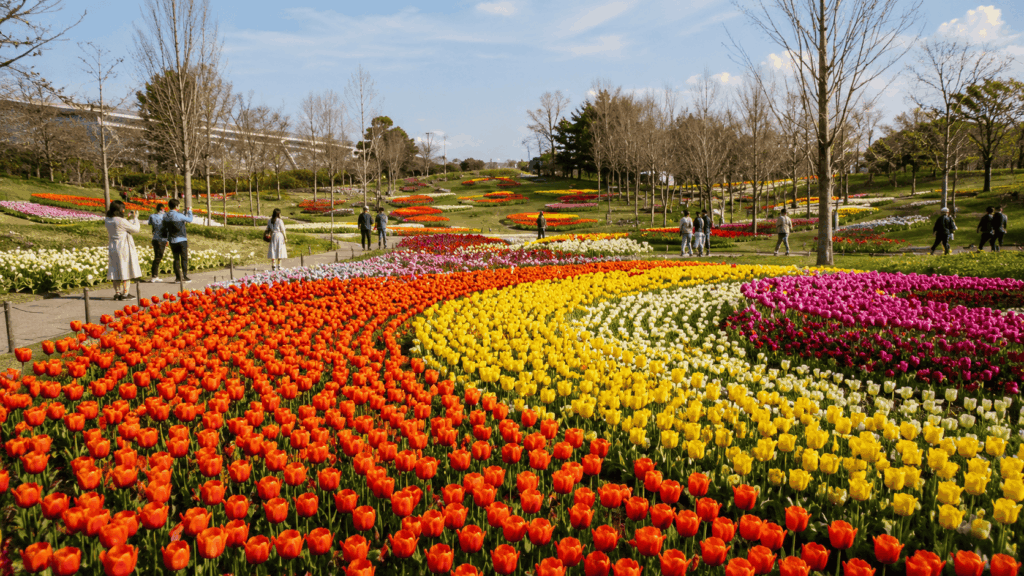
Is one day enough for Awaji Island? Yes — if you build the day around the tides. This itinerary links the island’s three most rewarding stops into a single driving route: the flower fields at Awaji Hanasajiki, lunch at Michi-no-Eki Awaji, and the Naruto whirlpools from the Uzushio Cruise at Fukura Port. The route runs from the bridge-side north to the island’s southern tip — roughly 60 km one way — and works as a day trip from both Osaka and Kobe.
The one thing that decides the order of your day is the whirlpool timetable, not the map. So that is where this guide starts.
Prefer this kind of Awaji Island day trip without doing the driving? A private customizable tour from Osaka or Kobe is the closest alternative to the route below, with Awaji Island and the Naruto area built into the day. Check current availability, pickup options, and tour length for the Awaji Island & Naruto private tour before deciding whether self-drive is still the better fit.
Awaji Island One-Day Itinerary: The Quick Verdict
One day on Awaji Island is realistic if you drive. The most reliable pattern is north-to-south:
- Morning: Awaji Hanasajiki flower park (opens 9:00, entry free).
- Early lunch: Michi-no-Eki Awaji, the road station closest to the Akashi Kaikyo Bridge.
- Afternoon: Uzushio Cruise from Fukura Port, timed to a good-tide sailing.
Two rules keep this route from falling apart:
- Check the whirlpool timetable before you leave. The cruise is the only stop you cannot reschedule — the tide sets the schedule, not you.
- Do not add a fourth stop. Three stops fill a comfortable day; the drive from the bridge to Fukura alone is about 50–60 minutes each way.
If this route appeals but you would rather not drive, the alternatives (private tour, public buses) are covered later in this guide.
One-Day Itinerary at a Glance (Example Only)
Shift every time below to match your chosen cruise sailing — the tide table comes first, this table second.
| Time (example) | Stop | Why it works |
|---|---|---|
| 8:30 | Leave Kobe (Sannomiya) by car | Cross the Akashi Kaikyo Bridge; about 1 hour 15–30 min to the island’s north end. |
| 9:30 | Awaji Hanasajiki | Flowers in morning light, before the midday tour groups arrive. |
| 11:15 | Michi-no-Eki Awaji | Early lunch at the seafood counter, ahead of the noon rush. |
| 12:30 | Drive south on the expressway | About 50 minutes by toll road to Fukura Port. |
| 13:30 | Uzushio Cruise | A 60-minute sailing timed to a high-expectation slot. |
| 15:30 | Drive back north | Return to Kobe or Osaka by early evening. |
Who This One-Day Route Is Best For
Best for: first-time visitors who want a balance of flowers, local seafood, and the Naruto whirlpools; couples and small families comfortable with a full day in the car; travelers who are happy driving on expressways.
Skip it if: you do not drive and prefer trains (public buses link the island’s towns, but not these three stops efficiently in one day); you want to spend the whole day at Nijigen no Mori, the anime theme park; or you need a slow, beach-and-café pace rather than a three-stop route. If any of these sound more like your style, check our broader guide on things to do in Awaji Island to build a trip that suits you.
Before You Plan Anything, Check the Whirlpool Timetable
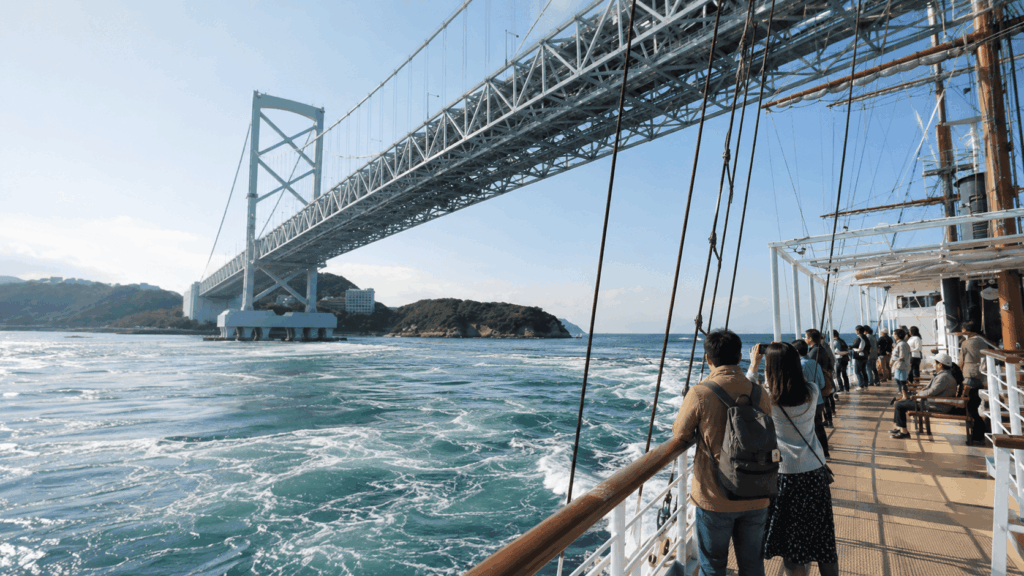
The Naruto Strait current runs fastest around high and low tide, which is when the whirlpools are most likely to be dramatic. The official Uzushio Cruise timetable shows the day’s high and low tide times and gives every sailing an expectation rating — the closer a departure is to the tide, the higher the rating. Days around the new and full moon (spring tides) are marked as the ones with the largest whirlpools expected.
The mistake I see in most online itineraries is building the day around breakfast or the ferry back to the city, then slotting the cruise in wherever it fits. On the island it works the other way around. Pick the cruise sailing with the best expectation rating for your day, then arrange Hanasajiki and lunch around it. What catches people out is assuming the 1:00 sailing is as good as the 1:40 one — on some days it is, on others the ratings differ noticeably.
North-First or South-First?
If the good tide falls in the afternoon (the most common pattern for a Kobe start): keep the order as written — Hanasajiki in the morning, lunch around 11:30, cruise mid-afternoon.
If the good tide falls in the morning (for example, a 9:00–10:00 sailing): reverse the route. Take the cruise first, lunch at Michi-no-Eki Awaji on the way back north, then finish at Hanasajiki in the early afternoon — it stays open until 17:00. Alternatively, pick a later sailing and keep the original order; the timetable usually offers several departures through the day, around every 30–40 minutes depending on the season.
How the Route Fits Together (Your Mental Map)
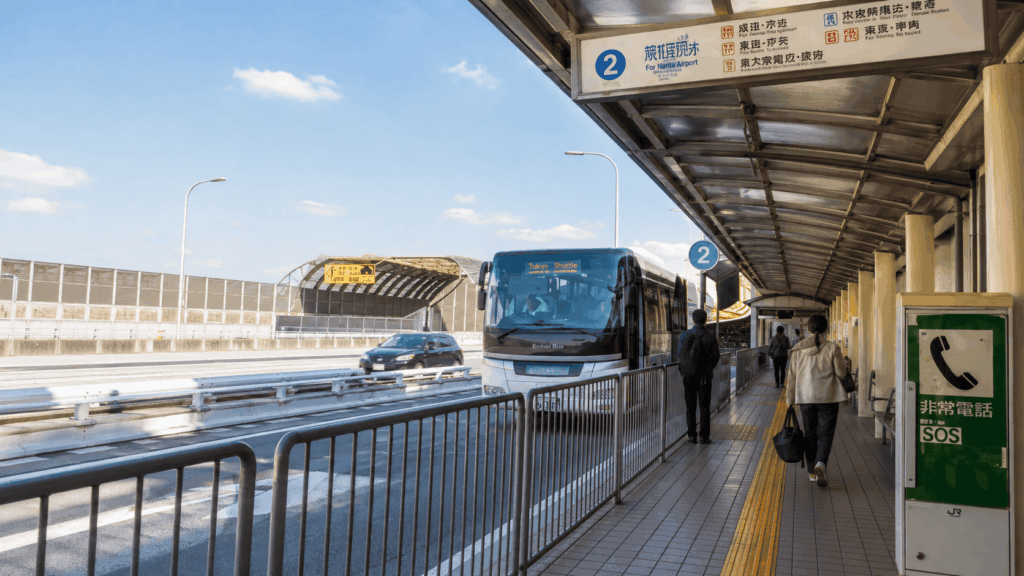
You cross from Kobe over the Akashi Kaikyo Bridge onto the island’s north end, then travel south along the Kobe-Awaji-Naruto Expressway to the port town of Fukura, just before the Onaruto Bridge that leaps across to Shikoku. Everything else on the island branches off this spine.
| Leg | Route | Approx. driving time |
|---|---|---|
| Kobe Sannomiya → Akashi Kaikyo Bridge → Awaji IC | Expressway over the bridge | 1 hr 15–30 min |
| Awaji IC → Awaji Hanasajiki | Prefectural Route 157 south, about 7 km | ~12 min |
| Awaji Hanasajiki → Michi-no-Eki Awaji | Back north toward the bridge | ~15 min |
| Michi-no-Eki Awaji → Fukura Port | Kobe-Awaji-Naruto Expressway south | ~50 min (toll) / ~65 min (local roads) |
Note the back-and-forth between stops one and two: Hanasajiki sits a few minutes south of the Awaji IC interchange, while Michi-no-Eki Awaji sits near the bridge itself. It is a short hop, not a wasted detour — you eat looking at the bridge and take your under-the-bridge photos before heading south for good.
Stop 1 — Awaji Hanasajiki: Flower Fields Above the Strait
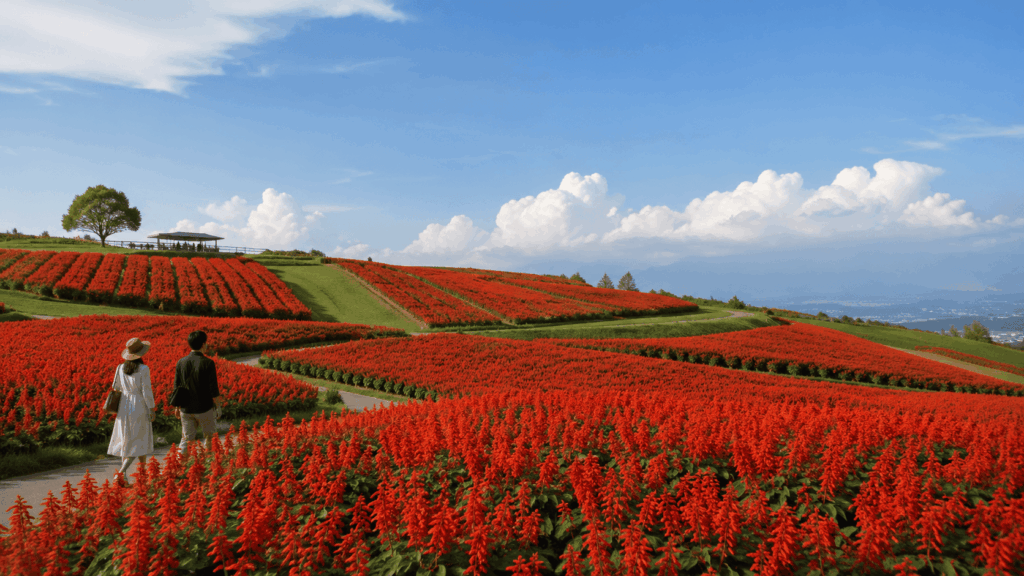
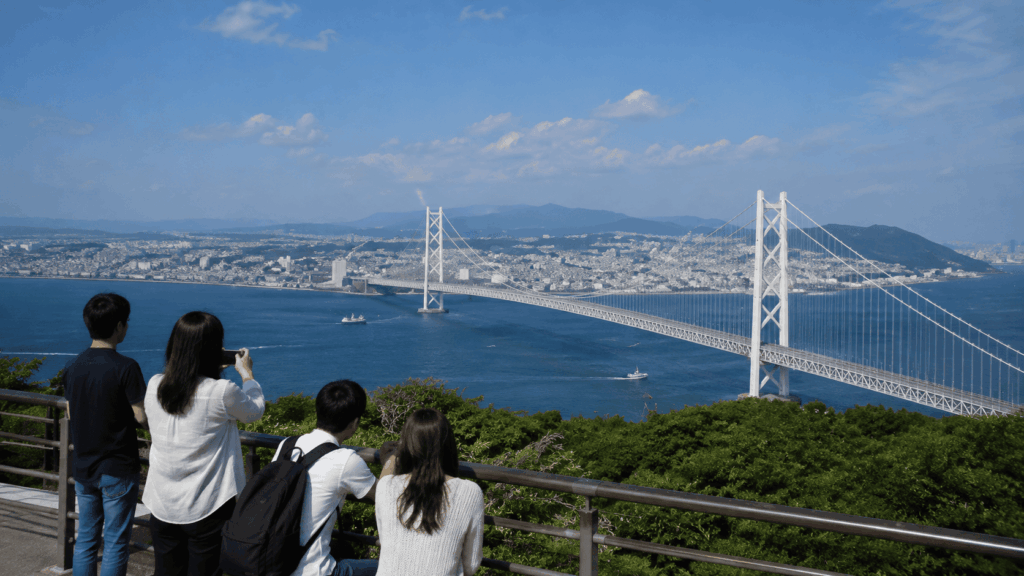
Hyogo Prefectural Awaji Hanasajiki is a hillside flower park about 7 km south of the Awaji IC, reached along Prefectural Route 157 (from the south, the East Awaji IC is closer — about 4 km). From the top paths the flower beds step down toward the sea, with the Akashi Strait and the bridge in the distance.
- Hours: 9:00–17:00 (last entry 16:30); closed late December to early January and on Wednesdays outside busy periods. Summer weekends may stay open until 18:00.
- Entry: Free. Parking costs ¥200 per standard car (paid at a machine before you leave).
- What blooms when: rapeseed fields from early March; cleome and sunflowers in summer; salvia and cosmos from August into autumn. The park changes character completely by season.
Check the Bloom Before You Drive There
The park publishes an official Flowering Information page, updated regularly through the season. It is worth a look the night before: if the main beds are between blooms, the stop still has excellent bridge views, but you may want to shorten it and give the extra time to Fukura. If the flowers are at their peak, budget a full hour — the paths invite slow walking.
Kai’s tip: The park sits on an open hillside, and the wind is stronger than it looks from the car park — I have watched travelers in skirts and wide-brimmed hats spend more time adjusting than looking. Dress in layers you can hold down, keep hats on a strap, and check the official flowering information the night before. The flowers decide whether this is the highlight of your morning or a pleasant photo stop.
Stop 2 — Early Lunch at Michi-no-Eki Awaji
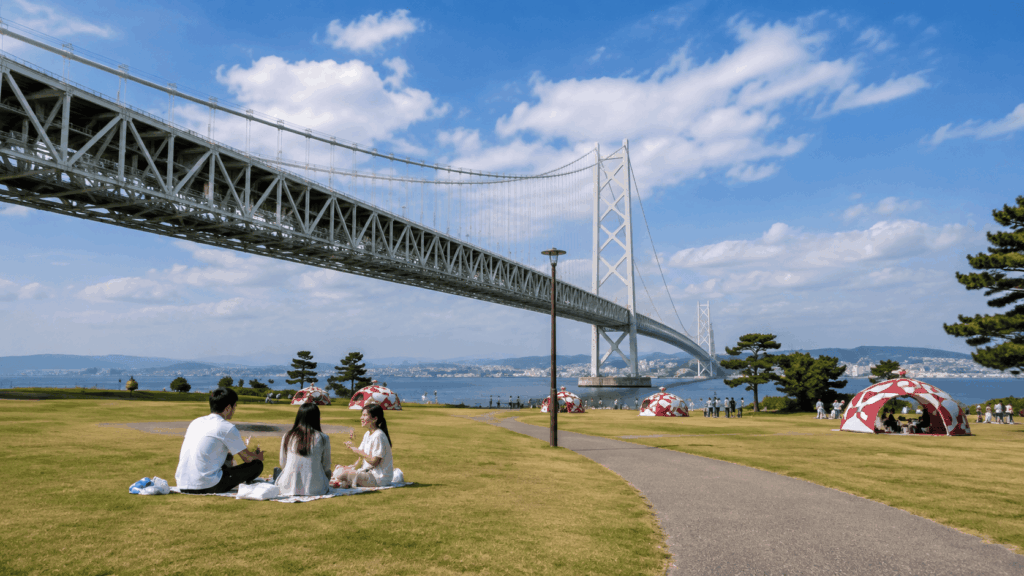
Michi-no-Eki Awaji, at Iwaya on the island’s north end, is the road station closest to the Akashi Kaikyo Bridge — about five minutes from the Awaji IC, with free parking. It is a working lunch stop, not a tourist trap: a seafood bowl counter, a burger stand, a second-floor restaurant, and a gift shop heavy on local onion products.
- Hours: weekdays 9:30–17:30 (until 17:00 in December–February); weekends and holidays from 9:00. The second-floor restaurant opens at 11:00.
- Eat here: the seafood bowl counter Ebisumaru for a quick, filling meal; the second-floor restaurant for a sit-down version with bridge views.
- Photo spot: the terrace looks straight at the bridge, and there is a spot directly beneath the structure where you can shoot upward along the cables — the road station is one of the few places you can stand right under the deck.
Should You Try the Nama Shirasu Don?
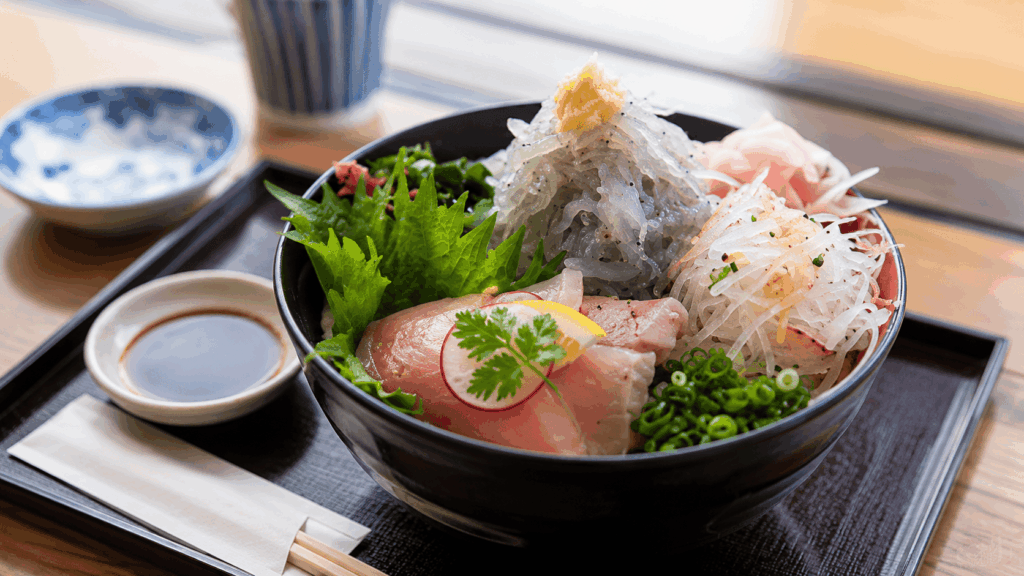
The local signature is nama shirasu don — a bowl of raw whitebait over rice, served with wasabi, soy, and toppings. It is seasonal, roughly mid-April to the end of November, and costs in the region of ¥1,200–1,400 depending on the season and catch. I expected a stronger fishy smell, but fresh shirasu is delicate and mild — the texture is the point, not the flavor. If raw fish is not for you, the counter also has cooked and grilled options, so nobody in the group is stuck.
Kai’s tip: If your cruise sails in the early afternoon, I make it a habit to eat before 11:30. The road station is a magnet for tour buses around noon, and you do not want a lunch queue eating into the buffer you need before the boat. It is not a guarantee of an empty restaurant — just a better hand. Order at the counter, eat, and you are back on the road by 12:30.
Drive South to Fukura Port
From Michi-no-Eki Awaji, take the Kobe-Awaji-Naruto Expressway south. The drive to Fukura Port runs about 50 minutes by toll road, or a little over an hour on local roads if you prefer to save the toll. The expressway is the realistic choice on a one-day trip — it frees up the time you will want in Fukura.
Most visitors underestimate the island’s length — it is roughly 60 km from the bridge to Fukura. That is exactly why this itinerary commits to three stops rather than five: a comfortable day means driving less and looking more.
Two practical notes for the drive:
- Strong winds can close the Akashi Kaikyo Bridge — rarely, but when it happens the crossing shuts for safety. If heavy wind is forecast, check the bridge status before you leave the city and keep a morning buffer in your plan.
- Fukura itself is worth ten minutes before the boat. The port has a road station (Michi-no-Eki Fukura) and the Uzushio Dome Nanairo-kan exhibition dome; both are a short walk from the cruise boarding point. Save the exploring for after you have confirmed your boarding time.
Stop 3 — Uzushio Cruise: The Highlight You Must Time Correctly
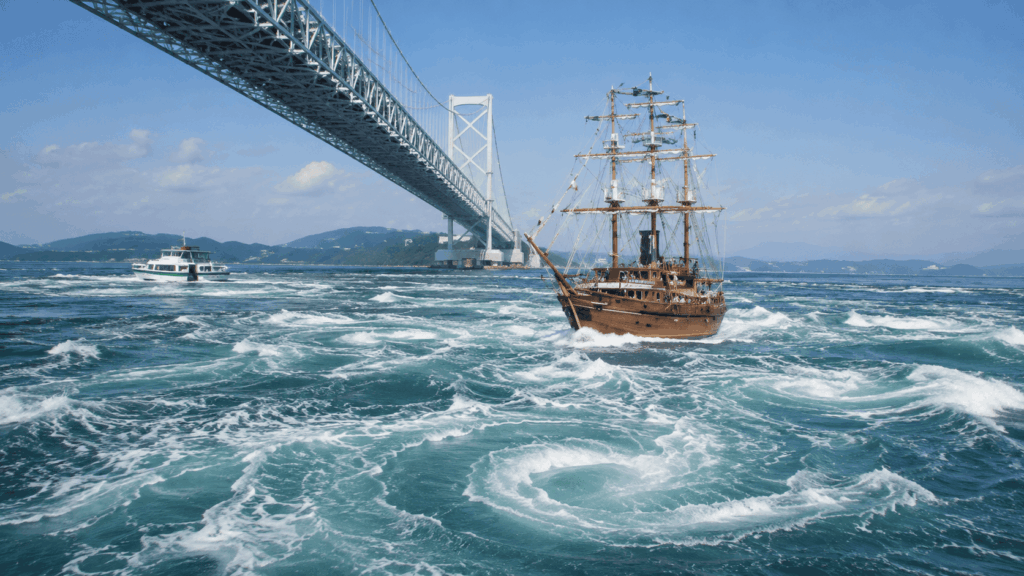
From the south end of the island, the Uzushio Cruise runs sightseeing boats from Fukura Port out to the Naruto Strait, where the tide squeezes through a narrow channel between the island and Shikoku and forms the famous whirlpools. The boats — the Kanrin Maru and Nippon Maru — take about 20 minutes to reach the strait, spend around 20 minutes circling the whirlpool area, and return, for a total trip of roughly one hour.
- Fare: around ¥3,000 per adult, ¥1,500 for elementary-school children (rates can change — confirm on the official site).
- Boarding point: Fukura Port, about a three-minute walk from the Fukura bus terminal. The ticket office is the low, half-round building at the water’s edge — you can see the boats moored beside it.
- Booking: online reservations are available up to about 40 minutes before departure, which is worth doing on weekends and public holidays.
- When to arrive: the official guidance is 30 minutes before departure on weekdays and 40–50 minutes on holidays. The queue builds quickly on good-tide days.
The timetable is published day by day, and every sailing carries an expectation rating based on how close it falls to the day’s high or low tide. Days around the new and full moon — the spring tides — are marked as having the largest whirlpools expected, but every day is different, and no sailing guarantees a dramatic spin.
Kai’s tip: The single biggest difference between a great whirlpool trip and a flat one is the sailing time, not the boat or the weather. On the days when the tide is right, you can hear the difference in the crowd — people move from one side of the boat to the other and stay there. When the current is weak, the strait is still worth seeing, but it reads more like fast-moving water than whirlpools. So check the expectation ratings on the official timetable the night before, pick the best-rated sailing that fits your morning, and build the rest of the day around that number — not the other way around.
What If You Do Not See a Big Whirlpool?
Be honest with yourself about this before you pay: the whirlpools are a tide phenomenon, and no operator can guarantee them. What you are guaranteed is a boat ride into one of the world’s fastest tidal channels, passing beneath the Onaruto Bridge, with the water visibly churning around the boat. Recent visitors who went on a strong-tide day consistently describe the scale as bigger than photos suggest; those who went at a weak time describe the cruise as pleasant but the whirlpools as underwhelming. Both are fair outcomes.
Two ways to protect your day:
- Choose a high-expectation sailing even if it means adjusting the route order. This is the entire logic of this itinerary.
- If the ratings are low all day (it happens on some dates), consider skipping the cruise and giving the extra time to the flower park or a slow lunch instead. The strait is still visible from the shore near the Onaruto Bridge, and your budget and schedule stay intact.
If you are prone to seasickness, the crossing from Fukura is generally calm, but the circling section can be bouncy; a pre-booked window seat and a look at the horizon help. The boats sail close enough to the whirlpools that you feel the water moving under you, which is part of the point — and part of why it is fun.
Do You Need a Car for This Awaji Island Itinerary?
Short answer: for this three-stop route in one day, a car makes the difference between a smooth day and a rushed one. Awaji Island is served by buses — Awaji Kotsu and Honshi Kaikyo Bus run express services from Kobe and Osaka to the island’s main towns — but the stops in this itinerary sit far apart, and the bus network is built around towns, not sightseeing loops. You can reach Hanasajiki and Fukura by bus, but tying both to a specific cruise sailing in a single day is tight and unforgiving.
| Self-drive (rental car) | Private customizable tour | Public buses | |
|---|---|---|---|
| Freedom to chase the tide | High — you set the sailing time | High — a private tour adjusts to your plan | Low — you fit the cruise into bus times |
| Driving | You drive the whole day (~120 km round trip) | None — driver and vehicle included | None, but several transfers and waiting |
| Cost | Rental + tolls + fuel | Highest — price depends on group size and pickup point | Lowest — bus fares only |
| Language support | Self-navigated; signs on the expressway are bilingual | An English-speaking driver/guide is the usual setup — confirm when booking | Japanese announcements; plan your stops in advance |
| Best for | Confident drivers who want total control | Travelers who dislike driving, families, or anyone short on planning time | Budget travelers with a flexible schedule and no fixed cruise time |
If you like this route but would rather not drive, a private customizable tour from Osaka or Kobe is the closest match to this itinerary — you agree the stops and pickup point in advance, and the driver handles the island’s long southern leg while you watch the scenery. For a full comparison of transit options, see our guide on how to get to Awaji Island by bus, car, or tour. Prices vary with group size, so the comparison that matters is not the sticker price but whether it buys you the same day without the driving.
One honest note about the bus option: it works if you treat it as a two- or three-day island visit, or if you accept that you will see fewer places in one day. Trying to hit Hanasajiki, Michi-no-Eki Awaji, and the cruise by bus on a single timetable is how travel days turn into waiting days.
If you fall into that camp — you want the island’s north-to-south highlights but do not want a full day of expressway driving — this is the one private option that most closely matches the logic of the itinerary above.
Why I’d book this one
- It matches the route rather than replacing it with a generic sightseeing loop. Awaji Island and the Naruto area are built into the experience, with stops such as Awaji Hanasajiki available within a customizable day.
- It removes the hardest part of the itinerary. The private vehicle handles the long drive between the island’s north end and Naruto, which is exactly where public transport makes this one-day plan awkward.
- It keeps the commitment flexible. Pickup options, tour length, cancellation terms, and availability can all be checked for your date before you finalize the rest of the day.
When You Should Reverse, Shorten, or Skip This Route
This itinerary is designed to be adjusted, not followed rigidly. The decision rules:
- Reverse it when the best-rated cruise sailing falls in the morning. Do the cruise first, lunch at Michi-no-Eki Awaji on the way back north, and finish at Hanasajiki in the early afternoon (it stays open until 17:00).
- Shorten Hanasajiki when the official flowering information shows the main beds between blooms. Keep it to a quick photo stop and give the extra hour to Fukura, or leave earlier for the return drive.
- Shorten the whole route when you are traveling with young children or anyone who needs a slower pace. Two stops — lunch and the cruise — make a genuinely relaxed day.
- Skip the cruise entirely on dates when the tide ratings are low all day, or when you are sensitive to motion and the sea looks rough. The island still has a full day in it without the boat.
- Split it into two days if you also want Nijigen no Mori, the anime-themed park on the north end, or a beach-and-café afternoon. That is a different trip, and trying to add it here is how this route stops being comfortable.
If you are tempted to add a fourth stop, use this test: does it sit within 15 minutes of the road you are already on, and can you do it without touching your cruise buffer? If the answer to either is no, leave it for the return visit.
Final Tips for a Smooth Awaji Island Day Trip
A short checklist to run the night before — this is the part that decides whether the day feels easy or feels like logistics:
- Check the cruise timetable and expectation ratings for your exact date, then fix the sailing you want. Everything else hangs off this.
- Check the Hanasajiki flowering information and decide in advance whether the park gets a full hour or a quick look.
- Check the weather and bridge status. Strong wind can close the Akashi Kaikyo Bridge; if it is forecast, keep a morning buffer or move the day.
- Set the car navigation to Fukura Port (or your chosen sailing time) and know that the expressway is the time-efficient choice on this route.
- Carry a little cash — the Hanasajiki parking lot takes card payments at the machine, but small road-station counters and parking can still be cash-friendly territory. ¥2,000–3,000 covers the day.
- Dress for wind, in layers. The flower park is exposed, and the boat deck is cooler than the shore.
- Book the cruise online up to 40 minutes before departure if your date falls on a weekend or holiday.
- Arrive at the port with a buffer — 30 minutes on weekdays, 40–50 on holidays — and use the spare time at the port’s road station rather than in a queue.
FAQ
Is one day enough for Awaji Island?
Yes, if you drive and stick to this three-stop route: Awaji Hanasajiki in the morning, lunch at Michi-no-Eki Awaji, and the Uzushio Cruise from Fukura Port in the afternoon. The island is roughly 60 km long from the Akashi Kaikyo Bridge to Fukura, so a comfortable day means limiting yourself to stops that sit on one north-south line. If you want to add Nijigen no Mori or a beach-and-café afternoon, plan for two days instead.
Do I need a car for this one-day itinerary?
For these three specific stops in one day, a car is the practical choice. Public buses (Awaji Kotsu and Honshi Kaikyo Bus) reach the island’s towns, but the stops here sit far apart and the network is built around towns rather than sightseeing loops — tying both the flower park and a fixed cruise sailing to bus times is tight. If you do not drive, a private customizable tour from Osaka or Kobe matches this route most closely, or you can spread the island over two or three days by bus.
Can I see the Naruto whirlpools and the north of the island on the same day?
Yes — that is exactly what this itinerary is designed for. The key is picking your cruise sailing first, then fitting the flower park and lunch around it. With an afternoon tide you go north-to-south as written; with a morning tide you reverse the route and do the cruise first. The drive between the two ends of the island is about 50 minutes on the expressway, which is manageable in a full day.
What time should I take the Uzushio Cruise?
The sailing closest to the day’s high or low tide, which the official timetable marks with a higher expectation rating. This changes every day, so there is no fixed best time — the answer is “the sailing with the best rating that fits your morning.” Days around the new and full moon (spring tides) tend to have the largest whirlpools expected, but no sailing guarantees them.
Can I do this day trip from Osaka, or only from Kobe?
Both work. Kobe is closer — about 1 hour 15–30 minutes by car to the island’s north end — while Osaka adds roughly 40–60 minutes to the drive depending on where you start. From Osaka, leave early and keep the same structure: flowers, early lunch, afternoon cruise. For a route explicitly timed from the city, see our dedicated Awaji Island day trip from Osaka itinerary. The route works from either city; the starting time is the only thing that changes.
Is the Uzushio Cruise worth it if the tide ratings are low?
It depends on what you want. On a weak-tide day the strait reads more like fast-moving water than dramatic whirlpools, and recent visitors describe the trip as pleasant but underwhelming on those dates. The boat ride under the Onaruto Bridge is still a good hour on the water. If the ratings are low all day, consider skipping the cruise and giving the time to the flower park instead — the strait is also visible from shore near the bridge.
What is the best season to visit Awaji Island?
Each season changes the flower park: rapeseed from early March, cleome and sunflowers in summer, salvia and cosmos from August into autumn. The nama shirasu don at Michi-no-Eki Awaji is seasonal too, roughly mid-April to the end of November. The whirlpool cruise runs year-round, so the best season is really a choice between flower colors and how much you want the raw whitebait.
Final Verdict: Who Should Do This Awaji Island Itinerary
What I would tell a friend visiting for the first time: do not try to see the island — decide on three things, get the tide right, and let the day feel long. This route is built exactly that way.
Choose this itinerary if you are a first-time visitor who wants flowers, local seafood, and the Naruto whirlpools in one balanced day; you are comfortable driving on expressways; and you like the idea of a full but unhurried day rather than a checklist.
Choose another option if you do not drive (look at a private customizable tour from Osaka or Kobe, or plan two or three days by bus); your group includes young children or anyone who needs a slow pace (drop to two stops); or your real goal is Nijigen no Mori, beaches, or cafés — that is a different trip.
For first-time visitors: follow the route as written, north-to-south, with the cruise in the afternoon. The order is the point — Hanasajiki in morning light, lunch before the noon crowd, and the tide working for you when you reach Fukura.
For families: cut the day to two stops — an early lunch at Michi-no-Eki Awaji and the cruise — and let Hanasajiki be optional depending on the kids’ mood and the flowering status. The road station has the practical advantage of free parking, quick food, and the bridge as a backdrop.
For travelers on a tight schedule: skip nothing except the extras. Commit to the three stops, use the expressway for the southern leg, and book the cruise online the night before so the port is not where your buffer disappears.
For repeat visitors: skip the flower park if the flowering information is weak and spend the morning in Fukura — the port’s road station and the Nanairo-kan dome are worth more time than a second look at beds between blooms. Then take whatever sailing has the best rating; on a spring-tide day, that is the version of the whirlpools people travel to Japan for.
For non-drivers: this specific route in one day is the wrong fit for the public bus network, and I would rather tell you that plainly than sell you a timetable that does not exist. Match the day with a private tour, or accept a slower two-day island visit by bus — both are better than a rushed transfer day.
Hi, I’m Kai. I’m a Tokyo-based travel writer, tourism industry insider, and the author of a published guidebook for international visitors to Japan. With over 10 years of professional experience at a leading Japanese tourism company, my mission is to help you skip the tourist traps and navigate Japan’s best destinations like a local. I believe the perfect day trip is like a traditional kaiseki meal: a beautiful balance of precise planning and unforgettable seasonal discovery. When I’m not out conducting field research, you’ll usually find me drafting new itineraries with one of my favorite fountain pens!