
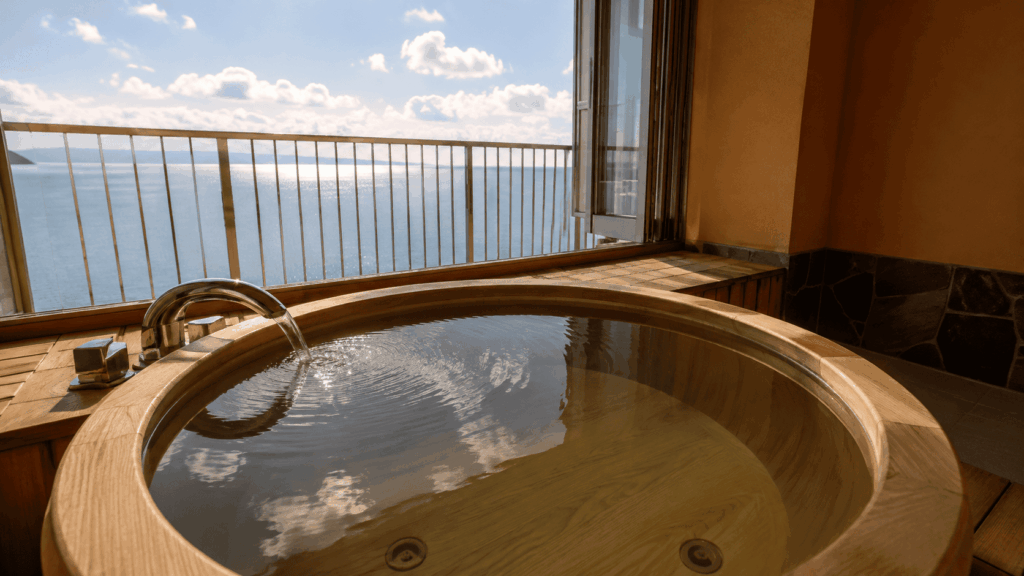
Awaji Island is Kansai’s easiest resort escape — roughly 90 minutes by express bus from Kobe or a short drive across the Akashi Kaikyo Bridge — and yes, it has real onsen. But it is not a classic hot-spring town in the mold of Arima or Kinosaki. Its strength is different: ocean-facing baths, two of Japan’s most dramatic bridges, and seafood-driven ryokan dinners. This guide compares the island’s main onsen areas and hotels so you can pick the one that fits your trip, whether you have a rental car, a day to spare, or a full overnight stay in mind.
Leaning toward an overnight rather than a quick day soak? If the Ōnaruto Bridge view is the reason you’re considering Awaji, compare current dates and room options for Plaza Awajishima before fixing your south-island itinerary.
Is Awaji Island Worth Visiting for Onsen?
The short answer: yes, if you want ocean views, bridge views, and a resort-style soak within easy reach of Osaka or Kobe — no, if you expect a compact hot-spring town you can wander in a yukata.
- Choose Awaji for: open-sea baths, the Akashi Kaikyo Bridge and Ōnaruto Bridge as backdrops, fresh seafood and Awaji Island beef at dinner, and a relaxed seaside stay that works well for couples and families.
- Skip Awaji if: your idea of onsen is a traditional mountain town with a river, sake bars, and rotenburo hopping on foot — Arima Onsen (40 minutes from Kobe) or Kinosaki Onsen (2.5 hours from Osaka) serve that better.
What I tell first-time visitors is that the memory here is rarely the water itself — it’s the setting. Standing in an outdoor bath watching the Akashi Kaikyo Bridge light up at dusk, or soaking while the Ōnaruto Bridge cuts across the sunset, is what people actually talk about afterwards. As of August 2026, these are the island’s main onsen options, grouped by the area where they sit.
Quick Guide: Which Awaji Island Onsen Should You Choose?
| Place | Best for | View | Day use? | Without a car | Stay or visit? | Main drawback |
|---|---|---|---|---|---|---|
| Matsuho no Sato (Northern Awaji) | Bridge views on a day trip | Akashi Kaikyo Bridge | Yes | Feasible via Banban bus (¥150 flat fare) | Day visit | Hilltop location; no overnight onsen on site |
| Kaigetsukan (Sumoto) | Open-sea soak in the onsen town | Kii Channel (ocean) | Yes, afternoons | Easy — Sumoto is the main bus hub | Day visit or stay | Classic facilities; limited day-use hours |
| Hotel New Awaji / Awaji Yumesenkei (Sumoto) | Fuller resort stay with multiple baths | Ocean | Lunch-and-onsen plans only | Free shuttle from Sumoto Bus Center | Overnight recommended | Bath-only visits are not currently accepted |
| Plaza Awajishima (Minamiawaji) | Ōnaruto Bridge views and two different springs | Ōnaruto Bridge & Naruto Strait | Not currently | Free shuttle from Fukura Bus Terminal | Overnight | Works best as a stay, not a stop-off |
| AWAKAN (Sumoto) | Families who want fishing plus onsen | Ocean | No | Free shuttle from Sumoto Bus Center | Overnight | Activities need advance planning |
Prices, shuttle schedules, and day-use policies change, so treat this table as a shortlist rather than a booking reference. The sections below go into the details that matter on the day.
Awaji Island’s Three Onsen Areas at a Glance
Before choosing a hotel, it helps to understand the island’s geography. Awaji runs roughly north to south, and the three onsen clusters sit far apart — about an hour’s drive between the northern and southern ends.
| Area | Main appeal | Best for | Transport hub | Onsen style | Nearby experience |
|---|---|---|---|---|---|
| Northern Awaji (Iwaya area) | Akashi Kaikyo Bridge views; closest to Kobe | Day-trippers, bridge fans | Awaji IC, Iwaya port | Day-use onsen (Matsuho no Sato) | Akashi Kaikyo Bridge viewpoints, road stations, Nijigen no Mori |
| Sumoto (east coast) | Seaside onsen town vibe with ryokan clusters | Couples, no-car travelers, first-timers | Sumoto Bus Center | Ocean-facing ryokan baths | Sumoto Castle, harbor walks, seafood restaurants |
| Minamiawaji (south tip) | Ōnaruto Bridge panorama, resort-style hotels | Scenic overnight stays, couples | Fukura Bus Terminal | Resort onsen with bridge views | Naruto whirlpools (Uzu-no-michi), UZU LOOP shuttle |
A common mistake I see is booking the first hotel that looks nice in photos without realizing how far the island’s attractions are from it (if you’re still planning your stops, here are the best things to do in Awaji Island). If your plan includes the Naruto whirlpools, staying in the south saves you a long drive; if you’re crossing the bridge just for an afternoon, the north is the practical choice.
1. Matsuho no Sato — Best for Akashi Kaikyo Bridge Views on a Day Trip
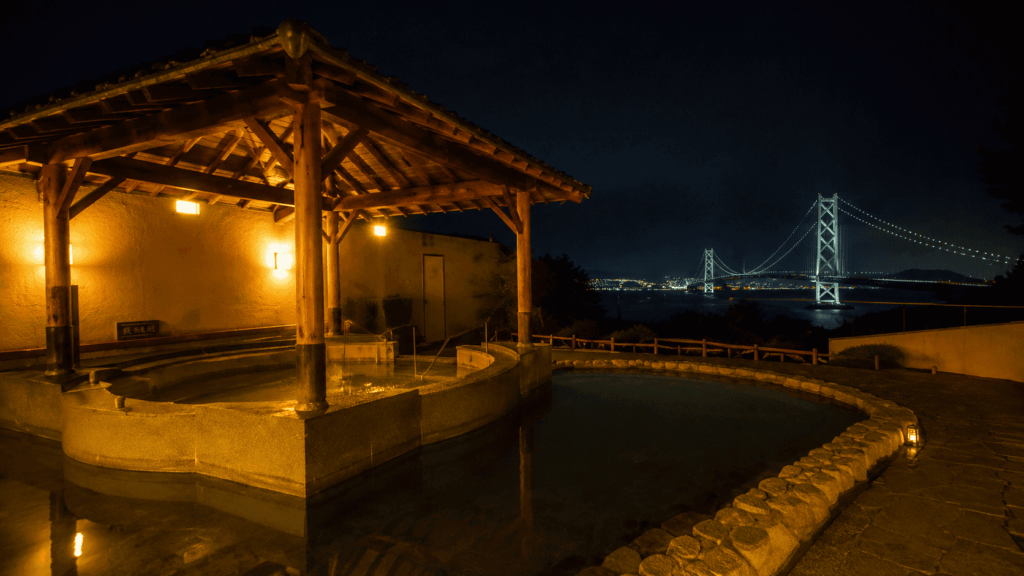
Matsuho no Sato (美湯松帆の郷, Biyu Matsuho no Sato) is the island’s best day-use onsen, sitting in the Iwaya area at the northern tip — the first onsen you reach after crossing the Akashi Kaikyo Bridge from Kobe. The facility has two outdoor baths, one Japanese-style and one Western-style, which alternate between men and women by day. Both face the bridge, so the view works regardless of which side you get.
The water is a simple weak radon spring — nothing dramatic in mineral content, but the setting is the draw. Timing matters: the bridge is lit up after sunset, and the dusk-to-evening window is consistently the most recommended time to visit. Admission is ¥800 for adults, ¥450 for children aged 4 and up, and the onsen is open 11:00–22:00 (last entry 21:00). It closes on the first Thursday of most months, though not in January, April, May, or August — check before you go.
Kai’s tip: The onsen sits partway up a hill above the shore, and the walk from the nearest bus stop includes a steady climb. On a fine day it’s manageable, but with luggage, in rain, or after dinner it feels longer than the map suggests. If you’re driving, this is a non-issue — there’s a free 70-car lot at the top. If you’re on foot, give yourself an extra 10–15 minutes and consider taking a taxi from Iwaya port.
Who Matsuho no Sato Is Best For
- Best for: bridge photographers, day-trippers coming from Kobe or Akashi, drivers, and anyone who wants a quick soak without committing to an overnight stay.
- Less ideal for: travelers who want a classic onsen town experience, families needing a place to sleep nearby, or anyone with limited mobility — the hilltop access is the one real friction point.
Getting there by public transport is straightforward: take the ferry from Akashi port to Iwaya (about 15 minutes), then the local Banban bus — the flat fare is ¥150 per ride anywhere on the route — or a short taxi. From Awaji IC on the expressway, it’s about five minutes by car. Note that the onsen’s free shuttle from Iwaya has not been listed on the official access page recently, so plan around the bus or taxi instead of assuming a pickup.
2. Sumoto Onsen — Best Overall Choice Without a Car
Sumoto is the island’s de facto onsen town and the easiest base for travelers relying on public transport. Express buses from Osaka (about 2 hours 20 minutes, from around ¥2,600) and Kobe (about 1.5 hours, from around ¥2,270) arrive at Sumoto Bus Center, which is also where most hotels run free shuttles. The baths here face the Kii Channel — an open stretch of sea that changes color through the day — and the town has enough restaurants and a castle for a relaxed evening stroll.
Kaigetsukan — Best for Location Over Luxury
Kaigetsukan (海月館) is a classic seaside ryokan right on the Sumoto waterfront, with a large bath facing the channel and a rooftop open-air bath, “Shiosai no Yu,” on the fifth floor. For a day visit, it’s the most accessible of the Sumoto options: afternoon bathing runs 13:00–19:00, with admission around ¥1,500 without a towel or ¥2,000 with one (rates were revised in 2025, so confirm current pricing). Overnight guests can use the baths in the early morning and evening windows.
What stands out here is the sense of being almost on the water — the outdoor bath looks straight out to sea, and on a clear day the horizon stretches unbroken. Recent visitors consistently praise this openness, and for a quick soak in Sumoto it’s hard to beat the location.
Kai’s tip: On one of my visits, the outdoor water felt noticeably warmer than at the newer resort baths on the island, and the building has a classic, slightly dated character that some guests love and others notice. That’s not a reason to skip it — the open-sea setting is genuinely lovely — but if sleek modern facilities are a priority, set expectations accordingly and weigh it against the two hotels below.
Hotel New Awaji and Awaji Yumesenkei — Better for a Fuller Onsen Stay
If you’re staying overnight, the two big names in Sumoto are Hotel New Awaji and its sister property Awaji Yumesenkei. Hotel New Awaji is a large oceanfront resort with two bath areas — the forest-inspired “Mori no SPA” and the detached “Umi no Mori” — plus private baths. Note that bath-only day visits are not currently accepted; the practical day option here is a lunch-and-onsen plan starting at roughly ¥3,000.
Awaji Yumesenkei, a short drive north, is the more atmospheric choice: it draws from two springs on its own grounds — the newer Sumoto Onsen and the cloudy, mineral-rich Komoe Onsen — and its signature baths include an infinity-style pool overlooking the sea and a rocky open-air bath at the water’s edge. It’s about 90 minutes from Kobe by car, and the higher price tag buys quieter, more design-led surroundings than Hotel New Awaji.
Both hotels run free shuttles from Sumoto Bus Center, so neither requires a car — but plan the shuttle timing in advance, because the buses run on fixed schedules rather than on demand.
3. Plaza Awajishima — Best for Ōnaruto Bridge Views and Two Different Hot Springs
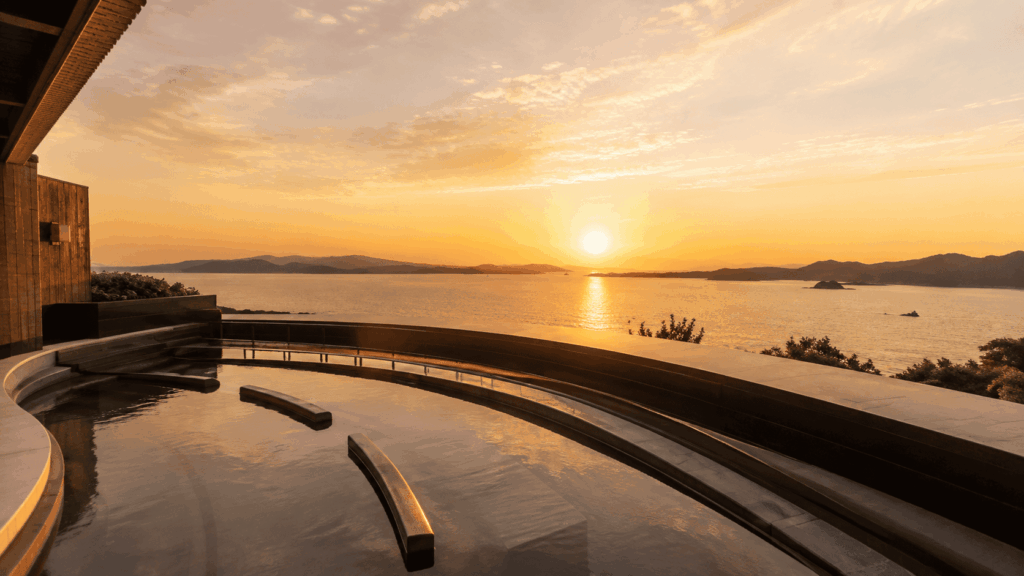
For the island’s most dramatic onsen setting, head south. Hotel New Awaji Plaza Awajishima (ホテルニューアワジ プラザ淡路島) sits near the tip of Minamiawaji, where the Ōnaruto Bridge spans the Naruto Strait toward Shikoku. The main bathhouse, “Tenku no Spa Yuhae no Yu,” looks straight at the bridge — on clear evenings the sunset lines up behind the span, and it is genuinely the kind of view people photograph from the water.
What makes this hotel unusual is that it draws from two different springs. The outdoor bath uses the hotel’s own Minamiawaji Onsen source, a sulfur-bearing sodium chloride spring that opened in 2018 and is classed as a therapeutic water; the indoor bath uses Uzushio Onsen Ten no Yu, a sodium bicarbonate cold mineral spring — the classic “beauty water” type. Having two distinct waters in one bathhouse is rare enough on a small island that I’ve taken guests here specifically to compare them, and the difference between the mineral-rich outdoor water and the softer indoor one is immediately noticeable.
From showing guests around this hotel, I’d add two practical notes: the bathhouse closes in the late morning and reopens at noon (roughly 5:30–10:00 and 12:00–24:00), and the evening hours are when the bridge view is at its best — so plan your soak for after dinner rather than right after check-in. And because the two springs really do feel different, try both baths even if the outdoor one is the crowd-pleaser.
The Main Drawback: It Works Best as an Overnight Stay
Day-use bathing is not currently accepted at Plaza Awajishima. This is a hotel bathhouse first, so treat it as an overnight proposition — which, given the location, is not a bad thing. An evening soak with the bridge lit up, a seafood dinner, and a morning bath before the express bus back is a complete trip in itself.
If you want the bridge-view bath, dinner-time pace, and a second soak the next morning without moving hotels, this is the stay to compare first.
Why I’d book this one
- It matches the Minamiawaji route particularly well if the Naruto whirlpools are also part of your trip.
- An overnight stay removes the biggest limitation described above: the baths are not currently positioned as a simple bath-only stop.
- You can check current room availability and booking conditions for your dates before finalising the rest of your south-island itinerary.
See current room availability, stay options, and booking conditions for Plaza Awajishima.
Getting there without a car is workable: express buses from Kobe (about 95 minutes) arrive at Fukura Bus Terminal, where the hotel runs a free shuttle, and the UZU LOOP free shuttle bus also stops at the hotel on its Minamiawaji circuit. From Osaka, allow for a transfer or a longer direct bus. If you’re driving, the hotel is about 15 minutes from the Naruto whirlpools viewing spots, which makes it a natural base for combining onsen with the whirlpools the next morning.
4. AWAKAN — Best for Families Who Want More Than Just an Onsen
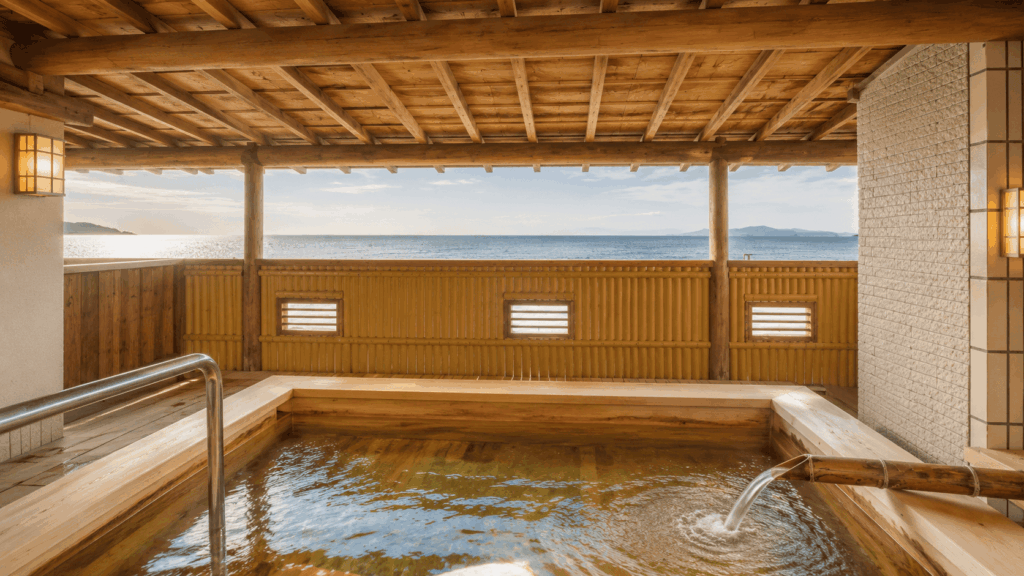
AWAKAN (あわかん) in the Sumoto area is the island’s most family-oriented onsen ryokan — a converted resort hotel with a fishing theme rather than a traditional inn. The headline feature is a private fishing pier that overnight guests can use free, around the clock, with a service that prepares whatever you catch for dinner that same evening. Kids tend to remember the fishing long after they forget the bath, which is exactly the point of this place.
The onsen itself is a straightforward ocean-facing bath in the Sumoto spring area — pleasant but not the reason to book. The reason is the combination: soak in the morning, fish in the afternoon, and eat your catch at dinner. Note that offshore boat fishing is available but paid and requires advance contact, and the kitchen’s fish preparation depends on what is actually caught, so treat the dinner plan as flexible rather than guaranteed.
For non-Japanese speakers, AWAKAN is one of the easier ryokan experiences on the island: the staff roster covers nine languages including English, and the free shuttle from Sumoto Bus Center works by phoning the hotel on arrival. It’s about 60 minutes from Kobe by car.
- Best for: families with school-age kids, first-time ryokan guests who want activities built in, travelers who enjoy fishing.
- Less ideal for: couples seeking a quiet, design-led escape, or anyone on a tight schedule — the fishing experience needs an unhurried overnight stay to work.
Day Trip or Overnight Stay: Which Makes More Sense?
This is the question most people actually face when planning, and the honest answer depends on which area you choose:
- Choose a day trip if you’re crossing the bridge from Kobe or Akashi for a few hours and want a single soak with a view (for a full route, see our one-day driving itinerary from Osaka). Matsuho no Sato covers this perfectly, and Kaigetsukan’s afternoon bathing window works if you’re already in Sumoto.
- Choose an overnight stay if you want the Ōnaruto Bridge sunset bath at Plaza Awajishima, a full seafood dinner, a second soak the next morning, or the fishing experience at AWAKAN. Half of what makes Awaji onsen memorable simply does not exist for day visitors.
My observation from covering the island: first-time visitors who come just for a day usually leave satisfied but slightly puzzled about the fuss — the island’s onsen are good, but the magic is in the slower rhythm of an evening bath, dinner, and a morning soak with the sea in front of you. If your schedule allows one night anywhere in Kansai, spending it here is the way to actually feel the difference.
What Eating at an Awaji Onsen Ryokan Is Actually Like
Dinner is where Awaji Island separates itself from a generic resort stay. Ryokan meals here lean heavily on the sea — local fish, shellfish, and the island’s famous onions and beef — served as multi-course kaiseki in your room or a dining hall. Two things deserve attention:
- Awaji Island beef: a regional wagyu with a milder, leaner character than Kobe beef, usually served as a small grilled course rather than the centerpiece.
- Awaji Island onions: the island’s signature crop, sweet enough that Western visitors regularly mistake them for a different vegetable entirely.
Why Awaji Island Onions Are Worth Paying Attention To
Every time I’ve sat with foreign guests at an Awaji dinner table, the onions are the sleeper hit. They appear as a slice in soup, caramelized on the side of a beef course, or as a sweet-sour pickle — and the reaction is almost always the same surprised double-take. The soil and the island’s mild climate produce onions with unusually low sharpness and real sweetness, and they’re not something you can recreate at home with supermarket onions. Keep an eye on the vegetable courses; the beef gets the billing, but the onions are the detail people remember.
One practical note: most ryokan dinners need to be included in your booking — very few properties accept walk-in dinner guests — and meal plans are usually booked at the same time as the room. If you have dietary restrictions, inform the hotel at booking; the larger properties like Hotel New Awaji and Plaza Awajishima are the most flexible, while smaller ryokan kitchens have less room to adapt.
Visiting Awaji Island Onsen Without a Car
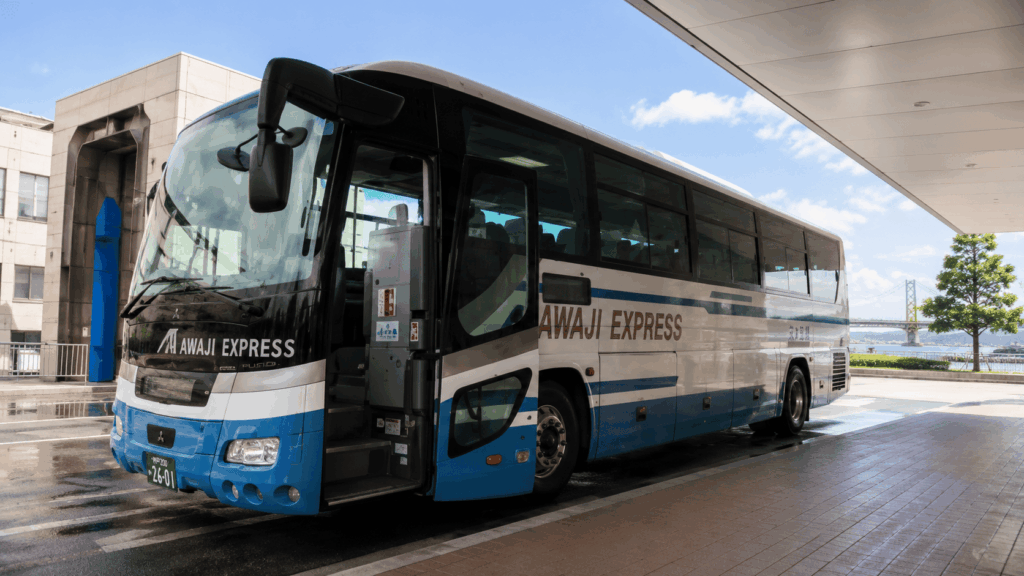
No car is required for any of the onsen in this guide, but the effort varies a lot by area (if you’re still planning your route, check our detailed guide on how to get to Awaji Island) — here’s the realistic picture:
- Sumoto (easiest): express buses from Osaka and Kobe stop at Sumoto Bus Center, the island’s main hub. Kaigetsukan is a short walk or taxi away; Hotel New Awaji, Awaji Yumesenkei, and AWAKAN run free shuttles from the bus center on fixed schedules.
- Minamiawaji (workable): buses from Kobe (about 95 minutes) arrive at Fukura Bus Terminal, where Plaza Awajishima offers a free shuttle. The UZU LOOP free shuttle connects key south-coast stops, but check its operating calendar — some services are seasonal.
- Northern Awaji (possible with planning): the ferry from Akashi to Iwaya takes about 15 minutes, then the Banban bus (flat fare ¥150 per ride) or a short taxi reaches Matsuho no Sato. The walk from the nearest stop includes that uphill stretch mentioned earlier.
Shuttles are the detail that catches people out. They run on fixed timetables matched to bus arrivals, not on demand, so missing one can mean a 30–60 minute wait or a taxi fare. Check the hotel’s shuttle schedule before your bus departs, and if you’re arriving late, ask the hotel directly — some properties, like AWAKAN, expect a phone call on arrival to dispatch the pickup.
Small Things That Can Make or Break an Awaji Onsen Stay
These are the details that rarely appear in hotel photos but shape how your stay actually feels:
- Breakfast crowds: the large properties in Sumoto and Minamiawaji host tour groups, and the breakfast buffet window is where the traffic jams. Kai’s tip: At the bigger hotels I’ve stayed at on the island, the first hour of breakfast is noticeably calmer and the food is fresher — the buffet lines start building as the morning goes on. If you’re not a late sleeper anyway, an early breakfast turn saves time and stress, and leaves the morning free for a quiet bath before check-out.
- Water temperature: bath temperatures vary noticeably between properties, and the classic ryokan baths tend to run warmer than the newer resort ones. If you’re sensitive to heat, the newer hotels (Awaji Yumesenkei, Plaza Awajishima’s indoor bath) are the safer bets.
- Facility age: Kaigetsukan and the older wings of Hotel New Awaji have a dated, functional character, while Yumesenkei and Plaza Awajishima’s newer buildings feel modern. Neither is dirty — just set expectations by era.
- Group tours: Sumoto’s big hotels commonly host tour groups in the evenings. If you want quiet, check reviews for the property’s group-tour volume before booking, or choose a smaller ryokan.
- Towel and locker rules: at day-use baths like Matsuho no Sato, towels are not included in the admission price — you buy a small towel (around ¥200) or bring your own, and the shoe lockers take ¥100 coins (returned).
Check Tattoo Rules Before You Go
Tattoo policy is the most common surprise for international visitors. Matsuho no Sato states its rule plainly on the official site: guests with tattoos — including stickers — are not admitted to the bath, so don’t count on covering up with a bandage. At the hotel properties, policies are set individually and change over time; Plaza Awajishima and the Hotel New Awaji group are known to accept tattoos in the main baths, but you should confirm with the hotel directly before booking. If tattoos are a factor in your choice, send one short message to the property before you commit — it saves an awkward arrival.
FAQ: Awaji Island Onsen Questions, Answered
Are there natural hot springs on Awaji Island?
Yes. The island has several genuine onsen sources, mostly concentrated in the Sumoto area (Sumoto Onsen) and Minamiawaji (Minamiawaji Onsen, including Uzushio Onsen Ten no Yu). Matsuho no Sato in the north runs on a radon spring. Some older hotels pumped plain hot water, but the properties recommended in this guide — Kaigetsukan, Hotel New Awaji, Awaji Yumesenkei, Plaza Awajishima, and AWAKAN — draw from real springs.
Which is better: Sumoto Onsen or Minamiawaji onsen?
For convenience, transport, and a proper onsen-town feel, choose Sumoto — it’s the main bus hub, has more ryokan and restaurants, and works well without a car. For the most dramatic setting, choose Minamiawaji: Plaza Awajishima’s baths face the Ōnaruto Bridge and the Naruto Strait, and it sits close to the whirlpools. The honest summary is that Sumoto is the practical base, Minamiawaji is the scenic splurge.
Can I visit an Awaji Island onsen for the day without staying overnight?
Yes, but the options narrow. Matsuho no Sato in the north is a dedicated day-use bathhouse (¥800 adults, open 11:00–22:00). Kaigetsukan in Sumoto accepts day bathers in the afternoon (13:00–19:00, around ¥1,500–¥2,000). The resort hotels are different: Hotel New Awaji only offers lunch-and-onsen day plans, and Plaza Awajishima currently does not accept day-use bathing at all — both are effectively overnight propositions.
Do I need a car to visit Awaji Island onsen?
No. Express buses connect Osaka and Kobe to Sumoto Bus Center and Fukura Bus Terminal, and most hotels run free shuttles from those hubs. In the north, the Akashi–Iwaya ferry plus the Banban bus (flat fare ¥150) reaches Matsuho no Sato, though the final walk includes a hill. A car makes the island dramatically easier to explore, but every onsen in this guide is reachable without one.
Are tattoos allowed at Awaji Island onsen?
Policies differ by property. Matsuho no Sato officially does not admit guests with tattoos, including stickers. The hotel properties set their own rules and they change over time — the Hotel New Awaji group (including Plaza Awajishima) has accepted tattoos in the main baths, but confirm directly with the hotel before booking, because this is exactly the kind of policy that shifts without warning.
Which Awaji Island onsen has the best ocean view?
For an open-sea horizon, Kaigetsukan’s rooftop outdoor bath in Sumoto is hard to beat. For a bridge-focused view, Plaza Awajishima’s bathhouse faces the Ōnaruto Bridge, and Matsuho no Sato looks across the Akashi Kaikyo Bridge from the north. All three deliver what photos promise, but at different times of day — dusk is the money hour at every one of them.
Is Awaji Island onsen worth it compared with Arima or Kinosaki?
That depends on what you want. Arima (near Kobe) and Kinosaki (north of Osaka) offer classic mountain onsen towns with multiple baths you can hop between on foot. Awaji offers something different: ocean-facing and bridge-facing baths, resort amenities, seafood and Awaji beef dinners, and family activities like fishing. If you value scenery and a relaxed seaside stay over traditional town atmosphere, Awaji is worth it; if you want a textbook hot-spring town, it isn’t.
My Recommended Awaji Onsen Choices by Traveler Type
If you’re still deciding, here’s how I’d steer a friend — and how I’d steer you, based on the kind of trip you’re planning:
- First-time visitor without a car: base yourself in Sumoto. Express buses and hotel shuttles make everything predictable, and Kaigetsukan’s open-sea bath gives you the classic Awaji view on day one. If one night is all you have, this is the lowest-risk choice.
- Day-tripper crossing from Kobe or Akashi: head to Matsuho no Sato for the Akashi Kaikyo Bridge view — it’s the only option that combines a real onsen with a realistic half-day plan. Combine it with a bridge viewpoint or Nijigen no Mori nearby if time allows.
- Couples who want the postcard shot: book Plaza Awajishima in Minamiawaji. The Ōnaruto Bridge bath at dusk, a seafood dinner, and a morning soak before the whirlpools is the island’s most complete onsen package — just be prepared for it to be an overnight stay rather than a stop-off.
- Travelers who value modern facilities: Awaji Yumesenkei’s twin springs and infinity-style bath are the most design-led on the island; Plaza Awajishima’s newer buildings are the southern alternative. Both cost more than the classic ryokan but deliver on comfort.
- Families with school-age kids: AWAKAN. The free 24-hour fishing pier and the dinner-from-your-catch service turn the stay into an experience the kids will actually retell — the onsen becomes the bonus, not the point.
- Repeat visitors to Kansai looking for something different: this is where Awaji genuinely shines. You’ve done the mountain towns; the bridge views and sea-facing baths here are a change of rhythm, and the onions at dinner will be the detail you mention for years.
Whichever you choose, the pattern is the same: arrive early enough for an evening soak, book dinner with the room, and don’t leave before a morning bath. That rhythm — not any single pool — is what makes Awaji Island’s onsen worth crossing the bridge for.
Hi, I’m Kai. I’m a Tokyo-based travel writer, tourism industry insider, and the author of a published guidebook for international visitors to Japan. With over 10 years of professional experience at a leading Japanese tourism company, my mission is to help you skip the tourist traps and navigate Japan’s best destinations like a local. I believe the perfect day trip is like a traditional kaiseki meal: a beautiful balance of precise planning and unforgettable seasonal discovery. When I’m not out conducting field research, you’ll usually find me drafting new itineraries with one of my favorite fountain pens!