
Ine in winter is worth visiting for the funaya boathouses, winter seafood and a quiet coastal stay. Treat snow as a bonus, and plan lunch and the journey home before you go. A snowy waterfront is possible; a guaranteed white village is not.
For a day trip from Kyoto or Osaka, the main decision is how much time you want in Ine. Public transport works with planning. A private vehicle can simplify transfers and let you discuss the balance between Ine and Amanohashidate; an overnight stay gives you the evening and morning that a day tour cannot.
Want Ine and Amanohashidate without winter driving?
Compare this private trip from Kyoto or Osaka if pickup and fewer transfers would help your group. Discuss your preferred time in Ine before booking; boat rides, viewpoints and meals cost extra.
This guide contains affiliate links. One Day Away may earn a commission if you book through them, at no extra cost to you.
In this guide: Is winter worth it? · Snow and weather · Car, bus or private trip · Boathouses and boats · Food · Day trip or overnight · Itineraries · FAQ
Is Ine Worth Visiting in Winter?
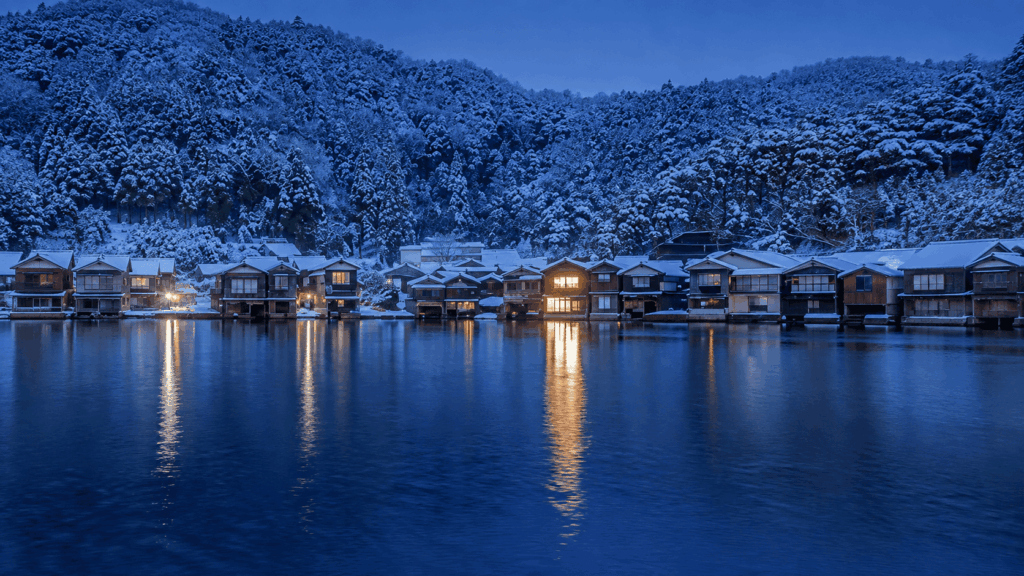
Ine is a working fishing village on the Tango Peninsula in northern Kyoto Prefecture. Its roughly 230 funaya stand around the bay, with boat-storage spaces at water level and buildings rising above them. The appeal is the relationship between the houses, water and everyday harbor life, rather than a long list of ticketed attractions.
Winter is my favorite season to see the funaya. What I see first-time visitors get wrong is treating this as a snow trip. The village can be rewarding without snow: light over the bay, a good seafood lunch and an unhurried walk are stronger foundations for the day than a particular photograph.
| Your priority | Winter reality | A good plan |
|---|---|---|
| Snow photography | Snow can fall, but roofs and streets may be clear or wet | Check the forecast and enjoy the waterfront even without a white landscape |
| Funaya scenery | The boathouses are the main sight in every season | Leave time for a slow public-road walk and, if operating, a boat ride |
| Winter seafood | Buri dishes are a reason to visit; menus and supply vary | Choose the meal and confirm its requirements before building the route |
| A quiet overnight stay | Evenings are subdued and dining needs advance thought | Book suitable accommodation and a confirmed dinner arrangement |
| Two coastal destinations in one day | Ine and Amanohashidate take time to connect | Pick one priority and allow for winter daylight, roads and return transport |
| A busy schedule of indoor sights | There are fewer easy substitutes when weather turns poor | Consider whether this is the right use of your only free day |
Winter can feel calmer than peak sightseeing periods, but do not assume an empty village or a restaurant without a queue. A small number of open tables can create a wait even when the waterfront looks quiet. Leaving room in the day matters more than trying to arrive at a theoretically perfect crowd-free hour.
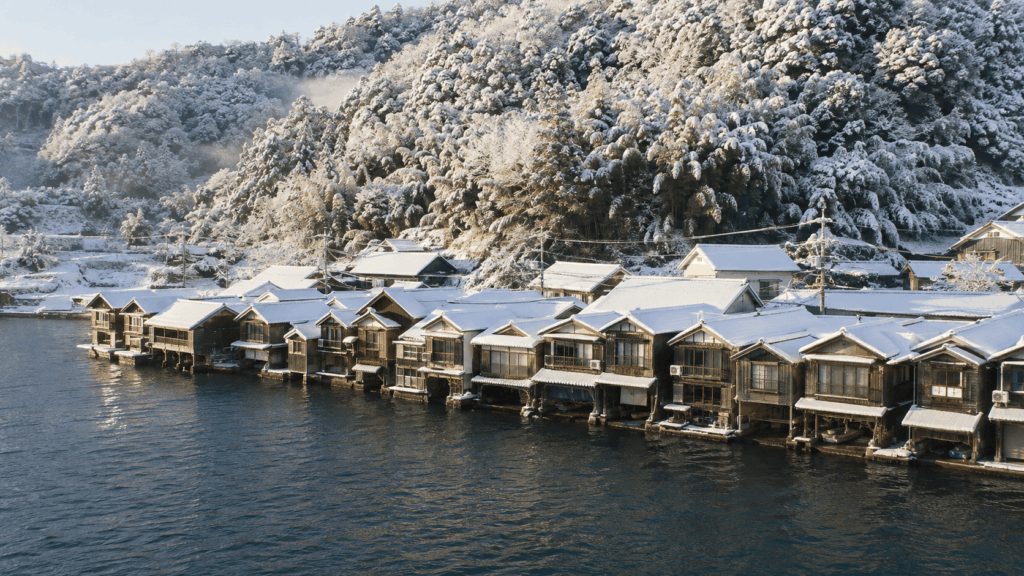
If you like fishing villages, seasonal food and watching the light change, Ine can justify a long journey. If you mainly want to see snow, choose a destination and activity where snow itself is central, and keep Ine for its own attractions. Booking transport does not change that basic fit.
Does It Snow in Ine in Winter?
Yes, snow is possible. Northern Kyoto faces the Sea of Japan and has different winter conditions from Kyoto city. The journey north can encounter snow or ice even when central Kyoto and the village waterfront look clear. Snow at your destination and safe road conditions along the entire route are separate questions.
Coastal snow cover changes with individual weather systems. A photograph of heavily covered roofs does not tell you what the village will look like on your date. Check the local forecast, road information and transport notices shortly before traveling, then check again on the day if conditions are unsettled.
When I visited a few years ago in mid-winter, we woke to a light dusting on the rooftops that was gone by mid-morning — still beautiful, but not the deep-snow village of the postcards.
The useful lesson from that visit is to build a day that still works after the snow melts. A good lunch and a harbor walk can deliver that; a plan whose only success condition is a deep layer of fresh snow cannot.
What Is the Best Winter Month for Snow?
January and February are the colder core of winter, but there is no defensible guarantee for a particular week. December can bring winter weather too, and conditions do not switch off on a fixed date in March. Choose your date around the trip you can enjoy, then use a short-range forecast for the weather-dependent parts.
- December: combine early-winter scenery with a meal you have confirmed. Around New Year, check each inn, restaurant and transport service separately.
- January: prepare for cold, wet weather and possible snow or ice. Keep the day’s route flexible enough to shorten outdoor stops.
- February: the same winter preparation applies. It can suit a food-and-funaya trip, but neither snow cover nor a specific fish dish is assured.
The Miyazu climate reference below provides temperature context, not a snow forecast for Ine. Its published monthly table has no usable snowfall normals, so it cannot establish a precise probability of snow or prove that one two-week window is the snowiest.
How Cold Is Ine in Winter?
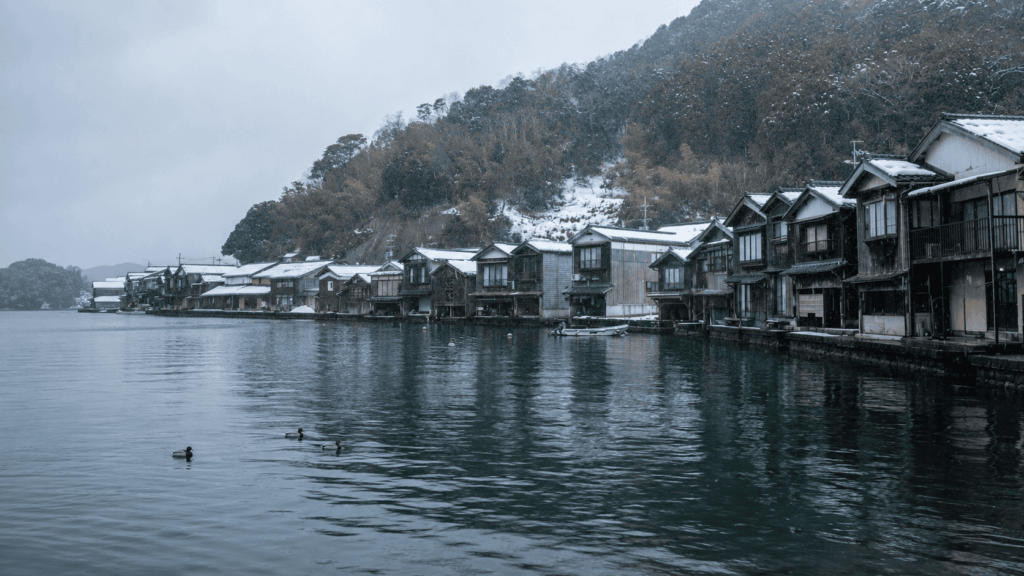
The waterfront can feel colder than the headline temperature suggests, especially while standing still or sitting on an exposed boat. Dress for wind and damp surfaces as well as cold. A dry, bright morning can become an uncomfortable outing if your gloves or shoes get wet.
| Month | Monthly average | Average daily high / low | How to use it |
|---|---|---|---|
| December | 6.6°C / 44°F | 10.8 / 3.1°C, about 51 / 38°F | Prepare for wet, windy conditions rather than expecting mild Kyoto-city sightseeing |
| January | 4.1°C / 39°F | 7.9 / 0.9°C, about 46 / 34°F | Keep warm layers and weather protection available throughout the day |
| February | 4.3°C / 40°F | 8.6 / 0.6°C, about 47 / 33°F | Continue to allow for winter road conditions and slippery walking surfaces |
Source: Japan Meteorological Agency, Miyazu 1991–2020 normals. These are averages at a different location, not actual-day temperatures or minimum possible temperatures in Ine. Use the current local forecast when packing.
My packing rule for a winter visit is a windproof outer layer over a warm mid-layer, a hat and gloves, and waterproof shoes with grip. Add warm socks, a compact rain layer and a bag that keeps your essentials dry. The right footwear should handle a wet road, a dock and any ice you encounter; smooth city soles are a poor choice when surfaces freeze.
For a boat ride, keep your warmer layer where you can reach it rather than packed away in the car. If cold, wind or slippery ground would make the day difficult for someone in your party, reduce the outdoor plan and choose transport and meal stops accordingly.
Getting to Ine in Winter: Car, Bus or Tour?

Ine has no railway station. From Kyoto, a common independent route is a train or highway bus to Amanohashidate, followed by a local bus. Driving is another option, while a private trip can connect the places directly from an agreed pickup point. From Osaka, allow for your own starting location and chosen service rather than copying a Kyoto timing estimate.
Think in terms of a full-day outing. Rail or highway-bus travel, a local connection and waiting can make the public-transport journey roughly three hours each way or longer. Road travel also varies with departure point, traffic and winter conditions. A map’s shortest driving estimate is not a complete day-trip budget.
The guide to getting to Ine covers the route choices in more detail. For winter, use this comparison to decide who should handle the connections and how much freedom you need once you arrive.
| Option | Best fit | What you gain | What still needs planning |
|---|---|---|---|
| Train or highway bus + local bus | Independent travelers happy to match timetables | No winter driving; choose how long to spend in Ine | Separate outward and return connections, stop locations, payment and buffers |
| Rental car | Drivers comfortable with winter conditions | Control over stops, bags and the route within a realistic day | Winter tires, possible chains, road status, tolls, parking and rental return |
| Shared coach tour | Travelers who accept a set route and meeting point | Transport between the listed stops without separate local-bus planning | Exact time in Ine, language, included tickets and the fixed group pace |
| Private vehicle trip | Groups wanting pickup and an agreed balance between the two areas | Direct transport and a route you can discuss before departure | Selected duration, pickup area, time at each stop, driver support and extra costs |
Driving to Ine in Winter
The route from Kyoto commonly uses the Kyoto Jukan Expressway before the final coastal approach. Winter preparation is needed for the journey, even when the funaya district has no snow. The Ine tourism association’s winter guidance asks visitors to arrive with winter tires and links to current road information.
When reserving a rental, request the right tires explicitly and confirm whether suitable chains are available and when they must be fitted. Ask about the vehicle, insurance terms, snow-related restrictions, pickup opening time and return deadline. Winter equipment is not something to assume from the season or from a generic vehicle photograph.
Kai’s tip: When I drove to Ine one winter a few years ago, the snow was light in the village itself — the challenges were all on the way there. Sections of the Kyoto Jukan Expressway had winter-tire checks in place, and the local roads up the peninsula were the ones that felt sketchy. If you rent a car between December and February, request studless winter tires when you book (rental desks usually ask about this in advance), confirm chains are in the trunk, and leave Kyoto early so you are not driving the last stretch back after dark. If the forecast shows heavy snow for the Tango area, I would switch to the bus or a tour without hesitation.
Public buses and tours can also be delayed or canceled in severe weather. If conditions deteriorate, changing the date or shortening the trip may make more sense than switching vehicles and expecting the problem to disappear.
If you will drive independently from Kyoto, compare pickup locations that work with your hotel and departure time. Check the full rental cost with winter equipment, tolls, fuel and parking before deciding it is the cheaper option for your group.
Compare Kyoto car rentals & pickup locations
In Ine, use a designated parking place and walk from there; the narrow waterfront roads serve residents and fishing activity. Check your inn’s arrangement for an overnight stay. A roadside station’s visitor parking is not an automatic permission for overnight or long-term parking, and a lunch stop there does not solve parking elsewhere in the village.
Public Transport from Amanohashidate

Plan three distinct parts: reaching Amanohashidate, the local bus into Ine, and the return. The local ride is roughly an hour depending on the service and stop. Use the current Tankai route-bus information, which now refers to the October 2026 timetable revision, rather than an older April schedule.
The operator gives ¥400 one way from Amanohashidate Station to Ine Bay Cruise / Hide as an example of its two-area fare. That is a local-bus fare, not the cost from Kyoto. Confirm your actual boarding and alighting stops and add the rail or highway-bus fare separately.
- Ine Bay Cruise / Hide is for the larger sightseeing boat. It is not the same stop as the central Ine waterfront.
- Ine is useful for Ineura Park and the tourist information office. Choose it for the central waterfront and nearby eateries.
- Funaya-no-Sato-Koen-mae serves the hilltop roadside-station area. The hilltop restaurants and viewpoint are a different stop from the waterfront.
Check the service day carefully. The operator uses a holiday timetable for December 30–January 3 as well as other designated holiday periods. That does not mean every bus stops running over New Year, or that a general winter reduction applies to every departure. Read the actual timetable and its individual notes.
Payment: Tankai route buses do not accept transport IC cards such as ICOCA. Cash, supported contactless payment cards and supported QR payments are different options. For cash, take the numbered ticket and pay the fare when leaving; carry coins or ¥1,000 notes because the bus cannot change larger notes. For contactless payment, use the same supported card or device when boarding and alighting, following the operator’s instructions.
There is also a separately advertised Amanohashidate–Ine sightseeing express bus. The current published operation period is October 1–December 20, 2026. Do not build a January or February trip around those advertised departures unless a new schedule is announced. Its rules and stops should be checked separately from the ordinary route bus.
Build the return first: choose the bus out of Ine, leave a connection buffer at Amanohashidate, and then select the onward train or coach. A crowded or delayed local bus can disrupt an otherwise sensible plan. Avoid a same-evening connection that only works if every leg reaches its minimum scheduled time.
When a Day Tour Makes More Sense
A tour is useful when the transfer planning or winter driving is the part stopping you from going. But a shared coach and a private vehicle solve that problem in different ways. A coach offers a fixed program; a private arrangement can let your party discuss the route, stop order and time in Ine before departure.
For any shared tour, read the actual itinerary. A short stop may be enough for a first look, but it may not fit a boat connection, a sit-down buri meal and a hilltop viewpoint. Do not assume every tour provides the same hour in Ine, or that every vehicle includes the same guide, tickets and food.
For the private option below, the useful question is specific: can the selected trip give your party the time and route you want within its service duration? Tell the provider whether Ine, lunch or Amanohashidate is the priority. If you want an extended meal and a boat, be ready to reduce other stops rather than asking for an unlimited itinerary.
Private Amanohashidate & Ine trip from Kyoto or Osaka
This fits a family, couple or small group that wants to avoid separate connections and discuss how the day is divided between the coast’s two destinations.
- Direct transport: a private vehicle and pickup within the selected service area replace the train-and-local-bus combination.
- A clearer route discussion: explain whether you want more waterfront time, a meal or a viewpoint, and confirm a feasible plan before paying.
- Defined transport inclusions: the listing includes fuel, highway tolls and parking for the arranged route. Viewpoint transport, admission, the Ine boat and meals are separate.
Check your selected option: the page offers an 8–10-hour duration range. Confirm the pickup location, actual service time, vehicle and luggage capacity, language support, total and cancellation terms. The listed driver-guide support is not the same as a licensed guide accompanying you through every attraction.
A useful inquiry is: “Our pickup is in [area], with [people] and [bags]. Ine and a seafood lunch are the priority. Can we agree the time in Ine, a boat if operating, one Amanohashidate viewpoint and the return within the selected duration? What would cost extra?” This produces a more useful answer than simply asking whether the tour is flexible.
Private transport does not guarantee snow, clear views, a boat departure or open restaurants. Nor does it turn an 8–10-hour outing into an overnight stay. Choose it for transport and an agreed plan, and compare the complete group total rather than assuming it will always beat independent fares.
What to Do in Ine in Winter
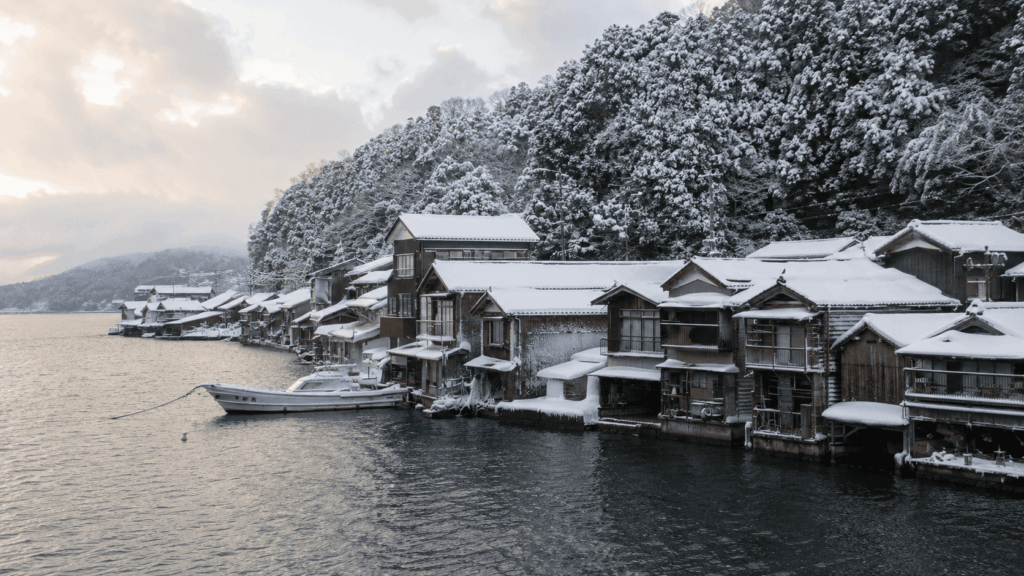
The three anchors are the funaya streetscape, seeing the bay from the water and a meal worth making time for. A clear winter afternoon can be beautiful, but the day does not need to depend on all three working perfectly. Choose a walking-and-food version if boat conditions are poor, or a shorter outdoor visit if cold is limiting the group.
The wider things to do in Ine guide helps you choose extra stops. In winter, prioritize the ones that fit the weather, daylight and actual meal or bus bookings rather than adding every possible activity.
Walk the Funaya District
Ineura Park and the tourist information office are useful orientation points in the central waterfront area. Walk along public roads, look at the boathouses from permitted viewpoints and give working vehicles room. Much of what makes the village photogenic is still someone’s home, boat space or workplace.
Do not enter an open boat shed, private terrace or waterside platform just because it looks inviting. A building used for guest accommodation is not automatically open to nonguests either. If you want an interior visit, ask the tourist office about an authorized option rather than improvising one.
Michinoeki Funaya no Sato Ine is the roadside station on the hill, with a view over the bay and dining facilities. It is a separate outing from the level waterfront. Allow for the uphill approach, winter footing, the bus or car connection and the restaurant’s own opening times. Do not treat an elevated map pin as a quick, flat detour.
For photographs, wait somewhere that does not block a driveway or ramp, and keep moving when local work needs the road. Wet surfaces and boats are part of the setting, not invitations to step closer to the water. An ordinary public-road walk is enough to appreciate the shape and detail of the funaya.
See the Funaya from the Water
There are two main choices. The larger Ine Bay sightseeing boat departs from Hide, outside the central waterfront area. Its current standard schedule is 9:00 AM–4:00 PM, on the hour and half-hour, with a cruise of about 25 minutes. The listed fare is ¥1,200 for adults aged 13+ and ¥600 for children aged 6–12; check the current operation and fare for your date.
The ride time is not the whole excursion. Add getting to the correct pier, buying tickets, waiting for a departure and returning toward your lunch or walking area. A one-hour stop in “Ine” does not automatically provide an unhurried cruise and a central-village visit.
Sea taxis are smaller sightseeing boats run by local boatmen. The tourism association currently lists approximately 25-minute trips, generally around ¥1,000 per adult, cash payment and capacities of up to about 12 passengers. Individual boats can have different prices, child rules, hours and weather limits. Small parties may be able to board without a reservation, but availability is not guaranteed.
Use the official sea-taxi information to contact the boatman and identify the boarding point; the Shichimenyama parking area is a common starting location. Do not assume every departure is booked at the tourist-office counter or that every vessel is covered and comfortable in rain.
Both options depend on conditions. Check the local boat operation information close to the outing. If the boats are not running, keep the public-road walk and the hilltop view as alternatives when those are safe and accessible. A private vehicle booking does not override a captain’s decision.
Winter Food in Ine: Yellowtail Season
Buri, or mature yellowtail, is a genuine reason to plan a winter visit. You may find it as sashimi, a rice-bowl meal, a cooked dish or buri shabu: slices briefly cooked in hot broth, often served with vegetables and dipping sauces. The dish and preparation matter as much as the label “seafood.”
The season is broader than a guaranteed December–February menu. Regional tourism information describes a winter period extending into March, while actual restaurants and inns set their own offering dates. Weather, landings and supply can change what is served. Ask whether the specific buri dish is available on your date, whether advance ordering is needed and what the meal includes.
Why Buri Shabu Is Worth Planning Around
Kai’s tip: On my winter visits, buri shabu was always the meal I built the day around — and I’d plan it for lunch, not dinner. Most restaurants in Ine close by mid-afternoon, so the lunch window (roughly 11:00–15:00) is the reliable one. Order the buri shabu set rather than the generic seafood set if it’s on the menu; the locally landed yellowtail in season is a different dish from what you’ll find in Kyoto city. If you’re staying overnight, ask your inn whether dinner includes buri — many funaya inns feature it during the season.
Use that lunch-first approach as a planning preference, then confirm the actual restaurant. Some places take reservations for a course; others do not accept seat bookings. A driver can help coordinate timing, but transport does not reserve a table or guarantee the catch.
| Place | Where it is | Useful current details | What to confirm |
|---|---|---|---|
| Restaurant Funaya | At the hilltop Michinoeki Funaya no Sato Ine, not the central waterfront | Closed Tuesdays; the operator lists seasonal hours and cash-only self-service | That day’s lunch service and last order, current menu and time to reach the hill |
| Funaya Shokudo | Second floor of the tourist-information building beside Ineura Park | Breakfast from 8:30 AM, lunch from 11:00 AM, Thursday closure; currently cash-only | Breakfast availability, kitchen last order and current dishes; seats are first-come, first-served |
Use the tourism association’s restaurant directory to check the specific place. For lunch, aiming for the earlier part of service is more useful than arriving at the stated closing time. For Funaya Shokudo, arrive well before the roughly 3:00 PM lunch finish; published last-order details differ slightly, and waiting can use the remaining window.
If buri shabu is the reason for the trip, ask for that dish by name rather than booking a generic seafood lunch and hoping it appears. Confirm dietary needs directly, including broth, sauces and substitutions. Cooked fish is an option for travelers who prefer it to sashimi, but a brief shabu-style preparation is not a substitute for explaining allergies or asking how thoroughly food should be cooked.
Keep the meal’s cost separate from transport. The private trip’s listed price excludes food, and a local transport pass does not include restaurant meals. A longer lunch also uses sightseeing time, which is why it belongs in the route discussion before the day begins.
The Biggest Winter Mistake: Not Planning Dinner
Ine has evening dining, but it is not a city neighborhood where you can assume several walk-in kitchens will be open near your accommodation. Some establishments serve only breakfast or lunch; others require a booking, have regular closure days or change service for winter. Your inn’s room-only plan does not create a dinner arrangement.
Kai’s tip: Decide where dinner happens before you arrive, not after. If you’re staying overnight, book a dinner-included plan at your inn — that is the most reliable meal in the village and usually the best one, since many funaya inns cook the day’s catch. If you’re day-tripping, don’t plan to eat dinner in Ine at all: have a proper lunch in the village, then grab your evening meal in Miyazu or Amanohashidate before the last bus or train. Arriving in Ine at 6 p.m. hungry, with no plan, is the fastest way to end a good day badly.
A prearranged village restaurant can also work for an overnight guest. The current official directory includes places with evening service, so “everything closes at 3:00 PM” would be wrong. Choose a confirmed dinner-included stay or a confirmed restaurant, then check the route back to your accommodation. Do not rely on arriving hungry and finding something after dark.
If returning to Kyoto, decide whether dinner is before or after the long return. A meal near Amanohashidate needs to fit your actual train or highway bus; the last service is not a flexible deadline. If the travel plan leaves little margin, an earlier village lunch and dinner back at your base is simpler.
Carry cash for meals, boats and small businesses even if you also have cards. Restaurant Funaya and Funaya Shokudo currently specify cash-only arrangements. Do not assume that a displayed card logo or an old directory listing overrides a venue’s current payment notice.
Likewise, do not make a late convenience-store run the only backup without locating a usable shop first. Ask your host about what is nearby and what you may bring. For a meal you particularly want, confirm it before departure rather than treating snacks as the whole fallback plan.
Day Trip or Overnight Stay in Ine?
A day trip gives you the streetscape and a meal; an overnight stay gives you a different rhythm around the sightseeing hours. Neither is automatically better. Choose according to the time you have, the accommodation you can actually book and whether you want an evening with very little programmed activity.
| Decision | Day trip | Overnight stay |
|---|---|---|
| What you get | A waterfront visit, lunch and selected extra stops | More time, dusk and morning, plus the experience of your chosen accommodation |
| Transport | Protect a realistic same-day return; do not overload both destinations | Plan two travel days, check-in, bags and the onward route |
| Food | Confirm lunch, then decide where dinner will happen | Confirm dinner and breakfast separately from the room |
| Cost | Long-distance travel, local transport, food and selected activities | Those costs plus the actual room and meal plan |
| Weather flexibility | You may need to cut a stop to protect the journey home | There is more time, but boats and roads can still be affected |
| Best fit | A first look or a trip with limited spare nights | Travelers who want the waterside stay itself and a slower visit |
The Ine day-trip guide helps with a shorter visit. If Ine is the main purpose of your day, give it priority over collecting every Amanohashidate attraction. If Amanohashidate is the main purpose, accept a smaller Ine program rather than promising yourself both places in depth.
For accommodation, start early and check the particular property’s booking window. The official listings show different advance-booking periods, meal plans and language support. There is no universal rule that every funaya opens reservations three months ahead or is fully booked for that entire period. Check the actual calendar and conditions.
Luggage for a Day Trip or a Funaya Stay
For a return day trip, leaving large bags at your Kyoto hotel is often the simplest arrangement. If you are between hotels or your hotel cannot help, compare storage near a point you will return to. Your departure time and late return must both fit the chosen store’s access hours.
Bounce can be useful for that gap. The link below opens its general service: search around your Kyoto base or station, then check the location, bag limits and opening hours for your date. A shop that opens after your early departure or closes before your return will not solve this trip.
Find luggage storage & check collection hours
For an overnight stay in Ine, a Kyoto storage booking only works if you are returning there to collect the bags. Otherwise ask your inn about bag drop, bring a manageable overnight bag, or arrange a confirmed forwarding option. For a private trip, tell the provider the real luggage quantity before selecting the vehicle.
There is also a local option: Ine’s tourism association lists ¥500 coin lockers at its information office, with counter storage for bags that do not fit. Its published office hours are 9:00 AM–5:00 PM, excluding the New Year closure. Confirm the day’s availability, oversized-bag fee and collection deadline at the official visitor information page. Do not use that daytime service for a plan that requires collecting bags after dinner.
Staying in a Funaya in Winter: What to Check Before Booking

A funaya stay can place you close to the water and the sounds of a working bay. But “funaya” describes a building tradition, not one standard level of accommodation. A converted guesthouse, a renovated whole-house rental and a room with modern private facilities can provide very different stays.
Some older buildings have cool floors, steep stairs or sound that carries; others have substantial renovation and modern bathrooms. Do not assume either luxury or discomfort from the word boathouse alone. Look at the actual room, heating, access and facilities, especially if traveling with children, older relatives or someone with mobility needs.
- Meals: is the booking room-only, breakfast-only or two meals? Is a winter fish course specifically included?
- Bath and toilet: private or shared, and in the same building? A funaya room does not automatically include an onsen.
- Heating and layout: where are the sleeping and bathing areas, are there stairs, and what footwear or room clothing is provided?
- Arrival: what is the check-in deadline, especially with dinner, and how do you reach the property from the bus stop?
- Communication: can the host handle your booking and meal questions in English, or will you need assistance?
- Winter disruption: how do cancellation terms apply if your transport is affected? Accommodation and day-tour bookings may have separate conditions.
The official accommodation directory is useful for comparing facilities and booking windows. Check whether a property is actually in the central funaya area; the broader Ine municipality includes accommodation elsewhere, which can require additional transport.
What I Would Pack for a Winter Funaya Stay
Thick room socks are the single most useful thing I’ve packed for a funaya stay — tatami gets cold underfoot even with heating, and most inns provide thin slippers at best.
Add a warm sleep layer if the host recommends it, shoes suitable for wet outdoor surfaces and a small light or charged phone for finding your way after dark. Ask about stairs before packing a heavy case, and use any indoor footwear appropriately rather than assuming loose slippers are safe on steep steps.
Bring the items that let you enjoy a slow evening: your charging cable, any essentials you cannot buy locally and clothing for sitting comfortably indoors. Confirm what is provided before duplicating towels or room amenities. The stay works best when the quiet is part of what you want, rather than an unexpected absence of nightlife.
A Practical Winter Itinerary for Ine
Build the route around a meal, a return connection and one clear priority. The sequence below is a planning framework, not a claim that a particular 7:00 AM train or bus exists. Choose actual services for your date before assigning clock times.
One-Day Amanohashidate + Ine Plan
For a food-focused Ine day, aim to reach the village during the earlier lunch window. If your chosen transport cannot do that after a substantial Amanohashidate visit, put Ine first or reduce the other stop. Trying to add a long viewpoint visit before the local bus can leave you arriving just as kitchens stop taking orders.
- Before departure: confirm your meal plan, local return bus and onward service. Check roads and weather if driving, or the selected pickup and duration for a private trip.
- Travel north: take your booked or chosen service toward Amanohashidate, then the correct bus to central Ine or your meal location. Do not get off at the large-boat pier expecting to be at the tourist office.
- Lunch first if that is the priority: allow for a queue at a walk-in restaurant or meet the time of your reserved course. This is not the place to squeeze lunch into the final ten minutes before a bus.
- Choose the main Ine activity: a public-road walk, or a boat plus the time to reach the pier. Add the hilltop view only if its route and the remaining time work.
- Use Amanohashidate selectively: choose one viewpoint or a short waterfront/sandbar visit according to weather and opening hours. Do not schedule both viewpoints and a full sandbar walk by default.
- Protect the journey home: finish in time for the chosen bus, train, coach or rental return, including a realistic buffer. Decide whether dinner fits before departure or back at your base.
As an editorial planning allowance, two to three hours in Ine can support a meal and a modest visit. A boat, transfer to its pier, a leisurely lunch, the waterfront and the hilltop together need more room. For a private arrangement, explain that priority and ask what must be shortened elsewhere; do not assume any advertised duration automatically accommodates the whole list.
If Amanohashidate is your main interest, reverse the priorities and accept a shorter Ine visit. Use the Amanohashidate winter guide for the two different viewpoint systems and their winter operation. Current closure notices include View Land on December 15–17, 2026, and Kasamatsu Park on December 18; check your chosen viewpoint directly before fixing the day.
Overnight Winter Plan
- Day 1, earlier afternoon: arrive with time to ask about bag drop and walk before the light goes. If lunch is part of the plan, arrive during its service window.
- Day 1, afternoon: take a boat if operating, or choose the waterfront and a viewpoint according to the weather. Keep any check-in or dinner deadline in mind.
- Day 1, evening: use the meal arrangement you confirmed with your host or restaurant. A short stroll may be pleasant when conditions allow; there is no need to seek a busy night scene.
- Day 2, morning: enjoy the bay and your booked breakfast. If using Funaya Shokudo instead, verify breakfast service and its Thursday closure rather than expecting an 8:00 AM meal every day.
- Day 2, onward: collect bags and take the planned bus or drive onward. Add Amanohashidate only if the connection, opening hours and luggage arrangements work.
For two independent days using several local services, compare the existing Klook two-day sightseeing pass with separate fares. The operator’s current adult two-day ticket benchmark is ¥3,500 and covers specified local buses, sightseeing boats and the Kasamatsu transport system. Kasamatsu Park is not Amanohashidate View Land, and this local pass does not pay for your long-distance trip from Kyoto or Osaka.
For perspective, two ¥400 local bus rides plus the ¥1,200 large boat total ¥2,000 before food and long-distance travel. Buying a pass is not automatically cheaper for that limited plan. It becomes worth comparing when your actual itinerary uses more of the covered transport; closures and canceled boats can change that calculation.
Check the 2-day pass coverage & current price
Confirm the selected pass’s exact validity, redemption and service coverage before purchase. Do not substitute a different similarly named rail-and-bus pass: the region sells several tickets with different inclusions. A pass also does not reserve a bus seat, restaurant table or boat sailing, or extend a service beyond its winter operating hours.
Winter Mistakes to Avoid in Ine
- Making snow the only success condition. Prepare for a cold coastal village, and let a white landscape be a bonus.
- Checking the destination but not the road. The journey can need winter equipment even when the waterfront is clear.
- Combining every sight before lunch. Give your chosen meal a realistic place in the day and confirm the kitchen’s last order.
- Confusing the two Funaya restaurants. Restaurant Funaya is on the hill; Funaya Shokudo is beside the central waterfront.
- Using the wrong bus stop or schedule. Hide’s large-boat pier, central Ine and the hilltop are different stops. The holiday timetable also matters.
- Relying on an IC card for the route bus. Carry a usable payment backup and follow the correct cash or contactless procedure.
- Expecting any tour to fit a long meal and every activity. Check the actual stop time and, for a private trip, agree priorities within the selected service.
- Assuming dinner or a particular fish course is included with a room. Confirm the meal plan and any advance-order requirement.
- Leaving bags where you cannot retrieve them. Early departures, late returns and an overnight stay need different storage plans.
- Treating all funaya stays alike. Check the actual property, facilities, stairs, heating and location.
FAQ: Visiting Ine in Winter
Is Ine worth visiting in winter?
Yes, for the funaya scenery, winter food and a slower coastal visit, provided you plan the travel and meals. It is a weaker choice when guaranteed snow or a long list of indoor attractions is the only reason to go. A day trip suits a first look; an overnight booking suits people who want the stay itself.
Does it snow in Ine?
It can, but the waterfront may be clear, wet, lightly dusted or more heavily covered depending on the weather. January and February are the colder winter months, not a snow guarantee. Use a local forecast for your date and check road conditions along the route as well as in the village.
How do I get to Ine from Kyoto or Amanohashidate in winter?
Independently, take a suitable train or highway bus toward Amanohashidate, then the Tankai route bus to your chosen Ine stop. The local ride is roughly an hour, with ¥400 as the operator’s example fare from Amanohashidate to Ine Bay Cruise / Hide. Long-distance travel is extra. Driving, a fixed coach tour or a private trip are alternatives with different timing and flexibility.
Do I need snow tires to drive to Ine in winter?
Follow the tourism association’s winter-tire guidance and request appropriate equipment when booking. Confirm chain availability and current road restrictions, too. Snow or ice along the journey can matter even if central Ine has none. If you are not comfortable driving in those conditions, choose transport operated by others or change the plan when weather is severe.
Can I do Ine as a day trip from Kyoto in winter?
Yes, with a full day and realistic priorities. Public transport can make it a long outing, and combining a substantial Amanohashidate visit with lunch, boats and every viewpoint in Ine can become too much. Pick a meal and main activity, then fit the transport around them. A private trip helps with connections, but its time is still limited.
Where can I eat dinner in Ine in winter?
Use a confirmed dinner-included accommodation plan or a restaurant whose evening service and booking requirements you have checked. Some local businesses do serve dinner; that does not make spontaneous dining reliable. If day-tripping, decide whether dinner fits the return schedule or is better left until you are back at your base.
Do Tankai buses accept IC cards?
Tankai route buses do not accept transport IC cards such as ICOCA. Cash and supported contactless or QR payments are separate options. With cash, take the numbered ticket; with contactless payment, use the supported card or device as instructed on boarding and alighting. A transport IC card and a contactless bank card are not interchangeable.
Is a funaya stay worth it in winter?
It can be if sleeping close to the water and enjoying a quiet evening and morning are part of the point. Check the actual property’s heating, bathroom, stairs, meals and location. Facilities and booking windows vary, so neither basic comfort nor a luxury experience should be assumed from the word funaya alone.
Does the private tour include the Ine boat and buri shabu?
The private option described above lists sightseeing boat tickets, viewpoint transport and meals as extra. Confirm the selected plan and total, and arrange any specific meal before the day. Flexible transport can help coordinate a feasible itinerary; it does not guarantee a fish dish, restaurant seat or boat operation.
Final Verdict: Who Should Visit Ine in Winter?
Do not make snow the test. Make the test whether a working fishing village, a seasonal meal and a slower waterfront visit justify the journey for you. Those are the reasons that can still deliver when the rooflines are bare and the boats need to stay in port.
For a first visit: choose a lunch plan and one main way of seeing the funaya, then add Amanohashidate selectively. Avoid an itinerary that depends on reaching every stop at the fastest possible pace.
For couples and repeat visitors: compare actual funaya stays, confirm the food and facilities, and leave room for the evening and morning. The overnight experience deserves its own plan rather than being squeezed into a day-tour booking.
For non-drivers or a group wanting fewer connections: compare the independent bus route with a private arrangement that matches your pickup, time in Ine and complete budget. Select the service that solves your actual difficulty.
Choose another destination or date if the only acceptable result is deep snow, if severe weather makes the journey unsuitable, or if the time and meal arrangements cannot work. A good Ine winter visit begins with a realistic plan, not a promise that the coast will reproduce a postcard.
Practical information and linked services checked in November 2026. Confirm transport, weather, restaurant service and the selected booking conditions for your travel date.
Hi, I’m Kai. I’m a Tokyo-based travel writer, tourism industry insider, and the author of a published guidebook for international visitors to Japan. With over 10 years of professional experience at a leading Japanese tourism company, my mission is to help you skip the tourist traps and navigate Japan’s best destinations like a local. I believe the perfect day trip is like a traditional kaiseki meal: a beautiful balance of precise planning and unforgettable seasonal discovery. When I’m not out conducting field research, you’ll usually find me drafting new itineraries with one of my favorite fountain pens!