
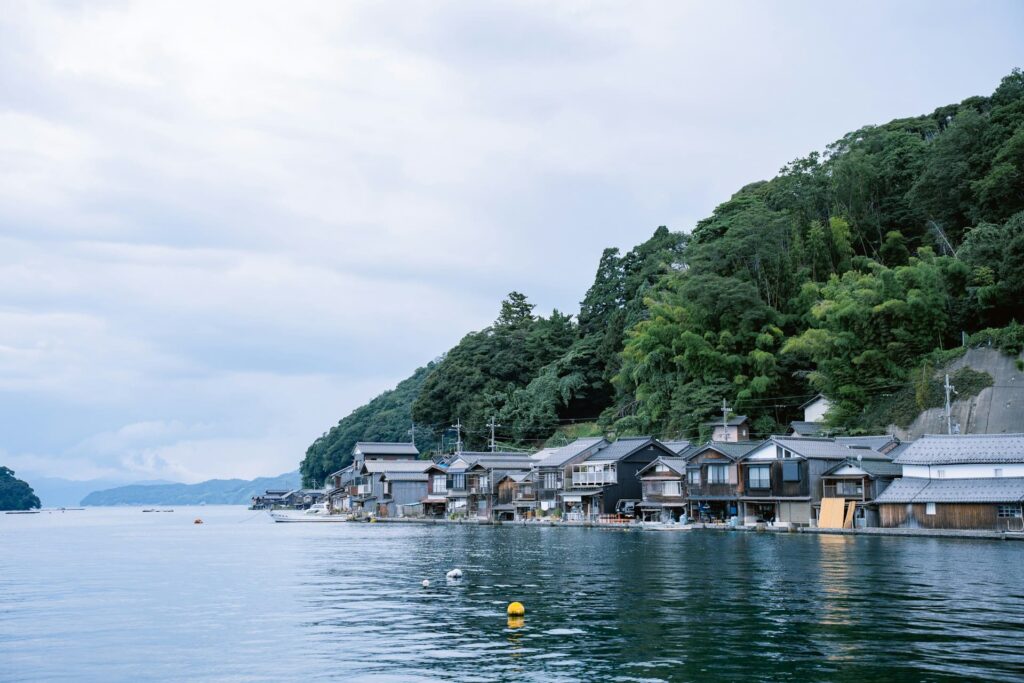
Search Reddit for “Ine, Japan” and you’ll meet two very different villages: one that travelers describe as among the most peaceful places they visited in Japan, and one that reviewers warn is simply too far for what it offers. Both are talking about the same place — Ine no Funaya, the cluster of roughly 200 wooden boat houses (funaya) lined along Ine Bay on Kyoto’s northern Tango Peninsula coast. The disagreement is rarely about the village itself. It’s almost always about the cost of getting there.
If Ine already sounds like your kind of place but the long train-and-bus connections do not, check live availability, pickup options, cancellation terms, and traveler feedback for this private Amanohashidate & Ine day tour before deciding how much of the logistics you want to handle yourself.
Is Ine Worth Visiting? My Short Verdict

Ine is worth visiting for the right traveler — but not at any cost. The village itself is genuinely special: a living fishing community where the ground floor of each boat house shelters boats and the upper floor is someone’s home, all facing a quiet, mirror-calm bay. If that kind of place speaks to you, Ine can be one of the most memorable afternoons of your trip.
The catch is the journey. From Kyoto, public transport takes roughly 3 hours each way; from Osaka, closer to 3.5. That means a day trip from Kyoto commits about 6 hours to trains and buses for a village you can comfortably walk in an hour. Whether that trade makes sense depends less on Ine than on who you are and how much travel time you have to spend.
The mistake I see first-time visitors make is treating “Ine is beautiful” and “Ine is worth it for me” as the same question. They’re not. Ine’s quality is high; its accessibility is the weak point. Once you separate those two things, the Reddit debate becomes much easier to read.
| Traveler type | My verdict | Best way to visit | Main trade-off |
|---|---|---|---|
| First-time visitor with only 2–3 days in Kyoto | Probably not — your days are better spent in Kyoto’s core sights | Day tour, if you insist on going | Transit eats a full day you can’t get back |
| Repeat visitor or slow traveler | Yes, absolutely | Overnight stay, or rental car | Committing a night is what makes the quiet pay off |
| Photographer or architecture lover | Yes | Early boat ride plus a walk, off-peak season | Needs good light and low crowds to really deliver |
| Traveler who dislikes long transfers and waiting for buses | Probably not, unless the logistics are handled for you | Day tour with round-trip transport | Less flexibility, far less planning stress |
| Family with small children | Maybe — weigh the long bus ride and limited lunch options | Rental car or day tour | Narrow roads and a village built around boats, not strollers |
| Visitor already going to Amanohashidate | Yes — combine them | Car, day tour, or an overnight in the area | Doing both in one day on public transport is tight |
If you’ve already decided Ine is on your list but the train-and-bus connections are the part you don’t want to manage, an Amanohashidate & Ine day tour from Kyoto or Osaka handles the entire transfer for you. I compare all three ways to get there — public transport, rental car, and tour — later in this article.
Why Reddit Is So Divided About Ine

Read enough threads and you’ll notice the same words appearing over and over. On the positive side, travelers consistently call the village beautiful, peaceful, quiet, and unique — a rare escape from the crowds of Kyoto and Osaka, often described as one of the most atmospheric places they saw in Japan. Ine regularly comes up in “hidden gems” and “off the beaten path” discussions on r/JapanTravelTips and r/travel, usually alongside the note that it’s not an easy trip.
On the negative side, the recurring complaints are almost never about the boat houses. They’re about the journey: the long train ride, the local bus that runs about once an hour, the stress of matching connections, and the feeling of a rushed day. A common refrain in r/JapanTravelTips threads is that Amanohashidate works as a day trip but Ine is better with an overnight stay — and that trying to do both in one day on public transport is a stretch. One traveler who missed the last bus back described paying for a taxi that cost roughly $50. The village, meanwhile, rarely gets criticized for being ugly or boring — mostly for being small and quiet.
That’s the key insight: Reddit’s split is not about Ine’s quality. It’s about the travel-effort-to-reward ratio. A traveler with five days in Kyoto experiences the same quiet village as a traveler with fourteen — and judges it completely differently. The quiet that one person calls serene is the same quiet another person calls boring. Once you know which kind of traveler you are, the reviews stop contradicting each other.
Who Will Love Ine — and Who Should Probably Skip It

Ine is a strong fit if:
- You’re interested in how people actually live in rural Japan, not just how places look in photos
- You’ve been to Japan before and want something that doesn’t feel like a checklist sight
- You enjoy slow, quiet walks and are comfortable with an afternoon that has no “attractions” beyond the scenery itself
- You’re a photographer willing to work with the light and the crowds to get the shot
- You’re already planning to visit Amanohashidate and can add Ine without a separate long journey
Consider skipping or deprioritizing Ine if:
- This is your first trip to Japan and your Kyoto days are limited — the city’s temples, shrines, and districts will fill them faster than you expect
- Waiting for an hourly local bus or juggling connections would ruin the day for you
- You want a full day of varied activities — Ine is best enjoyed as one slow, atmospheric stop, not a packed itinerary
- You’re traveling with young children and need easy stroller access, predictable meal times, and abundant facilities
- Bad weather would genuinely cancel the trip for you — the village’s appeal is heavily tied to the bay and the light
One thing that surprises many travelers here is that Ine is not a museum village or a theme-park reconstruction. It’s a working community. Residents still fish, park boats at their front doors, and live in these buildings. That’s exactly what makes it authentic — and it means you should treat it like someone’s neighborhood, not an open-air exhibit.
What Visiting Ine Is Actually Like: My Route

The reason Ine photographs so well from every angle is that the boat houses are designed around the water: a garage-like door at sea level for the boat, living space above. You only really understand that structure if you see it from three viewpoints — above, on the water, and at street level. My usual route covers all three, and I’d recommend the same order: start high, go out on the bay, then walk the streets. It’s an easy half-day, and it gives you a complete picture of the village. For a full list of activities, see our guide to the best things to do in Ine.
Start Above the Village at Michi-no-Eki Funaya no Sato Ine
The best first stop is the roadside station Michi-no-Eki Funaya no Sato Ine (道の駅 舟屋の里伊根), which sits on a hill above the village. From its observation area you get the classic postcard view of the entire bay — dozens of boat houses in a neat line along the water, mountains behind them. It’s the view that makes you understand, in five seconds, why people describe this place as a hidden Japan.
The station itself has a restaurant, a souvenir shop selling local dried fish from the Ine fishing cooperative, and a large free parking lot (about 138 spaces, open 24 hours) — which also makes it the natural first stop if you’re driving. If you’re on the bus, get off at the “Funaya no Sato Koen-mae” stop. There’s an Ine town tourist information desk here, and it’s worth grabbing a walking map before you head down to the water.
Kai’s tip: If you arrive by car, start at this hilltop lot rather than parking straight down in the village. You get the overview first, which makes everything you see afterward easier to read, and you avoid fighting for one of the smaller paid lots near the funaya frontage during peak hours. On busy weekends the hilltop lot fills up too, but it’s the largest one in town.
Take the Ine Bay Sightseeing Boat — but Know About the Birds
From the hill, head down to the water and take the Ine Bay Sightseeing Boat (伊根湾めぐり遊覧船), which departs from the Hinode pier (日出駅) every hour on the hour and half-hour — roughly 9:00 to 16:30, depending on season — for a 25-minute loop around the bay. Fares are around 1,200 yen for adults and 600 yen for children. The boats run year-round but suspend service in rough weather, so check the operating status on a rough day.
The boat gives you the view you can’t get any other way: boat houses seen from the water, with their sea-level doors open and fishing boats tucked inside. The vessels are large two-level catamarans, and the lower indoor cabin has air conditioning and toilets — more relevant than it sounds, as I’ll explain in a moment.
Here’s what the marketing photos don’t prepare you for: the seagulls. As soon as the boat leaves the pier, gulls fly alongside it, and feeding them (kibble is sold at the pier and on board) is one of the most popular things to do. The official site even warns passengers to watch for kites (tobi) swooping in. On a busy departure, the birds can easily become the main event of the cruise — a lot of fun, but also a distraction if what you came for is the architecture.
Kai’s tip: If the boat houses are your real reason for taking the cruise, don’t feel obliged to head upstairs to the open deck. That’s where the seagull feeding happens, and with a big group on board it can get loud and crowded. The lower indoor cabin gives you an unobstructed view of the funaya at water level, plus shelter on windy days — and you can still go up for a few minutes when you want the breeze. In my experience, the lower cabin is the better seat for anyone who wants the architecture to be the memory.
Walk the Funaya Streets — but Remember People Actually Live Here
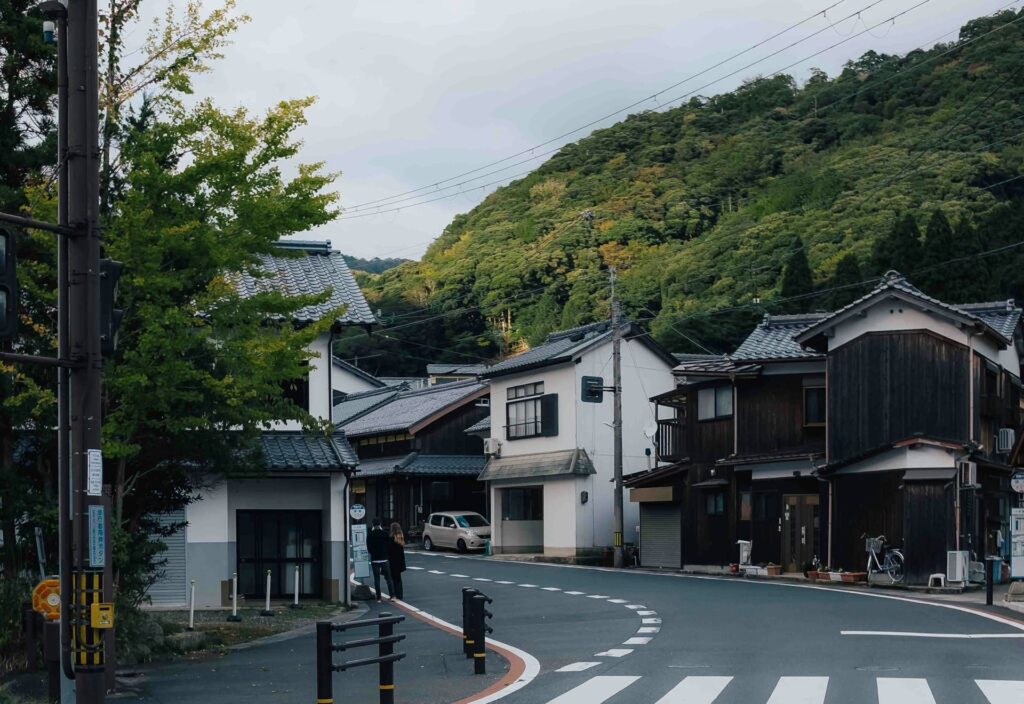
After the cruise, spend time on foot. The funaya frontage along Ineura Park is walkable in roughly 20 to 30 minutes at a relaxed pace — and that’s the point. There are no must-see attractions strung along the way; the pleasure is in the details: boats moored at front doors, nets drying, a café in a converted boat house, an old woman sweeping her doorstep. Over the years, more and more of the old funaya have been converted into cafes, restaurants, and guesthouses, so the walk itself has become the attraction.
A few practical notes from my visits. The streets here are narrow and still carry local traffic — you’ll be sharing them with residents’ cars and delivery vehicles, so keep your camera shots quick and stay aware. On weekend afternoons, the handful of restaurants in the village can have real waits, and some shops are cash-only, so carry some yen. The village is also a private residential area: the boat houses are people’s homes and workplaces, and entering one without permission is exactly as rude as it sounds. The official guidance is blunt about this — treat Ine the way you’d treat your own neighborhood.
If you want to see inside a funaya, the legitimate way is a house tour at Tomobutoya (ともぶと屋), an 80-year-old boat house open to visitors (admission around 300 yen, or about 700 yen with a gelato; closed Fridays, cash only). The Ine Tourist Information Center across from Ineura Park can also point you to guided walking tours and English-speaking guides. And note the one thing you cannot do: swimming is not allowed in the funaya area, since the bay is busy with boats.
How Much Time Does Ine Really Cost From Kyoto or Osaka?

Let’s be precise about the numbers, because this is the heart of the Reddit debate.
- From Kyoto: about 3 hours each way by public transport (train + local bus), about 2 hours by car.
- From Osaka: about 3.5 hours each way by public transport, about 2.5 hours by car.
The standard public-transport route runs from Kyoto Station toward Amanohashidate Station — roughly two hours by limited express, or by the reservation-only highway bus — then continues on a local bus operated by Tango Kairiku Kotsu, from Amanohashidate Station toward Ine, Kyo-ga-misaki, or Kamo-iri. That local bus runs about once an hour, and that number is what makes or breaks the day. Miss one, and you’re not five minutes late — you’re waiting an hour at a station in the countryside.
So a day trip from Kyoto is not a half-day excursion. It’s roughly six hours of transit for two to three hours in the village, assuming the connections go smoothly. From Osaka, add another hour. What surprises most travelers here isn’t the village — it’s how much of the day the journey quietly consumes. “Day trip” is technically true; “relaxing day trip” is not, unless you’re on a tour bus where the driving happens while you do something else.
One practical note: if you’re set on Ine but worried about a missed bus, the overnight option changes the equation entirely — the return connection becomes tomorrow’s problem, not today’s. That is the single biggest lever on this trip’s stress level.
Day Trip, Overnight, or Amanohashidate + Ine?

There are three realistic ways to structure the visit, and they suit very different travelers.
| Option | Best for | Time commitment | Pace | The catch |
|---|---|---|---|---|
| Day trip from Kyoto (Ine only) | Travelers who must return to the city the same day | Full day — roughly 6 hours of transit | Rushed; about 2–3 hours in the village | The transit becomes the dominant memory if connections slip |
| Overnight stay in Ine or Amanohashidate | Slow travelers, repeat visitors, photographers | 1–2 days | Slow; quiet evenings and early-morning light on the bay | Limited lodgings and restaurants; books up in season |
| Amanohashidate + Ine in one day | Visitors who want both of the area’s highlights | Full day | Busy — doable by car or tour, tight on public transport | You see both, but commit to a long day |
The overnight option is where Ine’s magic actually lives. During the day the village is shared with visitors; by evening the boats are back, the day-trippers are gone, and the bay turns quiet in a way no day trip can reproduce. If your experience of Japan so far has been city nights, the stillness of a fishing village at dusk is a different country. That said, it means planning a stay in an area with a small number of ryokan and guesthouses — and booking ahead in peak seasons.
If you’re staying overnight and handling the area independently, the Kyoto Amanohashidate Ine Sightseeing 2-day Pass is worth comparing for local buses and several sightseeing rides around Amanohashidate and Ine. It does not replace the long-distance journey from Kyoto to Amanohashidate, so check the current inclusions before building your DIY route.
The Amanohashidate + Ine combination is the most efficient use of a day if you’re coming from Kyoto or Osaka. Amanohashidate’s sandbar viewpoint is one of Japan’s classic sights, and Ine is only about 40 minutes away by local bus or 25 by car. On public transport, doing both comfortably in one day is a stretch — the Reddit threads that warn about it are right — but by car or on a guided day tour, it’s a very manageable day.
If you only do one thing differently after reading this, make it this: don’t judge the “day trip” question by the distance on a map. Judge it by the return connection. If the last bus or train back feels too early, or the transfer feels too fragile, spend the night or take the tour — the cost difference is smaller than the stress difference.
Public Transport vs Rental Car vs Day Tour

If you’ve decided Ine is for you, the next question is how to get there. Here’s the honest comparison (for full timetables and routing details, see our complete guide on how to get to Ine from Kyoto or Osaka).
| Option | Best for | Main advantage | Main downside | Planning effort |
|---|---|---|---|---|
| Public transport | Budget travelers comfortable with connections | Cheapest; no driving; the classic route | About 3 hours each way; hourly local bus; one missed connection can cost an hour | High — timetables matter |
| Rental car | Drivers who like flexibility | About 2 hours from Kyoto; stop anywhere; easy to add Amanohashidate | Narrow village roads; paid parking in the core; weekend congestion | Medium — book the car, pick parking |
| Day tour (Amanohashidate + Ine) | Travelers who want Ine without managing logistics | Round-trip transport, English-speaking guide, pairs Ine with Amanohashidate in one day | Group pace; least flexibility; the sightseeing boat is an optional extra | Low — book once, done |
If you drive, know that parking exists but the good spots are the hilltop ones. Michi-no-Eki Funaya no Sato Ine’s lot is free, open 24 hours, and holds about 138 cars — the biggest in town. The lots near the funaya frontage (Ineura Park, Shichimensan, Onishi) are smaller, paid, and fill early on weekends. The hilltop lot is also the smartest place to leave the car while you walk the village.
Kai’s tip: If you’re renting a car, the part that surprises most drivers isn’t the highway — it’s the last kilometer. The roads along the funaya frontage are genuine residential streets, not sightseeing roads, and in places a delivery van and a pedestrian can’t comfortably pass at the same time. My approach: park at the hilltop station first, walk down to the water, and save driving through the core for early morning or late afternoon, when local traffic is lightest. You see just as much, and you spend the visit looking at boat houses instead of mirrors.
The day-tour option exists precisely because the public-transport version of this trip is fiddly. Most tours from Kyoto or Osaka run roughly 10 hours door to door, with an English-speaking guide, about 1.5 hours in Ine, the sightseeing boat as an optional add-on, and a stop at Amanohashidate’s viewpoint. Recent guests consistently describe the scenery and the guide as the strengths; the recurring mild complaint is wanting more time at Amanohashidate. Prices vary by season and start around $50–70 per person — worth comparing against the cost and stress of doing it yourself.
If the decision has come down to “Ine yes, logistics no” — you don’t want to manage train connections, an hourly bus, or narrow roads — a day tour from Kyoto or Osaka bundles the round-trip transport with a guide and pairs Ine with Amanohashidate. It’s the version of this trip where you show up and look.
If you fall into that camp — you want Ine and Amanohashidate in the same day, but the transfers and driving are the part you would rather remove — this private guided option is the one booking worth comparing first.
Why I’d book this one
- Fewer moving parts: Private transport and an English-speaking guide remove the hourly-bus problem and the need to navigate Ine’s narrow roads yourself.
- A better fit for combining both stops: The itinerary is built around Amanohashidate and Ine together, which is exactly the combination that becomes tight when you rely only on public transport.
- You can judge the commitment before paying: The booking page shows the current pickup options, cancellation terms, payment choices, availability, and latest traveler feedback for your date.
Small Things I’d Want to Know Before Visiting Ine
None of these will change whether you go, but each one changes how smoothly the day goes.
- Carry cash. Several shops and restaurants in the village are cash-only. There’s a post office ATM in Ine if you run low, but plan ahead.
- Lockers exist but are limited. The Ine Tourist Information Center (open 9:00–17:00) has coin lockers for around 500 yen — useful if you’re arriving with bags before a stay.
- The boat is weather-dependent. The sightseeing boat suspends service in rough weather, and on heavily overcast days the bay loses much of its color. Check the operating status the morning of your visit, and keep the day flexible.
- Lunch needs a plan, especially on weekends. The village’s restaurants are small and genuinely good, and on busy afternoons the waits are real. Eat early, or carry snacks.
- The funaya are private homes. You can photograph from the street and the water, but entering a boat house without permission is a real breach of local etiquette. The legitimate way inside is Tomobutoya’s house tour, or a guided walk arranged through the tourist information center.
- Swimming is not allowed in the bay. The water is busy with working boats — this is a harbor, not a beach.
- Bathrooms are at the hilltop station and the tourist information center. Don’t count on public toilets scattered along the walk.
Kai’s tip: If your visit falls on a weekend, decide your lunch plan before you arrive. The handful of restaurants in the village are small, and the wait at peak times is the most common thing I hear visitors complain about afterward — not the distance, the wait. My habit is to eat before 11:30 or keep snacks on hand, and to check the boat’s operating status before committing to the whole trip on a rough day. Two small decisions turn a stressful day into a smooth one.
And one more piece of honesty about weather: the village’s appeal is heavily tied to light and water. On a bright day, the bay and the boat-house row are genuinely stunning. On a gray, rainy day, it’s still atmospheric — but you’ll want the boat ride less, the walk less, and the whole visit becomes a much shorter experience. If your only window is a rainy day, weigh whether the long trip earns its keep.
FAQ: Ine, Japan — Quick Answers Before You Decide
Is Ine worth visiting as a day trip from Kyoto?
It depends entirely on your itinerary. Ine itself is beautiful — the boat-house village is quiet, photogenic, and unlike anything in central Kyoto. But the round trip from Kyoto takes roughly six hours on public transport, leaving only two to three hours in the village. If you’re a repeat visitor or a slow traveler, that trade is often worth it. If this is your first trip and your Kyoto days are numbered, your time is better spent in the city’s core sights — or on a guided day tour that handles the logistics for you.
How long does it take to get from Kyoto to Ine?
About 3 hours each way by public transport: roughly two hours by limited express or the reservation-only highway bus from Kyoto Station toward Amanohashidate Station, then a local bus from Amanohashidate Station that runs about once an hour. By car, it’s about 2 hours each way. From Osaka, add roughly 30 to 60 minutes to both numbers.
Is it better to stay overnight in Ine or do a day trip?
If your schedule allows, staying overnight is where Ine’s atmosphere really delivers. Day-trippers leave in the late afternoon, the boats return, and the bay settles into a quiet that a day trip simply cannot reproduce. The catch is limited lodgings in a small area — book ahead, especially in peak seasons. If you can’t stay, a day trip still works; just plan the return connection carefully, because the local bus only runs about once an hour.
Can you do Amanohashidate and Ine in one day?
Yes, but choose your transport wisely. By rental car, it’s a manageable day — Amanohashidate is roughly 25 minutes from Ine by car, or about 40 minutes by local bus. On public transport alone, doing both comfortably in one day is tight, and the Reddit warnings about this are accurate. A guided day tour that combines both is the most stress-free way to see them together.
Is the Ine Bay Sightseeing Boat worth the 1,200 yen?
For most visitors, yes — it’s the only way to see the boat houses from the water, with their sea-level doors open and boats tucked inside. The 25-minute ride runs roughly every 30 minutes from about 9:00 to 16:30, year-round, but stops in rough weather. Just know what you’re buying: on busy departures, seagull feeding can steal the show. If you want the architecture to be the memory, sit in the lower indoor cabin rather than the open upper deck.
Can you go inside the funaya boat houses?
Not freely — and you shouldn’t try. The boat houses are private homes and workplaces, and entering one without permission is a genuine breach of local etiquette. The legitimate way inside is the house tour at Tomobutoya (a historic boat house open to visitors, admission around 300 yen, closed Fridays, cash only), or a guided walking tour arranged through the Ine Tourist Information Center.
Is it difficult to drive in Ine?
The highway approach is straightforward; the challenge is the village itself. The streets along the funaya frontage are narrow residential roads shared with local traffic, and the parking lots near the water are small and paid. The practical approach is to park at the hilltop Michi-no-Eki Funaya no Sato Ine lot (free, about 138 spaces) and walk down to the bay.
Final Verdict: Is Ine Worth the Trip?
Ine is one of the few places in Japan that looks exactly like its photographs — and photographs can’t tell you how quiet the bay is at dusk, or how ordinary and human the village feels up close. It is a genuinely special place, and I’d tell a friend that without hesitation. But the honest answer to “is it worth it” has three versions.
Yes, go — if you’re a repeat visitor, a slow traveler, a photographer, or someone who loves architecture with a story. Plan for an overnight stay if you can, or combine Ine with Amanohashidate by car or tour. This is your trip.
Maybe — if you’re already going to Amanohashidate and can add Ine without a separate journey, or if a guided day tour fits your budget. You’ll see the village, enjoy it, and let someone else handle the connections.
Probably not — if this is your first trip to Japan with limited days in Kyoto, or if waiting for hourly buses and fragile connections would drain the enjoyment out of the day. Ine will still be there on your next trip — and it rewards travelers who have time to let it be quiet.
For first-time visitors: skip Ine unless you’re taking a tour or pairing it with Amanohashidate. Use your Kyoto days on the city itself, and save the Tango Peninsula for a trip with more time.
For families: the village is walkable and safe, but the long bus ride, narrow roads, and limited meal options make it a heavier lift than most Kyoto sights. A rental car or a tour removes the hardest parts. Consider a day tour if the kids’ patience is the real constraint.
For travelers on a tight schedule: choose the option that removes decision fatigue — the day tour, or a car with a planned parking strategy. An unplanned trip to Ine on public transport is where the day starts to feel long.
For repeat visitors: this is exactly the kind of Japan you came back for. Stay overnight if you can; if not, take the early boat and walk the streets before the day-trippers arrive. The quiet hours are the point.
The last thing I’ll say is about the reviews themselves. When you read a Reddit thread calling Ine magical and another calling it not worth the trip, both writers are telling the truth about their own day — one had time, the other didn’t. The village didn’t change between those posts. Your schedule did. Decide based on what you have, not on what they had, and Ine will either earn its place on your itinerary or wait for a better trip.
If your only remaining objection is the logistics — the train connections, the hourly bus, the narrow roads — a day tour from Kyoto or Osaka removes that entire layer. It’s the version of this trip where you simply show up and look.
Hi, I’m Kai. I’m a Tokyo-based travel writer, tourism industry insider, and the author of a published guidebook for international visitors to Japan. With over 10 years of professional experience at a leading Japanese tourism company, my mission is to help you skip the tourist traps and navigate Japan’s best destinations like a local. I believe the perfect day trip is like a traditional kaiseki meal: a beautiful balance of precise planning and unforgettable seasonal discovery. When I’m not out conducting field research, you’ll usually find me drafting new itineraries with one of my favorite fountain pens!