
Amanohashidate is worth visiting in winter if you want the pine-covered sandbar, coastal views and seasonal food, with snow as a possible bonus. January and February are cold, but a white landscape is never guaranteed. Check Miyazu’s weather, viewpoint closures and your return transport before leaving Kyoto.
Want Amanohashidate and Ine without arranging the connections? For a family or small group, a private vehicle with agreed pickup can simplify the winter day. Compare your party’s total, service hours and pickup area; sightseeing tickets and meals are separate.
Is Amanohashidate Worth Visiting in Winter?
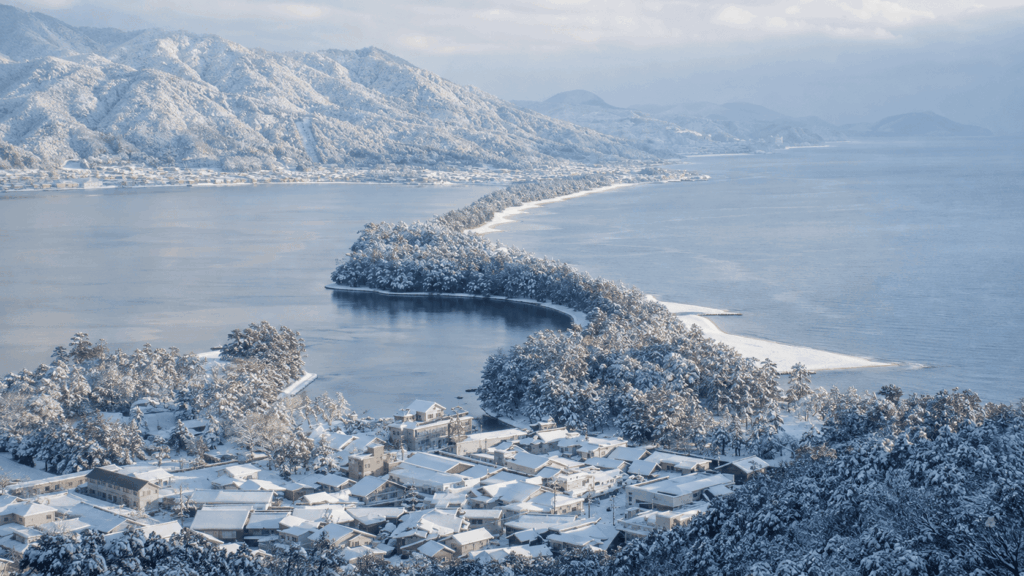
Yes, if the destination appeals to you with or without snow. Amanohashidate is a roughly 3.6-kilometer pine-covered sandbar separating Miyazu Bay from the inner Aso Sea, on the northern coast of Kyoto Prefecture. It is a different outing from visiting temples in Kyoto city: allow around two hours or more each way by train, depending on the service and connections.
The reward is a coastal landscape that changes with the light, quieter stretches of pine forest, warm seafood meals and the possibility of snow on the mountains and trees. The compromises are wind, wet weather and a limited sightseeing window. Winter does not mean that the whole area shuts down, but individual attractions have maintenance dates and weather interruptions.
| What works in winter | What to plan around |
|---|---|
| Quieter walks away from the busiest station-side spots | Snow cover changes from day to day |
| Snow-dusted pines or mountains when conditions align | Rain, cloud and sea wind are also normal possibilities |
| Winter yellowtail dishes and a warm ryokan meal | Special meals need their own reservation and time allowance |
| A manageable day focused on one viewpoint and the sandbar | Adding Ine takes time from the same short daylight window |
| Accommodation choices if you want a slower visit | Crab-season meals, weekends and holidays can be expensive |
Do not assume winter is automatically the cheapest season for a ryokan: food plans and travel dates matter. For the broader decision, including the long journey from Kyoto, see whether Amanohashidate is worth the trip. This guide focuses on what changes in winter and how to make the day work.
Does It Snow in Amanohashidate?
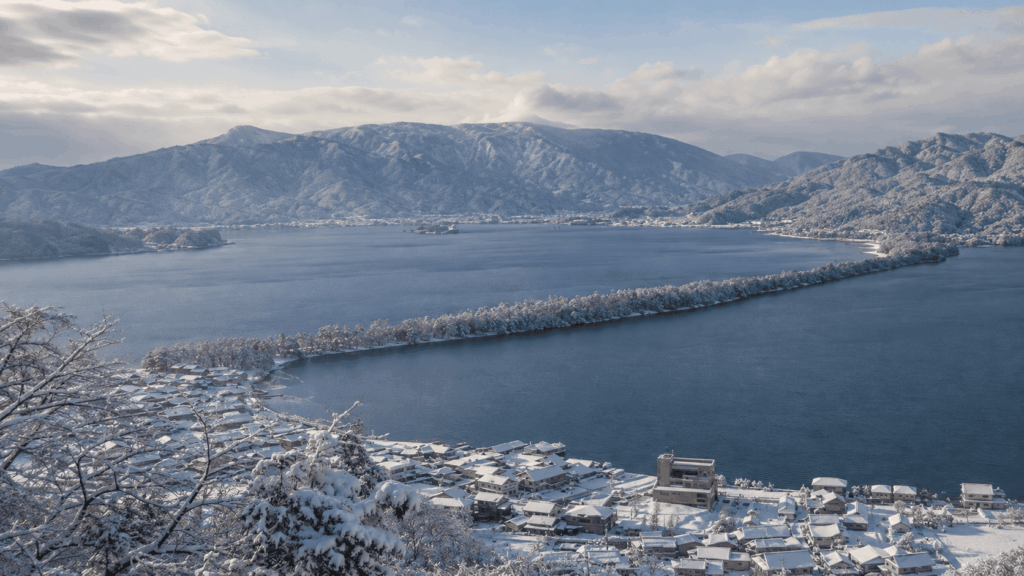
Yes, Amanohashidate can receive snow, including snow that settles on the sandbar. Northern Kyoto has a different winter weather pattern from Kyoto city. However, being on the Sea of Japan side does not mean that every December, January or February day comes with a white landscape.
Separate three things when looking at photographs: snow falling now, snow remaining on the ground, and snow on the pine branches. They do not always happen together. Recent precipitation, temperature, rain, sunshine and the condition of the ground all affect what you see. Snow may remain in the surrounding hills after the waterfront has thawed.
January and February are sensible months to consider for a snow-focused visit, but there is no reliable calendar date to book for a guaranteed snow scene. A cold, wet winter day can bring rain near the water, and a forecast for snow is not a promise that the sandbar will still be white when you arrive.
The most useful final check is the live camera on View Land’s official website. Look at the image time as well as the picture, and check whether it actually shows the sandbar. A camera gives you current evidence; it cannot guarantee the afternoon’s weather or that the ride to the viewpoint is operating.
Why Amanohashidate Weather Can Be So Different From Kyoto City
Kyoto Prefecture spans different climate regions. The Japan Meteorological Agency describes a contrast between the northern Sea of Japan climate and the southern part of the prefecture. In winter, a clear morning in Kyoto city is therefore a poor substitute for checking the northern coast.
On one of my winter visits, Kyoto city was clear and dry when I boarded the train north, and Miyazu was in the middle of a full snow squall when I stepped off. By early afternoon the sky had cleared and I finally saw the sandbar under a light dusting of snow. The lesson I would pass on to anyone planning the trip: the Kyoto forecast tells you almost nothing about Amanohashidate. Check Miyazu directly.
Use that experience as a reason to check locally, rather than expecting the weather to improve at a particular hour. The JMA forecast and warnings let you select the Miyazu area. Look at precipitation, wind and warnings together: the temperature alone does not tell you how comfortable a waterfront walk will be.
December, January or February: When Is Best for Winter Scenery?
Choose a month around the kind of trip you want, then use the actual forecast to decide the day’s activities. December is generally milder than midwinter; February gives you more daylight as the month progresses. Neither point guarantees that a viewpoint will be clear.
The temperatures below are Miyazu’s 1991–2020 climate normals, from the Japan Meteorological Agency. The high and low columns are monthly averages of daily highs and lows, not the maximum and minimum you might experience.
| Month | Mean temperature | Average daily high / low | Planning implication |
|---|---|---|---|
| December | 6.6°C / 44°F | 10.8°C / 51°F; 3.1°C / 38°F | Snow is possible, but rain and bare ground are also plausible. Check the published December maintenance dates. |
| January | 4.1°C / 39°F | 7.9°C / 46°F; 0.9°C / 34°F | A cold month for a snow-oriented trip; keep the walking route flexible and expect New Year variations at individual businesses. |
| February | 4.3°C / 40°F | 8.6°C / 47°F; 0.6°C / 33°F | Still cold, with a longer sightseeing window toward month-end. Ice and wet surfaces can remain an issue. |
These figures come from JMA’s Miyazu climate table. They are averages, not a travel-day forecast or a snow probability. Dress for the conditions you will actually encounter, including the time spent waiting outdoors.
If your dates are flexible, a forecast with usable visibility and manageable wind is more useful than choosing January simply because a snowy photograph was taken then. If your dates are fixed, plan a worthwhile visit without depending on snow, cycling and two separate boat rides all being available.
Check the Weather Before You Leave Kyoto

Check the main decisions before departure, and check local operations again when you arrive. The aim is to choose an achievable version of the day, rather than pack the same itinerary into every forecast.
- Read Miyazu’s forecast. Include wind, rain or snow, visibility and any active warnings. Use Ine’s local conditions as well if you are continuing up the coast.
- Look at the sandbar camera. Check the timestamp and whether the view is clear enough to justify making the panorama your first stop.
- Check the entire transport chain. A train journey can involve JR West and Kyoto Tango Railway; the highway bus and local buses are separate services. A normal train status does not confirm that the boat or your next bus is running.
- Check your chosen viewpoint’s calendar. Distinguish a chairlift-only inspection from a full closure. View Land and Kasamatsu Park are separate businesses with separate calendars.
- Choose the return you can realistically catch. Keep time for lunch, warm breaks and walking back to the station. If conditions or operations undermine the plan, shorten it or choose another day.
Kai’s tip: Kyoto city can be clear and dry while Miyazu is in a full snow squall — I have watched it happen on the train ride north. Check the forecast for Miyazu itself (not Kyoto) and glance at the View Land live camera before you leave; it takes two minutes and changes how you pack, dress and plan your order of sights.
For travel choices and the relevant railway and bus arrangements, use the Kyoto to Amanohashidate transport guide. Confirm the actual departure and return on your travel date; an estimated two-hour journey does not mean there is a direct train whenever you want to leave.
Self-Guided or Tour in Winter?
The useful choice is between an independent Amanohashidate day, a shared sightseeing bus, and a private vehicle for your party. All can work. Which is worth paying for depends on whether you want Ine as well, how much walking everyone can comfortably do, and how much control you need over the day.
| Decision | Independent travel | Shared day tour | Private trip |
|---|---|---|---|
| Strongest fit | One destination, your own lunch and pace | Both places on a set group schedule | A family or small group wanting fewer connections |
| Transfers | You arrange trains or highway buses and local transport | The operator links the sightseeing stops | An agreed pickup and vehicle replace the public-transport connections |
| Walking and breaks | You choose a shorter route or a longer meal | Fit them into the group’s stop durations | Discuss priorities and realistic stop lengths in advance |
| Weather changes | You can change your own sightseeing plan | The operator may adjust the itinerary | Discuss an alternative route, within the booked service |
| Cost comparison | Return transport, local rides, tickets and food | Price for each traveler plus excluded activities | Your party’s vehicle quote plus excluded activities |
For an independent day, compare the actual return train or highway-bus fare with the activities you intend to use. A local sightseeing pass does not replace your journey from Kyoto. For a private trip, divide a group quote only by the people who will actually travel, and check the selected vehicle’s passenger and luggage limits.
Private transport is especially worth comparing when moving children, older relatives or several people between connections would be the hard part. It can also make a two-stop day more practical without requiring anyone in your party to drive. It does not make a closed viewpoint open or remove the effect of snow on the roads.
For a group that wants both coastal stops with less transfer planning
- A private vehicle links Amanohashidate and Ine for your own party.
- Pickup within the selected service area can reduce cold outdoor waits between connections.
- You can discuss your priorities before the trip, rather than trying to fit an independent plan between local buses.
The linked option offers English driver-guide support on selected smaller vehicles; this is basic assistance rather than licensed professional guiding. Confirm your Kyoto or Osaka pickup, vehicle, duration and any requested changes. Viewpoint rides, boat tickets and meals are extra.
Send the operator your party size, luggage and preferred stops before departure. A request is not a confirmed arrangement, and additional time or out-of-area pickup may cost extra. Avoid booking a fixed evening commitment immediately after a winter road trip.
If a Shared Bus Fits Your Budget Better
For a solo traveler or couple happy with a set schedule, the shared Kyoto–Amanohashidate–Ine outing is a separate option. Its listing describes a roughly ten-hour trip with multilingual guiding and designated meeting points. The boat and viewpoint ride are optional extras, and food is not included. Select the correct departure city and meeting point rather than expecting hotel pickup.
Check shared-bus dates & optional activity costs
If you only want the sandbar and a quiet lunch, independent travel remains a good fit. Paying for a second destination you do not really want is not the same as saving time.
What to Do in Amanohashidate on a Winter Day
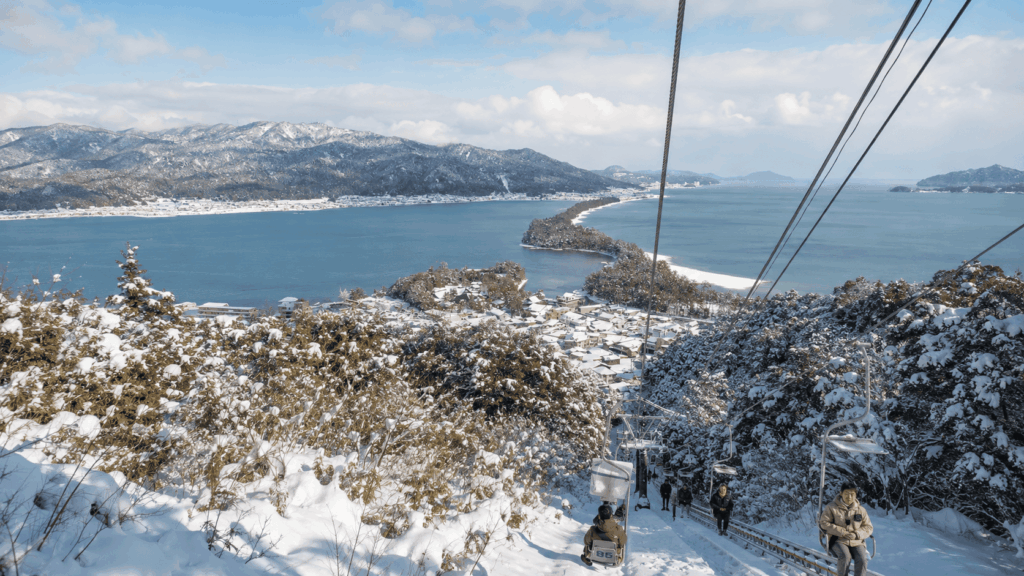
Make one good view, a comfortable walk and a warm meal the core of the day. Treat the other viewpoint, a full crossing or Ine as additions to assess once you know your transport and conditions. Winter rewards a clear priority more than a long checklist.
Use visibility to choose the order. If the panorama is clear on arrival, take advantage of it. If the hill is in cloud, consider lunch, the temple area or a short sheltered section of the sandbar, then reassess. Waiting for better visibility is a choice, not a promise that the afternoon will clear.
Start With the View When the Sky Clears
The two main viewpoints look at the same landscape from opposite ends. View Land is on the southern, station side; Kasamatsu Park is on the northern, Fuchu side. Their tickets and rides are different. The famous upside-down matanozoki view is not a reason to assume that one admission covers both.
| Viewpoint | When it fits | Winter details |
|---|---|---|
| Amanohashidate View Land | You arrive at Amanohashidate Station and want a straightforward first panorama | Adult return ride/admission is ¥1,000. From November 16 to February 15, ticket sales normally run 9:00 AM–4:30 PM and the park closes at 5:00 PM. The monorail’s final uphill departure is earlier than the ticket cutoff. |
| Kasamatsu Park | Your route already takes you to the northern shore by boat, bus or a sandbar crossing | Adult cable-car/lift return fare is ¥800. Cable-car hours are normally 9:00 AM–5:00 PM in December–January and until 5:30 PM in February. Check ride-specific operation and exceptions. |
At View Land, the published winter final uphill monorail is 4:20 PM, while the chairlift’s is 4:30 PM. Do not arrive at the ticket cutoff expecting a long visit or every ride to remain available. At Kasamatsu, the chairlift normally runs only on weekends and public holidays from January 6 through the end of February; the cable car is the usual alternative.
Important for winter 2026–27: View Land has announced a full closure on December 15–17, 2026. Its chairlift is also closed all day on December 14 and 18, when the monorail is the alternative, subject to operation. Separately, Kasamatsu Park is closed on December 18, 2026, including its cable car, lift and associated facilities.
That makes the distinction useful in practice: do not head to View Land during its full closure, or use Kasamatsu as the fallback on December 18. Check View Land’s ride and maintenance information and Kasamatsu’s official operating information for your date, including later January or February inspections.
For 2027, View Land’s published chairlift checks interrupt service after 3:00 PM on January 20 and February 17, and until 11:00 AM on January 21 and February 18. These are partial chairlift suspensions, with the monorail as the normal alternative, subject to operation. Allow for its departures and queues.
Kai’s tip: If the forecast shows snow or rain for the morning, do the viewpoint first and the sandbar walk after lunch — that is the order that has saved my winter days more than once. A squall can clear completely by early afternoon, and the sandbar is far more pleasant to walk when the wind has dropped and the sun is out.
Apply that advice to the actual sky: take the viewpoint early when visibility is usable. If it is obscured, a warm break and a later attempt may work better. Avoid replacing a clouded panorama with a long exposed walk in strong wind simply to keep moving.
Walk the Sandbar When Conditions Improve
The pine-lined sandbar is a worthwhile experience at ground level as well as from above. Walk far enough to leave the busiest entrance area, listen to the water and look at the contrast between the trees, shoreline and hills. You do not need to cross the entire length to appreciate it.
For the full 3.6-kilometer crossing, allow roughly 50–60 minutes one way in good walking conditions, with extra time for photographs, snow or slippery patches. A return walk is twice the distance, not a short add-on. Families can choose a smaller out-and-back section and keep lunch close to the station.
Walking one way and returning by the Amanohashidate Sightseeing Boat can form a useful loop. The normal direct crossing between Amanohashidate and Ichinomiya piers takes about 12 minutes; some scheduled services have a different route. The published adult fare is ¥800 one way or ¥1,300 return.
Before walking to the far shore, check the boat’s timetable and operating notices. Weather can interrupt it, and the winter timetable omits some later seasonal sailings. If your boat does not run, your return could become a bus journey or another long walk. Check that alternative before depending on it.
Cycling Can Be Great — But Only in Suitable Conditions
A bicycle can cover the sandbar in roughly 15–20 minutes, but winter conditions determine whether it is a pleasant option. Use it on a dry, calm day with a clear surface. On snow, ice or in strong wind, choose a shorter walk or a different activity.
Tankai’s published rental rate is ¥500 for two hours, with ¥300 per additional hour. Bikes are available at the Amanohashidate and Ichinomiya piers, and the operator permits returns on the opposite shore. Confirm the arrangement and the day’s return deadline when you collect the bike.
It is a practical rental, not a guaranteed all-weather service: rain can affect lending, and the operator does not provide children’s bicycles. A cycling plan for the adults may therefore be a poor family plan. Check the rental operator’s current terms rather than relying on a photograph of people cycling in another season.
What to Wear in Amanohashidate in Winter
Prioritize staying dry and blocking wind. A temperature that sounds manageable can feel much less comfortable while you are waiting for a ride or standing at an exposed viewpoint. Plan for pauses as well as walking, with layers you can adjust inside restaurants and vehicles.
- Outer layer: a windproof, water-resistant or waterproof jacket. Choose protection suitable for the expected rain or snow, rather than relying on thickness alone.
- Insulation: a fleece, sweater or light insulated jacket that fits under the outer layer. You should be able to add or remove it without unpacking your whole bag.
- Base layer: a thermal top, and thermal bottoms if you feel the cold or expect prolonged outdoor time.
- Footwear: waterproof shoes with a grippy sole for a dry or wet day; insulated winter boots are more useful when snow or freezing conditions are expected. Allow extra walking time when surfaces are slippery.
- Hands and head: warm gloves, a hat or ear protection, and a neck warmer or scarf. Keep these accessible for viewpoints and outdoor waits.
- Small extras: a compact daypack, spare socks when wet weather is likely, and protection for your phone or camera. Keep the bag small enough to manage comfortably on the ride you choose.
Kai’s tip: Prioritize windproof and waterproof over sheer thickness — a waterproof shell plus a mid-layer beats a huge padded coat that the sea wind cuts straight through. I would also bring proper snow boots only when the forecast for Miyazu actually shows snow or freezing conditions; on a dry, cold day, waterproof shoes with grip are enough and far easier to travel with.
For children or anyone who tires quickly in the cold, shorten the outdoor sections and add a warm break before the next one. A boat, lift or monorail has its own boarding arrangements; neither a tour booking nor a warm coat removes the need to check those details.
A Simple Winter Itinerary for Amanohashidate
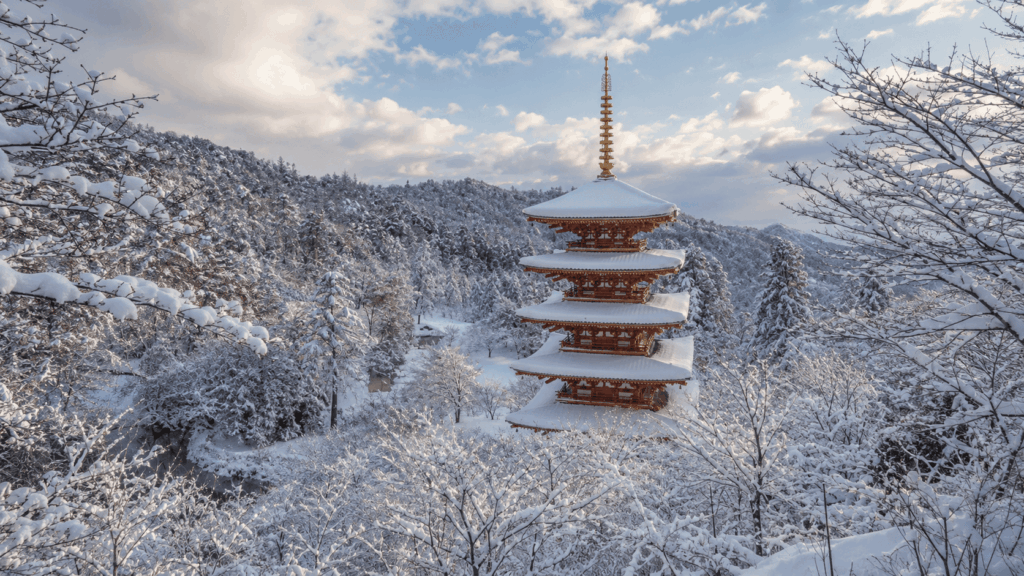
This Amanohashidate day-trip plan focuses on the sandbar area. The windows below are sightseeing allowances, not published train departures. First choose your actual outward and return services, then fit the activities between them. Arrival later in the morning means shortening the plan.
| Stage | Suggested plan | What makes it realistic |
|---|---|---|
| Before leaving Kyoto | Check Miyazu’s forecast, live camera, ride closures and transport | Choose a workable return as well as an outward journey |
| Morning journey | Take your booked or selected train or highway bus | Use the timetable for your date; do not assume an early direct train leaves at any chosen time |
| First 60–90 minutes locally | View Land if the view is clear, or a short temple-area walk and warm break | Allow for the walk to the ride, waiting, the panorama and descent |
| Lunch | Choose a station-side meal or a separately reserved winter course | A full buri-shabu course needs more time than a quick lunch |
| Early afternoon | Walk a comfortable section of the sandbar, or use a confirmed boat-and-north-shore route | A full crossing plus Kasamatsu requires a deliberate return plan |
| Mid-afternoon onward | Return toward the station with time for your chosen departure | Collect bags, use the toilets and leave a margin for queues or a delayed local ride |
Two useful versions are View Land plus a partial sandbar walk, or a boat-based loop with Kasamatsu. Choose between them when your local time is limited. Trying to add both viewpoints, the entire sandbar, an unhurried set meal and Ine turns a simple day into a much tighter undertaking.
December loses daylight substantially earlier than late February, and a ride’s closing time is not the same as sunset. If photography is a priority, use the Amanohashidate sunset guide to compare the light with the actual descent and return options. Do not let a desired photograph decide the last available connection for you.
From Osaka, plan the complete route from your accommodation rather than adding a fixed number of minutes to the Kyoto example. A transfer through Kyoto, a route through Fukuchiyama and a road tour have different arrangements. If you want both coastal stops and an easier pace, staying locally is another option.
Warm Up With Buri Shabu
Winter yellowtail, or buri, is one reason the coast can be enjoyable even without snow. For buri shabu, thin slices of fish are briefly swished through hot broth. The meal gives you a warm pause between outdoor visits and makes a food-focused winter day worthwhile in its own right.
Toriki is a cooking ryokan close to Amanohashidate Station, known for its winter buri-shabu offering. November–March is the usual seasonal window, but availability, the course and the price depend on the date and booking. Contact the property before planning a day-visit meal there; an overnight dinner plan is not proof that an unreserved lunch is available.
I have eaten my share of this dish around the Tango coast, and Toriki’s version is the one I would send a friend to in winter: the fish is rich and sweet from the cold-season fat, and the broth lets it speak for itself. It is a splurge rather than a budget meal, but on a cold day it is exactly the right way to finish a trip to the sandbar.
Give a reserved course its proper place in the itinerary. Ask the serving time and expected duration, and do not combine it with an activity whose schedule leaves only a short lunch stop. If a full course is outside your budget or unavailable, a simpler seafood lunch can still be a satisfying warm break.
For an overnight plan, compare the location and meal arrangements in the Amanohashidate onsen and ryokan guide. A dinner-and-breakfast stay can suit someone who would rather enjoy the food and scenery slowly than return to Kyoto the same evening.
Should You Add Ine in Winter?
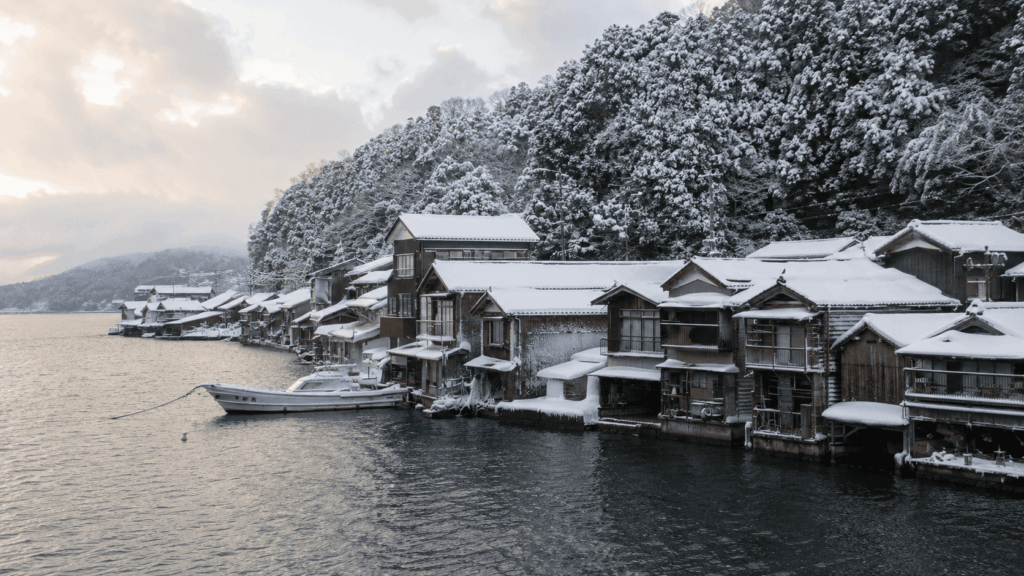
Ine is possible in the same day, but it should be part of the initial plan. Its waterfront boathouses are a different landscape from the sandbar. The difficulty is fitting local travel, walking, meals and the journey back into limited daylight; it is not that the village is inaccessible throughout winter.
Allow roughly an hour for a regular bus journey from the Amanohashidate area, depending on the exact stops and service. Check the October 2026 or later timetable for your date. Do not assume either that buses come whenever you need one or that older descriptions of very sparse service still match the current schedule.
For the regular Tankai route, the operator currently gives ¥400 as the example adult fare between Amanohashidate Station and the Ine Bay cruise stop. This is different from the separate sightseeing express service. That express is advertised only through December 20, 2026; do not extend its timetable into January or February without a new announcement.
Start with the regular bus timetable and choose both directions. Check the relevant stop: the Ine Bay sightseeing-boat boarding point at Hide and the village’s Ine stop are not interchangeable places to start a walk. Account for any travel between them.
Going to Ine first can work when your arrival and bus connection align, but it is not a rule. If an earlier clear panorama, a reserved meal or your return transport makes the opposite order more sensible, follow that. A bus gap should not be filled by trying to rush every other stop.
The Local Pass and the Two Different Boat Rides
A local pass can be useful when you will actually use several covered rides. The two-day Tankai ticket covers specified local buses, the Amanohashidate sightseeing ferry, Ine Bay cruise and Kasamatsu rides, among other listed transport. It is not a general ticket for View Land, nor does it include your Kyoto-to-Amanohashidate train or highway-bus journey.
Compare the operator’s coverage and ticket list with your actual route. For a single viewpoint and a short walk, individual tickets may be enough. A two-day validity window does not force the rides into one day, and a pass does not keep a closed attraction operating.

Also distinguish the boats. The Amanohashidate Sightseeing Boat links the two sides of the sandbar area. The Ine Bay cruise is a separate excursion around the boathouses, from a different boarding point. Taking one does not transport you to the other destination.
If Ine is an important part of your trip rather than a quick photo stop, read the Ine winter guide and consider giving it more time. An overnight stay or a private route with agreed priorities may suit you better than trying to add it at the end of an independent Amanohashidate day.
Driving From Kyoto: When a Rental Car Makes Sense
A rental car is an alternative for independent travelers who already have the required documents and are comfortable with winter driving. It can help on a wider northern-Kyoto itinerary or when several people want their own timetable. Compare it with the train, shared bus and private vehicle rather than treating it as a necessary extra.
If you are starting in Kyoto, compare Kyoto pickup locations and the actual rental terms. Ask the supplier about winter tires and any other equipment for the expected route before reserving. A standard vehicle listing does not establish that suitable winter equipment is included.
Compare Kyoto pickup locations & rental-car terms
Add fuel, expressway tolls, parking and the rental return deadline to the comparison. Check road conditions before departure and leave time for the drive back. If you do not want responsibility for snow or ice, use public transport or an appropriate operated trip instead of making this your first winter drive.
What to Do With Luggage on a Winter Day Trip
A small daypack makes lifts, boats and a wet-weather walk easier. If you are returning to the same Kyoto accommodation, ask it about keeping your main suitcase. On a checkout day, hotel storage or a station locker may still be the simplest arrangement.
For a reservable alternative, search Bounce around the Kyoto departure and return area. Choose a location whose opening hours cover both an early start and a potentially late return. Some storage shops open after morning tour departures or close before a long day trip finishes; check the actual listing and leave a collection margin.
Find luggage storage & check collection hours
The link opens a general search, so enter the area that fits your route. Do not assume it books storage at Amanohashidate Station. If you are continuing onward rather than returning to Kyoto, arrange storage or luggage space that works with that onward journey instead.
When I Would Skip Amanohashidate in Winter
A cloudy day can still be worthwhile. The more useful reasons to change the plan concern actual operations, uncomfortable conditions and what you wanted from the trip.
- Serious weather or transport disruption affects the route. Read the relevant warnings and operator notices before traveling. A sightseeing booking does not override them.
- The main experience you want is unavailable. A full viewpoint closure matters more to a panorama-focused visitor than to someone coming for lunch and a short walk.
- Snow scenery is the only reason you would travel. If the camera shows bare ground and no useful snow is expected, consider another day rather than relying on a calendar promise.
- A delay would undermine a flight, long-distance train or essential evening plan. Give the trip a day with room for uncertainty.
Conversely, no snow is not the same as no reason to go. A clear view, a shorter sandbar walk and a warm seasonal meal can make a good winter day. Match the version of the trip to the weather and your party rather than measuring it against one perfect photograph.
FAQ: Amanohashidate in Winter
Does it snow in Amanohashidate?
Yes. Snow can fall and settle, including on the pine trees, but the coast also gets rain and snowless periods. Check the Miyazu forecast and current sandbar camera rather than assuming that snowfall somewhere in northern Kyoto means snow cover at the water.
What is the best month to see snow at Amanohashidate?
January and February are the main midwinter months to consider, with December generally milder. There is no guaranteed snow month or dependable date for a white sandbar. If you can choose the day, recent snow, actual camera conditions and a workable forecast are more useful than the month alone.
Is Amanohashidate worth visiting in winter even if there is no snow?
Yes, when the coastal view, pine forest and seasonal food appeal to you. A snowless day can be easier for walking and still atmospheric. The decision depends more on visibility, wind, operating attractions and your available travel time than on whether every tree is white.
What should I wear to Amanohashidate in winter?
Wear adjustable insulation under a windproof outer layer, waterproof footwear with grip, gloves and head or ear protection. Winter boots are more useful when snow or freezing conditions are expected. Include time standing still at viewpoints and stops when deciding how warmly to dress.
Can I visit Amanohashidate and Ine in one day in winter?
Yes, with a deliberate transport plan and fewer activities at each stop. Check the actual outward and return buses if traveling independently, or compare a shared or private road trip. Do not expect to fit both viewpoints, a complete sandbar crossing, a long meal and an unhurried Ine visit into the same short day.
Are the viewpoints open throughout winter?
They normally operate in winter, but maintenance and weather can interrupt them. For winter 2026–27, View Land is closed December 15–17, 2026, and Kasamatsu Park is closed December 18. Chairlift-only inspections are different from full closures; check your ride and date before heading there.
Does a tour include the boat, viewpoint tickets and lunch?
It depends on the product and selected option. The private trip discussed here excludes sightseeing tickets, boat rides and meals. On the shared-bus alternative, boat and viewpoint activities are optional extras and food is excluded. Check the actual inclusions and total for your booking rather than relying on a photograph of an activity.
Do I need a car for Amanohashidate in winter?
No. A train or highway bus can get you to the area, with local transport for the north shore and Ine. A rental car suits a different traveler: someone prepared for the route, equipment and winter conditions who wants independent driving. An operated vehicle is another option if your main aim is fewer connections.
Final Verdict: Who Should Visit Amanohashidate in Winter?
Choose it for a coastal winter day, with snow as a bonus. The visit works well when you can enjoy the sandbar and food without needing a perfect panorama at a fixed hour. Check locally, dress for wind and water, and give the return journey room.
For first-time visitors: start with one viewpoint, a manageable walk and lunch. Choose View Land for the station-side route or Kasamatsu when your plan already takes you to the northern shore. There is no need to collect both views on a short day.
For families: shorten the exposed walking, make warm breaks part of the plan and compare the cost of moving everyone independently with an agreed private vehicle. Confirm child-seat, luggage and ride arrangements where needed.
For travelers on a tight schedule: focus on Amanohashidate or build both destinations into a checked itinerary from the outset. A private or shared trip changes the transfer planning, while the weather and daylight still set limits.
For repeat visitors: winter food, changing light and quieter walking can be the reason to return. You can skip a clouded viewpoint and spend longer on the parts of the landscape you enjoy.
Go with a plan that can still be satisfying without snow. That is the difference between a winter visit shaped around the place and one that depends entirely on the weather matching a photograph.
Hi, I’m Kai. I’m a Tokyo-based travel writer, tourism industry insider, and the author of a published guidebook for international visitors to Japan. With over 10 years of professional experience at a leading Japanese tourism company, my mission is to help you skip the tourist traps and navigate Japan’s best destinations like a local. I believe the perfect day trip is like a traditional kaiseki meal: a beautiful balance of precise planning and unforgettable seasonal discovery. When I’m not out conducting field research, you’ll usually find me drafting new itineraries with one of my favorite fountain pens!