
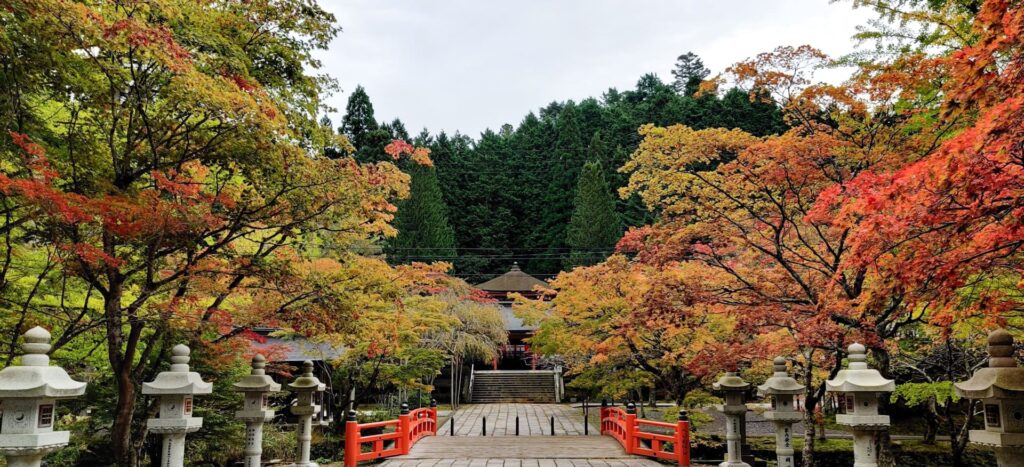
Want to see Koyasan without managing the train, cable-car and bus connections? Compare live dates, pickup details and current traveler reviews for a full-day Mount Koya cultural tour from Osaka before finalising your autumn itinerary.
When Is the Best Time to See Autumn Leaves in Koyasan?
If you are looking for a single window to aim for: late October through early November is the established peak period for Koyasan’s autumn foliage, based on data from Visit Wakayama and the Japan National Tourism Organization. In an average year, the color reaches its most vivid during the first week of November.
What catches many first-time autumn visitors off guard is timing. Koyasan sits at roughly 1,000 meters above sea level, which means its leaves peak two to three weeks earlier than those in Kyoto and Osaka. Travelers who plan a Koyasan day trip from Kyoto in late November, expecting full autumn color, often find the trees bare or past their best.
A note on 2026: peak timing ultimately depends on temperature patterns through September and October, which cannot be predicted far in advance. What follows is based on historical averages. For real-time confirmation before your trip, check the official autumn-foliage reports from Visit Wakayama or the Koyasan Shukubo Association roughly two weeks before your planned date.
| Period | Color Level | Crowds | Accommodation Cost | Best for |
|---|---|---|---|---|
| Mid to Late October | First color appears; green, yellow and early red mix | Moderate | Standard rates | Travelers who prioritize quiet over peak color. The illumination events may not have started yet. |
| Late October to Early November | Likely near peak. Most reliable window for strong color. | High (weekends especially) | Rising; book early | First-time autumn visitors who want the most vivid foliage combined with temple sightseeing. |
| First to Second Week of November | Traditional peak window. Consistent reds and yellows in most years. | Very high | Peak season pricing | Photographers and travelers who accept crowds for the best color. |
| Mid-November | Variable. Some years hold color; others see significant leaf drop. | Moderate to high | Still elevated | Repeat visitors or those combining Koyasan with lower-altitude destinations. |
| Late November | Mostly past peak. Evergreens dominate. | Low | Standard rates | Travelers whose primary interest is the temples, not autumn color. |
What to Expect in Late October
Late October is an underrated window for autumn visitors who dislike crowds. The maples and ginkgoes are typically in the early stages of turning, so you see a gradient of green, yellow and red rather than a full blanket of color. The main advantage is lower accommodation prices and more space at key sites.
Jabara-michi and Danjo Garan begin showing noticeable color toward the end of the month. The night illumination near Kongobu-ji and along Jabara-michi typically runs through the autumn-leaf season, but if you arrive very late in October, check whether it has started yet.
What to Expect in Early November — The Center Window
The first half of November is historically the most reliable period for peak foliage. The Konpon Daito pagoda at Danjo Garan with fully colored maples around it is the image most autumn visitors are hoping for, and this is the window in which you are most likely to see it.
Two trade-offs come with this timing. Weekend crowds can be significant, especially at Danjo Garan and along Jabara-michi. Temple-stay prices also rise sharply during this period, and popular shukubo can book out weeks or months in advance. If you plan to stay overnight, booking through the Koyasan Shukubo Association’s official site or a major accommodation platform at least a few months ahead is strongly advised. For more help choosing a temple, see our guide on where to stay in Koyasan.
Is Mid-November Too Late?
Not necessarily, but it requires adjusted expectations. In some years, strong autumn color holds well into the second half of November. In others, a period of rain or wind accelerates leaf drop significantly. If mid-November is your only available window, the sensible approach is to plan your visit around Koyasan’s temples and culture first, and treat autumn color as a welcome bonus rather than the main goal.
Okunoin, Kongobu-ji and the Reihokan Museum offer enough architectural and religious substance to justify a visit regardless of foliage conditions. The cedars and moss at Okunoin are always photogenic, and the Banryutei rock garden at Kongobu-ji does not depend on seasonal color.
The Best Places to See Autumn Leaves in Koyasan
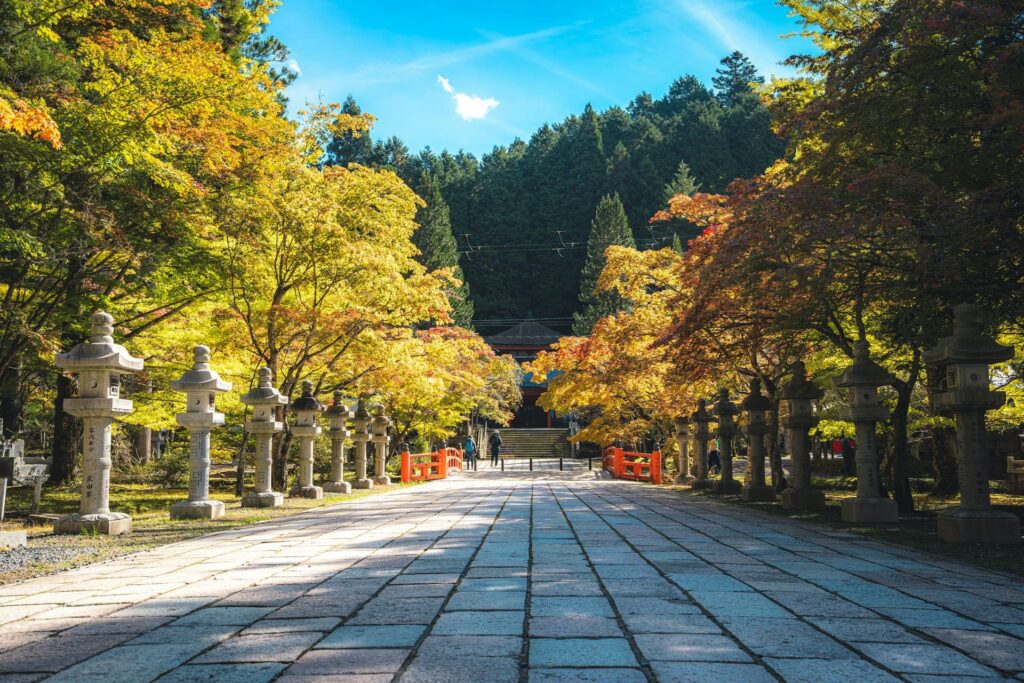
The table below compares the main autumn-viewing spots on Koyasan across the factors that matter most for decision-making: foliage density, cultural importance, the time you need to allocate, photographic value, and how high they should rank on a day-trip itinerary.
| Spot | Foliage Density | Cultural Significance | Time Needed | Photo Value | Day-Trip Priority |
|---|---|---|---|---|---|
| Jabara-michi | High | Medium | 10–15 min walk | Very high (tunnel effect) | 1st (quick, concentrated) |
| Danjo Garan & Konpon Daito | Medium–High | Very high | 30–60 min | High (vermilion pagoda + leaves) | 2nd |
| Koyasan Reihokan Museum (grounds) | Medium | Medium | 15–20 min (exterior) | Medium | 3rd (good wet-weather stop) |
| Kongobu-ji (grounds & garden) | Medium | Very high | 30–45 min | Medium–High | 3rd (pair with Reihokan) |
| Daimon | Low | Medium (symbolic entrance) | 10–15 min | Medium (sunset) | Optional |
| Okunoin | Low–Medium (mostly cedars) | Highest | 45–90 min walk | Medium (atmosphere > foliage) | 4th (if short on time) |
| Central Street (between sites) | Medium–High | Low | Passing through | High | N/A (connects other spots) |
Jabara-michi — The Most Focused Autumn Walk
Jabara-michi (Dragon’s Belly Path) is the short road connecting the entrance of Kongobu-ji to the Danjo Garan complex. It is the single most concentrated autumn-foliage walk on Koyasan. The maples on both sides form a canopy that, at peak, turns the path into a tunnel of red and orange. If you only have a brief window, this is the one spot to prioritize.
Because the walk takes only 10 to 15 minutes, it fits naturally into any itinerary. The night illumination held here after sunset during the foliage season adds a different character, though the light-up times and exact dates vary by year.
Danjo Garan and Konpon Daito — Best for Temple-and-Foliage Photos
The Danjo Garan complex is Koyasan’s spiritual center, anchored by the vermilion Konpon Daito pagoda. The combination of the two-story pagoda with surrounding autumn leaves is the most photographed scene on the mountain. While the pagoda itself dominates the view, the maples around the edges of the complex add the seasonal color that makes the composition work.
The interiors of the Kondo Hall and the pagoda are open from 8:30 to 17:00 (admission around 500 yen each, or a combination ticket for 2,500 yen that covers multiple sites). The grounds themselves are free to walk at any time. During the autumn season, the evening illumination along Jabara-michi also extends to the main gate area of Kongobu-ji, visible from the edge of the Garan grounds.
Reihokan Museum and Kongobu-ji — A Flexible Stop for Cold or Wet Weather
Koyasan in late autumn can be cold and occasionally wet. The Reihokan Museum (admission 1,300 yen; 200 yen off with the Koyasan World Heritage Ticket) houses a collection of Buddhist artifacts and scrolls. Photography is not permitted inside, but the trees around the museum building add color to the exterior. It is a practical stop on a chilly day when you want to warm up without abandoning the autumn-viewing plan entirely.
Kongobu-ji, the head temple of Shingon Buddhism, is a short walk away. The admission fee of 1,000 yen (as of 2026) grants access to the interior corridors, the Banryutei rock garden (Japan’s largest Zen rock garden), and a cup of green tea. The temple grounds themselves have some maples, though the foliage here is not as dense as at Jabara-michi. The combination of the two stops makes a solid indoor-outdoor circuit in about an hour.
Daimon — Worth Adding If You Have Time
Daimon is the large two-story gate that marks the western entrance to the sacred town of Koyasan. The foliage immediately around the gate itself is sparse compared to Jabara-michi or Danjo Garan. What Daimon offers instead is a wide view over the valley, with the gate acting as a foreground frame for distant autumn color.
For day-trippers, Daimon is worth a brief stop if you are walking between the Danjo Garan area and the central bus stop, which takes most people past it anyway. It is not worth a dedicated detour unless you are specifically aiming for sunset or a wide-angle landscape shot.
Okunoin — Essential for Koyasan, but Not Mainly for Maple Color
This is the most important expectation to set. Okunoin is regularly listed alongside other Koyasan autumn spots, which leads many first-time visitors to arrive expecting a maple-lined path similar to Jabara-michi. The reality is different.
Okunoin is Koyasan’s holiest site: the mausoleum of Kobo Daishi (Kukai), the founder of Shingon Buddhism. The approach is a two-kilometer path lined with towering cedar trees, moss-covered stone lanterns, and over 200,000 graves of monks, feudal lords, and historic figures. The atmosphere is solemn, ancient and deeply atmospheric, but the autumn color comes almost entirely from scattered ginkgo trees rather than dense clusters of maples.
The path from Ichi-no-hashi Bridge to the Kobo Daishi Mausoleum is worth doing for its cultural weight and photographic mood, especially in the late afternoon when low sunlight filters through the cedars. But if your primary reason for visiting Koyasan is to see concentrated autumn color, Okunoin should be a lower priority than Jabara-michi and Danjo Garan.
A practical note: the walk from Ichi-no-hashi Bridge to the mausoleum and back takes 45 minutes at a steady pace, longer if you stop frequently. The path is flat and paved, which makes it manageable in autumn footwear. Photography etiquette matters more here than elsewhere on the mountain — avoid using flash near worshippers and refrain from photographing the mausoleum interior.
Is Koyasan Worth Visiting Just for Autumn Leaves?
This depends entirely on what you are comparing it against. Koyasan’s autumn color is real and beautiful, but the mountain is not a single-purpose foliage destination in the way that Kyoto’s Eikando, Tofuku-ji or Arashiyama are. The value of Koyasan in autumn comes from combining moderate-to-good foliage with a temple-town atmosphere that has no equivalent near Kyoto or Osaka.
Who Will Enjoy Koyasan in Autumn Most
- Travelers who appreciate Buddhist architecture, mountain scenery and cultural depth alongside autumn color
- Those visiting Kansai in late October to early November who want autumn leaves before Kyoto peaks
- Photographers who enjoy compositions involving temple roofs, pagodas, lanterns and moss with seasonal accents
- Anyone open to an overnight temple stay (shukubo) with vegetarian shojin ryori and morning prayers
- Solo travelers and couples who prefer a quieter, less commercial atmosphere than major Kyoto sites
Who May Prefer Another Autumn Destination
- Travelers whose top priority is dense, unbroken autumn color — locations like Kyoto, Arashiyama or Minoh Park will deliver more foliage per minute
- Day-trippers with only half a day available — reaching Koyasan from central Osaka takes roughly 2 hours each way, leaving limited time on site
- Travelers who dislike multiple train and cable-car transfers — Osaka to Koyasan requires at least two changes (train + cable car + bus)
- Anyone visiting Kyoto in mid-to-late November who expects Koyasan to have similar color at the same time
A Practical Koyasan Autumn Day-Trip Route
The typical day-tripper departs from Osaka (Namba Station) and has roughly five hours on the mountain before the last convenient return departures. The following route is designed to maximize the combination of autumn foliage and temple experience within that window. For a broader look at organizing your day, check out our detailed Koyasan day trip itinerary.
If you are coming from Kyoto, add roughly one extra hour of travel time (Kyoto to Namba via private railway or JR), which reduces the available window on Koyasan proportionally. You can find more specific logistics in our dedicated guide to visiting Koyasan from Kyoto.
If You Have About Five Hours in Koyasan (Standard Route)
- 10:00 – Arrive at Koyasan Station by taking the Nankai Koya Line limited express from Osaka-Namba to Gokurakubashi (roughly 80 minutes), then the cable car (5 minutes) to the top. Note that walking from the cable-car station into town is not permitted; take the Nankai Rinkan bus to Senjuinbashi (10 minutes).
- 10:15 – 10:40: Daimon (optional). Walk five minutes from the bus stop for a quick photo stop if the weather is clear.
- 10:45 – 11:30: Danjo Garan and Konpon Daito. Visit the pagoda and Kondo Hall. This is the main photography spot for autumn temple shots.
- 11:35 – 11:50: Jabara-michi. The most concentrated foliage walk on the mountain. Merges naturally into the next stop.
- 11:55 – 12:45: Kongobu-ji. Tea, rock garden, temple corridors. Combine with a quick exterior look at the Reihokan Museum grounds if time permits.
- 12:45 – 13:30: Lunch. Several restaurants near the main street serve Koya tofu and other local dishes.
- 13:45 – 14:45: Okunoin. Walk from Ichi-no-hashi to the mausoleum and back. Keep a brisk pace if you are on a tight schedule.
- 15:00 – Return to Koyasan Station and begin the reverse journey to Osaka.
If You Arrive After Lunch (Short Route)
A common mistake is underestimating the travel time and arriving on the mountain after 13:00 with a return deadline around 16:30 or 17:00. When that happens, the sensible move is to choose one side of the town rather than trying to cover both.
Choose the Danjo Garan side if your priority is autumn foliage and temple photos. Visit Danjo Garan (30 minutes), walk Jabara-michi (10 minutes), and spend the remaining time at Kongobu-ji (30 minutes). You will cover the most visually rewarding spots in compact sequence.
Choose the Okunoin side if your priority is the cultural atmosphere of the mountain. The Okunoin path takes about 45 minutes round-trip, and you can add a brief stop at the Danjo Garan complex on the bus ride back. The foliage will be less intense, but the experience will feel distinctly different from any other autumn destination in Kansai.
Koyasan Day Trip or Overnight Stay in Autumn?
This decision affects your budget, your schedule and the kind of experience you take away from the mountain. Both options are valid, but they suit different travelers.
| Factor | Day Trip | Overnight Stay |
|---|---|---|
| Total time commitment | 8–10 hours from Osaka | 24–30 hours |
| When you experience the sites | 10:00–15:00 (peak crowd hours) | Before 09:00 and after 17:00 (quieter) |
| Evening illumination | Only if you stay late; last return options are limited | Full access to Jabara-michi and Kongobu-ji night lights |
| Cost per adult (approx.) | ¥4,200–¥6,000 (transport + temples + lunch) | ¥12,000–¥25,000+ per person (includes shukubo, dinner, breakfast) |
| Meals included | No (pay per meal) | Shojin ryori (Buddhist vegetarian dinner) and breakfast typically included |
| Crowd experience | Same as most other day visitors | Quiet morning and evening at major sites |
| Photography conditions | Midday light; some spots busy with people | Soft morning light; empty paths before 09:00 |
| Luggage | Carry your own; use lockers at Koyasan Station (check current availability) | Drop at shukubo (check check-in/out times) |
Choose a Day Trip If
- Your time in Osaka is limited and you want to fit Koyasan into a single day efficiently
- You are comfortable with a moderately packed schedule and do not mind midday crowds at the main spots
- You are mainly after the autumn foliage and the Danjo Garan-Jabara-michi-Kongobu-ji circuit
- Your budget is tighter and the premium for peak-season shukubo accommodation is hard to justify
Stay Overnight If
- You want to experience Koyasan without the day-trip crowds — the mountain is noticeably different before 09:00 and after 17:00
- The evening illumination and a quiet morning walk through Okunoin are important to you
- You are interested in shojin ryori (Buddhist vegetarian cuisine) and attending morning prayer service
- You are comfortable carrying or forwarding luggage; most shukubo are a short walk from the central bus stop
Independent Travel or a Guided Koyasan Tour?
Reaching Koyasan independently requires navigating a train, a cable car, and a bus with two to three transfers. For travelers accustomed to Japan’s transit system, this is straightforward. For those who find multiple changes stressful in a limited time window, a guided tour removes the coordination burden.
| Factor | Independent Travel | Guided Tour |
|---|---|---|
| Cost per adult | ¥3,980–¥5,200 (transport + ticket) | US $70–$80+ (¥10,000–¥12,000+) |
| Total travel time | ~2 hours each way (3 transfers) | ~2 hours (direct bus; no individual transfers) |
| Flexibility | High. You stay as long or as short as you want. | Set schedule; you follow the group. |
| Information depth | Self-guided (guidebook, audio, research) | Live commentary from a local guide |
| Language support | Signage in English at major sites; limited elsewhere | Usually English-speaking guide included |
| Best for | Experienced transit users; travelers who want complete control of their time | First-time Japan visitors; anyone who prefers not to manage transfers independently |
When Independent Travel Makes More Sense
If you have used Japan’s train network before and are comfortable with a station transfer and a cable car, the independent option is both cheaper and more flexible. The Koyasan World Heritage Digital Ticket (from ¥3,980 for the regular version, ¥4,910 for the limited express version, as of 2026) covers the round trip from Namba, unlimited bus rides on the mountain, and discounted admission to several temples and the museum.
The ticket is available as a digital pass (smartphone scan) or a paper pass (purchase at Namba Station). For a standard day trip visiting two or three paid sites, the ticket pays for itself. The main trade-off is that you manage your own time and transfers, which is straightforward but requires attention to the return schedule.
If you are taking the independent route, check the current inclusions, validity rules and price for the Koyasan World Heritage Digital Ticket before finalising your train plan.
When a Guided Tour Is Worth Paying For
A tour makes sense in three specific situations. First, if the multiple transfers (rapid train, cable car, bus) feel like a barrier to including Koyasan in your itinerary at all. Second, if having a guide explain the religious significance of Kongobu-ji, Danjo Garan and Okunoin adds meaning to the visit. Third, if your available day in Osaka is short and you want to minimize logistical risk.
Several full-day bus tours from Osaka cover the main Koyasan sites (Daimon, Danjo Garan, Kongobu-ji, Okunoin) with a local guide, and some include a goma fire ritual experience. For autumn visitors who want to focus on the experience rather than the navigation, the higher cost can be a reasonable trade-off.
If you want Koyasan’s autumn scenery but know that multiple transfers and self-guided temple visits would drain too much of the day, this is the one tour worth comparing with the DIY route.
Why I’d book this one
- Pickup in central Osaka and coordinated transport remove the train, cable-car and bus connection chain.
- The itinerary combines major Koyasan sites with English guidance, rather than leaving the religious context entirely to signs and advance research.
- Recent travelers mention knowledgeable guiding and the value of the cultural elements, though it is worth checking the newest feedback and exact inclusions before choosing.
Before finalising, confirm which booking option includes the professional guide and check the current participant and cancellation terms.
Practical Autumn Tips: Weather, Crowds, Buses and Luggage
What to Wear
Koyasan in late October and November is noticeably colder than Osaka or Kyoto. Daytime temperatures typically range from 8–15°C, dropping to 3–8°C in the evening and early morning. Moisture from clouds and fog is common, which makes the cold feel sharper than the thermometer suggests.
A layered approach works best: a base layer, a mid-layer (fleece or light wool), and a windproof or waterproof outer layer. Gloves and a hat make a meaningful difference during the Okunoin walk, which is partially shaded by cedars. Comfortable walking shoes with reasonable grip are essential — the paths between sites are paved but can be slick with fallen leaves and dampness.
How to Reduce Crowd and Transport Stress
Weekends draw significantly larger crowds than weekdays, especially during the first two weeks of November. The Nankai Koya Line limited express fills up on Saturday and Sunday mornings heading toward Koyasan. Reservations are not available on these trains, so arriving at Namba Station early (before 08:00) improves your chances of a comfortable seat.
The Nankai Rinkan bus that runs from Koyasan Station into town can be packed during peak foliage weekends. The walk from the cable-car station to the town center is not permitted, so there is no alternative. If the queue at Koyasan Station is long, the wait is usually under 15 minutes, but patience helps.
A recurring concern among autumn visitors is that by late afternoon, the bus stop near the cemetery path to Okunoin can collect a significant queue heading back to Koyasan Station. If your return timing is tight, starting your return from the central Senjuinbashi stop is more reliable than waiting at the stop furthest from the station.
Travel Light or Store Large Bags Before Going Up
Koyasan Station has coin lockers, but availability is limited and they fill quickly during peak foliage season. If you are arriving from Osaka with a larger suitcase, the more reliable option is to store it at Namba Station (in the Nankai area or nearby department-store lockers) before boarding the Koya Line. Coming from Kyoto, lockers at Kyoto Station offer a similar solution. For other alternatives, see our guide to Koyasan luggage storage options.
For overnight visitors, most shukubo can hold luggage before check-in, but they typically expect guests to arrive via the bus and walk from the central stop. Packing a light day bag for the mountain while leaving the main suitcase below makes the bus and path transfers far more comfortable.
How to Check the 2026 Koyasan Autumn-Leaf Conditions
Since peak timing depends on weather patterns that are only predictable a week or two in advance, checking near your travel date is the most reliable approach. The following resources publish real-time foliage updates during the season:
- Visit Wakayama (website and social media) — Regular autumn-foliage reports covering Koyasan and other Wakayama locations, typically starting in mid-October.
- Koyasan Shukubo Association — Updates on accommodation availability and general mountain conditions during autumn.
- Nankai Electric Railway — Service announcements, timetable changes, and seasonal information for the Koya Line and cable car.
- Japan Meteorological Corporation / Weather News — Seasonal forecasts and koyo (autumn leaf) forecasts for the Kansai region, though these are broad estimates rather than site-specific guarantees.
FAQ
Can I see autumn leaves at Koyasan in late November?
In most years, late November falls after the peak period. The mountain’s elevation means the color window is earlier than in Kyoto or Osaka. Some years hold color into the second half of November, but the more reliable outcome is significant leaf drop by that point. If late November is your only option, treat the culture and atmosphere as the main draw and autumn color as a secondary bonus.
Do I need to book a tour, or can I go independently?
Both are viable. The independent option using the Koyasan World Heritage Digital Ticket (from ¥3,980 for the regular version, ¥4,910 with limited express) is cost-effective and flexible if you are comfortable with the train-to-cable-car-to-bus transfers. A guided tour removes the logistical load and adds live commentary, which some travelers find valuable for understanding Koyasan’s religious significance.
Is Okunoin worth visiting for autumn leaves?
Okunoin is worth visiting for its atmosphere, its cultural importance, and its role as the spiritual heart of Koyasan. It is not, however, a maple-foliage destination. The path is lined with towering cedars and scattered ginkgo trees, not dense clusters of momiji. If you visit expecting the kind of vibrant color you get at Jabara-michi or Danjo Garan, you may leave disappointed. Visit Okunoin for the quiet walk through ancient graves under tall trees, and appreciate whatever autumn accent you find along the way.
How much time do I need for Koyasan on a day trip?
A comfortable day trip from Osaka requires roughly five hours on the mountain, which covers the main sites (Danjo Garan, Jabara-michi, Kongobu-ji, and Okunoin) at a steady pace. From Kyoto, the additional travel time reduces the mountain window to about four hours. Shorter visits are possible but require choosing either the Danjo Garan side or the Okunoin side, rather than trying to cover both.
What is the best way to get from Osaka to Koyasan?
The most common route is the Nankai Koya Line from Osaka-Namba Station. The limited express reaches Gokurakubashi Station in about 80 minutes (¥2,030 regular fare; ¥1,880 with digital ticket pre-purchase). From Gokurakubashi, the cable car takes five minutes to ascend the mountain. From the top cable-car station, the Nankai Rinkan bus runs into town (10 minutes, ¥460, or included in the World Heritage Digital Ticket). The full door-to-door time from Namba to the central Senjuinbashi bus stop is roughly 2 hours.
Final Verdict
Choose Koyasan for autumn if you are visiting Kansai in late October to early November, you value the combination of temple culture and seasonal color, and you are comfortable with a 2-hour commute from Osaka for a destination that feels genuinely different from Kyoto’s foliage circuit. The mountain delivers its best autumn experience when you treat the foliage as one part of a broader cultural visit, not the sole reason for going.
Choose another destination if your top priority is dense, concentrated autumn leaves without the time and transfer investment. Kyoto (Eikando, Tofuku-ji, Kiyomizu-dera), Minoh Park near Osaka, or Arashiyama offer more foliage per minute of travel time and require fewer logistical steps. Koyasan rewards the traveler who wants context with their color.
For first-time visitors: arrive early, prioritize Jabara-michi and Danjo Garan for foliage, buy the World Heritage Digital Ticket at Namba Station before boarding, and do not try to cover both Okunoin and Danjo Garan in detail if you have less than four hours on the mountain.
For overnight visitors: the early morning at Okunoin before the day-trippers arrive and the evening illumination along Jabara-michi are the two experiences that justify the premium cost of a temple stay. Book through the Koyasan Shukubo Association or a major accommodation platform at least two to three months ahead if visiting during the first two weeks of November.
For photography-focused travelers: the best light for Danjo Garan and Konpon Daito is early to mid-morning. Jabara-michi works well under the soft light of late afternoon. The illumination after sunset requires a tripod and a willingness to shoot in cool evening temperatures.

Hi, I’m Kai. I’m a Tokyo-based travel writer, tourism industry insider, and the author of a published guidebook for international visitors to Japan. With over 10 years of professional experience at a leading Japanese tourism company, my mission is to help you skip the tourist traps and navigate Japan’s best destinations like a local. I believe the perfect day trip is like a traditional kaiseki meal: a beautiful balance of precise planning and unforgettable seasonal discovery. When I’m not out conducting field research, you’ll usually find me drafting new itineraries with one of my favorite fountain pens!