
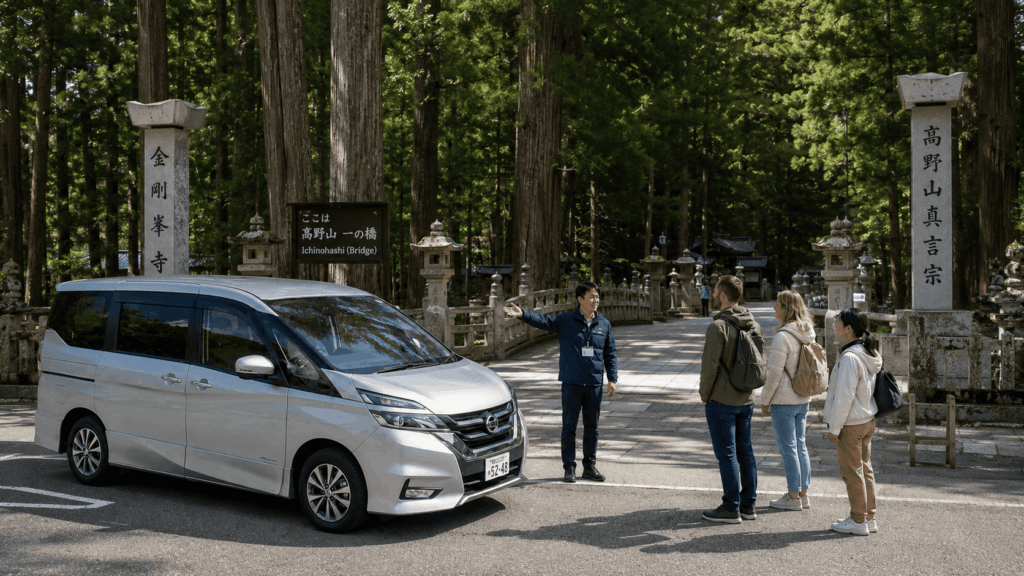
Koyasan (Mount Koya) presents a unique luggage challenge. You take a train, transfer to a cable car, and then ride a local bus—all before you even reach the temple town. If you’re carrying a large suitcase, that journey can quickly become a puzzle of where to leave it, how to retrieve it, and whether it was worth bringing at all.
This guide breaks down every luggage storage option available to Koyasan visitors—station lockers, temple storage, luggage forwarding, and alternatives in Osaka—so you can choose the strategy that fits your itinerary before you leave home.
Prefer to avoid the train–cable car–bus chain entirely? Day-trippers can check pickup details, current start times, live availability, and recent reviews for a guided Mount Koya tour from Osaka before deciding whether the DIY route is worth the extra moving parts.
Which Luggage Strategy Is Right for You?
The best place to store your luggage depends on three things: whether you’re staying overnight, where you’re headed next, and how much you’re carrying. Here’s the quick answer by scenario.
| Your Plan | Best Strategy | Key Consideration |
|---|---|---|
| Day trip from Osaka/Kyoto | Leave luggage at Namba Station (Osaka), pack a day bag | No backtracking needed; return to Osaka in the evening |
| Overnight temple stay (shukubo) | Send main suitcase via takkyubin to your next hotel; bring a small overnight bag to Koyasan | Most temples can hold bags before check-in, but large suitcases are awkward on the cable car and bus |
| Passing through Koyasan (Osaka → Koyasan → next city) | Koyasan Station lockers (if size fits) or forward luggage from Osaka to your next destination | Large lockers are limited (only 4); same-day use only—you must retrieve before last cable car |
| Hiking Choishi-michi or Kumano Kodo Kohechi | Koyasan Station lockers for day hikes; Kohechi Luggage Shuttle for multi-day treks | Lockers are best for a single-day hike starting from Koyasan; multi-day treks need a shuttle service |
Kai’s tip: The mistake I see most first-time visitors make is assuming they can store a large suitcase at Koyasan Station and come back for it later without backtracking. If you’re not returning to Osaka the same day, the round trip on the cable car just to retrieve your bag costs around ¥1,460 and about 30 minutes—money and time you’d rather spend at Okunoin or Kongobu-ji.
Koyasan Station Coin Lockers — What’s Available
Koyasan Station is the final stop after the cable car and the gateway to the temple town. Its coin lockers are the only self-service storage option on the mountain itself.
Location & How to Find Them
Exit the ticket gate and turn right. The lockers are in a small space next to the souvenir shop, directly opposite the Koyasan Tourist Information Center. You can spot them immediately after arriving—no need to leave the station building.
Sizes & Pricing
Based on the most recent on-site survey (January 2023), the locker breakdown is:
- Small (¥300): 9 lockers — fits a backpack or small duffel
- Medium (¥400): 6 lockers — fits a carry-on suitcase
- Large (¥500): 4 lockers — fits a standard checked suitcase (up to around 60–70L)
All lockers accept 100-yen coins only. There is no change machine nearby, so stop at a convenience store or ticket vending machine to break larger bills before you arrive.
Important Limitations
- Same-day use only: Lockers must be emptied by the last cable car departure. If you need to store luggage overnight, speak to station staff before using the locker—otherwise, stored items may be removed.
- Very limited large lockers: Only 4 large lockers serve the entire station. During peak seasons (autumn foliage, Golden Week, Obon), these can fill up by mid-morning.
- No lockers at Gokurakubashi Station: The cable car base station has no coin lockers at all. Do not plan to store luggage there.
Kai’s tip: What catches many travelers out is the assumption that Gokurakubashi Station (where you transfer from the Nankai train to the cable car) has the same locker availability as Koyasan Station at the top. It doesn’t. Gokurakubashi has zero lockers. If you’re planning to store luggage mid-transfer, you’ll need to do it either at Namba Station before boarding the Nankai Koya Line, or at Koyasan Station after the cable car—not between them.
Koyasan Station Locker Alternatives on the Mountain
Beyond the station, dedicated public coin lockers are not available elsewhere in the temple town. Some sources mention lockers near the Tourist Information Center adjacent to the station—this refers to the same set described above. For other locations, your options are temple storage or luggage forwarding (covered below).
Namba Station (Osaka) — Leave Your Suitcase Before You Go
For most travelers visiting Koyasan from Osaka or Kyoto, the single most practical option is to store your main suitcase at Namba Station in Osaka before boarding the Nankai Koya Line. This is especially sensible for day-trippers and overnight visitors who will return to Osaka.
Nankai Namba Station Coin Lockers
Namba Station, the departure point for the Nankai Koya Line to Koyasan, has extensive coin locker facilities across multiple floors:
- 1F (near the Nankai ticket gates): A large bank of lockers beside the Sumitomo Mitsui Banking Corporation entrance
- B1F and 2F: Additional clusters near the Kintetsu side (adjacent station area)
Pricing generally ranges from around ¥400 for small lockers to ¥1,000 for extra-large sizes. The number of large and extra-large lockers at Namba is substantial—far more than the 4 large lockers at Koyasan Station—so finding space is much more reliable.
For even greater peace of mind, Namba Station also has a Yamato Transport Baggage Storage Counter where you can leave luggage for the day. This is useful if your suitcase is too large for a standard coin locker or if all lockers happen to be full.
If you’re visiting Koyasan as a day trip and the real problem is not just storage but managing bags, transfers, and the return journey, this is the guided option worth comparing with the DIY route.
Why I’d book this one
- Central Osaka hotel pickup and private transport remove the train, cable car, local bus, and locker chain from the day.
- An English-speaking guide adds context at Okunoin, Kongobu-ji, and the main temple sites instead of leaving you to interpret them alone.
- The available traveler feedback highlights knowledgeable guiding and the value of combining transport, temple visits, lunch, and a cultural activity in one day.
Cost Comparison: Namba vs. Koyasan Station
| Option | Estimated Cost | Time & Convenience |
|---|---|---|
| Store at Namba (locker), day trip to Koyasan | ¥400–¥1,000 (locker fee) | Retrieve in Osaka at end of day; no backtracking |
| Store at Koyasan Station (locker), return to retrieve | ¥500 (locker) + ¥1,460 (round-trip cable car) | ~30 extra minutes for retrieval + cable car fare |
| Ship via takkyubin (Osaka hotel → next hotel) | ¥1,500–¥2,500 (per suitcase) | Hands-free; bag arrives at your next accommodation |
Kai’s tip: The hidden cost travelers overlook is the round-trip cable car fare just to retrieve luggage from Koyasan Station’s lockers. At around ¥730 each way (¥1,460 total), plus 15 minutes each direction, that locker effectively costs ¥1,960 and 30 minutes of your day—before you even factor in the bus ride from the station back to the temple area. If your itinerary doesn’t naturally bring you back to Koyasan Station at the end of the day, Namba storage or luggage forwarding is almost always the better call.
Temple Stay (Shukubo) Luggage Storage
If you’re staying overnight at a temple lodging (shukubo), your luggage situation improves considerably. Most temples that accept overnight guests can hold your bag before check-in and after check-out, but the specifics vary by temple.
Checking In Before Exploring
Standard check-in at most shukubo is between 3:00 PM and 5:00 PM. If you arrive in Koyasan earlier, nearly all temples will allow you to drop your luggage at the reception and explore hands-free until your room is ready. Some temples even offer to bring your bag directly to your room so it’s waiting when you return.
However, there are two important caveats:
- Reception hours vary. Some temples close reception between check-out and check-in. If you arrive during that gap, you may have to wait or find an alternative. Always email your temple a few days before arrival to confirm early luggage drop-off.
- Large suitcases are harder to accommodate. Shukubo rooms are traditionally small, and many temples store luggage in a common area. While a standard suitcase is usually fine, an oversized suitcase may be a tight fit in the storage space available.
Kai’s tip: If I had one piece of advice for temple stay guests, it would be to email your lodging before arrival rather than assuming walk-in luggage storage is always available. Many shukubo operate with limited front desk staff, and reception hours can be narrower than a hotel’s. A quick email in English with your estimated arrival time and a question about luggage is almost always answered helpfully—and it costs you nothing to ask.
Checking Out with a Late Departure
Check-out at shukubo is typically early—often around 9:00 AM or 10:00 AM. If your train or bus doesn’t leave until later in the afternoon, most temples will hold your luggage for a few hours after check-out. This lets you continue exploring the temple town, visiting Okunoin, or hiking a section of the Choishi-michi before you depart.
Again, confirm this with your temple in advance. Some temples have a specific time by which you must collect your bag (for example, by 3:00 PM or 4:00 PM), and they may close reception entirely during certain hours.
How to Ask Your Temple About Luggage Storage
Here’s a simple message template you can use when emailing or booking:
“I will arrive at Koyasan around [time]. Would it be possible to leave my luggage at reception before check-in? I’m carrying a [medium / large] suitcase plus a small backpack. I will also need to store my bag for a few hours after check-out on [date]. Thank you.”
Most temples are accustomed to this question from international travelers and respond helpfully. If you book through a platform like Booking.com or JapaniCan, you can also send a message via the booking system.
Luggage Forwarding (Takkyubin) — Ship It Ahead
For travelers who want to be completely hands-free on the mountain, luggage forwarding is the most elegant solution. Japan’s takkyubin (home parcel delivery) service, operated primarily by Yamato Transport, lets you send your suitcase from your Osaka or Kyoto hotel directly to your next accommodation—bypassing Koyasan entirely.
How Takkyubin Works for Koyasan Visitors
The process is straightforward:
- Fill out a shipping slip at your hotel front desk (concierge staff handle this daily)
- Your suitcase is picked up and delivered within 24–48 hours
- Your next hotel receives and holds it for you
Cost is typically between ¥1,500 and ¥2,500 per standard suitcase, depending on size and distance. Hotels and temples registered with Yamato Transport accept deliveries on your behalf. Most shukubo in Koyasan do accept takkyubin deliveries—but again, confirm directly with your temple first, as smaller temples may not have the space or staffing to receive packages.
Send Osaka → Next City (Skip Koyasan Entirely)
The most popular luggage forwarding route for Koyasan visitors is:
- Osaka hotel → next hotel (e.g., Osaka → Kyoto or Osaka → Tokyo)
- Carry only a small overnight bag for your 1–2 nights in Koyasan
- Your main suitcase is waiting for you when you arrive at your next destination
This completely eliminates the need to deal with any luggage on the cable car, bus, or temple town streets. It costs slightly more than a coin locker (¥1,500–¥2,500 vs. ¥500–¥1,000 for lockers), but it saves you the backtracking time and gives you genuine hands-free freedom.
If your forwarding route is between covered Osaka or Kyoto hotels—or between a hotel and Kansai International Airport—you can check the available hotel-to-hotel and airport luggage delivery options on Klook. Confirm destination coverage, bag limits, collection times, and the delivery date before relying on the service.
Send to Koyasan Temple (Confirm First)
If you prefer to have your main suitcase at your temple, you can forward it from Osaka to your shukubo. Address it to the temple with your reservation name and check-in date. Call or email the temple a few days ahead to confirm they accept deliveries—most do, but some do not, and you don’t want your suitcase sitting unattended.
Hiking the Choishi-michi or Kohechi — Where Does Your Bag Go?
Koyasan is a major trailhead for two important walking routes: the Choishi-michi (a day hike from Koyasan down to Jison-in) and the Kumano Kodo Kohechi (a multi-day trek from Koyasan to Kumano Hongu Taisha). Each requires a different luggage approach.
Choishi-michi Day Hike: Koyasan Station Lockers
The Choishi-michi is a 5.5 km (3.4 mile) downhill path from Koyasan to Jison-in temple, taking about 2–3 hours. If you’re hiking it as a day walk from Koyasan, you can store your day bag in a small or medium locker at Koyasan Station (¥300–¥400) and carry only water and a camera. The trail ends at Jison-in, from where you can take a bus back to Koyasan Station to retrieve your belongings.
For a one-way hike where you don’t return to Koyasan (starting from the bottom and ending at Koyasan, or vice versa with onward travel), consider using the Choishi-michi Baggage Delivery service offered by local operators. This delivers your main bag to your next accommodation so you can walk unencumbered.
Kohechi Multi-Day Trek: Kohechi Luggage Shuttle
For hikers tackling the 70 km (43 mile) Kohechi trail from Koyasan to Kumano Hongu Taisha (typically 3–4 days), the Kohechi Luggage Shuttle run by Sanko Taxi is the standard solution. This service transfers your luggage between accommodations along the trail, delivering it each day to the lodging where you’ll sleep that night.
- Operator: Sanko Taxi / KUMANO TRAVEL
- Coverage: Koyasan — Totsukawa Onsen — Kumano Hongu area
- Pricing: Varies by section (roughly ¥2,800–¥5,800 per bag per transfer)
- Reviews: Consistently rated 4.9+ across multiple seasons; used by virtually all Kohechi thru-hikers
You can arrange the shuttle before your trip through the KUMANO TRAVEL website. The service is reliable and well-tested, but it’s essential to book at least a few days in advance during peak hiking seasons (spring and autumn).
Kai’s tip: If you’re hiking the Kohechi, trim your pack down to the essentials—a change of clothes, rain gear, water, snacks, and a sleeping bag liner if your accommodation requires one. The Kohechi Luggage Shuttle is dependable, but the lighter your bag, the easier the steep ascents and descents become. Every kilogram you leave behind is one you won’t have to carry up the Totsukawa Pass.
What to Do If the Lockers Are Full
Koyasan Station has only 4 large lockers and 6 medium lockers. During peak travel periods—autumn foliage season (late October to mid-November), Golden Week (late April to early May), Obon (mid-August), and weekends year-round—these spaces can fill up by late morning.
If you arrive and find all lockers taken, here are your backup options in order of practicality:
- Check with Koyasan Station staff. In some cases, station attendants can direct you to overflow storage or allow luggage to be held at the station office. This is not guaranteed, but it’s worth asking.
- Use the Yamato Transport counter at Namba Station before departure. If you’re already at Koyasan, this isn’t helpful—but if you’re still in Osaka, storing your bag at Namba before boarding the Nankai line is the most reliable solution.
- Forward your luggage via takkyubin from the temple. If you’re staying at a shukubo, ask at reception if they can arrange same-day or next-day delivery to your next destination. Many temples can help arrange this even if you haven’t pre-booked.
- Carry your bag to your temple. As a last resort, you can take your suitcase onto the Koyasan internal bus and to your temple. The bus runs every 15–30 minutes between Koyasan Station and the central temple area (a 5–10 minute ride, ¥310). The bus has no dedicated luggage space, so this is only comfortable if your bag is manageable and the bus is not crowded.
Recent traveler reports consistently mention that Koyasan Station’s lockers fill up by mid-morning on weekends and during peak foliage season. Having a plan B—whether that’s temple storage, luggage forwarding, or simply leaving your large suitcase in Namba—transforms a potential headache into a non-event.
FAQ
Are there coin lockers at Gokurakubashi Station?
No. Gokurakubashi Station (the cable car base station) has no coin lockers. If you need to store luggage on the Koyasan route, your options are Namba Station (before boarding), Koyasan Station (after the cable car), or your temple accommodation.
Can I store luggage overnight at Koyasan Station?
Koyasan Station lockers are intended for same-day use only. If you need overnight storage, speak to station staff before using the locker—they may be able to accommodate you or direct you to an alternative. Do not assume overnight use is permitted without asking.
Do shukubo temples hold luggage before check-in?
Most temples that offer lodging do accept early luggage drop-off, but you should confirm directly with your temple by email a few days before arrival. Reception hours vary, and some temples have limited front desk coverage during the midday gap between check-out and check-in.
Can I bring a large suitcase on the Koyasan cable car?
The cable car has limited luggage space. A medium suitcase (carry-on size) is manageable and can be held near your seat. A large checked suitcase is physically possible but can be awkward, especially when the car is crowded. If you’re traveling with a large suitcase, consider leaving it in Namba or forwarding it to your next destination.
Can I take a suitcase on the Koyasan internal bus?
Yes, you can bring a suitcase onto the internal bus from Koyasan Station to the central temple area—it’s a short 5–10 minute ride (¥310). However, the bus is a standard route bus with no dedicated luggage space. A backpack or duffel is far easier in crowded conditions. If your suitcase is large or you’re traveling during peak season, walking to your temple (most are within a 10–20 minute walk from the bus stop) may be more comfortable.
How much does it cost to forward luggage from Osaka to my next destination?
Takkyubin service via Yamato Transport typically costs between ¥1,500 and ¥2,500 per standard suitcase, depending on size and destination. Your hotel front desk can arrange this—fill out the slip at check-out and your bag arrives at your next accommodation within 24–48 hours.
What’s the best luggage option for a day trip from Osaka to Koyasan?
Store your main luggage at Namba Station (Osaka) before boarding the Nankai Koya Line. Namba has extensive coin lockers on the 1F, B1F, and 2F levels, plus a Yamato Transport baggage storage counter. Pack a small day bag with essentials and enjoy Koyasan hands-free. Return to Osaka, retrieve your bag, and continue your trip.
Is there luggage storage near Okunoin or the central temple area?
No. There are no public coin lockers at Okunoin, Kongobu-ji, or anywhere in the central temple town beyond Koyasan Station. The only on-mountain self-service storage is at the station. For luggage near the temples, your options are your shukubo’s storage or carrying your bag with you.
Final Verdict — Choose Your Koyasan Luggage Plan by Traveler Type
The right luggage strategy for Koyasan depends on your itinerary, your luggage size, and whether you’re willing to spend a modest amount on forwarding services for the freedom of traveling hands-free. Here’s my take based on the most common visitor profiles.
For first-time visitors on a day trip from Osaka: Leave everything at Namba Station. It costs ¥400–¥1,000, the lockers are plentiful, and you avoid the cable car backtrack entirely. Bring only a small backpack with water, a snack, and a camera. This is the simplest, cheapest, and most time-efficient option.
For temple stay guests with a standard suitcase: Forward your main suitcase via takkyubin from your Osaka hotel to your next hotel. Carry an overnight bag to your shukubo. This costs around ¥1,500–¥2,500 but eliminates every luggage hassle—the cable car, the bus, the narrow temple corridors—and your bag is waiting at your next stop. If you prefer not to forward, most temples accept early luggage drop-off; just email them first.
For travelers with a large suitcase (checked size, 25+ kg): Do not bring it to Koyasan. The cable car has limited space, the station has only 4 large lockers that fill early, and the internal bus has no dedicated luggage storage. Forward it or leave it in Namba. You will thank yourself the moment you step onto the cable car without a 70-liter bag.
For travelers on a tight schedule (one night in Koyasan, then onward): Use luggage forwarding from Osaka to your next destination. This way you spend zero time backtracking to station lockers or coordinating pickup times. Your only bag on the mountain is a small backpack or duffel.
For hikers walking the Choishi-michi or Kohechi: Use Koyasan Station lockers (¥300–¥500) for a single-day Choishi-michi hike. For the multi-day Kohechi, book the Kohechi Luggage Shuttle through KUMANO TRAVEL in advance—it’s the standard tool used by virtually every thru-hiker and is well worth the cost.
For families visiting with children: Forward your luggage. Managing kids, bags, and the cable car/bus transfer simultaneously is challenging even with good planning. A single overnight bag per family member is all you need for one night on the mountain.
Whichever plan you choose, the principle is the same: less luggage on Koyasan means more energy for the moss-covered graves of Okunoin, the quiet of the temple halls, and the mountain air that makes this place special. The bags can wait.
Hi, I’m Kai. I’m a Tokyo-based travel writer, tourism industry insider, and the author of a published guidebook for international visitors to Japan. With over 10 years of professional experience at a leading Japanese tourism company, my mission is to help you skip the tourist traps and navigate Japan’s best destinations like a local. I believe the perfect day trip is like a traditional kaiseki meal: a beautiful balance of precise planning and unforgettable seasonal discovery. When I’m not out conducting field research, you’ll usually find me drafting new itineraries with one of my favorite fountain pens!