
You’ve seen the photos—the sun melting into Sagami Bay, the silhouette of Mt. Fuji turning pink in the distance, the warm glow spreading across Enoshima’s rocky coast. But planning an Enoshima sunset visit comes with practical questions that most guides skip: Which spot actually gives you the best view? Will you really see Mt. Fuji? And what happens after the sun goes down—can you get back to Tokyo, or should you stay the night?
This guide covers the best sunset spots by type of experience, when to go for a clear Mt. Fuji view, and exactly how to plan your evening—whether you’re heading back to Tokyo or staying overnight on the island.
If you want the sunset mood without managing late trains, Enoden transfers, and the after-dark return yourself, compare the afternoon-to-evening Kamakura, Enoshima Sunset & Yokohama Night View tour from Tokyo before locking in a fully DIY plan.
Quick Answer: Enoshima Sunset at a Glance
Here is what you need to know before you go:
- Best overall spot: Enoshima Sea Candle (observation deck inside Samuel Cocking Garden) for 360° views that include both the sunset and Mt. Fuji on clear days.
- Best dramatic sunset: Chigogafuchi, the rocky shore at the island’s southwestern tip, where waves crash around you as the sun dips into the sea. Selected as one of the “50 Scenic Spots of Kanagawa.”
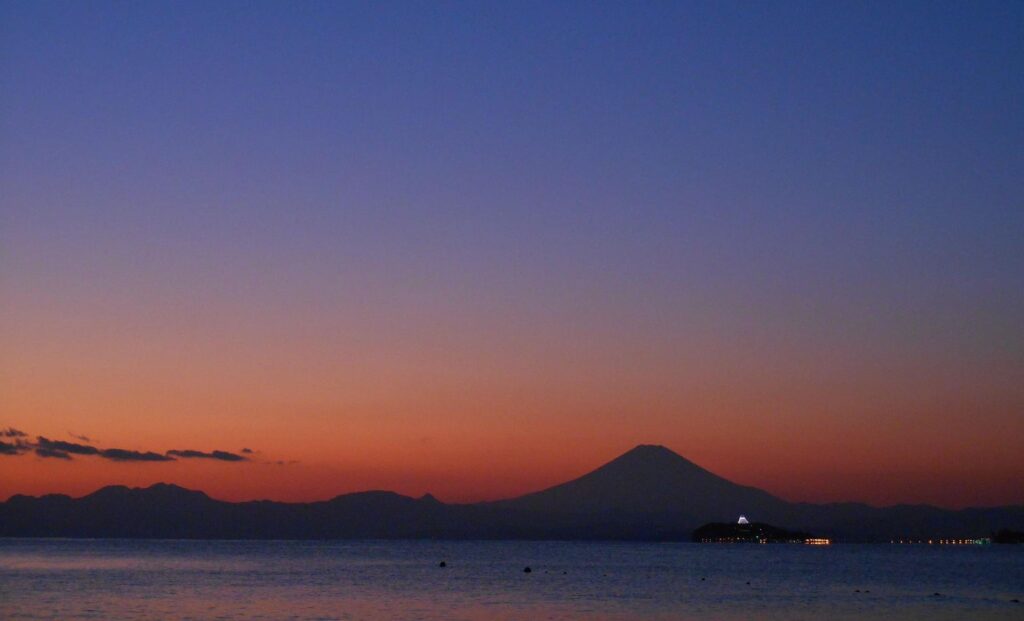
- Best Mt. Fuji + Enoshima composition: Katase West Beach (on the mainland side) or Benten Bridge, where you can frame both the island and Fuji in one shot.
- Best time of year for Mt. Fuji visibility: November through March, on dry, clear days. Summer humidity often obscures the mountain even when skies look “clear.”
- Arrival time: Aim to arrive at your chosen spot 45–60 minutes before sunset. Golden hour starts earlier than you expect.
- Can you return to Tokyo? Yes—last trains from Katase-Enoshima (Odakyu) toward Shinjuku run until around 21:00–22:00 depending on the day. Check real-time schedules before heading out.
- Worth staying overnight? If you want sunset + night illumination + sunrise the next morning without rushing—yes. Enoshima has two accommodation options on the island itself.
Best Sunset Spots on Enoshima: Which One Is Right for You?
No single spot is “the best” for everyone. Your choice depends on whether you prioritize a wide panoramic view, a dramatic sea-level experience, or a classic photo composition that includes Mt. Fuji. Here are the four main options, with honest notes on what each delivers.
1. Enoshima Sea Candle (Samuel Cocking Garden)
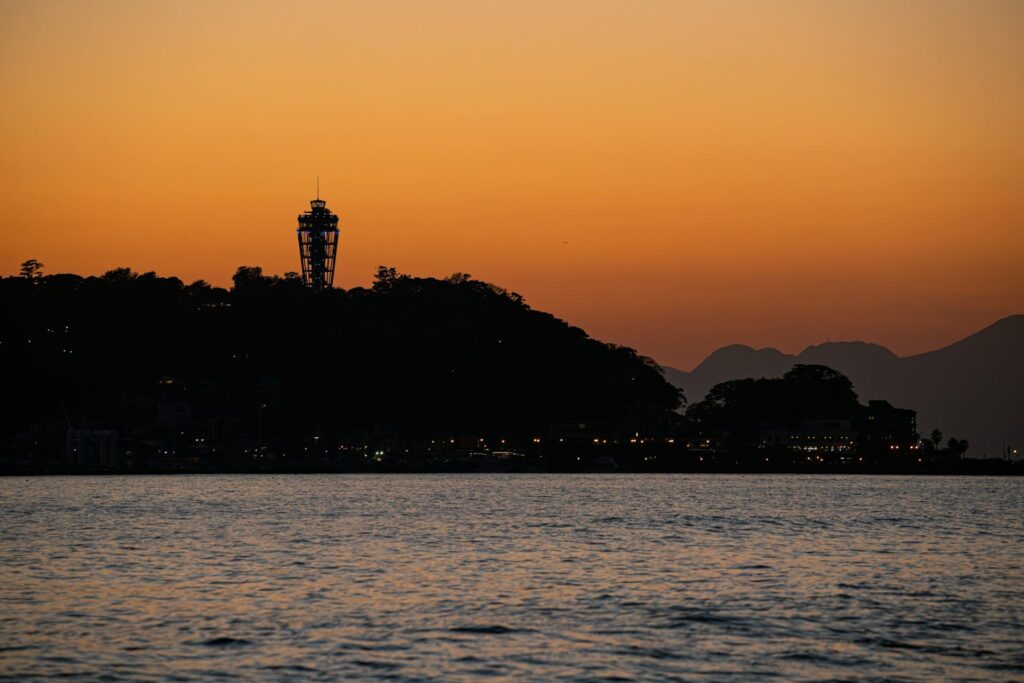
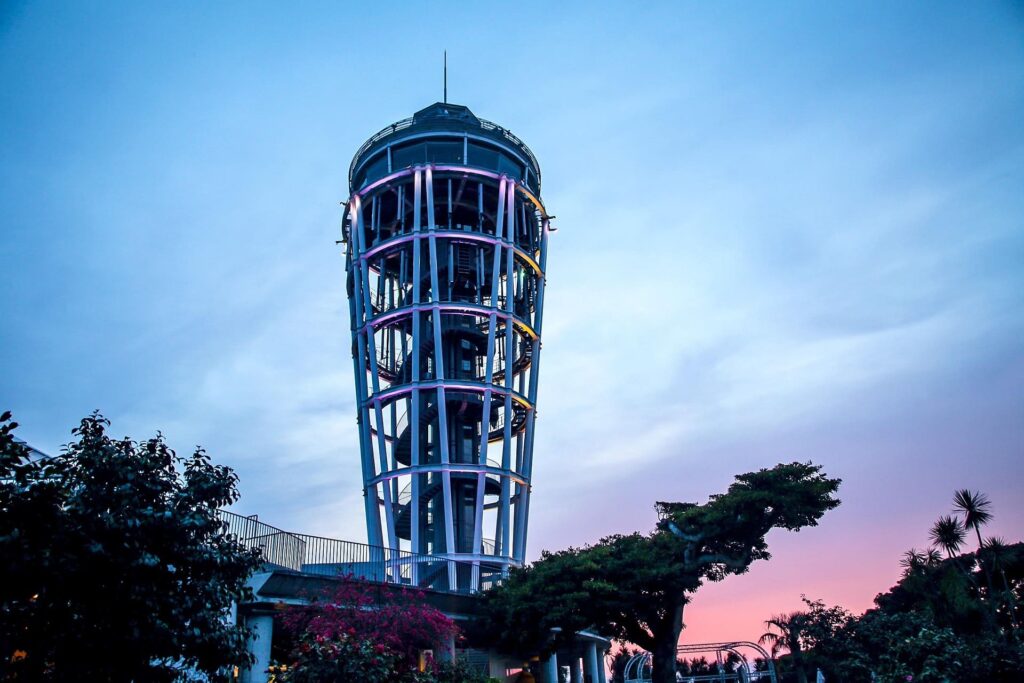
The Sea Candle is the island’s lighthouse-style observation tower, standing about 100 meters above sea level inside the Samuel Cocking Garden. It offers a 360° view from both an indoor glass-enclosed level and an open-air upper deck. On a clear day, you can see Mt. Fuji to the west, the Izu Peninsula, and the entire Shonan coastline stretching toward Kamakura.
Best for: Travelers who want a reliable, comfortable viewing experience regardless of weather, and those who plan to stay for the night illumination afterward (the garden and tower are the main venue for Jewel of Shonan and Shonan Candle events).
Good to know: The open-air upper deck can get windy. The tower is open until 20:00 (last entry around 19:30), so you can watch the sunset and stay for the evening lights without leaving the premises.
Kai’s tip: The Sunset Terrace inside the garden—a popular deck where many visitors plan to sit and watch the sunset—has been under full renovation since June 2026 and will remain closed until at least late November 2026. Do not count on it for your visit. The upper deck of the Sea Candle tower and the garden pathways are still fully accessible, so plan your evening around those instead.
2. Chigogafuchi (稚児ヶ淵)
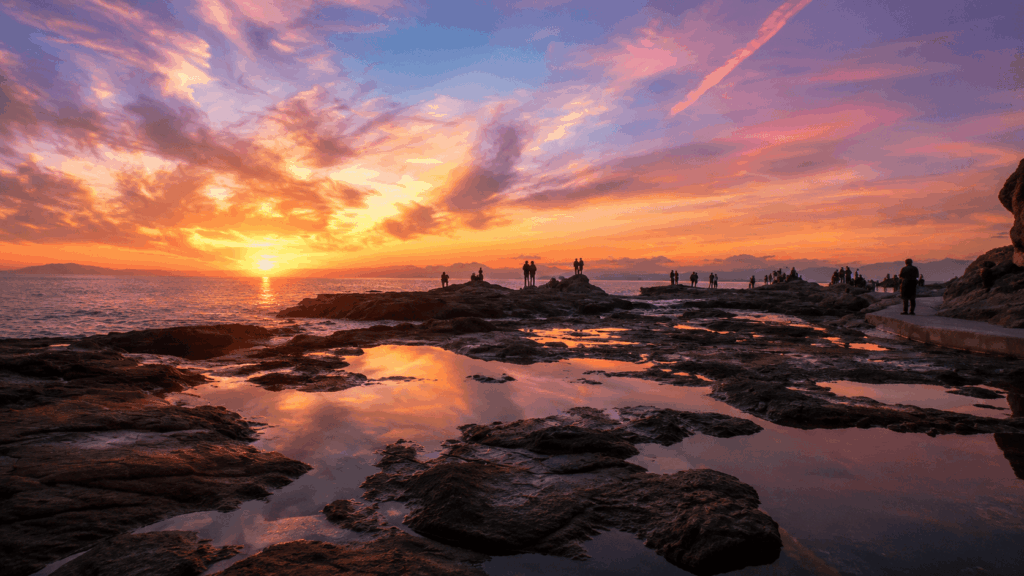
At the southwestern tip of Enoshima, just below the Iwaya Caves, Chigogafuchi is a flat rocky terrace at sea level where waves crash against the shore. This is the most dramatic sunset spot on the island—you are right at the water’s edge, and the sunset spreads across the entire western horizon. On clear winter days, Mt. Fuji appears directly across the bay.
Best for: Photographers who want foreground rocks and waves in their sunset shots. Couples looking for a more secluded, atmospheric spot away from the crowds at Sea Candle.
Not ideal for: Anyone with mobility concerns—reaching Chigogafuchi requires navigating a long set of stairs and uneven rocks. The rocks can also be slippery when wet.
Kai’s tip: The natural route to Chigogafuchi passes through the Iwaya Caves, which close at 17:00 (sometimes 18:00 in summer). If you go to Chigogafuchi for golden hour, the caves will likely be closed by the time you head back. This means you will have to climb back up the dark staircase on the other side of the island. Bring a smartphone flashlight and do not cut your timing too tight—give yourself at least 20 minutes for the uphill return before dark.
3. Katase West Beach (片瀬西浜)
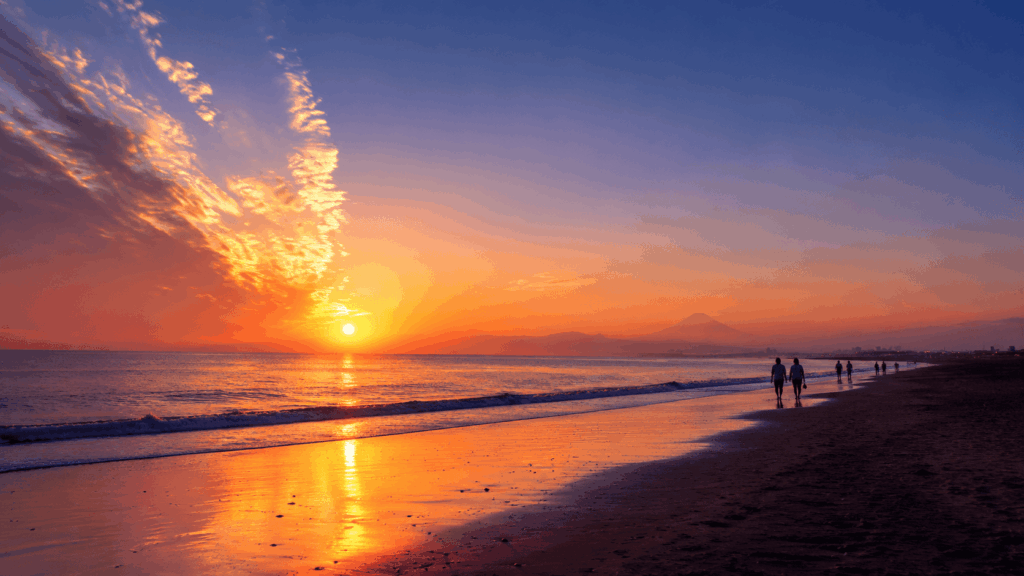
This is not on the island itself—it is the sandy beach on the mainland side, directly across from Enoshima. From here, you get the classic composition: Enoshima island in the foreground, the setting sun beside or behind it, and Mt. Fuji in the distance if conditions allow.
Best for: Travelers who want an effortless sunset without climbing stairs or paying admission. Also the best backup option if Mt. Fuji is not visible—the sea sunset alone is stunning from the beach, and you avoid the disappointment of climbing the tower for a hazy horizon.
Good to know: The beach is a 5-minute walk from Katase-Enoshima Station, making it the easiest sunset spot to access. There are several benches and a paved promenade.
4. Benten Bridge (弁天橋)
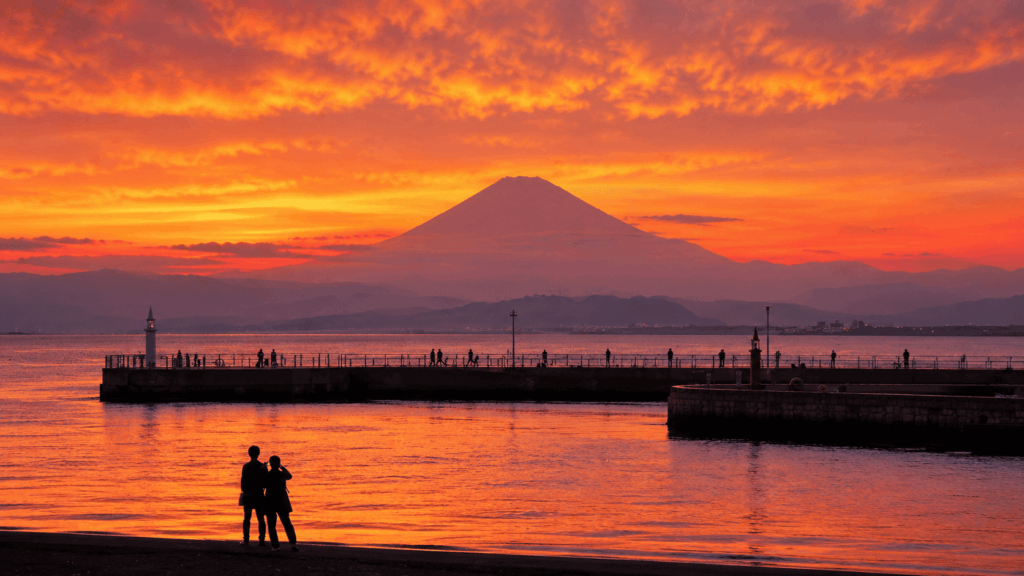
The bridge connecting the mainland to Enoshima island offers a lesser-known sunset angle. From the bridge, facing west, you can frame the island’s coastline with Mt. Fuji in the background. It is a popular spot for photographers who want a leading-line composition.
Best for: Photographers who already plan to cross the bridge and want to capture a quick shot on the way. Not a full “sunset-watching” spot—more of a bonus angle if you are passing through.
Quick Comparison: Which Spot Should You Choose?
| Spot | Mt. Fuji View | Crowds | Effort (Stairs) | Accessible After Dark | Best For |
|---|---|---|---|---|---|
| Sea Candle (Tower) | Good on clear days | Moderate–Busy | Low (escalator available) | Yes (open until 20:00) | Panoramic view + night illumination |
| Chigogafuchi | Excellent (winter) | Low–Moderate | High (steep stairs, uneven rocks) | Difficult (dark stairs, no lighting) | Dramatic sea-level sunset |
| Katase West Beach | Moderate (farther from Fuji) | Moderate | None | Yes (public beach) | Easy access, backup plan |
| Benten Bridge | Good (framed with island) | Low | None | Yes (bridge is lit) | Quick photo stop |
If I had to recommend one spot for a first-time visitor, I would say start at the Sea Candle for the panoramic view and golden hour, then walk down toward Chigogafuchi if you have the energy and daylight—you get two completely different sunset experiences in one evening.
Can You Actually See Mt. Fuji from Enoshima?
This is the question nearly every sunset visitor asks, and the honest answer is: it depends. Enoshima is about 70 kilometers (43 miles) from Mt. Fuji as the crow flies. That distance means even on a day that looks “clear” to the naked eye, haze or humidity can completely obscure the mountain.
Best Season for Mt. Fuji Visibility
Based on what I have observed over many visits, the best chance of seeing Mt. Fuji from Enoshima is during the colder months—November through March—when the air is dry and the skies are crisp. Winter mornings and evenings produce the clearest silhouettes. The trade-off, of course, is that sunset comes as early as 16:30 in December.
Summer (June through September) is the most difficult season for Mt. Fuji visibility. Even on a sunny July afternoon, the humidity often creates a haze that swallows the mountain. What surprises many first-time visitors is that a “cloudy but dry” winter day can deliver a clearer Fuji view than a “sunny but humid” summer day.
Diamond Fuji: The Special Case
Twice a year—roughly early April and early September—the setting sun aligns perfectly with the summit of Mt. Fuji when viewed from Enoshima. This phenomenon, called Diamond Fuji, lasts only a few minutes. The exact dates shift each year depending on weather and seasonal timing. If your visit happens to overlap with this window and the sky is clear, you are in for something truly special. But do not plan your entire trip around it—the alignment is brief, and clouds can easily ruin it.
What to Do If Mt. Fuji Is Not Visible
This is where having a backup plan makes all the difference. The sunset itself over Sagami Bay is beautiful regardless of whether Fuji appears. If you arrive at the Sea Candle or Chigogafuchi and the mountain is hidden, consider walking back to Katase West Beach, where the sea horizon alone frames a stunning sunset—and you have not spent money on admission for a view that disappointed.
Kai’s tip: Before you leave your hotel in Tokyo, check a live camera for the Enoshima area to see whether Mt. Fuji is actually visible in real time. The Shonan Monorail’s Mt. Fuji View Live Camera updates every 10 minutes and gives you an honest snapshot of current conditions. If Fuji is completely clouded over, shift your plan to Katase West Beach for a no-stairs, no-admission sunset that still delivers.
What Time to Arrive: Sunset Timing by Season
Sunset time on Enoshima shifts dramatically between summer and winter. Here is a rough guide by season:
| Season | Approx. Sunset Time | Recommended Arrival | Daylight After Sunset |
|---|---|---|---|
| June (Summer solstice) | ~19:00 | ~18:00 | Twilight until ~19:30 |
| March / September (Equinox) | ~17:30–18:00 | ~16:30–17:00 | Twilight until ~18:30 |
| December (Winter solstice) | ~16:30 | ~15:30 | Twilight until ~17:00 |
A good rule of thumb is to arrive at your chosen spot 45 to 60 minutes before the actual sunset time. This gives you time to settle in, take photos during golden hour, and watch the sky change color before the sun dips below the horizon. In winter especially, sunset arrives deceptively fast—what looks like an hour of daylight left can disappear in 20 minutes.
For precise sunset times on your exact travel dates, check a site like Time and Date for the Kamakura area (Enoshima’s sunset times are nearly identical).
After Dark: What’s Open and How to Get Back to Tokyo
One of the biggest concerns visitors have is whether they can comfortably enjoy the sunset on Enoshima and still make it back to Tokyo without rushing. The short answer is yes—with some planning.
What Remains Open After Sunset
After the sun goes down, these facilities are still accessible:
- Enoshima Sea Candle & Samuel Cocking Garden: Open until 20:00 (last entry around 19:30, seasonal variation). This is your main option for a post-sunset viewpoint.
- Enoshima Escar (escalator): Operates until 19:05 uphill only. If you are returning from the upper island areas after dark, be prepared to walk down the stairs.
- Enoshima Shrine: The grounds remain accessible 24 hours, though the shrine office closes earlier (usually around 17:00). Walking through the lit torii gates at night is atmospheric and safe.
- Restaurants and cafés: Many restaurants on the main approach street stay open until 20:00–21:00. The island is well-lit along the main paths.
What Closes Before Sunset
- Iwaya Caves (岩屋洞窟): Closes at 17:00 (16:30 last entry). Extended to 18:00 in summer. This matters if you plan to visit Chigogafuchi—the caves are on the natural route to the rocky shore.
- Enoshima Island Spa: Closes around 19:00–20:00 depending on the season. Last entry is usually 1.5 hours before closing.
Getting Back to Tokyo: Train Options
There are two main train routes from Enoshima back to central Tokyo:
| Route | From | To | Approx. Last Departure | Travel Time |
|---|---|---|---|---|
| Odakyu Line (direct) | Katase-Enoshima | Shinjuku | ~21:00–22:00 (depends on day) | ~60 min (express) |
| Enoden → JR → Tokyo | Enoshima (Enoden) | Fujisawa → transfer to JR → Tokyo | Enoden last train ~22:00 | ~75–90 min |
The Odakyu Romancecar limited express from Katase-Enoshima to Shinjuku is the most comfortable option, but it runs only on select schedules—not all trains are Romancecar. Standard express trains also run the same route and take about the same time.
Important: Train schedules change by season and day of the week. Do not rely on memory or old blog posts—check Google Maps, Navitime, or the Odakyu app before you head to the island. I have seen travelers rush back from Chigogafuchi only to realize the last express had already departed.
If you fall into that camp — you want the late-afternoon Enoshima atmosphere but do not want to manage trains, timing, and the return after dark — this is the booking to compare against a DIY plan.
Why I’d book this one
- It starts later than a typical Kamakura day tour, so it fits travelers who care more about soft afternoon light and evening atmosphere than temple-hopping from early morning.
- The route keeps the moving parts simple: Tokyo round-trip transport, Enoshima time, an Enoden ride, and a Yokohama night-view finish are bundled into one plan.
- It is a better match for couples or first-time visitors who want the coastal mood without worrying about late train transfers after sunset.
Check the current schedule, start time, and recent traveler reviews for the Kamakura, Enoshima Sunset & Yokohama Night View tour from Tokyo before deciding whether to go fully DIY.
Night Events: Illumination & Seasonal Highlights
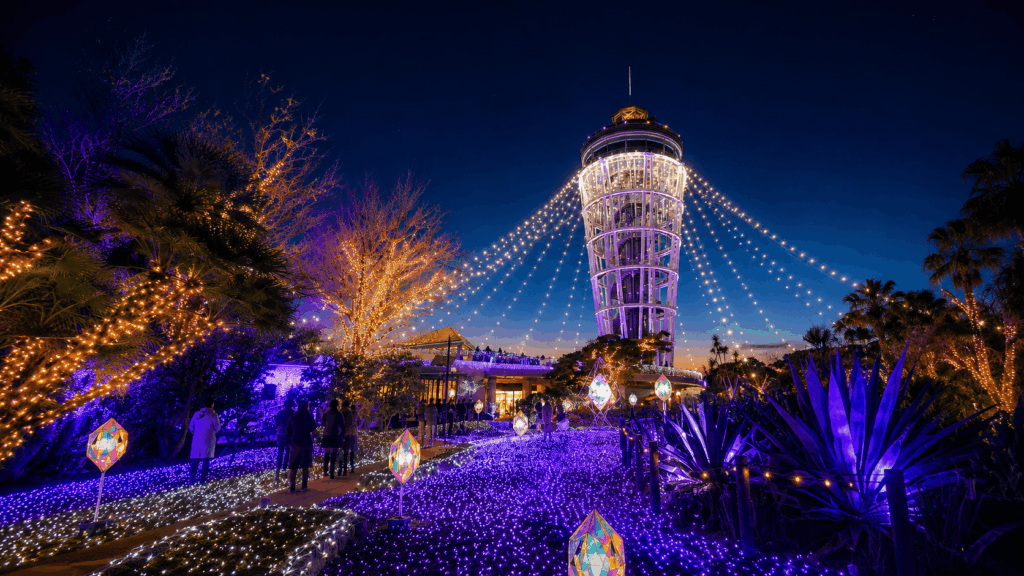
If you plan your visit between autumn and late winter, Enoshima’s evening hours are transformed by seasonal illuminations. These events alone can justify staying on the island after sunset.
Jewel of Shonan (湘南の宝石) — Winter Illumination
Held annually from late November through late February, the Jewel of Shonan illumination turns the Samuel Cocking Garden and Sea Candle area into a waterfront light display. The garden paths, trees, and observation deck are decorated with tens of thousands of LED lights, with the Sea Candle itself glowing in changing colors. The illumination is visible from the garden grounds and from the Sea Candle observation deck.
Lighting hours: Typically 17:00–20:00 on weekdays, 17:00–21:00 on weekends and holidays. Extended hours during the Christmas period.
Admission: Night entry to the garden during illumination season is around ¥500 for adults (separate from daytime garden entry). The Enoshima 1 Day + Night Pass covers this.
Best for: Couples and photographers. The contrast of the warm lights against the dark sea horizon is unique to this coastal location.
Shonan Candle — Autumn Candle Event
For about three weeks in October through early November, the Samuel Cocking Garden hosts Shonan Candle, featuring roughly 10,000 real candles arranged along the garden paths and around the Sea Candle. The atmosphere is quieter and more intimate than the winter illumination—no LEDs, just candlelight.
Lighting hours: Approximately 17:00–20:00 (extended to 21:00 on weekends).
Good to know: This event is less crowded than Jewel of Shonan but still draws a steady flow of visitors. If you visit during this period, you get both the autumn sunset and the candlelit evening in one trip.
Kai’s tip: The Sunset Terrace—a popular photo spot inside the garden where many visitors plan to take their night illumination shots—has been under full renovation since June 2026 and is closed until at least November 2026. Do not base your evening plan around it. The Sea Candle’s upper observation deck and the garden’s main pathways are still open and offer plenty of great angles for both sunset and illumination photos. Focus your energy there instead.
Should You Stay Overnight on Enoshima?
This depends on what kind of experience you want. Here is an honest breakdown of when it makes sense to stay—and when it does not.
Stay overnight if…
- You want to watch the sunset from Chigogafuchi without worrying about climbing back in the dark and catching the last train.
- You want to experience both the sunset and the night illumination (Jewel of Shonan or Shonan Candle) without rushing out before the event ends.
- You want to wake up for sunrise on Enoshima—the island faces east over Sagami Bay, and sunrise from the Sea Candle or the east-side promenade is a completely different experience from sunset.
- You are celebrating a special occasion or traveling as a couple looking for a quieter, more romantic evening.
Return to Tokyo if…
- You are on a tight budget—island accommodation is not cheap, and a day trip saves significantly.
- You have early plans the next morning in Tokyo and do not want the extra transit time.
- You only care about the sunset itself and are fine skipping illumination and sunrise.
Accommodation Options on the Island
There are two main accommodation options actually on Enoshima island itself:
- Enoshima Hotel: Opened in 2020, this is the more modern option with rooms facing the sea. Prices are mid-range by Japanese standards—expect to pay more than a chain hotel but less than a luxury ryokan.
- Iwamotoro: A long-established traditional inn (ryokan) at the entrance of the island. Known for its kaiseki-style dinner and onsen. More expensive, but the experience includes a full Japanese evening meal and morning breakfast.
If neither has availability, the mainland side around Katase-Enoshima Station has several budget hotels and business hotels that are a 5–10 minute walk from the bridge to the island.
Kai’s tip: If you are considering staying at Enoshima Island Spa, note that their onsen and pool areas have a strict no-tattoo policy—this includes small, covered tattoos. They also do not admit children under 6 (for the spa area) and require swimwear for the pool. Check these policies before booking, especially if you are traveling with family or have visible ink.
Best Ticket & Pass for Sunset Visitors
Which ticket you choose depends on whether you are coming from Tokyo and what you plan to do on the island. Here is a quick guide:
| Pass | Price (approx.) | What It Covers | Best For |
|---|---|---|---|
| Enoshima-Kamakura Freepass (Odakyu) | ¥1,640 (adult) | Round trip Shinjuku ↔ Katase-Enoshima + unlimited Enoden rides | Day-trippers from Tokyo who also want Kamakura |
| Enoshima 1 Day Pass | ¥1,550 (adult) | Escalator, Sea Candle, Iwaya Caves, aquarium, garden (daytime) | Visitors exploring island facilities during the day |
| Enoshima 1 Day + Night Pass | ¥1,950 (adult) | Same as above + night garden entry during illumination season | Sunset visitors who want evening illumination access |
| Sea Candle Set Ticket | ¥1,100 (adult) | Escalator + Garden + Sea Candle (daytime) | Visitors who only want the tower and garden |
Which Pass Makes Sense for a Sunset Visit?
- Coming from Tokyo and visiting Enoshima only: Buy a regular Odakyu round-trip ticket (around ¥1,200 from Shinjuku) plus the Enoshima 1 Day + Night Pass (¥1,950) if you plan to use the escalator, visit Sea Candle, and see the night illumination. This combo covers everything efficiently.
- Coming from Tokyo and combining with Kamakura: The Enoshima-Kamakura Freepass (¥1,640) is excellent value. Note that it covers transport only—you still need separate admission for Sea Candle and the garden. Buy the Sea Candle Set Ticket (¥1,100) on arrival if you want the tower.
- Already staying in Kamakura or nearby: Just buy the Enoshima 1 Day + Night Pass (¥1,950) or Sea Candle Set Ticket depending on what you plan to visit.
If you are going independently and only need the Sea Candle/Escar side of the plan, you can also check the current Klook Enoshima Sky View Ticket options before buying separate tickets on arrival.
Important: Prices listed are as of 2026 and may change. Check the official Enoshima Tourist Information site or Odakyu website for current rates before your visit.
Frequently Asked Questions
Can I really see Mt. Fuji from Enoshima at sunset?
Yes, but it is not guaranteed. Enoshima is about 70 km from Mt. Fuji, so the mountain is visible only on clear, dry days. The best months are November through March, when the air is crisp and humidity is low. Even on a “clear” summer day, haze often obscures the mountain. If Fuji does not appear, the sunset over Sagami Bay is still beautiful—especially from Katase West Beach, where the sea horizon alone creates a stunning view.
What time should I arrive for sunset on Enoshima?
Arrive at your chosen spot 45–60 minutes before the actual sunset time. This gives you golden hour light, time to find a good position, and a relaxed pace before dark. Sunset ranges from around 16:30 in December to around 19:00 in June. Check the exact time for your travel dates on a site like Time and Date (search for Kamakura—sunset times are nearly identical).
Is it safe to walk around Enoshima after dark?
Yes, Enoshima is safe at night. The main approach street and the path to the Samuel Cocking Garden are well-lit and have other visitors around until the last events close. The Sea Candle area and garden remain open until 20:00 during illumination season. The main concern is the path to and from Chigogafuchi—the staircases on the western side of the island are not well-lit and can feel isolated after dark. If you visit Chigogafuchi for sunset, bring a flashlight or use your smartphone light for the uphill return.
Can I visit Chigogafuchi after the Iwaya Caves close?
Yes—the caves closing does not block access to Chigogafuchi entirely, but it removes the most direct route. You will need to take a different staircase that descends from the upper island paths directly to the rocky shore. However, this alternative route is steeper and less obvious. If you arrive after the caves close (17:00, or 18:00 in summer), allow extra time to find the path and be prepared for a dark climb back up. Most visitors who go to Chigogafuchi for sunset plan to be back on the main paths before full dark.
What is the last train from Enoshima back to Tokyo?
From Katase-Enoshima Station (Odakyu Line), the last express train toward Shinjuku departs around 21:00–22:00 depending on the day of the week and season. The Enoden line from Enoshima Station to Fujisawa runs until about 22:00, from where you can transfer to the JR line toward Tokyo. These times vary significantly—always check Google Maps, Navitime, or the Odakyu app on the day of your visit. If you are visiting during the winter illumination, be mindful that the event closing time (20:00–21:00) is close to last train time, leaving little margin for error.
Is the Enoshima 1 Day + Night Pass worth it for a sunset visit?
If you plan to use the escalator, visit the Sea Candle observation deck, and enter the Samuel Cocking Garden during nighttime illumination hours—yes, it pays for itself. The pass costs ¥1,950 and covers the escalator (¥500), Sea Candle (¥800), and night garden entry (¥500), which would cost ¥1,800 individually. If you only want the Sea Candle and garden, the Sea Candle Set Ticket (¥1,100) is cheaper. If you are coming from Tokyo and also visiting Kamakura, the Enoshima-Kamakura Freepass (¥1,640) covers transport but not island facilities—you would need to buy a separate Sea Candle ticket on arrival.
When is the best time of year for an Enoshima sunset?
For the best combination of clear skies, comfortable temperatures, and Mt. Fuji visibility, aim for November or December. The air is dry, the sunset is early (16:30–17:00) but dramatic, and the Jewel of Shonan winter illumination starts in late November. October offers the Shonan Candle event and mild weather but hazier skies. Spring (March–April) is the second-best window—Diamond Fuji occurs around early April if you are lucky. Summer (June–September) has the latest sunsets but the lowest chance of seeing Mt. Fuji due to humidity.
Final Verdict: Is Enoshima Sunset Worth It?
Yes—but with some honest expectations. The sunset itself over Sagami Bay is genuinely beautiful from any of the spots described in this guide. The question is whether your experience matches what you came for.
Choose Enoshima sunset if…
- You are a first-time visitor: Start at the Sea Candle observation deck. It is the most reliable spot—no stairs if you take the escalator, 360° views, and indoor shelter if it gets windy. You can see the sunset, the coastline, and (on a clear day) Mt. Fuji from one place. After dark, walk through the garden illumination if the season aligns.
- You are a photographer: Do not limit yourself to one spot. Arrive early and hit two locations in one evening: Chigogafuchi for sea-level drama with foreground rocks, and Benten Bridge or Katase West Beach for the classic Enoshima + Fuji composition. Winter gives you the clearest conditions.
- You are traveling as a couple: Chigogafuchi offers a quieter, more intimate atmosphere than the Sea Candle deck. If the seasonal illumination is running, the candlelit or LED-lit garden paths are especially romantic after dark. Consider staying overnight at Enoshima Hotel to avoid the rush back to the station.
- You have limited mobility or are traveling with young children: Katase West Beach is your best option—flat, free, and a 5-minute walk from the station. The Sea Candle is accessible via the escalator (paid), but the upper deck does involve stairs or a small elevator.
Choose a different plan if…
- You are visiting in July or August: The humidity is high, Mt. Fuji is rarely visible, and the sunset time (around 19:00) means you will be leaving the island close to last train. The summer sunset is pleasant but not special enough to justify the logistics. Consider a Kamakura beach sunset (Yuigahama or Shichirigahama) instead—easier access and similar experience.
- You only have 2–3 hours for Enoshima and want to see the whole island: Sunset is time-consuming. If you arrive after 15:00, you will have to choose between exploring the shrine and caves versus settling in for sunset. In that case, skip the Sea Candle and catch the sunset from Benten Bridge on your way out—it takes 5 minutes and you keep your afternoon for exploring.
- You are on a very tight budget: Enoshima sunset is not expensive, but if you want the Sea Candle + escalator + night illumination, costs add up (¥1,100–¥1,950 per person plus transport from Tokyo). The free option—Katase West Beach—gives you a perfectly good sunset without spending a yen on admission.
What I would tell a friend visiting Enoshima for the first time: do not over-plan the logistics. Pick one spot (Sea Candle if you want comfort, Chigogafuchi if you want drama), arrive an hour before sunset, and let the evening unfold. If the sky is clear in winter, you will see Mt. Fuji. If not, the colors over the bay will still make you forget to check the time—and that is the point.
Hi, I’m Kai. I’m a Tokyo-based travel writer, tourism industry insider, and the author of a published guidebook for international visitors to Japan. With over 10 years of professional experience at a leading Japanese tourism company, my mission is to help you skip the tourist traps and navigate Japan’s best destinations like a local. I believe the perfect day trip is like a traditional kaiseki meal: a beautiful balance of precise planning and unforgettable seasonal discovery. When I’m not out conducting field research, you’ll usually find me drafting new itineraries with one of my favorite fountain pens!