
Takachiho Gorge at a Glance: Two Ways to See It
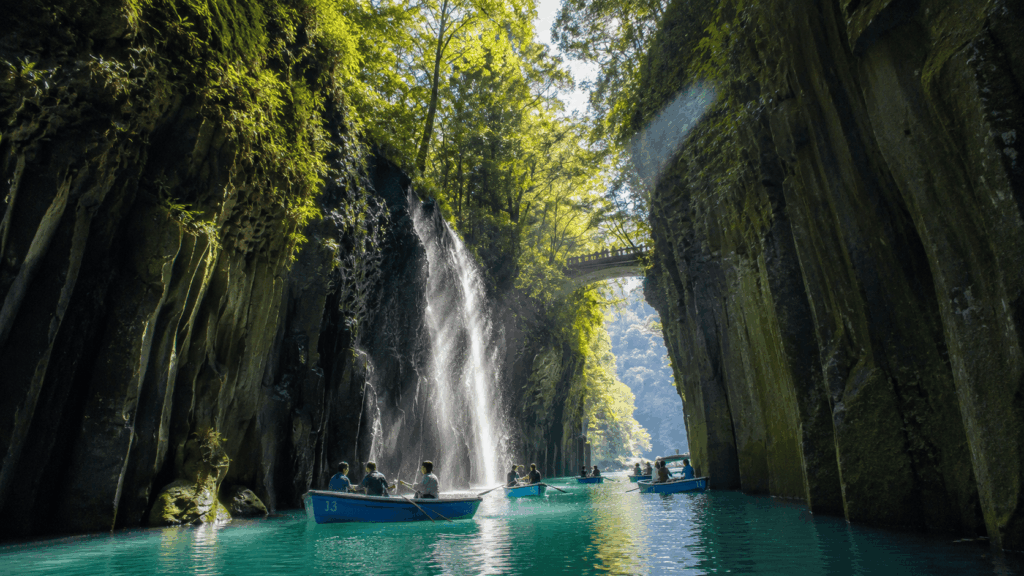
If you’ve seen a photo of Takachiho Gorge, chances are it was taken from a rowboat looking up at Manai Falls—emerald water, sheer basalt cliffs, a curtain of white spray. That image is real. But it’s also only half the story.
Takachiho Gorge, a narrow chasm carved by the Gokase River through ancient lava flows from Mount Aso, offers two distinct perspectives: from the water by rowboat, and from above on the riverside Takachiho Promenade. Here’s what surprised me when I first visited: the view from the promenade—completely free—is just as striking as the one from the boat. And for many visitors, it’s actually the more practical choice.
The gorge itself is compact—something that catches many first-time visitors off guard. The walking trail runs roughly one kilometre, and the rowboat takes just 30 minutes. The honest first impression I’ve heard from more travellers than I can count? Is that it? But that’s only the core. What makes Takachiho a full-day destination—or better yet, an overnight stop—is the constellation of sights around it: Amano Iwato Shrine, Amano Yasugawara, Takachiho Shrine’s nightly Kagura, and Kunimigaoka’s sea of clouds, if conditions align. This guide breaks down what to do, what to skip, and how to prioritise when you have limited time.
If you’re trying to do Takachiho without renting a car, the main thing to compare early is whether a guided Aso–Takachiho day tour makes the day easier than stitching rural buses together. Before locking in your route, check live availability, pickup details, and recent traveller reviews for the Kumamoto Aso & Takachiho private tour.
| Takachiho Gorge — Quick Facts | |
|---|---|
| Location | Takachiho Town, Miyazaki Prefecture, Kyushu |
| Admission | Free (boat rental and parking are separate) |
| Walking trail length | Approx. 1 km (one-way) / 1 hour round trip |
| Rowboat duration | 30 minutes per rental |
| Manai Falls height | 17 metres |
| Parking (main lots) | ¥1,000 each near boat dock and trail entrance |
| Official info | Takachiho Tourism Association |
Takachiho Gorge Rowboat: Is It Worth the Hype?
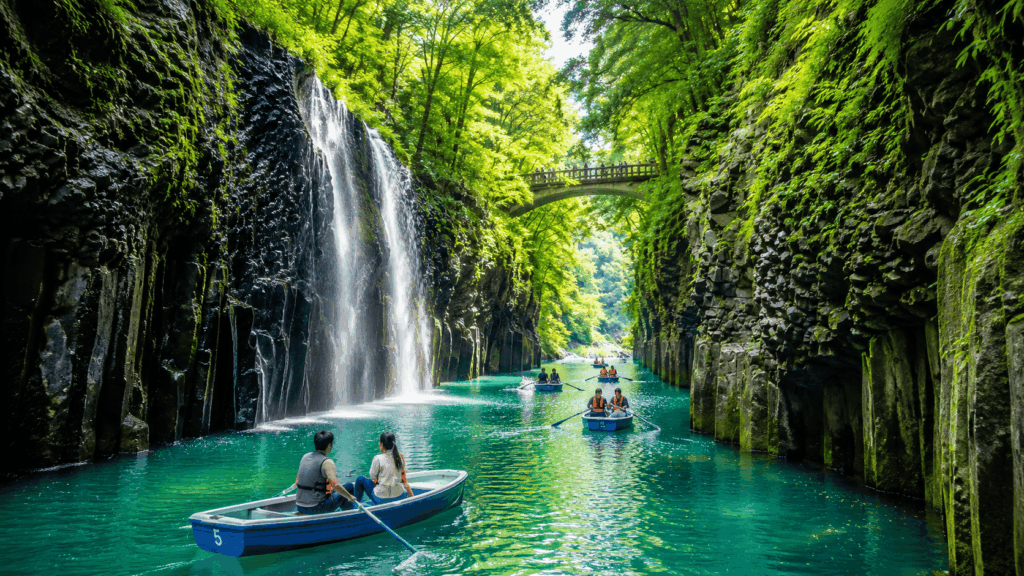
The rowboat experience at Takachiho Gorge is genuinely beautiful—gliding across the calm green water toward the base of Manai Falls, feeling the mist on your face. It’s also very short (30 minutes), and getting a slot requires planning.
How the Boat Rental Works
Here is the current information as of 2025–2026:
| Detail | Information |
|---|---|
| Price per boat | Weekdays (Tue–Thu): approx. ¥4,100 Weekends & Mon/Fri/holidays: approx. ¥5,100 |
| Capacity | 3 adults (up to 4 with preschool children) |
| Duration | 30 minutes |
| Hours | 8:30 AM – 4:30 PM (last rental) |
| Reservations | Online only, from 9:00 AM JST two weeks before your date until 9:00 AM two days before |
| Same-day tickets | Limited number available at the dock from morning (arrive early) |
All rentals depart from a dock reached via steep stone stairs near the Daiichi Oshioi parking lot (Car Park 1). No licence is required—the boats are easy to row, and the gorge is narrow enough that you won’t drift far. If you’re struggling to get a slot, see our detailed guide to Takachiho Gorge reservations for strategy and alternatives.
Important note on pricing: Many older guides still quote ¥2,000 per boat, but the rates have increased significantly. Expect to pay around ¥4,100–5,100 depending on the day of your visit. Always check the official boat page for the latest rates before booking.
Kai’s tip: How to Actually Secure a Boat (and What to Do If You Can’t)
Kai’s tip: The online booking system opens at exactly 9:00 AM JST, two weeks before your desired date. For weekend slots, you need to be online the moment it opens—slots for popular times can fill within hours. On busy Saturdays and public holidays, same-day tickets can mean joining a queue with wait times of up to several hours, or being turned away entirely. The one upside? If you can’t get a boat, the view of Manai Falls from the promenade above is free, uncrowded, and arguably just as photogenic. The classic “boat photo” angle is taken from the water, but the falls themselves are perfectly visible from the walking path.
When the Boat Isn’t Running
The rowboats operate subject to river conditions. After heavy rain or during typhoon season (roughly June–October), the river level can rise and force a temporary suspension. The operating status is updated around 8:00 AM each morning on the official website. If you’re visiting during the rainy season or autumn typhoon window, it’s wise to have a backup plan—which the promenade route provides perfectly.
The Takachiho Promenade: Free Views of Manai Falls
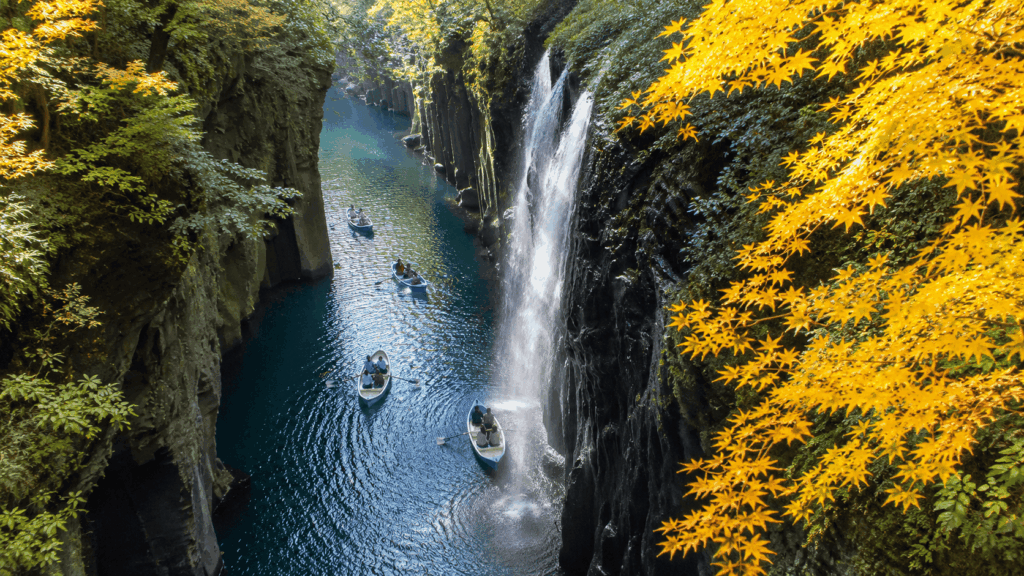
The Takachiho Promenade runs along the south bank of the Gokase River, connecting the area near the boat dock with the Daini Araragi parking lot. It’s the quieter, more flexible way to experience the gorge—and completely free.
What You’ll See Along the Walk
- Manai Falls (真名井の滝): The 17-metre cascade that defines Takachiho Gorge. The promenade offers a head-on viewpoint that is arguably more dramatic than the one from the boat, since you see the full height of the cliff and the columnar basalt formations alongside the waterfall. There’s no fence or barrier blocking the view at this spot—it’s open, direct, and uncrowded compared to the boat queue area.
- Kihachi’s Power Stone (鬼八の力石): A massive boulder that local legend says was hurled here by the mythical giant Kihachi. It sits beside the trail and makes a good photo stop.
- Sennen no Byobu-iwa (Hermit’s Folding Screen Rock): A striking rock formation along the gorge wall that resembles a traditional folding screen.
- The Three Bridges: The trail offers the only spot where you can see all three bridges spanning the gorge (Shinbashi, Takachiho Ohashi, and Shinto Takachiho Ohashi) in a single view.
Trail Length and Time
The developed walking trail is approximately one kilometre from end to end. Walking it slowly with photo stops takes roughly one hour round trip. The path has stairs and some uneven sections but is generally well-maintained.
⚠️ Trail update (as of early 2026): A section of the trail between the Daisan Ohashi parking lot and the Daini Araragi parking lot has been closed since July 2025 due to typhoon damage. A detour route is available that leaves the trail briefly onto the road. Check the official tourism association news page for the latest reopening status before your visit.
Parking for the Promenade
- Daiichi Oshioi Parking Lot (第1御塩井駐車場): ¥1,000. Closest to Manai Falls and the boat dock. Address: 204 Mukoyama, Takachiho-cho.
- Daini Araragi Parking Lot (第2荒磯駐車場): ¥1,000. Closest to the walking trail entrance. Address: 1245 Oshikata, Takachiho-cho.
Both lots fill early on weekends and public holidays. Arriving before 9:00 AM is the best way to secure a spot.
Kai’s tip: If you arrive and the boat queue is already long (which on weekends it often is by 9:30 AM), don’t waste your time waiting. Walk the promenade first, enjoy Manai Falls from above, and check back later for a potential standby slot. The view from the trail is excellent, and you won’t feel like you missed anything.
Beyond the Gorge: What to Do Nearby
The gorge itself is compact. What stretches Takachiho into a full-day destination are the cultural and natural sights within a 10–15 minute drive of the town centre. Here’s what’s worth your time, with honest notes on transport and timing.
Amano Iwato Shrine & Amano Yasugawara (Car Recommended)
Amano Iwato Shrine (天岩戸神社) stands roughly 8 km from central Takachiho—about 10–15 minutes by car. This Shinto shrine is dedicated to the cave (the “Heavenly Rock Cave”) where the sun goddess Amaterasu is said to have hidden herself, plunging the world into darkness. It’s one of the most significant mythological sites in Japan.
The shrine has two main areas:
- West Shrine (西本宮): The main sanctuary, open for prayer and visits. A free guided tour led by a Shinto priest runs every 30 minutes starting from 9:00 AM—no reservation needed, just show up. The tour is in Japanese, but the stories are woven into the landscape in a way that’s easy to follow.
- East Shrine (東本宮): This is where you can see the actual cave (Amano Iwato) from across the river. You can’t enter the cave—it’s a sacred site—but the viewing platform gives you a clear sightline to the legendary entrance where Amaterasu was coaxed out with music and dance.
From the East Shrine, a 5–10 minute walk along the river leads to Amano Yasugawara (天安河原), a cave-like riverside grotto where the gods are said to have gathered to decide how to lure Amaterasu out. Today, it’s filled with hundreds of stacked stone towers left by visitors as prayers. The atmosphere here is noticeably different—quiet, almost otherworldly.
Getting there without a car: A bus runs from Takachiho Bus Centre to the shrine roughly once every 1–2 hours. One-way takes about 20 minutes and costs around ¥300. However, the limited frequency means you can’t hop freely between sights. If you’re relying on public transport, expect to wait or combine the shrine visit with other stops carefully.
Near the shrine parking lot, look for the kama-iri-cha (釜炒り茶) ice cream—a local speciality made from pan-fired green tea. The flavour is smoky, nutty, and completely different from matcha.
Takachiho Shrine & Night Kagura (Yokagura)
Takachiho Shrine (高千穂神社) is in the heart of Takachiho town, easy to reach even without a car. The grounds feature a pair of massive cedar trees, estimated to be over 800 years old, known as the “married couple cedars” (meoto sugi). A walk through the main hall and the surrounding forest takes about 20–30 minutes.
But the real draw here is the evening performance of Takachiho Yokagura—traditional sacred dances that re-enact the story of Amaterasu emerging from the cave. A shortened version of the Kagura is performed nightly at the Kagura Hall (near the shrine):
- Time: 8:00 PM (20:00) — approximately 1 hour
- Performances: Four dances selected from the full repertoire
- Capacity: 150 seats (around 80 available for online reservation, 70 sold at the door from 7:00 PM)
- Price: Generally around ¥1,000–1,500 per person (check the latest)
For a deeper experience, the full-scale village Kagura performances are held on winter nights from mid-November to early February across about 20 hamlets in the Takachiho area. These are all-night affairs (often 6:00 PM to 5:00 AM or longer) passed down through local families. The schedule is announced each October and is primarily in Japanese, but visitors are welcome.
Kai’s tip: If you only do one thing after the gorge, make it the nightly Kagura performance. It takes the mythology you’ve seen at Amano Iwato—the goddess in the cave, the dancing gods—and makes it tangible and moving in a way that a shrine visit alone can’t. And at around ¥1,000–1,500, it’s one of the best-value cultural experiences in Kyushu.
Kunimigaoka & the Sea of Clouds (Manage Expectations)
Kunimigaoka (国見ヶ丘) is a viewpoint at 513 metres above sea level, about 6 km (15 minutes by car) from central Takachiho. On a clear day, the view stretches across to the Aso mountain range and the Kuju Mountains. What draws most visitors, though, is the sea of clouds (unkai) that occasionally fills the valley below at dawn.
Here’s the honest truth: The sea of clouds at Kunimigaoka is spectacular when it happens, but it requires a very specific set of conditions to form—clear skies, low wind, and a sharp temperature drop overnight. The prime season runs roughly from autumn through winter (October–February), with a secondary window in spring (March–May). Even during peak season, it’s not a daily occurrence.
Kai’s tip: Don’t plan your entire Takachiho itinerary around the sea of clouds. If you’re staying overnight in the area and can wake early (around 5:30–6:00 AM), by all means check the weather the night before—if the forecast shows clear skies and cold temperatures, go for it. But if you don’t see clouds, the daytime view of the Aso range is still pleasant, just not the showstopper you may have seen online. Treat it as a bonus, not a must-see.
Getting there: Kunimigaoka is not easily reached by public transport. The nearest bus stop is a 1.5 km walk from the viewpoint. For most visitors, a car or taxi is the realistic option.
Takachiho Amaterasu Railway
The Takachiho Amaterasu Railway runs along a remnant of the former Takachiho Railway line, offering a 5.1 km round trip in an open-sided “Grand Super Cart.” The highlight is crossing Japan’s highest railway bridge, suspended 105 metres above the Gokase River.
- Duration: Approx. 30 minutes round trip
- Price: Around ¥2,000 for adults, ¥1,000 for children (ages 6–12)
- Booking: No reservations accepted—first-come, first-served on the day
- Location: Departs from the former Takachiho Station (near the town centre)
- Hours: Typically 9:30 AM – 3:40 PM, with departures every 30–40 minutes
The railway station building also houses a small railway museum and a café, worth a quick look if you’re waiting for the next departure.
Best for: Families with children, railway enthusiasts, and anyone looking for a gentle, scenic ride to round out the day. If you’re short on time and deciding between the gorge and the railway, prioritise the gorge—the boat and promenade are the main event.
How to Spend Your Time: Priority by Duration & Transport
Takachiho is not a place you can rush through without planning. Below is a realistic breakdown of what fits into different trip lengths, with and without a car. For a step-by-step schedule, you can also check our realistic one-day itinerary.
Half a Day (4–5 hours) — With Car
- Takachiho Gorge: boat rental (30 min) OR promenade walk (1 hour). If you have time, do both.
- Quick visit to Takachiho Shrine (20 min) on your way back toward town.
- Lunch at one of the local restaurants (allow 1 hour—Imakin Shokudo can be 2+ hours at peak).
What you’ll miss: Amano Iwato Shrine, Amano Yasugawara, Kagura (night only), Kunimigaoka, Amaterasu Railway.
Full Day (8–9 hours) — With Car
- Morning (8:30–10:30 AM): Takachiho Gorge — promenade walk first, then check boat availability.
- Late morning (10:30 AM–12:00 PM): Amano Iwato Shrine + Amano Yasugawara (30 min drive round trip inc. travel).
- Lunch (12:00–1:30 PM): Pick one main restaurant (avoid the peak queue at Imakin by arriving early or late).
- Afternoon (1:30–3:00 PM): Amaterasu Railway OR Kunimigaoka (pick one).
- Late afternoon (3:00–4:30 PM): Takachiho Shrine (walk-through).
- Evening (8:00 PM): Kagura performance.
Full Day — Without Car
- Morning: Takachiho Gorge (walking distance from bus centre, about 20 min on foot).
- Midday: Takachiho Shrine (walking distance).
- Afternoon: Bus to Amano Iwato Shrine — check the return bus schedule at the stop as soon as you arrive (you may have 1–2 hours before the next bus back).
- Evening: Kagura performance (walking distance from bus centre).
Honest assessment: Without a car, you can cover the gorge, Takachiho Shrine, and Amano Iwato (1 shrine, not both), plus the Kagura. Kunimigaoka and the Amaterasu Railway are out of reach unless you arrange a taxi. For most travellers without a car, a guided day tour from Fukuoka or Kumamoto that bundles Mt. Aso and Takachiho is a more practical way to see the highlights without the logistics burden.
If you fall into that camp — you want Takachiho Gorge, Aso, and the mythology stops without spending half the day decoding rural bus schedules — this is the one guided option to compare first.
Why I’d book this one
- It solves the biggest practical problem in this article: connecting scattered rural sights that are awkward by bus, especially Amano Iwato, Takachiho, and the Aso area.
- Recent travellers tend to highlight the value of having the route, timing, and weather-related adjustments handled for them instead of self-managing every transfer.
- It keeps the day focused on context, not just transport — useful if you want the shrine mythology and volcanic landscape to make sense, not only a photo stop at the gorge.
Before deciding between self-driving, buses, or a guided day, see live availability, start times, pickup details, and recent traveller reviews for the Kumamoto Aso & Takachiho private tour.
Overnight (1 night, 2 days) — The Rewarding Way
- Day 1 afternoon: Arrive, walk the gorge (promenade + boat if running).
- Day 1 evening: Local dinner (nagashi somen, chicken nanban, or Takachiho beef) + Kagura performance.
- Day 2 early morning (before 6:00 AM): Kunimigaoka for the sea of clouds (if conditions look promising the night before).
- Day 2 late morning: Amano Iwato Shrine + Amano Yasugawara (uncrowded on weekday mornings).
- Day 2 lunch: Try the other restaurant you skipped on Day 1, or the kama-iri-cha ice cream by the shrine.
- Day 2 afternoon: Amaterasu Railway or depart for your next destination.
Kai’s tip: If the gorge itself made you think “is that it?” after 30 minutes on the water, I understand—it’s a compact attraction. But staying overnight transforms the experience completely. The morning mist over the gorge, the silence at Amano Yasugawara with no day-trippers around, and walking back from the Kagura through the dark streets of Takachiho—these are where the place reveals itself. I’ve seen travellers go from “should I stay?” to “I’m glad I did” in one evening.
Best Time to Visit Takachiho Gorge
Each season brings a different atmosphere to the gorge, and your experience will vary depending on crowds, weather, and special events. For an in-depth look at what each month offers, see our season-by-season guide.
| Season | Crowds | Boat availability | Highlights |
|---|---|---|---|
| Spring (Mar–May) | Moderate–High | Good (some rain risk) | Fresh greenery, mild temps, cherry blossoms (late March–early April) |
| Summer (Jun–Aug) | High (Aug holidays) | Variable (rainy season Jun–mid Jul, typhoon risk Aug–Oct) | Lush vegetation, evening lighting events (check seasonal schedule) |
| Autumn (Sep–Nov) | Moderate (peak Oct–Nov) | Good (typhoon risk decreases through Oct) | Autumn foliage (late Oct–mid Nov), sea of cloud season at Kunimigaoka begins |
| Winter (Dec–Feb) | Low | Generally good (cold but clear) | Lowest crowds, clearest skies for cloud sea, full-scale village Kagura (mid-Nov–early Feb) |
If your main goal is the boat and clear weather, May and October–November are the safest bets—low rain probability, comfortable temperatures, and manageable crowds on weekdays.
For the sea of clouds at Kunimigaoka, the window runs October–February, peaking in November and December. The key is avoiding rainy or windy days—check the forecast the evening before.
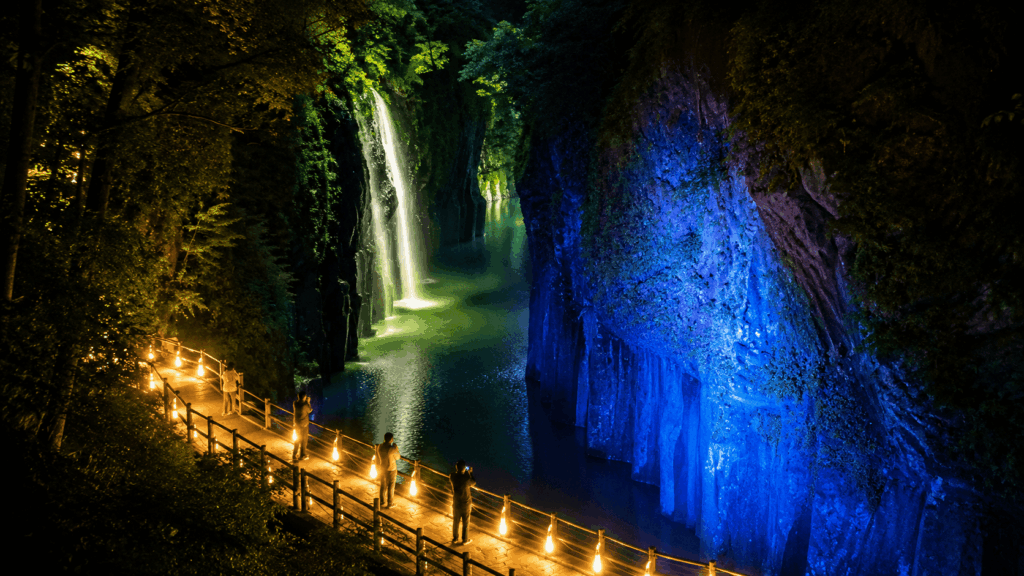
Evening illumination events: Seasonal lighting of the gorge is held in some years (recently under the name “峡 KAI”), typically running from mid-February to late March. Dates and availability change annually, so check the tourism association news page before planning around it.
FAQ
Do I need a reservation for the Takachiho Gorge rowboat?
Yes, it’s strongly recommended. Online reservations open at 9:00 AM JST, exactly two weeks before your desired date, and close at 9:00 AM two days prior. Weekend slots can sell out within hours of opening. Same-day tickets are available in very limited numbers—shown on the official website around 8:00 AM on the day—but on busy days the queue can mean several hours of waiting or being turned away entirely.
What happens if the boat is cancelled due to weather?
Boat rentals are suspended when the Gokase River rises after heavy rain or during typhoon conditions. The operating status is updated on the official website around 8:00 AM each morning. If the boat isn’t running, you can still see Manai Falls clearly from the Takachiho Promenade (the riverside walking trail)—the view from above is free, requires no booking, and is arguably just as impressive.
Can I visit Takachiho Gorge without a car?
Yes, but with limitations. The gorge itself is about a 20-minute walk from the Takachiho Bus Centre, and Takachiho Shrine is also within walking distance. Amano Iwato Shrine is reachable by bus (every 1–2 hours, about 20 minutes one-way, ¥300). However, Kunimigaoka and the Amaterasu Railway are difficult to reach without your own transport. For travellers without a car, a guided day tour from Fukuoka or Kumamoto that includes both Mt. Aso and Takachiho is a practical alternative that covers multiple sights in one day without the logistics stress.
How much time do I need at Takachiho Gorge?
The gorge itself is compact. The promenade walk takes roughly one hour round trip, and the rowboat is 30 minutes. If you do both and take photos, budget about 1.5–2 hours for the gorge alone. To make a full day of it, you’ll want to add Amano Iwato Shrine (1–1.5 hours including transport), the Kagura evening performance (1 hour at 8:00 PM), and one more stop (Amaterasu Railway or Kunimigaoka).
Is one day enough for Takachiho, or should I stay overnight?
You can see the main sights as a long day trip from Kumamoto or Fukuoka (both roughly 2–2.5 hours by car, longer by bus). However, staying overnight gives you three big advantages: you can catch the Kagura performance in the evening, you have a realistic shot at the Kunimigaoka sea of clouds at dawn, and you experience the gorge and shrines with far fewer people—most day-trippers leave by late afternoon. If your schedule allows, one night makes the trip noticeably more rewarding.
When is the best time of year to visit Takachiho Gorge?
Spring (late March–May) brings mild weather and fresh greenery. Summer (June–August) is warm but overlaps with the rainy season (June–mid July) and typhoon risk (August–October), which can suspend the boat. Autumn (October–November) offers pleasant temperatures and the possibility of the sea of clouds at Kunimigaoka. Winter (December–February) is cold but clear, with the lowest crowds and highest chance of the sea of clouds—plus the full-scale village Kagura performances run from mid-November to early February.
Is the Takachiho Gorge walking trail accessible for wheelchairs or strollers?
The promenade has stairs and uneven sections in places, so it is not fully wheelchair accessible. The path to the boat dock involves steep stone steps. If mobility is a concern, the Manai Falls viewpoint near the Daiichi Oshioi parking lot is the most accessible spot—you can see the waterfall from near the car park without navigating stairs or rough terrain.
Can children go on the rowboat?
Yes. Children are welcome on the boat, and the capacity is three adults or four people including small children. The current is gentle within the gorge, and life jackets are provided. There is no minimum age, but children must be supervised at all times.
What should I eat in Takachiho?
Three local specialities to know about: nagashi somen (flowing noodle—the town claims to have invented it)—served at Chiho-no-Ie (千穂の家) in the gorge area; chicken nanban—a crispy fried chicken with tartar sauce, famously served at Imakin Shokudo (今金食堂) in town (expect queues that can exceed an hour at peak lunch time); and Takachiho beef—a local wagyu brand served at Nagomi (なごみ) near the Gamasae Market. One more: the kama-iri-cha (pan-fired green tea) ice cream sold near Amano Iwato Shrine is a unique local treat worth trying.
Final Verdict: Is Takachiho Gorge Worth the Trip?
Takachiho Gorge is worth visiting—but it’s worth visiting with the right expectations. Here’s how it breaks down by traveller type.
Choose Takachiho if…
- You’re driving through Kyushu (Fukuoka–Kumamoto–Miyazaki route) and have at least a full day to spare.
- You’re interested in Japanese mythology—the Amano Iwato–Amano Yasugawara–Kagura connection gives Takachiho a depth that most scenic gorges in Japan lack.
- You can stay one night. The combination of the gorge at sunset, the Kagura at night, and the sea of clouds at dawn is the full Takachiho experience.
- You’re comfortable adjusting plans based on weather (boat cancellations, cloud cover for Kunimigaoka).
Consider another option if…
- You’re on a tight day trip from Fukuoka and only have 4–5 hours for Takachiho. You’ll see the gorge and little else, and the drive alone is around 2.5 hours each way.
- You don’t have a car and don’t want to join a tour. The bus network is sparse enough that you’ll spend more time waiting than seeing.
- Your main interest is hiking or long outdoor walks. The gorge promenade is a gentle stroll, not a hike—you cover it in under an hour.
For first-time visitors to Kyushu: If you’re choosing between Takachiho and a full day at Mt. Aso (assuming both fit your route), Mt. Aso is the more iconic experience. But if your itinerary allows for two days—Aso one day, Takachiho the next—that is the best combination for the central Kyushu leg of your trip.
For travellers on a tight schedule: Prioritise the promenade over the boat if you’re short on time or unable to book ahead. It’s free, no waiting, and the view of Manai Falls from above is excellent. Then spend your saved time at Amano Iwato Shrine and the Kagura—those two stops are where Takachiho becomes more than just a photo stop.
For repeat visitors to Japan: If you’ve seen the standard highlights (Kyoto, Tokyo, Hiroshima) and want something off the main tourist belt, Takachiho fits perfectly. It’s authentic, the mythology adds a layer most scenic spots lack, and the Kagura is a genuinely cultural event rather than a tourist show designed for foreign visitors.

Hi, I’m Kai. I’m a Tokyo-based travel writer, tourism industry insider, and the author of a published guidebook for international visitors to Japan. With over 10 years of professional experience at a leading Japanese tourism company, my mission is to help you skip the tourist traps and navigate Japan’s best destinations like a local. I believe the perfect day trip is like a traditional kaiseki meal: a beautiful balance of precise planning and unforgettable seasonal discovery. When I’m not out conducting field research, you’ll usually find me drafting new itineraries with one of my favorite fountain pens!