
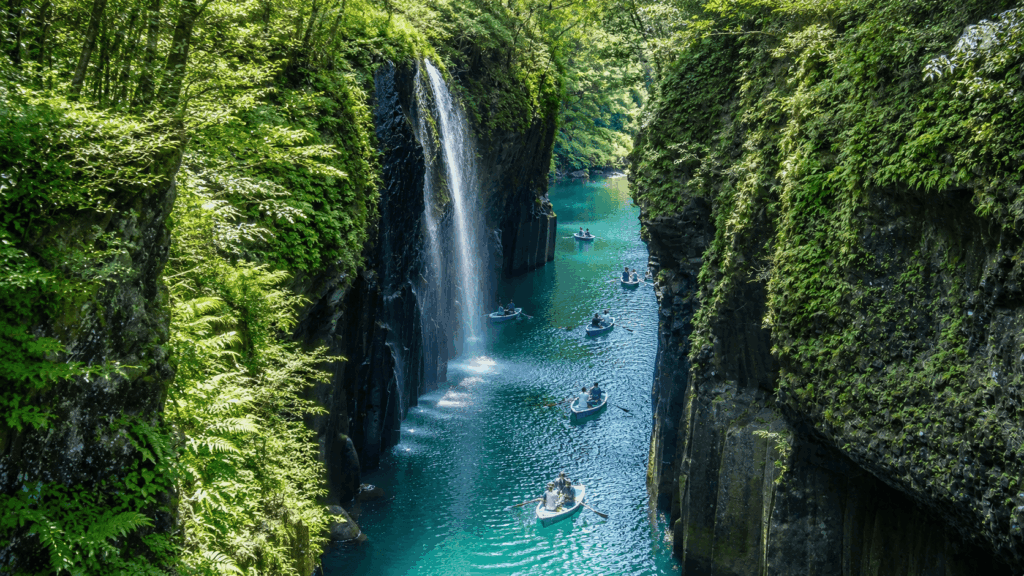
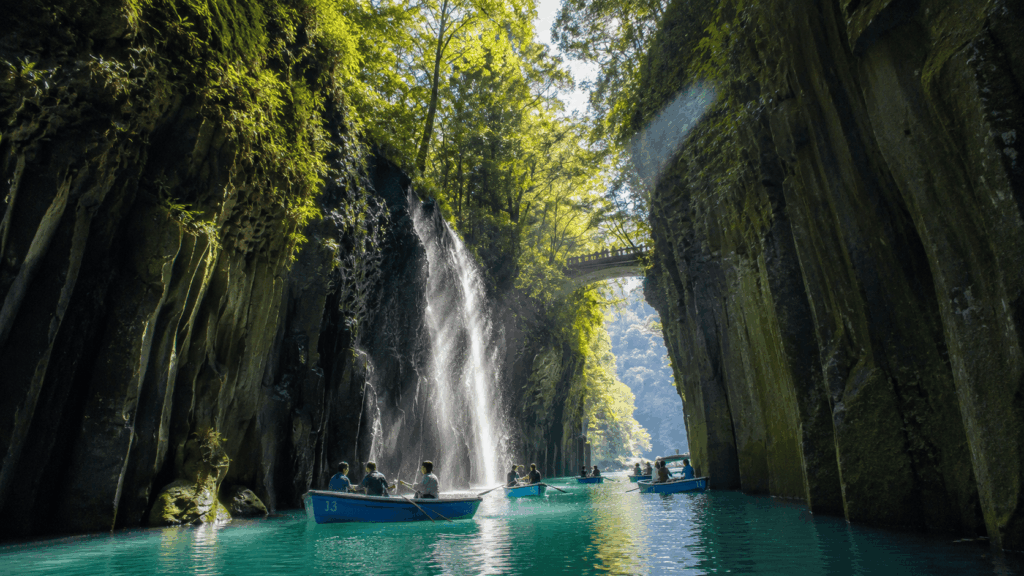
Takachiho Gorge is one of those places that looks almost unreally beautiful in photographs — sheer basalt cliffs, emerald-green water, a white waterfall threading down through the columns. But here’s the thing nobody tells you: that emerald water can turn brown overnight. And whether you see the version from the photos or a completely different one depends entirely on when you go.
This guide gives you an honest, season-by-season breakdown of what to expect — when the foliage peaks, whether winter is worth the drive, which months to think twice about, and how to time your visit so you actually get the experience you came for.
If your date is fixed: Takachiho Gorge is one of the places where planning ahead matters. For a lower-stress visit from Fukuoka, check live availability, start times, and boat-related details for the Takachiho Gorge private day tour with boat ride and lunch before you lock in your season.
Quick Answer: Takachiho Gorge by Month
| Month | Scenery | Boats | Crowds | Verdict |
|---|---|---|---|---|
| January | Bare trees, some green, quiet beauty | Available, easy to book | Low | Good for solitude |
| February | Same as Jan + KAI Lights Festival | Available, easy to book | Low | Good + evening bonus |
| March | Early spring green appearing | Available | Moderate | Decent shoulder season |
| April | Fresh green, cherry blossoms nearby | Competitive (GW approaching) | Moderate–High | Good but book ahead |
| May | Lush green, night illuminations start | Good availability | Moderate | One of the best months |
| June | ⚠️ Rainy season — water often brown | Frequently suspended | Low | Skip if possible |
| July | ⚠️ Peak rainy season — brown water risk | Often suspended | Low | Skip if possible |
| August | Green but hot, typhoon risk, illuminations | Weather-dependent | Moderate | Conditional |
| September | Transition month, lingering rain risk | Improving | Low–Moderate | Decent shoulder |
| October | Early autumn colors beginning | Available but filling up | Moderate | Excellent sweet spot |
| November | 🔥 Peak autumn foliage | Extremely competitive | Very high | Best scenery, worst crowds |
| December | Late foliage / early winter | Easier to book | Low | Good value |
Best Time of Day to Visit Takachiho Gorge
The single most important timing tip for Takachiho Gorge has nothing to do with seasons — it’s about the angle of the sun. The light enters the gorge at the right angle to illuminate Manai Falls directly only between 10:00 AM and 12:00 PM. During this window, the waterfall catches the sunlight and the emerald-green water appears at its most vibrant. This is the hour for the photographs you’ve seen.
Early Morning (8:30 AM – 10:00 AM)
The boat rental office opens around 8:30 AM, and arriving early is the single best strategy for securing a same-day ticket without waiting. The walking trail along the gorge rim is peaceful in the morning, and the closest parking lot (P1 Oshioi, ¥500) still has space. The trade-off? The gorge is still in shadow, so the waterfall won’t have that sunlit glow yet.
Late Morning (10:00 AM – 12:00 PM) — Best Window
This is the sweet spot. The sun clears the canyon walls and hits the waterfall directly. The water is at its most photogenic, the mist from the falls catches the light, and the basalt columns show their full texture. If you can only be at the gorge for one hour, make it this one.
Afternoon (12:00 PM – 4:00 PM)
After midday, shadows begin creeping back across the gorge floor. The waterfall loses its direct sunlight, and the colors flatten. The gorge is still beautiful — the walking trail is pleasant, and you can see the three-arch bridge view from Yarittobashi Bridge in good light — but the iconic waterfall shot becomes harder to get. Boat availability also drops as morning slots fill up.
Evening (Summer Only, until 10:00 PM)
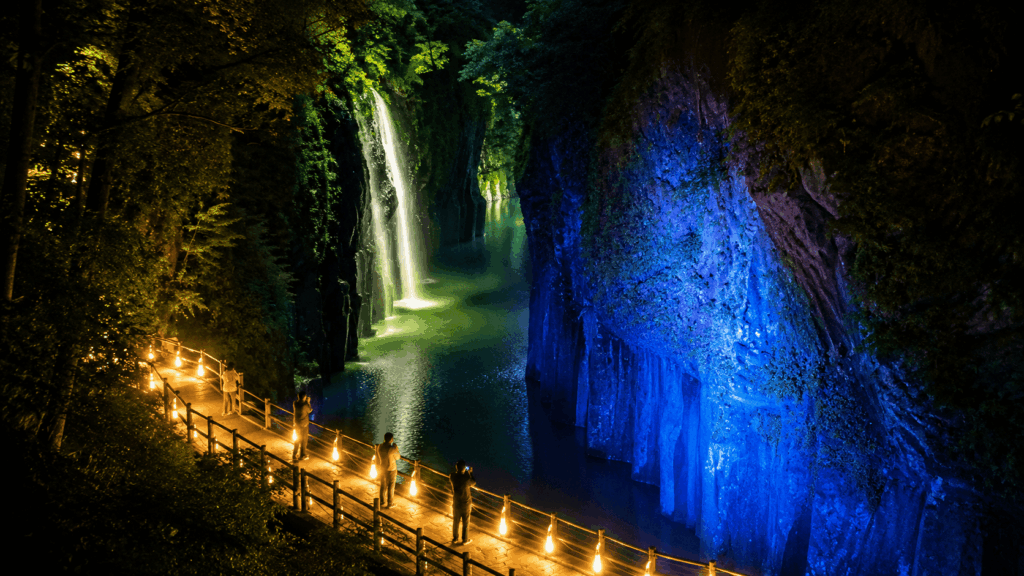
From mid-May through November, the gorge is illuminated after dark with spotlights on the basalt cliffs and Manai Falls. The atmosphere is completely different — moody, dramatic, and far quieter than daytime. If you’re visiting in summer, this is worth staying for even if you’ve already done the boat ride.
Spring (March – May): Fresh Green, Comfortable Weather
Spring at Takachiho Gorge is about fresh greenery, mild temperatures (10°C–20°C), and the classic “emerald gorge” look that most promotional photos are taken in. The trees along the rim are bright with new leaf growth from April onward, and the water is reliably clear — unlike summer, when rain can muddy it.
What’s Good
- The greenery is at its freshest — April through October is when you get the vibrant green foliage seen in stock photography
- Comfortable hiking temperatures for the 1-km walking trail (free, 40–60 minutes)
- May is particularly good: pre-rainy season, stable weather, and night illuminations begin mid-month
What’s Not
- Cherry blossom season draws crowds across Kyushu in late March–early April, so accommodation and rental cars can be harder to book
- Golden Week (late April–early May) is one of Japan’s busiest travel periods. Book boats and accommodation well in advance
- Spring offers vivid colors, but the absolute knockout scenic combo — autumn foliage + waterfall + emerald water — happens only in November
Best for: Travelers who want mild weather and reliable emerald water without peak-season chaos. May is the standout month.
Skip if: You’re specifically chasing autumn colors. In that case, wait until November.
Summer (June – August): The Gorge at Its Riskiest
June – July: The Rainy Season Problem ⚠️
This is the single most important thing to understand about Takachiho Gorge, and it’s the one thing most guides don’t say clearly enough.
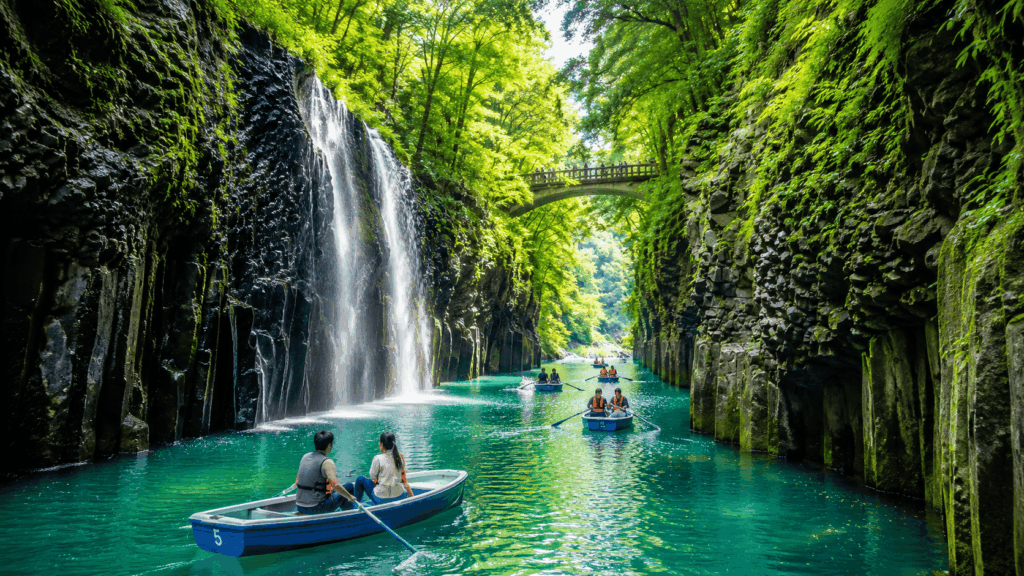
Kyushu’s rainy season (tsuyu) runs from early June through late July. During this period, heavy rainfall upstream turns the Gokase River — and by extension, the entire gorge — from its signature emerald color into a muddy, chocolate-brown torrent. The contrast with the photographs is shocking. Manai Falls still flows, but the water below it is unrecognizable.
The bigger problem is boat operations. When the river rises even moderately, rental boats are suspended entirely. A sunny forecast does not guarantee boats will run — if the upstream water level is still high from previous days of rain, the gorge stays closed. The boat office updates its operating status around 8:00 AM daily on the official website.
Kai’s tip: The mistake I see travelers make most often is driving two hours from Kumamoto or Fukuoka to Takachiho without checking the morning boat status first. After heavy rain, the boat office itself can look partially submerged, and the “emerald gorge” you came for is a brown rapid. Always check the official operating status before you leave — it updates around 8:00 AM. And have a backup plan: the walking trail and nearby shrines are still accessible even when the boats are down.
If you’re locked into a June or July itinerary and still want to visit, arrive with low expectations for the boat ride and focus on the walking trail, Takachiho Shrine, and Amano-Iwato Shrine. The gorge’s mythology and atmosphere are independent of the water color.
August: Heat, Typhoons & Night Illuminations
August is a mixed bag. The rainy season has typically ended by late July, but August brings the peak of typhoon season in Kyushu. A direct hit or even a passing storm can churn the river back to brown and shut down boats for days.
The upside: August is the heart of the night illumination season. From mid-May through November, the gorge is lit until 10:00 PM, with spotlights picking out the basalt columns and Manai Falls against the night sky. The evening atmosphere is genuinely special — far fewer people, cooler air, and the sound of the waterfall amplified in the dark.
Best for: Night owls who want the illuminated gorge experience. Bring bug spray — August humidity means mosquitoes along the trail.
Skip if: You’re prioritizing the classic clear-water boat ride. In that case, aim for October–November or April–May instead.
Autumn (October – December): Peak Scenery, Peak Crowds
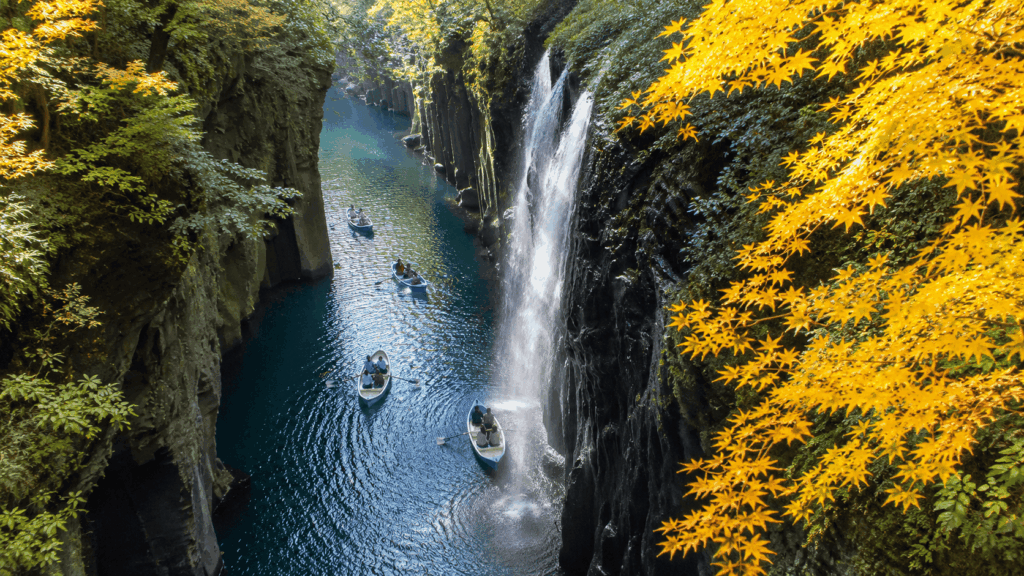
This is the season everyone wants. And for good reason — the combination of deep emerald water, the white curtain of Manai Falls, and the red and gold of the surrounding maple trees is one of the most photographed scenes in Kyushu. But autumn at Takachiho comes with real trade-offs that most guides gloss over.
When the Autumn Colors Actually Peak
The maple and ginkgo trees surrounding the gorge reach their peak color roughly from mid-November to early December. The exact timing shifts by a week or two each year — recent seasons have pushed closer to late November through the first week of December. If you have flexibility, aim for the last week of November and check the official Kyushu foliage forecasts as your trip approaches.
What you’re hoping for is the trifecta: warm-toned autumn leaves framing the top of the gorge walls, Manai Falls catching the late-morning light, and the Gokase River holding its clear emerald tone. When it works, it’s spectacular. But there’s one thing that can still ruin it, and it has nothing to do with the trees.
The Crowd Reality — and How to Beat It
By 11:00 AM in November, the main parking lot (P1 Oshioi, ¥500) is full. Cars queue on the approach road. The boat rental queue has a wait time measured in hours, not minutes. The walking trail, normally a peaceful stroll, becomes a conga line of tripods and selfie sticks.
This is the central paradox of Takachiho Gorge in autumn: the best conditions happen at the worst time for crowds. The 10:00 AM – 12:00 PM light window that makes the waterfall glow — that’s also when the gorge is at its busiest.
Kai’s tip: If you want both autumn colors and a manageable experience, here’s the strategy I’d give a friend. Arrive before the boat office opens at 8:30 AM — the gorge is quiet, the parking is easy, and you’ll be near the front of the queue. Aim your boat reservation for the 10:00 AM – 12:00 PM slot so you get the good light on the water. If boats are already booked out (which happens quickly on weekends, especially since online reservations open exactly two weeks ahead at 9:00 AM Japanese time), don’t panic — the walking trail is free, offers excellent views of the gorge from above, and in autumn the colors are just as good from the rim. Many visitors overlook this entirely because they fixate on the boat experience.
October — The Smart Compromise
If you want autumn atmosphere without the November crowds, October is the sweet spot. The early colors begin appearing from mid-October onward — not the full red-and-gold explosion, but a gradual shift with plenty of green still in the mix. The light is good, the weather is stable (average highs around 20°C), and the boat reservations are far easier to secure.
The view of the three consecutive arch bridges — Shinbashi (1947, stone), Takachiho-ohashi (1955, concrete), and Shinto-Takachiho-ohashi (2003, steel) — from Yarittobashi Bridge is particularly good in October, with the autumn colors beginning to frame the arches. It’s a composition you can only get here: Japan’s only spot where three different arch bridges line up in a single frame.
Best for: Photographers who want the classic autumn+waterfall shot. Anyone who values scenery over solitude — go for late November, brace for crowds, and plan ahead.
Skip if: You hate crowds entirely. Consider visiting in late October (less intense colors, fewer people) or switching to winter (no foliage, but the gorge is yours alone).
⚠️ Important: Reservations for boat rentals open exactly 14 days in advance at 9:00 AM Japan time. For November weekends, slots fill within minutes. If you miss the online window, a limited number of same-day tickets are available from the boat office at 8:30 AM — but the queue starts forming well before opening. Plan accordingly, or consider a guided day tour that handles the boat booking for you.
If you fall into that camp — you want the boat ride, late-morning light, and fewer moving parts, but you do not want to fight the reservation window alone — this is the one booking I’d push you toward.
Why I’d book this one
- It matches Takachiho’s biggest friction point: the tour is built around advance boat planning rather than treating the gorge as a quick photo stop.
- It reduces the transport stress: private pickup from Fukuoka means you are not relying on rental-car timing, mountain roads, or a long self-drive day.
- It gives you a fallback plan: if weather affects the boats, the itinerary still has room for shrines, gorge viewpoints, and the surrounding mythology that make Takachiho worth the trip.
Before you commit to autumn dates, see live availability, start times, cancellation terms, and recent traveler reviews for the Takachiho Gorge boat ride and lunch tour.
Winter (December – February): Quiet, Cold & Not What You Expect
Winter is the most misunderstood season at Takachiho Gorge. Some travelers come expecting a silent snow-covered wonderland and leave disappointed. Others skip it entirely assuming the gorge is “dead” in winter. The reality is somewhere in between — and if you understand what winter actually offers, it can be one of the most rewarding times to visit.
What Winter Actually Looks Like
Let me be direct about this: you will almost certainly not see snow at the gorge floor. Takachiho Gorge sits at a relatively low elevation, and while the surrounding mountains may get dusted, the gorge itself sees significant snowfall only once every few years. When it does snow, it’s typically a light dusting that melts within hours. The “Takachiho Gorge in snow” photos you might find online are rare captures, not the standard winter look.
What you actually get is a quiet, bare-branched version of the gorge. The deciduous trees along the rim have lost their leaves, which opens up sightlines that are hidden in summer. The basalt columns are more visible. Manai Falls is still flowing. And because the gorge is low-elevation, evergreen vegetation means there’s still green in the landscape — just not the lush canopy of spring and summer.
Kai’s tip: The real winter hazard at Takachiho isn’t the lack of snow in the gorge — it’s getting there. If you’re driving from the Kumamoto side, particularly via the mountain roads around Mt. Aso, you can encounter ice and chain regulations even when the gorge itself is dry and above freezing. I’ve seen rental cars turned around at checkpoints because they had summer tires. Check road conditions on the morning of your drive, and if you’re not confident about mountain driving in winter, a guided day tour is a genuinely smarter option — the drivers know the routes and carry the right equipment.
Winter Highlights That Save the Trip
The real strength of a winter visit is that Takachiho town has excellent evening and cultural activities that are harder to fit in during the peak daylight-focused months.
Takachiho Evening Kagura
Every night from 8:00 PM to 9:00 PM, a condensed version of the sacred Takachiho Kagura is performed at Takachiho Shrine‘s Kagura Hall. Admission is ¥1,000, and the performance draws from the thirty-three dances of the full Kagura tradition, focusing on the most dramatic episodes — including the famous story of Amaterasu hiding in the cave. The hall seats about 200, and no reservation is needed for most of the year, though weekends can fill up. For the full experience, the actual Takachiho Kagura Festival runs across various shrines from mid-November through February, with all thirty-three dances performed through the night — but that’s an all-night affair best suited to cultural enthusiasts.
KAI Lights Festival (February – March)
From mid-February to late March, Takachiho Gorge and the surrounding area host a special winter illumination event called KAI Lights. Four locations — Takachiho Shrine, Takachiho Gorge (including Manai Falls and Onokoro Pond), and two other spots — are illuminated from 6:00 PM to 10:00 PM. The gorge in particular takes on an entirely different character: the basalt columns glow against the dark, and the mist from the falls catches the colored lights. This is as close as winter gets to the summer illumination experience. (Check the official event page each year for exact dates, as they can shift.)
Takachiho Amaterasu Railway
This open-air sightseeing train runs through the Takachiho plateau, offering views of the gorge from above and the surrounding countryside. In winter, blankets are provided, and the bare trees actually improve some of the distant views. The fare is ¥2,000 for adults (as of 2026). It operates year-round except the third Thursday of each month. It’s not a substitute for the gorge itself, but it’s a good addition to a winter afternoon.
Best for: Crowd-avoiders, culture lovers, and budget travelers (winter accommodation and boats are significantly cheaper). The Evening Kagura alone justifies the trip for anyone interested in Japanese mythology.
Skip if: Your entire reason for visiting is the classic autumn foliage + waterfall photograph. Winter cannot deliver that. But for everything else — solitude, culture, affordability — it’s an underrated choice.
Which Months to Avoid (and Why)
No month at Takachiho Gorge is completely “bad” — even in the rainy season, you can enjoy the gorge through the walking trail and nearby shrines. But if your priority is the classic experience (clear emerald water + boat ride + good scenery), two periods carry real risk:
| Period | Risk Level | Why | Go If… |
|---|---|---|---|
| June – July (Rainy Season) | ⚠️ High | Heavy rain turns water brown, boats frequently suspended. The “emerald gorge” look is gone. | You’re okay with no boat ride or clear water. Focus on walking trail + shrines. |
| August (Typhoon Season) | Moderate | Typhoons can disrupt access and muddy the water. Between storms, conditions are fine. | You’re flexible with dates and can track typhoon forecasts. |
| Mid-November Weekends | ⚠️ High (crowds) | Not a weather risk, but the gorge is extremely congested. Boats book out instantly. | You can arrive before 8:30 AM and have booked boats weeks ahead. |
The golden rule: the morning of your visit, check the official boat operating status (updated ~8:00 AM). This one step will save you from the most common disappointment — driving hours to find the gorge at its worst.
What to Do If the Boats Are Canceled
Boat cancellations happen — from rain, from typhoon aftermath, from upstream reservoir releases. But Takachiho has more to offer than the boat ride. Here’s what to do instead:
The Walking Trail (Free, Always Open)
The approximately 1-km walking trail (Takimichi) runs along the opposite side of the gorge from the main road, giving you elevated views of the water, the basalt formations, and Manai Falls from above. It takes 40–60 minutes at a leisurely pace, it’s free, and in autumn the views from the trail are often better than from the water level anyway. The trail is unpaved in sections and can be slippery after rain — wear proper shoes. (Note: As of early 2026, a section of the main trail was closed for landslide repair. Check current conditions — the gorge remains accessible, but some trail segments may require detours.)
Takachiho Shrine & Amano-Iwato Shrine
Less than a 10-minute drive from the gorge, Takachiho Shrine is worth visiting for its atmospheric grounds and the Evening Kagura performance. A further 15 minutes north, Amano-Iwato Shrine marks the cave where, according to Japanese mythology, the sun goddess Amaterasu hid herself, plunging the world into darkness. The nearby Amano-Yasukawara cave is free to enter and lined with small stone towers left by visitors — a peaceful, photogenic spot that adds a mythological dimension to the trip.
Takachiho Amaterasu Railway
If the boats are out and you’ve already done the walking trail, the Amaterasu Railway offers a completely different perspective — an open-air trolley ride through the countryside above the gorge. The ¥2,000 fare is comparable to the boat but the experience is totally different. Good as a backup or an add-on.
Practical Tips for Every Season
- Check boat status daily: The official boat operations page updates around 8:00 AM. Bookmark it before your trip.
- Book boats early: Online reservations for boats open exactly 14 days in advance at 9:00 AM JST. For peak season (November, Golden Week), set an alarm.
- Parking strategy: P1 Oshioi (¥500) is closest. P2 Aratate (¥300, 15-min walk) is a reliable backup. P3 Ohashi (free, 20-min walk) and P4 Oshikata (free, 25-min walk) are options for budget travelers.
- Rainy day alternative: Even in bad weather, the shrines and the Amaterasu Railway are viable options. Don’t cancel the entire trip just because the gorge is wet — adjust your plan.
- Wear sturdy shoes: The walking trail and some sections of the gorge rim are unpaved, uneven, and can be slippery. No sandals or heels.
- Bring layers year-round: The gorge is shaded and cooler than the surrounding area, even in summer. In winter, the temperature at the water level can be several degrees colder than the parking lot above.
Frequently Asked Questions
Is Takachiho Gorge worth visiting in winter?
Yes — if you adjust your expectations. The gorge itself is quieter, cooler, and missing the autumn foliage, but the basalt columns and Manai Falls are still impressive. The real value of a winter visit is what surrounds it: the Evening Kagura performance at Takachiho Shrine (nightly, ¥1,000), the KAI Lights Festival (February–March), and the Amaterasu Railway. You’ll also have the boat rental queue practically to yourself. The one group I’d advise to skip winter is anyone whose sole goal is the classic emerald-water-plus-foliage photograph — winter cannot deliver that.
Can I see snow at Takachiho Gorge?
Probably not, and it’s important to know this before you go. Takachiho Gorge sits at a relatively low elevation, and significant snowfall at the gorge floor is rare — light dustings happen once every few years and melt within hours. The “Takachiho in snow” photos you may have seen online are exceptional, not typical. If you’re driving from the Kumamoto side via Mt. Aso, however, the mountain roads can have snow and ice even when the gorge itself is clear. Check road conditions before you drive, and consider a guided tour if you’re not confident with winter mountain driving.
When is the best time for autumn foliage at Takachiho Gorge?
The peak window is mid-November to early December, with the most reliable colors usually falling in the last week of November. The exact timing shifts by a week or two depending on the year’s temperature patterns, so check Kyushu-specific foliage forecasts as your trip approaches. October offers early colors with far fewer crowds — a smart compromise if you’re flexible.
Can I still enjoy the gorge without a boat?
Absolutely. The free walking trail (~1 km, 40–60 minutes) runs along the opposite side of the gorge and gives you elevated views of Manai Falls and the basalt columns. Many photographers actually prefer the trail views over the boat-level perspective. If the boats are suspended (common during and after rain), the walking trail, Takachiho Shrine, Amano-Iwato Shrine, and the Amaterasu Railway make for a full day without ever stepping into a boat.
Does the water really turn brown during rainy season?
Yes — and it can be startling if you’re not expecting it. Heavy rainfall upstream sends sediment into the Gokase River, and the emerald-green water you see in photographs becomes a muddy brown that completely changes the character of the gorge. This is most common from mid-June through late July during Kyushu’s rainy season, and can persist for days after the rain stops. The boat office also suspends operations during and after heavy rain, regardless of whether it’s sunny on the day of your visit.
How far in advance should I book a boat?
Boat reservations open online exactly 14 days in advance at 9:00 AM Japan time and close 2 days before your visit. For peak season (November weekends, Golden Week), slots can fill within minutes of opening. If you miss the online window, a small number of same-day tickets are available from the boat office from 8:30 AM — but expect to queue before opening. Weekdays and winter are far easier.
Final Verdict: Should You Visit Takachiho Gorge in Your Season?
Choose Takachiho Gorge in autumn (late October–early December) if: You’re a photographer or scenery chaser who wants the full trifecta — emerald water, Manai Falls, and autumn foliage. Book your boat exactly 14 days ahead, arrive before 8:30 AM, and target the 10:00 AM–12:00 PM light window. Accept that you’ll be sharing the gorge with many other people who had the same idea.
Choose Takachiho Gorge in winter (December–February) if: You value solitude, cultural experiences, and affordability over peak scenery. The Evening Kagura performance, KAI Lights Festival (February–March), and the uncrowded walking trail make this a genuinely good option — as long as you don don’t expect snow or autumn colors. This is also the best season for securing boat reservations with zero competition.
Choose Takachiho Gorge in spring (April–May) if: You want reliable emerald water, comfortable hiking weather, and manageable crowds. May is the standout spring month: the rainy season hasn’t started, the greenery is fresh, and the night illuminations begin mid-month.
Choose Takachiho Gorge in October if: You want autumn atmosphere without the November crowd chaos. The colors won’t be at their absolute peak, but you’ll trade that for empty parking lots, easy boat bookings, and a peaceful walking trail.
Consider another destination or adjust your plan if: Your dates are fixed to June or July. The rainy season carries a real risk of brown water and suspended boats. If you’re set on visiting anyway, build your plan around the walking trail and nearby shrines — treat the boat as a bonus, not the main event. And if your entire reason for coming is a photograph you saw on Instagram, check whether that photo was taken in late November.
If your travel dates don’t line up with that window, adjust your expectations — not every season delivers the same gorge. For help with scheduling, check our guide to a realistic one-day itinerary.

Hi, I’m Kai. I’m a Tokyo-based travel writer, tourism industry insider, and the author of a published guidebook for international visitors to Japan. With over 10 years of professional experience at a leading Japanese tourism company, my mission is to help you skip the tourist traps and navigate Japan’s best destinations like a local. I believe the perfect day trip is like a traditional kaiseki meal: a beautiful balance of precise planning and unforgettable seasonal discovery. When I’m not out conducting field research, you’ll usually find me drafting new itineraries with one of my favorite fountain pens!