
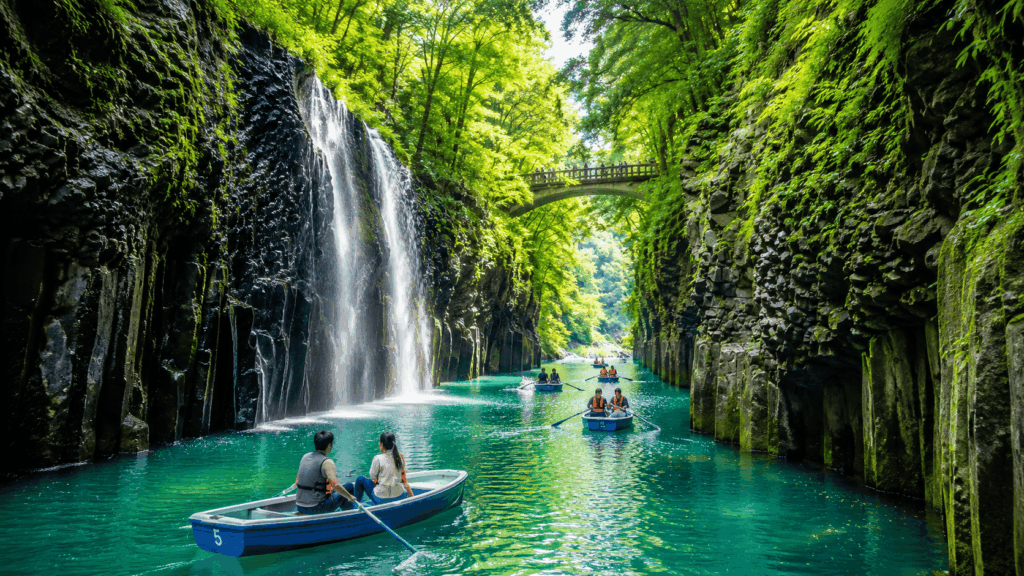
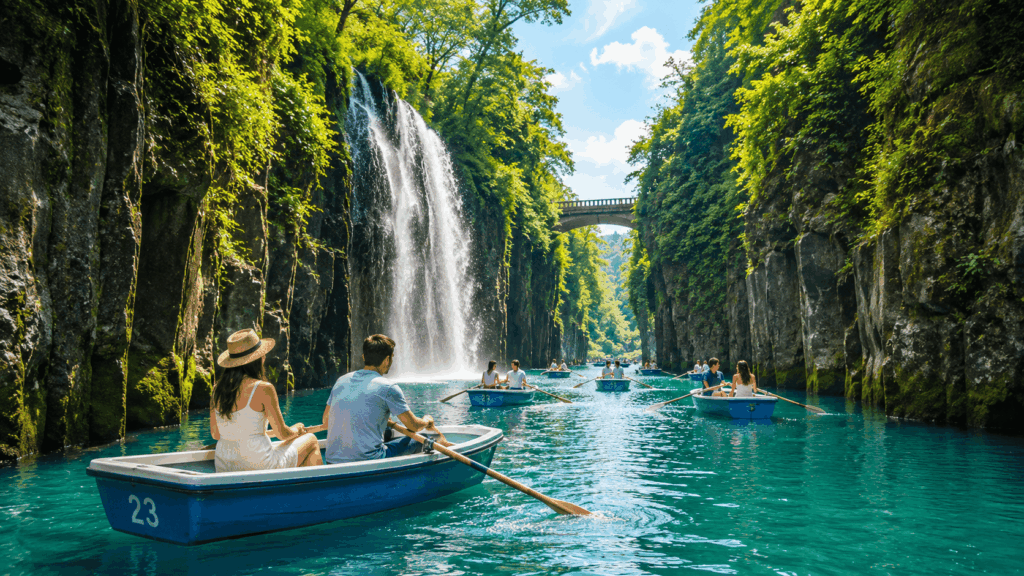
Takachiho Gorge has that effect on people. One look at the aerial shot of rowboats drifting past Manai Falls — turquoise water, basalt cliffs, a 17-meter veil of white — and it lands on every Kyushu itinerary. But then the reality check sets in: it’s in the mountains of northern Miyazaki, the train line was discontinued years ago, and the handful of bus services run on a maddeningly limited schedule.
The mistake I see most first-time visitors make is treating Takachiho like a convenient pit stop. It’s not. Getting there takes deliberate planning, and the difference between a great day and a frustrating one comes down to two decisions you need to make before you leave home. This guide walks you through both — with realistic hour-by-hour plans for drivers and non-drivers alike — so you arrive with a clear head and leave without regrets.
Planning without a rental car? Before you build the whole day around the limited bus schedule, it is worth checking live dates, start times, and recent traveler reviews for this Kumamoto-based Aso and Takachiho guided day tour. It is the kind of option to compare early if you want Takachiho and Mount Aso in one day with fewer transport decisions.
Takachiho Gorge at a Glance — Is It Worth the Trip?
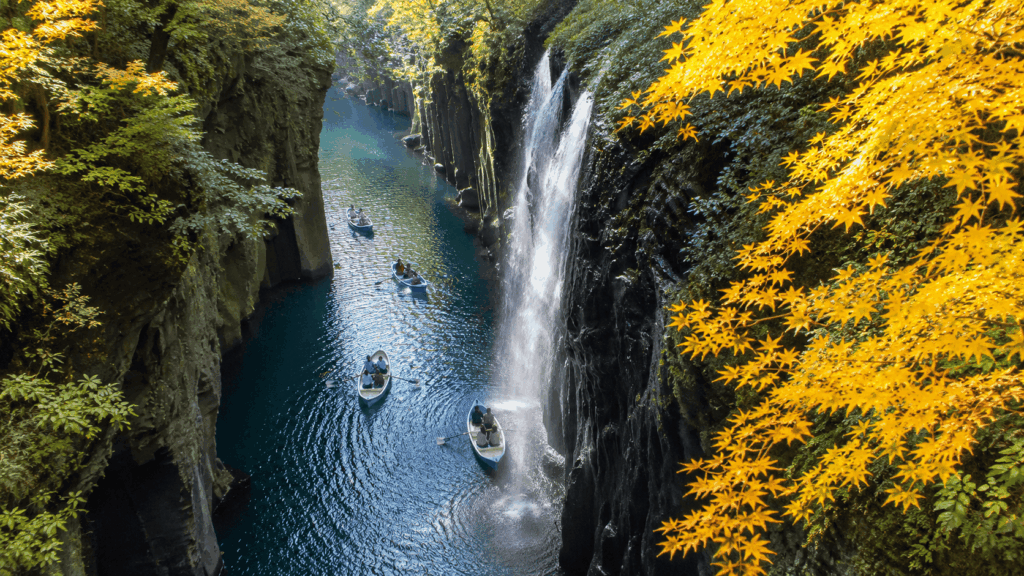
Yes — if you plan it right. The gorge itself is genuinely spectacular: a narrow chasm of columnar basalt carved by the Gokase River, with the iconic Manai Falls plunging into emerald water. But because the sites are scattered across town — the gorge, Takachiho Shrine, Amano Iwato Shrine, Amanoyasukawara cave, Kunimigaoka — you need a strategy to connect them without wasting time.
- Best for: Nature lovers, mythology enthusiasts, photographers, travelers combining with Mount Aso
- Skip if: You have mobility issues (many stairs, uneven paths) or are on a rushed multi-city itinerary with only a few hours to spare
- Minimum time needed: 3–4 hours for the gorge alone; 6–7 hours to include shrines; overnight if you want the full experience
- Can you do it in a day? Yes with a car. Tight but doable by bus from Kumamoto. Very tight by bus from Fukuoka.
- Crowds: Peak at the boat dock 10:00–13:00. Empty in the early morning and past the waterfall bottleneck.
Two Key Decisions Before You Plan
Every other choice you make about Takachiho flows from these two. Get them right and the rest falls into place.
Decision 1: Day Trip or Overnight?
The short answer: if you want to see the Yokagura night performance or the early-morning sea of clouds at Kunimigaoka, you need to stay overnight. More on this below — but keep it in mind as you read the itineraries.
Decision 2: Car or No Car?
Takachiho was built for car travel. The gorge, the shrines, and the viewpoints are scattered over a 5-kilometer radius with no efficient public transport loop. That said, a carless day trip is possible from Kumamoto if you’re disciplined about time. The itineraries below give you both paths.
Option A — One-Day Itinerary by Car
This is the stress-free way to see Takachiho. You control the timing, you can reach all the sites, and you can adjust on the fly. The drive from Kumamoto takes about 1.5–2 hours; from Fukuoka, about 2.5–3 hours. Both routes are straightforward — mostly expressway with local roads at the end.
Morning (9:00–12:30) — The Gorge and the Boat
If coming from Kumamoto: Depart around 8:00. Arrive at the gorge by 9:30–10:00.
If coming from Fukuoka: Depart around 7:30–8:00. Arrive by 10:30–11:00.
Head straight for the boat dock. The morning light on the cliff faces is at its best, and you’ll beat the worst of the midday queue. Park at P1 Oshioi (closest to the dock — paid, around ¥500–1,000, fills fast) or P2 Araragi (a 15-minute walk along the river, also paid). If both are full, P3 Ohashi is free but adds a 20-minute walk with stairs.
About the boat: A single rowboat costs ¥4,100 Tuesday–Thursday or ¥5,100 Friday–Monday and national holidays. It seats up to three adults (or two adults and two preschoolers) for 30 minutes — enough time to row to the waterfall, take your photos, and drift back. The river is calm, life jackets are provided, and the dock staff will show you the basics if you’ve never rowed before.
Kai’s tip: If you booked a morning slot (ideally the first one around 8:30), you’ll arrive at the waterfall before the logjam of boats forms. Most people show up around 10:00–11:00 and queue for their turn, which means the area directly in front of the falls becomes a congested knot of rowboats jostling for photos. Ride early, or time your slot for 12:00–13:00 when half the crowd breaks for lunch — the waterfall clears out noticeably.
After the boat, walk the Takachiho Promenade — the free 1-kilometer rim path that runs along the top of the gorge. It gives you a completely different perspective: looking down at the boats from above, watching the waterfall from the side, and seeing the full sweep of the basalt columns.
Kai’s tip: Most people walk as far as the waterfall viewpoint, snap a photo, and turn back. Keep going past that point. Within two minutes the path empties almost completely, and the gorge opens into a quieter, more contemplative stretch. This is where you feel the scale of the place without the crowd noise — and honestly, this section is what makes the walk worth doing even if you’ve already been on the water.
Lunch (12:30–13:30) — Nagashi Somen and Local Specialties
The cluster of restaurants near the gorge entrance covers most bases. The standout experience is nagashi somen (flowing noodles) — a Takachiho-originated summer dish where thin wheat noodles glide down a split bamboo pipe and you catch them with chopsticks. It’s fun, refreshing, and photogenic. Available roughly May–September. (You can read more about it and other local specialties in our guide to Takachiho food.)
Year-round options include Takachiho beef (Miyazaki’s famous wagyu, often served as steak or on rice bowls), chicken nanban (fried chicken with tartar sauce — a Kyushu specialty), and kagura udon (udon noodles in a light broth, named after the local dance). Most set meals run ¥1,000–2,000.
If you’re on a tight schedule, grab something quick from the small food stalls near the parking area and eat by the river.
Afternoon (13:30–16:00) — Shrines and Views
You have three solid options for the afternoon, and with a car you can comfortably do all of them in this order:
1. Takachiho Shrine (15 minutes by car from the gorge, or a steep 15-minute walk uphill)
The shrine grounds are free to enter and surprisingly quiet compared to the gorge. Look for the massive Meoto Sugi (Married Couple Cedar) — two ancient trees growing from a single root, said to bring good fortune in love and partnership. The shrine itself dates back over 1,800 years and is the venue for the nightly Yokagura performances.
2. Amano Iwato Shrine and Amanoyasukawara (10 minutes by car from Takachiho Shrine)
This is the mythological heart of Takachiho. The shrine has two sections: East Shrine (which faces the cave where the sun goddess Amaterasu hid, plunging the world into darkness — viewing platform is managed by the shrine office, no photos allowed) and West Shrine (the main worship hall, open to all). From the West Shrine, a 10-minute walk along the Iwato River leads to Amanoyasukawara — a cave where the gods gathered to lure Amaterasu out. Visitors stack small stones as prayers, creating a surreal field of rock piles. Photos allowed here.
3. Kunimigaoka (15 minutes by car from Amano Iwato)
A 513-meter viewpoint that earned a Michelin Green Guide star. On a clear day you see the distant mountains of Kyushu; during sea of cloud season (roughly mid-September to late November) it’s one of the best dawn views in Japan. If you’re visiting in autumn and can get here by late afternoon, the light is beautiful — but the real magic is at sunrise, which means staying overnight.
One mistake I see drivers make: they rush through the shrine stops to “save time,” then end up with an extra hour at the end with nothing planned. The gorge + all three shrines/viewpoints fits comfortably in a day if you keep moving at a relaxed pace. Aim to leave the gorge by 12:30, finish the shrine circuit by 15:30–16:00, and you’ll be back on the road home by 16:30–17:00.
If You Have Extra Time — Amaterasu Railway or Mount Aso
Amaterasu Railway (Takachiho Amaterasu Railway) runs the Grand Super Cart — an open-air sightseeing train that crosses the Takachiho Iron Bridge, Japan’s tallest railway bridge, at 105 meters above the gorge. The ride takes about an hour round trip and offers views you can’t get from the boat or the rim path. Best for families, train enthusiasts, and anyone who’s already done the gorge walk. Check the official site for operating days and times — it’s seasonal.
Mount Aso is 30–40 minutes by car from Takachiho. If you’re driving back toward Kumamoto, it’s a natural addition. You can hit the Kusasenri grasslands and the Aso crater viewpoint on the way home without a major detour. That said, adding Aso means a longer day — expect to return to Kumamoto around 18:00–19:00 rather than 17:00. Worth it if you have the energy; skip it if you’d rather take the afternoon at a relaxed pace.
Option B — One-Day Itinerary by Public Transport (No Car)
Let’s be honest about what you’re getting into. Takachiho was not designed for carless visitors. The train line that once served the town was decommissioned in 2008, leaving only buses — and those buses are not built for tourism volume. A one-day trip without a car is possible, but it is tight, and some sights will simply be out of reach. Here’s how to make the most of the time you have. (If you’re still deciding on your transport, see our dedicated guide to taking the bus to Takachiho first.)
The Hard Truth About Takachiho Without a Car
- From Kumamoto: One bus per day. One. The 9:11 departure arrives at Takachiho Bus Center at 12:19. The return bus departs at 16:57 (boarding starts at 16:42). That gives you about 4 hours and 20 minutes on the ground — less if you factor in waiting, walking, and lunch.
- From Fukuoka: Four buses per day, so slightly more flexibility on timing. But the journey takes 3–3.5 hours each way, meaning a day trip from Fukuoka means 6–7 hours in transit for 4–5 hours at the destination.
- Local transport: There is no regular local bus loop connecting the gorge, the shrines, and Kunimigaoka. A local bus runs between the Bus Center and Amano Iwato Shrine (about 4 times a day), but it doesn’t effectively connect multiple stops in sequence. Most carless visitors end up walking between the gorge and Takachiho Shrine, and taking a taxi to Amano Iwato (about ¥2,000 one way).
What this means in practice: If you’re arriving by bus from Kumamoto, your realistic reach is the gorge (walking distance from the Bus Center), Takachiho Shrine (a steep 20-minute walk or taxi), and a very quick visit to Amano Iwato if you take a taxi from the shrine. Kunimigaoka is out of reach by public transport within a day-trip window. From Fukuoka, you have a bit more flexibility with multiple bus options, but the same geographic constraints apply.
Sample Bus Itinerary from Kumamoto
9:11 — Depart Kumamoto Station (Sanko Bus, “Takahiho-go”). Reserve online in advance — the bus has limited seats and sells out on weekends. Fare is ¥2,700 one way.
12:19 — Arrive at Takachiho Bus Center. Walk straight to the gorge — it’s a 20-minute walk downhill (or a 5-minute taxi for ¥1,000–1,500). Go directly to the boat dock to check for same-day tickets.
12:30–13:30 — Boat ride or rim walk. If you missed the boat, walk the Takachiho Promenade instead — you’ll see the waterfall from above and the canyon views are excellent.
13:30–14:00 — Quick lunch at one of the restaurants near the gorge entrance.
14:00–15:00 — Walk or taxi to Takachiho Shrine. The walk is about 20 minutes uphill — if the weather is hot or you’re tired, take a taxi. See the Meoto Sugi cedar and the shrine grounds.
15:00–15:30 — If you have time and energy, take a taxi from the shrine to Amano Iwato Shrine (about 10 minutes, ¥2,000–2,500) and walk the short path to Amanoyasukawara cave. Then taxi back (another ¥2,000) or walk 30 minutes back to the Bus Center.
16:42 — Board the return bus at Takachiho Bus Center (boarding starts at 16:42, bus departs at 16:57).
19:58 — Arrive back at Kumamoto Station.
Honest verdict for this plan: You’ll see the gorge, walk the rim, get a good look at the waterfall, and visit the shrine. You won’t have time for Kunimigaoka, Amanoyasukawara (unless you skip the shrine), or the Amaterasu Railway. It’s a worthwhile day if the gorge is your priority. But you will feel the time pressure.
Sample Bus Itinerary from Fukuoka
Fukuoka has more frequent buses — about 4 departures per day from the Hakata Bus Terminal — but the journey takes 3–3.5 hours each way. A typical day trip using the earliest bus might look like this:
7:30–8:00 — Depart Hakata Bus Terminal. Fare is ¥4,700–7,000 depending on season and booking time.
10:30–11:00 — Arrive at Takachiho Bus Center.
11:00–13:30 — Gorge + boat + rim walk. Same strategy as above: hit the boat first, walk the promenade after.
13:30–14:30 — Lunch.
14:30–15:30 — Takachiho Shrine. You have just enough time for one additional stop before the return bus.
16:00–16:30 — Return to Bus Center for the ~18:00 return bus.
~21:00 — Arrive back at Hakata Bus Terminal.
Note that the last return bus from Takachiho to Fukuoka departs around 18:00. If you miss it, you’re looking at an expensive taxi or an unscheduled overnight stay.
Better Alternative — Join a Guided Tour
For non-drivers, a guided day tour solves almost every pain point of visiting Takachiho: transport from Kumamoto, a carefully timed schedule that hits the gorge and the shrines, and a local guide who navigates the logistics for you.
Explore Kumamoto runs a highly-rated small-group tour (maximum 6 people) led by English-speaking guides who focus on the storytelling and mythology of the region — not just the logistics. The tour departs from Kumamoto (meeting at Higo-Ozu Station around 9:00), visits the gorge with guided commentary and dedicated boat time, includes Kunimigaoka and Amano Iwato Shrine, and returns by 17:30. The cost is around ¥15,000 per person including guide and transport but not the boat rental (you still need to reserve your own boat slot 2 weeks ahead). Recent guests consistently mention the guide’s knowledge and the ease of not managing the schedule yourself.
Klook also lists several Takachiho day tours from Kumamoto and Fukuoka, typically in the ¥12,000–18,000 range. These are a better fit if you prefer a larger group or a fixed schedule.
Kai’s tip: If you’re going without a car and want to see more than just the gorge, budget for a tour. The cost of the tour is comparable to a rental car (which runs ¥7,000–10,000 for the day plus fuel and parking), and it saves you the mental load of watching bus timetables. The one thing you still manage yourself is the 2-week-ahead boat reservation — no tour operator can guarantee a slot for you.
If you fall into that camp — you want Takachiho and Mount Aso in one day, but the public bus schedule alone will not satisfy you — this is the guided option to check first.
Why I’d book this one
- It solves the hardest part of the trip: transport. Instead of building your day around one or two buses, you get a structured Kumamoto-based route that can cover Aso, Takachiho Gorge, and nearby highlights more efficiently.
- The guide adds context where it matters: Takachiho is not just a gorge; the shrines and cave stories are tied to Japanese mythology. Recent travelers tend to highlight the value of having those stories explained as you move through the area.
- It keeps the commitment clearer: you can check current start times, inclusions, cancellation terms, and recent reviews before deciding. Just remember that the Takachiho boat can still depend on weather and availability, so treat it as a bonus rather than the only reason to book.
See live availability, route details, and recent traveler reviews for the From Kumamoto: Aso & Takachiho Private All-inclusive Tour.
For a lower-cost group-bus option from Kumamoto, you can also compare current dates and inclusions on Klook’s Takachiho day tour before deciding whether the savings are worth the larger-group format.
Day Trip vs Overnight — The Honest Verdict
When a Day Trip Works
- You have a car and live within 2 hours of Takachiho (Kumamoto, Oita, Miyazaki City, Nagasaki)
- Your priority is the gorge itself — the boat, the waterfall, the rim walk
- You don’t care about the Yokagura night performance or pre-dawn cloud views
- You’re combining Takachiho with Mount Aso on a long day trip from Kumamoto
- You’re on a tight budget and a ¥15,000 tour feels like overkill
When You Should Stay the Night
This is the core decision that most guides dance around. Let me be direct.
You should stay overnight if you want to see the Yokagura. The night performance at Takachiho Shrine runs every evening from 20:00 to 21:00 (¥1,000 for adults, ¥500 for children, reserve online up to 30 days ahead). It’s a sacred Kagura dance that reenacts the myth of Amaterasu emerging from the cave — the same myth told at Amano Iwato Shrine. The atmosphere inside the candlelit Kagura-den is genuinely atmospheric, and it adds a layer of meaning to everything you saw during the day.
Here’s the catch: The last bus from Takachiho to Kumamoto departs at 16:57. The last bus to Fukuoka departs around 18:00. Both leave before the Yokagura even starts. If you arrive by bus, you cannot see the Yokagura and go home the same day. Period. This is not something you can decide on the day — you need to make the call at the planning stage, because it affects your entire transport setup.
Kai’s tip: Every season I get messages from travelers who assumed they could “figure out the return bus later” after seeing the Yokagura. The buses don’t run late in Takachiho — this isn’t Tokyo. If Kagura is on your bucket list, book accommodation the same day you book your bus or tour. The decision to stay isn’t a luxury; it’s a logistical necessity. Make it early.
You should also stay overnight if:
- You want to see the sea of clouds at Kunimigaoka. The cloud layer forms at dawn (roughly 5:30–7:00 depending on season) and only during autumn (mid-September to late November). You cannot reach it on a day trip.
- You want a quiet gorge experience. The rowboats start running around 8:30, and the first 30–45 minutes are noticeably calmer than the rest of the day. Staying in Takachiho means you can be at the dock before the tour buses arrive.
- You want to relax over dinner. Takachiho has several excellent restaurants serving local specialties — Takachiho beef, local sake, seasonal vegetables from the mountain farms — and none of them work well on a 16:00 bus schedule.
Where to Stay
Solest Takachiho is the most comfortable option (boutique hotel with modern rooms and a restaurant), within 10 minutes’ walk of the Bus Center and about 20 minutes’ walk from the gorge. Ryokan Shinsen is a traditional inn with onsen baths and excellent kaiseki dinners, slightly closer to the gorge. Both are within the central Takachiho area — you won’t need a car to walk between your hotel, the shrine, and dinner.
How to Secure a Boat at Takachiho Gorge
This section exists because the boat is the single most anxiety-inducing part of a Takachiho visit. Here’s the exact system, step by step. (For an even deeper dive, see our detailed breakdown of the boat reservation process.)
The Reservation System
- Open 2 weeks ahead at 9:00 AM JST sharp. The reservation website (eipro.jp/takachiho1) releases slots for your chosen date exactly 14 days in advance. Not 13 days. Not 15 days. 14 days.
- Choose a time slot. Slots are in 30-minute increments. The first ones (around 8:30–9:00) are the best for avoiding crowds at the waterfall. The 12:00–13:00 window is the second-best option — half the crowd is at lunch.
- Pay online. ¥4,100 (Tuesday–Thursday) or ¥5,100 (Friday–Monday and holidays). You can cancel free of charge until 2 days before.
- Bring your confirmation (on your phone is fine) to the dock. Check in 10 minutes before your slot.
Kai’s tip: If you’re visiting in October–November (peak season for autumn leaves and sea of clouds), the weekend slots can sell out within 30–60 minutes of opening. Set an alarm for 9:00 AM JST on the day they go live. If you miss it, don’t panic — you still have two backups (see below). But the guaranteed slot is the reservation, so treat it like a concert ticket sale.
Same-Day Tickets (The Backup Plan)
About 50–70 same-day tickets are released each morning (the number varies by day and weather). These are sold at the dock kiosk on a first-come, first-served basis. To maximize your odds:
- Arrive at the dock 45–60 minutes before opening (around 7:30 AM in summer, 8:00 AM in winter)
- Check the official website at 8:00 AM — they post the day’s operating status (including weather cancellations) early
- If you miss the same-day tickets too, join the walk-in waitlist — some no-shows free up slots during the day
No Boat, No Problem — The Rim Walk Is Free
If the boat simply doesn’t happen — sold out, weather cancelled, or you decide the queue isn’t worth it — the Takachiho Promenade (the free rim path along the top of the gorge) gives you 80% of the experience without the stress. You’ll see the waterfall from above and from the side, watch the boats drift below, and get a panoramic view of the entire chasm that boat passengers never see. Many first-time visitors actually prefer the rim walk — it’s less rushed, you control the pace, and the photography is better because you’re not trying to stabilize a camera in a rocking rowboat.
Walking the Gorge — Beyond the Waterfall Crowd
The rim walk is about 1 kilometer one way, flat and well-paved, and takes about 20–30 minutes at a relaxed pace. The first section — from the boat dock area to the main Manai Falls viewpoint — is where everyone stops. You’ll see clusters of people with selfie sticks, couples taking turns at the railing, and a general bottleneck around any clear sightline to the falls.
Keep walking. Past the main falls viewpoint, the path continues along the opposite side of the gorge, crossing a small suspension bridge and passing through a tunnel of trees. The crowd thins dramatically. Within 100 meters of the main viewpoint, you’ll have stretches of the path entirely to yourself. This is where the gorge reveals its quieter character — the sound of water echoing off the basalt walls, the way the light filters through the canopy, the occasional glimpse of a boat drifting far below without the huddle of others around it.
If you only have 30 minutes at the gorge, the rim walk is the most efficient use of your time. If you have 90 minutes, do both: the boat first, then the walk, and save the final stretch of the path for after you’ve returned the boat — the light is different from the second side.
Seasonal Tips for Your Takachiho Visit
| Season | What to expect | Key activities | Book ahead? |
|---|---|---|---|
| Spring (Mar–May) | Mild temperatures, cherry blossoms at the gorge (early April), moderate crowds | Boat, rim walk, shrines. Early green on the cliff faces. | Boat recommended but not essential on weekdays |
| Summer (Jun–Aug) | Hot and humid. Nagashi somen season. Peak domestic tourism in August. | Boat (book well ahead), nagashi somen, evening river walks. | Essential for boat. Book bus seats early too. |
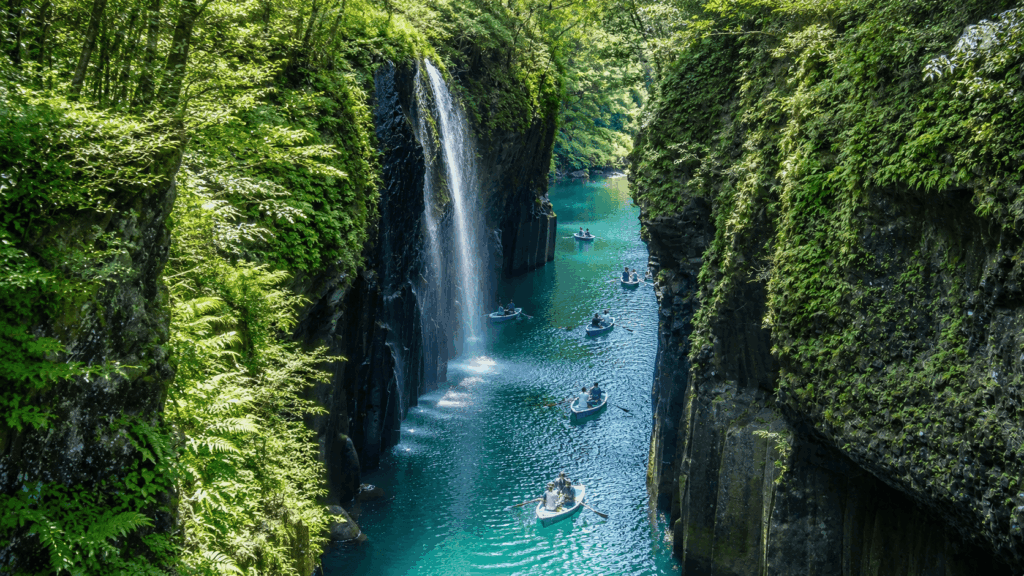
| Autumn (Sep–Nov) | Best season overall. Cool air, brilliant foliage (mid-November peak), sea of clouds at Kunimigaoka (Sep–Nov dawn). | Boat + rim walk, Kunimigaoka dawn, shrines in fall light. | Essential for boat. Book accommodation months ahead if staying overnight. |
| Winter (Dec–Feb) | Cold but quiet. Fewer crowds, crisp air. Road ice possible on mountain routes. | Boat (check for weather closures), rim walk, Takachiho Lights Festival (mid-Feb to mid-Mar). | Boat not usually necessary on weekdays. Check road conditions if driving. |
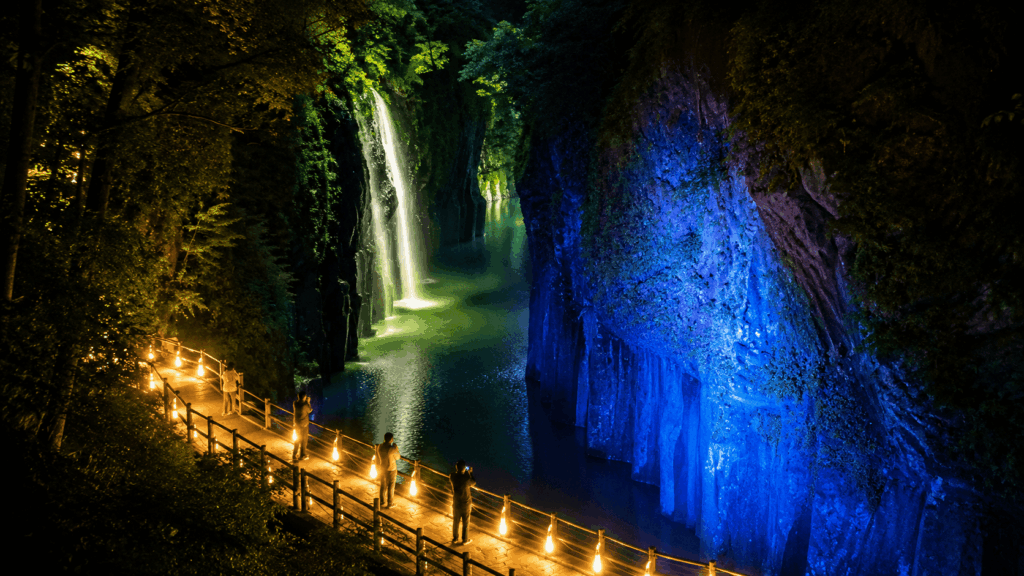
Takachiho Lights Festival “KAI” (mid-February to late March) illuminates the gorge, the waterfall, and Takachiho Shrine in the evening. It’s a short window and not a year-round attraction — if you’re visiting in summer or autumn, plan for the gorge in daylight only.
Important winter note for drivers: The roads to Takachiho — especially the mountain passes entering from Kumamoto and the approach to Kunimigaoka — can ice over in December–February. Rental cars in Kyushu do not always come with winter tires by default. Request them when you book. For a complete look at weather, crowds, and what to pack throughout the year, see our honest season-by-season guide.
FAQ — Takachiho Gorge Day Trip
Can I see Takachiho Gorge, Amano Iwato Shrine, and Kunimigaoka in one day?
Yes, with a car. The gorge, Takachiho Shrine, Amano Iwato, and Amanoyasukawara fit comfortably into a single day if you arrive by 10:00 and keep a steady pace. Kunimigaoka is the hardest addition — it’s a 15-minute drive from the shrine area, and you need clear weather for the view to be worth the detour. Without a car, you can reach the gorge and Takachiho Shrine by walking from the Bus Center, but Amano Iwato requires a taxi (about ¥2,000 each way), and Kunimigaoka is not realistic on a bus day trip.
Is it worth going without a car?
It depends on your starting point. From Kumamoto, the single daily bus gives you about 4 hours and 20 minutes in Takachiho — enough for the gorge, the rim walk, and a quick visit to the shrine if you walk fast. From Fukuoka, the longer travel time means you spend 6–7 hours on the bus for the same 4–5 hours on the ground. A guided tour from Kumamoto (such as Explore Kumamoto’s small-group option) is a better use of your time and money than the bus in most cases — it includes transport, a guide, and a schedule that hits more sights.
How far in advance should I book the boat?
Exactly 14 days before your visit. Slots open at 9:00 AM JST on the reservation website (eipro.jp/takachiho1). Weekend slots in October and November (autumn foliage season) can sell out within the first hour. If you miss the online reservation, about 50–70 same-day tickets are sold at the dock each morning — arrive 45–60 minutes before opening to queue for these.
Can I see the Yokagura night performance and still go home the same day?
No, if you’re coming by bus. The Yokagura runs from 20:00 to 21:00. The last bus from Takachiho to Kumamoto departs at 16:57, and the last bus to Fukuoka departs around 18:00. Both leave hours before the performance starts. If you have a car and are staying within a 2-hour drive (Kumamoto, Oita, Miyazaki City), you could in theory drive home after the performance ends around 21:15 — but most travelers find this too rushed and the mountain roads feel different at night. The safe answer is: if you want to see the Yokagura, plan to stay overnight.
Is the gorge still worth it if the boat is sold out or cancelled?
Absolutely. The Takachiho Promenade (the free rim walk along the top of the gorge) gives you elevated views of the waterfall, the basalt cliffs, and the entire canyon that boat passengers never see from water level. Many visitors actually prefer the rim walk for photography — you’re not trying to balance a camera in a moving rowboat, and you can take your time. The boat is a fun addition, but the gorge experience does not hinge on it.
How do I combine Takachiho Gorge and Mount Aso in one day?
This works best by car. The drive between Takachiho and the Aso caldera is about 30–40 minutes. A realistic plan: start at Takachiho Gorge at 9:00 (boat + rim walk done by 11:30), lunch near the gorge, then drive to Aso’s Kusasenri grassland and Nakadake crater viewpoint in the afternoon. You’ll arrive back in Kumamoto around 17:00–18:00. Trying to do both by public transport is not practical — there’s no direct bus connecting them, and the Aso→Kumamoto train alone takes 1.5 hours.
What is the best season to visit?
Autumn (mid-October to late November) offers the best combination of comfortable weather, brilliant foliage, and the sea of clouds season at Kunimigaoka. It’s also the busiest time — book accommodation and boat slots well ahead. Spring (April) is lovely for cherry blossoms but cooler. Summer (July–August) is hot and humid but brings the nagashi somen flowing-noodle experience. Winter (December–February) is quiet but cold, with a risk of road ice — the Takachiho Lights Festival in mid-February to mid-March is a seasonal highlight.
Is Takachiho suitable for families with young children?
Yes, with some planning. The boat fits 2 adults + up to 2 preschoolers (or 3 adults). Life jackets are provided for all ages. The rim walk is flat and stroller-friendly in its first half, but gets steeper past the main viewpoint. Takachiho Shrine is uphill from the gorge — consider a taxi if walking with small children. The Amaterasu Railway (open-air sightseeing train) is a big hit with kids. Restaurants near the gorge have high chairs at some but not all establishments.
Final Verdict — Which Plan Is Right for You?
Choose the car day trip if…
- You’re based in Kumamoto, Fukuoka, Oita, or Miyazaki City
- You’re comfortable driving on two-lane mountain roads
- Your priority is the gorge + the shrines + Kunimigaoka in one efficient day
- You don’t care about the Yokagura performance
Choose the public bus day trip from Kumamoto if…
- You don’t drive and are based in Kumamoto
- You’re happy to focus on the gorge and Takachiho Shrine (skipping Kunimigaoka and Amano Iwato)
- You’re on a tight budget (the bus is ¥2,700 each way)
- You understand that you’ll have about 4 hours on the ground and need to keep moving
Choose a guided tour if…
- You don’t drive and want to see more than just the gorge
- You’re based in Kumamoto but want Amano Iwato and Kunimigaoka included
- You prefer not to manage the schedule, bus connections, or taxi logistics yourself
- You value a local guide’s storytelling about the myths and history of the area
Stay overnight if…
- You want to see the Yokagura night performance
- You want to photograph the sea of clouds at Kunimigaoka (autumn only)
- You want to experience the gorge in the quiet early morning before the crowds arrive
- You’re visiting from far away (Tokyo, Osaka, or overseas) and want to make the long journey worth it
Skip Takachiho entirely if…
- You have mobility issues that make stairs and uneven paths difficult
- You’re on a rushed itinerary where Takachiho would mean 6+ hours of driving or bus travel in a single day for a 1-hour walk
- You’re looking for a quick highway pull-off attraction — Takachiho demands time and intention
What I’d tell a friend visiting for the first time: Drive if you can, book the boat slot for 8:30 the moment it opens 14 days ahead, walk the rim path past the waterfall bottleneck until the crowd disappears, and — if you have any room in your schedule — stay one night to watch the Yokagura by candlelight. Takachiho is remote and requires effort to reach, but that’s also why it sticks with you long after you’ve left. The places that require a plan are the ones you remember.

Hi, I’m Kai. I’m a Tokyo-based travel writer, tourism industry insider, and the author of a published guidebook for international visitors to Japan. With over 10 years of professional experience at a leading Japanese tourism company, my mission is to help you skip the tourist traps and navigate Japan’s best destinations like a local. I believe the perfect day trip is like a traditional kaiseki meal: a beautiful balance of precise planning and unforgettable seasonal discovery. When I’m not out conducting field research, you’ll usually find me drafting new itineraries with one of my favorite fountain pens!