
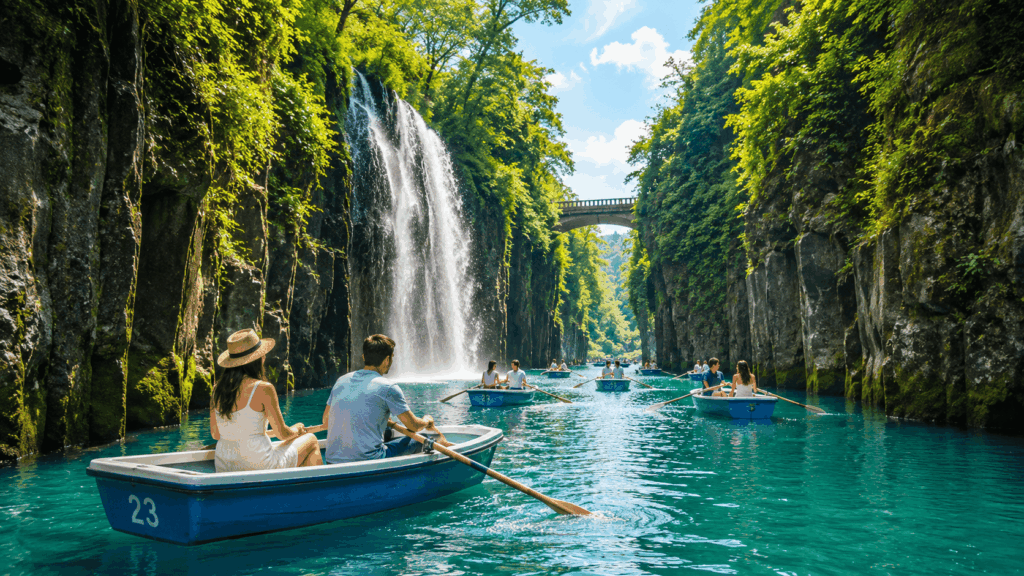
If you are planning a trip to Kyushu and wondering whether Takachiho Gorge is worth the long drive—or whether the famous boat ride lives up to the photos—you are not alone. This is one of the most-asked questions in Japan travel forums, and for good reason: Takachiho is remote, requires a car (or a tour), and the experience hinges heavily on one thing: whether you get on that boat.
Here is the honest answer up front, so you can decide before you read the details.
Not planning to drive? Before you commit to the long trip, it is worth checking current start times, boat options, and recent traveler reviews for a guided Mt. Aso and Takachiho Gorge day tour from Fukuoka.
Is Takachiho Gorge Worth It? The Honest Short Answer
Yes—if you are already in Kyushu with a car or on a tour, and you plan ahead for the boat. The gorge is genuinely beautiful, and the combination of columnar basalt cliffs, the 17-meter Manai Falls, and the emerald Gokase River is unlike anything else in Japan. But it is also compact. The free walkway takes 15–20 minutes end to end. The real magic happens from the water, and that requires a reservation.
No—if you are on a tight Japan-wide itinerary (Tokyo → Osaka → Hiroshima) and would need to add 6–8 hours of round-trip driving just for this. The gorge is stunning, but it is not worth blowing your itinerary over unless you have a strong interest in Shinto mythology, photography, or both.
Still worth considering—if you cannot get a boat reservation or the walking path is partially closed. I will explain exactly how much you will see (and what to pair it with) so you can decide whether the trip still makes sense.
Here is the key fact many first-time visitors miss: Takachiho Gorge has two completely different experiences stacked vertically—one from above and one from the water—and they feel like different places.
What Makes Takachiho Gorge Special — and What Doesn’t
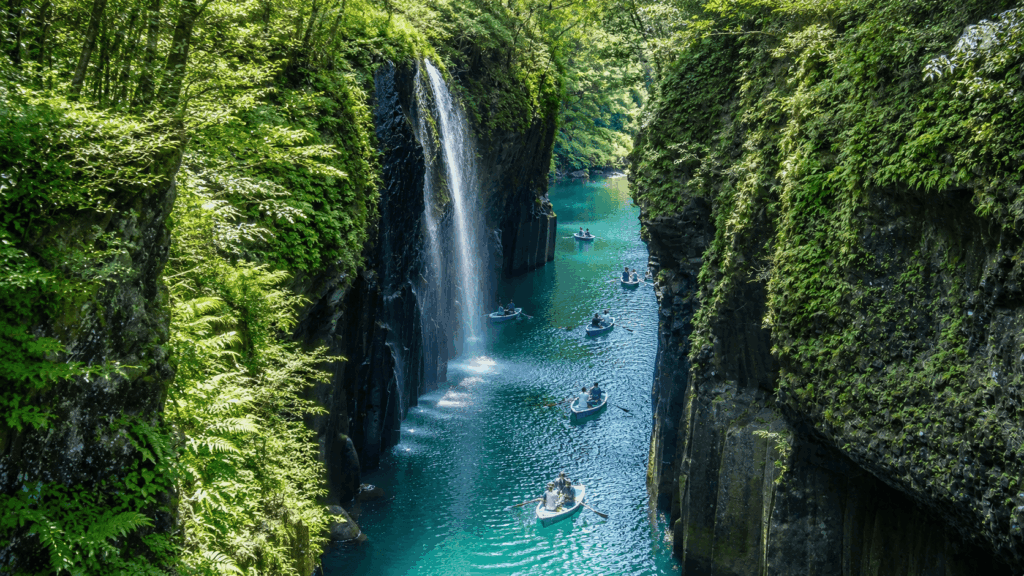
The gorge was carved by the Gokase River into a dramatic layer cake of columnar jointed basalt. The star feature is Manai Falls, a 17-meter veil of water that plunges directly into the river. When you see photos of small rowboats drifting past a waterfall framed by lush green cliffs, that is Manai Falls from below. It is genuinely one of Japan’s most photogenic spots.
The catch is scale. The gorge itself is roughly one kilometer long. The paved walkway along the upper edge gives you excellent views of the cliffs and the falls from above, but you can comfortably walk it in under 20 minutes. What surprises most first-time visitors is how short the gorge is in person—the photos make it feel vast, but it is really a concentrated pocket of beauty. That does not make it less worth visiting, but it does mean you should plan around it rather than treating it as an all-day destination.
The Two Ways to Experience the Gorge
From Above: The Free Walkway and Bridges
The upper walkway runs along the road side of the gorge, connecting the parking areas to several lookout points and bridges. The best overhead view of Manai Falls is from the walkway near the Ohashi Bridge side (accessible from the P3 Ohashi parking lot). This is free, requires no reservation, and gives you the classic postcard angle of the falls framed by the gorge walls.
Best for: Travelers who want a quick photo stop (15–20 minutes), those without boat reservations, or anyone who wants to see the gorge from a completely different perspective before or after the boat ride.
What to know: As of 2026, sections of the lower riverside trail (Takimichi) have been closed at various times for landslide repair work. The upper paved walkway and bridge viewpoints have generally remained open, but it is worth checking the official Takachiho Tourism Association page before you visit for current trail status.
From the Water: The Rental Boat Experience
This is the experience people travel across Kyushu for. Rowing a small boat across the emerald water toward Manai Falls, with the columnar basalt walls rising on both sides, is genuinely memorable—when conditions are right.
Key facts:
- Price: ¥4,100–¥5,100 per boat (30 minutes), depending on the day and season
- Capacity: 3 adults per boat (4 if including an infant)
- Reservations: Online only, no phone bookings. Opens 9:00 AM JST exactly 2 weeks before your desired date. Bookings close 2 days before.
- Same-day tickets: Around 50–70 released each morning (check the official site for availability), but these sell out fast during peak season.
- Check-in: Boat rental reception is inside the P1 Oshioi Parking Lot. After checking in, you are directed to the boarding stage.
- Cancellations: The boats shut down during heavy rain and rising river levels. Typhoon season (June–October) carries real risk of closure.
For a deeper dive into securing a slot and navigating the official system, read our detailed guide to Takachiho Gorge boat reservations.
Best for: Photographers, couples, mythology enthusiasts, and anyone willing to plan ahead. If you want the iconic Manai Falls shot, this is the only way to get it.
Who should skip it: Anyone who dislikes queuing or finds rowing more frustrating than relaxing. And anyone who has not booked ahead and is visiting during peak season or a holiday weekend.
Kai’s tip: Most boaters paddle straight to the falls, take their photos, and turn back—which means the area directly in front of Manai Falls turns into what I can only describe as a bumper-boat circle. It can feel busy and far from the serene scene in the brochure. The trick is simple: keep rowing upstream past the falls. Within about 30 seconds of paddling beyond the main cluster, the other boats disappear and the gorge opens into a quiet, almost empty stretch of river where you can float in genuine silence. Many visitors never discover this because they turn around as soon as they get their waterfall shot. That single extra minute of rowing changes the entire experience.
Expectations vs. Reality: What the Boat Ride Is Really Like
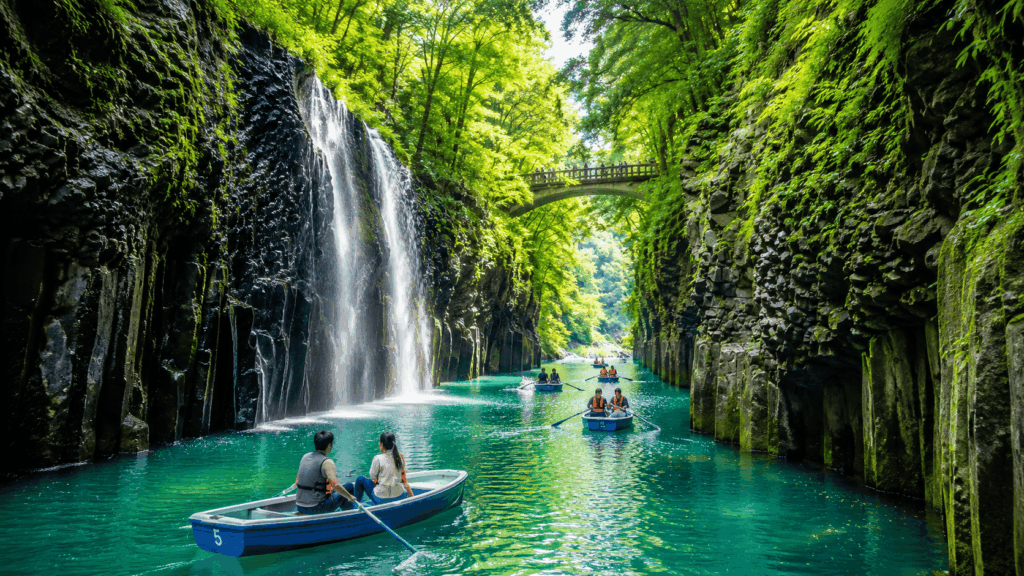
This is the part most promotional articles skip. The boat ride can be the magical experience you see in photos—but it depends heavily on timing and luck.
The reality: During peak hours (late morning to early afternoon, especially between 10:30 AM and 1:00 PM), the area around Manai Falls becomes congested with rental boats. You will be sharing the view with 10–15 other boats, all jockeying for the same photo angle. The waiting time for same-day tickets can stretch from 30 minutes to over 2 hours on busy days, and even with a reservation, you may spend part of your 30-minute slot queueing near the falls rather than exploring.
The upside: As I mentioned above, paddling upstream changes everything. The gorge extends further than most visitors realize, and the further you go, the emptier it gets. Early morning (8:30–9:30 AM) and late afternoon (after 3:00 PM) also see significantly fewer boats.
A common complaint I hear from travelers is that the gorge itself feels smaller than expected. This is fair—it is small. But the experience is not about walking the gorge; it is about being on the water looking up at it. If you judge the visit solely by the walkway, you will miss the point.
Crowds, Timing, and How to Beat Them
Takachiho Gorge is popular—there is no way around it. But the crowds are not constant throughout the day, and knowing the rhythm can dramatically improve your experience.
The Best Time of Day to Visit
The single most effective thing you can do is arrive early. Here is why the morning matters more than at most sightseeing spots in Japan:
- Parking: The closest lot (P1 Oshioi, right next to the boat reception) fills up first. P2 Araragi and P3 Ohashi follow. The free P5 Taguchino lot is furthest away and rarely full, but adds a 20–25 minute walk. Arriving by 8:30–9:00 AM means you can park within a short walk and start your visit before the crowds build.
- Boat queue: With a reservation, the morning window (8:30–10:00 AM) sees the lightest traffic on the water. Same-day ticket seekers who arrive early also have the best chance of snagging one.
- Walkway peace: The upper walkway is genuinely quiet before 10:00 AM. You can stand on the bridge overlooking Manai Falls with maybe one or two other people, not thirty.
Kai’s tip: Tour buses from Fukuoka and Kumamoto typically arrive in a wave between 11:00 AM and 1:00 PM. You can feel the atmosphere shift when they arrive—the walkway fills, the boat queue doubles, and the parking situation becomes noticeably tighter. If you can complete your walkway visit and be on the water (or already off it) before 11:00 AM, you will experience a completely different gorge from the one that gets the afternoon reviews. The early start also creates a nice chain reaction: you park closer, walk the quiet trail, finish the boat before the worst of the crowd, and still have the afternoon free to explore the nearby shrines.
By Season: What You Will See and When
| Season | What to Expect | Crowd Level | Best For |
|---|---|---|---|
| Spring (Apr–May) | Fresh green foliage, mild temperatures. New leaves frame the gorge beautifully. Cherry blossoms are finished by mid-April in this region. | Moderate–High | Pleasant weather, lush scenery |
| Summer (Jun–Aug) | Deep green, hot and humid. Typhoon season (Jun–Oct) means real risk of boat suspension. Water levels can rise suddenly. | High (Jul–Aug) | Vibrant green, summer festivals |
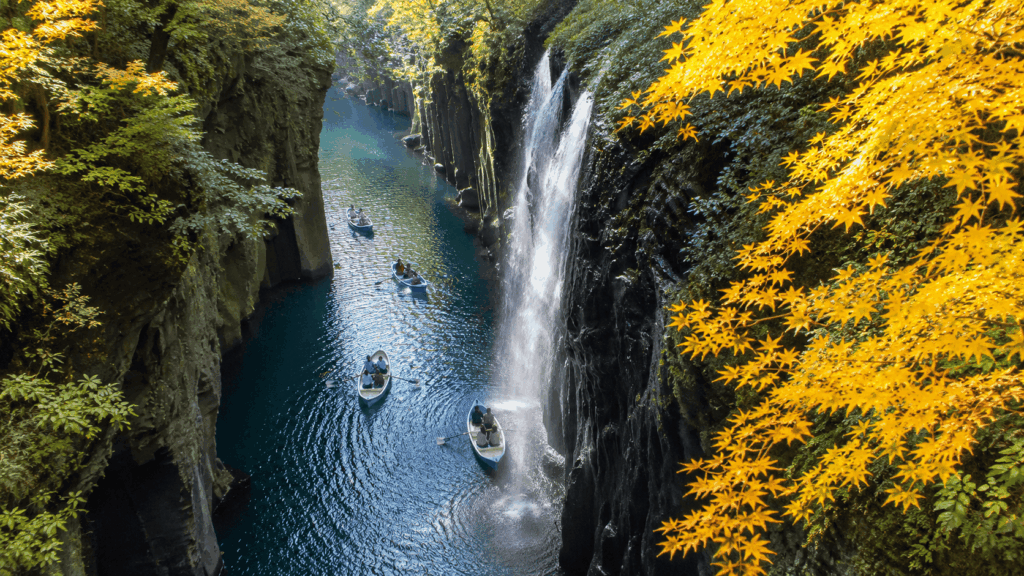
| Autumn (Nov–early Dec) | Peak colors typically mid-to-late November. The contrast of red and orange foliage against the basalt cliffs and emerald water is spectacular. | Very High (Nov) | Photography, color lovers |
| Winter (Dec–Feb) | Bare trees, quieter atmosphere. Overcast days are common, which can dull the water color. Snow is rare but possible. | Low | Peace, solitude, no queues |
Important: The boat operation is suspended during heavy rain and rising water levels regardless of season. This happens most frequently from June through October during typhoon season. In June 2026, for example, the boats were suspended for 8 consecutive days due to a typhoon approach. Always check the official Takachiho Boat Reservation site on the morning of your visit for real-time operating status.
What If You Can’t Get a Boat Ride? (Or the Walkway Is Closed)
This is the question that matters most for planning, and it is the one most guides avoid answering honestly. So here it is:
Without the boat and with a partially closed walkway, the gorge itself is a 15–20 minute stop. You walk the upper path, look down at Manai Falls from the bridge, take a few photos, and you are done. If that is all you are coming for, the long drive from Fukuoka (3 hours) or Kumamoto (2 hours) feels heavy.
But that does not mean the trip is wasted. The key is to treat Takachiho as a half-day area rather than a single gorge stop. Here is how to build a full, satisfying day even without stepping into a boat:
Pair the Gorge with the Shinto Mythology Circuit
Takachiho is the heart of Japanese Shinto mythology, and three nearby sites connect directly to the gorge’s story. Collectively, they turn a 20-minute stop into a meaningful half-day outing.
- Amano Iwato Shrine (天岩戸神社 – West Shrine): This shrine sits on the cave where, according to myth, the sun goddess Amaterasu hid herself, plunging the world into darkness. The cave itself is visible from the shrine’s viewing platform (photography is not permitted inside the inner sanctum). Free guided tours in Japanese run every 30 minutes from 9:00 AM, with English pamphlets available. — 10 minutes by car from the gorge
- Amanoyasukawara (天安河原): A 10-minute walk from the West Shrine through a forest path. This is a massive cave along the same river, where the gods are said to have gathered to decide how to lure Amaterasu out. What strikes most visitors is the thousands of stacked stone cairns left by pilgrims and visitors. As of June 2026, access has fully reopened after restoration work. — Walk from Amano Iwato Shrine West
- Takachiho Shrine (高千穂神社): Located in the town center. The 800-year-old married cedar tree (夫婦杉) dominates the grounds. It is a quiet, atmospheric shrine that takes about 15 minutes to walk through. — 5 minutes by car from the gorge, near the bus center
Add Chiho-no-ya’s Nagashi Somen
Right beside the gorge, Chiho-no-ya (千穂の家) serves nagashi-somen—flowing noodles that race down bamboo channels and you catch them with chopsticks. Takachiho is the birthplace of this style of eating, and doing it beside the river that feeds the gorge adds a layer of context you cannot get anywhere else. Around ¥1,000 per person for the experience. Be prepared to queue during peak hours. If you want to know more about this and other local specialties, check out our guide on what to expect for food in Takachiho.
Or Try the Amaterasu Railway
If you want a different kind of gorge view, the Amaterasu Railway is an open-air cart that runs on a former railway line through the hills above the town. The 25–30 minute ride costs around ¥2,000 per adult and offers a broad valley perspective rather than the close-up gorge view. It is a separate activity from the gorge itself—good if you have extra time but not a direct replacement for the boat experience.
Kai’s tip: Here is the itinerary I suggest to travelers who ask whether the trip still makes sense without a boat reservation. Start at the gorge first thing in the morning (8:30–9:00 AM) for the walkway and bridge views—this takes 15–20 minutes. Then drive 5 minutes to Amano Iwato Shrine West (30 minutes), walk to Amanoyasukawara (20–30 minutes), and stop at Takachiho Shrine on your way back through town (15 minutes). Finish at Chiho-no-ya for the nagashi-somen experience. That sequence turns a potentially disappointing 20-minute stop into a solid 3–4 hour outing that feels complete. You saw the gorge, you experienced the mythology that gives the place its cultural weight, and you ate something you cannot get anywhere else. The long drive suddenly feels justified.
How to Get There: The Real Cost of Getting to Takachiho
Takachiho is not served by any train line. This is the single biggest barrier for visitors, and it is worth being realistic about what getting there involves.
By Rental Car (Most Common)
- From Fukuoka: ~3 hours via Kyushu Expressway and Route 325
- From Kumamoto: ~2 hours via Route 57 and Route 325
- From Aso: ~1.5 hours via Route 325 (mountainous, winding roads)
- Tolls: Around ¥3,000–¥4,000 one-way from Fukuoka; less from Kumamoto and Aso
- Parking: ¥300–¥800 depending on the lot (P3 Ohashi and P5 Taguchino may be free)
If you are already renting a car for your Kyushu trip, the added driving time is manageable. If you are renting a car specifically for this trip, factor in the full-day rental cost plus fuel and tolls.
By Guided Tour (From Fukuoka or Kumamoto)
A day tour bundles transportation, a guide, and often includes multiple stops such as Mount Aso and Takachiho Gorge in a single day. Some tours offer the optional boat add-on, which removes the stress of booking it yourself or worrying about parking. This is the most practical option for solo travelers, non-drivers, and anyone who wants to make the long journey feel efficient.
Tours from Fukuoka typically run around 10 hours and cost from roughly $50–$100 per person depending on inclusions. Kumamoto departures are shorter and slightly cheaper. Given that the main friction of visiting Takachiho is the drive, a tour that handles all the logistics is a strong value proposition for most visitors.
If you fall into that camp—you want Takachiho Gorge and Mount Aso, but the driving distance, parking, and boat logistics are the parts making you hesitate—this is the one booking I would push you toward.
Why I’d book this one
- It solves the hardest part of Takachiho: the long, awkward day of getting there without a train line or frequent public transport.
- It turns the gorge into a fuller Kyushu day: pairing Takachiho with Mount Aso makes the journey feel less like a long drive for one compact viewpoint.
- It lets you check the boat piece before committing: the optional boat element means you can review current details, timing, and recent traveler feedback on the booking page.
Is It Worth It Without a Car?
Public buses run from Kumamoto and Nobeoka, but frequency is low (2–4 buses daily on most routes) and the schedules make a day trip tight. If you are determined to use public transport, read our guide to reaching Takachiho by bus to avoid getting stranded. The Takachiho Bus Center is a 30–40 minute walk from the gorge, or a short taxi ride.
Sample Itinerary: Turning a Long Journey into a Full Day
Option A: With Boat Reservation (Recommended)
- 8:00 AM — Arrive, park at P1 Oshioi or P2 Araragi
- 8:30–9:00 AM — Walk the upper path and bridges (15–20 min)
- 9:00–9:30 AM — Boat ride (if you booked the first available slot)
- 10:00–11:00 AM — Amano Iwato Shrine + Amanoyasukawara
- 11:30 AM — Nagashi-somen at Chiho-no-ya
- 12:30 PM — Quick stop at Takachiho Shrine
- 1:00 PM — Depart (or add Amaterasu Railway if you have time)
Option B: Without Boat (Still Worthwhile)
- 8:30 AM — Arrive, park at P3 Ohashi (free, close to walkway entrance)
- 8:40–9:00 AM — Walkway + bridge views of Manai Falls
- 9:15–10:15 AM — Amano Iwato Shrine + Amanoyasukawara walk
- 10:30–11:00 AM — Takachiho Shrine
- 11:30 AM — Chiho-no-ya for nagashi-somen
- 1:00 PM — Depart feeling you saw the full picture
FAQ
Is Takachiho Gorge worth it without a boat reservation?
It depends on your expectations. Without the boat, the gorge itself is a 15–20 minute stop from the upper walkway. However, if you pair it with the three nearby mythology sites (Amano Iwato Shrine, Amanoyasukawara, and Takachiho Shrine) and a meal at Chiho-no-ya, the combined experience easily fills a worthwhile half-day. The gorge alone is not worth a long drive. The gorge plus the mythology circuit is.
How long do you need at Takachiho Gorge?
15–20 minutes for the walkway and bridge views. If you add the boat ride, budget 45–60 minutes total (30 minutes on the water plus check-in and waiting). For the full Takachiho area experience including the shrines and lunch, plan on 3–4 hours.
Is the boat ride worth it?
Yes, if you manage your expectations. The experience of rowing toward Manai Falls from the water is genuinely unique and worth the reservation effort. The catch is that the area directly below the falls can be crowded with other boats during peak hours. Paddling upstream a short distance solves this completely. If you book early (first slot at 8:30 AM) or go late (after 3:00 PM), you will have a much quieter experience.
Can you walk to Takachiho Gorge from the bus center?
Yes, but it is a 30–40 minute walk uphill on a road without dedicated pedestrian paths in sections. Taxis are available at the bus center but limited. If you are relying on public transport, a guided tour is a more practical option.
Is Takachiho Gorge accessible for strollers or wheelchairs?
The upper paved walkway is mostly flat and accessible in dry conditions, though some sections are narrow. The boat is not wheelchair accessible. The path to Amanoyasukawara from Amano Iwato Shrine includes uneven forest ground and steps.
When is the best time of year to visit Takachiho Gorge?
Late April to early May for fresh green leaves and mild weather, or mid-to-late November for autumn colors. Summer is lush but crowded and carries typhoon-related closure risk. Winter is quiet but often overcast, which can mute the green of the water.
Do I need to book the boat in advance?
Yes. Online reservations open at 9:00 AM JST exactly 14 days before your visit date and close 2 days before. Same-day tickets exist (around 50–70 per day) but sell out fast during busy periods. During peak season, advance booking is strongly recommended.
What happens if it rains?
The boat operation is suspended during heavy rain and when the river level rises. The walkway remains open in light rain (the cliff overhang provides some shelter). Check the official Takachiho Boat Reservation site on the morning of your visit for the current operating status.
Is Takachiho Gorge worth it from Tokyo?
For most travelers, no. The combination of flights or Shinkansen to Kyushu plus a 3-hour drive makes this a significant detour. It is better saved for a dedicated Kyushu trip where you are already based in Fukuoka, Kumamoto, or Aso. However, if this is a must-do for your itinerary, see our dedicated guide on planning a trip to Takachiho Gorge from Tokyo.
How does Takachiho Gorge compare to other Japanese gorges?
It is smaller and more compact than places like Sounkyo (Hokkaido) or Kurobe Gorge (Toyama), but the combination of the boat ride, the columnar basalt cliffs, and the Shinto mythology context makes it unique. You cannot row a boat toward a 17-meter waterfall framed by columnar rock formations in many other places in Japan.
Final Verdict: Should You Go?
I have walked through Takachiho Gorge on quiet mornings and crowded afternoons, with and without the boat, and the honest conclusion depends on who you are. Here is how I would break it down.
Go, and plan ahead for the boat, if:
- You are already traveling in Kyushu with a rental car or joining a tour from Fukuoka or Kumamoto
- You are interested in Shinto mythology and want to visit Amano Iwato Shrine and Amanoyasukawara as part of the same outing
- You are a photographer and want the shot of Manai Falls from the water
- You enjoy quiet nature spots and are willing to arrive early (before 9:00 AM) to beat the crowds
Consider a guided tour if:
- You do not have a car and are not comfortable driving on Japanese mountain roads
- You want someone else to handle the boat booking, parking, and scheduling
- You are visiting as a solo traveler or non-driver
- A tour from Fukuoka that bundles Mount Aso and Takachiho in one day is a particularly strong option for time-efficient travelers
Skip it, or postpone for a later trip, if:
- You are on a tight Japan-wide itinerary (Tokyo → Kyoto → Osaka) and would need to add a flight or long Shinkansen ride just to get to Kyushu
- You are not interested in mythology, walking in nature, or rowing a boat
- You dislike driving on winding mountain roads and do not want to join a tour
- You are visiting during typhoon season and cannot afford the risk of same-day closure
Still worth visiting without the boat, but only if:
- You treat the gorge as one stop in a half-day circuit that includes Amano Iwato Shrine, Amanoyasukawara, Takachiho Shrine, and Chiho-no-ya for nagashi-somen. The gorge alone is too short to justify the drive. The gorge plus the mythology circuit is a different story entirely.
Takachiho Gorge is not Japan’s most spectacular natural wonder, and it is not worth derailing an entire itinerary for. But for anyone already in Kyushu who plans ahead and understands what they are getting into, it is one of those places where the reality with the right approach matches the photos. The key is knowing which approach is yours.

Hi, I’m Kai. I’m a Tokyo-based travel writer, tourism industry insider, and the author of a published guidebook for international visitors to Japan. With over 10 years of professional experience at a leading Japanese tourism company, my mission is to help you skip the tourist traps and navigate Japan’s best destinations like a local. I believe the perfect day trip is like a traditional kaiseki meal: a beautiful balance of precise planning and unforgettable seasonal discovery. When I’m not out conducting field research, you’ll usually find me drafting new itineraries with one of my favorite fountain pens!