
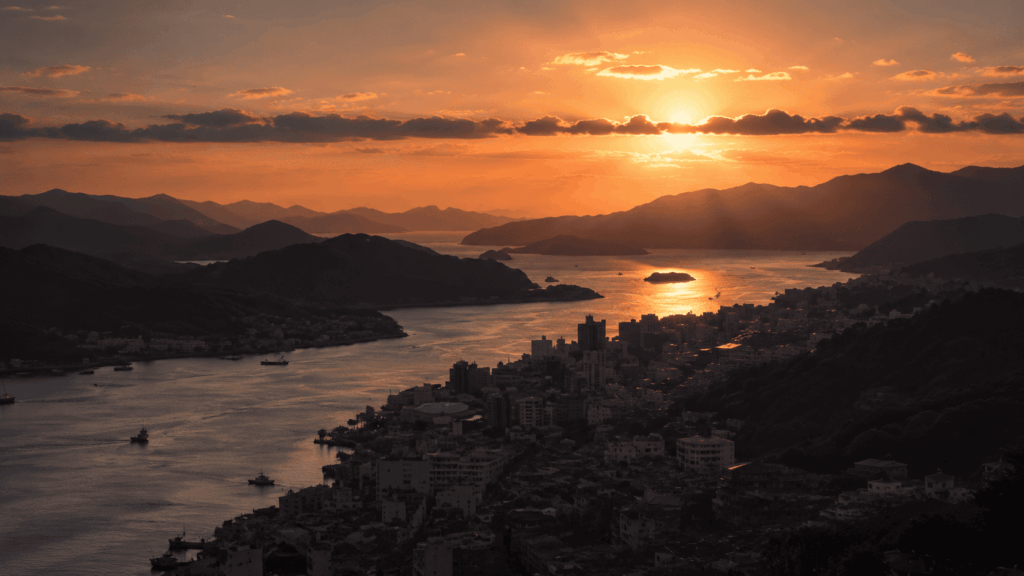
If you only have one evening in Onomichi, spend it on Senkoji-yama. The viewpoint most first-time visitors end up at — and the one I keep bringing people back to — is PEAK, the 63-meter observation deck at the top of Senkoji Park. The sweep over the Onomichi Waterway and the islands of the Seto Inland Sea is the kind of view that makes people rearrange their Shimanami Kaido plans.
The catch is logistics. The Senkoji Ropeway normally stops at 17:15, while sunset in Onomichi can come as early as 5 p.m. in early December and as late as 7:25 p.m. in late June. That gap is where most sunset plans quietly fall apart. This guide covers where to stand, what time to leave the station, why to buy a one-way ropeway ticket, and how to get back down safely after dark.
Prefer to have a local handle the hillside logistics? If you want the Senkoji ropeway-and-walking route without managing every turn yourself, check live availability for this private licensed-guide tour and ask whether a late-afternoon start can work with your sunset time.
Quick Answer: Where to Watch the Sunset in Onomichi
For almost everyone staying around JR Onomichi Station, the best sunset spot is PEAK, the observation deck at the top of Senkoji Park. It is about a 15-minute walk from the station to the ropeway base station, then a 3-minute ropeway ride (¥500 one way / ¥700 round trip for adults) to the summit. Plan to be on the deck 45–60 minutes before sunset, buy a one-way ticket, and walk back down the hillside through the temple lanes and Cat Alley after dark.
- Best viewpoint: PEAK, Senkoji Park summit deck (360° view, elevator from the ropeway summit station)
- Leave JR Onomichi Station: about 75–90 minutes before sunset, at a relaxed pace
- Ropeway: ¥500 one way / ¥700 round trip; normally runs 9:00–17:15, with extended hours on some event days — check your date
- After sunset: walk down (budget roughly 30–45 minutes at a relaxed pace, more if you stop at Cat Alley)
- Backup plan: the Onomichi waterfront promenade, if you don’t want the hill at all
Where Is the Best Place to Watch the Sunset in Onomichi?
In central Onomichi — the walkable area around the station — the answer for most travelers is PEAK. It is the highest viewpoint you can reach without a car, the deck is wide enough that you don’t feel like you’re competing for space, and the approach is simple: walk 15 minutes east from the station, ride the ropeway, step off directly onto the deck. You see the town, the Onomichi Waterway, and the islands of the Seto Inland Sea in one sweep, with the sunset coming in over the water to the west.
Two alternatives are worth knowing about before you commit:
- MiTeMi (千光寺公園視点場) — a newer viewpoint on the west side of Senkoji Park, opened in 2022. It looks back over the station area and the waterway, which gives a different, more “town-facing” angle. The trade-off: it is reached on foot up a steep path, with no ropeway stop right beside it.
- The Onomichi waterfront — the promenade along the waterway near the station. No elevation at all, so you trade the panorama for a zero-hill option when the ropeway timing doesn’t work or you simply don’t want to climb.
I compare all three in more detail further down, including who each one suits and how easy it is to get back down after dark.
My Recommended Onomichi Sunset Route from the Station
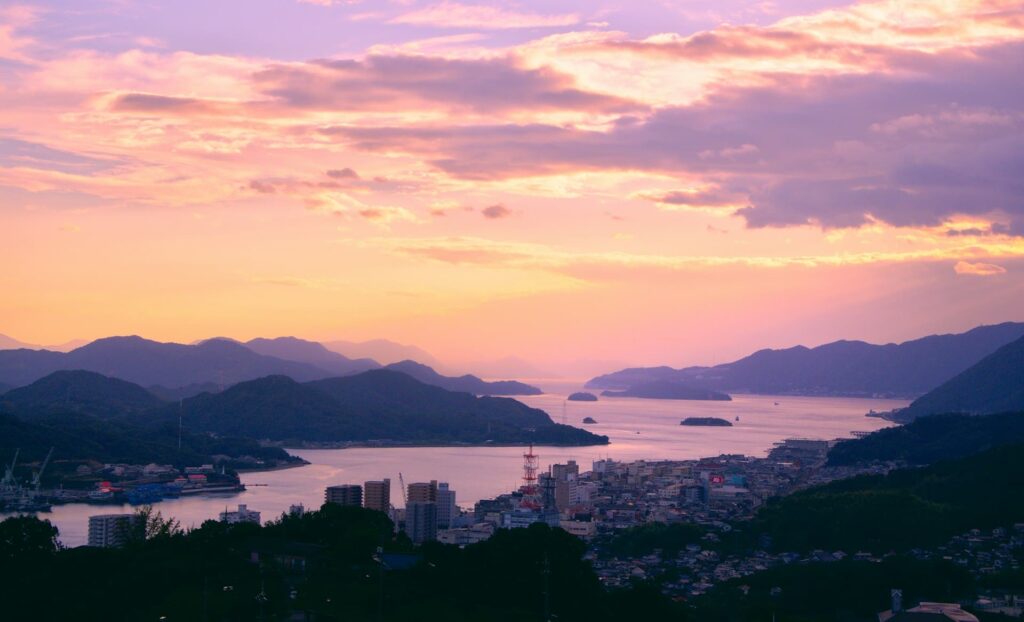
This is the plan I’ve walked with first-time visitors more times than I can count. It’s deliberately low-tech: no car, no taxi, one ropeway ride, and a downhill walk that happens to take in the best of Onomichi’s hillside on the way back.
- Leave JR Onomichi Station about 75–90 minutes before sunset. Head east along the main road toward the hillside. The ropeway base station (Senkoji Ropeway Sanroku Station) is about a 15-minute walk. The route isn’t perfectly signposted — in the backstreets near the base station the signage thins out, and more than once I’ve watched travelers (and, I admit, myself) pull out a map app to confirm the turn.
- Ride the ropeway up — ¥500 one way, about 3 minutes, cars every 15 minutes. Buy a one-way ticket; there’s a good reason, below.
- Step straight onto PEAK from the summit station. The deck is directly connected, and there’s an elevator if you’re traveling with a stroller or don’t want the stairs.
- Stay on the deck for the sunset, then walk down the hillside toward town — Senkoji Temple, past the Tennei-ji three-story pagoda, through Cat Alley (Neko no Hosomichi) and out at Ushitora Shrine.
Walking down is the right direction for an evening plan: the lanes, temple roofs, and cats show up in the last of the daylight, and you end at street level near dinner rather than back at a ropeway station that may already be closed.
Buy a One-Way Ropeway Ticket, Not Round-Trip
The ropeway costs ¥500 one way and ¥700 round trip for adults, so the saving is only ¥200. That is not the point. The point is that a round-trip ticket quietly commits you to riding back down before 17:15 — exactly the constraint that ruins sunset plans.
Kai’s tip: If you’re going up for sunset, buy one-way and treat the walk down as part of the plan, not as a fallback. The first time I organized this for a small group, we bought round-trip out of habit and then spent half the sunset checking our watches instead of watching the sky. Now I buy one-way every time. It removes the deadline, and the descent through the temple lanes becomes the second half of the experience instead of an inconvenience. Reserve the round-trip for days when you want to be back at street level before dark.
Aim to Reach PEAK 45–60 Minutes Before Sunset
You don’t need to camp out on the deck for hours — the approach is a 15-minute walk and a 3-minute ride. What the timing actually buys you:
- 45–60 minutes before sunset: comfortable. You can pick a spot, take the daylight shots, and watch the light shift from gold to pink without rushing.
- 30–45 minutes before: workable, but you’ll be watching the clock instead of the sky, and the deck tends to be at its busiest.
- Under 30 minutes before: you’ll likely arrive as the sun drops behind the islands — fine for a quick look, frustrating if you came for photos.
Check the exact sunset time for your date before you go. Onomichi’s sunset sits around 5 p.m. in early December and around 7:25 p.m. in late June; a quick search for “Onomichi sunset” plus your date gives you the local time, and it’s worth treating the “golden” window as the 30–40 minutes after the listed time, when the sky often colors up over the water.
The Ropeway Timing Problem Most Sunset Guides Miss
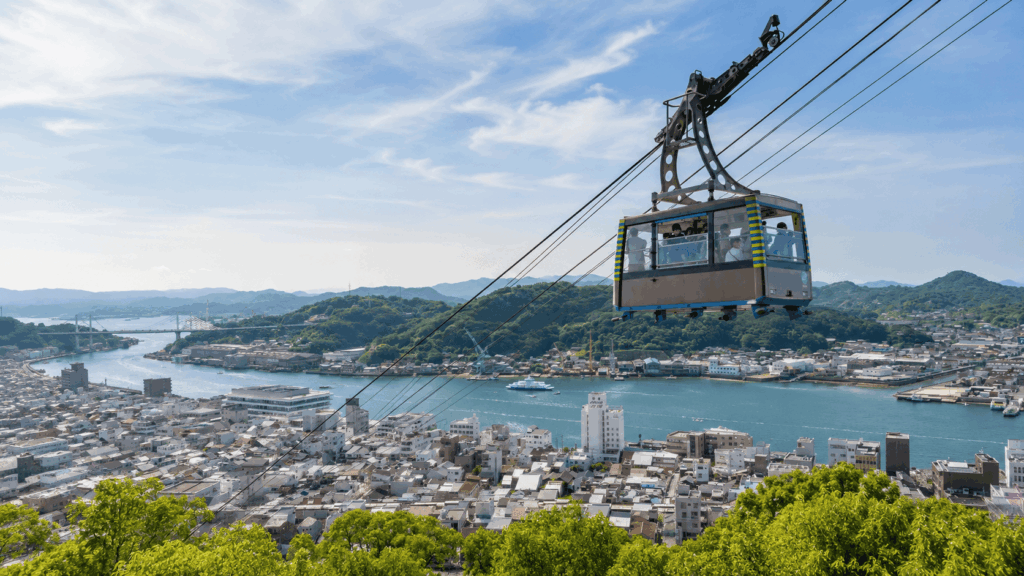
Here’s the fact most articles don’t tell you: the Senkoji Ropeway normally operates 9:00–17:15, and sunset in Onomichi is later than 17:15 for most of the year. From roughly late March through mid-October, the sun sets after the ropeway has stopped. If you assume you can ride back down after the sunset you just watched, you will be standing at a closed station on a hill in the dark.
This is the mistake I see first-time visitors make most often. Someone reads that PEAK is the sunset spot, rides up mid-evening, watches a beautiful sunset, and then discovers the last car left an hour ago. The version that works is: ride up on the last car you need, watch the sunset, and walk down.
Kai’s tip: Check the ropeway’s actual operating hours for your date instead of assuming the default 17:15. It does run later on some days — in 2026, cherry-blossom week, Golden Week, the Obon holidays, and the Sumiyoshi fireworks night all had extended hours, sometimes until 19:00 or later. But extensions are seasonal, announced in advance, and never guaranteed; the ropeway can also suspend service in bad weather. Treat 17:15 as your working assumption and any extension as a bonus, and you won’t be the person at the gate with a round-trip ticket and no ride back.
Important: Senkoji Temple Is Not Open All Evening
PEAK sits inside Senkoji Park, and the park itself is open around the clock — you can be on the deck after dark. The temple is a different story: Senkoji Temple keeps roughly 9:00–17:00 hours, with closures around the New Year period. If your evening plan assumes you’ll tour the temple hall after the sunset, it won’t be open. Visit the temple before the ropeway ride or on a separate daytime visit, and treat the evening strictly as a viewpoint-and-walk plan.
What the Sunset from PEAK Actually Feels Like
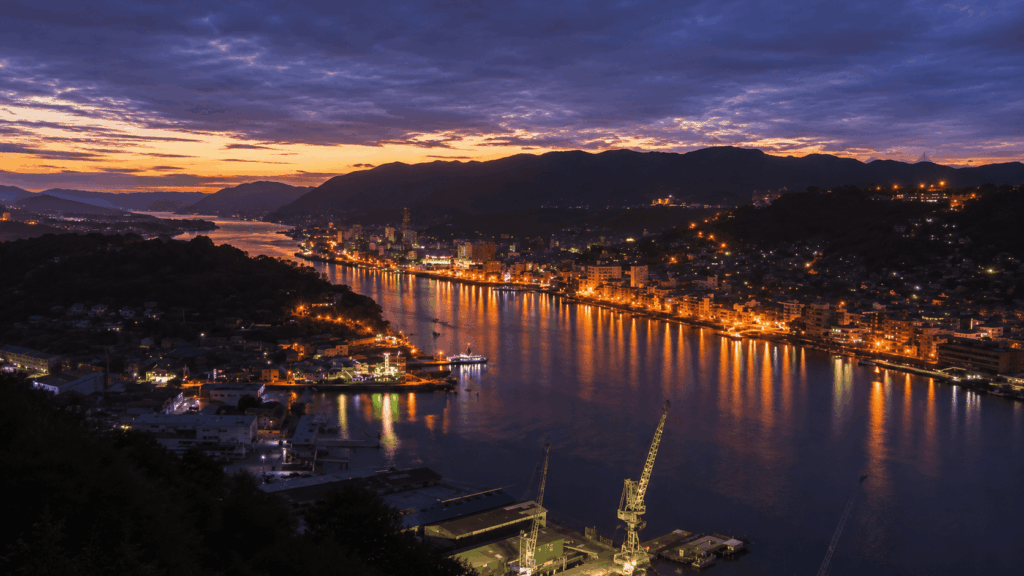
I’ve brought first-time visitors up to PEAK more times than I can count, and the view is the one part of Onomichi that never disappoints. From the deck you look west across the Onomichi Waterway, with the islands of the Seto Inland Sea stacked in layers and the town’s rooftops falling away below you. The sunset comes in over the water, and the light moves fast — the last 20 minutes before the sun drops are when the sky does its real work, which is why the timing advice above matters more than the choice of viewpoint.
A few honest observations from my visits:
- It’s windy up there. PEAK is an open, elevated deck, and the breeze off the water is constant. I’ve watched travelers arrive in light shirts and start shivering within ten minutes of the sun going down. Bring a layer even on a warm day — the temperature drops noticeably right around sunset.
- You can see trains from the deck. To the east, the Sanyo Main Line curves along the waterfront, and trains pass within clear view of the hillside. It’s a nice bonus for rail fans, though I wouldn’t plan around exact train times — they change seasonally.
- The deck handles crowds better than you’d expect. At 63 meters long with a 360° view, there’s room to find your own spot. The busiest window is the 20–30 minutes right before sunset on clear days, so the earlier arrival time also buys you breathing room.
If the whole hillside idea feels like too much — the walking, the timing, the dark descent — there are easier ways to see Onomichi’s evening light. More on those below, along with who each option suits.
Walking Back Down After Sunset: What to Expect
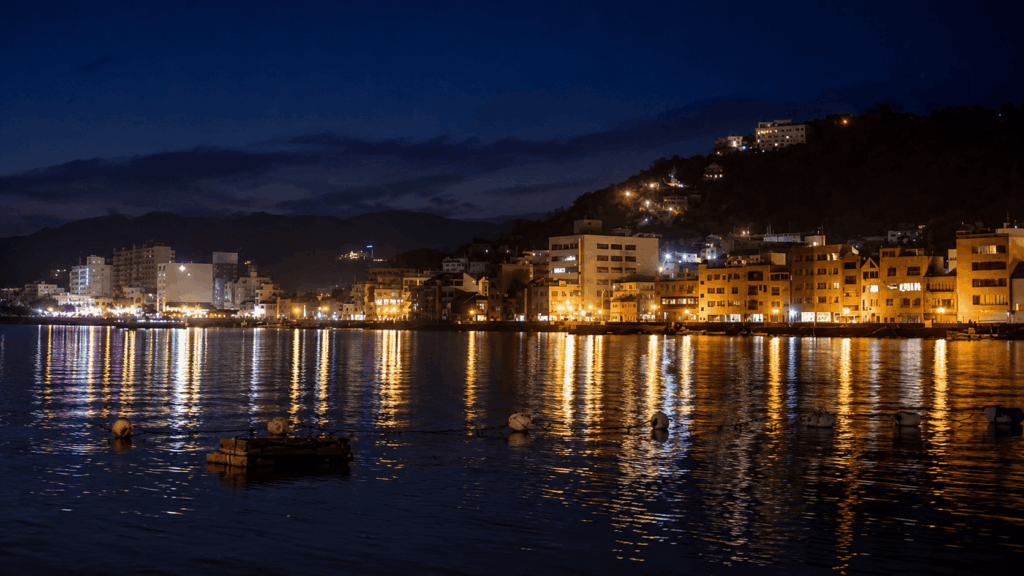
After the sun drops, the ropeway is done for the day in most seasons, so the plan is: walk down. This is genuinely fine — it’s downhill, and it’s how most locals and repeat visitors end their evening — but it’s worth knowing what the descent actually involves before you commit to it.
- You’re on stone steps and old lanes, not a paved boulevard. The path down from the summit passes Senkoji Temple, the Tennei-ji three-story pagoda, and the network of lanes that makes up the hillside. The steps are uneven in places — old stone, different heights, some with moss — and they get noticeably darker once the sun is gone.
- Budget 30–45 minutes at a relaxed pace. That’s without stopping much. Add time if you want to linger at Cat Alley or the pagoda, which you probably will.
- Street lighting is partial. The main lanes have lights, but the connecting paths and some stair sections don’t. Your phone flashlight works, but it’s a two-handed job on uneven steps.
Kai’s tip: Wear the shoes you’d wear for a day of city walking, not sandals — the stone steps are uneven and the light is low, and I’ve seen more than one traveler wobble on the descent in footwear chosen for dinner, not hillsides. Bring a layer even in summer: the temperature on the open deck drops fast once the sun is gone, and the walk down is cooler than the station area. And while your phone is fine for light, a small backup flashlight is the difference between a pleasant walk and a cautious shuffle — the path from the pagoda down toward Cat Alley is the dimmest stretch.
If you’re starting the descent in full darkness, add 10–15 minutes and stick to the main lanes even when a shortcut tempts you — the shortcuts are usually the unlit stretches.
If you’d rather not manage any of this alone — the route-finding, the timing, the dark steps — a private walking tour with a local guide covers the same evening loop with someone who knows the lanes and the schedule. The standard tours are daytime-focused, but guides are generally happy to adjust start times if you mention you want to catch sunset; confirm the timing when you book rather than assuming it.
If you fall into that camp — you want PEAK and the hillside lanes but don’t want to manage the route and timing alone — this is the one guided option worth comparing with doing the loop independently.
Why I’d book this one
- It’s private and customizable, so the itinerary can focus on Senkoji Park, the ropeway, temples, and Onomichi’s hillside streets instead of locking you into a large-group route.
- Recent travelers consistently mention knowledgeable guides, personalized pacing, and useful local context around Onomichi’s temples and streets.
- It keeps the logistics in one place; check the current booking conditions and confirm that a late-afternoon start works for your sunset date before finalising.
Should You Walk Through Cat Alley After Sunset?
Cat Alley (Neko no Hosomichi) is the roughly 200-meter lane between Ushitora Shrine and the Tennei-ji pagoda, lined with hand-painted stone cats — 108 of them, if you’re counting. It sits right on the natural descent route, so you’ll pass through it whether you plan to or not.
- In daylight, it’s a highlight. The painted cats, the temple roofs, the last of the light through the lanes — this is the part of Onomichi that photos don’t quite capture.
- After sunset, it’s atmospheric but dim. The lane is narrow and partly unlit. The stone cats read as silhouettes rather than details, and the live cats (when they appear) tend to be more active at dusk — I’ve had a few wander out on visits around this hour, though I’d never promise anyone a cat sighting.
My honest advice: walk it as part of your descent, but don’t treat it as the evening’s main event. If cats and the lane are a big reason you came to Onomichi, see it in daylight on a separate afternoon, then do the sunset from PEAK on another evening if your schedule allows.
PEAK vs MiTeMi vs the Waterfront for Sunset
Three real options, three different trade-offs. Here’s how they compare:
| Spot | Best for | View | Access | After-sunset difficulty | My take |
|---|---|---|---|---|---|
| PEAK (Senkoji Park summit deck) | First-time visitors; anyone who wants the classic panorama | 360° over the waterway, town, and islands; trains to the east | 15-min walk from station + 3-min ropeway (¥500 one way); elevator from the summit station | Walk down 30–45 min on uneven steps; partial lighting | The default choice for a reason — best view-to-effort ratio in central Onomichi |
| MiTeMi (west-side viewpoint in Senkoji Park) | Repeat visitors; anyone who wants the town-facing angle instead of the sea panorama | Looks back over the station area and the waterway | On foot up a steep path; no ropeway stop right beside it | Same hillside descent, with less signposting | Worth the detour if you’ve already done PEAK; I’d still send first-timers to PEAK |
| Onomichi waterfront (promenade by the waterway) | Anyone skipping the hill: limited mobility, heavy luggage, tired kids, tight schedule | Low, direct view over the water toward the islands; no panorama | 2–5 min from the station, flat | None — you’re at street level, straight to dinner | The reliable backup when ropeway timing or hills don’t work |
Note: Setoda Sunset Beach, which shows up in some “best sunset in Onomichi” lists, is a separate trip on Ikuchijima island — not walkable from Onomichi Station. Treat it as a Shimanami Kaido stop, not an evening plan in central Onomichi.
Plan Dinner Before You Go Up for Sunset
The one piece of planning most sunset guides skip is what happens after you come down. Hillside restaurants are thin on the ground, and by the time you’re back at street level, the evening rush is on.
- Decide where you’re eating before you go up. The main options sit along Onomichi Hondori Shopping Street and the lanes around the station — Onomichi’s local ramen (a soy-based bowl with pork and scallions, distinct from Hiroshima’s version) is the obvious pick, but the area also has izakaya and casual places that work for an early dinner.
- Check closing hours in advance. Many of the smaller places close earlier than visitors expect, and some take last orders well before the listed close. I’ve ended up walking the evening streets with hungry travelers more than once because a place we’d spotted in the afternoon had already stopped serving by the time we came down the hill.
- Two workable patterns: eat a relaxed early dinner before heading up (the deck is quiet at that hour and you skip the post-descent rush), or book/confirm a late-evening spot in advance and eat after you come down. The first pattern is easier with kids; the second keeps the sunset as the main event.
Who Should Skip This Sunset Plan?
PEAK + ropeway + walk down is my default recommendation, but it isn’t for everyone. Be honest about which of these describes you:
- Anyone with limited mobility or joint problems: the walk down is downhill but the steps are uneven and long. The waterfront sunset is the smarter pick — the view is lower but the effort is near zero.
- Travelers with heavy luggage: there’s no luggage storage on the deck, and hauling a suitcase up the hillside path is miserable. Store bags at the station area (or your hotel) first, or skip the hill entirely.
- Families with very young children: kids who are already tired by late afternoon will not enjoy the descent. Go up early, catch the sunset, and come down while there’s still light — or choose the waterfront.
- Anyone on a very tight schedule: the whole loop runs 2–2.5 hours door to door. If you’re catching a train right after sunset, do the waterfront instead.
- Days with poor visibility or heavy rain: the ropeway can suspend service in bad weather, and a cloudy sunset is a different experience. Check the forecast; if it’s grim, save the hill for another evening.
Sunset Planning Checklist
| Check | Why it matters |
|---|---|
| Sunset time for your exact date | Onomichi’s sunset runs from ~5 p.m. (early Dec) to ~7:25 p.m. (late June) — don’t guess |
| Ropeway hours for your date | Default is 9:00–17:15; extended hours on some event days, suspension possible in bad weather |
| Weather & visibility | Cloudy or rainy evenings change the whole experience; ropeway may not run |
| Footwear & a layer | Uneven stone steps on the way down; the deck gets cold right after sunset |
| Dinner plan & closing hours | Hillside restaurants are rare; check last orders before you go up |
| Luggage | No storage on the deck; leave bags at the station or hotel first |
Is It Worth Planning Your Onomichi Evening Around Sunset?
In one sentence: if you have one evening in Onomichi, yes — this is the best use of it. The hillside is the town’s signature view, and the sunset is the one hour where it all comes together: the waterway turning gold, the islands going dark in layers, the town lights coming on below you as you walk down.
The plan works because it doesn’t depend on luck. The ropeway is reliable, the walk down is manageable for anyone in normal walking shape, and the backup (the waterfront) costs you nothing. The only way it fails is the one I keep flagging: assuming the ropeway will take you back down after dark. Fix that one assumption and the evening pretty much runs itself.
FAQ: Onomichi Sunset Planning
What time is sunset in Onomichi?
It changes a lot through the year. The earliest sunsets come in early December, around 5 p.m., and the latest in late June, around 7:25 p.m. For most of the year the sun sets between those two ends, so the exact time depends on your date — search “Onomichi sunset” plus your date before you plan the evening. The sky usually colors up most in the 30–40 minutes after the listed sunset time, so stay on the deck for a while rather than leaving the moment the sun drops.
Is PEAK or Senkoji Park actually good for sunset?
Yes, for most travelers. PEAK is a 63-meter, 360° observation deck at the top of Senkoji Park, and it’s the highest viewpoint in central Onomichi you can reach without a car. The view takes in the Onomichi Waterway, the town, and the islands of the Seto Inland Sea, with the sunset coming in over the water. The deck is wide enough that crowds aren’t usually a problem. If you’d rather not climb at all, the waterfront promenade by the station is a flat backup with a lower, more direct view.
Should I buy a round-trip or one-way ropeway ticket?
If you’re going up for sunset, buy one-way (¥500 for adults) and walk back down. The round-trip ticket (¥700) only makes sense if you plan to ride back down before the ropeway stops — usually 17:15 — which defeats the purpose of watching a sunset that happens after that in most seasons. The walk down through the temple lanes and Cat Alley takes 30–45 minutes at a relaxed pace and is part of the experience, not a hardship.
How do I get back down after the ropeway closes?
You walk. The descent from PEAK passes Senkoji Temple, the Tennei-ji three-story pagoda, and Cat Alley before reaching street level near the station area — it’s downhill, roughly 30–45 minutes at a relaxed pace. The stone steps are uneven in places and some stretches are dimly lit, so wear shoes with grip, bring a layer, and use your phone flashlight or a small backup light. If you’re not comfortable with the idea, the waterfront sunset is the zero-hill alternative, or a private walking tour can handle the route and timing for you.
Can I combine Cat Alley with the sunset?
Yes, but manage expectations. Cat Alley (Neko no Hosomichi) sits right on the natural descent route between Ushitora Shrine and the Tennei-ji pagoda, so you’ll pass through it on the way down whether you plan to or not. After sunset the lane is atmospheric but dim — the painted stone cats read as silhouettes, and live cats (when they appear) tend to be more active at dusk, though nobody can promise a sighting. If the cats are a big reason you came to Onomichi, see the lane in daylight on a separate afternoon and treat the sunset as a different plan.
Can I eat dinner after the sunset?
Yes, but decide where before you go up. The main options are along Onomichi Hondori Shopping Street and the lanes around the station, and many smaller places close earlier than visitors expect or stop taking orders before their listed close. Two workable patterns: eat a relaxed early dinner before heading up (the deck is quiet then, and you skip the post-descent rush), or confirm a late-evening spot in advance and eat after you come down. Onomichi’s local ramen is the signature pick.
Final Verdict: Who Should Plan an Evening Around the Onomichi Sunset?
I’ve organized this exact evening loop for first-time visitors more times than I can count, and it’s the one plan in Onomichi I keep recommending without hesitation — with one adjustment that most guides never mention: buy the one-way ticket, walk down, and check the ropeway hours for your specific date before you commit.
- Choose this plan if you’re a first-time visitor in central Onomichi with a normal level of walking fitness, and you want the town’s signature view without complicated logistics. PEAK via the ropeway, then the walk down through the temple lanes, is the best use of one evening in town.
- Choose the waterfront instead if you have limited mobility, joint problems, heavy luggage, very young children, or a tight schedule. The view is lower, but the effort is near zero and you walk straight into dinner.
- For repeat visitors: if you’ve already done PEAK, consider MiTeMi, the newer west-side viewpoint, for a different town-facing angle — but expect a steeper on-foot approach and less signposting on the way down.
- For families: go up earlier than you think you need to, catch the sunset, and start the descent while there’s still light. Kids who are already tired by late afternoon will not enjoy a fully dark walk down uneven steps.
- For travelers on a tight schedule: the full loop runs roughly 2–2.5 hours door to door. If you’re catching a train right after sunset, skip the hill and watch from the waterfront promenade instead.
- For anyone who’d rather not manage the timing themselves: a private walking tour with a local guide covers the same loop with someone who knows the lanes and the ropeway schedule. Standard tours are daytime-focused, so mention that you want to catch sunset and confirm the start time when you book — don’t assume it’s included.

Hi, I’m Kai. I’m a Tokyo-based travel writer, tourism industry insider, and the author of a published guidebook for international visitors to Japan. With over 10 years of professional experience at a leading Japanese tourism company, my mission is to help you skip the tourist traps and navigate Japan’s best destinations like a local. I believe the perfect day trip is like a traditional kaiseki meal: a beautiful balance of precise planning and unforgettable seasonal discovery. When I’m not out conducting field research, you’ll usually find me drafting new itineraries with one of my favorite fountain pens!