
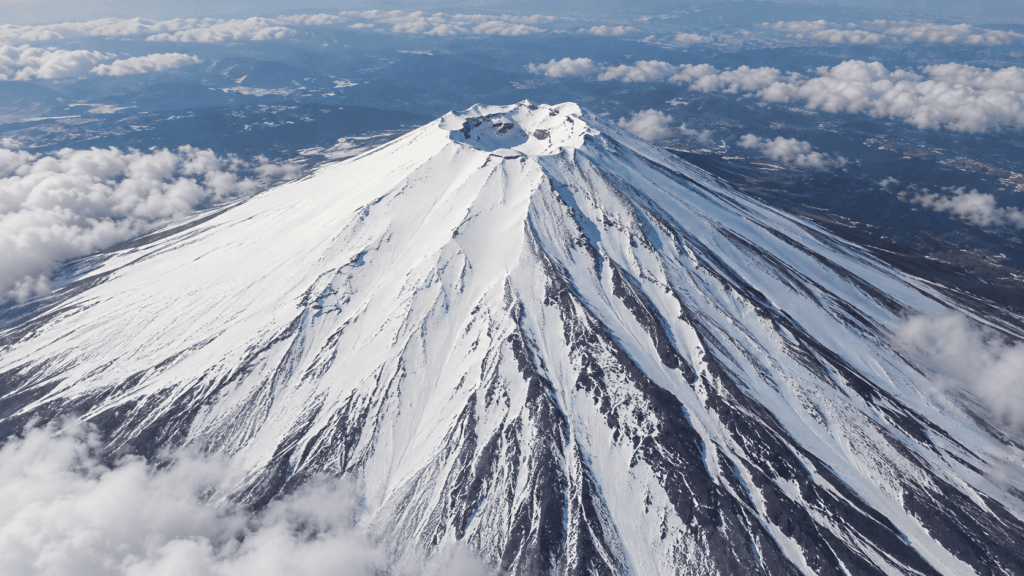
Snow on Mt Fuji is one of the most photographed sights in Japan and one of the most misunderstood. The day the summit first turns white is a weather event. The white cone you are picturing is something else, and it depends on three separate conditions: snow on the mountain, a clear line of sight, and what the ground looks like where you are standing.
Quick answer: for the classic snow-capped Fuji, plan around December to February. November and March can look identical in a good year, but the amount of snow swings widely between winters. October is a month when a first dusting is possible, not a month that promises a white mountain.
- Most reliable window: December–February, when the cap is usually thick and the air clearest.
- Also plausible: November and March, with more year-to-year variation.
- Not guaranteed: a snowcap on any given date, or a clear view on any given morning.
- Two different things: snow on the summit and snow on the ground around Lake Kawaguchiko.
If your bigger worry is winter transport rather than which month to choose, the self-guided versus guided comparison below covers that decision directly.
Planning a winter day trip from Tokyo? If you’d rather not coordinate transport between Chureito Pagoda, Lake Kawaguchi, and Oshino Hakkai yourself, check the Mt Fuji full-day guided tour’s itinerary and available dates. The tour simplifies the journey, although clear views of Fuji are never guaranteed.
When Does Mt Fuji Have Snow?
The Japan Meteorological Agency’s long-term average for Mt Fuji’s first snowcap is October 2. That figure comes from visual observations by staff at the Kofu Local Meteorological Office between 1991 and 2020, and it is the number most articles quote. It is also the number that helps travelers least.
The first snowcap was confirmed on October 5 in 2023, on November 7 in 2024 — the latest date since records began around 130 years ago — and on October 23 in 2025, 21 days behind average. That is a spread of more than five weeks between two consecutive years. If you are booking flights, the range is the honest picture, not the date.
One complication matters if you read older statistics. From the 2026–27 season, the agency stopped relying on staff looking at the mountain and switched to an analyzed snow-depth method, which can register snow at night or when the summit is hidden by cloud. It states plainly that these figures cannot be compared directly with the visual records kept up to the 2026 cold season. The famous “”October 2″” is a historical reference, not a live forecast.
The useful takeaway is simpler than the statistics: a first snowcap is a thin, often temporary layer that can melt or blow off within days. The thick, even cone that fills travel photographs builds over the following weeks. Treat the announcement as the start of a season, not the day the postcard becomes available.
If snow is only one factor in your timing, a broader month-by-month comparison of Mt Fuji’s weather and crowds is worth reading before you commit to dates.
First Snow Is Not the Same as a Full Winter Snow Cap
The first snowcap is defined as the first time snow is confirmed on the summit after summer. It says nothing about how much follows, how long it stays, or how the mountain will look on the morning you arrive. A single cold front in autumn can whiten the peak and then be erased by a week of mild weather. What you are actually waiting for is the build — streaks, then patches, then a full cap, usually by some point in December.
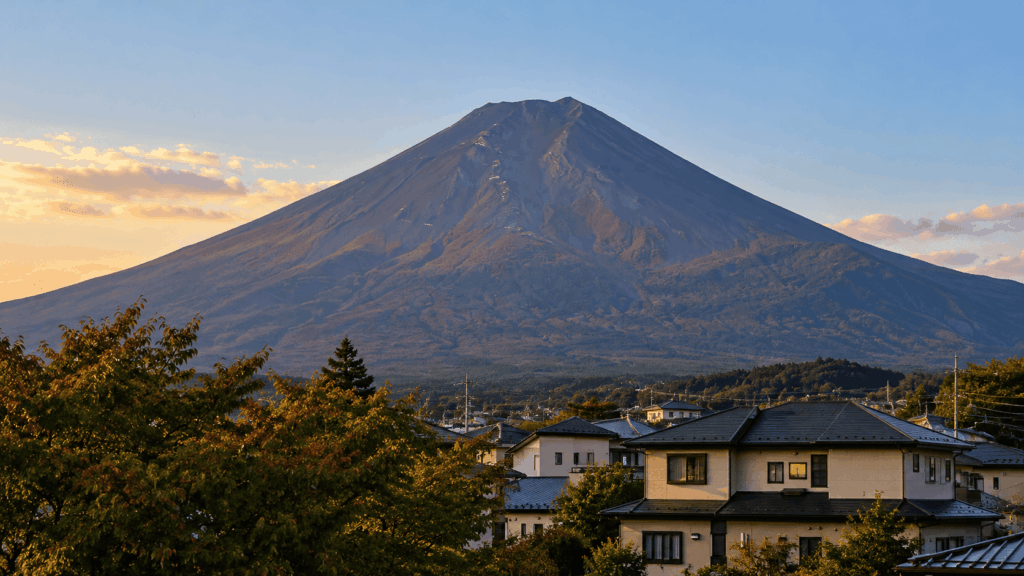
Best Months to See Snow on Mt Fuji
Three things change month by month, and they do not move together: the snow on the cone, the odds of a clear view, and the snow under your feet. The table separates them.
| Period | Snow-cap expectation | Fuji visibility | Snow at Kawaguchiko / Fujiyoshida | Best for | Main drawback |
|---|---|---|---|---|---|
| October | First cap possible early in the month; thin and temporary | Low to moderate | Essentially none | Autumn color, smaller crowds | The white cone is unlikely; typhoon season tail |
| November | Usually established by late month; a bare summit is still possible | Moderate to high | First snow possible, rarely lasting | A quieter alternative to December | Widest year-to-year variation of any month |
| December | Thick and reliable in most years | Highest of the year | Snow falls, cover is not continuous | The classic photograph and crisp long views | Cold hands, short days, busy weekends |
| January | At its fullest | Highest of the year | Deepest snow of the year on average | Clearest air and the strongest winter look | Coldest month; ice on shaded stairs |
| February | Still full for most of the month | High, easing late | Similar to January | Winter conditions with fewer visitors | Weather softens toward month end |
| March | Snowy early, thinning by late March | Moderate and dropping | Melting and patchy | Milder days, early blossom nearby | Spring haze; the cone looks streaked |
| April–May | Remnant snow on upper slopes only | Low to moderate | None | Warm-weather sightseeing | Not a snow trip by this point |
The visibility column reflects a decades-long seasonal pattern measured from the Shizuoka side of the mountain, not a promise for your date. The measurements and their limits are explained further down.
A common misconception among first-time visitors is that a winter month guarantees a white town as well as a white mountain. It does not.
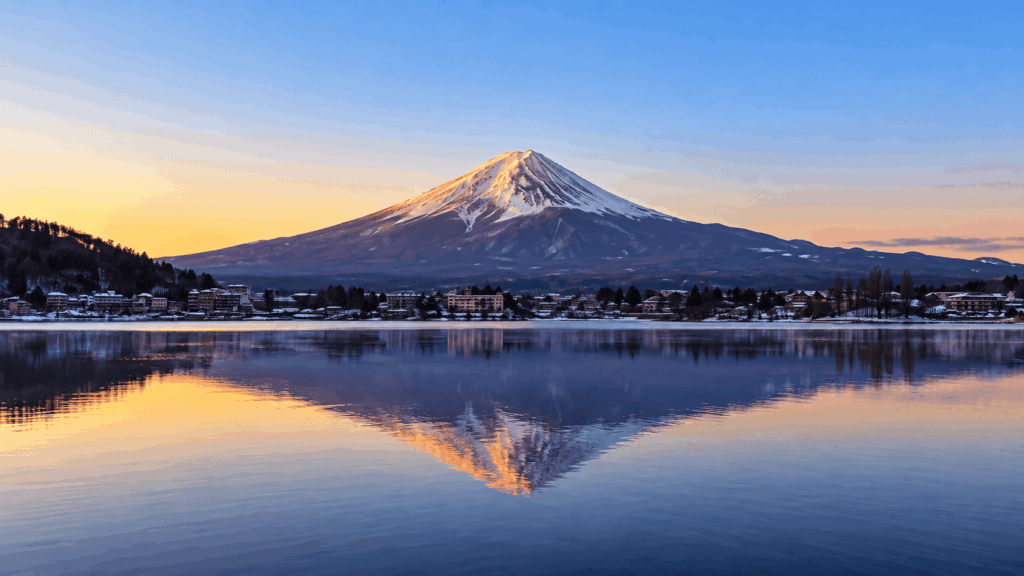
Does Mt Fuji Have Snow All Winter?
In most winters, yes. The summit carries snow from autumn into late June and reads as white for most of that period. But “”snow-capped all winter”” is not the same as “”identical every day””: wind scours the upper slopes, rain darkens the surface, and the boundary between white and bare shifts with every weather system.
Snow on Mt Fuji Is Not the Same as Snow Around Lake Kawaguchiko
A perfectly white summit tells you nothing about the roads, parks, and rooftops at the foot of the mountain. They are two separate weather outcomes, and the second needs its own snowfall at low elevation.
Kawaguchiko is not a snow-free valley, which is the opposite error. The Japan Meteorological Agency’s normals for its Kawaguchiko station, 1991 to 2020, show a January mean of -0.4°C with an average daily minimum of -5.7°C and about 37 cm of total snowfall across the month. February averages 0.6°C, a mean minimum of -4.8°C, and roughly 28 cm of snowfall. The average deepest cover in January is around 21 cm.
So snow falls here, often. What does not happen is a permanent white blanket. Cover arrives with each system, gets cleared from roads, trampled on paths, and dirtied within days. On many winter mornings you will find a brilliant white Fuji above a town that is mostly brown and grey, with snow surviving only in shaded corners and on north-facing slopes.
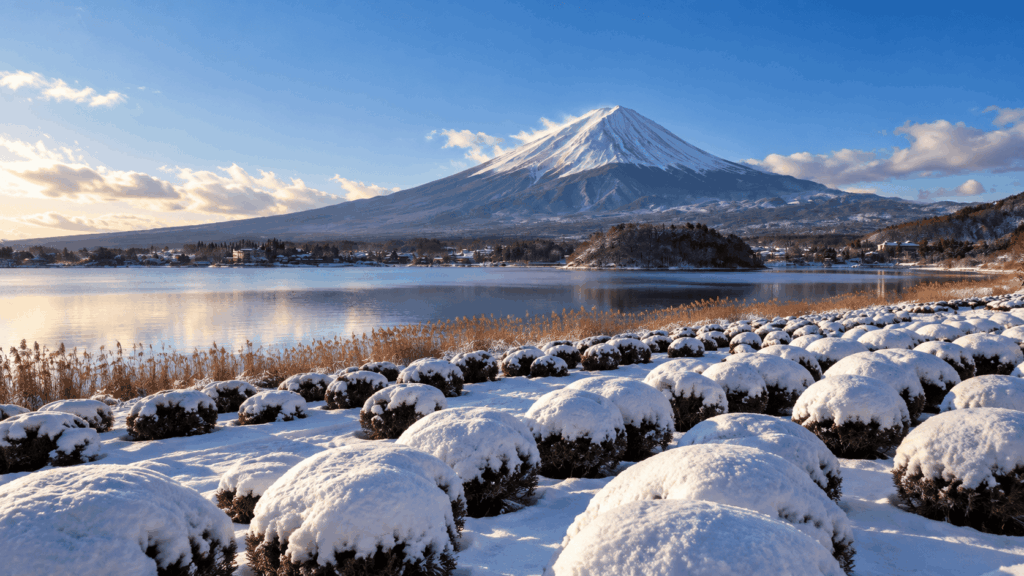
Two consequences follow. If your photograph includes snow on the pagoda or the rooftops, a white summit is not enough — you need a snowfall at town level shortly before you arrive, which is a last-minute question rather than a seasonal one. And the figures above come from the Kawaguchiko weather station, not the Chureito observation deck, which sits on a hillside above Fujiyoshida and holds ice in shaded sections long after the town has cleared.
What Chureito Pagoda Is Really Like in Winter
If you have seen a photograph of a five-story pagoda with Mt Fuji behind it, that is Chureito Pagoda at Arakurayama Sengen Park, on the hillside above Fujiyoshida. It is the most photographed snow-Fuji composition in the country, and the version most people carry in their heads has snow on the roof, snow on the trees, and a perfectly clear mountain. Getting all three at once is luck as much as planning.
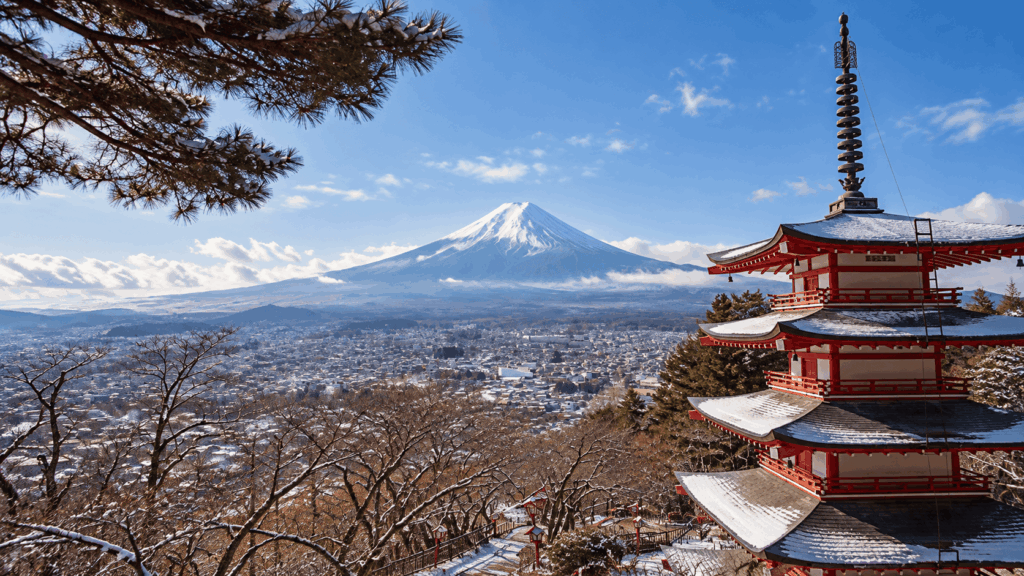
Take the Fujikyu Railway to Shimoyoshida Station, walk 10 to 15 minutes through a residential area to the base of the park, then climb through Arakura Fuji Sengen Shrine and up the Sakuya-hime Staircase, which the city of Fujiyoshida officially counts at 398 steps. Allow 20 to 30 minutes from the station to the observation deck, and about two hours for the visit if you want to shoot rather than just look.
Driving changes the arithmetic but not the last part. The city runs several paid lots near the park, generally around 1,000 to 1,500 yen per visit, with the outer lots adding a 5 to 10 minute walk. The closest lot fills first in cherry and autumn color seasons, street parking is prohibited, and large buses cannot enter the park at all — which is why group tours drop passengers near Shimoyoshida Station.
Kai’s tip: I regularly take guests up to Arakurayama Sengen Park for the pagoda-and-Fuji view, and winter changes the climb more than the view. After a snowfall, the shaded sections of those 398 steps can stay icy well after the town has cleared, and this is one place where I would not trust smooth everyday sneakers. If there has been snow or a hard freeze, grippy soles or winter boots are worth the luggage space.
Go Early—but Do Not Expect an Empty Viewpoint
Morning is the better half of the day for seeing Fuji, and there is unusually good data behind that. The city of Fuji, on the Shizuoka side, has recorded how much of the mountain is visible from its city hall three times a day since 1991. Over 35 years, the mountain was fully visible in 36.6% of 8 a.m. observations, 23.3% at noon and 22.5% at 4 p.m. By month, the 8 a.m. figures peak at 61.7% in December and 60.0% in January, against 9.9% in July.
Two caveats keep this honest. The observations are made from a building in Fuji City, roughly 25 km away, so they describe the regional pattern rather than the odds at this deck. And “”fully visible”” is a strict standard: a mountain with cloud around its base counts as a failure in that dataset, even when it makes a better photograph.
What the numbers do support is the direction. In January, sunrise near Lake Kawaguchiko falls at roughly 6:45 to 6:55, so a 7 a.m. arrival means shooting in first light with the mountain in its most stable part of the day.
Kai’s tip: Even on a winter weekday, I have arrived around 8 a.m. to find the front row of the viewing area already occupied. By the time I have walked back down around 10, the flow of people coming up is noticeably heavier. Early genuinely helps with both cloud and crowds — but it does not buy you an empty viewpoint, so adjust expectations before setting an alarm for 5 a.m.
If visibility is your main worry rather than snow, the separate question of how often Fuji disappears behind cloud deserves its own reading. Snow cover and visibility are two different bets, and you can lose one while winning the other.
What to Wear for Mt Fuji in Winter
Tokyo winter clothing is the wrong benchmark. The city rarely drops below freezing, while the Fuji Five Lakes area averages -0.4°C in January with nights near -6°C, and the viewpoint adds wind on top.
- Shoes: grippy, waterproof soles; winter boots if there is snow or a freeze.
- Socks and base layer: wool or synthetic socks, thermal top and leggings.
- Outer layer: insulated and wind-resistant rather than merely thick.
- Hands and head: gloves and a knit hat, both non-negotiable for photography.
- Bag: a small daypack, so your hands stay free on the stairs.
Kai’s tip: The cold that catches people out here is not the air temperature but the wind at the open viewpoint. I have had my hands stiffen within about ten minutes of standing there, which is roughly the point where I stop wanting to take the camera out of the bag. Gloves and a hat are not accessories on this trip; they decide how long you can actually shoot.
Assume ice on the stairs even with no snow in the forecast. A clear, cold night after any moisture is enough to glaze the shaded steps.
Self-Guided or Tour for a Winter Mt Fuji Trip?
This is less about quality than about what you want to spend the day on. Independent travel gives you the earliest arrival and the freedom to abandon a plan when cloud moves in. A guided day trip removes the winter transport problem entirely, at the cost of control over timing.
| Self-guided | Guided day tour | |
|---|---|---|
| Earliest possible arrival | Dawn, if you stay overnight nearby | Mid-morning, after the Tokyo departure |
| Flexibility if weather changes | High — wait, move on, or return tomorrow | Low — the itinerary runs regardless |
| Winter transport stress | On you: trains, buses, icy roads | Handled by the operator |
| Viewpoints in one day | Two or three, realistically | Four or five, briefly at each |
| Photography freedom | Unlimited, including long waits for light | Fixed stops, typically under 90 minutes at Chureito |
| Best for | Photographers, overnighters, travelers with spare days | Tokyo-based visitors with one day and no appetite for winter logistics |
Neither column wins outright. The honest rule: if the photograph is the point of the trip, sleep near Fujiyoshida or Kawaguchiko and go up before dawn. If the mountain is one part of a short Japan trip and you would rather not work out winter buses, the tour is a reasonable trade. To explore your options further, you can compare DIY, bus, and private Mt Fuji tours in our dedicated guide.
Is a Day Tour Worth It for Snow-Capped Mt Fuji?
The main option on this route, sold as From Tokyo: Mount Fuji Full-Day Highlights Sightseeing Trip through GetYourGuide, runs about 10 hours with a live English or Chinese-speaking guide and pickup at Shinjuku or Tokyo Station. The published itinerary gives roughly 30 minutes at Oishi Park on Lake Kawaguchi, 75 minutes at Arakurayama Sengen Park including the pagoda, 80 minutes at Oshino Hakkai with a lunch stop, and 40 minutes at the Mt Fuji 5th Station, with bus legs of about two hours each way.
Read those numbers carefully, because they answer the question better than any review. Seventy-five minutes has to cover the walk from the drop-off, the 398 steps, time at the deck, and the return. That is enough to see the view and take good photographs in decent conditions. It is not enough to wait out a passing cloud bank for forty minutes, which is what a serious photographer would want to do.
Three details matter in winter. The 5th Station stop is seasonal; outside the operating season the tour substitutes the highest accessible point and the Mt Fuji Museum, so do not book expecting snow at altitude. Visibility is explicitly not guaranteed and no refund applies if the tour runs while the mountain stays hidden. And peak-season traffic can push the return back by two to three hours. Reviews cluster around a consistent pattern: guides and transport are praised, and the most common complaint is pace.
What you are buying is not a better chance of a white Fuji. It is the removal of winter transport planning, plus three or four viewpoints in a single day. If your priority is being on the deck before the daytime crowds, staying near Fujiyoshida and going independently gives you something no Tokyo departure can: arrival at first light.
If you have just one day from Tokyo and want several classic Fuji viewpoints without planning winter transport, this is the guided trip worth comparing.
Why I’d book this one
- Helpful guides and comfortable transport: Recent travelers regularly praise the guides’ assistance and the convenience of having the journey organized, rather than navigating multiple connections independently.
- Several viewpoints in one day: The itinerary combines Chureito Pagoda, Lake Kawaguchi, and Oshino Hakkai without separate train and bus arrangements. The trade-off is limited time at each stop.
- Booking flexibility: The listing offers cancellation flexibility and a reserve-now-pay-later option. Check the specific conditions for your date before committing.
See live availability, departure times, and recent traveler reviews for the Mt Fuji full-day tour before deciding whether its fixed itinerary works for you.
Can You Climb Mt Fuji in Winter?
No — not as a sightseeing activity. The official season ends in early September, and for the rest of the year the trails to the summit are closed: from the 5th Station up on the Yoshida, Subashiri and Gotemba routes, from the 6th Station on the Fujinomiya route, and around the crater rim. The official climbing site notes that huts and first-aid stations are closed, mobile coverage is unreliable, and the weather is severe. This guide is about looking at a snowy Mt Fuji, not standing on one.
How to Maximize Your Chances of Seeing a Snow-Capped Mt Fuji
Choosing December or January is the first decision, not the last. The difference between a wasted day and a good one is usually made in the 24 hours before you leave.
- Pick the season first. December to February for the classic look; November and March if you accept more variability.
- Check the summit snow status. The Japan Meteorological Agency publishes current summit conditions alongside the first-snowcap records.
- Check the forecast the day before. Look at cloud cover for the Fuji Five Lakes area, not just the chance of rain.
- Check a live camera on the morning. A “”sunny”” forecast frequently coexists with a cloud sitting on the summit.
- Go early if the sky is clear. Morning is when the mountain is most often unobstructed, and the light is better anyway.
- Change your footwear after snow or ice. The staircase is where the wrong shoes turn a photo stop into a risk.
- Have a second stop that does not depend on Fuji. Oshino Hakkai and the lakeside are worth the trip even when the mountain hides.
- Keep a spare morning if you can. Two possible days roughly halves the chance that one cloudy morning defines the trip.
If you would rather hand the winter logistics to someone else after reading all of this, the day trip described above fits that preference. If you are still deciding between seasons rather than chasing snow, the broader seasonal guide is the better place to start.
A Good Winter Morning at Chureito: A Practical Order
The sequence that works is simple: get up the stairs early, come down before the crowd thickens, and eat something hot while the day warms up. Arriving at the deck around first light, spending thirty to forty minutes there, and starting down by mid-morning puts you ahead of both the tour buses and the day-trippers from Tokyo.
After a cold morning shoot, one of our usual ways to warm up is to head back down toward Shimoyoshida and get a hot bowl of hoto or Yoshida no Udon. Both are local Fujiyoshida dishes rather than tourist menu items, and after an hour on an exposed hillside they do more for the rest of the day than another cup of coffee. From there, the afternoon is yours: Oshino Hakkai, the north shore of Lake Kawaguchiko, or a slow train back toward Tokyo. If you want to keep shooting, there are plenty of other iconic Mt Fuji photo spots to fill the rest of your day.
Frequently Asked Questions
When does it usually start snowing on Mt Fuji?
The long-term average for the first snowcap is October 2, based on visual observations from the Kofu Local Meteorological Office between 1991 and 2020. Recent years have been far less predictable: October 5 in 2023, November 7 in 2024, and October 23 in 2025. From the 2026–27 season the agency uses an analyzed snow-depth method, and states that the new figures are not directly comparable with the old records. The first snowcap marks the start of the season rather than the arrival of the thick white cone most travelers picture.
What is the best month to see snow on Mt Fuji?
December through February is the most dependable window, with December and January usually offering the clearest air as well as a full cap. February is close behind and tends to be slightly quieter. November and March can look just as good, but snow on the summit varies much more between years in those months. No month guarantees a visible mountain on a given morning.
Is Mt Fuji covered in snow in November?
Often, but not reliably, and usually not at the start of the month. In 2024 the first snowcap was not confirmed until November 7, the latest on record; in 2025 it arrived on October 23. If November is your only option, aim for the second half and check current summit conditions shortly before you travel rather than assuming a white mountain.
Is there snow around Lake Kawaguchiko in winter?
Yes, snow does fall at lake level — the Kawaguchiko weather station averages roughly 37 cm of snowfall in January alone. What you should not expect is a continuous white blanket. Snow arrives with each system, is cleared from roads, and often melts within days, so a white summit frequently sits above a mostly bare town. If snow on the ground is essential to your photograph, you need a recent low-elevation snowfall, which is a last-minute question rather than a seasonal one.
Can you climb Mt Fuji in winter?
Not as a normal sightseeing activity. The official climbing season ends in early September, and the trails to the summit are closed outside it — from the 5th Station on the Yoshida, Subashiri and Gotemba routes, and from the 6th Station on the Fujinomiya route. The official site warns that huts and first-aid stations are closed, mobile service is unreliable, and conditions are severe. Winter is the season to look at Mt Fuji, not to stand on it.
Final Verdict: Which Winter Plan Fits You?
The mountain makes the final decision, and nothing here changes that. What you can control is how many chances you give yourself, and whether the plan matches the kind of trip you are taking.
If this is your first visit to Mt Fuji
Aim for December or January and stay one night near Lake Kawaguchiko or Fujiyoshida if your schedule allows. That night converts a one-shot gamble into two mornings, which is the most effective thing you can do for your odds. If you only have one day, accept that you are buying a chance rather than a view.
If the photograph is the main reason you are going
Skip the Tokyo departure and sleep near Fujiyoshida. Be at the base of the Sakuya-hime Staircase before first light, wear shoes with real tread, and give yourself at least an hour at the top rather than the 75 minutes a group tour allocates to the whole park. If there is snow or a hard freeze, treat the shaded steps as the most dangerous part of the day.
If you are travelling with family or have limited mobility
Chureito’s 398 steps are a genuine constraint in winter, and ice makes them worse. The lakeside around Oishi Park and the flat village paths at Oshino Hakkai give you Fuji views without the climb, and a guided day trip handles the transport between them. For a complete plan that avoids the hardest climbs, see our stress-free Mt Fuji family itinerary. Choose the view you can actually enjoy over the one that requires a risk you would rather not take.
If you have exactly one day and no flexibility
Take the guided day trip and judge it for what it is: four viewpoints and a guide across about ten hours, with the winter driving removed. Check the forecast on the morning you leave, expect the 5th Station stop to be substituted outside the climbing season, and do not treat the booking as insurance against cloud.
If you have seen Fuji before and want the quieter version
Go in late November or early March. You trade some certainty about the snowcap for thinner crowds, softer prices and a mountain that still looks like winter. Late November in particular often delivers a fully white cone with far fewer people on the stairs than a December weekend.
The pattern behind all of this is the same one that shows up at every famous viewpoint in Japan: the best conditions are also the most demanding ones. A white Fuji in winter means a 6 a.m. alarm, frozen hands and a staircase that wants proper shoes — and that trade, rather than any particular date, is the real decision this guide is asking you to make.

Hi, I’m Kai. I’m a Tokyo-based travel writer, tourism industry insider, and the author of a published guidebook for international visitors to Japan. With over 10 years of professional experience at a leading Japanese tourism company, my mission is to help you skip the tourist traps and navigate Japan’s best destinations like a local. I believe the perfect day trip is like a traditional kaiseki meal: a beautiful balance of precise planning and unforgettable seasonal discovery. When I’m not out conducting field research, you’ll usually find me drafting new itineraries with one of my favorite fountain pens!