
If this is your first trip to Biei, start with Biei Curry Udon. It is a signature dish developed in Biei in 2005, built around Biei wheat, Biei pork and Biei vegetables — not simply a Hokkaido classic that happens to be served here. The useful question is not “which restaurant is best” but “what do I order, and how long am I willing to stand in line for it.”
Biei is a spread-out farming town with a handful of convenient lunch options for visitors, and much of the rest of your day is spent travelling between hills, trees and ponds. Get lunch right and the whole day works. Get it wrong and you spend the best light of the afternoon staring at a door.
If you’re planning Biei as a full-day trip from Sapporo and want more control over where you stop for lunch, a private Furano–Biei tour may be worth comparing with a fixed-route bus trip. Check private Furano–Biei tour options and available dates — and confirm with the operator whether a lunch stop in Biei town can be arranged.
What Should You Eat in Biei? The Short Answer
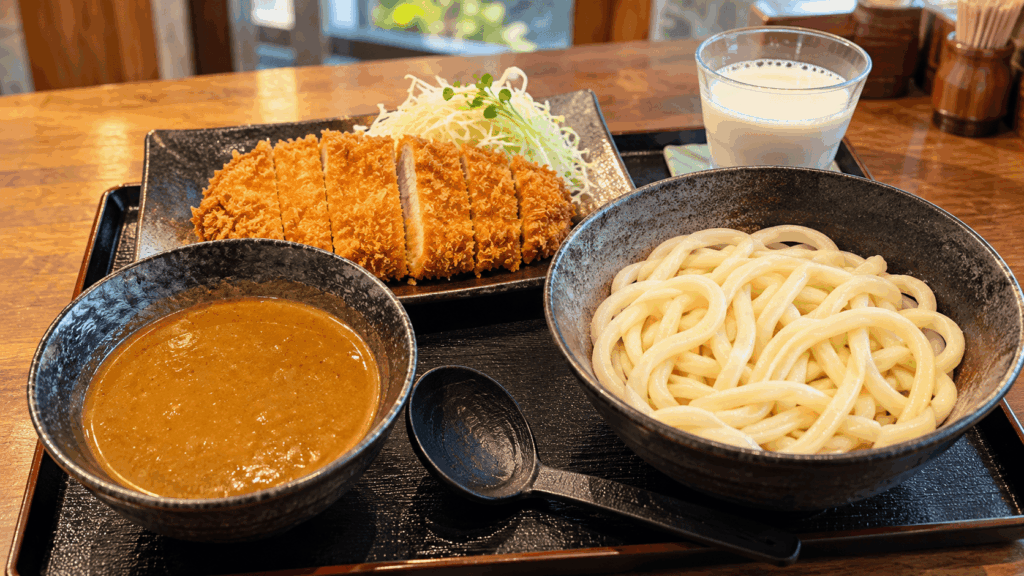
- Signature local dish: Biei Curry Udon — a dipping-style curry udon created in Biei in 2005, traditionally served with Biei milk.
- Best alternative if you want something crisp and filling: Ebi-don (fried shrimp rice bowl) at Cafe Junpei.
- Best quick extra: Biei milk soft serve — a short dessert stop when the counter is not crowded, and an easy way to get back on the road.
- Who should walk away from a long queue: anyone with Blue Pond and Shikisai-no-Oka still on the same afternoon.
The mistake I see most often is treating lunch as a fixed appointment. In Biei, a 40-minute wait at noon is 40 minutes taken out of the two or three hours of daylight you have for the hills. Keep lunch flexible and you will see more, eat just as well, and stop resenting the line.
| Dish | Why try it | Best for | Where to try it | Time risk | Our verdict |
|---|---|---|---|---|---|
| Biei Curry Udon | Invented in Biei in 2005; Biei wheat noodles, Biei pork, seasonal Biei vegetables, dipping style | First-time visitors who want the one dish that is genuinely from here | Family Restaurant Daimaru (also KOERU, behind the station) | Medium to high at noon | Order this first |
| Ebi-don | Large fried shrimp on rice with a sweet-savoury sauce; crisp batter, generous portion | Travellers who prefer fried food over curry, or who want takeout | Cafe Junpei | Medium; sells out | Strongest alternative |
| Biei pork cutlet | Locally raised pork, usually as a topping or a set rather than a dish on its own | Anyone who wants a heavier lunch before a long driving afternoon | Daimaru (pork cutlet curry udon, Biei pork hamburg steak) | Same queue as the curry udon | Add it if you are hungry, not as a separate stop |
| Biei milk soft serve | Soft serve made with Biei milk; cold, milky and quick | Anyone short on time, or squeezing in dessert between two viewpoints | Daimaru, Junpei, Biei Senka (seasonal) | Low | Easy add-on, not a destination |
1. Biei Curry Udon — The Dish to Try First
Biei Curry Udon did not come out of a century-old family recipe. It was launched in July 2005, after local farmers, restaurants and the town’s food community started talking about how to get people to eat more Biei wheat. The answer was a curry udon that could only be made here, using ingredients the town already grew.
That origin matters for expectations. It is a modern, deliberately designed local dish — and once you accept that, it is a very good one. The noodles are made with Komugi (香麦), a flour blend of the Kitahonami and Haruyokoi wheat varieties grown in Biei. The toppings are Biei-raised pork, shabu-shabu style, plus whatever vegetables are in season. And because Biei is dairy country, the classic set comes with Biei milk alongside the curry.
What Makes Biei Curry Udon Different?
If you are picturing the usual curry udon — thick noodles sitting in a thick, starch-thickened curry broth — this is not that. Biei’s version follows a set of local rules that participating restaurants agree to:
- The name must be exactly “Biei Curry Udon.”
- The noodles must use Biei-grown Komugi flour.
- The noodles, the curry sauce and the toppings are served separately — a dipping style, like tsukemen.
- The toppings are Biei pork shabu-shabu and seasonal Biei vegetables (other regions’ vegetables are allowed when nothing local is in season).
- The original dipping version comes with Biei milk.
In practice you get a bowl of chewy noodles, a small pot of hot curry to dip into, and a plate of pork and vegetables to drag through the same curry. Because the sauce never sits on the noodles, nothing turns gluey, and you control the ratio in every bite. Some shops also offer a baked version (yaki-men), finished in an oven under cheese, and a winter-only poured-soup version.
Where to Try It: Family Restaurant Daimaru
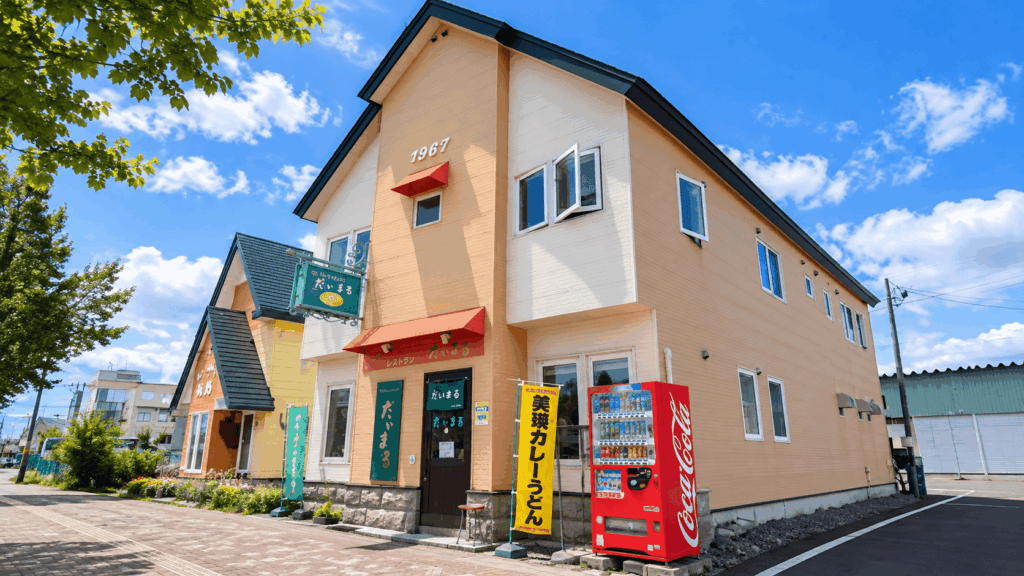
Family Restaurant Daimaru is the standard first stop, and the one I send people to. It sits on the main street about 500 metres — roughly a 7-minute walk — from Biei Station, which makes it workable even if you arrived by train. The building looks like a family restaurant in the most literal sense: bright, a bit dated, with tables, a raised tatami area and a second floor that fills up when the ground floor does. Nobody is here for the interior design.
Order the classic set: dipping curry udon with Biei milk. The Biei Tourism Association lists a reference price of ¥900, but menu prices can change, so confirm the amount at the restaurant rather than treating that listing as a guaranteed current price. There is also a pork cutlet curry udon, a baked curry udon, and a Biei pork hamburg steak set if you want a full meal rather than noodles. English menus are commonly reported, but do not expect anyone to explain the dipping format to you — you will work it out in about four seconds.
Lunch starts at 11:00. The tourism association and the restaurant’s LINE listing give Wednesday as the regular closing day, while the town’s 2025–26 winter holiday notice also lists second and fourth Thursdays; another restaurant listing shows additional Thursday closures. Confirm the exact day before going. Evening service is listed by some sources but not all, so do not assume it will be available. Some listings say reservations are accepted; call directly if you are a group. Bring cash as a backup even if a card works.
Kai’s tip: At lunchtime the line can reach outside the door — the day I passed, a dozen or so people were standing on the pavement. What I would tell a friend is not “get there early” but “look before you commit.” Walk up, see how fast the line is actually moving and how full the room looks, and then decide. Standing in a queue that has not moved in ten minutes is a choice, not a fact of life.
Want the Heavier Version? Order It With Biei Pork Cutlet
Biei pork is a real local ingredient rather than a marketing line: the town raises its own pork, and Daimaru states that all of its pork is Biei-produced. The most satisfying way to eat it here is as a pork cutlet on top of the curry udon — you dip the cutlet into the curry sauce the same way you dip the noodles, and the crust stays crisp instead of going soft in the broth.
Be honest with yourself about the size. Noodles plus a thick cutlet plus curry is a serious lunch, and I have never ordered it and then felt like doing a long walk immediately afterwards. If your afternoon is Blue Pond, Shikisai-no-Oka and the Patchwork Road in one go, the plain dipping udon is probably the smarter order. If your afternoon is a slow drive with photo stops, order the cutlet and enjoy it.
If you want the pork without the fried coating, the Biei pork hamburg steak set is the other obvious choice on the menu. I have not ordered it myself, so I will not pretend to review it — but it is the dish regulars mention when they are not talking about curry udon.
Is It Worth Waiting at Daimaru?
Yes — with a time limit you decide in advance. That limit is the whole answer, and it depends on what is left in your day.
Biei’s sights are not clustered. Shikisai-no-Oka is about a 12-minute drive from Biei Station, Blue Pond is roughly 20 minutes by bus or a little more by car, and the Patchwork Road loops northwest of town. Every one of those is a place where light and weather matter, and where a 40-minute delay at lunch can mean arriving at the pond after the sun has gone behind the trees.
A practical rule that has served me well:
- Under about 20 minutes of waiting: stay. You will be seated, fed and back in the car before you would have finished rerouting.
- 20–40 minutes: stay only if Blue Pond or Shikisai-no-Oka is not on today’s list, or if you have a reservation and no fixed afternoon.
- Over 40 minutes, or a queue that is not visibly moving: leave. Check KOERU behind the station or look for takeaway; Junpei is another alternative, although it can have its own queue.
Two practical notes. The 11:00 opening is the quietest window of the day — arriving ten minutes before it is the single most effective anti-queue move in Biei. And a late lunch is not a reliable escape: visitors have reported the room still nearly full well after 14:30, so “we’ll just eat at two” is a gamble rather than a plan.
The queue is not a scam and the food is not a tourist trap. Biei Curry Udon is simply the one dish everybody was told to eat here, in a town with a handful of lunch seats. Treat the wait as a cost you are choosing to pay, and the decision becomes easy either way.
2. Ebi-don at Junpei — The Best Alternative to Curry Udon
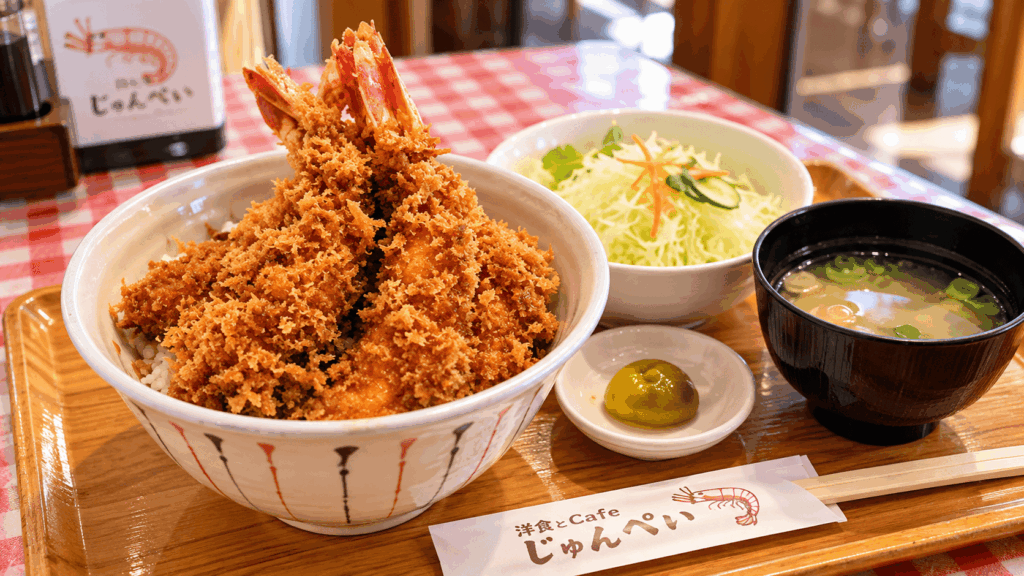
If curry is not what you want after a morning in the hills, Cafe Junpei is the other name worth having in your pocket. It is a Western-food restaurant and cafe on Honmachi 4-chome, about an 8-minute walk from Biei Station, and its signature is an ebi-don: a rice bowl topped with large fried shrimp and a sweet-savoury sauce.
The shrimp are coated in fresh breadcrumbs and fried to order, which is why the batter stays crisp rather than collapsing under the sauce. You choose the size by the number of shrimp — three (take) for around ¥1,600, four (matsu) for around ¥1,800 — and the set comes with salad and miso soup. Prices have moved recently, so confirm at the door. There is also a fried shrimp set meal where you can pick three, four or five pieces, plus curry, cutlet and café dishes if someone in your group does not want shrimp.
Two things to plan around. Junpei does not take reservations, opens at 11:00, and closes when it runs out — sometimes well before 15:00. It is also closed on Mondays. Travellers’ reviews repeat the same pattern: the room fills quickly after opening and the ebi-don is the first thing to go. Arriving at 11:00 is not obsessive here; it is the difference between choosing your lunch and having lunch chosen for you.
A note on authenticity, because this matters in Biei. Ebi-don is a popular restaurant dish, not a local tradition — do not expect a story about generations of Biei fishermen. It is simply a very good fried shrimp bowl in a town with limited lunch options, and that is exactly how it should be sold to you.
Biei Curry Udon vs Ebi-don: Which Fits Your Day?
This is the only real choice most visitors have to make, so make it on preference rather than on review scores:
- Choose Biei Curry Udon if this is your first visit and you want the one dish that exists only here. It is the answer to “what is Biei food?” and the local-ingredient story is built in.
- Choose Ebi-don if you would rather have something crisp and salty than a bowl of curry, or if you are travelling with someone who does not enjoy curry at all.
- Choose whichever queue is shorter if your afternoon is already fixed — Blue Pond, Shikisai-no-Oka or a JR departure. At that point the food is secondary and the clock is not.
- Choose neither, and take something to go, if both rooms are full and you still have two hours of driving ahead.
Do not try to do both at full size on the same day. Two heavy lunches in one afternoon is how people end up skipping the thing they came to Biei for.
Use Takeout Before the Queue Eats Your Sightseeing Time
Junpei is unusually flexible for a small-town restaurant: most of the menu can be ordered to take away, and the shop also does delivery locally. That single fact solves the most common Biei lunch problem — arriving at noon, finding a full room, and losing an hour you had earmarked for the hills.
It is worth being clear about the trade-off. A fried shrimp bowl does not improve in a box, and Biei’s viewpoints are fields, ponds and car parks rather than picnic tables. So decide where you will actually eat it before you order: in the car, back at the station area, or at the first stop where sitting down is possible. If none of those sound appealing, wait for a seat instead.
Kai’s tip: What catches people out here is the scale of the map. Biei looks compact on paper, but Shikisai-no-Oka and Blue Pond sit in different directions from town, and a 30-minute wait at lunch is rarely just 30 minutes — it pushes the next stop into worse light or a thinner bus window. I would rather eat something good out of a box at 11:30 than sit down at 13:00 and drive the last hour in a hurry. Set your own cut-off before you arrive, and the decision takes ten seconds instead of twenty minutes.
3. Biei Milk Soft Serve — The Easy Stop Between Sightseeing Stops
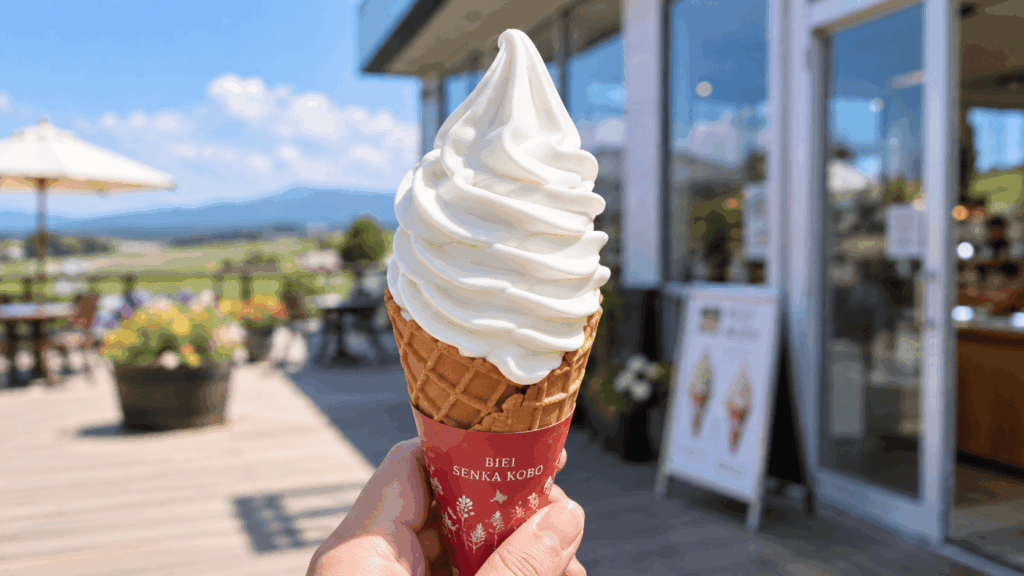
Biei is dairy country, and soft serve is the cheapest way to taste that. It is not a destination; it is the thing you eat in the ten minutes between two viewpoints, and on a hot afternoon it may be the most memorable bite of the day.
Three reliable places, each with a different reason to stop:
- Family Restaurant Daimaru — soft serve made with 100% Biei milk, according to the town’s tourism association. Easiest if you are already eating lunch there.
- Cafe Junpei — soft serve is part of the café menu, so it works as dessert after an ebi-don.
- Biei Senka (Senka Kobo) — the farm-shop complex about a 10–15-minute walk from the station, with soft serve, pudding and light snacks to eat in or take away. This one has a catch: the Senka Kobo is generally open from 8 April to 4 November, closed Wednesdays and the second and fourth Thursdays (the additional Thursday closures are waived in July and August), and shut from 5 November through winter, according to the operator’s published schedule. The market building remains open in winter, but that does not mean the soft-serve counter is open.
That last point is the one nobody mentions. If you visit Biei in winter or early spring with a soft serve stop in mind, you will find the shutters down. Check what is open before you drive out.
Kai’s tip: In summer, Biei soft serve starts melting before you have finished paying. If you want a photo of it against the hills, take the photo in the first thirty seconds or accept that you are photographing a puddle. Eat the first bite before you do anything else, and keep a wet wipe or tissue in your pocket — this is a two-napkin dessert in August, and Biei’s car parks do not always have a tap nearby.
Daimaru vs Junpei vs KOERU: Which Lunch Stop Fits You?
Most guides frame this as a two-way choice. It is really a three-way one, because there is a curry udon shop almost literally behind Biei Station that few English-language guides mention.
KOERU sits on the back side of the station, a 1–3 minute walk from the platform, and serves Biei Curry Udon. The tourism association gives ¥850 and up as a starting price for the restaurant, not a confirmed current price for the curry udon. It has roughly 42 seats, takes cards, and does a summer-only chilled curry udon as well as a curry doria and a Biei pork hamburg. Lunch starts at 11:00, with last orders at 14:30, and it is closed Tuesdays, with occasional irregular closures. It is less famous than Daimaru, but if the line there is long, KOERU gives you another way to try the local curry udon without committing to that queue.
| Restaurant | Signature | Walk from Biei Station | Hours & closed day | Queue or sell-out risk | Takeout | Best for |
|---|---|---|---|---|---|---|
| Family Restaurant Daimaru | Biei Curry Udon, dipping style; pork cutlet curry udon | About 7 minutes (500 m) | Lunch from 11:00; closed Wednesdays; limited evening service — confirm | High at midday; can still be full mid-afternoon | Limited; bento and platters by phone order | The classic first Biei meal |
| Cafe Junpei | Ebi-don with 3 or 4 shrimp; fried shrimp sets | About 8 minutes | 11:00–15:00; closed Mondays; closes early when sold out | Medium to high; sell-out is common | Yes — most of the menu | Crisp, filling lunch or a takeaway backup |
| KOERU | Biei Curry Udon; chilled curry udon in summer | About 1–3 minutes (behind the station) | Lunch from 11:00; last order 14:30; closed Tuesdays, occasional irregular closures | Lower; more seats, less famous | Limited | Train arrivals and anyone done with queuing |
How to Fit Lunch Into a Biei Sightseeing Day

One of the most useful scheduling decisions in Biei is to eat early. Aim to be seated at 11:00, when the kitchens open and the hills are still quiet, then drive out while everyone else is queuing. You will have more of the afternoon to spend at the sights rather than in a restaurant queue.
If early lunch is impossible, the next best option is to accept a shorter, simpler meal rather than a later, longer one. A takeaway bowl or a soft serve at 12:30 keeps the afternoon intact; a sit-down lunch that starts at 13:15 does not.
When planning your Biei day trip itinerary, build the day around three fixed points and let lunch fill the gap:
- Morning: if driving, visit the Blue Pond early before the parking queues, then Shirahige Falls; save the hills for later if you want softer afternoon light.
- 11:00–12:15: lunch in town, ideally with a reservation or right at opening.
- Afternoon: Shikisai-no-Oka (about 12 minutes by car from the station), then the Patchwork Road area. If the Blue Pond could not fit into your morning, allow extra time for its midday parking queues.
If you are visiting Biei in winter, compress all of this. Daylight is short, roads can be slower than the map suggests, and the soft serve stop you planned may be closed.
If You Are Visiting Biei Without a Car
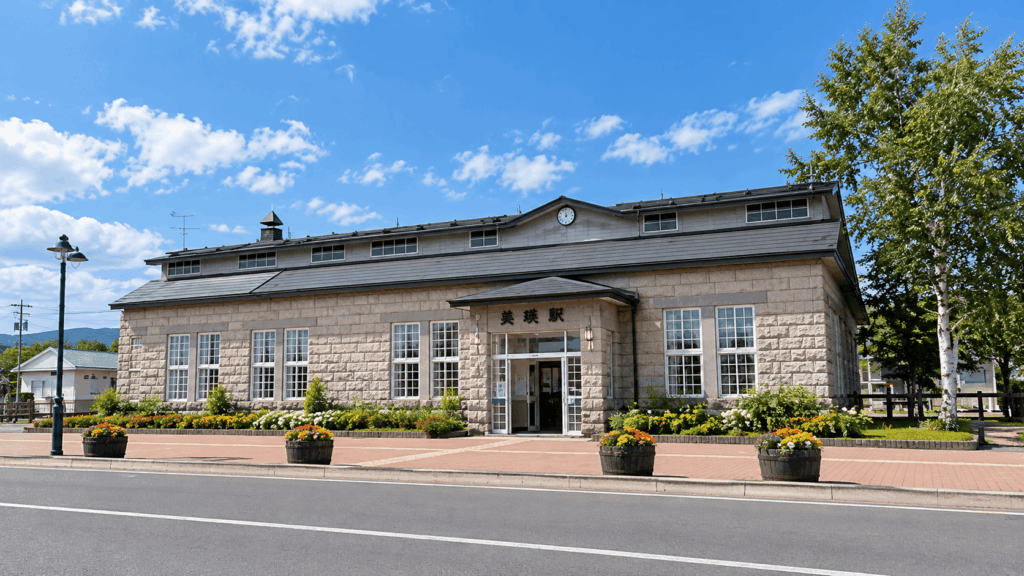
If you are travelling to Biei without a car, this is the good news: all three restaurants are walkable from Biei Station. Daimaru is about 7 minutes, Junpei about 8, and KOERU is on the station’s back side — you can see the platform from the window. A day trip by JR with a proper local lunch in the middle is entirely realistic, and the Furano Line connects Biei with Furano and Asahikawa, although combining several rural sights by public transport takes careful timetable planning.
The constraint is not lunch, it is everything after it. Buses toward Blue Pond run from the station but are not frequent, and the drive to Shikisai-no-Oka is not a walk. Check the timetable before you commit to a restaurant, because a 40-minute queue can cost you the one bus that would have made the afternoon work. If the timetable looks tight, choose a quick option near the station rather than risking the bus for a long restaurant queue.
If you are still planning your trip from Sapporo and want to fit Biei’s food and scenery into the same day without managing rural bus connections, a private tour is worth comparing with the train-and-bus approach.
Why I’d book this one
- A more flexible route: The private Furano–Biei itinerary can be adjusted to your interests. Ask the operator whether a lunch stop at Daimaru or Junpei can be accommodated before booking; neither restaurant is a guaranteed stop.
- Less transport planning: Having a dedicated driver makes it easier to connect distant sightseeing spots without arranging every rural bus connection yourself. Check the pickup location and the level of English-language guiding included in your selected option.
- Feedback and booking terms worth checking: An early verified traveler review mentions a helpful guide and comfortable vehicle, although the review sample is still small. Review the current cancellation conditions, itinerary and departure options before committing.
See live availability, itinerary details and recent traveler reviews for this private Furano–Biei tour. It is a sightseeing and transport option rather than a dedicated food tour, so confirm any specific restaurant stop with the operator.
Bicycles are another option in the green season, with rental shops near the station — but be realistic about distance and hills, especially if you are also fitting in a sit-down lunch.
What to Skip If You Only Have One Day in Biei

You do not need to eat everything on this list, and pretending otherwise is how food guides waste people’s afternoons.
- Skip the second big lunch. Curry udon with pork cutlet and a full ebi-don on the same day is too much food for an afternoon of driving. Pick one, and have the other on your next visit.
- Skip the queue if it costs you a viewpoint. Biei’s sights are the reason you came. No bowl of noodles is worth missing Blue Pond in decent light.
- Skip dessert if you are running late. Soft serve is a ten-minute pleasure, not a sightseeing stop. If the schedule is tight, cut the dessert, not the hill.
- Skip the Furano food detour. Melon and Furano’s own local dishes are fine, but they are not what this town is about, and crossing the valley for lunch eats the day.
One lunch, one dessert, and enough time left to stand in front of a pond without checking your watch — that is a good Biei day.
FAQ: What to Eat in Biei
What food is Biei famous for?
Biei is known for Biei Curry Udon, a dipping-style curry udon created in town in 2005 using Biei wheat, Biei pork and seasonal Biei vegetables. Beyond that, the local food identity is built on ingredients rather than dishes: Biei-raised pork, Biei milk and dairy, and the vegetables and wheat grown on the surrounding farms. Ebi-don at Cafe Junpei is a well-known restaurant dish rather than a local tradition, and Biei milk soft serve is the easy everyday treat.
Is Biei Curry Udon actually worth trying?
Yes, if it is your first visit. It is a signature local speciality developed here, and the dipping format — noodles, curry and toppings served separately — is genuinely different from the curry udon most people have had. Be clear-eyed about what it is: a modern local creation, not an ancient recipe. It is also a substantial meal, especially with pork cutlet added, so it works best as your main lunch rather than one stop on a food crawl.
Where can I eat Biei Curry Udon near Biei Station?
Two options are within walking distance. Family Restaurant Daimaru is about 500 metres, a 7-minute walk, on the main street and is the classic choice. KOERU is on the back side of the station, a 1–3 minute walk, with more seats and usually a shorter wait. KOERU is generally closed on Tuesdays, while Daimaru lists Wednesdays and may also close on certain Thursdays, especially in winter. Check before you plan around either. Other participating restaurants around town serve the same dish, and the official Biei Curry Udon site lists current providers.
Is Daimaru or Junpei better for lunch in Biei?
They serve different purposes, so the honest answer is “it depends what you want.” Daimaru is the better choice if you want the one dish specific to Biei and you are willing to accept a midday queue. Junpei is better if you would rather have crisp fried shrimp than curry, if you are travelling with someone who does not like curry, or if you may need to take your food away. If both are full, KOERU behind the station is the practical third option.
Can I get takeout in Biei if the restaurants are crowded?
At Junpei, yes — most of the menu can be ordered to take away, and the shop also does local delivery. Daimaru is more limited, though it takes phone orders for bento and platters. Before you order takeout, decide where you will eat it: Biei’s viewpoints are fields, ponds and car parks rather than picnic spots, so most people end up eating in the car or back near the station. If that does not appeal, waiting for a table may be the better call.
Can vegetarians eat Biei Curry Udon?
The standard version is not vegetarian. The local rules call for Biei pork shabu-shabu as a topping, and the curry sauce is not usually meat-free. Some shops may be able to leave the pork out, but each restaurant makes its own sauce, so ask before you sit down. If pork is a problem for you, Junpei’s café menu and the fried vegetable options elsewhere in town are worth checking instead.
Final Verdict: What to Eat in Biei, by Traveller Type
If you only remember one line from this guide, make it this: eat Biei Curry Udon once, early, and do not let the queue decide your afternoon. Everything else is a variation on that.
For first-time visitors: go to Daimaru, order the dipping curry udon with Biei milk, and add the pork cutlet only if you are genuinely hungry. Arrive just before 11:00. This is the meal that answers “what does Biei taste like,” and doing it once properly is worth more than eating at three places badly.
For travellers on a tight schedule: skip the queue entirely. Eat at KOERU behind the station when lunch service opens, or take an ebi-don from Junpei and eat it at your first stop. You will still have eaten something local, and you will have gained the hour that Blue Pond and Shikisai-no-Oka actually need.
For families: Daimaru is the easier room — tables, a raised tatami area, a second floor, and a menu with cutlet, hamburg steak and rice dishes for children who will not touch curry. Go at opening rather than at noon, and have a soft serve afterwards as the bargaining chip that gets everyone back in the car.
For travellers without a car: base your lunch on the bus timetable, not on the restaurant. KOERU’s position behind the station makes it the lowest-risk choice, and Daimaru is close enough if the line looks manageable. Either way, eat before you head for the pond, not after.
For repeat visitors: you have already done curry udon at Daimaru, so change the order rather than the town. Try the baked version, order the pork cutlet, or eat at KOERU and spend the saved time on the Patchwork Road. Junpei’s ebi-don is the natural next discovery.
For winter travellers: assume less is open than you expect. Biei Senka’s Senka Kobo dessert counter shuts from 5 November (although the market remains open), daylight is short, and a long lunch queue costs more than it does in summer. Eat early, keep the afternoon simple, and check opening days before you drive anywhere.
The mistake I would most like to talk first-time visitors out of is treating Biei as a checklist. It is a town of a handful of lunch seats wrapped around some of the best farmland scenery in Japan. Pick one dish, eat it without regret, and leave the rest of the day for the hills.

Hi, I’m Kai. I’m a Tokyo-based travel writer, tourism industry insider, and the author of a published guidebook for international visitors to Japan. With over 10 years of professional experience at a leading Japanese tourism company, my mission is to help you skip the tourist traps and navigate Japan’s best destinations like a local. I believe the perfect day trip is like a traditional kaiseki meal: a beautiful balance of precise planning and unforgettable seasonal discovery. When I’m not out conducting field research, you’ll usually find me drafting new itineraries with one of my favorite fountain pens!