
Furano works as a day trip from Sapporo — but only if you treat it as one place, not a region. If Farm Tomita is the reason you are going, a single day is enough for most travelers: you can walk the flower fields properly, add one more stop in the afternoon, and be back in Sapporo by evening. What does not work well is Furano and Biei and the Blue Pond on public transport in one day. That version looks fine on a map and falls apart at the timetable.
The deciding factor is not distance. It is how much of your day gets eaten by moving between stops, and whether you are willing to give up the one thing Furano does better than almost anywhere else in Hokkaido: a flower farm at a quiet hour.
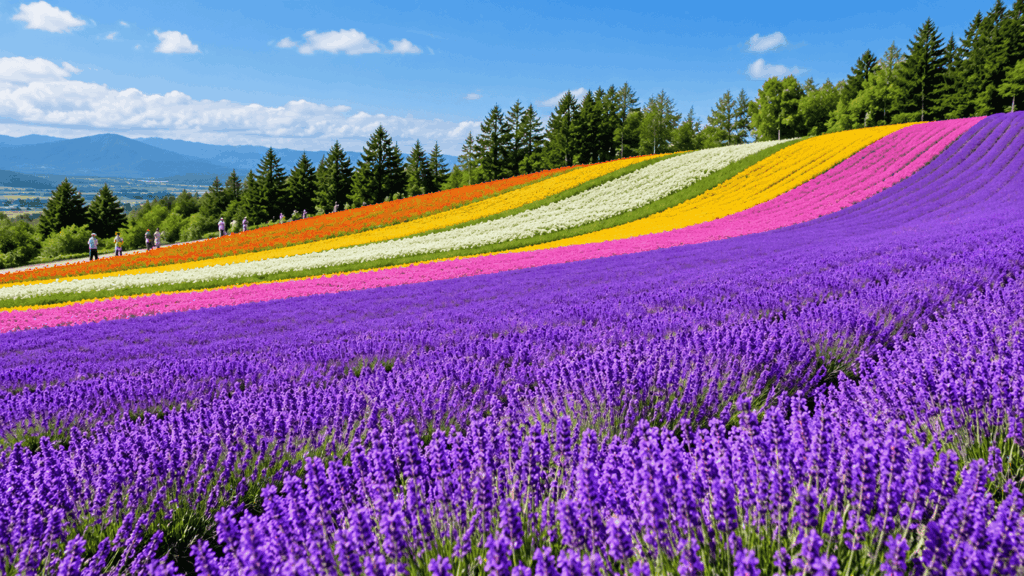
If you want to cover both Furano and Biei in one day without driving, a private-driver trip is worth comparing with a fixed-schedule coach tour. Check the suggested route, available dates, and private-group pricing for this Furano–Biei day trip from Sapporo before deciding whether the extra flexibility is worth it.
Is Furano Worth a Day Trip?
Yes, with one condition: pick a single anchor and build the day around it. For most first-time visitors that anchor is Farm Tomita in Nakafurano, with either the Ningle Terrace craft village or a slow lunch in Furano as the second half. That combination fits comfortably into a day trip, including about two hours each way by seasonal direct train, or closer to three hours each way by highway bus.
Furano and Biei are separate towns, not two neighborhoods of the same destination. Once you start adding Biei’s Blue Pond and Shikisai-no-Oka to the same day, you are no longer choosing stops — you are choosing a transport method, and the answer changes completely. On trains and buses, the connections between these places are few enough that the day becomes a timetable exercise. By car or on an organized bus tour, the same itinerary is realistic, but your time at each stop shrinks.
Best for: travelers whose main goal is flowers and photography, who can start early, and who are happy with two or three well-chosen stops rather than a full checklist.
Not ideal for: travelers who want Furano and Biei at a relaxed pace, who want to see Ningle Terrace in the evening, or who plan to cover several outlying spots using only public transport.
The mistake I see in most Furano itineraries online is not the list of places — it is the order. They put the busiest, most photogenic stop in the middle of the day and then wonder why the afternoon collapses. Crowds at Farm Tomita do not just make the fields feel busy; they slow down photography, walking, toilets and food, and every one of those delays pushes your next stop later. Fixing the order is more valuable than cutting a stop.
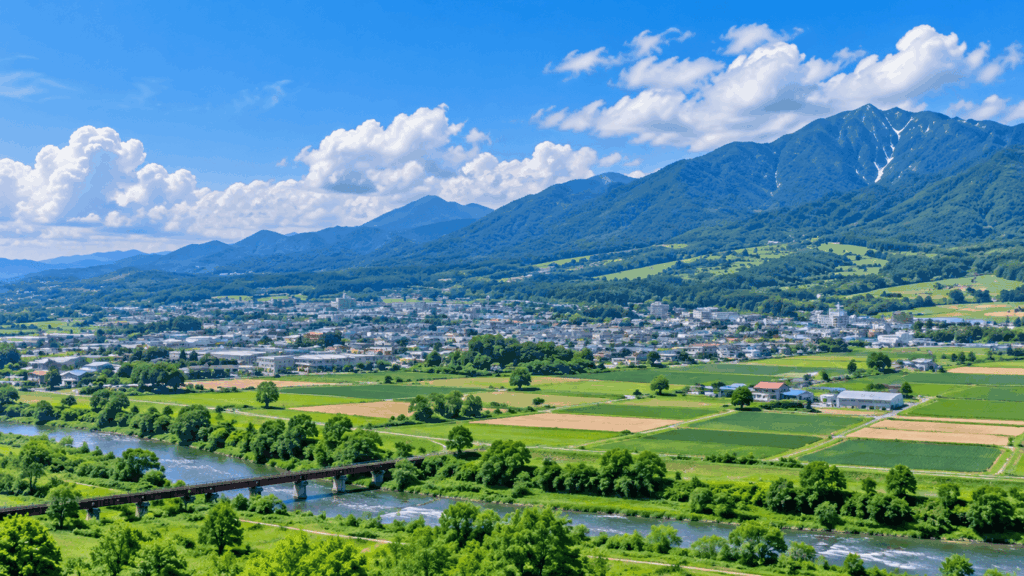
Is one day enough in Furano?
| Trip length | Best for | Realistic stops | Main trade-off |
|---|---|---|---|
| Day trip from Sapporo | Farm Tomita as the main goal, plus one secondary stop; travelers who cannot or do not want to change hotels | Farm Tomita, plus either Ningle Terrace or central Furano for lunch | You arrive mid-morning at best, so you miss the quietest hours; the return train sets a hard end to the day |
| 1 night / 2 days | Travelers who want Furano and Biei, or who want Farm Tomita early and Ningle Terrace after dark | Farm Tomita, Ningle Terrace, a Biei stop such as Shikisai-no-Oka or the Blue Pond | One more hotel change, and still not enough time for every flower farm in the area |
| 2 nights or more | Photographers, road-trippers, travelers building in a weather buffer | Multiple farms, Lavender East, Biei back roads, Tokachidake side trips | More time committed to a rural area that has fewer evening options than Sapporo |
If your plan is specifically to see Furano and Biei in one day from Sapporo, the transport problem is the whole problem — an organized bus tour is the only option that removes it entirely, at the cost of fixed time at each stop. The transport section below explains when that trade is worth it and when it is not.
A Realistic One-Day Furano Itinerary
This is a Furano-only day, built around the direct summer train from Sapporo. Times below are from the 2026 timetable as a reference, not a confirmed 2027 service — always check the current season’s operating dates and departures, because the return train is what decides how much you can fit in.
- 07:41 — Direct limited express from Sapporo to Furano (about two hours, all reserved seats)
- 09:44 — Arrive Furano Station, then continue to Nakafurano by train, bus or taxi
- Mid-morning to early afternoon — Farm Tomita, including the climb to the upper lavender field
- Lunch — Either in Nakafurano or back in central Furano
- Afternoon — One stop only: Ningle Terrace, or Furano itself
- 16:53 — Direct train from Furano back to Sapporo, arriving around 18:52
Two things about this shape matter more than the exact minutes. First, you are not arriving at opening time. A same-day start from Sapporo puts you at Farm Tomita somewhere around mid-morning at best, which is already when day-tour coaches begin to appear. Second, the return departure is fixed and unforgiving: if you are still at Ningle Terrace at 16:20, you have a problem. Decide your afternoon stop with the return train in mind, not the other way around.
If you are staying in the Furano area instead, the same day gets noticeably better, because you can be at Farm Tomita when the gates open and still have the whole afternoon free. That single difference — arriving at opening versus arriving at ten-something — is the strongest argument for one night in this article. If you decide to do this, our guide on where to stay in Furano can help you choose the right base.
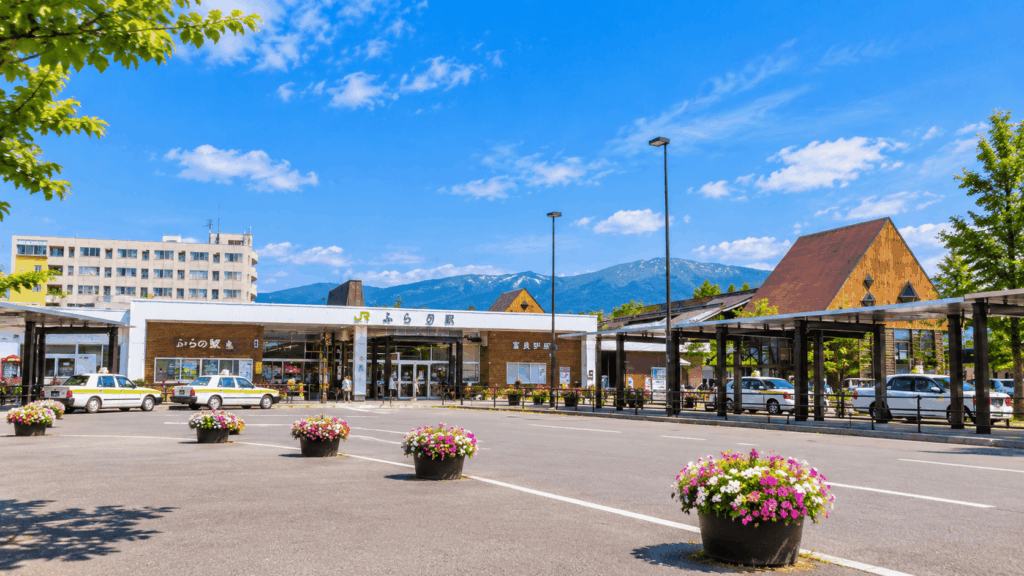
Start at Farm Tomita as Early as the Current Opening Hours Allow
Farm Tomita is free to enter and has facilities open year-round, but its hours move with the season: around 8:30 to 18:00 in July, 9:30 to 16:30 in October and November, and about 10:00 to 16:00 from December to early April. Individual shops and outdoor areas may have different opening periods. The farm also states clearly that entry is not allowed outside published opening hours. Check the official site for your specific date rather than trusting a number from a blog, including this one.
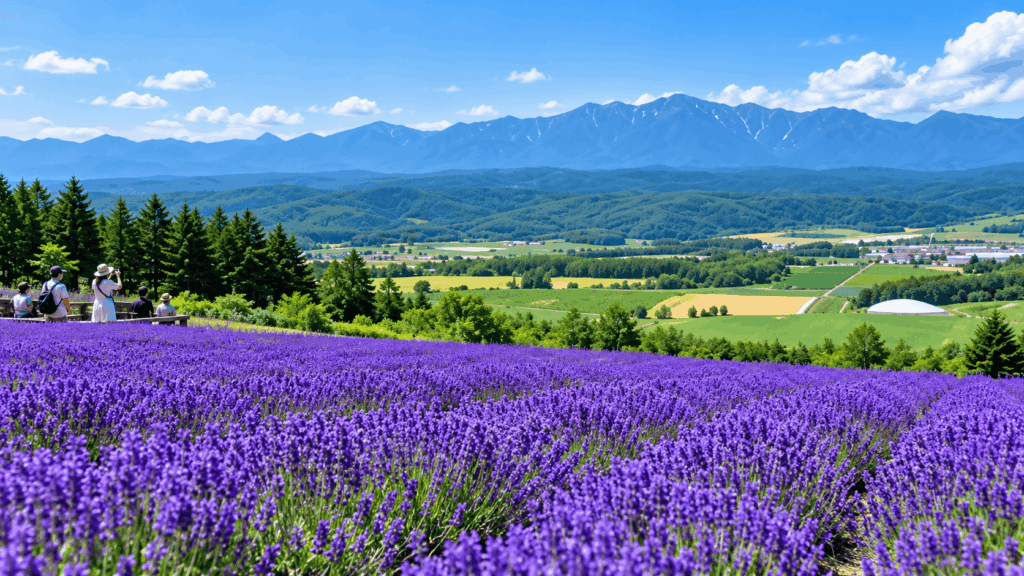
Within those hours, go as close to opening as you can manage. In lavender season the fields fill in a predictable pattern: independent travelers early, coach groups from mid-morning, and the narrow paths between the rows becoming a slow-moving queue by midday. The flower fields themselves do not change at 11am, but everything around them does — the viewpoints, the ice cream counter, the toilets.
Kai’s tip: On my 2025 summer visit I took the first train of the day from Furano, walked up from Nakafurano Station, and was in the fields before six-thirty. For a while the rows were almost empty; I could hear a woodpecker somewhere behind the trees and take photos without waiting for anyone to move. It was the best hour of the trip, and by the time I left, the same paths were crowded and the women’s toilet had a long line. Farm Tomita no longer permits entry before its published opening time, so I would not try to repeat that. What I would repeat is the principle: make it the first thing you do, and arrive as close to opening as the schedule allows.
Recent visitors consistently mention the same pattern — the farm is pleasant early and genuinely busy from mid-morning in peak season, with queues at the toilets and food counters. That matches what I saw, and it is the reason this stop belongs at the start of the day rather than after lunch.
One practical consequence: lavender soft cream is worth trying, but buy it when you first feel hungry rather than at the peak lunch moment. The queue grows faster than the appetite.
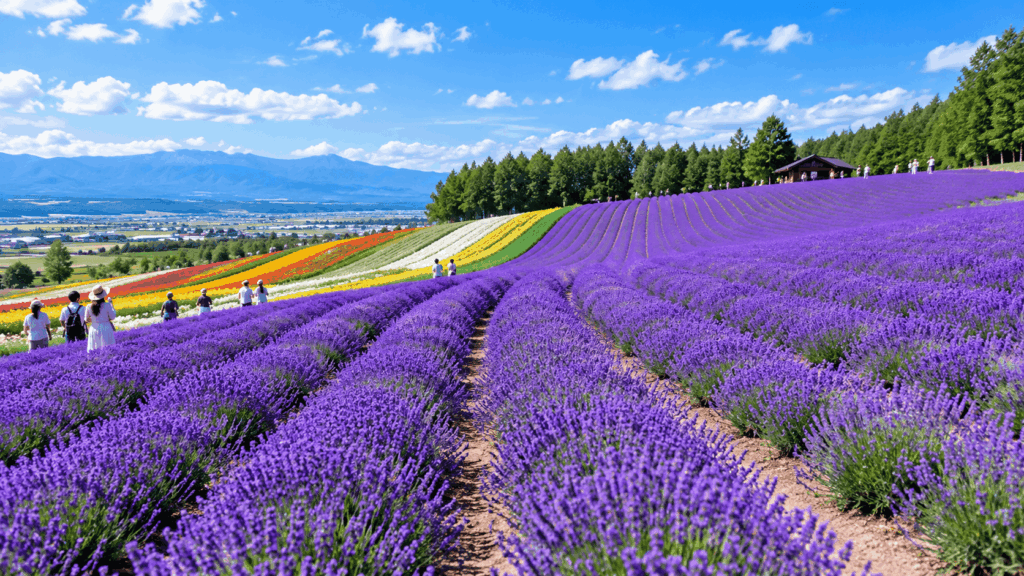
Allow Time for the Traditional Lavender Field
Farm Tomita is not a flat field you can loop in fifteen minutes. The Traditional Lavender Field sits at the back of the farm and rises up a slope, with the best view looking down over the Furano Basin toward the Tokachi mountains. Getting to the top takes real effort on a warm day, and the path is steeper than the postcard view suggests.
Budget 60 to 90 minutes for the farm as a whole if you want the upper viewpoint, the greenhouse and a drink, and wear shoes you can walk uphill in. This is not a place for sandals or heels. If you are traveling with someone who has knee or hip problems, the lower fields and the café area still give you the classic view without the climb.
Kai’s tip: I underestimated that slope. I was carrying a camera bag and stopped twice on the way up, and I was glad I had proper walking shoes rather than the sneakers I nearly wore. The other thing I would do differently is use the toilet the moment I arrived, before starting the loop — by the time I came back down, the line had formed and I had already walked past two chances to join a short one. Also, if you eat outside near the trees, keep an eye on the crows; one of them took an interest in my bag and made its point loudly. That is a small annoyance, not a reason to avoid the farm.
The viewpoint is the reason to make the climb, so give yourself permission to skip it if the day is hot, humid or you are short on time. The lower fields photograph well too, and you will not have spent your remaining energy on a slope.
Choose One Main Afternoon Stop
After Farm Tomita, resist the urge to add a third and fourth stop. A Furano-only day trip works best with exactly one afternoon anchor, chosen by what you actually enjoy rather than by what appears on lists.

Keep Ningle Terrace if you like craft workshops, forest settings and photographed timber huts, and you are comfortable wandering without a fixed plan. It is a cluster of small wooden shops in the trees beside Shin Furano Prince Hotel, free to walk through, roughly 10 to 15 minutes by car or taxi from Furano Station and around 17 to 20 minutes on the Lavender Bus.
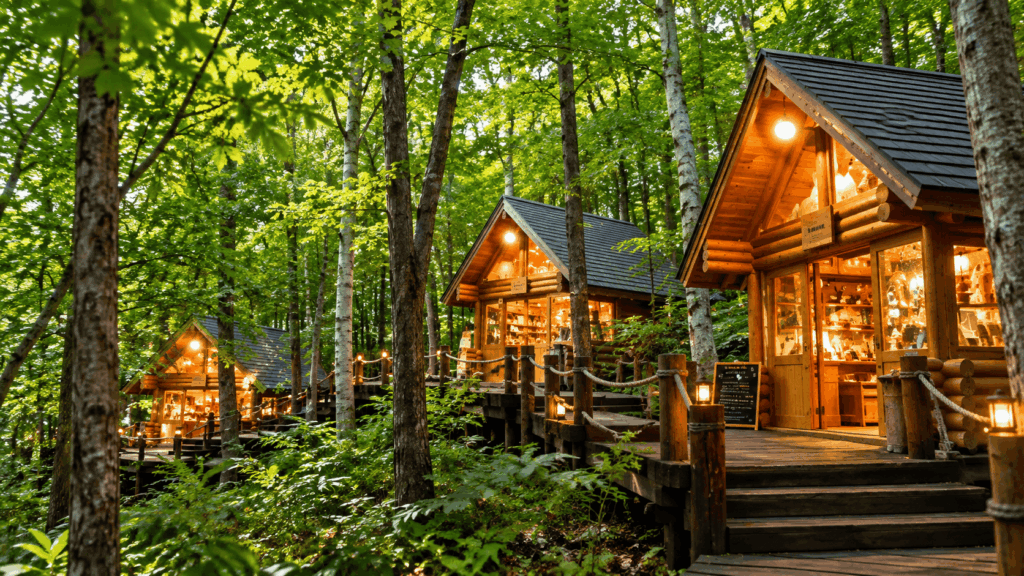
Skip Ningle Terrace if flowers are your only real priority, you have no interest in craft shopping, or you want to be back in Sapporo without rushing the final connection. It is a pleasant place, not an essential one, and the day does not collapse without it.
Opening hours vary by season and shop. The hotel lists 10:00–20:45 in July and August, 11:00–19:45 during the other summer operating period, and 12:00–20:45 in winter. COFFEE HOUSE Chuchu no Ie keeps a separate seasonal schedule; in summer 2026 it operated from 4 July to 23 August, noon to 19:45, with last orders at 19:30. Do not assume the café stays open as late as the craft shops. Check before you build a plan around it.
Kai’s tip: I expected a hushed forest and found something closer to a busy village. On my 2025 summer visit there were several overseas tour groups moving through at the same time, and the narrow walkways got congested in exactly the places everyone stops to photograph. That did not ruin it, but it changed how I would plan it: I would go for the craft huts and the walk, not for silence, and I would not schedule it as a peaceful break at the end of a long day. I also noticed several caterpillar warning signs in the trees that summer, so if insects bother you, long sleeves and trousers are a reasonable choice rather than an overreaction. After a lot of walking, the baked milk at Chuchu no Ie was the right kind of stop — small, warm and quick.
In practice, though, the evening version of Ningle Terrace — the one in every photo, with the huts lit up after dark — does not fit a Sapporo day trip. The last practical train back leaves Furano in the late afternoon. If the illuminated version is what you came for, that is a one-night stay, not a day trip.
What Changed for 2027: The Norokko Train Is Gone
If you are reading older Furano guides, this is the part that has changed. The Furano-Biei Norokko, the summer sightseeing train that stopped at the seasonal Lavender Farm Station seven minutes’ walk from Farm Tomita, made its final run on 23 September 2026. JR Hokkaido has described it as the end of operation, not a temporary suspension.
JR Hokkaido announced on 28 October 2026 that its new sightseeing train, Aoi Hoshi Oka no Irodori (Blue Star: Colors of the Hills), will now start on 1 July 2027, one month later than originally planned. It is scheduled to run between Asahikawa and Furano twice daily in each direction, with a published adult one-way ride-only price of ¥4,880 for the full route. The planned operating period runs through 20 September, with daily service at the beginning of the season and selected later dates. From 5 to 30 June 2027, a different temporary service, Kunpu no Oka, is planned for the route, with an adult one-way fare of ¥3,060. Check JR Hokkaido for the exact timetable, operating dates and stops before booking.
What that means for planning: do not assume you can step off a train at Lavender Farm Station in 2027. That stop existed for the Norokko, and no announcement has confirmed it will be served by the new service. Unless JR announces a new stop at the temporary station, the reliable ways to reach Farm Tomita without a car are the local train to Nakafurano Station plus a 25-minute walk, a taxi, or the year-round Lavender-go bus followed by the walk from its Nakafurano stop. Anyone who tells you otherwise is working from pre-2026 information.
How to Get Around Furano on a Day Trip
The three options are not really about convenience. They are about how many usable hours you get at your stops, and whether Furano and Biei can both be in the same day at all. For a detailed breakdown of routes and fares, see our guide on traveling from Sapporo to Furano.
| Transport | Flexibility | Best for | Main drawback | Furano + Biei in one day? |
|---|---|---|---|---|
| Rental car | Highest — change the order, wait out a shower, leave when you want | Travelers comfortable driving in Japan who want Farm Tomita at opening and freedom in the afternoon | Peak-season parking and traffic around the main farms; driver fatigue on a long return leg | Yes, realistically — the only self-guided option that does |
| Train and bus | Low — the day is built around departure times | Travelers whose main goal is Farm Tomita, with one nearby second stop | Local trains between Furano and Nakafurano run roughly every two hours; connections eat the afternoon | Not comfortably, especially for a first visit |
| Organized tour | Low at each stop, high door to door | Travelers who want Furano and Biei together without planning transport | Fixed time at each stop — the Farm Tomita stop on current tours is often around 50 minutes | Yes, and it is the simplest way to do it |
By Train — Best If Farm Tomita Is Your Main Goal
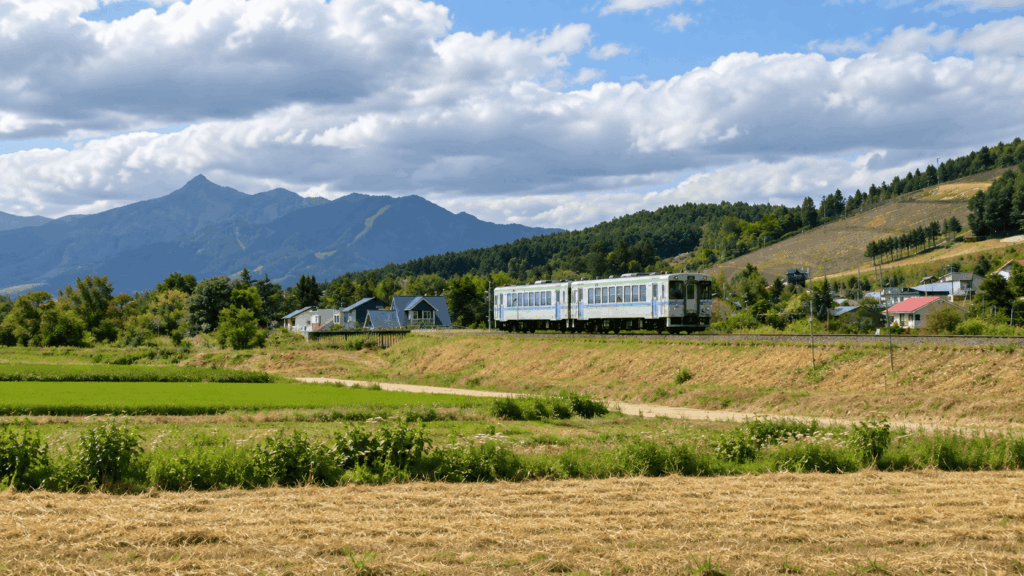
Trains work for a Furano-only day, provided you accept that the timetable runs the day rather than the other way around. From Sapporo, the summer direct limited express is the simplest option: in 2026 it left Sapporo at 7:41 and reached Furano at 9:44, returning at 16:53, all seats reserved, at 5,440 yen. It ran seasonally — 6–7 June, 13 June–11 August, selected weekends later in August and September, and 19–23 September 2026 — so confirm the current season’s operating days before you build a trip around it. Outside those dates, the usual route is a limited express to Takikawa and a local train onward, which takes between roughly two and two and three-quarter hours depending on the connection.
If you would rather not think about transfers at all, the highway bus from Sapporo Station to Furano Station runs several times a day, takes close to three hours, and cost 2,700 yen one way in the 2026 summer timetable. It is slower and less scenic than the train, but it requires no reservation and no changes, which matters if you are carrying luggage.
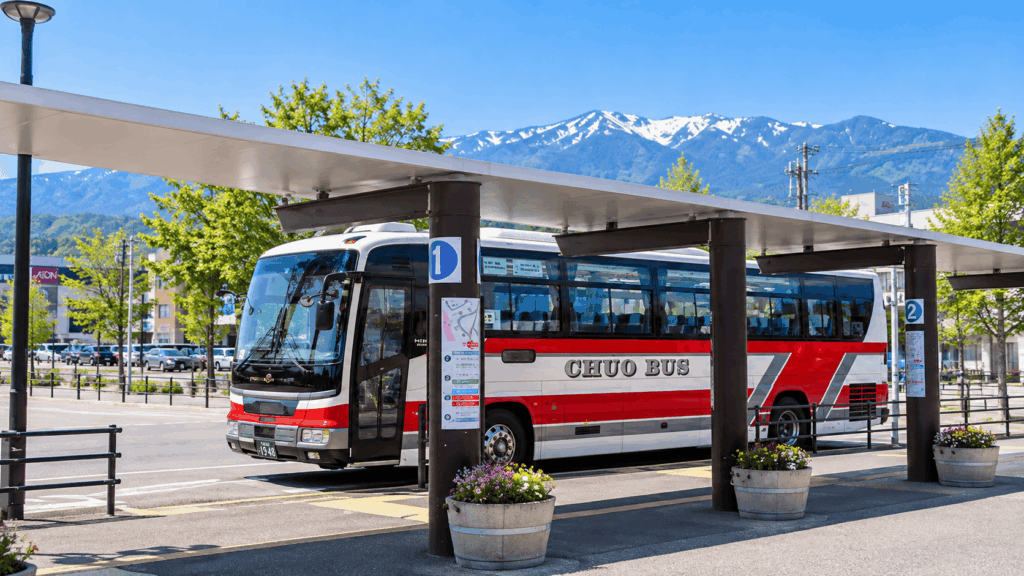
In Furano, the local line between Furano and Nakafurano takes about 15 minutes and costs a few hundred yen — but only a handful of trains run each day. This is the single most common place where public-transport itineraries fall apart. Check the return times before you commit to an afternoon stop, not after.
From Nakafurano Station, Farm Tomita is about a 25-minute walk on flat ground, which is pleasant in the morning and considerably less pleasant in the midday sun. The year-round Lavender-go bus connects Furano Station, Nakafurano and the New Furano Prince Hotel area, but departures are too limited to treat it as a turn-up-and-go service.
By Rental Car — Best for Flexibility

A car changes what is possible rather than just making it easier. You can be at Farm Tomita when it opens, retreat to Furano for lunch when the farm gets busy, and change the afternoon if the weather turns. It is also the only self-guided option that puts Furano and Biei in the same day.
The costs are real: peak-season parking around the best-known farms, slow traffic on the narrow approach roads, and a long return drive after a full day outdoors. Depending on the issuing country, foreign visitors may need a valid 1949 Geneva Convention international driving permit alongside their original home licence; certain licence holders can instead use an approved Japanese translation. Confirm the rule for your licence before booking, and reserve the car ahead of time — rental availability in Furano itself is thinner than in Sapporo.
By Organized Tour — Best for Furano + Biei in One Day
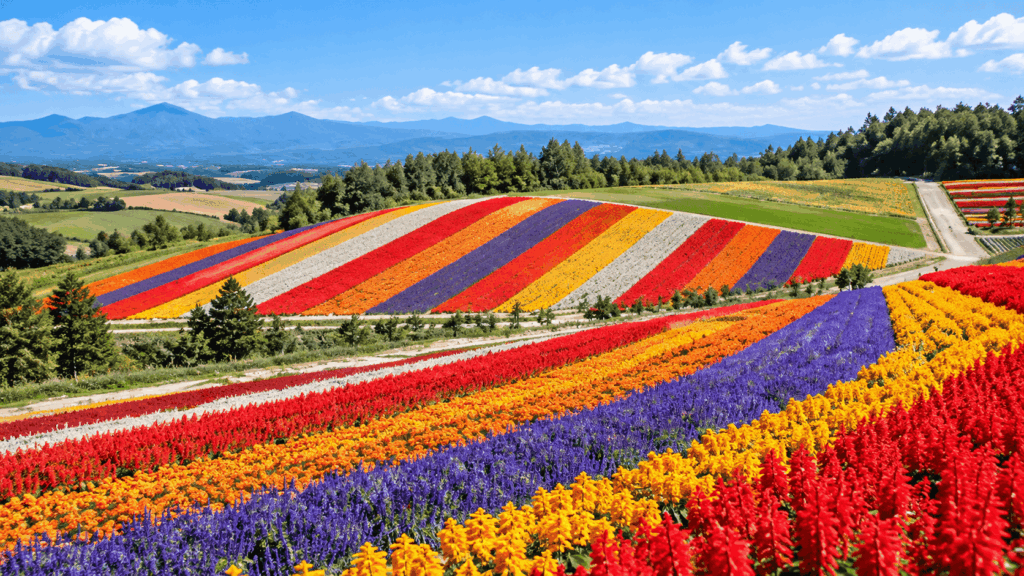
A coach tour is the only option that removes the transport problem entirely, and for the specific combination of Farm Tomita, Shikisai-no-Oka and the Blue Pond from Sapporo on the same day, it is the most sensible choice. Pickup is in central Sapporo in the morning, the driving is someone else’s job, and you are back in the city in the evening.
What you give up is time. On a representative Sapporo departure offering this route, the schedule runs roughly 30 minutes at the Blue Pond, 20 at Shirahige Falls, an hour for lunch, an hour at Shikisai-no-Oka and about 50 minutes at Farm Tomita, over a ten-hour day with free cancellation up to 24 hours before departure. Groups are small, and the guide is typically a driver-guide providing coordination rather than detailed commentary.
Fifty minutes at Farm Tomita is enough to walk the main fields and buy an ice cream. It is not enough to climb to the upper lavender viewpoint, wait for clean photos, and browse the shops. If your reason for visiting Furano is photography, this tour will frustrate you; if your reason is seeing a lot of Hokkaido scenery in one day without driving, it is a fair trade. Tour itineraries, stop lengths and operators change between seasons, so confirm the current inclusions before booking rather than relying on this description.
If you want to see both regions but a fixed 50-minute farm stop sounds too rushed, a private-driver trip is the higher-commitment alternative worth considering. It offers a way to discuss your sightseeing priorities without managing the driving yourself, although the route and time available at each stop still need to be agreed in advance.
Why I’d book this one
- More control over the route: Recent travelers mention drivers who were willing to adjust sightseeing plans and help manage the day efficiently, rather than simply following a rigid coach timetable.
- The right combination of stops: The suggested summer itinerary includes Farm Tomita, Shikisai-no-Oka and the Blue Pond. You can discuss which places matter most before settling on the route, subject to driving time and the operator’s conditions.
- Booking flexibility to check: The listing offers cancellation and pay-later options on eligible bookings. Review the current terms for your selected date before committing.
This is a private trip with a driver, not a fully guided sightseeing experience. It is better suited to travelers who value transport convenience and some itinerary flexibility than those looking for detailed English-language commentary. Confirm your preferred stops, communication needs and time at Farm Tomita before booking.
Should You Combine Furano and Biei in One Day?
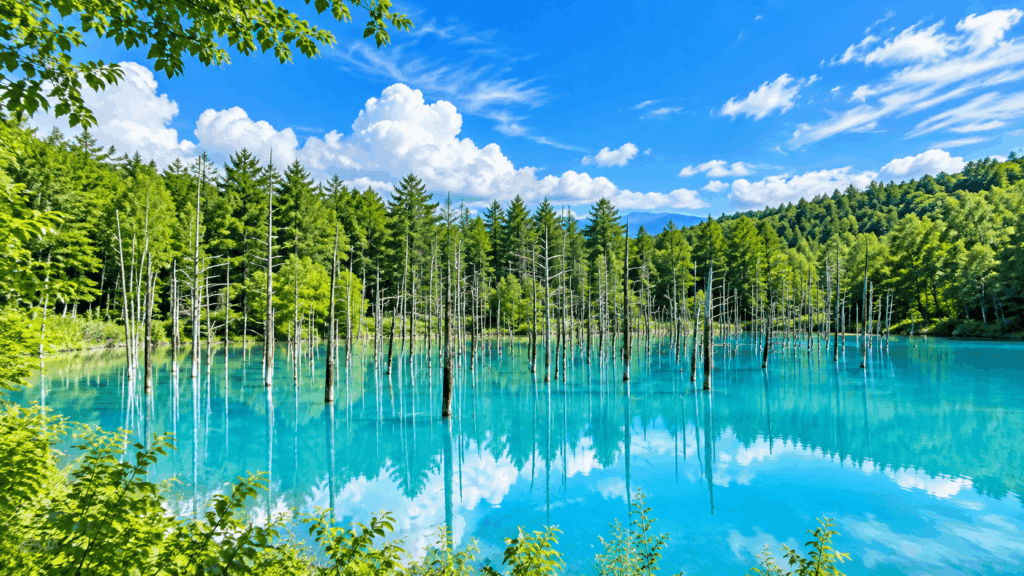
It is possible, but the honest answer depends entirely on how you move. By car or tour, yes — with the understanding that you will be moving quickly. By public transport, a first-time visitor trying to cover Farm Tomita, Shikisai-no-Oka and the Blue Pond in one day is signing up for a schedule with almost no slack: sparse local trains, buses that do not align, and a very long day.
| Option | What the day looks like | What you gain | What you give up | Who it suits |
|---|---|---|---|---|
| Furano only | Farm Tomita at a slow pace, a proper lunch, one afternoon stop | Depth, better photographs, no timetable stress | Variety — you see one kind of landscape | Photographers, flower-focused travelers, anyone who dislikes rushed stops |
| Furano + Biei | Farm Tomita, Shikisai-no-Oka, the Blue Pond, more time in the vehicle | Range: flower fields, patchwork hills, a cobalt pond in one day | Time at each stop, and any chance of waiting out bad light | Travelers prioritizing how much they see over how long they stay |
The distance between the two areas is the part people underestimate. Furano and Biei are separate towns roughly 40 to 60 minutes apart by road, and the photogenic spots within Biei are spread out further still. Adding Biei does not add a stop; it adds a second half-day of driving. If you prefer to dedicate a full day to the latter, see our dedicated Biei day trip itinerary.
If you are set on both, the practical version is one anchor in each area rather than three stops in Biei. Farm Tomita plus Shikisai-no-Oka is a coherent day. Farm Tomita, Shikisai-no-Oka, the Blue Pond and Shirahige Falls is a coach itinerary — fine in a vehicle with a driver, exhausting if you are the one reading timetables.
My own view, after walking Farm Tomita slowly, is that the farm rewards time in a way that a checklist cannot. I spent well over an hour there and still felt I had rushed the upper field. If you are the kind of traveler who wants to sit with a view for twenty minutes, adding Biei to the same day will take that away from you.
How Many Days Do You Need in Furano?
Rather than counting days, count the things you genuinely want to do and then check them against your transport. One non-negotiable anchor plus one flexible stop is a day trip. Two anchors in different towns is a night. Three or more, or a desire to be somewhere at opening time, is two nights.
A single day is enough for Farm Tomita done properly plus Ningle Terrace or central Furano — that is a satisfying day, and the one most first-time visitors actually want. One night opens up the version where you are at the farm gates when they open, see Biei in the afternoon, and come back to Ningle Terrace after dark. Two nights is for people who want a weather buffer, Lavender East, or the quieter back roads, and who are content with limited evening options in a rural town.
The most common planning error is booking one night but planning a two-night itinerary. Furano rewards a slower plan; it punishes an overstuffed one with time lost in transit rather than anything dramatic.
Practical Tips That Make a Furano Day Trip Better
- Check the farm’s hours for your date, not for the season in general. Farm Tomita’s opening time moves from around 8:30 in July to 9:00 or later outside summer, and entry outside published hours is not permitted.
- Wear shoes for walking uphill. The upper lavender field involves a genuine slope, and the ground between rows is uneven.
- Use the toilet early. Queues build through the late morning in peak season, and there are limited alternatives nearby.
- Do not count on Ningle Terrace being quiet. Coach groups pass through, and the narrow paths bottleneck where everyone stops to shoot.
- Treat the return train as a fixed deadline. Work backwards from the departure time when choosing your afternoon stop, and leave a buffer for the walk or bus back to Furano Station.
- Carry some cash and a transit IC card. Small buses and rural counters are not always card-friendly, and ticket machines are simpler with an IC card.
Best Time for a Furano Day Trip
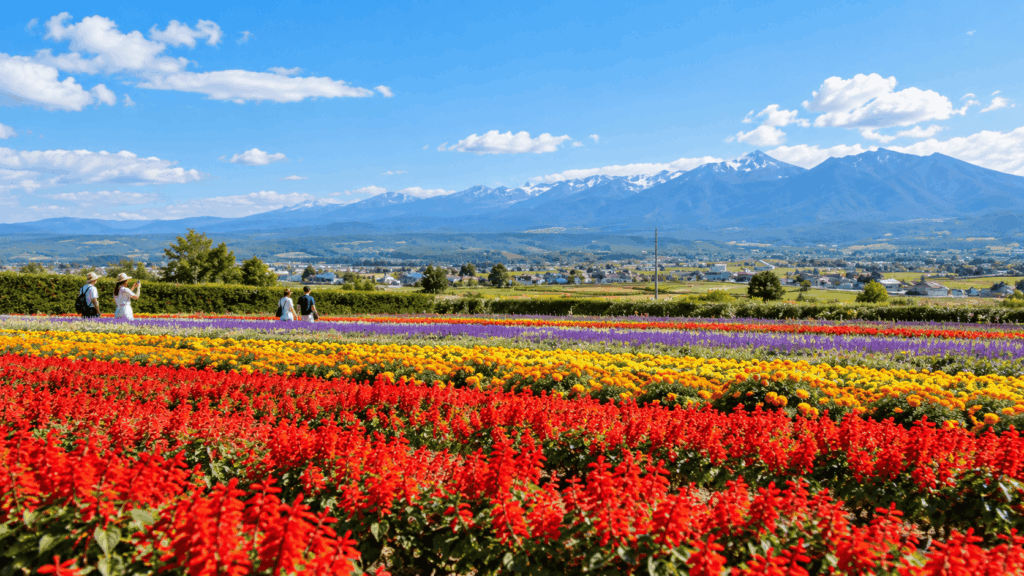
If lavender is the reason for the trip, the window is late June to early August, with the deepest colour usually falling in early to mid-July. That is a trend, not a guarantee — the exact peak shifts with the weather each year, and different varieties bloom in sequence, so a visit in the first week of July can look very different from one in the last week. Farm Tomita publishes bloom updates through the season; use those rather than a fixed date from any guide. For a deeper breakdown of the seasons, see our complete guide to the best time to visit Furano.
Peak bloom and peak crowds are the same weeks. That is the trade you are making: the fields look their best exactly when the coaches arrive. If you want the lavender and a calmer visit, the realistic compromise is to stay overnight and go at opening, because a day trip from Sapporo cannot get you there that early.
Outside lavender season, Furano is a different trip. Other flower fields on the farm bloom into autumn, the roads are quieter, and prices and availability are easier — but if the postcard image of purple rows is what you are chasing, late September will not deliver it. Spring and autumn are better suited to travelers who want the landscape and the driving rather than the lavender specifically.
One seasonal point worth knowing for summer: the Furano basin gets genuinely hot and humid in July and August, and the farm offers little shade on the upper slope. Starting early is as much about heat as it is about crowds.
Frequently Asked Questions
Can you visit Furano as a day trip from Sapporo?
Yes, and it is a comfortable day if you keep it to one area. On 2026 operating dates, the direct summer limited express took about two hours each way, and the late-afternoon return left roughly seven hours in Furano town, less the time needed to reach Farm Tomita and get back to the station. That is enough for Farm Tomita at a reasonable pace plus one afternoon stop. It is not enough for Furano, Biei and the Blue Pond together on public transport, because the connections between those places are too sparse.
Is one day enough in Furano?
For most first-time visitors whose main interest is the flower fields, yes. One day covers Farm Tomita properly and leaves room for either Ningle Terrace or a slow lunch in central Furano. A second day only becomes worthwhile when you want to add Biei, be at the farm when it opens, or see Ningle Terrace after dark — all of which require sleeping in the area rather than returning to Sapporo.
Can you visit Furano without a car?
Yes, but the shape of the trip changes. Farm Tomita is reachable by train to Nakafurano Station followed by a 25-minute walk, or by the year-round Lavender-go bus to Nakafurano followed by a similar walk, and Ningle Terrace is served by buses toward Shin Furano Prince Hotel. What you cannot easily do without a car is string together several outlying stops in one day, because local trains between Furano and Nakafurano run only a handful of times a day and the buses are not frequent enough to improvise around.
Can you visit Furano and Biei in the same day?
By car or on an organized coach tour, yes — though you will spend a meaningful part of the day in the vehicle, and the two towns are roughly 40 to 60 minutes apart by road. On public transport, it is technically possible but not advisable for a first visit: the combination of sparse local trains, widely spaced Biei sights and a fixed return departure leaves almost no margin for delays or for lingering anywhere.
What time should you visit Farm Tomita?
As close to the published opening time as you can manage on your date, which in lavender season means early morning rather than late morning. Farm Tomita does not allow entry outside its opening hours, and the hours themselves shift by season — around 8:30 to 18:00 in July, closer to 9:30–16:30 in October and November and 10:00–16:00 in midwinter. Check the official site for your specific day rather than relying on any guide, since the gates open at different times across the year.
Is Furano worth visiting outside lavender season?
It is a different trip rather than a lesser one. Other flowers on the farm bloom into autumn, the roads and viewpoints are far quieter, and you are not queuing for anything. But if the purple rows are the reason you are going, late June to early August is the only window, with the deepest colour usually in early to mid-July. Travelers who mainly want Hokkaido’s rolling farmland and a relaxed drive will find spring and autumn easier and more pleasant than the peak weeks.
Final Verdict: Day Trip, Overnight, or Tour?
Furano is one of the few places in Hokkaido where the transport choice determines the experience more than the itinerary does. Decide that first, and the rest of the plan falls into place.
Choose the day trip if Farm Tomita is your main reason for going, you can accept arriving mid-morning rather than at opening, and two or three stops is enough for you. Book the direct summer train early, treat the late-afternoon return as fixed, and pick one afternoon stop — Ningle Terrace for craft and forest, or central Furano for lunch and a slower pace.
Choose one night in the Furano area if you want the farm at opening, you want Biei in the same trip without a coach, or you want to see Ningle Terrace illuminated after dark. This is the version that makes Furano feel like a place rather than a photo stop, and it is the one I would pick for a first visit if the budget allows an extra night.
Choose an organized tour if your goal is to see Farm Tomita, Shikisai-no-Oka and the Blue Pond from Sapporo in a single day without driving. It is the only option that makes that combination realistic. Go in knowing that the Farm Tomita stop on current tours is around 50 minutes, which is fine for a walk and an ice cream and frustrating for a photographer.
For first-time visitors: the day trip with Farm Tomita as the anchor is the safest plan. It delivers the thing Furano is famous for without committing a night to a rural town with limited evening options.
For families: the coach tour removes the two hardest parts — driving and timetable management — and the short stops suit children better than a long adult-paced afternoon. The trade-off is an early start and a long day in a vehicle.
For travelers on a tight schedule: do not attempt Furano and Biei by public transport. Either take the tour and accept fixed stop times, or drop Biei and give Furano a proper half day.
For photographers and repeat visitors: stay overnight, be at the gates when the farm opens, and keep the afternoon deliberately loose. The upper lavender field, the walk down through the rows, and the light before the coaches arrive are the reasons to sleep in Furano rather than commute to it.
If you have already decided that the Furano and Biei combination is what you want, the remaining question is which departure fits your dates and how long each stop actually lasts — compare current Furano and Biei day tours from Sapporo before you commit, and check the stop times rather than just the list of places.

Hi, I’m Kai. I’m a Tokyo-based travel writer, tourism industry insider, and the author of a published guidebook for international visitors to Japan. With over 10 years of professional experience at a leading Japanese tourism company, my mission is to help you skip the tourist traps and navigate Japan’s best destinations like a local. I believe the perfect day trip is like a traditional kaiseki meal: a beautiful balance of precise planning and unforgettable seasonal discovery. When I’m not out conducting field research, you’ll usually find me drafting new itineraries with one of my favorite fountain pens!