
Kinosaki Ropeway: Is It Worth It? Views, Time, Hike & Tips
If you are weighing up the Kinosaki Onsen Ropeway, the honest short answer is: it is worth it on a clear day, and easy to skip when the weather is against you. The gondola ride takes about seven minutes to the top of Mount Daishi, and almost all of the value sits in the view — over the hot-spring town, along the Maruyama River and, on a bright day, toward the Sea of Japan. Give it 60–90 minutes in total rather than seven, go on a clear morning if you can, and it earns its place in a Kinosaki itinerary. On rainy or low-cloud days, the summit can be a wall of white, and because there is little else up there, skipping is a reasonable call.
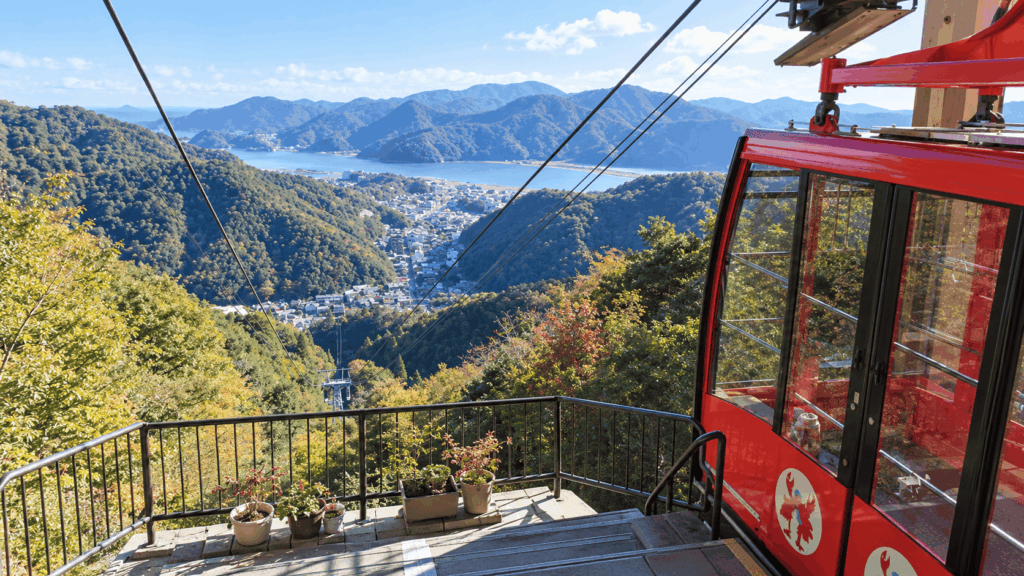
Planning the ropeway plus Onsenji? The Kinosaki Must-Visits 3 Days Pass bundles the ropeway round trip with several paid stops covered later in this guide. Check the current inclusions, redemption rules and cancellation terms before deciding whether the bundle makes more sense than buying separately.
Kinosaki Ropeway at a Glance
| Question | Quick answer |
|---|---|
| Ride time | About 7 minutes one way to the summit; about 3 minutes to the Onsenji middle station |
| Typical total visit | 60–90 minutes, including waiting and the viewpoint |
| Adult round-trip fare | From about ¥1,200 to the summit; ¥750 to Onsenji Station (children around half price) |
| Main attraction | The observation deck view over Kinosaki Onsen, the Maruyama River and the Sea of Japan |
| Best time | A clear morning; weekends are busier from early afternoon |
| Bad-weather verdict | Easy to skip — visibility is the whole experience |
| Hike alternative | A steep trail of roughly 45 minutes one way via Onsenji Temple; a bear warning is currently posted, so check current official safety information before walking |
| Accessibility note | 97 steps lead up to Sanroku Station before the ticket window, and the station platforms are stepped |
Fares and operating details were checked against the official ropeway site in 2026 and can change. Confirm current prices, hours and closure days before your visit.
Is Kinosaki Ropeway Worth It?
Yes, on a clear day. The ropeway is not an amusement ride or a major summit attraction — it is a short, comfortable way to reach the best viewpoint in the Kinosaki area. From the observation deck at the top of Mount Daishi, you look down over the tiled roofs of the hot-spring town, across the wide curve of the Maruyama River and out toward the Sea of Japan on the horizon. The view carries one star in the Michelin Green Guide Japan, and in my experience guiding first-time visitors, it is the moment people photograph the most.
The catch is that the view is the product. I have taken guests up on bright mornings when the whole coastline opened up, and I have also guided a group up on a rainy afternoon when the summit sat inside a cloud and we saw almost nothing until we came back down. Recent visitor reviews follow the same pattern: glowing reports on clear days, and genuine disappointment when low cloud hides the town below. So my honest verdict is conditional — worth the fare when you can see, not worth pushing on a day when you cannot.
Who Will Enjoy It Most
- View and photography lovers who want the wide panorama over Kinosaki Onsen, the Maruyama River and the sea
- Travelers with about 60–90 minutes to spare in a one- or two-night stay
- Anyone who wants to reach Mount Daishi without a strenuous climb, including families with young children and travelers who are fit but not looking for a mountain workout
- First-time visitors who want one memorable look at the town from above before soaking in the onsens below
One expectation to set now: the summit area is compact. It centers on the observation deck, a small cafe and a few temple buildings — you will not spend half a day wandering up there. If that sounds too quiet for you, the ropeway is a 60–90 minute add-on to a Kinosaki stay rather than a destination in itself.
When I Would Skip It
- Rainy days and days with low cloud — if the summit forecast is cloud or rain, the ticket value drops sharply because there is no indoor exhibition or second big draw to fall back on
- Very tight schedules — if you have under about 45 minutes and the weather is only average, your time is better spent on the onsen streets below
- Travelers expecting a large summit attraction — the experience is a viewpoint, a cafe and a quiet temple stop, not a theme-park summit
- Anyone who cannot manage the 97 steps up to Sanroku Station without assistance — the official FAQ is clear that the ropeway is not wheelchair-accessible for solo visitors
How Long Does Kinosaki Ropeway Take?
The ride itself is about seven minutes each way, but planning around seven minutes is the mistake I see first-time visitors make. Between the 20-minute walk from JR Kinosaki Onsen Station, the 97 steps up to the station, possible waiting at busy times, and time actually spent at the top, a realistic visit runs 60–90 minutes for most people. Most visitors I have guided finish comfortably within that window, and review patterns confirm that travelers typically spend one to two hours on the whole outing.
| Plan | What it includes | Realistic time to allow |
|---|---|---|
| Quick viewpoint visit | Round trip plus the observation deck | 45–60 minutes |
| Best first-time plan | Round trip, viewpoint, and a rest at Miharashi Terrace Cafe | 60–90 minutes |
| Add Onsenji | The plan above, plus a stop at Onsenji Station on the way down | 90 minutes–2 hours |
| Hiking involved | Walking all or part of the route instead of riding both legs | 2 hours or more |
These are planning guides, not official timings. Queues, gondola capacity and weather can all stretch them, so keep some slack in your day.
45–60 Minutes: Quick Viewpoint Visit
If you only want the panorama, buy a round-trip ticket to the summit, ride up, take in the observation deck, and come straight back down. The summit area is small enough that you can do this without rushing on a normal day. This is the right plan when the weather is good but your schedule is not, or when you are passing through Kinosaki on a day trip.
60–90 Minutes: The Best First-Time Plan
This is the version I recommend to most first-time visitors: ride up, enjoy the viewpoint, and then sit down at Miharashi Terrace Cafe at the summit station before heading back down. The cafe turns the visit from a quick look into a proper little outing, and it is my standard stop when I bring guests up on fine mornings. More on it below.
90 Minutes–2 Hours: Add Onsenji
If you want a little culture with your view, stop at Onsenji Station on the way down instead of riding straight to the bottom. The station sits right beside Onsenji Temple, the guardian temple of Kinosaki Onsen, which holds a nationally designated Important Cultural Property and is accompanied by the Onsenji Temple Museum. Your summit round-trip ticket allows this kind of stop — the official FAQ recommends getting off on the downward run, visiting the temple, and boarding again to finish the descent. Note that temple and museum admission are separate from the ropeway fare.
What Can You See and Do at the Top of Mount Daishi?
The summit is compact, and that is fine — the reason to ride up is the outlook. Around the top station you will find the observation deck, a small cafe, and a handful of quiet temple features, but nothing that needs more than an hour of your time.
The Mount Daishi Viewpoint
The observation deck at the top of Mount Daishi is the whole point of the ride. From here you look down across Kinosaki Onsen’s rooftops, follow the broad sweep of the Maruyama River toward the coast, and on a clear day see the Sea of Japan on the horizon. The setting is part of San’in Kaigan National Park, and the view carries one star in the Michelin Green Guide Japan. On the bright mornings when I have brought guests up, this is the spot where everyone stops taking photos and just looks — it gives you a genuine sense of how the hot-spring town sits inside the river valley.
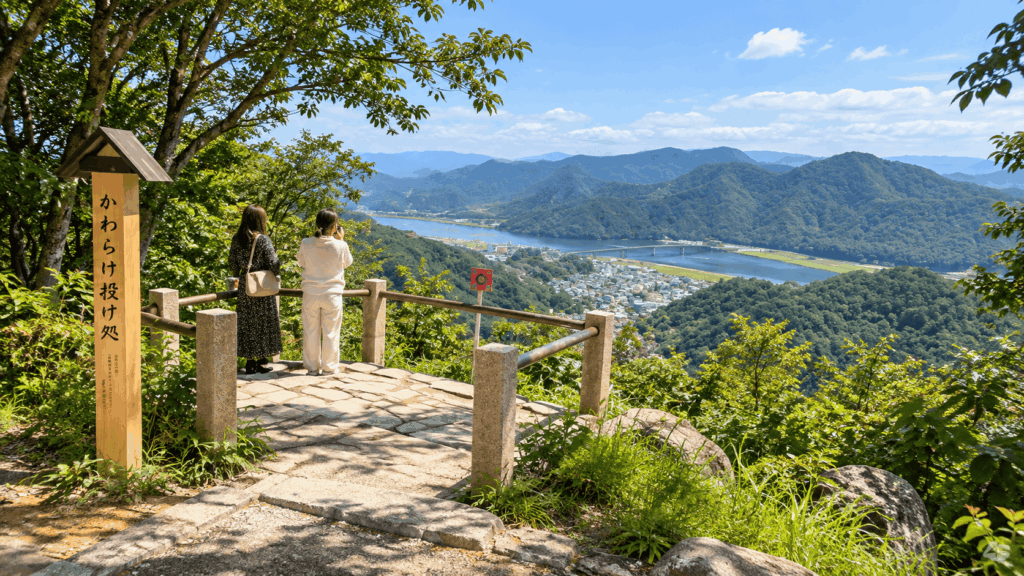
Other small features around the summit include Onsenji Okunoin (the inner sanctuary of Onsenji Temple), a statue of Jibo Kannon, and kawarake-nage, a traditional clay-disc throwing ritual where you try to land a small disc on a target below.
Miharashi Terrace Cafe
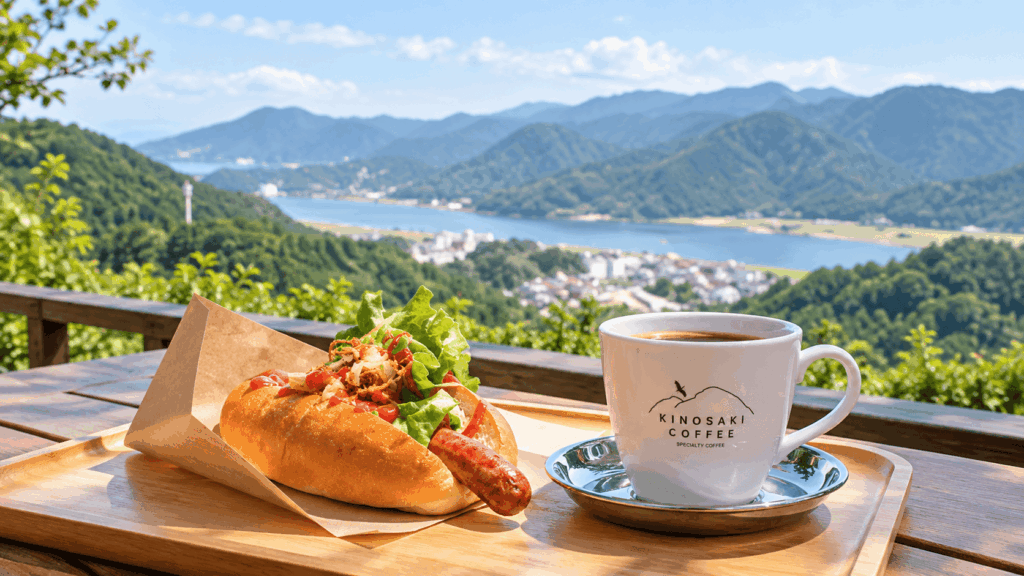
Run by Kinosaki Coffee, Miharashi Terrace Cafe sits right at the summit station with tables facing the view. It serves specialty coffee roasted locally, summit-original hot dogs, and sweets such as the rice-flour Baumkuchen brûlée — a caramelized version of the town’s famous cake that is my usual order when I bring guests up. A coffee break here is what turns the ropeway from a quick look into a relaxed 60–90 minute outing, and it is a good place to wait out a few minutes of passing cloud. The cafe generally opens around 10 a.m. and closes mid-afternoon, with the same second-and-fourth-Thursday closure pattern as the ropeway; check current hours before relying on it.
Best Time to Ride Kinosaki Ropeway
Two things decide how much you enjoy this ropeway: the weather first, then the crowds. Get both right and it is a highlight; get the weather wrong and the ride has little to offer.
Clear Weather Matters More Than the Time of Day
Choose visibility over schedule. A clear afternoon is worth more than a cloudy morning, because the town, the river and the sea simply are not visible once cloud sits on the summit — and the summit has no big indoor alternative to fall back on. Before you commit, check the current forecast for Toyooka/Kinosaki and, if you can, look at the summit conditions from town: if you cannot see the top of the mountain from the streets below, the view from the top will be limited too.
Why I Prefer the Morning on Weekends
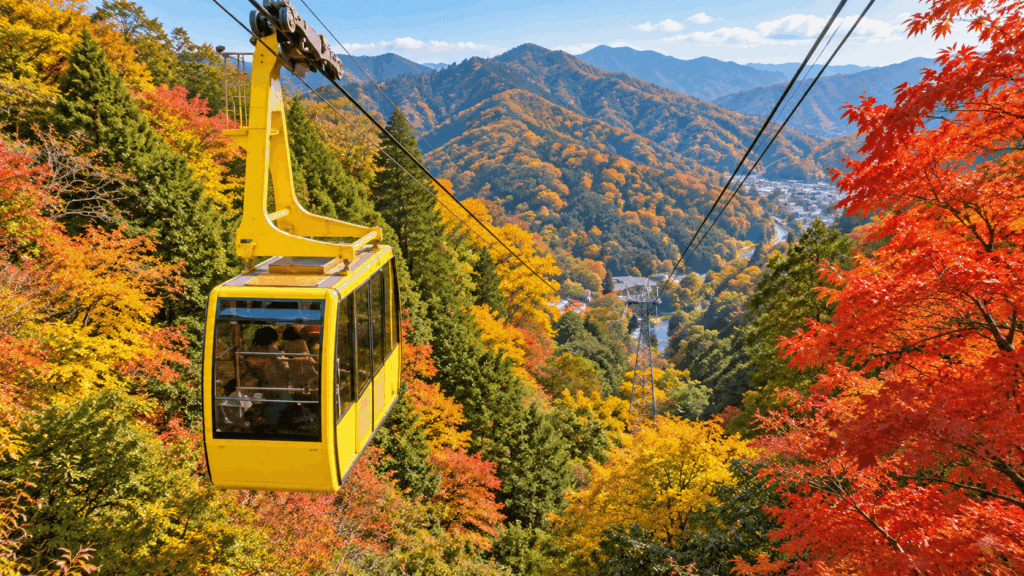
On weekdays the ropeway is generally calm and you can arrive when it suits you. On weekends and Japanese holidays it is a different story, especially from early afternoon, when day-trippers and ryokan guests head up at the same time.
Kai’s tip: On weekends I schedule ropeway visits for the morning. I have guided groups up after 1 p.m. on Saturdays when the queue built up and the gondola filled quickly, while an early start gets you the viewpoint, the cafe and the ride down before the busy stretch. It is not a hard rule — a clear weekday afternoon can be perfectly peaceful — but if your dates include a weekend, an early start removes one variable from the plan.
Summer Heat Inside the Gondola
The gondola carries up to around 30 passengers, and on hot summer days a full cabin heats up quickly. Riders have commented on it in reviews too, so it is worth planning around in July and August.
Kai’s tip: On hot days the gondola can feel stuffy before the seven minutes are up — there is a fan inside, but with a full load you stand close and it gets sweaty. Ride in the cooler morning hours, keep water with you, and if you want a window spot for photos, board near the front of the queue rather than at the tail end, where you can end up in the middle of the cabin.
Kinosaki Ropeway vs Hiking: Which Is Better?
For almost all sightseers, the ropeway wins — not because the hike is impossible, but because the walking route is a real climb on steep stone steps and mountain trail, not a gentle alternative to the gondola. Choose the hike if walking itself is part of the experience you want; choose the ropeway if your goal is the view, the temple or simply a pleasant 90 minutes.
| Ropeway | Hiking | |
|---|---|---|
| Time | About 7 minutes each way; 60–90 minutes total | About 45 minutes one way from the base to the summit via Onsenji (roughly 15 minutes to the temple, then 25 minutes beyond) |
| Effort | Minimal, apart from the 97 steps up to Sanroku Station | Around 500 stone steps to Onsenji Temple, then a steeper, uneven mountain trail |
| Cost | From about ¥1,200 adult round trip to the summit | Free, apart from Onsenji Temple admission |
| Footwear | Any comfortable shoes | Sneakers or better; the official FAQ warns the trail is slippery and muddy after rain |
| Weather sensitivity | Gondola runs in most weather (closure days aside), but the view still depends on visibility | Not advisable in rain; a bear warning is currently posted on the official FAQ |
| Who it suits | Most visitors, families, short stays | Active travelers who want the climb itself and have time, footwear and current safety information |
| Onsenji access | Stop at Onsenji Station on the way down | The trail passes Onsenji Temple about halfway |
| Accessibility | Not solo-wheelchair accessible: 97 steps to the station, stepped platforms | Not suitable for anyone with limited mobility |
How Hard Is the Hike?
Harder than it looks from town. The path from the base of the ropeway up to Onsenji Temple is roughly 500 stone steps — the official estimate is about 15 minutes up, but I found the climb more draining than the short time suggests, with the steps steep and unrelenting in places. Above the temple the character changes to an uneven mountain trail with tree roots and steeper slopes, officially about 25 minutes up to the summit. This is not a casual stroll in town footwear, and the official ropeway site itself advises against walking the temple approach in heels, slippers or geta. Some hikers compromise: they ride up and walk only the descending path, which the local tourism office notes is a popular way to enjoy the trail with less strain.
Check Current Trail Safety Before Walking
Do not rely on older blog posts — including anything I have written about past walks — to judge whether the trail is safe today. The ropeway’s official FAQ currently states that bears may appear on the lower approach and does not recommend walking it, and trail conditions change with weather and season. If you are set on hiking, confirm the current official advice on the Kinosaki Onsen Ropeway site (or at the ropeway ticket window) on the day itself, wear proper footwear, and carry water — there are no vending machines on the trail.
Tickets, Prices and the Kinosaki Must-Visits Pass
A round-trip ticket to the summit costs around ¥1,200 for adults and ¥600 for children, while a round trip to Onsenji Station is about ¥750 (children around ¥370). One-way fares are available for less. If the ropeway is your only paid stop, the standard round-trip ticket is the simple, correct choice — buy it at the window at Sanroku Station.
If you also plan to visit Onsenji Temple, the Onsenji Temple Museum and the straw craft workshop at Kamiya Mingei during your stay, compare the Kinosaki Must-Visits Pass before buying separate tickets. The pass covers a ropeway round trip, admission to Onsenji Temple and its museum, a 30-minute straw craft activity at Kamiya Mingei, and small perks at selected local shops. It costs about ¥3,200 per person when reserved online and ¥3,500 bought in person at the SOZORO Tourist Information Center near Kinosaki Station, and it is valid for three days. Note that it does not include the town’s hot-spring baths, which are covered by the separate onsen pass.
Two practical details matter here. First, the pass must be picked up at SOZORO regardless of where you buy it, so build that stop into your plan. Second, the official terms state that no refund is given if the ropeway stops running due to weather or maintenance — relevant if your dates are uncertain.
When the Pass Is Not Worth It
Skip the pass if the ropeway is the only included attraction you want to use, if your stay is too short to visit several sights, or if the straw craft workshop does not interest you. In those cases, separate tickets almost always work out cheaper. The pass only earns its keep when you actually use most of what it bundles — which is exactly why it suits travelers who plan to combine the ropeway with Onsenji and the museum in one visit.
If you fall into that camp — you already want the ropeway and several of the bundled Kinosaki sights — this is the one pass worth comparing before paying separately.
Why I’d book this one
- It matches a multi-stop Kinosaki day. The bundle combines the ropeway round trip with Onsenji Temple, the museum and the straw craft experience rather than asking you to organize each paid stop separately.
- Recent travelers commonly value the convenience. Reviews tend to highlight how straightforward it is to combine the ropeway and temple-side sights under one pass.
- The trade-offs are clear before you commit. If you only want the ropeway, or your dates look weather-sensitive, separate tickets may still make more sense, so check the current redemption and cancellation terms first.
How to Get to Kinosaki Ropeway
The ropeway entrance is about a 20-minute walk from JR Kinosaki Onsen Station (the official estimate). From the station, head through the hot-spring town to its far end, where the entrance and its paid parking lot sit at the base of Mount Daishi. If you are staying at a ryokan, ask at your inn — the ropeway company can sometimes arrange a microbus pickup for guests on request. Taxis are limited in town and are not usually waiting at the ropeway, so plan for the walk or the inn shuttle.
The 97 Steps Before the Ropeway
Here is the detail that surprises people: the gondola does not start at street level. From the entrance you climb 97 steps up to Sanroku Station before you reach the ticket window, and the official FAQ also notes that the station platforms are stepped. The ropeway is therefore not suitable for a solo wheelchair user, and anyone with limited mobility should check the current official information before visiting.
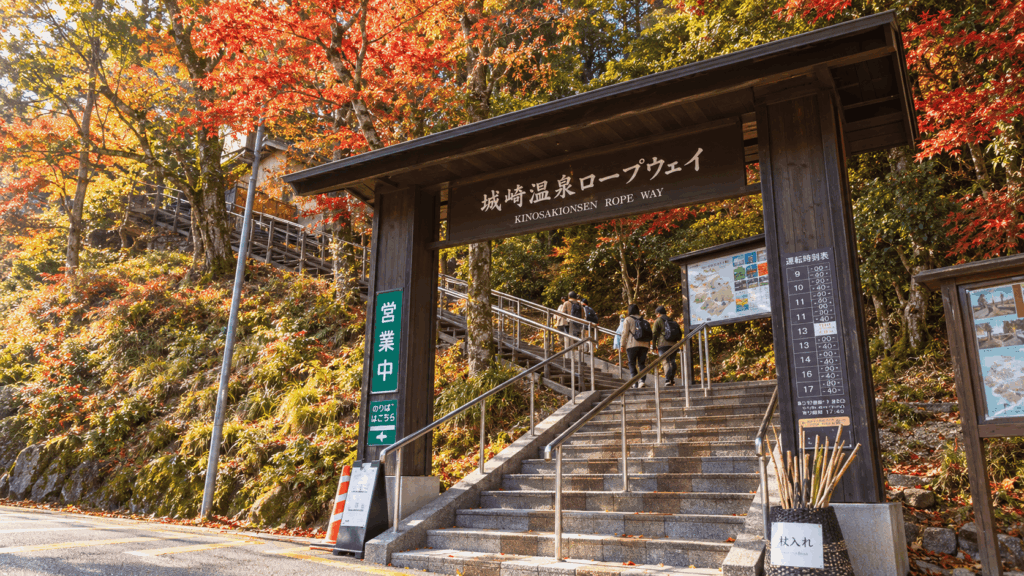
Kai’s tip: What catches first-time visitors out is that stair climb at the start — travelers who assume “ropeway means no climbing” are the ones I see surprised at the bottom. It is a normal staircase with handrails and takes only a few minutes, but go in knowing it is there, and if anyone in your group struggles with stairs, factor it in before choosing this outing.
A Simple Kinosaki Ropeway Plan I Recommend
For a first visit on a clear day, this is the sequence I use when planning someone’s morning:
- Check the sky first. If the summit is visible from town and the forecast is clear, go. If not, save the ¥1,200.
- Aim for a morning departure, especially on weekends, and allow 60–90 minutes in total.
- Buy a round-trip ticket to the summit at Sanroku Station after the 97-step climb.
- Ride up, enjoy the observation deck, then rest at Miharashi Terrace Cafe.
- If you have the time and interest, get off at Onsenji Station on the way down and visit Onsenji Temple before riding the last leg back.
This fits comfortably into a one-night Kinosaki itinerary: ropeway in the morning, onsens and the town streets in the afternoon and evening. If your stay is longer or you are also planning the other paid sights, it is worth comparing the Kinosaki Must-Visits Pass against separate tickets before you arrive.
FAQ
Is the Kinosaki Ropeway worth it?
On a clear day, yes. For roughly ¥1,200 round trip you get about seven minutes of gondola ride each way and the best viewpoint in the area, looking over Kinosaki Onsen, the Maruyama River and the Sea of Japan. The value drops sharply on rainy or low-cloud days, because the view is the whole experience and the summit has little else to offer — in those conditions, skipping is a reasonable choice.
How long does the Kinosaki Ropeway take?
The ride itself is about seven minutes each way, but a realistic visit takes 60–90 minutes once you include the 20-minute walk from the station, the 97 steps up to Sanroku Station, possible waiting, and time at the summit. A quick viewpoint-only visit can be done in about 45–60 minutes; adding the summit cafe, or a stop at Onsenji Station on the way down, stretches it toward two hours.
Can you hike up instead of taking the Kinosaki Ropeway?
A trail does run from the base to the summit via Onsenji Temple — officially around 45 minutes one way — but it is a genuine climb: about 500 stone steps up to the temple, then a steeper, uneven mountain trail beyond it. The official FAQ currently advises against the lower approach because bears may appear, so treat hiking as a choice for walkers who want the climb itself, not as a casual way to save the fare. Check the latest official safety information before setting out.
What is at the top of the Kinosaki Ropeway?
The main draw is the observation deck, with its Michelin-rated view over the hot-spring town, the Maruyama River and the Sea of Japan. Around the summit station you will also find Miharashi Terrace Cafe, run by Kinosaki Coffee, plus the quiet temple features of Onsenji Okunoin, a Jibo Kannon statue and kawarake-nage disc throwing. It is a compact area — most visitors finish it in under an hour before the ride back down.
Is the Kinosaki Ropeway worth it in the rain?
For the view, no — it is the one condition I would not push anyone into. I have guided a group up on a rainy day when the summit sat inside cloud and we saw almost nothing until we came back down, and recent reviews tell the same story. Bad weather can also suspend or change ropeway operations. If your only free slot looks wet, the town’s onsens and streets are a better use of the time.
What are the Kinosaki Ropeway operating hours and closed days?
The standard timetable starts at 9:10 a.m. and runs at roughly 20-minute intervals, with the usual last scheduled ride up at 4:30 p.m. and the final ride down at 5:10 p.m.; the 12:30 departure operates only on Sundays and holidays. Seasonal schedules and special notices can extend or shorten the final departure times. The ropeway is normally closed on the second and fourth Thursday of each month (open when those fall on a holiday) and operates over the New Year period. Weather, maintenance and special events can also change the schedule, so confirm the current timetable and latest notice on the official site before your visit.
Final Verdict: Should You Ride the Kinosaki Ropeway?
Ride it if you have a clear day and 60–90 minutes. The combination of the seven-minute gondola ride, the Mount Daishi viewpoint and a coffee at Miharashi Terrace Cafe is one of the most pleasant ways to spend a morning in Kinosaki Onsen, and the round-trip fare is fair for the panorama you get in return.
Skip it if the weather is against you or your schedule is genuinely tight. When the summit is in cloud, the ropeway loses its one big asset, and with no large indoor attraction up top, there is no fallback. If you only have a short window on an average day, the hot-spring town below is the better investment of your time.
For first-time visitors: take the standard plan — a clear morning, a round-trip ticket to the summit, the observation deck, and the cafe. Add the Onsenji Temple stop on the way down only if temple visits genuinely interest you.
For families: the gondola ride itself is gentle and short, but the 97 steps up to Sanroku Station and the stepped platforms are the real consideration — fine for kids who can manage stairs, harder with a stroller or limited mobility.
For hikers: choose the trail only if walking is part of the enjoyment, you have proper footwear, and you have confirmed the current official safety information — the official FAQ currently posts a bear warning on the lower approach. Otherwise, ride up and walk the descending path if you want a taste of the trail.
For repeat visitors on a second or third stay: the ropeway works best as a filler on a day with clear skies — pair it with the cafe rather than treating it as a main event.
If a friend asked me whether to fit the Kinosaki Ropeway into a one-night stay, my answer would be simple: go in the morning, go when the mountain is visible from town, and do not skip the cafe at the top. On those terms, it is a clear yes.
Hi, I’m Kai. I’m a Tokyo-based travel writer, tourism industry insider, and the author of a published guidebook for international visitors to Japan. With over 10 years of professional experience at a leading Japanese tourism company, my mission is to help you skip the tourist traps and navigate Japan’s best destinations like a local. I believe the perfect day trip is like a traditional kaiseki meal: a beautiful balance of precise planning and unforgettable seasonal discovery. When I’m not out conducting field research, you’ll usually find me drafting new itineraries with one of my favorite fountain pens!